



Abstract
In the intricate decision-making problems, the preference information of decision makers may be difficultly stated by numerical values due to the ambiguity of human thinking about the complex objective things in the real world, and sometimes, it may be easily expressed by LTs (linguistic terms). Thus, how to solve fuzzy MAGDM (multiple attribute group decision-making) problem in which the attributes are described by neutrosophic linguistic information and weights for the attributes and decision makers are fully unknown, has become an important research direction. To achieve this goal, this paper briefly reviews the basic concept of LTs, SVLNN (single-valued linguistic neutrosophic number), and the closeness degree, then we put forward the closeness degree between the LNNs (linguistic neutrosophic numbers) and the distance formula between LNNs, and they can be used to determine the weights of experts and attributes. Then, a MAGDM method based on the extended VIKOR (Visekriterijumska Optimizacija I Kom-promisno Resenje) method is established under the single-valued linguistic neutrosophic numbers (SVLNN) environment. Further, an illustrative example about selecting problems of fault handling point is presented to demonstrate the application of the developed approach, and the feasibility and effectiveness of the proposed method are proved by comparing this method with WAA (Weighted Arithmetic Averaging) and TOPSIS (Technique for Order Preference by Similarity to an Ideal Solution) method.
Keywords
Introduction
MAGDM is a hot research topic in modern decision theory and it has been widely used in various fields [1–4], such as benefit assessment, supplier selection, personnel decision-making, etc., however, when the environment is complex, we cannot describe the attribute values of these problems by real numbers, and sometimes decision-makers (DMs) can easily describe them by linguistic terms (LTs). For example, the evaluation of Chinese mobile customer service, the customers can give the LTs like “very satisfied”, “satisfaction”, “General”, and “poor”, etc. Therefore, how to make MAGDM in the linguistic environment is becoming more and more concerned for researchers.
Due to the uncertainty of information and many limitations such as time pressure, lack of knowledge and information extraction difficulties, etc., it is difficult for DMs to express their preferences numerically in many complex realities [5–10]. Then the theory of fuzzy set (FS) initiated by Zadeh [11] has attracted wide attention from different authors due to its effectiveness in dealing with uncertain situations in the real world. Further Atanassov [12] proposed the concept of intuitionistic FSs (IFSs), which is an extension of FS. IFSs consider membership (truth) function (TF) and non-membership (falsity) function (FF), and they can easier to describe complex information than FSs. By a variety of real-valued functions between IFSs, IFS has proven to be a powerful tool to quantify the similarity/dissimilarity of the two objects. However, it is difficult to express the indeterminate and inconsistent information. So Smarandache [13] proposed neutrosophic sets (NSs) by adding an independent indeterminacy function (IF) to overcome this shortcoming, which include a TF, an IF, and a FF, independently. Further, Wang et al. [14] proposed a single-valued NSs (SVNSs) and provided their various properties. Then Ye [15] put forward the information energy of SVNS, and then applied it to decision-making problems with SVNSs. The single-valued neutrosophic number (SVNN) is a basic element in a SVNS [16], which can only express a TF, an IF, and a FF independently, and can describe the incomplete, indeterminate, and inconsistent information; however, because the TF, IF, and FF of SVNNs can only be described by crisp numbers, and they cannot be expressed by linguistic information in linguistic decision-making problems, in order to overcome the defects, Ye [17] introduced the concept of the single-valued linguistic neutrosophic numbers (SVLNNs), and SVLNNs are very suitable for describing more complex linguistic information of human judgments under linguistic decision-making environment since LNNs contain the advantages of both SVNNs and linguistic variables (LVs), which imply the truth, falsity, and indeterminate linguistic information. However, none of the existing linguistic decision-making methods can handle decision problems with uncertain and inconsistent linguistic information. Therefore, how to carry out MAGDM in the linguistic environment is more and more concerned by the researchers [18, 19].
There are many specific methods for MAGDM, which have their own advantages in real applications. Commonly used multi-attribute decision-making methods are ELECTRE (elimination and choice translating reality) method, MABAC (multi-attribute border approximation area comparison) method, EDAS (estimation of distribution algorithms) method, Dempster-Shafer theory of evidence, TOPSIS method, VIKOR method, etc. Benayoun [20] proposed ELECTRE, and due to the ambiguity between schemes and the subjectivity of some thresholds in the method, this method has some unreasonable situations in the final sequencing of schemes. P. Ji, etc. proposed an MABAC–ELECTRE method to the selection of an outsourcing provider under the single-valued neutrosophic linguistic environments [21]. EDAS method was proposed in 1996, it is extended to resolve group decision-making problems in the linguistic neutrosophic environment [22–24]. J.M. Merigó, etc. develop a new approach for decision making with Dempster-Shafer theory of evidence by using linguistic information, which realized the unification of mixed information such as exact numbers, interval numbers and linguistic variables, retained the uncertainty of information the comprehensive foreground value of the scheme reduces the loss of decision information. [25]. TOPSIS method was originally introduced by Hwang and Yoon [26] and is a widely used method for dealing with MAGDM problems. Its focuses on choosing the alternative with the shortest distance from the positive ideal solution (PIS) and the farthest distance from the negative ideal solution (NIS). The VIKOR method was first proposed by Opricovic as an efficient tool to handle conflicting criteria [27, 28], which ranks alternatives and determines a compromise solution that is the closest to the ideal. Its most prominent feature is to maximize the effectiveness of the community and minimize the individual regret, and the choice of compromise solution is accepted by DMs. Obviously, the VIKOR method has more advantages than the other methods in selecting the compromise solution, and then it has been developed rapidly since it was proposed. Opricovic [29, 30] proposed a fuzzy VIKOR method in which both the attribute values and weights could be triangular fuzzy numbers. Sayadi et al. [31] extended the VIKOR method to a decision-making problem with interval numbers. Wan et al. [32] developed an extended VIKOR method for MAGDM using triangular intuitionistic fuzzy numbers. However, now the existing VIKOR method cannot deal with the fuzzy MAGDM with SVNNs.
There is a great deal of MAGDM problems how to determine these weights was an important research topic. X.D. Peng and J.G. Dai [33] present the combined weights, which can show both the subjective information and the objective information, and the objective weights of various attributes are determined via gray system theory. A fuzzy best-worst method was used to obtain the weights of risk factors by Z.P. Tian, etc. [34], and an integrated structure based on fuzzy proximity and fuzzy similarity entropy weights was developed to obtain the weights of FMEA team members with respect to different risk factors. Regarding the determination of weights, many scholars have done a lot of relevant research and application [35–39]. So far, there is no weight determination method for comprehensive application of closeness and distance measure. Because the SVLNNs are superior to other means in expressing complex uncertain information, and the VIKOR method has more advantages than the other methods in selecting the compromise solution, the objectives of this paper are to propose the extended VIKOR method for the MAGDM problem with SVLNNs. The main contributions of this paper are to propose an expert weight determination method based on closeness degree and the distance formula which is used to determine attribute weight; finally, we have verified the effectiveness and superiority of a MAGDM method based on extended VIKOR.
The rest of this paper is organized as follows: Section 2 briefly reviews the basic concept of LTS, SVNS, SVLNN and VIKOR method. Section 3, we put forward the closeness degree and extended the distance formula between LNNs, and, gave the steps of a MAGDM method based on the proposed VIKOR method under SVLNN environment. Section 4 gives an example and demonstrate the feasibility and validity of the method. Section 5 gives conclusions and future research directions.
Preliminaries
The LTS
There is a great deal of information in the real world which cannot be assessed by a quantitative form, especially for qualitative information, which is more easily evaluated by LTs. For the convenience of use, we have to choose the appropriate linguistic descriptors for the LT set (LTS) and their semantics, so we introduce some information about linguistic variables (LVs).
Assume that the LTS N ={ n0, n1, n2,. . . , n r } consists of an odd number of elements that r + 1 is an odd number. In practice, r + 1 is generally 3, 5, 7, 9 and so on [40]. For example, when r = 8, it is expressed as N = {n0 = extremely important, n1 = very important, n2 = important, n3 = slightly important, n4 = fair, n5 = unimportant, n6 = slightly unimportant, n7 = very unimportant, n8 = extremely unimportant}, where, n i is called a LV.
For any LTS N, the following conditions are met [40]. If i > j, then n
i
≻ n
j
; Exist a negative operator neg (n
i
) = n
j
, so j = r - 1 - i; If n
i
≥ n
j
, then max(n
i
, n
j
) = n
i
; If n
i
≤ n
j
, then min(n
i
, n
j
) = n
i
.
For any LTS N = (n0, n1, n2, . . , n
r
), in order to minimize the loss of linguistic decision information in operations, the LTS N is extended to a continuous one N = (n
α
|α ∈ R) [25]. Then operations of LVs are shown as follows [41]:
The VIKOR method [27] is from an aggregation function developed by Lp-metric. The Lp-metric over the option O
i
(i = 1, 2,. . . , m) for compromise programming is evaluated as:
According to the above operational rules, we can get the following properties:
Obviously, we have V (v) ∈ [- 1, 1].
If Y (v1) < Y (v2), then v1 ≺ v2; item If Y (v1) = Y (v2), and (a) V (v1) < V (v2), then v1 ≺ v2; (b) V (v1) = V (v2), then v1 = v2.
According to Definition 7, their ranking order is v2 ≻ v3 ≻ v1.
In this section, we propose the extended VIKOR to solve MAGDM problems with SVLNNs.
A description of the decision problem
For a MAGDM problem, let K = (K1, K2,. . . , K
m
) be a set of alternatives, P = (P1, P2,. . . , P
h
) be a set of attributes and Z = (Z1, Z2,. . . , Z
t
) be a set of DMs. w = (w1, w2,. . . , w
h
) is the attribute weight vector, and
Determining the expert weight
There are a great deal of MAGDM problems in which the expert weights are unknown, how to determine these weights is an important research topic. According to the traditional idea of maximizing the closeness between each alternative and the ideal solution [41], an optimal model is established to obtain the expert weights.
cl (A, A) = 1, cl (∅ , U) = 0; cl (A, B) = cl (B, A); A ⊆ B ⊆ C ⇒ cl (A, C) ≤ cl (A, B) ∩ cl (B, C).
The traditional closeness formula is defined as follows [42]:
Then cl (A, B) is called closeness between A and B.
Where cl (A, B) ∈ [0, 1], the closer to 0, the greater the distance between the two sets A and B, the thinner the relationship, otherwise, the closer the relationship between the two sets A and B.
Where, ∧ represents the operation of selecting the minimum number. ∨ represents the operation of selecting the maximum number.
Obviously, (23) can meet the properties (i)–(iii) in definition 10.
Then we propose the method of determining the expert weights as follows.
Where
Where,
Where, S is defined by (23).
Based on the Euclidean distance formula, we use the maximum deviation method to determine attribute weights. When the difference between the maximum attribute value and the minimum attribute value of the same attribute is used to represent the fluctuation amplitude of the attribute, this difference is called the maximum deviation [43]. According to the maximum deviation value of each attribute, the weight of the attribute is determined, which is called the maximum deviation fixed weight principle.
The method of determining the attribute weights is proposed as follows.
The specific steps of the extended VIKOR method in the SVLNN environment are shown as follows:
According to attribute types, if one attribute is cost index, it should be converted to benefit type by
According to section 3.2, we can get the expert weight vector ω = (ω1, ω2, ⋯ , ω t ).
According to section 3.3, we can get the attribute weight vector w = (w1, w2, ⋯ , w h ).
Cond1:
Cond2: In the sorting of
An illustrative example
In this section, we use an example (adapted from [17]) to show the application of the VIKOR method in SVLNN environment.
In the process industry, the occurrence of failures is inevitable, and the decision of fault handling is also worth studying. In order to solve the failure to determine the best processing point of the decision-making program, take an industrial explosion as an example, K1, K2, K3, K4 correspond to three fault handling points, and they are evaluated by three attributes (denoted by SVLNN): (1) P1 expresses the staff action; (2) P2 represents the storage capacity of the device;(3) P3 represents the personnel dispatching force, which weight vector is w = (w1, w2,. . . , w h ). Z1, Z2, Z3 represent three experts to form decision groups, Then, three DMs are invited to evaluate K1, K2, K3, K4 based on three attributes, and the importance of the three DMs is given as a weight vector ω = (ω1, ω2,. . . , ω e ). The goal is to be ranking K1, K2, K3, K4.
The evaluation information of each decision maker is expressed as the following SVLNN decision matrix [17]:
The following steps are given to solve this MAGDM problem.
Ranking of alternatives by
,
and
in ascending order
Ranking of alternatives by
In actual decision-making, experts may have different decision-making attitude, and then take a different compromise coefficient, that is, δ can choose the number between [0, 1]. In the VIKOR method, the compromise evaluation value of each alternative may be affected by the compromise coefficient δ. To consider the influence of different value δ on the decision-making results, sensitivity analysis is performed by setting different δ values; the ranking results are shown in Table 2 and Fig. 1.
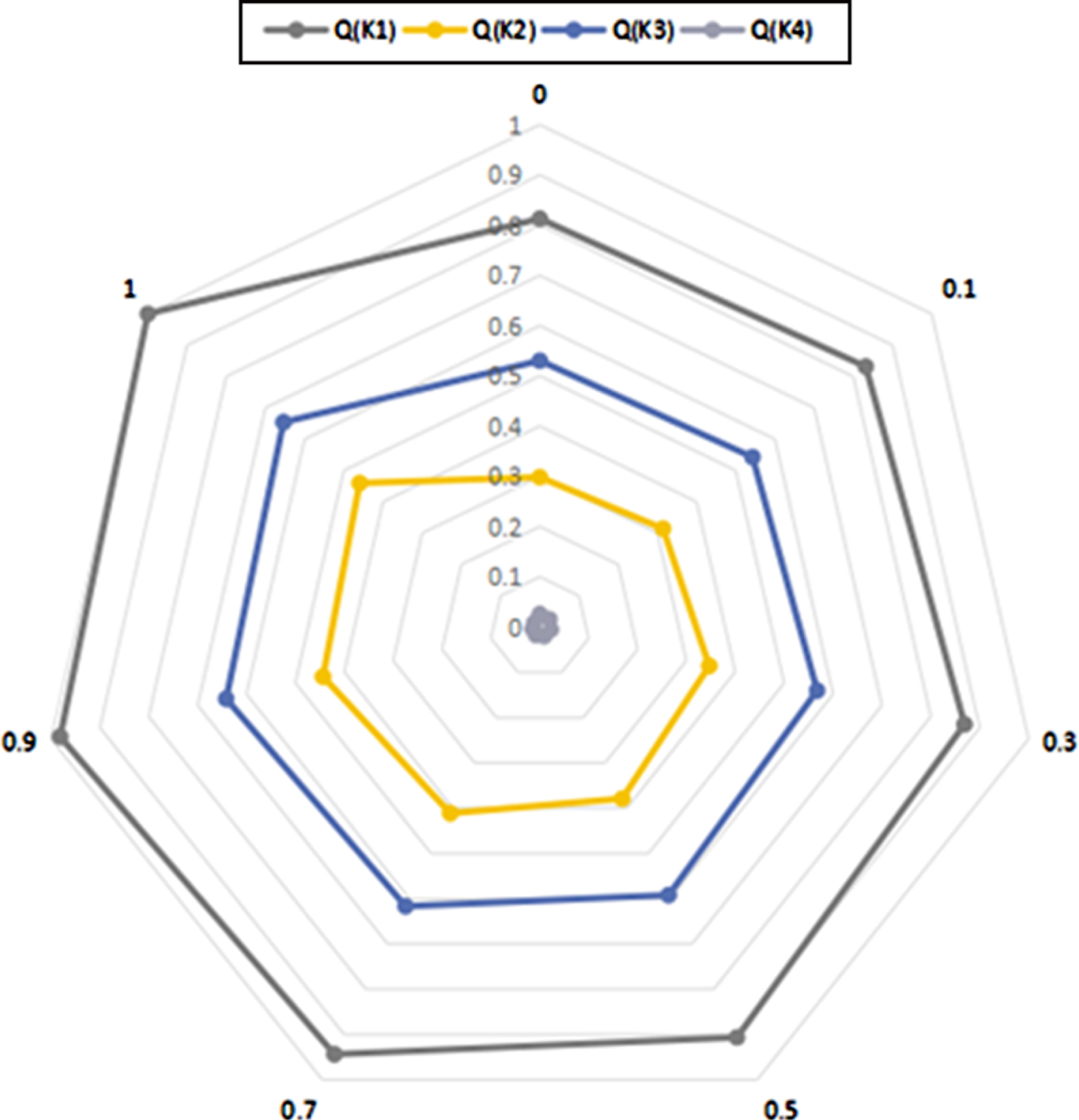
The change of the compromise value
The compromise value
From Fig. 1, it can be seen that under different value δ, the ranking results are stable; the optimal scheme remains unchanged, and δ has a limited impact on the ranking results. To sum up, the VIKOR decision method used in this paper is relatively insensitive to the coefficient δ, and the decision results have good stability.
To verify the effectiveness of the proposed method, we compare this method with the literature [2] (TOPSIS method) and [17] (WAA method), and we obtain the same ranking result, i.e., K4 ≻ K2 ≻ K3 ≻ K1 (Table 3). From this, the decision method proposed in this paper is effective.
In addition, from Fig. 2, it can be seen that the VIKOR method fluctuates greatly, and the ranking results can be clearly seen. The WAA and TOPSIS methods tend to be stable and the sorting results are not obvious.
Comparison of the different methods
Comparison of the different methods

Comparison of value fluctuations about WAA, TOPSIS and VIKOR.
In a word, our proposed fuzzy MAGDM method in this paper is the generalization of the existing decision-making method and can deal with the MAGDM with SVLNN information in which the expert weight and attribute weight are all unknown.
Because the SVLNN can clearly express the linguistic information, VIKOR algorithm has more advantages than the other methods in selecting the compromise solution, in this paper, we briefly reviews the basic concept of LTs, neutrosophic sets (NSs), single-valued linguistic neutrosophic number (SVLNN), and the closeness degree, then we put forward the closeness degree between the linguistic neutrosophic numbers (LNNs) and the distance formula between LNNs, and then we use them to determine the weights of experts and attributes. Based on the traditional VIKOR, a MAGDM method based on the extended VIKOR method is proposed under SVLNN environment. An illustrative example was given to demonstrate the steps and effectiveness of the proposed method by the comparison with existing methods. In the future, it is necessary to apply the proposed method to solve the real decision-making problems, such as evaluations on population resources and environment [45–48] or Chinese culture [44]. And take VIKOR into PFS or IVFSS [49, 50] in the linguistic neutrosophic environment.
Footnotes
Acknowledgment
This work was supported by Key R & D project of Shandong Province, China (2017XCGC0605).