Linguistic decision-making tools are very useful in determining the solution to real-life decision problems. In order to represent the complex fuzzy qualitative information more accurately, this paper introduces a novel concept called linguistic trapezoidal fuzzy intuitionistic fuzzy set (LTFIFS), where the degrees of membership (MS) and non-membership (NMS) are represented by trapezoidal fuzzy linguistic numbers. Further, work defines some basic operational laws, score and accuracy values, and a comparison method for LTFIFNs with a brief study of related properties. To aggregate different LTFIFNs, we develop several weighted arithmetic and weighted geometric aggregation operators such as the LTFIFWA operator, the LTFIFOWA operator, the LTFIFOWAWA operator, the LTFIFWG operator, the LTFIFOWG operator, and the LTFIFOWGWG operator. Paper also establishes several important properties and particular cases of these operators. Furthermore, by using proposed aggregation operators, we formulate a decision-making approach for solving group decision-making problems under the LTFIF environment with multiple attributes. Finally, the paper presents a real-life decision problem to validate the effectiveness and flexibility of the newly given approach.
Multiple attribute decision making (MADM) is the most significant task in our day to day life activities. It refers to ranking the limited number of feasible alternatives and selecting the best one(s) from them under some conflicting attributes. MADM theories have been successfully applied to solve many decision problems related to economy, management, society, engineering, and education, etc. Traditionally, it was assumed that the evaluation information, given by the decision-makers, is represented by real numbers. However, as we know, real-world decision-making situations are very complex and challenging due to the presence of vagueness and uncertainty, as well as the abstruseness of human cognition. Therefore, traditional decision approaches cannot be applied to solve these kinds of problems. In 1965, Zadeh [1] introduced the fuzzy set (FS) theory to provide a useful tool for modeling vague or uncertain information. Further, Atanassov [2] proposed the intuitionistic fuzzy set (IFS) theory, which has been widely studied and used in several application areas because of its efficient capability for modeling vague/uncertain information more precisely. Since its introduction, many researchers have been contributed to enrich the theory and applications of intuitionistic fuzzy set theory in different areas [3–15]. One of the most prominent areas of research in the intuitionistic fuzzy set theory is information aggregation. In the last 15 years, a large number of aggregation tools have been developed for fusing different intuitionistic fuzzy numbers into a collective one [6, 16–23].
It is worth to mention that the above-discussed studies under the intuitionistic fuzzy environment have been widely cited and used in the literature, but they consider only quantitative aspects of the available information. However, in many realistic situations, it is challenging for a decision-maker to provide his/her preference information corresponding to an alternative by real numbers, while it may easily express in terms of linguistic values by means of linguistic variables (LVs) [24–26]. For example: when the moral character of a people, the speed of a car, the service quality of a bank and the performance of a student in a specific subject are evaluated, it is very easy to express the evaluation information by LVs such as average, good, excellent, marvelous, etc. The references [27–32] highlight the necessity of linguistic representation models in real-life decision-making situations. The LVs provide an extra degree of freedom for representing human cognition in a more realistic way. In general, when we decide with linguistic information, it needs computing with words (CW). In recent years, different linguistic models have proposed for CW such as fuzzy membership function based models [33], the 2-tuple linguistic representation model [34], the type-2 fuzzy set based model [35], the numerical scale model [36], 2-tuple intuitionistic fuzzy linguistic representation model [37] and the Hesitant 2-tuple linguistic term set based model [38]. In the literature, a wide range of linguistic aggregation operators have been proposed to aggregate linguistic information [39–44].
Linguistic intuitionistic fuzzy set (LIFSs) was proposed by Zhang [45], where the degrees of the MS and the NMS are presented in terms of LVs rather than numerical values in between 0 and 1. He also defined a number of aggregation operators for linguistic intuitionistic fuzzy numbers (LIFNs) and formulated a decision-making approach under LIF environment. Chen et al. [46] defined some weighted averaging operators for fusing a collection of LIFNs. Garg and Kumar [47] developed some new aggregation operators for LIFSs by using set pair analysis to solve group decision-making problems with LIF information. Liu and Qin [48] defined Maclaurin symmetric mean for aggregating LIFNs. Peng et al. [49] defined the Heronian mean operator based on Frank’s operational laws on LIFSs. Recently, the theory of linguistic interval-valued intuitionistic fuzzy sets (LIVIFSs) was proposed by Garg and Kumar [50] as a generalization of LIFSs in which the MS and NMS values present in terms of interval-valued linguistic numbers. Besides, they developed some weighted arithmetic and weighted geometric aggregation operators for LIVIFNs. In addition, Kumar and Garg [51] also generalized the notion of the TOPSIS method for solving decision-making problems with LIVIF information.
Note that, in many realistic situations, the decision-maker may provide fuzzy linguistic information (e.g., ‘approximately very poor’ and ‘approximately between poor and slightly good’) corresponding to the MS and NMS degrees because of time pressure, lack of knowledge, and limited expertise in the problem domain. These situations cannot be represented by utilizing the LIFS and the LIVIFS. As we know, the trapezoidal fuzzy linguistic variables (Tra-FLVs), introduced by Xu [52], generalize the linguistic variables (LVs), uncertain linguistic variables (ULVs) and triangular fuzzy linguistic variables (Tri-FLVs). Tra-FLV is a very efficient tool for representing fuzzy linguistic information. Also, the Tra-FLVs provide more degree of freedom to decision-makers in expressing their preference values more comprehensively [53–56]. So keeping the flexibilities and advantages of Tra-FLVs in mind, the main objective of the present work is to propose a new set theory called ‘Linguistic Trapezoidal Fuzzy Intuitionistic Fuzzy Sets (LTFIFSs)’ in which the degrees of MS and NMS represent in terms of Tra-FLVs. The LTFIFS is more capable in handling the situations in which the MS and NMS degrees are given in the form of fuzzy linguistic information such as ‘approximately very poor’ and ‘approximately between poor and slightly good’ etc. This type of information about MS and NMS degrees can not be expressed in terms of LIFS and LIVIFS. Also, note that the LTFIFS theory generalizes the notion of LIFS [45] and LIVIFS [50]. Hence, the objective of the present work is divided into the following five parts:
To present the formal definition of LTFIFS and define some basic set-theoretic operations;
To define some generalized algebraic operational laws based on Archimedean t-norm and t-conorm;
To formulate a ranking method for LTFIFNs by defining the score and the accuracy values on them;
To propose some new arithmetic and geometric aggregation operators for aggregating different LTFIFNs;
To develop a new decision-making approach for solving MAGDM problems under the LTFIF environment and illustrate the developed decision-making approach through the support of a real-life numerical problem.
The remaining part of the paper is structured as follows: Section 2 presents some essential basic results related to LVs, Tra-FLVs, LIFSs, and Archimedean t-norm and t-conorm. Section 3 introduces the formal definition of the LTFIFS and defines some basic operational laws on them. A ranking method for LTFIFNs is also formulated here by using score and accuracy values. In Section 4 we introduce some weighted aggregation operators for LTFIFNs such as the LTFIF weighted averaging (LTFIFWA) operator, the LTFIF ordered weighted averaging (LTFIFOWA) operator, the LTFIF ordered weighted averaging weighted average (LTFIFOWAWA) operator, the LTFIF weighted geometric (LTFIFWG) operator, the LTFIF ordered weighted geometric (LTFIFOWG) operator, and LTFIF ordered weighted geometric weighted geometric (LTFIFOWGWG) operator. Some properties and particular cases of the proposed aggregation operators are also discussed. In Section 5 by using the proposed aggregation operators, we develop a decision-making approach to solve the MAGDM problems with LTFIF information. Besides, a numerical example is given to illustrate the effectiveness and flexibility of the newly developed decision approach. Section 6 concludes our work and presents some future scopes.
Preliminaries
This section briefly reviews the basic concepts connected to LVs, Tra-FLVs, LIFSs, and Archimedean t-norm and t-conorm.
Linguistic and trapezoidal fuzzy linguistic variables
The qualitative information aspects play a crucial role in many real-life decision processes, which are very difficult to judge by means of numerical values. For handling such issues, linguistic variables are more convenient and appropriate tool to assess the qualitative information. Formally, the linguistic variable representation model, defined by Herrera and Martínez [57], is given as follows:
Definition 1 [57]: Let L ={ lp|p = 0, 1, …, r } be a finite linguistic term set (LTS) with the odd cardinality, where each lp represents a possible linguistic value for a linguistic variable. For example, a set of seven linguistic terms corresponding to a linguistic variable ‘important’ is represented as
It is important to note that the linguistic term set must satisfy the following properties [57]:
(i) lp ⩽ lq ⇔ p ⩽ q (ii) Neg (lp) = lr-p (iii) lp ∨ lq = lp ⇔ p ⩾ q (iv) lp ∧ lq = lp ⇔ p ⩽ q
where Neg, ∨ and ∧ denote the negation, max. and min. operators.
Further, in order to preserve all the given information, Xu [7] defined the continuous-LTS , where, if lp ∈ L, then lp is called the original linguistic term (OLT), otherwise lp is called the virtual linguistic term (VLT). In general, decision-makers use OLTs to evaluate the alternatives, while VLTs can appear during the calculation process.
According to Xu [52], a Tra-FLV can be defined as follows:
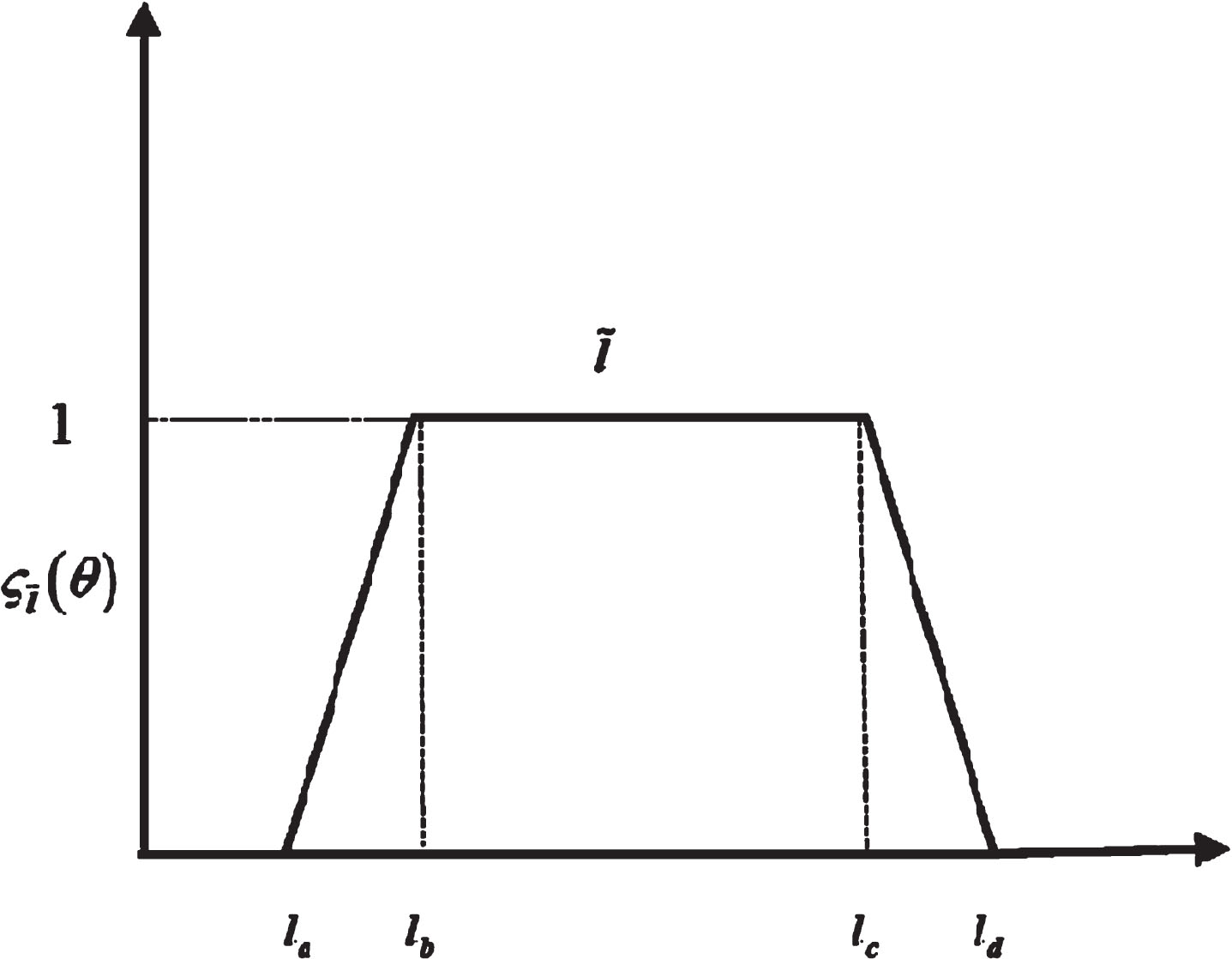
Definition 2 [52]: Let where la, lb, lc, ld ∈ L, lb and lc indicate the interval in which the membership value is 1, la and ld present the lower and upper values of , respectively. Then is called the Tra-FLV and characterized by the following membership function (see Fig. 1):
A trapezoidal fuzzy linguistic variable.
Special Cases:
If a ⩽ b = c ⩽ d, then becomes the Tri-FLV.
If a = b ⩽ c = d, then is reduced to the ULV variable.
Archimedean t-norm and t-conorm
Definition 3 [58]: A function T : [0, 1] × [0, 1] → [0, 1] is said to be a t-norm if it satisfies the following conditions:
(i) T (1, x) = x ∀ x ; (ii) T (x, y) = T (y, x) ∀ x, y ;
(iii) T (x, T (y, z)) = T (T (x, y) , z) ∀ x, y, z ; (iv) if x ⩽ x′, y ⩽ y′, then T (x, y) = T (x′, y′) .
Definition 4 [58]: A function S : [0, 1] × [0, 1] → [0, 1] is said to be a t-conorm if it satisfies the following conditions:
(i) S (0, x) = x ∀ x ; (ii) S (x, y) = S (y, x) ∀ x, y ;
(iii) S (x, S (y, z)) = S (S (x, y) , z) ∀ x, y, z ; (iv) if x ⩽ x′, y ⩽ y′, then S (x, y) = S (x′, y′) .
The t-norm and t-conorm are dual to each other, i.e., is a t-conorm if T is a t-norm while is a t-norm if S is a t-conorm.
Definition 5 [58]: A t-norm T (x, y) is called Archimedean t-norm if it is continuous and T (x, x) < x ∀ x ∈ (0, 1) . An Archimedean t-norm is called a strict Archimedean t-norm if it is strictly increasing with respect to each variable for x ∈ (0, 1).
Definition 6 [58]: A t-conorm S (x, y) is called Archimedean t-conorm if it is continuous and S (x, x) > x ∀ x ∈ (0, 1) . An Archimedean t-conorm is called a strict Archimedean t-conorm if it is strictly increasing with respect to each variable for x ∈ (0, 1).
In 2005, Klement and Mesiar [59] proved that a strict Archimedean t-norm can be expressed via its additive generator g as T (x, y) = g-1 (g (x) + g (y)), where g is a strictly decreasing function g : [0, 1] → [0, ∞] such that g (1) = 0. Similarly, applying its dual t-conorm, we have S (x, y) = f-1 (f (x) + f (y)) , where f is a strictly increasing function such that f (x) = g (1 - x) . For any (x, y) ∈ [0, 1] × [0, 1] , considering some special cases of the generator g, Table 1 presents some well-known pairs of Archimedean t-norms and t-corms:
Some well-known pairs of Archimedean t-norms and t-conorms and relative additive generators
Name
t-norm
t-conorm
Additive generators
Algebra
TA (x, y) = x . y
SA (x, y) = x + y - x . y
g (κ) = - log(κ)
f (κ) = - log(1 - κ)
Einstein
Hamacher
As we know, the Archimedean t-norms and t-conorms have been widely used in defining generalized aggregation operators. However, the domain and the range of the Archimedean t-norms and t-corms must be in [0, 1]. So, the above discussed Archimedean t-norms and t-conorms cannot be used directly under the linguistic environment. To address this issue, Liu and Chen [60] defined the notion of extended t-norm and extended t-conorm and discussed some well-known Archimedean E-t-norms and E-t-corms. The results are shown in Table 2.
Some well-known pairs of Archimedean E-t-norms and E-t-corms and relative additive generators
Name
E-t-norm
E-t-conorm
Additive generators
Algebra
Einstein
Hamacher
Linguistic intuitionistic fuzzy set
Zhang [45] extended to the notion of IFSs to the linguistic environment and presented the following definition of LIFS.
Definition 7: Let X be a universe of discourse and be a continuous linguistic term set. A LIFS in X is defined as
where represent the degrees of MS and NMS of the element x ∈ X to the set , respectively. For any given x ∈ X, the condition always holds and the hesitancy index of x ∈ X to the set is obtained by . For simplicity, the pair is called a linguistic intuitionistic fuzzy number (LIFN) and denoted as .
Definition 8 [13]: Let , and be three LIFNs and λ > 0 be a real number, then
if and only if and ;
if and ;
;
;
;
;
;
;
.
Based on the presented information and background, in the next section, we introduce the notion of LTFIFS, which generalizes the theory of LIFSs and LIVIFSs. Then we define some operational laws, score and accuracy values for them.
Linguistic trapezoidal fuzzy intuitionistic fuzzy sets
We propose the following formal definition of LTFIFS:
Definition 9: Let X be a universe of discourse and F [l0, lr] be the set of all LTFVs defined on a continuous linguistic term set . A LTFIFS M in X is defined as
where
The linguistic trapezoidal fuzzy variables , , respectively, denote the degrees of MS and NMS of an element x ∈ X to the set M with the condition . The hesitancy index of x ∈ X to the set M is obtained by For a given element x ∈ X, the pair is called
linguistic trapezoidal fuzzy intuitionistic fuzzy number (LTFIFN), and in the interest of simplicity, it is denoted by . For convenience, we use the symbol Ω to denote the set of all LTFIFN. Furthermore, if a1 ⩽ a2 = a3 ⩽ a4 and b1 ⩽ b2 = b3 ⩽ b4 hold in LTFIFN ρ, then it gives a linguistic triangular fuzzy intuitionistic fuzzy number (LTFIFN). When a1 = a2 ⩽ a3 = a4 and b1 = b2 ⩽ b3 = b4 hold in LTFIFN ρ, then it is reduced to LIVIFN [50].
For a LTFIFN ρ, we present the definition of score and accuracy values as follows:
Definition 10 (Score and Accuracy Values): Let be a LTFIFN. The score value of ρ, is defined as
and the accuracy value is defined as
For any two LTFIFNs ρ1 and ρ2, we introduce the following comparison method for ranking these LTFIFNs:
If SV (ρ1) < SV (ρ2), then ρ1 is inferior to ρ2, denoted by ρ1≺ ρ2 ;
If SV (ρ1) = SV (ρ2), then we check their accuracy values and decide as follows:
If AV (ρ1) < AV (ρ2), then ρ1 is inferior to ρ2, denoted by ρ1≺ ρ2 ;
If AV (ρ1) = AV (ρ2), then ρ1 and ρ2 represent the same information, denoted by ρ1 = ρ2.
Example 1: Let be a continuous linguistic term set. Assume that , , and are four LTFIFNs derived from . Then using the Equatios (5) and (6), we get
According to the score values of the given LTFIFNs ρi, we obtain the ranking order given by
Now, we define the following set-theoretic operational laws between LTFIFNs.
Definition 11: Let be two LTFIFNs, then the set-theoretic operational laws for LTFIFNs are summarized as follows:
ρ1 = ρ2 if and only if and ;
α1 ⩽ α2 if and ;
;
;
;
where ∨ and ∧ denote the max. and min. operators.
Next, based on Archimedean E-t-norm and E-t-conorm, we define the following algebraic operational laws between LTFIFNs.
Definition 12: Let , , be three LTFIFNs and λ > 0 be a real number, then
In the following theorems, we prove several important properties associated with LTFIFNs.
Theorem 1:For LTFIFNs, , and λ > 0, the , , and are also LTFIFNs.
Proof. Let . From Definition 12, we have , , , , , and .
By the basic nature of the functions f and g, it is clear that . Further, as and f is strictly increasing function, then
Thus, , hence is a LTFIFN. Other results can be proved similarly. ■
Theorem 2:Letbe three LTFIFNs, then
iii.
iv.
Proof. The proof follows directly from Definition 12. ■
Theorem 3:Let, , be three LTFIFNs and λ, λ1, λ2 > 0 be real numbers, then
(vi). ;
; vii. ;
; (viii).
; (ix). ;
; (x). .
Proof. (i) For any two LTFIFNs ρ1, ρ2 and λ > 0, by Definition 8, we have
Then
(ii) For any two LTFIFNs ρ1, ρ2 and λ > 0, by Definition 8, we have
In the following, we present some special cases of the proposed operational laws on LTFIFNs considering different additive generators.
Case 1: For the Algebraic E-t-norm (ETA) and E-t-conorm (ESA), we obtain the following algebraic operational laws on LTFIFNs:
,
where , , , , , , (k = 1, 2, 3, 4) .
Case 2: For the Einstein E-t-norm (ETE) and E-t-conorm (ESE), we get the following Einstein operational laws on LTFIFNs:
,
where
Case 3: For the Hamacher E-t-norm (ETH) and E-t-conorm (ESH), we obtain the following Hamacher operational laws on LTFIFNs:
,
where , , , , , , ,
Example 2: Let , be any two LTFIFNs and λ = 2, γ = 3, then the obtained results by using different operational laws on LTFIFNs are summarized in Table 3.
Values of different operations under different E-t-norm (T) and E-t-conorm (S)
Aggregated values based on different aggregation operators
LTFIFAWA
LTFIFEWA
LTFIFHWA (γ = 3)
In the next section, using the proposed operational laws on LTFIFNs, we introduce some arithmetic and geometric aggregation operators for aggregating the different LTFIFNs.
Weighted arithmetic and geometric aggregation operators for LTFIFNs
In the literature, a wide range of aggregation operators have been developed for aggregating IFNs, IVIFNs, LIFNs, and LIVIFNs. However, the fact is that the existing aggregation tools cannot be used for fusing LTFIFNs. Therefore, we need a particular class of aggregation operators that can be utilized under the LTFIF environment. For doing so, in this section, we propose some new arithmetic and geometric aggregation operators for aggregating LTFIFNs. It is worth to mention that the proposed aggregation operators are more general and applicable in different information environments, including LIF and LIVIF.
A. Weighted Arithmetic Aggregation Operators for LTFIFNs
LTFIFWA Operator
Definition 13: Let be a collection of LTFIFNs and LTFIFWA : Ωn → Ω. If
where w = (w1, w2, …, wn) T is a weighting vector of ρi (i = 1, 2, …, n) with wi ∈ [0, 1], and Ω is the set of all the LTFIFNs, then LTFIFWA is called the linguistic trapezoidal fuzzy intuitionistic fuzzy weighted averaging (LTFIFWA) operator.
Note that when w = (1/ - n, 1/ - n, …, 1/ - n) T, the LTFIFWA operator gives the LTFIFA operator and presented as
Theorem 4:Letbe a collection ofnLTFIFNs, then the aggregated result by LTFIFWA operator is also a LTFIFN, and represented by
Proof. The first result holds immediately from Theorem 1. To prove the second result, we use mathematical induction on n. Let n = 2, from operational laws for LTFIFNs given in Definition 12, we get
Then
This shows that the result holds for n = 2.
Next, let us consider that Equation (15) holds for n = k, i.e.
When n = k + 1, based on the LTFIF operational laws, we have
Example 3: Let , , and be four LTFIFNs derived from and w = (0.15, 0.35, 0.25, 0.25) T be the weighting vector of LTFIFNs. Then the obtained aggregated values by using different aggregation operators mentioned in Equations (22)-(24) are summarized in Table 4.
Next, using the notion of ordered weighted averaging (OWA) [61] operator, we propose the linguistic trapezoidal fuzzy intuitionistic fuzzy ordered weighted averaging (LTFIFOWA) operator as follows:
LTFIFOWA Operator
Definition 14: Let be a collection of LTFIFNs, the LTFIFOWA operator of dimension n is a mapping LTFIFOWA : Ωn → Ω that has an associated weighting vector ω = (ω1, ω2, …, ωn) T with ωi > 0 and , and defined according to the following formula
where ρσ(i) is the ith largest LTFIFN of all LTFIFNs ρi.
Theorem 6:Letbe a collection ofnLTFIFNs, then the aggregated result by LTFIFOWA operator is also a LTFIFN and given by
Proof. This theorem can be proved similar to Theorem 4, so we omit the proof from here.
Example 4: Let , , and be four LTFIFNs derived from and ω = (0.30, 0.20, 0.15, 0.35) T be the weight vector associated with LTFIFOWA operator.
Since SV (ρ1) = 0.6000, SV (ρ2) = 0.2250, SV (ρ3) = 0.6375 and SV (ρ4) = 0.4375, then we get
After utilizing the LTFIFOWA operator with different values of the additive generator g, Table 5 presents the obtained aggregated results.
Similar to Theorem 5, LTFIFOWA operator also holds the idempotency, monotonicity, boundedness, and commutativity.
Note 1. If ω = (1, 0, …, 0) T, we have LTFIFOWA (ρ1, ρ2, …, ρn) = (ρ1 ∨ ρ2 ∨ … ∨ ρn).
Note 2. If ω = (0, 0, …, 1) T, we have LTFIFOWA (ρ1, ρ2, …, ρn) = (ρ1 ∧ ρ2 ∧ … ∧ ρn).
In the next, using the idea of geometric mean and ordered weighted geometric [62] operator, we define the linguistic trapezoidal fuzzy intuitionistic fuzzy weighted geometric (LTFIFWG) operator and linguistic trapezoidal fuzzy intuitionistic fuzzy ordered weighted geometric (LTFIFOWG) operator.
B Weighted Geometric Aggregation Operators for LTFIFNs
LTFIFWG operator
Definition 15: Let be a collection of LTFIFNs and let LTFIFWG : Ωn → Ω. If
where w = (w1, w2, …, wn) T is the weight vector of ρi (i = 1, 2, …, n) with wi ∈ [0, 1], and Ω is the set of all the LTFIFNs, then LTFIFWG is called the linguistic trapezoidal fuzzy intuitionistic fuzzy weighted geometric (LTFIFWG) operator.
Also, if w = (1/ - n, 1/ - n, …, 1/ - n) T, then the LTFIFWG operator reduces to the LTFIFG operator as
Theorem 7:Let be a collection of n LTFIFNs, then the aggregated result by using the LTFIFWG operator is also a LTFIFN, and
Proof. By using the operational laws given in Definition 12, Theorem 8 can be easily proved similar to Theorem 4.
Now, we present some particular cases of the LTFIFWG operator by taking different values of the additive generator g as follows:
which is called the linguistic trapezoidal fuzzy intuitionistic fuzzy Hamacher weighted geometric (LTFIFHWG) operator.
Example 5: Considering the same numerical data as mentioned in Example 3, the obtained aggregated values based on LTFIFWG operator are presented in Table 6.
Theorem 8:Letandbe two collections of n LTFIFNs, then LTFIFWG satisfies the following properties:
P1.(Idempotency): If ρi = ρ ∀ i, then LTFIFWG (ρ1, ρ2, …, ρn) = ρ .
P2(Monotonicity): If ρi ⩽ χi ∀ i, then LTFIFWG (ρ1, ρ2, …, ρn) ⩽ LTFIFWG (χ1, χ2, …, χn) .
P3(Boundedness): Let and
then ρ- ⩽ LTFIFWG (ρ1, ρ2, …, ρn) ⩽ ρ+ .
P4: Let be another LTFIFN, then
P5: If η > 0 is a real number, then
P6:…, χn) .
P7: If η1, η2 > 0 are two real number, then
Proof. The proof of the properties (P1), (P2) and (P3) are similar to the Theorem 5. So we shall present the proofs of the remaining properties.
(P4) Since ρi, χ ∈ Ω, so
Therefore
■
(P5) Since ρi ∈ Ω. Then, for any η > 0, we have
Therefore
■
This completes the proof.
(P6) Since ρi, χi ∈ Ω, so
Therefore
■
(P7) It follows direly from Property 5 and 6.
LTFIFOWG Operator
Definition 16: Let be a collection of LTFIFNs, the LTFIFOWG operator of dimension n is a mapping that has an associated weighting vector with ωi > 0 and , and defined according to the following formula
where ρσ(i) is the ith largest LTFIFN of all LTFIFNs ρi.
Theorem 9: Let be a collection of n LTFIFNs, then the aggregated result by LTFIFOWG operator is also a LTFIFN and given by
Proof. The theorem can be proved similarly as Theorem 4. ■
Example 6: Assuming the same numerical data asmentioned in Example 4 and utilizing the LTFIFOWG operator, the obtained aggregated values are mentioned in Table 7.
Aggregated values based on LTFIFOWA considering different values of the additive generatorg
LTFIFAOWA
LTFIFEOWA
LTFIFHOWA (γ = 3)
Aggregated values based on different geometric aggregation operators
LTFIFAWG
LTFIFEWG
LTFIFHWG (γ = 3)
Aggregated values based on different geometric aggregation operators
LTFIFAOWG
LTFIFEOWG
LTFIFHOWG (γ = 3)
Furthermore, the LTFIFOWG operator also satisfies properties such as idempotency, monotonicity, boundedness, and commutativity.
Note 3., we have .
Note 4., we have .
It has been observed that the LTFIFWA and LTFIFWG operators only consider the importance degree of LTFIFNs while the LTFIFOWA and LTFIFOWG operators only consider the position weights of the LTFIFNs during aggregation process. Therefore, the weight vectors represent different aspects in LTFIFWA, LTFIFWG, and LTFIFOWA, LTFIFOWG operators. However, the developed aggregation operators for LTFIFNs consider only one of them. Nevertheless, in many real situations, we need to consider both types of importance degrees simultaneously. The ordered weighted averaging-weighted average (OWAWA) operator, proposed by Merigó [63], is a hybrid aggregation operator that combines the features of OWA operator and the WA in a single formulation. The OWAWA operator includes the OWA operator and WA operators as its particular cases. Therefore, utilizing the notion of OWAWA operator, we define the linguistic trapezoidal fuzzy intuitionistic fuzzy ordered weighted averaging weighted average (LTFIFOWAWA) operator and the linguistic trapezoidal fuzzy intuitionistic fuzzy ordered weighted geometric weighted geometric (LTFIFOWGWG) operator.
LTFIFOWAWA operator
Definition 17: Let be a collection of LTFIFNs. The LTFIFOWAWA operator of dimension n is a mapping that has an associated weighting vector with ωi > 0 and , and presented according to the following formula
where ρσ(i) is the ith largest LTFIFN ρi, each argument ρi has an importance weight wi with ρi > 0, with is the weight wi ordered according to ρσ(i), that is, according to the ith largest ρi.
Note 5: If β = 1, we get the LTFIFOWA operator and when β = 0, the LTFIFWA operator.
Theorem 10: Let be a collection of n LTFIFNs, then the aggregated result by LTFIFOWAWA operator is also a LTFIFN and
Proof. Theorem 10 can be easily proved similar to Theorem 4.
LTFIFOWGWG Operator
Definition 18: Let be a collection of LTFIFNs. LTFIFOWGWG operator of dimension n is a mapping that has an associated weighting vector with ωi > 0 and , and defined according to the following formula
where ρσ(i) is the ith largest LTFIFN ρi, each argument ρi has an associated weight wi with ρi > 0, with is the weight wi ordered according to ρσ(i), that is, according to the ith largest ρi.
Note 6: If β = 1, we get the LTFIFOWG operator and if β = 0, the LTFIFWG operator.
Theorem 11: Let be a collection of n LTFIFNs, then the aggregated result by LTFIFOWGWG operator is also a LTFIFN and
Proof. The proof can obtain similarly as Theorem 4.
Example 7: Let be four LTFIFNs and be the weight vector associated with LTFIFOWAWA and LTFIFOWGWG operators. Further, assume that is the importance weight vector of ρi.
Since , then we get
Using the LTFIFOWAWA and LTFIFOWGWG operators, the obtained results are summarized in Table 8.
The values of LTFIFOWAWA and LTFIFOWGWG operators based on different values of the additive generator g and β
β
0
0.2
0.5
0.8
1
LTFIFAOWAWA operator
LTFIFEOWAWA operator
LTFIFHOWAWA operator
LTFIFAOWGWG operator
LTFIFEOWGWG operator
LTFIFHOWGWG operator
We can also easily prove that the operators LTFIFOWAWA and LTFIFOWGWG accomplish similar properties as the LTFIFOWA and LTFIFOWG operators. It is important to note that the weight vector associated with LTFIFOWAWA (or LTFIFOWGWG or LTFIFOWA or LTFIFOWG) can be obtained by using different methods available in the literature [64].
In the next section, based on proposed aggregation operators, we develop a decision-making approach to solve MAGDM problems in which the decision information given in the form of LTFIFNs. We also present a numerical example to illustrate the efficiency and usefulness of the developed decision approach.
An approach to multiple attribute group decision making with linguistic trapezoidal fuzzy intuitionistic fuzzy information
Problem formulation
Let X ={ X1, X2, . . . , Xm } be a set of m alternatives and G ={ G1, G2, . . . , Gn } be a set of n attributes, whose weight vector is (w1, w2, …, wn) T such that wj ∈ [0, 1] and . Let D ={ D1, D2, . . . , Dt } be a set of decision-makers (experts) and (ω1, ω2, …, ωt) T be the weight vector of the Dq (1, 2, …, t) with ωq ∈ [0, 1] and . Let be a decision matrix, where represents an attribute evaluation value given by the decision-maker Dq ∈ D in terms of LTFIFN for the alternative Xi ∈ X with respect to the attribute Gj ∈ G such that , i = 1, 2, …, m; j = 1, 2, …, n
Decision making steps
The decision approach involves the following steps.
Step 1: To balance the physical dimensions of the given data, first transform the decision matrices into the normalized decision matrices , where (i = 1, 2, …, m ; j = 1, 2, …, n ; q = 1, 2, …, t) and
Step 2: Aggregate all the individual normalized decision matrices into a collective decision matrix by utilizing either LTFIFOWA operator
or LTFIFOWG operator
where is the qth largest value of and (ω1, ω2, …, ωt) T represents the associated ordered position weight vector with ωq ∈ [0, 1] and .
Step 3: Aggregate all LTFIF preference values for obtaining the overall LTFIF preference values corresponding to the alternatives Xi (i = 1, 2, . . . , n), by using LTFIFOWAWA operator
or LTFIFOWGWG operator
where is the jth largest value of the LTFIFNs , w = (w1, w2, …, wn) T represents the weight vector of such that wj ∈ [0, 1], , with β ∈ [0, 1] and wσ(j) is the weight wj ordered according to .
Step 4. Calculate the score values as follows:
If the score values and corresponding to alternatives Xk1 and Xk2 have no difference, then we shall calculate the accuracy values as
Step 5. Obtain the ranking order of the alternatives Xi (i = 1, 2, . . . , m) in accordance with the score values or accuracy values and identify the best one(s).
An Illustrative example
In this section, a real-life decision problem searching for the best contractor is considered to illustrate the decision-making procedure with LTFIF information.
Example 8: Chile is a South American country that runs from the Andes to the Pacific. It shares borders with Argentina, Peru, and Bolivia. In Chile, tourism is one of the main sources of income for the people, especially living in its most extreme areas. In 2018, a record of total 7 million international tourists visited Chile. The online guestbook Lonely Planet listed Chile as its number one tourist destination to visit in the year 2018. Chile is typically divided into three geographic areas: (1) Continental Chile (2) Insular Chile and (3) Chilean Antarctic Territory. Chile, with its unique natural features, attracts more and more tourists every year. To promote and stimulate growth within Chile’s tourism sector, the Chilean government wants to develop many road-building projects for making road transportation convenient from one place to another one. For doing so, the Chilean government had been issued a global tender in leading newspapers to select the contractor for these projects and defined the following four attributes for this selection process: (1) financial status (G1) (2) organizational experience (G2) (3) past performance and knowledge (G3) (4) ability to deal with unanticipated problems. The attribute weight vector is given by w = (0.30, 0.25, 0.30, 0.15) T. The four contractors (i.e. alternatives), namely, (1) Eurovia (X1) (2) Sacyr Global Company (X2) (3) Bechtel Group Inc. (X3), and (4) Acciona Construction (G4), bid for these projects. For selecting the best contractor, the government forms a committee of three experts {D1, D2, D3} to evaluate the contractors under fixed attributes. The experts provide their evaluation information corresponding to each attribute by LTFIFNs as per the following linguistic term set:
After evaluation of the available alternatives, the experts construct the following linguistic trapezoidal fuzzy intuitionistic fuzzy decision matrices , as shown in Tables 9, 10, and 11, respectively.
Decision matrix A(1) given by the expert D1
G1
G2
G3
G4
X1
〈 [l4, l5, l6, l7] , [l0, l1, l2, l3]〉
〈 [l0, l2, 3, l4] , [l1, l2, l2, l3]〉
〈 [l4, l5, l5, l7] , [l1, l2, l3, l3]〉
〈 [l0, l3, l4, l5] , [l1, l2, l4, l4]〉
X2
〈 [l1, l3, l4, l5] , [l0, l1, l1, l2]〉
〈 [l2, l3, l5, l6] , [l2, l2, l3, l4]〉
〈 [l0, l1, l2, l3] , [l4, l5, l6, l7]〉
〈 [l2, l4, l5, l5] , [l1, l2, l3, l4]〉
X3
〈 [l0, l1, l4, l5] , [l2, l3, l4, l5]〉
〈 [l3, l4, l6, l7] , [l0, l1, l2, l2]〉
〈 [l3, l4, l5, l6] , [l1, l3, l4, l4]〉
〈 [l1, l2, l3, l5] , [l1, l2, l3, l4]〉
X4
〈 [l3, l5, l5, l6] , [l2, l3, l3, l4]〉
〈 [l0, l2, l4, l5] , [l1, l3, l4, l5]〉
〈 [l2, l3, l4, l6] , [l0, l1, l2, l3]〉
〈 [l4, l5, l6, l7] , [l0, l1, l1, l2]〉
Decision matrix A(2) given by the expert D2
G1
G2
G3
G4
X1
〈 [l2, l4, l5, l5] , [l0, l1, l1, l2]〉
〈 [l1, l3, l3, l5] , [l0, l1, l2, l3]〉
〈 [l3, l4, l5, l6] , [l1, l2, l2, l3]〉
〈 [l0, l2, l3, l5] , [l0, l1, l2, l2]〉
X2
〈 [l2, l4, l4, l6] , [l0, l1, l2, l3]〉
〈 [l3, l4, l5, l6] , [l0, l1, l2, l4]〉
〈 [l2, l3, l3, l4] , [l1, l3, l5, l5]〉
〈 [l1, l2, l3, l4] , [l0, l3, l3, l4]〉
X3
〈 [l2, l3, l4, l6] , [l1, l2, l2, l3]〉
〈 [l1, l3, l5, l6] , [l1, l2, l3, l3]〉
〈 [l2, l3, l5, l6] , [l0, l2, l2, l3]〉
〈 [l0, l2, l2, l4] , [l1, l2, l3, l3]〉
X4
〈 [l1, l3, l5, l5] , [l0, l3, l4, l5]〉
〈 [l0, l3, l4, l4] , [l1, l2, l2, l5]〉
〈 [l3, l4, l5, l7] , [l0, l1, l1, l3]〉
〈 [l1, l3, l5, l6] , [l0, l1, l2, l3]〉
Decision matrix A(3) given by the expert D3
G1
G2
G3
G4
X1
〈 [l2, l3, l5, l6] , [l1, l2, l3, l3]〉
〈 [l0, l1, l2, l5] , [l0, l2, l2, l4]〉
〈 [l2, l4, l5, l6] , [l0, l2, l3, l4]〉
〈 [l1, l2, l4, l6] , [l0, l3, l3, l4]〉
X2
〈 [l2, l3, l3, l6] , [l0, l2, l2, l3]〉
〈 [l1, l2, l4, l5] , [l0, l1, l2, l2]〉
〈 [l1, l3, l3, l4] , [l2, l3, l4, l5]〉
〈 [l2, l3, l4, l6] , [l0, l2, l3, l3]〉
X3
〈 [l0, l2, l3, l3] , [l1, l2, l3, l4]〉
〈 [l1, l3, l5, l6] , [l0, l1, l1, l2]〉
〈 [l2, l3, l5, l5] , [l0, l1, l1, l3]〉
〈 [l2, l3, l3, l5] , [l0, l1, l1, l3]〉
X4
〈 [l1, l4, l6, l7] , [l0, l2, l3, l3]〉
〈 [l0, l1, l3, l6] , [l1, l2, l3, l4]〉
〈 [l0, l2, l3, l5] , [l1, l2, l2, l4]〉
〈 [l3, l4, l5, l5] , [l0, l2, l3, l4]〉
Step 1: Since all the attributes are benefit type, therefore R(q) = A(q) (q = 1, 2, 3).
Step 2: By utilizing the normal distribution method [64], we obtain the weight vector ω = (0.243, 0.514, 0.243) T corresponding to experts. Then, we use the LTFIFIOWA operator given in Equation (43)) (without loss of generality, we have taken the additive generator , γ = 3) to obtain the collective decision matrix . The collective decision matrix is summarized in Table 12.
Collective decision matrix R by using LTFIFOWA operator
G1
G2
G3
G4
X1
X2
X3
X4
Step 3: Aggregate all linguistic intuitionistic fuzzy preference values by using the LTFIFOWAWA operator (Equation (45)) with ω = (0.1550, 0.3450, 0.3450, 0.1550) T (obtained from the normal distribution method [64]), and w = (0.30, 0.30, 0.25, 0.15) T to derive the overall LTFIF preference values for alternatives Xi (i = 1, 2, 3, 4) by taking different values of β. We get the results presented in Table 13.
The overall LTFIF preference values by considering the different values of β in LTFIFOWAWA
β
0
0.5
1
Step 4: We calculate the score values of the alternatives Xi (i = 1, 2, 3, 4) based on overall LTFIF preference values . The obtained ranking order of the alternatives Xi in accordance with the score values are presented in Table 14.
The score values and ranking of alternatives for different values β
β
Ranking of the alternatives
Best alternative
0
0.5917
0.5762
0.5712
0.5953
X4 ≻ X1 ≻ X2 ≻ X3
X4
0.5
0.5914
0.5632
0.5850
0.5880
X1 ≻ X4 ≻ X3 ≻ X2
X1
1
0.5912
0.5535
0.5987
0.5806
X3 ≻ X1 ≻ X4 ≻ X2
X3
In the above example, if we use the LTFIFOWG operator in step 2 and the LTFIFOWGWG operator in step 3, then the following steps are directed to obtain the best alternative(s) as:
Step 1: Since all the attributes are of the same type, hence R(q) = A(q) (q = 1, 2, 3).
Step 2: After utilizing the LTFIFOWG operator (Equation (44)) (without loss of generality, we have taken the additive generator ,
γ = 3) to obtain the collective decision matrix , we get the results summarized in Table 15.
Collective decision matrix R′ by using LTFIFOWG operator
G1
G2
G3
G4
X1
X2
X3
X4
Step 3: Aggregate all LTFIF preference values by using the LTFIFOWGWG operator (Equation (46)) with ω = (0.1550, 0.3450, 0.3450, 0.1550) T and w = (0.30, 0.30, 0.25, 0.15) T to derive the overall LTFIF preference values for alternatives Xi (i = 1, 2, 3, 4) by assuming different values of β. Table 16 presents the results.
The overall LTFIF preference values by taking the different values of β in LTFIFOWGWG
β
0
0.5
1
Step 4: Calculate the score values of the alternatives Xi (i = 1, 2, 3, 4) based on overall LTFIF preference values and find the ranking order of the alternatives Xi (i = 1, 2, 3, 4) in accordance with the score values. The results are listed in Table 17.
The score values and ranking of alternatives for different values β
β
Ranking of the alternatives
Best alternative(s)
0
0.5619
0.5381
0.5388
0.5620
X4 ≻ X1 ≻ X3 ≻ X2
X4
0.5
0.5598
0.5230
0.5519
0.5552
X1 ≻ X4 ≻ X3 ≻ X2
X1
1
0.5577
0.5080
0.5653
0.5486
X3 ≻ X1 ≻ X4 ≻ X2
X3
From Tables 14 and 17, we observe that X4 is the best alternative when β = 0 whereas X3 is the best alternative when β = 1. Additionally, if we take β = 0.5, then X1 becomes the best alternative.
On the other hand, instead of taking a particular generator , we have been used other generators in Step 2 and Step 3 of the developed decision-making approach. Then, after applying the steps, the obtained results are summarized in Table 18, along with the ranking order of the alternatives. From Table 18, it has been observed that the ranking of the alternatives for different additive generators is slightly different, which shows the impact of different aggregation methods and flexibility of the developed decision approach.
The score values and ranking of alternatives for different additive generators
Additive generator
The operator used in Step 2
The operator used in Step 3
β
Score values
Ranking of the alternatives
LTFIFOWA
LTFIFOWAWA
0
0.5958
0.5781
0.5753
0.5993
X4 ≻ X1 ≻ X2 ≻ X3
0.5
0.5961
0.5676
0.5890
0.5925
X1 ≻ X4 ≻ X3 ≻ X2
1
0.5963
0.5566
0.6022
0.5855
X3 ≻ X1 ≻ X4 ≻ X2
LTFIFOWG
LTFIFOWGWG
0
0.5572
0.5307
0.5348
0.5580
X4 ≻ X1 ≻ X3 ≻ X2
0.5
0.5557
0.5164
0.5478
0.5513
X1 ≻ X4 ≻ X3 ≻ X2
1
0.5543
0.5006
0.5614
0.5448
X3 ≻ X1 ≻ X4 ≻ X2
LTFIFOWA
LTFIFOWAWA
0
0.5935
0.5757
0.5727
0.5964
X4 ≻ X1 ≻ X2 ≻ X3
0.5
0.5934
0.5647
0.5865
0.5894
X1 ≻ X4 ≻ X3 ≻ X2
1
0.5931
0.5533
0.5999
0.5825
X3 ≻ X1 ≻ X4 ≻ X2
LTFIFOWG
LTFIFOWGWG
0
0.5605
0.5316
0.5373
0.5606
X4 ≻ X1 ≻ X3 ≻ X2
0.5
0.5585
0.5205
0.5504
0.5538
X1 ≻ X4 ≻ X3 ≻ X2
1
0.5565
0.5052
0.5639
0.5472
X3 ≻ X1 ≻ X4 ≻ X2
Next, we analyze the influences on the ranking order with respect to the different values of the parameter γ in the proposed arithmetic and geometric aggregation operators. The ranking order of the alternatives concerning different values of the parameter γ in the additive generator is presented in Table 19.
The score values and ranking of alternatives for different values γ in
The operator used in Step 2
The operator used in Step 3
γ
β
Score Values
Ranking of the alternatives
LTFIFOWA
LTFIFOWAWA
0.5
0
0.5994
0.5794
0.5779
0.6021
X4 ≻ X1 ≻ X2 ≻ X3
0.5
0.5993
0.5706
0.5915
0.5952
X1 ≻ X4 ≻ X3 ≻ X2
1
0.5990
0.5588
0.6044
0.5882
X3 ≻ X1 ≻ X4 ≻ X2
1
0
0.5958
0.5781
0.5753
0.5993
X4 ≻ X1 ≻ X2 ≻ X3
0.5
0.5961
0.5676
0.5890
0.5925
X1 ≻ X4 ≻ X3 ≻ X2
1
0.5963
0.5566
0.6022
0.5855
X3 ≻ X1 ≻ X4 ≻ X2
2
0
0.5935
0.5757
0.5727
0.5964
X4 ≻ X1 ≻ X2 ≻ X3
0.5
0.5934
0.5647
0.5865
0.5894
X1 ≻ X4 ≻ X3 ≻ X2
1
0.5931
0.5533
0.5999
0.5825
X3 ≻ X1 ≻ X4 ≻ X2
3
0
0.5917
0.5762
0.5712
0.5953
X4 ≻ X1 ≻ X2 ≻ X3
0.5
0.5914
0.5632
0.5850
0.5880
X1 ≻ X4 ≻ X3 ≻ X2
1
0.5912
0.5536
0.5987
0.5806
X3 ≻ X1 ≻ X4 ≻ X2
6
0
0.5885
0.5755
0.5687
0.5923
X4 ≻ X1 ≻ X2 ≻ X3
0.5
0.5882
0.5610
0.5827
0.5849
X1 ≻ X4 ≻ X3 ≻ X2
1
0.5878
0.5524
0.5967
0.5775
X3 ≻ X1 ≻ X4 ≻ X2
LTFIFOWG
LTFIFOWGWG
0.5
0
0.5563
0.5296
0.5324
0.5556
X1 ≻ X4 ≻ X3 ≻ X2
0.5
0.5542
0.5126
0.5454
0.5489
X1 ≻ X4 ≻ X3 ≻ X2
1
0.5521
0.4960
0.5592
0.5425
X3 ≻ X1 ≻ X4 ≻ X2
1
0
0.5572
0.5307
0.5348
0.5580
X4 ≻ X1 ≻ X3 ≻ X2
0.5
0.5557
0.5164
0.5478
0.5513
X1 ≻ X4 ≻ X3 ≻ X2
1
0.5543
0.5006
0.5614
0.5448
X3 ≻ X1 ≻ X4 ≻ X2
2
0
0.5606
0.5361
0.5373
0.5605
X1 ≻ X4 ≻ X3 ≻ X2
0.5
0.5585
0.5205
0.5504
0.5538
X1 ≻ X4 ≻ X3 ≻ X2
1
0.5565
0.5052
0.5639
0.5472
X3 ≻ X1 ≻ X4 ≻ X2
3
0
0.5619
0.5381
0.5388
0.5620
X4 ≻ X1 ≻ X3 ≻ X2
0.5
0.5598
0.5230
0.5519
0.5552
X1 ≻ X4 ≻ X3 ≻ X2
1
0.5577
0.5080
0.5653
0.5486
X3 ≻ X1 ≻ X4 ≻ X2
6
0
0.5639
0.5413
0.5412
0.5643
X4 ≻ X1 ≻ X2 ≻ X3
0.5
0.5617
0.5269
0.5543
0.5575
X1 ≻ X4 ≻ X3 ≻ X2
1
0.5595
0.5123
0.5679
0.5508
X3 ≻ X1 ≻ X4 ≻ X2
Further discussions: In Table 20, we present a characteristic comparison of our developed approach with some existing methods available in the literature.
The characteristic comparisons of different methods
Properties\Methods
Whether flexibly to express a wider range of information
Whether describe information using linguistic features
Whether have the characteristic of generalizations
Whether describe information by trapezoidal fuzzy numbers
Whether have the ability to consider the attitude of the decision-maker during the aggregation process
The methods developed by Xu [22] and Xu & Yager [21] adopt IFNs to represent the decision information, which considers only quantitative aspects. In order to provide more flexibility in information representation, Xu [65] approach considered interval-valued intuitionistic fuzzy numbers, whereas Ye [66] adopted trapezoidal intuitionistic fuzzy numbers, but these also reflect only quantitative features of the problem. On the other hand, the method developed by Zhang [45] used LIFNs to characterize the uncertainties in the data with qualitative aspects but does not have flexibility in information representation. The methods proposed by Garg and Kumar [50, 51] used LIVIFNs to provide flexibility to the user in expressing their preference information but not able to consider the decision maker’s attitude during the aggregation process. In the present work, we have been used LTFIFNs to describe the uncertain information, which gives more degree of freedom to the user for describing his/her evaluation information more naturally. The proposed approach has been utilized the Archimedean t-norm and t-conorm for defining more general aggregation operators for aggregating LTFIF information. Besides, our approach also has an additional parameter for considering the attitude of the decision-maker during the aggregation process. Therefore, the developed approach is more general and applicable in real-life situations.
Conclusions
This paper has studied and examined MAGDM problems with qualitative aspects. In this work, we have proposed the notion of LTFIFS theory and then defined some basic operational laws, score, and accuracy values on LTFIFNs. Further, several weighted arithmetic and geometric aggregation operators for aggregating different LTFIFNs such as LTFIFWA, LTFIFOWA, LTFIFWG, LTFIFOWG, LTFIFOWAWA, and LTFIFOWGWG have been defined along with some important desirable properties and particular cases. It is important to note that the newly proposed aggregation operators can also be applied to aggregate LIFNs as well as LIVIFNs. Finally, the paper has developed a MAGDM approach to solve the real-life decision problem under the LTFIF environment and considered a practical numerical example for illustrating the decision-making process. We have also compared the obtained results with some well-known methods available in the literature, and it has been established that the developed MAGDM approach is more flexible and robust in solving realistic decision problems with qualitative information.
In the future, we shall consider further extensions of these aggregation operators by considering generalized means, quasi-means, Bonferroni means, prioritized weighted averages, and moving averages. We shall also explore the applications of developed approaches in another area, including medical diagnosis, pattern recognition, and facility location selection.
Footnotes
Acknowledgments
Support from the Chilean Government (Conicyt) through the Fondecyt Postdoctoral program (Project Number 3170556) is gratefully acknowledged.
References
1.
ZadehL.A., Fuzzy sets, Information and Control8 (1965), 338–353.
2.
AtanassovK.T., Intuitionistic fuzzy sets, Fuzzy Sets and Systems20 (1986), 87–96.
3.
BoranF.E., GençS., KurtM. and AkayD., A multi-criteria intuitionistic fuzzy group decision making for supplier selection with TOPSIS method, Expert Systems with Applications36 (2009), 11363–11368.
4.
ChairaT., A novel intuitionistic fuzzy C means clustering algorithm and its application to medical images, Applied Soft Computing11 (2011), 1711–1717.
5.
VermaR. and SharmaB.D., Intuitionistic fuzzy Jensen-Rényi divergence: Applications to multiple-attribute decision making, Informatica37 (2013), 399–409.
6.
VermaR. and SharmaB., Intuitionistic fuzzy Einstein prioritized weighted average operators and their application to multiple attribute group decision making, Applied Mathematics and Information Sciences9 (2015), 3095–3107.
7.
XuZ., Intuitionistic preference relations and their application in group decision making, Information Sciences177 (2007), 2363–2379.
8.
DeS.K., BiswasR. and RoyA.R., An application of intuitionistic fuzzy sets in medical diagnosis, Fuzzy Sets and Systems117 (2001), 209–213.
9.
DeschrijverG. and KerreE.E., On the position of intuitionistic fuzzy set theory in the framework of theories modelling imprecision, Information Sciences177 (2007), 1860–1866.
10.
IakovidisD.K. and PapageorgiouE., Intuitionistic fuzzy cognitive maps for medical decision making, IEEE Transactions on Information Technology in Biomedicine15 (2011), 100–107.
11.
DengfengL. and ChuntianC., New similarity measures of intuitionistic fuzzy sets and application to pattern recognitions, Pattern Recognition Letters23 (2002), 221–225.
12.
ShuM.-H., ChengC.-H. and ChangJ.-R., Using intuitionistic fuzzy sets for fault-tree analysis on printed circuit board assembly, Microelectronics Reliability46 (2006), 2139–2148.
13.
VermaR. and SharmaB.D., On generalized intuitionistic fuzzy divergence (relative information) and their properties, Journal of Uncertain Systems6 (2012), 308–320.
14.
VermaR. and SharmaB.D., Exponential entropy on intuitionistic fuzzy sets, Kybernetika49 (2013), 114–127.
15.
VermaR. and SharmaB.D., A new measure of inaccuracy with its application to multi-criteria decision making under intuitionistic fuzzy environment, Journal of Intelligent and Fuzzy Systems27 (2014), 1811–1824.
16.
BeliakovG., BustinceH., GoswamiD.P., MukherjeeU.K. and PalN.R., On averaging operators for Atanassov’s intuitionistic fuzzy sets, Information Sciences181 (2011), 1116–1124.
17.
HeY., ChenH., ZhouL., LiuJ. and TaoZ., Intuitionistic fuzzy geometric interaction averaging operators and their application to multi-criteria decision making, Information Sciences259 (2014), 142–159.
18.
HeY., HeZ. and ChenH., Intuitionistic fuzzy interaction Bonferroni means and its application to multiple attribute decision making, IEEE Transactions on Cybernetics45 (2015), 116–128.
19.
WanS.P. and DongJ.Y., Power geometric operators of trapezoidal intuitionistic fuzzy numbers and application to multi-attribute group decision making, Applied Soft Computing29 (2015), 153–168.
20.
WeiG., Some induced geometric aggregation operators with intuitionistic fuzzy information and their application to group decision making, Applied Soft Computing10 (2010), 423–431.
21.
XuZ. and YagerR.R., Some geometric aggregation operators based on intuitionistic fuzzy sets, International Journal of General Systems35 (2006), 417–433.
XuZ. and YagerR.R., Intuitionistic fuzzy Bonferroni means, IEEE Transactions on Systems, Man, and Cybernetics, Part B: Cybernetics41 (2011), 568–578.
24.
ZadehL.A., The concept of a linguistic variable and its application to approximate reasoning-I, Information Sciences8 (1975), 199–249.
25.
ZadehL.A., The concept of a linguistic variable and its application to approximate reasoning—II, Information Sciences8 (1975), 301–357.
26.
ZadehL.A., The concept of a linguistic variable and its application to approximate reasoning-III, Information Sciences9 (1975), 43–80.
27.
HerreraF. and Herrera-ViedmaE., Linguistic decision analysis: Steps for solving decision problems under linguistic information, Fuzzy Sets and Systems115 (2000), 67–82.
28.
DelgadoM., HerreraF., Herrera-ViedmaE. and MartínezL., Combining numerical and linguistic information in group decision making, Information Sciences107 (1998), 177–194.
29.
ChenZ.S., ChinK.S., MartinezL. and TsuiK.L., Customizing Semantics for Individuals with Attitudinal HFLTS Possibility Distributions, IEEE Transactions on Fuzzy Systems26 (2018), 3452–3466.
30.
ChenZ.S., MartínezL., ChinK.S. and TsuiK.L., Two-stage aggregation paradigm for HFLTS possibility distributions: A hierarchical clustering perspective, Expert Systems with Applications104 (2018), 43–66.
31.
LiC.C., DongY., HerreraF., Herrera-ViedmaE. and MartínezL., Personalized individual semantics in computing with words for supporting linguistic group decision making An application on consensus reaching, Information Fusion33 (2017), 29–40.
32.
LiC.C., RodríguezR.M., MartínezL., DongY. and HerreraF., Personalized individual semantics based on consistency in hesitant linguistic group decision making with comparative linguistic expressions, Knowledge-Based Systems145 (2018), 156–165.
33.
DeganiR. and BortolanG., The problem of linguistic approximation in clinical decision making, International Journal of Approximate Reasoning2 (1988), 143–162.
34.
HerreraF. and MartínezL., A 2-tuple fuzzy linguistic representation model for computing with words, IEEE Transactions on Fuzzy Systems8 (2000), 746–752.
35.
MendelJ.M. and WuH., Type-2 fuzzistics for symmetric interval Type-2 fuzzy sets: Part 2, inverse problems, IEEE Transactions on Fuzzy Systems15 (2007), 301–308.
36.
DongY. and Herrera-ViedmaE., Consistency-Driven Automatic Methodology to Set Interval Numerical Scales of 2-Tuple Linguistic Term Sets and Its Use in the Linguistic GDM with Preference Relation, IEEE Transactions on Cybernetics45 (2015), 780–792.
37.
WeiG.W., 2-tuple intuitionistic fuzzy linguistic aggregation operators in multiple attribute decision making, Iranian Journal of Fuzzy Systems16 (2019), 159–174.
38.
WeiC. and LiaoH., A Multigranularity Linguistic Group Decision-Making Method Based on Hesitant 2-Tuple Sets, International Journal of Intelligent Systems31 (2016), 612–634.
39.
MengD. and PeiZ., On weighted unbalanced linguistic aggregation operators in group decision making, Information Sciences223 (2013), 31–41.
40.
MerigoJ.M. and CasanovasM., Decision making with distance measures and linguistic aggregation operators, International Journal of Fuzzy Systems12 (2010), 190–198.
41.
PeiZ., ZouL. and YiL., A linguistic aggregation operator including weights for linguistic values and experts in group decision making, International Journal of Uncertainty, Fuzziness and Knowlege-Based Systems21 (2013), 927–943.
42.
XuZ., A method based on linguistic aggregation operators for group decision making with linguistic preference relations, Information Sciences166 (2004), 19–30.
43.
XuZ., Uncertain linguistic aggregation operators based approach to multiple attribute group decision making under uncertain linguistic environment, Information Sciences168 (2004), 171–184.
44.
XuZ., On generalized induced linguistic aggregation operators, International Journal of General Systems35 (2006), 17–28.
45.
ZhangH., Linguistic intuitionistic fuzzy sets and application in MAGDM, Journal of Applied Mathematics (2014), 1–11.
46.
ChenZ., LiuP. and PeiZ., An approach to multiple attribute group decision making based on linguistic intuitionistic fuzzy numbers, International Journal of Computational Intelligence Systems8 (2015), 747–760.
47.
GargH. and KumarK., Some Aggregation Operators for Linguistic Intuitionistic Fuzzy Set and its Application to Group Decision-Making Process Using the Set Pair Analysis, Arabian Journal for Science and Engineering43 (2018), 3213–3227.
48.
LiuP. and QinX., Maclaurin symmetric mean operators of linguistic intuitionistic fuzzy numbers and their application to multiple-attribute decision-making, Journal of Experimental and Theoretical Artificial Intelligence29 (2017), 1173–1202.
49.
PengH.G., WangJ.Q. and ChengP.F., A linguistic intuitionistic multi-criteria decision-making method based on the Frank Heronian mean operator and its application in evaluating coal mine safety, International Journal of Machine Learning and Cybernetics9 (2018), 1053–1068.
50.
GargH. and KumarK., Linguistic interval-valued Atanassov intuitionistic fuzzy sets and their applications to group decision-making problems, IEEE Transactions on Fuzzy Systems27 (2019), 2302–2311.
51.
GargH. and KumarK., An extended technique for order preference by similarity to ideal solution group decision-making method with linguistic interval-valued intuitionistic fuzzy information, Journal of Multi-Criteria Decision Analysis26 (2019), 16–26.
52.
XuZ., An approach based on similarity measure to multiple attribute decision making with trapezoid fuzzy linguistic variables, in: International Conference on Fuzzy Systems and Knowledge Discovery (FSKD 2005), (2005), pp. 110–117.
53.
LiangX.C. and ChenS.F., Multiple attribute decision making method based on trapezoid fuzzy linguistic variables, Journal of Southeast University (English Edition)24 (2008), 478–481.
54.
LiuP. and SuY., The multiple-attribute decision making method based on the TFLHOWA operator, Computers and Mathematics with Applications60 (2010), 2609–2615.
55.
LiuP. and SuY., Multiple attribute decision making method based on the trapezoid fuzzy linguistic hybrid harmonic averaging operator, Informatica36 (2012), 83–90.
56.
VermaR., Multiple attribute group decision making based on generalized trapezoid fuzzy linguistic prioritized weighted average operator, International Journal of Machine Learning and Cybernetics8 (2017), 1993–2007.
57.
HerreraF. and MartínezL., A model based on linguistic 2-tuples for dealing with multigranular hierarchical linguistic contexts in multi-expert decision-making, IEEE Transactions on Systems, Man, and Cybernetics, Part B: Cybernetics31 (2001), 227–234.
58.
KlirG.J., YuanB., Fuzzy Sets and Fuzzy Logic: Theory and Applications, Prentice Hall, Upper Saddle River, 1995.
59.
KlementE.P., MesiarR., Logical, Algebraic, Analytic and Probabilistic Aspects of Triangular Norms, Elesvier, New York, 2005.
60.
LiuP. and ChenS.M., Multiattribute group decision making based on intuitionistic 2-tuple linguistic information, Information Sciences430–431 (2018), 599–619.
61.
YagerR.R., On ordered weighted averaging aggregation operators in multicriteria decision making, IEEE Transactions on Systems, Man and Cybernetics18 (1988), 183–190.
62.
ChiclanaF., HerreraF., Herrera-ViedmaE., The ordered weighted geometric operator: Properties and application in MCDM problems, in: In Proc. 8th Conf. Inform. Processing and Management of Uncertainty in Knowledgebased Systems (IPMU), Madrid, Spain, (2002), pp. 985–991.
63.
MerigóJ.M., OWA operators in the weighted average and their application in decision making, Control and Cybernetics41 (2012), 605–643.
64.
XuZ., An overview of methods for determining OWA weights, International Journal of Intelligent Systems20 (2005), 843–865.
65.
XuZ., Methods for aggregating interval-valued intuitionistic fuzzy information and their application to decision making, Control and Decision22 (2007), 215–219.
66.
YeJ., Prioritized aggregation operators of trapezoidal intuitionistic fuzzy sets and their application to multicriteria decision-making, Neural Computing and Applications25 (2014), 1447–1454.