In this paper, we introduce the notions of an almost φ-fuzzy subalgebra and an almost φ-fuzzy semi-ideal in groupoids by using the concept of a function. This concepts are generalizations of a fuzzy subalgebra and a fuzzy ideal in groupoids respectively. We discuss some relations between almost φ-fuzzy subalgebras and vanishing, level subsets. By introducing the notions of (μ, φ)-extremes, e-ideals, we obtain several properties of almost φ-fuzzy subalgebras. The relations between almost φ-fuzzy semi-ideals and (μ, φ)-special elements are discussed. Finally we discuss fuzzy algebraic structures of almost φ-fuzzy semi-ideals by diagrams.
Introduction
The notion of a fuzzy subset of a set was introduced by L. A. Zadeh ([16]). His seminal paper in 1965 has opened up new insights and applications in a wide range of scientific fields. A. Rosendfeld ([14]) used the notion of a fuzzy subset to set down corner stone papers in several areas of mathematics. J. N. Mordeson and D. S. Malik ([13]) published a remarkable book, Fuzzy commutative algebra, presented a fuzzy ideal theory of commutative rings and applied the results to the solution of fuzzy intersection equations. The book included all the important work that has been done on L-subspaces of a vector space and on L-subfields of a field.
The notions of BCK-algebras and BCI-algebras were introduced by Y. Imai and K. Iséki ([8, 9]). The class of BCK-algebras is a proper subclass of the class of BCI-algebras. We refer useful textbooks for BCK-algebras and BCI-algebras to [6, 12].
For a given set X, we consider the collection Bin (X) of all binary systems (groupoids, algebras) defined on X. Given arbitrary groupoids (X, *) and (X, ∘), define an operation “ □ " as follows: x □ y : = (x * y) ∘ (y * x) for any x, y ∈ X. H. S. Kim and J. Neggers ([10]) showed that the collection Bin (X) of all groupoids defined on a set X forms a semigroup, i.e., the operation □ as defined in general is associative. Furthermore, the left-zero-semigroup is an identity for this operation. J. S. Han et al. ([4]) introduced the notion of hypergroupoids (HBin (X), □), and showed that (HBin (X), □) is a supersemigroup of the semigroup (Bin (X), □) via the identification x ↔ {x}. They proved that (HBin* (X), ⊖, [∅]) is a BCK-algebra.
P. J. Allen et al. ([2]) introduced several types of groupoids related to semigroups, i.e., twisted semigroups which are related to the associative law by using the functions. J. S. Han et al. ([5]) generalized the concept of Fibonacci numbers by using the functions, and obtained several properties of Fibonacci functions. In the sequel, by using the functions we generalize the concepts of a fuzzy subalgebra, a fuzzy (semi-)ideal, (μ, φ)-extremes, (μ, φ)-special in groupoids.
S. S. Ahn et al. ([1]) discussed fuzzy upper bounds in groupoids, and obtained four different types of fuzzy subsets. S. J. Shin et al. ([15]) discussed properties of a class of real-valued functions on a set X2 constructed as finite (real) linear combinations of functions denoted as [(X, *) ; μ], where (X, *) is a groupoid (binary system) and μ is a fuzzy subset of X and where [(X, *) ; μ] (x, y) : = μ (x * y) - min {μ (x), μ (y)}. Y. L. Liu et al. ([11]) extended the theory of groupoids (Bin (X), □) to the hyperfuzzy sets (HBin (X), □), and discussed hyperfuzzy subsets, convex hull of hyperfuzzy subsets and some operations of hyperfuzzy subsets. M. Farshi et al. ([3]) associated a partial g-hypergroupoid with a given g-hypergraph and analyzed the properties of this hyperstructure.
In this paper, we introduce the notions of an almost φ-fuzzy subalgebra and an almost φ-fuzzy semi-ideal in groupoids, which are generalizations of a fuzzy subalgebra and a fuzzy ideal respectively. We generalize several properties related to fuzzy algebraic structures.
Preliminaries
Let (X, *) ∈ Bin (X). Let S be a non-empty subset of X. Then (S, *) is called a subalgebra of X if for any x, y ∈ S, x * y ∈ S. A map μ : X → [0, 1] is called a fuzzy subalgebra of X if μ (x * y) ≥ min {μ (x), μ (y)} for any x, y ∈ X. Let (X, *) and (Y, •) be groupoids. A mapping φ : (X, *) → (Y, •) is called a groupoid homomorphism if φ (x * y) = φ (x) • φ (y) for all x, y ∈ X. A homomorphism φ : X → Y is called a groupoid epimorphism if X = Y.
A BCK-algebra ([8, 9]) is a non-empty set X with a constant 0 and a binary operation “ * " satisfying the following axioms:
x * x = 0,
0 * x = 0,
x * y = 0 and y * x = 0 imply x = y,
(x * y) * (x * z)) * (z * y) =0,
(x * (x * y)) * y = 0 for all x, y, z ∈ X.
We denote the BCK-algebra by (X, * , 0). A groupoid (X, * , 0) satisfying the conditions (ii) ∼ (v) is called a BCI-algebra ([8, 9]). A BCI-algebra X is said to be p-semisimple ([6]) if 0 * (0 * x) = x for all x ∈ X. The following equivalent conditions are proved:
Theorem 2.1. ([6]) Let (X, * , 0) be a BCI-algebra. Then the following conditions are equivalent:
X is p-semisimple,
(x * y) * (z * u) = (x * z) * (y * u),
0 * (x * y) = y * x,
x * y = 0 implies x = y for all x, y, z, u ∈ X.
Almost φ-fuzzy subalgebras in groupoids
Let (X, *) and (Y, •) be groupoids. A map φ : (X, *) → (Y, •) is called a (groupoid) homomorphism if f (x * y) = f (x) • f (y) for all x, y ∈ X. A groupoid homomorphism φ : X → Y is said to be an endomorphism if X = Y.
Definition 3.1. Let (X, *) ∈ Bin (X). A mapping μ : (X, *) → [0, 1] is called an almost φ-fuzzy subalgebra of (X, *) if, for any x, y ∈ X, μ ((x * y) * φ (x * y)) ≥ min {μ (x * φ (x)), μ (y * φ (y))}.
Example 3.2. Let X : = {0, 1, 2, 3} be a set with the following table:
*
0
1
2
3
0
0
0
3
3
1
1
0
3
2
2
2
3
0
1
3
3
3
0
0
It is easy to see that (X, * , 0) is a BCI-algebra. Define a map φ : (X, *) → (X, *) by φ (0) = φ (3) =0 and φ (1) = φ (2) =1. It is easy to show that φ : X → X is a BCI-homomorphism. Define a map μ : X → [0, 1] by μ (3) < μ (1) = μ (2) = μ (0). It it is easy to check that μ is an almost φ-fuzzy subalgebra of X, but not a fuzzy subalgebra of (X, *), since μ (1 *2) = μ (3) < μ (1) = min {μ (1), μ (2)}.
Definition 3.3. An endomorphism of groupoids φ : (X, *) → (X, *) is said to be vanishing if x * φ (x) = x for all x ∈ X.
Proposition 3.4.Let (X, *) be a groupoid with the conditions: x * x = 0 and x * 0 = x for any x ∈ X. Define a map φ : X → X by φ (x) =0 for any x ∈ X. Then φ is vanishing.
Proof. For any x, y ∈ X, we have φ (x * y) =0 = 0 *0 = φ (x) * φ (x). Hence x * φ (x) = x * 0 = x.□
Example 3.5. Let X : = {0, 1, 2, 3} be a set with the following table:
*
0
1
2
3
0
0
0
0
0
1
1
0
0
0
2
2
1
0
0
3
3
3
3
0
Define a map φ : X → X by φ (0) = φ (1) = φ (2) =0 and φ (3) =1. It is easy to show that φ : X → X is vanishing. Define a map ψ : X → X by ψ (0) = ψ (1) = ψ (2) =0 and ψ (3) =2. It is easy to check that ψ is also vanishing.
Given (X, *) ∈ Bin (X), we define two subsets V (X, *) and E (X, *) as follows: V (X, *) : = {φ|φ : X → X is vanishing} and E (X, *) : = {φ|φ : X → X is an endomorphism}.
Proposition 3.6.If (X, *) is a semigroup, then (V (X, *), ∘) is a subsemigroup of (E (X, *), ∘), where ∘ is a composition of mappings.
Proof. For any x ∈ X, and for any φ, ψ ∈ V (X, *), we have x * (φ ∘ ψ) (x) = (x * ψ (x)) * (φ ∘ ψ) (x) = x * (ψ (x) * (φ ∘ ψ) (x)) = x * [ψ (x) * φ (ψ (x))] = x * ψ (x) = x. Hence φ ∘ ψ ∈ (V (X, *), ∘). Similarly, we obtain ψ ∘ φ ∈ (V (X, *), ∘).□
Proposition 3.7.Let φ ∈ V (X, *). Then the class of almost φ-fuzzy subalgebras of (X, *) is equal to the class of fuzzy subalgebras of (X, *).
Proof. Straightforward. □
Level subsets and almost φ-fuzzy subalgebras
Definition 4.1. Let α ∈ [0, 1] and let μ be a (resp., almost φ)-fuzzy subalgebra of X. The set μ (φ, α) : = {x * φ (x) |μ (x * φ (x)) ≥ α} is called the level subset of μ (resp., with respect to φ). The set μ* (φ, α) : = {x ∈ X|x * φ (x) ∈ μ (φ, α)} is called the pre-level subset of μ (resp., with respect to φ).
Proposition 4.2.Let φ ∈ V (X, *). Then μ (φ, α) = μ*(φ, α) for any α ∈ [0, 1] and any fuzzy subset μ of X.
Proof. For any α ∈ [0, 1] and any fuzzy subset μ of X, we have μ (φ, α) = {x * φ (x) |μ (x * φ (x)) ≥ α} = {x ∈ X|x * φ (x) ∈ μ (φ, α)} = μ* (φ, α), since φ ∈ V (X, *). □
Definition 4.3. Let φ ∈ E (X, *). Then φ is said to beweakly vanishing if μ (φ, α) = μ* (φ, α) for any α ∈ [0, 1] and any almost φ-fuzzy subalgebra μ of X.
Corollary 4.4.If φ ∈ V (X, *), then φ is weaklyvanishing.
Proof. It follows from Proposition 4.2 and Definition 4.3.□
Definition 4.5. A groupoid (X, *) is said to medial if (x * y) * (z * w) = (x * z) * (y * w) for any x, y, z and w ∈ X.
Definition 4.6. Let μ : (X, *) → [0, 1] be a fuzzy subset of X. We say μ has the fuzzy subalgebra property with respect toφ ∈ E (X, *) if, for any α ∈ [0, 1], μ (φ, α) is a subalgebra of (X, *).
Theorem 4.7.Let (X, *) be a medial groupoid and let φ ∈ E (X, *). Then μ is an almost φ-fuzzy subalgebra of (X, *) if and only if μ has the fuzzy subalgebra property with respect to φ.
Proof. Suppose that μ is an almost φ-fuzzy subalgebra of X. Let x * φ (x), y * φ (y) ∈ μ (φ, α) for any α ∈ [0, 1]. Then μ (x * φ (x)) ≥ α and μ (y * φ (y)) ≥ α. Since X is medial and φ ∈ E (X, *), we obtain μ ((x * φ (x)) * (y * φ (y))) = μ ((x * y) * (φ (x) * φ (y))) = μ ((x * y) * φ (x * y)) ≥ min {μ (x * φ (x)), μ (y * φ (y))} ≥ α and so (x * φ (x)) * (y * φ (y)) ∈ μ (φ, α). Hence μ (φ, α) is a subalgebra of (X, *) for any α ∈ [0, 1]. Therefore μ has the fuzzy subalgebra property with respect to φ.
Assume that μ is not an almost φ-fuzzy subalgebra of (X, *). Then there exist x, y ∈ X such that μ ((x * y) * φ (x * y)) < min {μ (x * φ (x)), μ (y * φ (y))}. Let , where p : = μ ((x * y) * φ (x * y)) and q : = min {μ (x * φ (x)), μ (y * φ (y))}. Then x * φ (x), y * φ (y) ∈ μ (φ, t0). Since μ (φ, t0) is a subalgebra of (X, *), we have (x * φ (x)) * (y * φ (y)) ∈ μ (φ, t0). Since (X, *) is medial, we obtain (x * y) * φ (x * y) = (x * y) * (φ (x) * φ (y)) = (x * φ (x)) * (y * φ (y)) ∈ μ (φ, t0). Hence μ ((x * y) * φ (x * y)) ≥ t0, which is a contradiction, proving the theorem. □
Definition 4.8. Let μ : (X, *) → [0, 1] be a fuzzy subset of X. Then μ has the weak fuzzy subalgebra property with respect to φ ∈ E (X, *) if for any α ∈ [0, 1], μ* (φ, α) is a subalgebra of (X, *).
Theorem 4.9.Let (X, *) be a medial groupoid with φ ∈ E (X, *). Then μ has the weak fuzzy subalgebra property with respect to φ if and only if μ has the fuzzy subalgebra property with respect to φ.
Proof. Suppose that μ has the weak fuzzy subalgebra property with respect to φ. Let x * φ (x), y * φ (y) ∈ μ (φ, α) for any α ∈ [0, 1]. Then x, y ∈ μ* (φ, α). By assumption, we have x * y ∈ μ* (φ, α) and so (x * y) * φ (x * y) = (x * y) * (φ (x) * φ (y)) ∈ μ (φ, α). Since (X, *) is medial, we have (x * y) * (φ (x) * φ (y)) = (x * φ (x)) * (y * φ (y)) ∈ μ (φ, α). Therefore μ (φ, α) is a subalgebra of (X, *) for any α ∈ [0, 1]. Hence μ has the fuzzy subalgebra property with respect to φ.
Conversely, assume that μ has the fuzzy subalgebra property with respect to φ. Let x, y ∈ μ* (φ, α) for any α ∈ [0, 1]. Then x * φ (x), y * φ (y) ∈ μ (φ, α). By assumption, we have (x * φ (x)) * (y * (φ (y)) ∈ μ (φ, α). Since (X, *) is medial, we have (x * φ (x)) * (y * φ (y)) = (x * y) * (φ (x) * φ (y)) = (x * y) * φ (x * y) ∈ μ (φ, α). Hence x * y ∈ μ* (φ, α). Therefore μ has the weak fuzzy subalgebra property with respect to φ. □
Proposition 4.10.Let (X, *) ∈ Bin (X) and let x * x = e for all x ∈ X. If μ is an almost φ-fuzzy subalgebra of X, then μ (e) ≥ μ (x * φ (x)) for any x ∈ X, where φ ∈ E (X, *).
Proof. For any x ∈ X, we have e = φ (x) * φ (x) = φ (x * x) = φ (e). If μ is an almost φ-fuzzy subalgebra of X, then μ (e) = μ (e * e) = μ (e * φ (e)) = μ ((x * x) * φ (x * x)) ≥ min {μ (x * φ (x)), μ (x * φ (x))} = μ (x * φ (x)) for any x ∈ X. □
Corollary 4.11.Let (X, * , 0) be a BCK/BCI-algebra and let φ ∈ E (X, *). Then for any almost φ-fuzzy subalgebra of X, μ (0) ≥ μ (x * φ (x)) for any x ∈ X.
(μ, φ)-extremes and e-ideals
Definition 5.1. Let (X, *) ∈ Bin (X) and φ ∈ E (X, *). Let μ : (X, *) → [0, 1] be a fuzzy subset of X. Then e ∈ X is said to be a (μ, φ)-extreme if μ (e) ≥ μ (x * φ (x)) for any x ∈ X.
In Corollary 4.11, 0 is a (μ, φ)-extreme in BCK/BCI-algebras.
Definition 5.2. Let (X, *) ∈ Bin (X). A non-empty subset I of X containing e (∈ X) is said to be an e-ideal of X if it satisfies the following condition:
For example, every ideals in a BCK/BCI-algebra (X, * , 0) are 0-ideals of X.
Proposition 5.3.Let μ : (X, *) → [0, 1] be a fuzzy subset of X and let φ ∈ E (X, *). If μ (φ, α) is an e-ideal of X for any α ∈ [0, 1] with μ (φ, α)≠ ∅, then e is (μ, φ)-extreme, i.e., μ (e) ≥ μ (x * φ (x)) for any x ∈ X.
Proof. Assume that there exists x0 ∈ X such that μ (e) < μ (x0 * φ (x0)). Let . Then μ (e) < λ0 < μ (x0 * φ (x0)), and hence x0 * φ (x0) ∈ μ (φ, λ0), but e ∉ μ (φ, λ0). Hence μ (φ, λ0)≠ ∅ and e ∉ μ (φ, λ0). This shows that μ (φ, λ0) is not an e-ideal, a contradiction. □
Proposition 5.4.Let (X, *) ∈ Bin (X) and φ ∈ E (X, *). Let μ : (X, *) → [0, 1] be a fuzzy subalgebra of X. Define a set Ext (μ, φ) : = {e ∈ X|e : (μ, φ) - extreme}. Then Ext (μ, φ) is a subalgebra of (X, *) if it is not empty.
Proof. Let e1, e2 ∈ Ext (μ, φ). Then μ (ei) ≥ μ (x * φ (x)) for any x ∈ X where for any i = 1, 2. Since μ is a fuzzy subalgebra of X, we have μ (e1 * e2) ≥ min {μ (e1), μ (e2)} ≥ μ (x * φ (x)) for any x ∈ X. Hence e1 * e2 ∈ Ext (μ, φ), proving the proposition. □
Example 5.5. Let X : = {0, 1, 2, 3} be a set with the following table:
*
0
1
2
3
0
0
1
2
3
1
1
1
3
2
2
2
3
0
1
3
3
2
1
0
Define a map φ : X → X by φ (0) = φ (1) =0 and φ (2) = φ (3) =2. It is easy to show that φ is a groupoid homomorphism, but φ is not vanishing, since 3 * φ (3) =3 * 2 =1. Define a map μ : X → X by μ (2) = μ (0) =0.9 and . It is easy to check that μ is a fuzzy subalgebra of X, Ext (μ, φ) = {0, 2} and {0, 2} is a subalgebra of X.
Remark. The condition “μ is a fuzzy subalgebra of (X, *)” is very necessary in Proposition 5.4 (see Example 5.6.).
Example 5.6. Consider a set X = {0, 1, 2, 3} as in Example 5.5. Define a map μ : X → [0, 1] by μ (0) =0.1, μ (1) =0.5 and μ (2) = μ (3) =0.8. It is easy to show that Ext (μ, φ) = {2, 3}. But Ext (μ, φ) is not a subalgebra of (X, *), since 2 * 3 =1 ∉ Ext (μ, φ). Moreover, μ is not a fuzzy subalgebra of X, since μ (2 *3) = μ (1) =0.5 < 0.8 = min {μ (2), μ (3)}. Since μ ((1 * 3) * φ (1 *3)) = μ (2 * φ (2)) = μ (0) =0.1 < 0.5 = μ (1) = min {μ (1 * φ (1)), μ (3 * φ (3))}, μ is not an almost φ-fuzzy subalgebra of X.
Proposition 5.7.Let (X, *) ∈ Bin (X) and φ ∈ E (X, *). If μ : (X, *) → [0, 1] is a constant map, then Ext (μ, φ) = X.
Proof. Straightforward.□
Almost φ-fuzzy semi-ideals
Definition 6.1. Let (X, *) ∈ Bin (X) and let φ ∈ E (X, *). A fuzzy subset μ : (X, *) → [0, 1] is called an almost φ-fuzzy semi-ideal of X if μ (x * φ (x)) ≥ min {μ ((x * y) * φ (x * y)), μ (y * φ (y))} for any x, y ∈ X.
Proposition 6.2.Let (X, *) ∈ Bin (X) with 0 * x = 0 for any x ∈ X. Let μ : (X, *) → [0, 1] be a fuzzy subset of (X, *) such that μ (0) ≥ μ (x) for all x ∈ X. If μ is an almost φ-fuzzy semi-ideal of X where φ ∈ E (X, *), then x * y = 0 implies μ (x * φ (x)) ≥ μ (y * φ (y)) for any x, y ∈ X.
Proof. Assume that x * y = 0 for any x, y ∈ X. Then (x * y) * φ (x * y) =0 * φ (x * y) =0. Since μ is an almost φ-fuzzy semi-ideal of X, we have μ (x * φ (x)) ≥ min {μ ((x * y) * φ (x * y)), μ (y * φ (y))} = min {μ (0), μ (y * φ (y))} = μ (y * φ (y)).□
Example 6.3. (1) Consider a BCI-algebra (X, * , 0), and maps φ, μ as in Example 3.2. It is easy to see that μ is an almost φ-fuzzy semi-ideal.
(2) Let X : = {0, 1, 2, 3} be a set with the following table
*
0
1
2
3
0
0
0
0
0
1
1
1
1
1
2
2
3
2
2
3
3
3
3
3
Then it is easy to see that (X, * , 0) is a BCI-algebra. Define a map φ : (X, *) → (X, *) defined by φ (0) = φ (3) =3, φ (1) =1 and φ (2) =2. It is easy to show that φ : X → X is a BCI-homomorphism. Define a map μ : X → [0, 1] by μ (3) < μ (1) = μ (2) = μ (0). It it is easy to see that μ is an almost φ-fuzzy semi-ideal of X. But μ is not an almost φ-fuzzy subalgebra of X, since μ ((2 * 1) * φ (2 *1)) = μ (3 * φ (3)) = μ (3) < μ (1) = min {μ (2) , μ (1)} = min {μ (2 * φ (2)) , μ (1 * φ (1)}}.
(3) Let X : = {0, 1, 2, 3} be a set with the following table:
*
0
1
2
3
0
0
0
2
2
1
1
0
3
2
2
2
2
0
0
3
3
2
1
0
Then it is easy to see that (X, * , 0) is a BCI-algebra. Define a map φ : (X, *) → (X, *) defined by φ (0) = φ (2) =0 and φ (1) = φ (3) =1. It is easy to show that φ : X → X is a BCI-homomorphism. Define a map μ : X → [0, 1] by μ (3) < μ (1) = μ (2) = μ (0). It is easy to see that μ is both an almost φ-fuzzy subalgebra of X and an almost φ-fuzzy semi-ideal of X.
(3) Consider X : = {0, 1, 2, 3} be a BCK-algebra ([12]) with the following table:
*
0
1
2
3
0
0
0
0
0
1
1
0
0
0
2
2
2
0
0
3
3
3
2
0
Define a map φ : (X, *) → (X, *) defined by φ (0) = φ (1) =0, φ (2) =2 and φ (3) =3. It is easy to show that φ : X → X is a BCK-homomorphism. Define a map μ : X → [0, 1] by μ (1) < μ (0) = μ (2) = μ (3). It is easy to see that μ is an almost φ-fuzzy subalgebra of X, but it is not an almost φ-fuzzy semi-ideal of X, since μ (1 * φ (1)) = μ (1) < μ (0) = min {μ ((1 * 2) * φ (1 *2)) , μ (2 * φ (2))}.
Theorem 6.4.Let (X, *) ∈ Bin (X) and (X, *) be medial. Then μ is an almost φ-fuzzy semi-ideal of (X, *) if and only if μ (φ, α) satisfies the condition (I) for any α ∈ [0, 1] with μ (φ, α)≠ ∅.
Proof. Assume that μ (φ, α)≠ ∅. Let (x * φ (x)) * (y * φ (y)) , y * φ (y) ∈ μ (φ, α). Then μ ((x * φ (x)) * (y * φ (y))) ≥ α and μ (y * φ (y)) ≥ α. Since μ is an almost φ-fuzzy semi-ideal of X and (X, *) is medial, we have
Hence x * φ (x) ∈ μ (φ, α).
Conversely, assume that there exist x0, y0 ∈ X such that μ (x0 * φ (x0)) < min {μ ((x0 * y0) * φ (x0 * y0)) , μ (y0 * φ (y0))}. Let κ0 : = min {μ ((x0 * y0) * φ (x0 * y0)) , μ (y0 * φ (y0))} and let . Then μ (x0 * φ (x0)) < λ0 < κ0 ≤ 1 and so μ (y0 * φ (y0)) ≥ κ0 > λ0. Hence y0 * φ (y0) ∈ μ (φ, λ0). Since (X, *) is medial, we have (x0 * φ (x0)) * (y0 * φ (y0)) = (x0 * y0) * (φ (x0) * φ (y0)) = (x0 * y0) * φ (x0 * y0) ∈ μ (φ, λ0). By assumption, x0 * φ (x0) ∈ μ (φ, λ0). Therefore μ (x0 * φ (x0)) ≥ λ0, a contradiction. This proves the theorem. □
Corollary 6.5.Let (X, * , 0) be a p-semisimple BCI-algebra. If μ is an almost φ-fuzzy semi-simple ideal of X, then μ (φ, α) is a 0-ideal of X for any α ∈ [0, 1] with μ (φ, α)≠ ∅.
Proof. It follows immediately from Theorem 6.4 and Theorem 2.1.□
Proposition 6.6.Let (X, *) be a medial groupoid. If μ is an almost φ-fuzzy semi-ideal of (X, *), then μ* (φ, α) satisfies the condition (I) for any α ∈ [0, 1] with μ* (φ, α)≠ ∅.
Proof. Let x * y, y ∈ μ* (φ, α). Then (x * y) * φ(x * y) , y * φ (y) ∈ μ (φ, α). Since (X, *) is medial. we have (x* φ (x)) * (y * φ (y)) = (x * y) * (φ (x) *φ (y)) = (x * y) * φ (x * y) ∈ μ (φ, α). Hence μ ((x*φ (x)) * (y * φ (y))) ≥ α and μ (y * φ (y)) ≥ α. Since μ is an almost φ-fuzzy semi-ideal of X, we obtain μ (x * φ (x)) ≥ min {μ ((x * y) * φ (x * y)) , μ (y * φ (y))} = {μ ((x * φ (x)) * (y * φ (y))) , μ (y * φ (y))} ≥ α. Hence x * φ (x) ∈ μ (φ, α). Therefore x ∈ μ* (φ, α), proving the proposition.□
Proposition 6.7.Let (X, *) be a medial groupoid and let μ be an almost φ-fuzzy semi-ideal of (X, *). Assume that μ (e * φ (e)) ≥ μ (x * (φ (x)) for all x ∈ X. Then μ* (φ, α) is an e-ideal of X for any α ∈ [0, 1] with μ* (φ, α)≠ ∅.
Proof. Let α ∈ [0, 1] be such that μ* (φ, α)≠ ∅. Then there exists x ∈ X such that x * φ (x) ∈ μ (φ, α). Hence μ (x * φ (x)) ≥ α. By assumption, we have μ (e * φ (e)) ≥ μ (x * φ (x)) ≥ α. Therefore e ∈ μ* (φ, α). By Proposition 6.6, μ* (φ, α) is an e-ideal of X.□
(μ, φ)-special elements
Let (X, *) ∈ Bin (X) and let μ : (X, *) → [0, 1] be fuzzy subset of (X, *). An element e (∈ X) is said to be (μ, φ)-special if
e * φ (e) = e,
μ (e * φ (e)) ≥ μ (x * φ (x)) for all x ∈ X.
Note that every (μ, φ)-special element is a (μ, φ)-extreme element.
Proposition 7.1.Let (X, *) be a medial groupoid and let e be a (μ, φ)-special element. If μ is an almost φ-fuzzy semi-ideal of X, then μ (φ, α) and μ* (φ, α) are e-ideals of X for any α ∈ [0, 1] with μ (φ, α)≠ ∅.
Proof. Let α ∈ [0, 1] be such that μ (φ, α)≠ ∅. Then there exists x ∈ X such that x * φ (x) ∈ μ (φ, α). It follows that μ (x * φ (x)) ≥ α. Since e is (μ, φ)-special, we have μ (e * φ (e)) ≥ μ (x * φ (x)) ≥ α for all x ∈ X. Hence e = e * φ (e) ∈ μ (φ, α). By Theorem 6.4, μ (α, φ) is an e-ideal of X. Also by Proposition 6.7, μ* (φ, α) is an e-ideal of X. □
Proposition 7.2.Let (X, *) be a medial groupoid and let μ be a fuzzy subalgebra of X. If e1, e2 are (μ, φ)-special elements, then e1 * e2 is also (μ, φ)-special element.
Proof. Let e1, e2 be (μ, φ)-special elements and μ be an almost φ-fuzzy subalgebra of (X, *). Since (X, *) is medial, we have e1 * e2 = (e1 * φ (e1)) * (e2 * φ (e2)) = (e1 * e2) * (φ (e1) * φ(e2)) = (e1 * e2) * φ (e1 * e2). Since μ is a fuzzy subalgebra of X, we have μ (e1 * e2) ≥ min {μ(e1) , μ (e2)} = min {μ (e1 * φ (e1)) , μ (e2 * φ (e2))} ≥ min {μ (x * φ (x)) , μ (x * φ (x))} = μ (x * φ (x)) for any x ∈ X. Hence μ ((e1 * e2) * φ (e1 * e2)) = μ (e1 * e2) ≥ μ (x * φ (x)) for all x ∈ X. Therefore e1 * e2 is a (μ, φ)-special element.□
Proposition 7.3.Let (X, *) be a medial groupoid and let φ ∈ E (X, *). If μ is an almost φ-fuzzy semi-ideal of (X, *) and if e is a (μ, φ)-special element, then the set A : = {x * φ (x) |μ (x * φ (x)) = μ (e)} is an e-ideal of X.
Proof. Let μ be an almost φ-fuzzy semi-ideal of (X, *) and let e be a (μ, φ)-special element. Then μ (e) ≥ μ (x * φ (x)) for all x ∈ X. If we let λ : = μ (e), then A = μ (φ, λ). In fact, if x * φ (x) ∈ A, then μ (x * φ (x)) = μ (e) = λ and hence x * φ (x) ∈ μ (φ, λ). Hence A ⊆ μ (φ, λ). If q ∈ μ (φ, λ), then there exists x0 ∈ X such that q = x0 * φ (x0) and μ (q) ≥ λ = μ (e). Now, since e is (μ, φ)-special, we have μ (e) ≥ μ (x * φ (x)) for all x ∈ X. Hence μ (e) ≥ μ (x0 * φ (x0)) = μ (q). Therefore μ (e) = μ (q) = μ (x0 * φ (x0)) and so q = x0 * φ (x0) ∈ A. Thus μ (φ, λ) ⊆ A. By Proposition 7.1, A is an e-ideal of X. □
Some diagrams
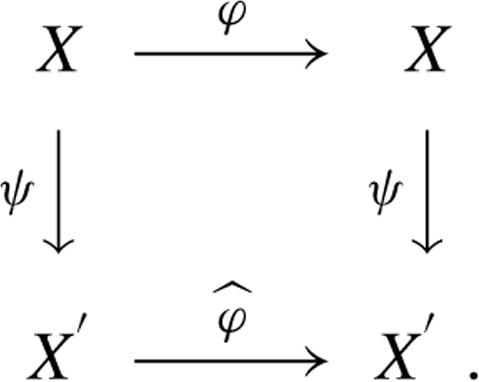
Let (X, *), (Y, ⊛) be groupoids and let ψ : (X, *) → (Y, ⊛) be a groupoid epimorphism. Assume that following diagram commutes:
i.e., . We say can be lifted to φ via ψ and φ can be lowered to via ψ.
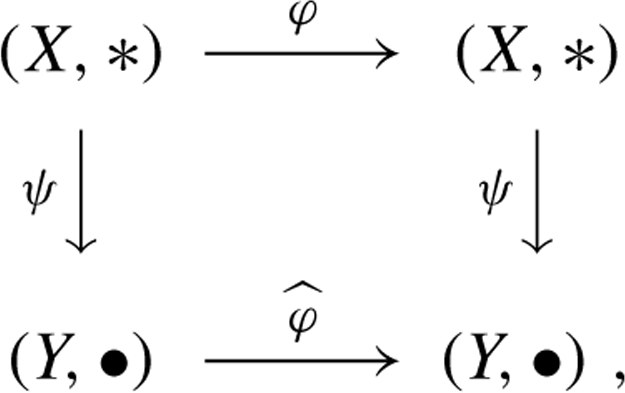
Proposition 8.1.Let (X, *), (Y, •) be groupoids such that the following diagram commutes:
where ψ is a groupoid epimorphism and are groupoid homomorphisms. Assume that ν : (Y, •) → [0, 1] is an almost -fuzzy semi-ideal of (Y, •). If we define μ : = ν ∘ ψ, then μ is an almost φ-fuzzy semi-ideal of (X, *).
Proof. Since ν is an almost -fuzzy semi-ideal of Y, we have
for any x, y ∈ X. Now, for any y ∈ X, we obtain • (ψ ∘ φ) (y)) = ν (ψ (y) • ψ (φ (y))) = ν (ψ (y * φ (y)))= μ (y * φ (y)). Similarly, we get . Therefore μ (x * φ (x)) ≥ min {μ ((x * y) * φ (x * y)) , μ (y * φ(y))} for any x, y ∈ X. Thus μ is an almost φ-fuzzy semi-ideal of (X, *).□
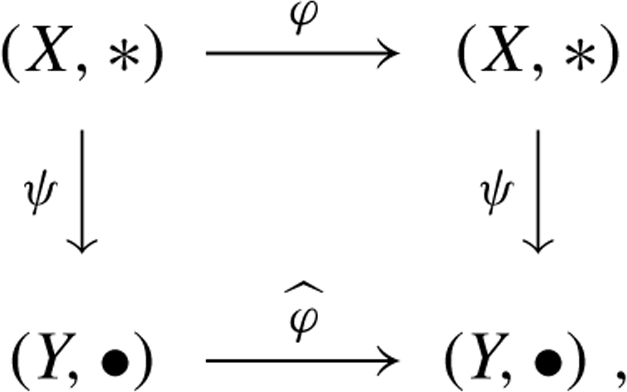
Proposition 8.2.Let (X, *), (Y, •) be groupoids such that the following diagram commutes:
where ψ is a groupoid epimorphism and are groupoid homomorphisms. Assume that μ is an almost φ-fuzzy semi-ideal of (X, *) and ν : (Y, •) → [0, 1] is a map such that ν ∘ ψ = μ. Then ν is an almost -fuzzy semi-ideal of (Y, •).
Proof. Let y1, y2 ∈ Y. Since ψ is an epimorphism, there exist x1, x2 ∈ X such that ψ (xi) = yi for i = 1, 2. Hence
Similarly, we obtain and . Since μ is an almost φ-fuzzy semi-ideal of (X, *), we obtain
Hence ν is an almost -fuzzy semi-ideal of(Y, •).□
Footnotes
Acknowledgement
The authors are very grateful for referee/editor’s valuable suggestions and help.
References
1.
S.S.Ahn, Y.H.Kim and J.Neggers, Fuzzy upper bounds in groupoids, The Scienctific World Journal2014 (2014), 6. Article ID 697012.
2.
P.J.Allen, H.S.Kim and J.Neggers, Several types of groupoids induced by two-variable functions, Springer Plus5 (2016), 1715–1725.
3.
M.Farshi, B.Davvaz and S.Mirvakili, On the g-Hypergroupoids associated with g-hypergraphs, Filomat31 (2017), 4819–4831.
4.
J.S.Han, H.S.Kim and J.Neggers, The hypergroupoid semigroups as generalizations of the groupoid semigroups, Journal of Applied Math2012 (2012), 8. Article ID 717698.
5.
J.S.Han, H.S.Kim and J.Neggers, On Fibonacci functions with Fibonacci numbers, Advances in Difference Equations2012 (2012), 26–32.