In order to avoid combinatorial rule explosion in fuzzy reasoning, distributive laws related to fuzzy implications and aggregation functions have been widely studied in recent years. In 2017, Qiao and Hu investigated the distributivity equation I (x, O1 (y, z)) = O2 (I (x, y), I (x, z)), when O1 and O2 are additively generated overlap functions and I is an unknown function. In this paper, this kind of distributivity equation continues to be studied at the situation that both O1 and O2 are multiplicatively generated overlap functions and I is a continuous function. Unfortunately, there is no continuous solution for this distributivity equation that is fuzzy implication, but a characterization for the case that I is continuous except for the point (0, 0) is given. More importantly, some solutions to the system of functional equations consisting of I (x, O1 (y, z)) = O2 (I (x, y), I (x, z)) and I (x, y) = I (N (y), N (x)) are characterized. Finally, considered any other overlap functions, sufficient and necessary conditions, under which the previous distributivity equation holds when O1 is an idempotent overlap function, O2 is an Archimedean overlap function and I is an unknown function, are given. Meanwhile, some solutions to the system of functional equations are also presented.
Probability theory, evidence theory, fuzzy set theory and rough set theory are most important mathematical tools for dealing with vague, imprecise, inconsistent and uncertain knowledge. In recent years, researches and applications on fuzzy set theory and rough set theory have attracted more and more researchers’ attention. And they are also hot issues in the artificial intelligence field [36–38].
In 2009, Bustince et al. introduced the concept of overlap functions in [10] for the purpose of dealing with the frequent overlapping problem of classification in image processing, and the main use of overlap functions is to measure the overlapping degree between the two functions standing for the object and background, respectively. Later, it was Elkano et al. who applied overlap functions into classification. In 2015, they adapted the inference system of Fuzzy Association Rule-based Classification model for High-Dimensional problems by replacing the product t-norm with n-dimensional overlap functions [20]. In 2016, they studied the influence of the usage of n-dimensional overlap functions to model the conjunction in several Fuzzy Rule-Based Classification Systems in order to enhance their performance in multi-class classification problems applying decomposition techniques [19]. At the same time, overlap functions were also applied to many other fields, such as fuzzy preference modeling and decision making [12, 21].
Not only in application but also in theory have overlap functions developed quickly. In 2013, some important properties of overlap functions were discussed by Bedregal et al. in [9]. Then Dimuro and Bedregal studied Archimedean overlap functions and idempotent overlap functions, and gave the ordinal sum of overlap functions in [16]. In 2015, the concept of residual implication derived from overlap function was proposed by Dimuro and Bedregal in [14] and the laws of contraposition for these residual implications were analyzed in [15]. In 2016, Dimuro et al. introduced overlap functions with additive generator pairs in [17]. Two years later, Qiao and Hu proposed overlap and grouping functions with multiplicative generator pairs in [25]. Some other studies related to overlap functions can be found also in [11, 31].
The investigations of distributive laws of fuzzy implications over different fuzzy logic connectives have attracted the attention of many authors. In order to achieve the desired accuracy better in fuzzy approximation, a large rule base is commonly needed. And, in many cases, the problem of rule explosion hinders the further application and development of fuzzy system. Thus, there arise many works to construct fuzzy systems having specified performance by using as less as possible fuzzy rules. For instance, to avoid the problem of combinatorial rule explosion, Combs and Andrews required of the classical tautology (p ∧ q) → r ≡ (p → r) ∨ (q → r) in their inference mechanism towards reduction in the complexity of fuzzy “If-then” rule in [13]. After that, from the point of fuzzy logic, Trillas and Alsina firstly introduced the following generalized version of the above law in [32]: I (T (x, y), z) = S (I (x, z), I (y, z)), where T is a t-norm, S is a t-conorm and I is a fuzzy implication, and got all solutions of T when I is R-implication, or S-implication, or QL-implication. Along the line, the other three functional equations were also discussed by Balasubramaniam and Rao in [8]. On the other hand, Türksen et al. in [33] gave the necessary conditions for a fuzzy implication I satisfying the equation
when T is the product t-norm. And then, Baczyński investigated Equation (1) while T is a strict t-norm in [1] and presented the sufficient and necessary conditions of functional equations composed of Eq.(1) and the equation I (x, I (y, z)) = I (T (x, y), z). Subsequently, he gave a further study in [4] of the system of functional equations consisting of Eq.(1) and the following equation
Eq.(2), called contrapositive symmetry equation of implication, was introduced by Fodor in [6] to construct a new family of t-norms, and it has important application in fuzzy preference modeling and expert systems with incomplete information [4, 33]. However, the full characterization of the system of Equations (1) and (2) for strict t-norm was given by Yang and Qin in [35]. And then later, the distributive laws of fuzzy implications over nilpotent or strict or t-conorms were studied in [2, 34]. Finally, Qin and Baczyński generalized Eq.(1) into the following equation
and presented the sufficient and necessary conditions of solutions for Eq.(3) and the system of functional equations composed of Eq.(2) and Eq.(3), when T1 is a continuous t-norm, T2 is a continuous Archimedean t-norm, I is an unknown function and N is a strong negation, all these related results have been summarized in [5].
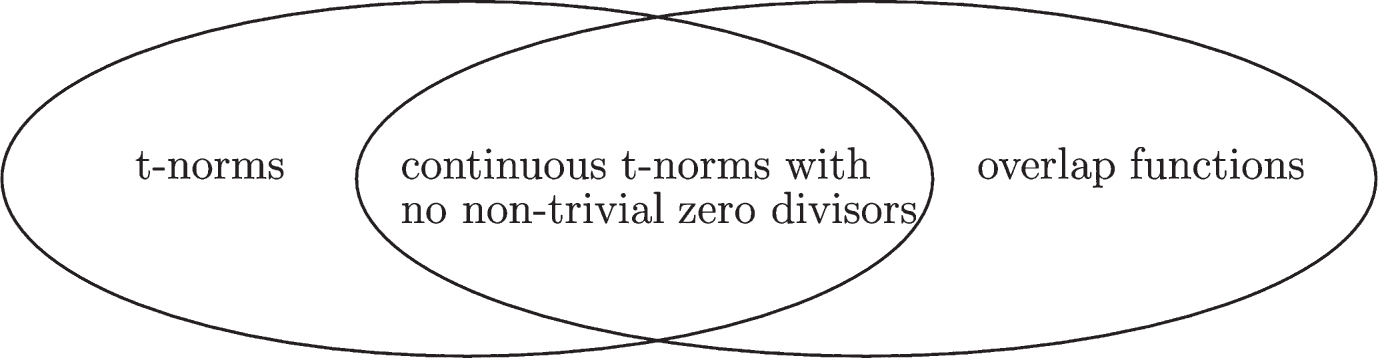
The relation between t-norms and overlap function.
Overlap function, as a relatively new non-associative fuzzy logic connective, has close relationship with t-norm, as shown in Fig. 1. So it is natural to consider the distributivity of fuzzy implication functions over overlap functions. The pioneer work in this framework was started by Qiao and Hu, who introduced the distributive equation in [27] as follows:
where O1 and O2 are overlap functions, I is one of the residual implications derived from overlap functions, or (G, N)-implications for grouping functions and fuzzy negations, or QL-operations for overlap functions, grouping functions and fuzzy negations. Recently, Qiao and Hu gave the characterization of Eq.(4) when O1 and O2 are additively generated by strict additive generator pairs and I is an unknown function in [28]. The purpose of this paper is to explore and give solutions to the system of functional equations consisting of Eq.(2) and Eq.(4) when O1 and O2 have multiplicative generator pairs and I is a continuous binary function. What’s more, another possibility is considered and some solutions to the system consisting of Eq.(2) and Eq.(4) are also presented at the situation that O1 is an idempotent overlap function and O2 is an Archimedean overlap function.
This paper is organized as follows: Section 2 presents a specific formalization of the main concepts used throughout the paper, such as multiplicatively generated overlap functions, idempotent overlap functions, Archimedean overlap functions, fuzzy implications, fuzzy negations and so on. Section 3 gives characterizations of solutions to Eq.(4) when O1 and O2 are multiplicatively generated overlap functions and I is a continuous function, and shows that no continuous fuzzy implications satisfy Eq.(4). But sufficient and necessary conditions are given when fuzzy implication I is continuous except for the point (0, 0). Subsequently, section 4 characterizes solutions to the functional equations composed of Eq.(2) and Eq.(4) at the situation that I is a fuzzy implication and is continuous expect at the points (0, 0) and (1, 1), N is a strong fuzzy negation. Section 5 considers some other possibilities and gives sufficient and necessary conditions of solutions to Eq.(4) when O1 is an idempotent overlap function, O2 is an Archimedean overlap function, I is an unknown function, and discusses some solutions to the system of Eq.(2) and Eq.(4).
Preliminaries
This section recollects some main concepts and results used throughout the subsequent sections. For a further reading about such concepts, we recommend [4, 25].
Definition 2.1. ([16]) A binary function O: [0, 1] 2 ⟶ [0, 1] is said to be an overlap function if it satisfies the following conditions:
(O1) O is commutative;
(O2) O (x, y) = 0 if and only if xy = 0;
(O3) O (x, y) = 1 if and only if xy = 1;
(O4) O is increasing;
(O5) O is continuous.
Definition 2.2. ([16]) Let O be an overlap function, an element a ∈ [0, 1] is called an idempotent element of O if O (a, a) = a. If each a ∈ [0, 1] is an idempotent element of O, then O is said to be idempotent. The numbers 0 and 1 are called trivial idempotent elements of O, each idempotent element in (0, 1) will be called a non-trivial idempotent element of O. And the set of idempotent elements of O is denoted by Idem (O).
The power of the overlap function O is defined as: with .
Definition 2.3. ([16]) An overlap function is said to be Archimedean if for each (x, y) ∈ (0, 1) 2 there is an such that .
Proposition 2.4. ([16]) Let O be an Archimedean overlap function. Then O has only trivial idempotent elements.
Example 2.5. ([16])
(1) Any positive continuous t-norm is an overlap function.
(2) The overlap function Op: [0, 1] 2 ⟶ [0, 1] with p > 0 and p ≠ 1, given by Op (x, y) = xpyp, is neither associative nor with 1 as its neutral element. Specially, when , is an idempotent overlap function; when p > 1, Op is an Archimedean overlap function.
Definition 2.6. ([25]) Let g, h: [0, 1] ⟶ [0, 1] be two continuous and increasing functions. If the binary function Og,h: [0, 1] 2 ⟶ [0, 1] given by
is an overlap function, then (g, h) is called a multiplicative generator pair of Og,h and Og,h is said to be multiplicatively generated by the pair (g, h).
Theorem 2.7.
([25]) Let g, h: [0, 1] ⟶ [0, 1] be two continuous and increasing functions such that
(a) h (x) = 0 if and only if x = 0;
(b) h (x) = 1 if and only if x = 1;
(c) g (x) = 0 if and only if x = 0;
(d) g (x) = 1 if and only if x = 1.
Then (g, h) multiplicatively generates an overlap function.
Proposition 2.8. ([25]) Let g, h: [0, 1] ⟶ [0, 1] be two continuous and increasing functions such that
g (x) = 0 if and only if x = 0;
g (x) = 1 if and only if x = 1;
Og,h (x, y) = g (h (x) h (y)) is an overlap function.
Then the following statements hold:
h (x) = 0 if and only if x = 0;
h (x) = 1 if and only if x = 1.
Proposition 2.9. ([25]) ıLet O be an overlap function multiplicatively generated by the pair (g, h). Then the following statements hold:
(1) h (x) = 0 if and only if x = 0;
(2) g (x) = 0 if and only if x = 0.
Example 2.10. ([25]) (1) Consider Op (p > 0, p ≠ 1), its multiplicative generator pair (g, h) can be given by g (x) = x and h (x) = xp.
(2) The overlap function , x, y ∈ [0, 1] can be multiplicatively generated by the pair (g, h), where and h (x) = x.
Definition 2.11. ([6]) A function I: [0, 1] 2 ⟶ [0, 1] is called a fuzzy implication, if it fulfills the following conditions:
(I1) I is decreasing with respect to the first variable;
(I2) I is increasing with respect to the second one;
(I3) I (0, 0) = I (1, 1) = 1, I (1, 0) = 0.
Remark 2.12. ([6]) Clearly, fuzzy implication I satisfies the following property:
(RB) I (x, 1) = 1 for all x ∈ [0, 1](right boundary condition).
Definition 2.13. ([6]) A function N: [0, 1] ⟶ [0, 1] is a fuzzy negation if the following properties are satisfied: for all x, y ∈ [0, 1],
(1) If x ≤ y then N (y) ≤ N (x);
(2) N (0) = 1 and N (1) = 0.
Moreover, a fuzzy negation N is strong if it also satisfies the involution property, i. e. N (N (x)) = x for each x ∈ [0, 1].
Theorem 2.14. ([24]) A function is a continuous solution of the multiplicative Cauchy functional equation
if and only if either f = 0, or f = 1, or there exists a constant such that
where D is one of sets (0, 1), [0, 1), (0, 1]. If 0 ∈ D, then c > 0.
Continuous solutions to Eq.(4) when O1 and O2 are multiplicatively generated overlap functions
In this section, Eq.(4) is investigated and its continuous solutions are presented for multiplicatively generated overlap functions. To start with, we show some properties of multiplicative generator pair of overlap function.
Lemma 3.1.Let (g, h) be a multiplicative generator pair of the overlap function Og,h. Then g (1) = 1.
Proposition 3.2.Let g, h: [0, 1] ⟶ [0, 1] be two continuous and increasing functions. If g is strict, then the following statements are equivalent:
(1) (g, h) is a multiplicative generator pair of the overlap function Og,h;
(2) g and h satisfy the following conditions:
(a) g (x) = 0 if and only if x = 0;
(b) g (x) = 1 if and only if x = 1;
(c) h (x) = 0 if and only if x = 0;
(d) h (x) = 1 if and only if x = 1.
Theorem 3.3. Let O1, O2 be two overlap functions generated, respectively, by the multiplicative generator pairs (g1, h1) and (g2, h2) with g1, h1, g2, h2 being strictly increasing and I: [0, 1] 2 ⟶ [0, 1] be a continuous binary function satisfying (RB). Then the following statements are equivalent:
(1) the triple of functions (O1, O2, I) satisfies Eq.(4) for all x, y, z ∈ [0, 1].
(2) I = 1 or there exists a continuous function c: [0, 1] ⟶ (0, ∞) such that for all x, y ∈ [0, 1],
Proof. (1)⇒(2) Let the triple of functions (O1, O2, I) satisfy Eq.(4). Since O1, O2 are generated, respectively, by the multiplicative generator pairs (g1, h1) and (g2, h2), so Eq.(4) has the following form:
For any fixed x ∈ [0, 1], define Ix: [0, 1] ⟶ [0, 1] by Ix (y) = I (x, y), y ∈ [0, 1]. Moreover, take and , then both fx and kx are unary function on [0, 1]. Let u = h1 (y) and v = h1 (z), Eq.(4) can be rewritten as follows:
By a simple calculation, it shows that fx (1) = kx (1) = 1. Let u = 1, then it holds that fx (v) = kx (1) kx (v) = kx (v) for all v ∈ [0, 1]. That is to say, Eq.(7) can be seen as
Thus, from Theorem 2.14, it leads to three possibilities:
or
or there exists a constant cx ∈ (0, ∞) such that
Combined with the continuity of I and fx (1) = kx (1) = 1, it can be concluded that fx = kx = 1, or there exists a constant cx ∈ (0, ∞) such that
Thus, by definitions of fx and kx, it shows that
or there exists a constant cx ∈ (0, ∞) such that for all y ∈ [0, 1],
Let us assume that there exists x0 ∈ [0, 1] such that I (x0, y) = 1 for all y ∈ [0, 1]. Particularly, I (x0, 0) = 1. But for another possible vertical section, the I (x, 0) = 0 always holds. Since I is continuous, so the only possible solution in this case is I = 1. So the first solution is obtained. Finally, assume that the vertical sections Ix is Eq.(13) for all x ∈ [0, 1]. Define function c: [0, 1] ⟶ (0, ∞) by c (x) = cx, Eq.(13) means that for all x, y ∈ [0, 1],
The function c is continuous since for any fixed y ∈ (0, 1), it is the composition of continuous functions.
(2)⇒(1) If I = 1 for all x, y ∈ [0, 1], it is obvious that the triple of functions (O1, O2, I) satisfies Eq.(4) for all x, y, z ∈ [0, 1].
If I is the form (6), then for any x, y, z ∈ [0, 1], Eq.(4) can be verified as follows:
□
Example 3.4. Consider in Eq.(4) and take its multiplicative generator pair (g, h) as and h (x) = x. If c (x) = 1 + x, x ∈ [0, 1], then the solution for Eq.(4) is as follows:
Lemma 3.5.Let I be a binary function on [0, 1], and O1, O2 be two overlap functions, x ∈ [0, 1]. If the vertical section I (x, ·) has one of the following forms:
then the triple of functions (O1, O2, I (x, ·)) satisfies Eq.(4) for all y, z ∈ [0, 1].
Since Eq.(4) is the generalization of a tautology from the classical logic involving Boolean implication, it is reasonable to expect that the solution I of Eq.(4) is also a fuzzy implication.
Corollary 3.6.If O1, O2 are two overlap functions generated, respectively, by the multiplicative generator pairs (g1, h1) and (g2, h2) with g1, h1, g2, h2 being strictly increasing, then there is no continuous solution I of Eq.(4) that is fuzzy implication.
Proof. Suppose that fuzzy implication I is a continuous solution of Eq.(4). Since the triple of functions (O1, O2, I) satisfies Eq.(4), by Theorem 3.3, I must be I = 1 or Eq.(6). Obviously, I = 1 doesn’t satisfy (I3). If I is Eq.(6), then I (0, 0) = 0, it is an obvious contradiction with (I3). Thus, there is no continuous solution I of Eq.(4) that is fuzzy implication.□
For Eq.(6), the conditions of (I1) and (I2) can be reached easily. However, from Corollary 3.6, it shows that Eq.(6) fails to be a fuzzy implication only because I (0, 0) = 1 doesn’t hold. So it is reasonable to explore solutions that I is not continuous at point (0, 0).
Lemma 3.7.Let O1, O2 be two overlap functions and I: [0, 1] 2 ⟶ [0, 1] be a binary function satisfying (I3). If the triple of functions (O1, O2, I) satisfies Eq.(4), then I (0, y) = 1 for all y ∈ [0, 1].
Proof. Let the triple of functions (O1, O2, I) satisfy Eq.(4). Substitute x = 0 and z = 0 in Eq.(4), it follows that I (0, O1 (y, 0)) = O2 ((I (0, y), I (0, 0)) for all y ∈ [0, 1]. That is I (0, 0) = O2 ((I (0, y), 1). By (I3), it holds that O2 ((I (0, y), 1)=1. Since O2 satisfies (O3), so I (0, y) = 1 holds for all y ∈ [0, 1].□
Theorem 3.8. Let O1, O2 be two overlap functions generated, respectively, by the multiplicative generator pairs (g1, h1) and (g2, h2) with g1, h1, g2, h2 being strictly increasing and I: [0, 1] 2 ⟶ [0, 1] be continuous expect at the point (0, 0) which satisfies (RB) and (I3). Then the following statements are equivalent:
(1) the triple of functions (O1, O2, I) satisfies Eq.(4) for all x, y, z ∈ [0, 1].
(2) there exists a continuous function c: [0, 1] ⟶ [0, ∞) with c (x) >0 for x ∈ (0, 1] and c (0) = 0 such that I has the form
for all x, y ∈ [0, 1].
(1)⇒(2) Let the triple of functions (O1, O2, I) satisfy Eq.(4) for all x, y, z ∈ [0, 1]. Since I is continuous on (0, 1] × [0, 1], similar to the proof of Theorem 3.3, it shows that either I = 1 or there exists a continuous function c′: (0, 1] ⟶ (0, ∞) such that I has the form
for all (x, y) ∈ (0, 1] × [0, 1]. Obviously, the solution I = 1 doesn’t satisfy I (1, 0) = 0, so the only possible solution is the latter. And by Lemma 3.7, I (0, y) = 1 holds for all y ∈ [0, 1]. Fix arbitrarily y ∈ (0, 1), from the continuity of I, it holds that Moreover, h1, h2 are bijections, so it follows that Since h1 (y) ∈ (0, 1), so Define function c: [0, 1] ⟶ [0, ∞) by
Obviously, the function c is continuous and I has the form (14).
(2)⇒(1) It can be proved easily.□
The previous proof shows that the function given by Eq.(14) with a continuous function c satisfies condition (I3) and is increasing with respect to the second variable. Unfortunately, nothing can be said about its monotonicity with respect to the first one. The next result solves this by showing the necessary and sufficient condition.
Theorem 3.9.Let O1, O2 be two overlap functions generated, respectively, by the multiplicative generator pairs (g1, h1) and (g2, h2) with g1, h1, g2, h2 being strictly increasing and I be a fuzzy implication that is continuous expect at the point (0, 0). Then the following statements are equivalent:
(1) the triple of functions (O1, O2, I) satisfies Eq.(4) for all x, y, z ∈ [0, 1].
(2) there exists a continuous and increasing function c: [0, 1] ⟶ [0, ∞) with c (x) >0 for x ∈ (0, 1] and c (0) = 0 such that I has the form
for all x, y ∈ [0, 1].
Solutions to Eq.(2) and Eq.(4) when O1 and O2 are multiplicative generated overlap functions
In this section, solutions to the system of functional equations composed of Eq.(2) and Eq.(4) are discussed. At this situation, if I is discontinuous at the point (0, 0), then I must be discontinuous at point (1, 1). Therefore, the discussion about the solutions to Eq.(4) under the assumption that I is not continuous at the points (0, 0) and (1, 1) is necessary.
Proposition 4.1.Let O1, O2 be two overlap functions generated, respectively, by the multiplicative generator pairs (g1, h1) and (g2, h2) with g1, h1, g2, h2 being strictly increasing and I: [0, 1] 2 ⟶ [0, 1] be continuous expect at the points (0, 0) and (1, 1) which satisfies (RB) and (I3). Then the following statements are equivalent:
(1) the triple of functions (O1, O2, I) satisfies Eq.(4) for all x, y, z ∈ [0, 1].
(2) there exists a continuous function c: [0, 1] ⟶ [0, ∞] with 0< c (x) < ∞ for x ∈ (0, 1) and c (0) = 0, c (1) = ∞ such that I has the form
for all x, y ∈ [0, 1].
Proof. (1)⇒(2) Let us assume that I is the solution of Eq.(4) satisfying the required properties. Since I is continuous on (0, 1) × [0, 1], again from the proof of Theorem 3.8, there exists a continuous function c′: [0, 1) ⟶ [0, ∞) with c′ (x) >0 for x ∈ (0, 1) and c′ (0) = 0 such that
for all (x, y) ∈ [0, 1) × [0, 1]. For x = 1, using argumentation for the function I1 (y) = I (1, y), y ∈ [0, 1), and similar to the proof of Theorem 3.3, it can be obtained that
Finally, fix arbitrarily y ∈ (0, 1), since , so it holds that
Define function c: [0, 1] ⟶ [0, ∞] by
Obviously, the function c is continuous and I has the form (15).
(2)⇒(1) It is clear from Theorem 3.3, Lemma 3.5 and Lemma 3.7.□
As a direct consequence of Proposition 4.1, the following result about fuzzy implication is given.
Corollary 4.2. Let O1, O2 be two overlap functions generated, respectively, by the multiplicative generator pairs (g1, h1) and (g2, h2) with g1, h1, g2, h2 being strictly increasing and I be a fuzzy implication that is continuous expect at the points (0, 0) and (1, 1). Then the following statements are equivalent: (1) the triple of functions (O1, O2, I) satisfies Eq.(4) for all x, y, z ∈ [0, 1]. (2) there exists a continuous and increasing function c: [0, 1] ⟶ [0, ∞] with 0< c (x) < ∞ for x ∈ (0, 1) and c (0) = 0, c (1) = ∞ such that I has the form
for all x, y ∈ [0, 1].
Now, the solutions to the system consisting of Eq.(2) and Eq.(4) are given as follows:
Theorem 4.3. Let O1, O2 be two overlap functions generated, respectively, by the multiplicative generator pairs (g1, h1) and (g2, h2) with g1, h1, g2, h2 being strictly increasing, I: [0, 1] 2 ⟶ [0, 1] be continuous expect at the points (0, 0) and (1, 1) which satisfies (RB) and (I3), and N be strong fuzzy negation. Then the following statements are equivalent:
(1) the quaternion of functions (O1, O2, I, N) satisfies Eq.(2) and Eq.(4) for all x, y, z ∈ [0, 1].
(2) there exist constants r1, r2 ∈ (- ∞, 0) such that
and I has the form
for all x, y ∈ [0, 1].
Proof. (1)⇒(2) Let I be the solution of Eq.(4) satisfying the required properties. Then by Proposition 4.1, I is the form (15). Since I and N satisfy Eq.(2), it can be obtained that for any (x, y) ∈ (0, 1)2,
where c: (0, 1) ⟶ (0, ∞) is a continuous function. So it holds that (h1 (y)) c(x) = (h1 (N (x))) c(N(y)). Take natural logarithms of both sides, i.e.c (x) ln(h1 (y)) = c (N (y)) ln(h1 (N (x))).
This implies that for all (x, y) ∈ (0, 1) 2, Obviously, two sides of this equation are both unary function and independent with each other. Since c (x), ln(h1 (N (x))), c (N (y)), ln(h1 (y)) ∉ {0, - ∞ + ∞}, so exists a constant r1 ∈ (- ∞, 0) such that c (x) = r1 ln(h1 (N (x))), x ∈ (0, 1). By the similar way, it can be obtained that there exists a constant r2 ∈ (- ∞, 0) such that So it must hold that
Since N is strong, so it means that for all x ∈ (0, 1). Moreover, x = 0 and x = 1 naturally hold, so Eq.(17) is obtained. Furthermore, by the assumption that c (0) = 0, c (1) = ∞, I is the form (18).
(2)⇒(1) Obviously, (O1, O2, I) satisfies Eq.(4). Since N is strong, so we prove the left part through the following cases:
If x, y ∈ (0, 1), then this law follows from our construction.
If x = 1 and y ∈ (0, 1), then
If x = 0 and y ∈ (0, 1], then
If x = 1 and y = 0, thenI (N (0), N (1)) = I (1, 0) = 0.
If x = 1 and y = 1, then
I (N (1), N (1)) = I (0, 0) = 1.
Consequently, I satisfies Eq.(2).□
In fact, by a simple analysis, it can seen that Eq.(18) is actually a fuzzy implication, that is the following result:
Corollary 4.4. Let O1, O2 be two overlap functions generated, respectively, by the multiplicative generator pairs (g1, h1) and (g2, h2) with g1, h1, g2, h2 being strictly increasing, I be a fuzzy implication which is continuous expect at the points (0, 0) and (1, 1), and N be strong fuzzy negation. Then the following statements are equivalent:
(1) the quaternion of functions (O1, O2, I, N) satisfies Eq.(2) and Eq.(4) for all x, y, z ∈ [0, 1].
(2) there exist two constants r1, r2 ∈ (- ∞, 0) such that , x ∈ [0, 1], and I has the form
for all x, y ∈ [0, 1].
Solutions to Eq.(2) and Eq.(4) when O1 is idempotent and O2 is Archimedean
Not every overlap function can be multiplicatively generated, such as TM and , x, y ∈ [0, 1]. So it is natural to consider whether there exist any other cases that also have solutions for Eq.(2) and Eq.(4). As we all know, either idempotent overlap functions or Archimedean overlap functions have many effective properties, which may be helpful for us to solve some problems. Fortunately, solutions to Eq.(2) and Eq.(4) can be given under the condition that O1 is an idempotent overlap function and O2 is an Archimedean overlap function. Firstly, a full characterization for Eq.(4) under this assumption should be given. In this paper, sup ∅ = 0 and inf ∅ = 1 are stipulated.
Lemma 5.1.Let O1 be an overlap function, O2 be an Archimedean overlap function and I be a binary function on [0, 1]. If the triple of functions (O1, O2, I) satisfies Eq.(4) for all x, y, z ∈ [0, 1], then either I (x, y) = 0 or I (x, y) = 1 holds for every x ∈ [0, 1] and every y ∈ Idem (O1).
Proof. For every x ∈ [0, 1] and y ∈ Idem (O1), by virtue of the assumption that the triple of functions (O1, O2, I) satisfies Eq.(4), it shows that I (x, y) = I (x, O1 (y, y)) = O2 (I (x, y), I (x, y)). That is to say, I (x, y) is an idempotent element of O2. Since O2 is an Archimedean overlap function, so by Proposition 2.4, it shows that I (x, y) = 0 or I (x, y) = 1.□
Lemma 5.2.Let O1, O2 be overlap functions, I: [0, 1] 2 ⟶ [0, 1] be a binary function and y0 be a fixed idempotent element of O1. If I (x, y0) = 0 for some x ∈ [0, 1] and the triple of functions (O1, O2, I (x, ·)) satisfies Eq.(4) for all y, z ∈ [0, 1], then it follows I (x, t) = 0 for all t ≤ y0.
Proof. Let I (x, y0) = 0 and t ≤ y0. Because O1 (·, y0) is continuous on [0, y0], and O1 (0, y0) = 0, O1 (y0, y0) = y0, so there exists u ∈ [0, y0] such that t = O1 (u, y0). Since (O1, O2, I (x, ·)) satisfies Eq.(4), it holds that I (x, t) = I (x, O1 (u, y0)) = O2 (I (x, u), I (x, y0)) = O2 (I (x, u), 0) = 0.
Lemma 5.3.Let O1 be an overlap function, O2 be an Archimedean overlap function, I be a binary function on [0, 1] and y0 be a fixed idempotent element of O1. If I (x, y0) = 1 for some x ∈ [0, 1] and the triple of functions (O1, O2, I (x, ·)) satisfies Eq.(4) for all y, z ∈ [0, 1], then it follows that I (x, t) = 1 for every t ∈ (↑ y0) ⋂ Idem (O1).
Proof. For any t ∈ (↑ y0) ⋂ Idem (O1), then t is an idempotent element of O1, by Lemma 5.1, it shows that I (x, t) = 0 or I (x, t) = 1. Suppose that I (x, t) = 0. Because of t ≥ y0, then by Lemma 5.2, it can be concluded that I (x, y0) = 0, which is a contradiction. Consequently, I (x, t) = 1.
Proposition 5.4.Let O1, O2 be overlap functions, I: [0, 1] 2 ⟶ [0, 1] be a binary function, y1, y2 be two different idempotent elements of O1 and assume that the triple of functions (O1, O2, I) satisfies Eq.(4) for all x, y, z ∈ [0, 1]. If both I (x, y1) = 0 and I (x, y2) = 1 hold for some x ∈ [0, 1], then y1 < y2.
Proof. Let I (x, y1) = 0 and I (x, y2) = 1 hold for some x ∈ [0, 1]. Suppose that y1 > y2, then by Lemma 5.2, I (x, y2) = 0 holds, which is a contradiction.□
Theorem 5.5. Let O1 be an idempotent overlap function, O2 be an Archimedean overlap function and I be a binary function on [0, 1]. Then the following statements are equivalent:
(1) the triple of functions (O1, O2, I) satisfies Eq.(4) for all x, y, z ∈ [0, 1].
(2) For any x ∈ [0, 1], the vertical section I (x, ·) belongs to one of the following statements:
(a) There exists a constant cx ∈ [0, 1] with O1 (cx, 1) = cx such that for all y ∈ [0, 1],
(b) There exists a constant cx ∈ [0, 1] satisfying the condition that y < cx if and only if O1 (y, 1) < cx, such that for all y ∈ [0, 1],
Proof. (1)⇒(2) Let the triple of functions (O1, O2, I) satisfy Eq.(4). For x ∈ [0, 1], since O1 is idempotent, so by Lemma 5.1, it follows that I (x, y) = 0 or I (x, y) = 1 for all y ∈ [0, 1]. Definecx = ⋁ {y ∈ [0, 1] ∣ I (x, y) = 0}dx = ⋀ {y ∈ [0, 1] ∣ I (x, y) = 1}.
Clearly, cx = dx.
(a) If I (x, cx) = 0, then by Lemma 5.2, Lemma 5.3 and Proposition 5.4, it shows that
On the one hand, since the triple (O1, O2, I (x, ·)) satisfies Eq.(4), so it follows that I (x, O1 (cx, 1)) = O2 (I (x, cx), I (x, 1)) = O2 (0, I (x, 1)) = 0. Furthermore, O1 (cx, 1) ≤ cx holds. On the other hand, by virtue of the monotonicity and idempotency of O1, it can be obtained that O1 (cx, 1) ≥ O1 (cx, cx) = cx. Consequently, O1 (cx, 1) = cx.
(b) If I (x, cx) = 1, similarly, it holds that
Now we show that y < cx if and only if O1 (y, 1) < cx. On the one hand, when y < cx holds, by Eq.(4), it follows that I (x, O1 (y, 1)) = O2 (I (x, y), I (x, 1)) = O2 (0, I (x, 1)) = 0. Obviously, O1 (y, 1) < cx. On the other hand, assume that O1 (y, 1) < cx, let us now prove that y < cx. Assume to the contrary, then by the monotonicity and idempotency of O1, it holds that O1 (y, 1) ≥ O1 (cx, 1) ≥ O1 (cx, cx) = cx, which is a contradiction. Consequently, y < cx if and only if O1 (y, 1) < cx.
(2)⇒(1) For each fixed x ∈ [0, 1]. Two cases are considered.
If I (x, ·) belongs to the case (a). Fix arbitrarily y, z ∈ [0, 1]. If max (y, z) ≤ cx, then by the monotonicity of O1, it shows that O1 (y, z) ≤ O1 (max (y, z), max (y, z)) = max (y, z) ≤ cx. So the left side of Eq.(4) is I (x, O1 (y, z)) = 0 and the right side of Eq.(4) is O2 (I (x, y), I (x, z)) = O2 (0, 0) = 0. If min (y, z) ≤ cx < max (y, z), similarly, it can be obtained that O1 (y, z) ≤ O1 (cx, 1) = cx. Thus, the left side of Eq.(4) is I (x, O1 (y, z)) = 0 and the right side of Eq.(4) is O2 (I (x, y), I (x, z)) = O2 (I (x, min (y, z)), I (x, max (y, z))) = O2 (0, 1) = 0. If cx < min (y, z), it shows that O1 (y, z) ≥ O1 (min (y, z), min (y, z)) = min (y, z) > cx. So the left side of Eq.(4) is I (x, O1 (y, z)) = 1 and the right side of Eq.(4) is O2 (I (x, y), I (x, z)) = O2 (1, 1) = 1.
If I (x, ·) belongs to the case (b). Fix arbitrarily y, z ∈ [0, 1]. If max (y, z) < cx, then O1 (y, z) < cx. So the left side of Eq.(4) is I (x, O1 (y, z)) = 0 and the right side of Eq.(4) is O2 (I (x, y), I (x, z)) = O2 (0, 0) = 0. If min (y, z) < cx ≤ max (y, z), then it holds that O1 (y, z) ≤ O1 (min (y, z), 1) < cx. Thus, the left side of Eq.(4) is I (x, O1 (y, z)) = 0 and the right side of Eq.(4) is O2 (I (x, y), I (x, z)) = O2 (0, 1) = 0. If cx ≤ min (y, z), then it holds that O1 (y, z) ≥ min (y, z) ≥ cx. So the left side of Eq.(4) is I (x, O1 (y, z)) = 1 and the right side of Eq.(4) is O2 (I (x, y), I (x, z)) = O2 (1, 1) = 1.□
Corollary 5.6.Let O1 be the idempotent t-norm TM, O2 be an Archimedean overlap function and I be a binary function on [0, 1]. Then the following statements are equivalent:
(1) the triple of functions (TM, O2, I) satisfies Eq.(4) for all x, y, z ∈ [0, 1].
(2) For any x ∈ [0, 1], there exists a constant cx ∈ [0, 1] such that the vertical section I (x, ·) has one of the following forms:
Remark 5.7. 2 If the set of all continuous Archimedean t-norms and the set of all Archimedean overlap functions are denoted by AT and AO, respectively, then it can be obtained that AT ⊈ AO, AO ⊈ AT and AO⋂ AT ≠ ∅. For instance, Op (p > 1) ∈ AO, but Op ∉ AT; the Łukasiewicz t-norm TLK ∈ AT, but TLK ∉ AO; the product t-norm TP ∈ AO ⋂ AT. According to Corollary 3.9 obtained by Qin and Baczyński [29], O2 should be a continuous Archimedean t-norm, while in Corollary 5.6, we take O2 as an Archimedean overlap function, so two results are essentially different. However, after a carefully comparison, we can find that the two equations have identical solutions.
Example 5.8. Consider , x, y ∈ [0, 1] and O2 = Op for p > 1 in Eq.(4), then solutions for Eq.(4) can be given: for any x ∈ [0, 1], the vertical section I (x, ·) has one of the following forms:
Corollary 5.9.If O1 is an idempotent overlap function, O2 is an Archimedean overlap function, then there is no continuous solution I of Eq.(4) that is fuzzy implication.
Proof. Assume that fuzzy implication I is a continuous solution of Eq.(4). For any x ∈ [0, 1], since the triple of functions (O1, O2, I (x, ·)) satisfies Eq.(4), by Theorem 5.5, it holds that I (x, ·) = 0 or I (x, ·) = 1. And the continuity of I also implies I = 0 or I = 1, which is a contradiction with (I3). Thus, there is no continuous solution I of Eq.(4) that is fuzzy implication.□
Theorem 5.10. Let O1 be an idempotent overlap function, O2 be an Archimedean overlap function, I be a fuzzy implication which is continuous expect at the point (1, 0) and N be strong fuzzy negation. Then the following statements are equivalent:
(1) the quaternion of functions (O1, O2, I, N) satisfies Eq.(2) and Eq.(4) for all x, y, z ∈ [0, 1].
(2) I is the greatest fuzzy implication.
Theorem 5.11.Let O1 be an idempotent overlap function, O2 be an Archimedean overlap function, I be a fuzzy implication which is continuous expect at the boundary x = 0, y = 1, and N be strong fuzzy negation. Then the following statements are equivalent:
(1) the quaternion of functions (O1, O2, I, N) satisfies Eq.(2) and Eq.(4) for all x, y, z ∈ [0, 1].
(2) I is the least fuzzy implication.
Conclusion
This work is a further study of the distributivity equation of fuzzy implication over overlap functions, it concentrates on giving solutions for the system composed of this kind of distributivity equation and contraposition symmetry equation. The main contributions of this paper are listed as follows:
(1) Characterizations of continuous binary function I which satisfies Eq.(4) for multiplicatively generated overlap functions are given. Although there is no continuous fuzzy implication fulfilling Eq.(4), sufficient and necessary conditions for fuzzy implication I satisfying Eq.(4) when I is continuous expect for the point (0, 0) are presented.
(2) Equivalent characterizations of the system consisting of Eq.(2) and Eq.(4) are given under the assumption that O1, O2 are multiplicatively generated overlap functions, I is a fuzzy implication which is continuous expect at the points (0, 0) and (1, 1), and N is a strong fuzzy negation.
(3) Eq.(4) under the assumption that O1 is an idempotent overlap function and O2 is an Archimedean overlap function is studied, and its equivalent characterization is presented. At the same time, solutions to the system composed of Eq.(2) and Eq.(4) are also characterized.
For the further work, we tend to discuss the distributive laws and conditional distributive laws between overlap functions and some other special aggregation functions, such as t-norms, t-conorms, uninorms, nullnorms, semi-norms, semi-t-operators and so on.
Footnotes
Acknowledgments
The authors thank the editors and the anonymous reviewers for their valuable suggestions in improving this paper. This research is supported by a grant of National Natural Science Foundation of China (11531009).
References
1.
BaczyńskiM., On a class of distributive fuzzy implications, Int J Uncertain Fuzziness Knowl-Based Syst9 (2001), 229–238.
2.
BaczyńskiM., On the distributivity of fuzzy implications over continuous and Archimedean triangular conorms, Fuzzy Sets Syst161 (2010), 1406–1419.
3.
BaczyńskiM., On two distributivity equations for fuzzy implications and continuous, Archimedean t-norms and t-conorms. Fuzzy Sets Syst211 (2013), 34–54.
4.
BaczyńskiM., Contrapositive symmetry of distributive fuzzy implications, Int J Uncertain Fuzziness Knowl-Based Syst10 (2002), 135–147.
BaczyńskiM. and JayaramB., On the distributivity of fuzzy implications over nilpotent or strict triangular conorms, IEEE Trans Fuzzy Syst17 (2009), 590–603.
8.
BalasubramaniamJ. and RaoC.J.M., On the distributivity of implication operators over T- and S-norms, IEEE Trans Fuzzy Syst12 (2004), 194–198.
9.
BedregalB., DimuroG.P., BustinceH. and BarrenecheaE., New results on overlap and grouping functions, Information Sciences249 (2013), 148–170.
10.
BustinceH., FernándezJ., MesiarR., MonteroJ. and OrdunaR., Overlap index, overlap functions and migrativity, Proceedings of IFSA/EUSFLAT Conference (2009), 300–305.
BustinceH., PagolaM., MesiarR., HüllermeierE. and HerreraF., Grouping, overlaps, and generalized bientropic functions for fuzzy modeling of pairwise comparisons, IEEE Trans Fuzzy Syst20 (2012), 405–415.
13.
CombsW.E. and AndrewsJ.E., Combinatorial rule explosion eliminated by a fuzzy rule configuration, IEEE Trans Fuzzy Syst6 (1998), 1–11.
14.
DimuroG.P. and BedregalB., On residual implications derived from overlap functions, Information Sciences312 (2015), 78–88.
15.
DimuroG.P. and BedregalB., On the laws of contraposition for residual implications derived from overlap functions, 2015 IEEE International Conference on Fuzzy Systems (FUZZIEEE)2015, pp. 1–7 .
16.
DimuroG.P. and BedregalB., Archimedean overlap function: The ordinal sum and the cancellation, idempotency and limiting properties, Fuzzy Sets Syst252 (2014), 39–54.
17.
DimuroG.P., BedregalB., BustinceH., AsiáinM.J. and MesiarR., On additive generators of overlap functions, Fuzzy Sets Syst287 (2016), 76–96.
18.
DimuroG.P., BedregalB., BustinceH., JurioA., BaczyńskiM. and MiésK., QL-operations and QL-implication functions constructed from tuples (O, G, N) and the generation of fuzzy subsethood and entropy measures, Int J Approx Reason82 (2017), 170–192.
19.
ElkanoM., GalarM., SanzJ.A. and BustinceH., Fuzzy Rule-Based Classification Systems for multi-class problems using binary decomposition strategies: On the influence of n-dimensional overlap functions in the Fuzzy Reasoning Method, Information Sciences332 (2016), 94–114.
20.
ElkanoM., GalarM., SanzJ.A., FernándezA., BarrenecheaE., HerreraF. and BustinceH., Enhanceing multi-class classification in FARC-HD fuzzy classifier: On the synergy between n-dimensional overlap functions and decomposition strategies, IEEE Trans Fuzzy Syst23 (2015), 1562–1580.
21.
ElkanoM., GalarM., SanzJ.A., SchiavoP.F., PereiraS., DimuroG.P., BorgesE.N. and BustinceH., Consensus via penalty functions for decision making in ensembles in fuzzy rulebased classification systems, Applied Soft Computing67 (2018), 728–740.
JurioA., BustinceH., PagolaM., PraderaA. and YagerR., Some properties of overlap and grouping functions and their application to image thresholding, Fuzzy Sets Syst229 (2013), 69–90.
24.
KuczmaM.An Introduction to the Theory of Functional Equations and Inequalities: Cauchyąŕs Equation and Jensenąŕs Inequality. PWN-Polish Scientific Publishers, Warszawa, Katowice, 1985.
25.
QiaoJ.S. and HuB.Q., On multiplicative generators of overlap and grouping functions, Fuzzy Sets Syst332 (2018), 1–24.
26.
QiaoJ.S. and HuB.Q., On interval additive generators of interval overlap functions and interval grouping functions, Fuzzy Sets Syst323 (2017), 19–55.
27.
QiaoJ.S. and HuB.Q., The distributive laws of fuzzy implications over overlap and grouping functions, Information Sciences438 (2018), 107–126.
28.
QiaoJ.S. and HuB.Q., On the distributive laws of fuzzy implication functions over additively generated overlap and grouping functions, IEEE Trans Fuzzy Syst (2017). 10.1109/TFUZZ.2017.2776861.
29.
QinF., BaczyńskiM. and XieA., Distributive equations of implications based on continuous triangular norms(I), IEEE Trans Fuzzy Syst20 (2012), 153–167.
30.
QinF. and YangL., Distributivity equations of implications based on nilpotent triangular norms, Int J Approx Reason51 (2010), 984–992.
31.
SantosH., LimaL., BedregalB., DimuroG.P., RochaM. and BustinceH., Analyzing subdistributivity and superdistributivity on overlap and grouping functions, in: Proceedings of the 8th International Summer School on Aggregation Operators (AGOP), 2015, pp. 211–216.
32.
TrillasE. and AlsinaC., On the law (p ∧ q) → r = (p → r) ∨ (q → r) in fuzzy logic, IEEE Trans Fuzzy Syst10 (2002), 84–88.
33.
TürksenI.B., KreinovichV. and YagerR.R., A new class of fuzzy implications. Axioms of fuzzy implication revisited, Fuzzy Sets Syst100 (1998), 267–272.
34.
XieA., LiuH.W., ZhangF. and LiC., On the distributivity of fuzzy implications over continuous Archimedean t-conorms and continuous t-conorms given as ordinal sums, Fuzzy Sets Syst205 (2012), 76–100.
35.
YangL. and QinF., Distributivity equations based on fuzzy implications, in: IEEE International Conference on Fuzzy Systems(FUZZ-IEEE), 2009, pp. 560–563.
36.
ZhanJ. and XuW., Two types of coverings based multigranulation rough fuzzy sets and applications to decision making, Artificial Intelligence Review (2018) 10.1007/s10462-018-9649-8.
37.
ZhangQ., XieQ. and WangG., A survey on rough set theory and its applications, CAAI Transactions on Intelligence Technology1 (2016), 323–333.
38.
ZuhrieM.S.Munoto, E.Hariadi and S.MuslimThe design of artificial intelligence robot based on fuzzy logic controller algorithm, IOP Conf Ser: Mater Sci Eng336 (2018), 012020.