



Abstract
Housing market industry is the main factor of economic growth for each country to enhance the gross domestic product. In this respect, countries should implement the best strategy among the candidate strategies in each period to control the housing market for growing the economy and avoiding the impact of a sustainability crisis. Meanwhile, identifying the assessment criteria and recognizing the relative importance of them by regarding their interdependencies coherence could assist decision makers to apply and define the best strategy in each period. Also, in real complex cases, evaluating the criteria based on exact values in which the information is incomplete or decision makers faced with qualitative criteria are impossible. To address the issue, dynamic interval-valued hesitant fuzzy set (DIVHFS) theory is an appropriate tool that allows experts to define some membership degrees under a set for different periods to suitably cover the dynamic uncertainty. However, this paper proposes a new dynamic hesitant fuzzy hierarchical group decision approach regarding a last aggregation concept for computing the criteria weights regarding the global and local weights by keeping away from the data loss. Thereby, the local weights of criteria are calculated by developing dynamic interval-valued hesitant fuzzy correlation and standard deviation method. Also, the global weight of each criterion is determined based on decision making trial and evaluation laboratory (DEMATEL) methodology regarding the interdependencies coherence of each criterion. In the process of proposed approach, the weight of each decision maker is specified based on manipulated dynamic interval-valued hesitant fuzzy compensatory degree technique to increase the reliability of obtained results. Finally, a real case study for specifying the relative importance of each sustainable criterion in housing market strategy selection problem is prepared to indicate the feasibility and performance of proposed dynamic hesitant fuzzy hierarchical group decision approach.
Keywords
Introduction
Strategic management of housing markets is continuous planning, controlling, and evaluating approach that helps governments to appropriately manipulate this market regarding the sustainability factors and complex environment. In this respect, governments should implement the best strategy in each period to achieve a preferred compromise solution in the planning horizon. Thus, selecting the most suitable strategy among the candidate sustainable strategies in each period is a serious issue in which identifying sustainable evaluation criteria and determining their importance can increase the accuracy and reliability of obtained results. Meanwhile, the expertise level of decision makers (DMs) and the interdependencies coherence among the criterions are two influencing factors that may change the criteria importance. To address the issue, group decision-making tools are powerful and efficient techniques that can be considered for criteria assessment. Thereby, some authors focused on group decision-making tools to precisely solve their decision issues by concentrating on criteria importance and experts’ weights determination.
In this sake, Xu and Zhang [1] presented an optimization modeling regarding the maximizing deviation concept for determining the criteria importance. Also, Zhang et al. [2] provided a hesitant fuzzy decision-making methodology utilizing Shannon information entropy to increase the accuracy of obtained results. Feng et al. [3] developed a hesitant fuzzy group decision tool based on TOPSIS method to compute the important information that is entirely known. Tavakkoli-Moghaddam et al. [4] designed a TOPSIS methodology under interval-valued hesitant fuzzy setting to cope with the importance. Mousavi et al. [5] presented an imprecise group compromise ranking methodology based on Euclidean– Hausdorff distance measure, in which the criteria weights were determined based on a hierarchical structure. Dong et al. [6] created a connection between the numerical scale and the linguistic hierarchy models to handle the unbalanced linguistic term sets. Besides, Ebrahimnejad et al. [7] defined a preference evaluation procedure based on IVHFSs to specify the significance of each assessment criterion. Yu et al. [8] developed the TODIM method based on unbalanced hesitant fuzzy linguistic term sets to solve the group decision-making problems according to the psychological behavior of experts. Mousavi et al. [9] elaborated an uncertain compromise ranking process, in which the importance of each criterion was obtained regarding the experts’ weights and hierarchical structure.
In the field of experts’ weights computations, Yue [10] developed the TOPSIS method to compute the weight of each expert by avoiding the information loss. Yue [11] presented an intuitionistic fuzzy TOPSIS-based group decision analysis to determine the expertise level of individual preferences of DMs. Also, Borujeni and Gitinavard [12] as well as Ebrahimnejad et al. [13] computed the experts’ weights based on a group decision model to increase the reliability of obtained results. Gitinavard et al. [14] predicted the importance of each expert based on group decision analysis and interval-valued hesitant fuzzy sets (IVHFSs). Ravichandran and Krishankumar [15] proposed an intuitionistic fuzzy weighted geometry aggregation operator to balance the releasing of DM’s weight constraint.
In real-life group decision problems, the aim of constructing a group of DMs/experts is reaching a unanimous solution that leads to finding the best possible decision. In this respect, some researchers focused on this exciting topic to solve their group decision problems by the goal of obtaining a suitable group satisfactory solution. Thereby, Dong et al. [16] defined a complex and dynamic group decision framework based on selection and consensus processes to obtain the preferred ranking of candidates under the advice generation mechanism. Zhang et al. [17] elaborated a group decision model according to multigranular linguistic-based 2-rank group decision-making problem and 2-rank consensus achieving procedure with minimum adjustments. Meanwhile, Ghaderi et al. [18] as well as Teimoury et al. [19] provided a cognitive map approach to solve the group decision problems cooperatively regarding the interdependencies coherence between criteria. Hence, Zhang et al. [20] extended a consensus group decision-making approach based on social network analysis to manage non-cooperative behaviors. In their study, the weight of each expert was obtained based on a trust aggregation and propagation mechanism.
Li et al. [21] proposed a consensus model based on linguistic large-scale group decision making and personalized individual semantics with a feedback recommendation mechanism. Wu et al. [22] elaborated a hesitant fuzzy linguistic group decision approach by goals of maximizing the support degree of experts’ preferences. Zhang et al. [23] defined the best additive consistency index, the average additive consistency index, and the worst additive consistency index to compute the consistency level of hesitant fuzzy preference relation. Zhang et al. [24] extended a group analytic hierarchy process based on logarithmic least squares method to obtain a priority weight vector from incomplete hesitant fuzzy preference relation in group decision-making problems. Moreover, Li et al. [25] proposed an interval consistency index based on the concepts of best and worst consistency indexes to predict the consistency range of a hesitant fuzzy linguistic preference relation. Li et al. [26] personalized the individual semantics based on consistency measure in group decision-making problems with comparative linguistic expressions under hesitant fuzzy linguistic term sets.
Survey of the literature represents that developing a suitable group decision approach is obtained by tailoring the determination of criteria relative importance, considering the interdependencies coherence among the criteria and procedure of experts’ weights computation. In this respect, extending a group decision-making tool with weights determination of experts and criteria under dynamic uncertainty and linguistic evaluation is a crucial topic [27, 28]. Meanwhile, in some decision-making problems that should be evaluated in multi-periods, selecting the most suitable uncertainty theory can help DMs to deal with imprecise information in each period and reach a reliable result in the planning horizon.
To address the issue, this study proposes a hierarchical group decision approach based on DEMATEL method and correlation and standard deviation procedure under dynamic interval-valued hesitant fuzzy sets (DIVHFSs). The DIVHFSs can assist DMs to allocate some interval-valued membership degrees for achieving the criteria’ importance in different periods under a set [29]. Furthermore, the DEMATEL method could determine the interdependencies coherence among the criteria to enhance the final criteria weights determination. On the other hand, the proposed dynamic interval-valued hierarchical group decision model can compute the weights of criteria in different periods and planning horizon by aims of considering the criteria’ interdependencies coherence and experts’ weights. Also, a real case study is considered about the determination of sustainability criteria’ importance for strategic management of housing market problem.
In sums, advantages and novelties of this article are explained as below: (1) Tailoring a hierarchical group decision model based on local and global criteria importance, weight determination of each expert, and DIVHFSs; (2) Proposing a dynamic interval-valued hesitant fuzzy compensatory degree method to obtain the experts’ weights; (3) Developing dynamic interval-valued hesitant fuzzy correlation and standard deviation method to calculate the criteria’ local weights; (4) Extending a dynamic interval-valued hesitant fuzzy DEMATEL approach to compute the criteria’ global weights regarding the interdependencies coherence among the criteria; (5) Defining a novel index to represent the criteria’ importance in each period and planning horizon; (6) Considering the last aggregation concept in a procedure of proposed approach to avoid the data loss; and (7) Providing the hierarchical structure for defining the assessment criteria to analyze all aspects of group decision-making problems.
The structure of this study is designed as follows: In section 2, the proposed dynamic interval-valued hesitant fuzzy hierarchical group decision approach is presented based on four stages. In section 3, a real case study about the criteria assessment in strategic management of housing market problem is considered to indicate the profitability of the proposed approach. In this section, a comparative analysis is considered regarding the recent literature to validate the obtained results. In section 4, verification and validation analysis is considered to represent that the proposed approach is worked fine and the obtained results are reliable. Finally, some concluding remarks and future suggestions are discussed in section 5.
Proposed approach
Procedures of the presented hierarchical group decision model
In this section, a novel hierarchical group decision algorithm is proposed based on DEMATEL methodology, correlation and standard deviation method, and compensatory degree method under DHFSs. The proposed approach is constructed to assess the local and global weights of each criterion regarding the interdependencies coherence along with the criteria. In the process of proposed hierarchical methodology, a group of experts (DM K ; DM1, DM2, \dots , DM K ) is considered to evaluate the provided alternatives (A i ; A1, A2, \dots , A m ) regarding assessment criteria (C j ; C1, C2, \dots , C n ) and sub-criteria (SC r ; SC1, SC2, \dots , SC R ) under some periods (t p ; t1, t2, \dots , t p ). Moreover, the schematically representation is depicted in Fig. 1 to indicate the performance procedure of the proposed approach.

Presented hierarchical group decision-making approach.
However, the following steps are provided to explain the computational procedure of proposed hierarchical group decision-making methodology.
Moreover, the aggregated final criteria weights are
The proposed hierarchical group decision methodology is deduced regarding the following stages:
Case study and comparative analysis
In this section, a real case study about the determination of criteria importance in strategic management of housing market is considered to represent the implementation procedure of proposed dynamic interval-valued hesitant fuzzy hierarchical group decision approach. To address the issue, a group of including three experts is established to assess three candidate strategies as financial resources to increase the purchasing power (S1), urban development (S2), and reducing the land price (S3) under two periods and based on 17 evaluated sub-criteria that are categorized to three following aspects of sustainability factors.
Economical aspects (C1);
Social factors (C2);
Environmental competencies (C3).
Meanwhile, the assessment criteria, sub-criteria, and candidate strategies are evaluated based on linguistic terms that are converted to DIVHFEs. In this sake, the linguistic evaluations and their DIVHFEs for criteria/sub-criteria assessment and candidate strategies rating are provided in Tables 1 and 2, respectively. Besides, the DIVHF- pair-wise comparison matrix for rating the attributes’ significance is defined in Table 3. Also, the candidate strategies are evaluated based on sub-criteria that is represented in Table 4. Moreover, the local criteria and sub-criteria weights are specified based on experts’ preferences by linguistic terms in Tables 5 and 6, respectively.
Linguistic terms for appraising the criteria importance
Linguistic terms for appraising the criteria importance
Linguistic terms for appraising the candidate strategies
DIVHF-pair-wise comparison matrix for rating the criteria weights
Candidate strategies assessment under the sub-criteria via linguistic terms
Local criteria weights via linguistic terms
Local sub-criteria weights via linguistic terms
However, the proposed DIVHF-hierarchical group decision methodology is implemented to solve the aforementioned problem. In this sake, the proposed approach is implemented in four stages. At first, the experts’ weights are calculated regarding the proposed DIVHF-compensatory degree. In this respect, the DIVHF-GDM is normalized (
Implementation procedure of experts’ weights determination
The second stage is implemented to compute the local weight of each criterion based on dynamic interval-valued hesitant fuzzy correlation and standard deviation method. Then, the weighted normalized dynamic interval-valued hesitant fuzzy group decision matrix (
Sub-criterion local weights regarding the DIVHF-based correlation and standard deviation method
Also, the criteria global weights are obtained based developed DIVHF-DEMATEL method regarding the interdependencies coherence among the criteria. In this respect, the dynamic interval-valued hesitant fuzzy directed-relation matrix (
Influence matrix based on dynamic interval-valued hesitant fuzzy information for each DM
Criteria global weights regarding interdependencies coherence
Finally, the fourth stage is provided to compute the final weight of sub-criteria based on DIVHF-DEMATEL methodology, dynamic interval-valued hesitant fuzzy correlation and standard deviation method, and regarding the hierarchical decision levels by considering the Equation. (22). The obtained results are represented in Table 11.
Final criteria weights regarding the criteria local and global weights
In this section, verification and validation analysis are considered to represent that the proposed approach is worked fine and the obtained results are reliable. However, discussing on the obtained results from the dynamic interval-valued hesitant fuzzy hierarchical group decision model could represent the reliability of them. In this respect, a procedure trend analysis regarding the obtained criteria weights from the experts’ judgments, criteria local weights, and final criteria weights could suitably indicate the verification of the proposed approach. As represented before, the final criteria weights and criteria local weights are determined based on proposed dynamic interval-valued hesitant fuzzy hierarchical group decision approach and dynamic interval-valued hesitant fuzzy correlation and standard deviation method, respectively. Therefore, Fig. 2 shows that both approaches have followed the trend of experts’ judgments about the criteria weights that is ensured the verification of presented methodology. Hence, comparing the obtained results of final criteria weights and criteria local weights have the same trend approximately, in which the experts’ weights are considered in the procedure of the final criteria weights determination. Consequently, the obtained results from the final criteria’ weights may be reliable than the criteria’ local weights.
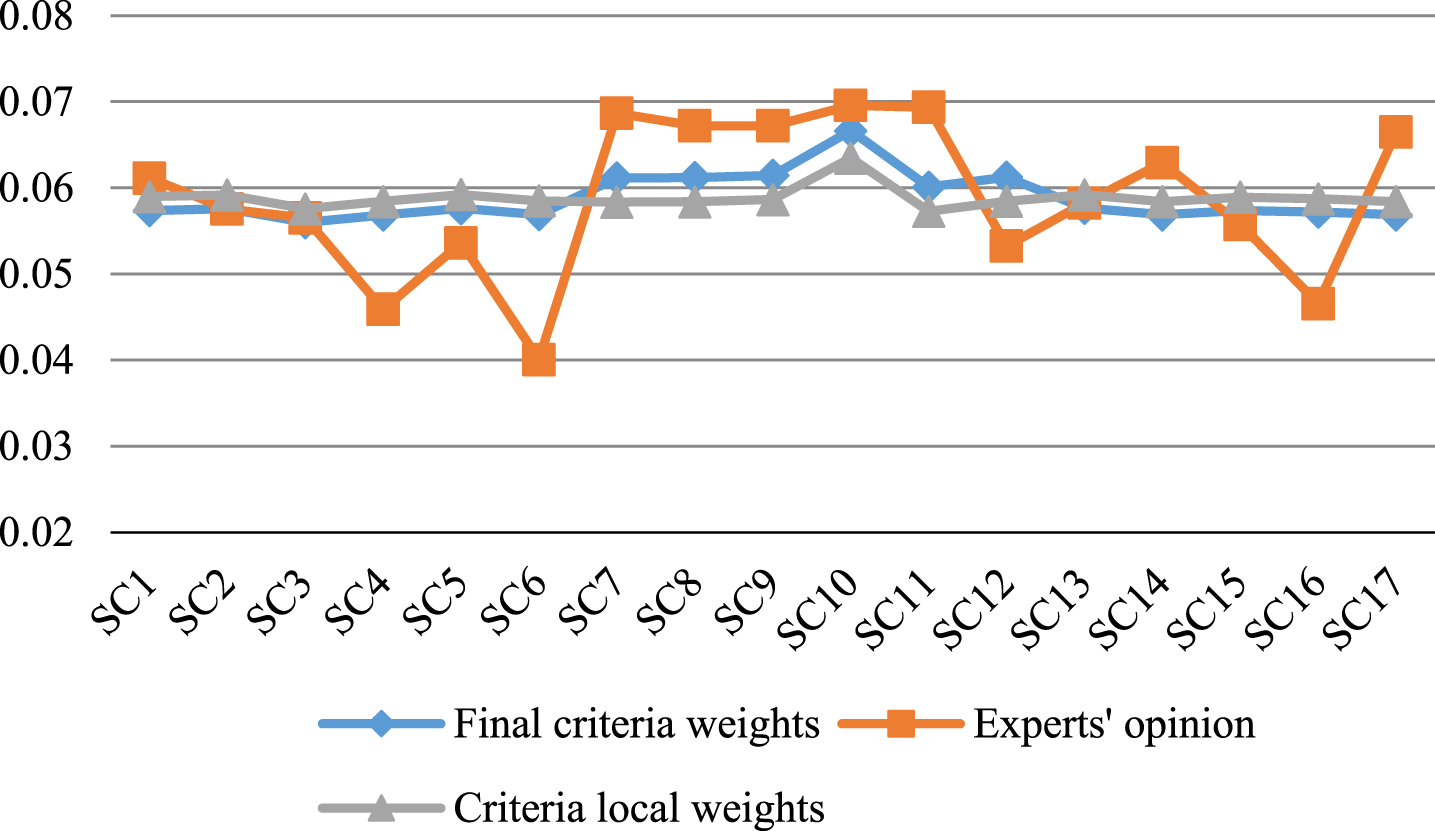
Comparing the results of experts’ judgments, criteria local weights, and final criteria weights.
Furthermore, two recent studies as Xu and Zhang [1] and Tavakkoli-Moghaddam et al. [4] are implemented for comparing the obtained results to dynamic interval-valued hesitant fuzzy hierarchical group decision model for the validity of presented approach. As represented in Fig. 3, the proposed approach of this study leads to robust results regarding two other methods. Meanwhile, the standard deviation measure is considered to show the deviation values of three approaches. The results show that the deviation value of the proposed approach is much less than the other methods [1]. Thus, the criteria weights that are achieved from the proposed approach can appropriately deal with fluctuated parameters that are existed in real life applications with imprecise information.

A comparative analysis to consider the validity of the proposed approach.
Housing market management based on sustainable development factors is handled by implementing the best strategies during the different periods. In this respect, identifying sustainable criteria according to economic, environmental, and social competencies and determining the relative significance of them regarding the interdependencies coherence can play a central role to address the issue. This study proposed a hierarchical group decision approach based on dynamic interval-valued hesitant fuzzy information to obtain the weights of sustainable criteria for strategy selection of housing market management problem. The dynamic interval-valued hesitant fuzzy sets (DIVHFSs) theory appropriately covered the uncertain situation of multi-periods problems that allowed experts to give some membership degrees for assessing the sustainable criteria under a set for different periods. However, the proposed approach was developed by determining the local and global weights of criteria. In this respect, the criteria local weights were determined based on dynamic interval-valued hesitant fuzzy correlation and standard deviation methodology. Besides, the proposed dynamic interval-valued hesitant fuzzy DEMATEL method was elaborated to compute the criteria global weights regarding the interdependencies coherence. In the process of proposed approach, the weight of each expert was computed based on dynamic interval-valued hesitant fuzzy compensatory degree method to reach a unanimous solution. Furthermore, the last aggregation concept was provided for proposing the dynamic interval-valued hesitant fuzzy hierarchical group decision method to prevent the data loss. Finally, a real case study about the sustainable criteria assessment in strategy selection of housing market management was considered to represent the proficiency of the proposed approach. Then, a verification and validation analysis was reported regarding the recent literature to show the reliability and robustness of the presented approach. For future directions, the proposed dynamic interval-valued hesitant fuzzy hierarchical group decision approach can be enhanced to solve a large-scale problem regarding the recent studies [30–38].