



Abstract
In this paper, we introduce and study the concept of generalized intuitionistic fuzzy hypergraph (shortly, g-if-hypergraph) and establish a relation between generalized if-hypergraph and if-hyperstructures. Further, we introduce partial if-hypergroupoid and extend the results for higher order if-hypergroupoids and study their properties.
Introduction
Graph theoretical studies, particularly, hypergraphs, are important for the development of modeling system architecture and to represent partition, covering and clustering in circuit design. Many mathematicians expanded graph models for the modeling of complex systems. Hypergraphs are the generalization of graphs to the set of multiary relations [1, 13]. In 1970, Berge [6, 7] introduced the term hypergraph. In 1976, Berge introduced some more relevant concepts in [8, 9] for modeling systems with fuzzy binary and multiary relations between objects, which was a transition to fuzzy hypergraphs combining both fuzzy and graph models. In 1975, Rosenfield [23] introduced the concept of fuzzy graph on the basis of the idea introduced by Kauffmann [16] in 1973. Mordeson and Peng [21] introduced some operations on fuzzy graph. In [20], there is a very good presentation of fuzzy graph and fuzzy hypergraph theory. Recently, Parvati et al. [22] defined intuitionistic fuzzy hypergraphs. After that, many researchers in the field of hyperstructure theory established significant connections between hypergraphs and hyperstructures (see, for instance, [10, 18]). In [24], Sen et al. introduced and studied fuzzy semihypergroups by using the concept of fuzzy hyperoperation.
Hypergraphs play a very significant role in circuit design and modeling system architectures. However, there are situations where some aspects of graph theoretic design may not be certain. In such cases, we must take help of fuzzy sets or fuzzy logic. But then again, the use of higher order fuzzy sets makes the solution procedure more complex. Intuitionistic fuzzy sets come to rescue and provides more flexibility in computation for such problems, which motivates the current study.
In this paper, we extend the concept of if-hypergraphs into generalized if-hypergraphs and establish some connection between generalized if-hypergraphs and if-hyperstructures. We also extend the results for higher order. We have discussed examples those motivate the necessity of studying the intuitionistic version of corresponding fuzzy graph model.
Preliminaries
First of all, we recall some essential notions and results of generalized intuitionistic fuzzy(in short “g-if") hypergraphs.
The set of all fuzzy subsets of X will be denoted by I
X
. For each μ1, μ2, ν1, ν2 ∈ I
X
, say μ2 ⊆ μ1 and ν2 ⊆ ν1 if μ2 (x) ≤ μ1 (x) and ν2 (x) ≤ ν1 (x), for all x ∈ X. Suppose μ
α
, ν
α
∈ I
X
, in the index set
If μ1, μ2, μ3 and ν1, ν2, ν3 are fuzzy subsets of X, then μ2 ⊆ μ1 and ν2 ⊆ ν1 satisfying that (μ1 ∖ μ2) ∪ μ2 = μ1 and (ν1 ∖ ν2) ∩ ν1 = ν1. Moreover μ1 ∪ μ2 = μ1 ∪ μ3 and ν1 ∩ ν2 = ν1 ∩ μ3 implies that μ2 ∖ μ3 ⊆ μ1 and ν2 ∖ ν3 ⊆ ν1.
X = {x1, x2 ⋯ x
n
} is a finite set of vertices; E = {E1, E2 ⋯ , E
n
} is a family of intuitionistic fuzzy subsets of X; E
j
= {μ, ν ∈ I*
X
: δ (x
i
, μ
j
, ν
j
) >0 forsome x ∈ X and μ
j
(x
i
) + ν
j
(x
i
) ≤1} for all i = 1, 2, ⋯ , n and j = 1, 2, ⋯ , m; E
j
≠ φ, j = 1, 2, ⋯ , m; ⋃
j
supp (E
j
) = X, j = 1, 2, ⋯ , m.
Here elements of X are called vertices and the IFS E j = {μ, ν ∈ I* X : δ (x i , μ j , ν j ) >0 forsome x ∈ X and μ j (x i ) + ν j (x i ) ≤1} for all i = 1, 2, ⋯ , n and j = 1, 2, ⋯ , m are called IF hyperedges.
A partial intuitionistic fuzzy hyperoperation on a non-empty set X mean the functions •, ⊲ from X × X to I X . In other words, for any x, y ∈ X, x • y and x ⊲ y are intuitionistic fuzzy subset of X. Every mapping from X × X to I* X is called a if- hyperoperation. If μ1, μ2 ; ν1, ν2 ∈ I* X , then we define μ1 • μ2 = ⋃ {a • b | a ∈ supp (μ1) , b ∈ supp (μ2)} and ν1 ⊲ ν2 = ⋂ {a ⊲ b | a ∈ supp (ν1) , b ∈ supp (ν2)}, x • μ2 = χ{x} • μ2 and μ1 • y = μ1 • χ{y} and x • ν2 = χ{x} ⊲ ν2 and ν1 ⊲ y = ν1 ⊲ χ{y} where χ X denotes the characteristic function of a given set X. If μ1 =∅ or μ2 =∅, then we define μ1• μ2 = ∅.
An intuitionistic fuzzy hypergroup is a reproductive intuitionistic fuzzy semihypergroup. The notion of H v -structures was introduced by Vougiouklis [25]. A if-hypergroupoid (X, • , ⊲) is called if-H v -semigroup if the weak associative axiom is valid, i.e., x• (y • z) ⋂ (x • y) • z ≠ ∅ and x⊲ (y ⊲ z) ⋂ (x ⊲ y) ⊲ z ≠ ∅, for all x, y, z ∈ X and it is called if-H v -group if it is reproductive if-H v -semigroup.
Main Results
Here we aim to establish some theorems and results on g-if hypergroupoids with the help of g-if hypergraph.
Partial (g-if)-hypergroupoids
Here we are going to introduce the concept of partial (g - if) p -hypergroupoid to each g-if hypergraph. We also establish some relations and conditions for separable intuitionistic fuzzy hypergroupoid and separable intuitionistic fuzzy semihypergroup.
In the case that •
p
, ⊲
p
are intuitionistic fuzzy hyperoperations,
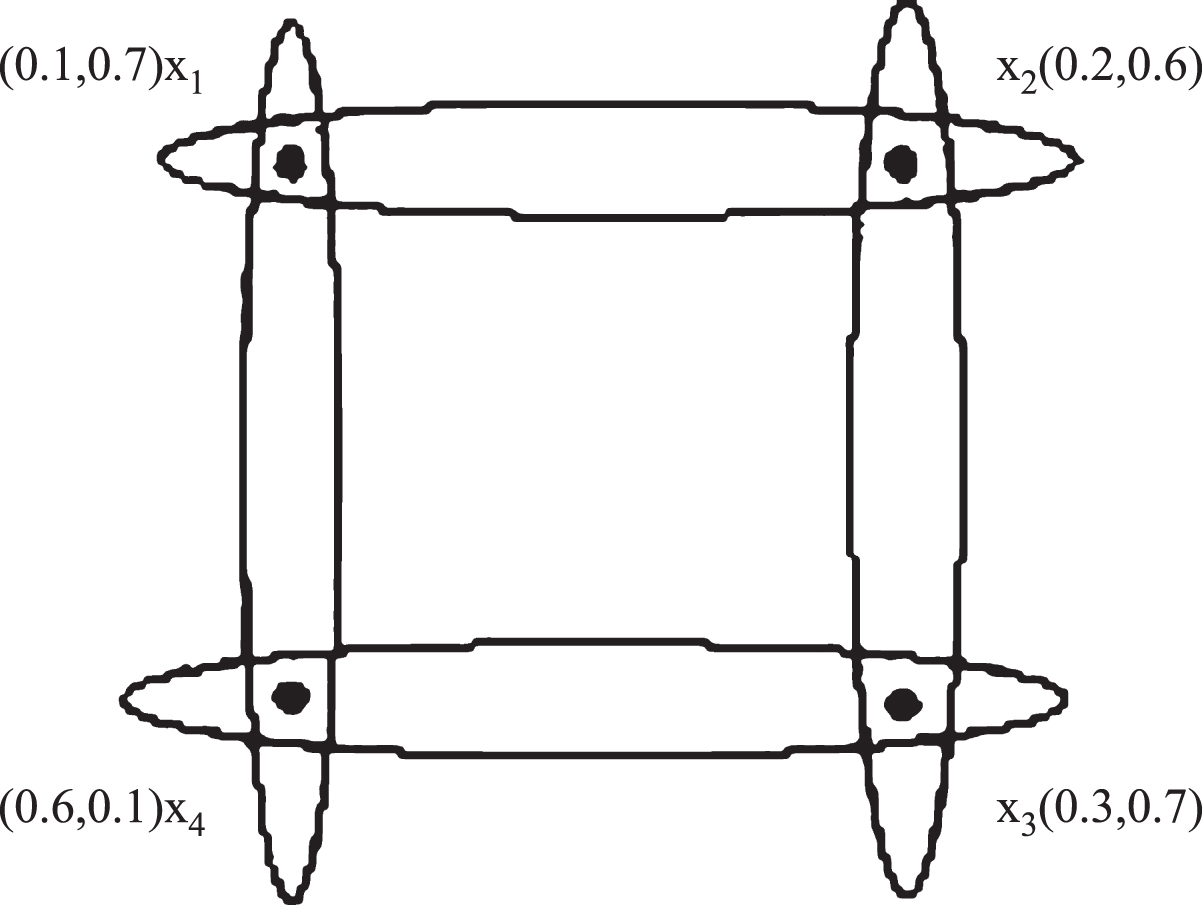
Let δ be a if-h-relation on X as shown in the following figure-

Then from the above figure we have,
δ (1, μ1, ν1) =0.5, δ (1, μ2, ν2) =0; δ (2, μ1, ν1) =0.5, δ (2, μ2, ν2) =0.1; δ (3, μ1, ν1) =0.5, δ (3, μ2, ν2) =0.7; and δ (4, μ1, ν1) =0.5, δ (4, μ2, ν2) =0.
This implies, δ (x, μ1, ν1) =0.5 for all x ∈ X i.e.
Again, δ (2, μ2, ν2) =0.1 and δ (1, μ2, ν2) =0 implies that Γ = (X, δ) is not v0.1-linked but it is 0.1-plenary.
Therefore,
Then, (X, • , ⊲) is the (g-if) p -hypergroupoid associated with the v p -linked (g-if)-hypergraph Γ = (X, δ). Therefore, every separable hypergroupoid can be considered as a (g-if) p -hypergroupoid, where p ∈ (0, 1].
x •
p
y = y •
p
x and x ⊲
p
y = y ⊲
p
x, (x •
p
x) •
p
(x •
p
x) = ⋃ t∈supp(x•
p
x)t •
p
t and (x ⊲
p
x) ⊲
p
(x ⊲
p
x) = ⋂ t∈supp(x⊲
p
x)t ⊲
p
t, (μ •
p
μ) ∘
p
(μ •
p
μ) = ⋃ t∈supp(μ•
p
μ)t •
p
t and (ν ⊲
p
ν) ⊲
p
(ν ⊲
p
ν) = ⋂ t∈supp(ν⊲
p
ν)t ⊲
p
t.
Hence, we obtain
It suffices to show that X ⊆ ⋃ μ,ν∈Cod p (δ)supp (μ, ν).
Let x ∈ X be an arbitrary element. Since
Conversely, let Γ be p-plenary. As Γ is a v
p
-linked (g-if)-hypergraph, therefore by Lemma 3.2,
supp (x • p χ X ) = supp (χ X • p x) = X and supp (x ⊲ p χ X ) = supp (χ X ⊲ p x) = X, for each x ∈ X.
Trivially, supp (x • p χ X ) ⊆ X and supp (x ⊲ p χ X ) ⊆ X. We have to show that
X ⊆ supp (x •
p
χ
X
) and X ⊆ supp (x ⊲
p
χ
X
). Let z ∈ X be an arbitrary element. Since Γ is p-plenary, there exists μ, ν ∈ Cod
p
(δ) such that z ∈ supp (μ, ν). Since μ, ν ∈ Cod
p
(δ), there is y ∈ X such that δ (y, μ, ν) ≥ p and so we have z ∈ supp (x •
p
y) ⊆ supp (x •
p
χ
X
) and z ∈ supp (x ⊲
p
y) ⊆ supp (x ⊲
p
χ
X
). This implies that X ⊆ supp (x •
p
χ
X
) and X ⊆ supp (x ⊲
p
χ
X
). Therefore supp (x •
p
χ
X
) = X and supp (x ⊲
p
χ
X
) = X. Similarly, we have supp (χ
X
•
p
x) = X and supp (χ
X
⊲
p
x) = X. Therefore
x • x ⊆ (x • x) • (x • x) and x ⊲ x ⊆ (x ⊲ x) ⊲ (x ⊲ x) , for all x ∈ X, ((x • x) • (x • x)) ∖ (x • x) ⊆ (y • y) • (y • y)and ((x ⊲ x) ⊲ (x ⊲ x)) ∖ (x ⊲ x) ⊆ (y ⊲ y) ⊲ (y ⊲ y) , forall x, y ∈ X.
Now, associativity of •, ⊲ implies that
Thus, ((x • x) • (x • x)) ∖ (x • x) ⊆ (y • y) • (y • y) and ((x ⊲ x) ⊲ (x ⊲ x)) ∖ (x ⊲ x) ⊆ (y ⊲ y) ⊲ (y ⊲ y), for all x, y ∈ X. Therefore, (2) holds.
For the converse, suppose that x, y, z are arbitrary elements of X and conditions (1) and (2) hold. From the Lemma 3.1, we have
Then,
μ • μ ⊆ (μ • μ) • (μ • μ) and ν ⊲ ν ⊆ (ν ⊲ ν) ⊲ (ν ⊲ ν) , forall μ, ν ∈ I*
X
, ((μ1 • μ1) • (μ1 • μ1)) ∖ (μ1 • μ1) ⊆ (μ2 • μ2) • (μ2 • μ2) and ((μ1 ⊲ μ1) ⊲ (μ1 ⊲ μ1)) ∖ (μ1 ⊲ μ1) ⊆ (μ2 ⊲ μ2) ⊲ (μ2 ⊲ μ2) , forall μ1, μ2, ν1, ν2 ∈ I*
X
.
Again, (y • y) • (y • y) ⊆ (μ2 • μ2) • (μ2 • μ2) and (y ⊲ y) ⊲ (y ⊲ y) ⊆ (ν2 ⊲ ν2) ⊲ (ν2 ⊲ ν2). Therefore,
For the converse, suppose that conditions (1) and (2) hold. Let x, y be arbitrary elements of X. By putting μ1 = χ{x}, μ2 = χ{y} and ν1 = χ{x}, ν2 = χ{y}, conditions (1) and (2) of Theorem 3.1 hold and therefore •, ⊲ is associative.□
Higher-order if-hypergroupoids
In this section we discuss some results and theorems of if-hypergroupoids for higher-order.
Let (X, • , ⊲) be a separable if-hypergroupoid. We construct a sequence of if-hypergroupoids X0 = (X, • 0) , X1 = (X, • 1) , X2 = (X, • 2) , … and X0 = (X, ⊲ 0) , X1 = (X, ⊲ 1) , X2 = (X, ⊲ 2) , … recursively as follows: for all x, y ∈ X we set x • 0y = x • y, x • k+1x = (x •
k
x) •
k
(x •
k
x) and
The following properties are holds for the higher-order where k ≥ 0:
μ1 ⊆ μ2 implies that
, .
By Theorem 3.12, X
k
is a semihypergroup if and only if the following conditions hold:
μ • k+1μ = (μ •
k
μ) •
k
(μ •
k
μ) and ν ⊲ k+1ν = (ν ⊲
k
ν) ⊲
k
(ν ⊲
k
ν), for all μ, ν ∈ I*
X
, x • k+2x = ((x • k+1x) •
k
(x • k+1x)) •
k
((x • k+1x) •
k
(x • k+1x)) and x ⊲ k+2x = ((x ⊲ k+1x) ⊲
k
(x ⊲ k+1x)) ⊲
k
((x ⊲ k+1x) ⊲
k
(x ⊲ k+1x)), for all x ∈ X.
If X
k
= (X, •
k
, ⊲
k
) satisfies condition (α) for some k ≥ 0, then If X
k
= (X, •
k
, ⊲
k
) satisfies condition (β) for some k ≥ 0, then
The procedure of the proof of above theorem 3.17 is similar as the proof of Theorem 3.3 in [11].
Next proposition is a direct consequence of Theorem 3.12.
X
k
= (X, •
k
, ⊲
k
) is a separable if- semihypergroup,
X
r
= X
k
, for all r ≥ k.
Application
Some applications in connection with our present study is discussed in this section.
First we discuss an application of intuitionistic fuzzy hypergraph model for radio transmission that can be used to determine station programming or marketing strategies or to establish an emergency broadcast network.
Membership and nonmembership values near 1 and 0 denote “very clear reception on a very poor radio", respectively, whereas membership and nonmembership values near 0 and 1, could respectively, denote “very poor reception on even a very sensitive radio". As the signal strength gets affected by the location, each listening area may be considered as an intuitionistic fuzzy set. Further, for a fixed radio, the reception quality will be different between different stations. Such a model, therefore, gives rise to an intuitionistic fuzzy hypergraph.
A natural question arises that if there is a minimal subset of stations that reaches every radio with a given least signal strength. This could be an interesting investigation in future.
Next we show that an intuitionistic fuzzy quotient space model having the hypergroupoid structure can be utilized for the improvement of efficiency of fuzzy reasoning.
then
Conclusion
Recently, Ma et al. [19] have conducted a very interesting survey of decision making methods based on hybrid soft set models, which can further be explained and extended using intuitionistic fuzzy hypergroupoid structure. Zhang et al. [30] used fuzzy rough set models and applied them to multi-criteria fuzzy group decision making. Some very recent and significant applications of intuitionistic fuzzy hypergraphs in decision making with soft set/rough set models were established by Akram and his coauthors [3–5].
In this paper we have studied the concept of g-if-hypergraph and partial-if-hypergroupoid. We also established some important results and extended them to higher order. The concept of graph and hypergraph structures are highly utilized in computer science. Intuitionistic fuzzy models give more precision and compatibility to the system as compared to classical and fuzzy models. Therefore, intuitionistic fuzzy hypergraphs are more flexible than fuzzy hypergraphs. Extension and application of our results in decision making using the models of Zhan and coauthors [15, 26–31] will be very important topics for future study.
Footnotes
Acknowledgments
The authors are immensely thankful to the reviewers and the Associate Editor for their constructive feedback towards overall improvement of the paper.