Rough set theory initiated by Pawlak [16] and soft set theory initiated by Molodtsov [15] are strong mathematical tools for handling uncertain and vague information. In this study, we bring out some results of soft rough sets (-sets) and topological structure of soft rough sets. We define -open set, -closed set, -interior, -closure, -frontier, -neighbourhood and -limit point. Furthermore, we propose an algorithm to illustrate uncertainties in the multi-criteria group decision making (MCGDM) using -sets. We utilize another algorithm for modeling uncertainties in multi-criteria decision making (MCDM) using soft rough topology(-topology).
The intricacy of modeling real world problems is enhancing nowadays. Mostly we are incapable to determine the accurate solutions in some arduous mathematical models. We often encounter with various types of uncertainties, while considering the problems in social science, engineering, economics, environmental science, artificial intelligence and medical science. The information about a problem is usually imperfect and imprecise. This imprecision may be caused by the granularity in the representation of given data. In the field of computer science and mathematics, experts have proposed many beneficial theories including theory of probability, theory of fuzzy sets, theory of rough sets and interval mathematics. These approaches are useful to extract the beneficial information hidden in the voluminous data. Sometimes these theories are incompetent to handle the data involving parameterizations which was pointed out by Molodstov [15]. Fuzzy set proposed by Zadeh in 1965 [31] was the first tentative approach to deal with vagueness or uncertainty. Rough set introduced by Pawlak [16, 17] extract vagueness by means of boundary region instead of membership values. If boundary region is empty then the set under consideration is crisp otherwise it is rough or inexact. In 1999 Molodstov [15] initiated the concept of soft set as a powerful mathematical technique towards uncertainties. He efficiently used this technique in different areas like smoothness of functions, Riemann integration, game theory, theory of measurements and operation research. Ali et al. [1, 2] briefly discussed the connection between soft sets, rough sets and fuzzy soft sets. According to the study of Aktas and Cagman in 2007. [3] soft set, fuzzy set and rough set are closely related approaches. In 2002 Maji et al. [13, 14] presented some basic operations of soft set and effectively used this concept to decision making problem. In 2011 Shabir and Naz [29] and Cagman et al. [5] independently introduced soft topology on soft set. Mathew et al. [12] used multi-modal approach on soft set for medical diagnostic prediction system. Riaz et al. [19–21] established some results of soft algebra, soft metric spaces and measurable soft mappings. Riaz and Masooma [22–26] presented -topology and -compact spaces with some important applications of -set to the decision-making problems. They also introduced -mappings and fixed points of -mapping.
In contrast to other methodologies, the rough set approach depends only on the information presented by the data itself and does not need any outside parameters or assumptions. Rough set used to characterize any subset of the universe by defining two subsets namely lower approximation and upper approximation [16, 17]. In rough set theory the equivalence classes of an indiscernibility relation are considered to generate rough topology. Using equivalence relations, Thivagar et al. [30] established the topology on rough set which includes approximations and boundary region. The -approximations and -set which based on soft approximation space are introduced by Feng et al. [7, 8]. Zhan et al. [10, 32–34] introduced several ideas including soft rough covering, soft rough hemirings, z-soft fuzzy rough set and certain hybrid soft set models and efficiently employ these techniques in multi-criteria decision making problems. Zhang et al. [35–37] introduced covering based fuzzy rough sets and Covering-based generalized IF rough sets with applications to MCDM. Bakier et al. 2016 [4] introduced -topology. Applications of soft set theory and rough set theory have been studied by many mathematicians. [2, 30]. The remainder of the paper is composed as follows: In section 2, we have briefly define notions of rough set -set and soft rough set -set. In Section 3, we explain topological structure of -set as defined by Bakier et al. [4]. In section 4 we present some new results of -topology related to -closure, -interior, -frontier, -neighbourhood and -limit point. In section 5 we present use of -sets in multicriteria group decision making (MCGDM). In section 6 we modify an algorithm and use -topology to find out the deciding factors of the chronic disease Tuberculosis.
Preliminaries
This section presents some basic definitions including soft set, rough set and -set.
Definition 2.1. Let be the universal set. Let is collection of subsets of . A pair is said to be a soft set over the universe , where and is a set-valued function. We denote soft set as or and mathematically write it as
For any , is ζ-approximate elements of soft set . The set containing all soft sets over is denoted by " (See [15]).
Example 2.2. Suppose that be the set consisting of five pair of shoes and set criterions is given by , where ζ1 stands for “modern style”, ζ2 stands for “durable”, ζ3 stands for “reasonable price”, ζ4 stands for “comfortable”.
The soft set expresses the “quality of shoes” that Mr. Zeeshan required to purchase. Consider a mapping such that
Then the soft set is the set of approximations, each approximation is a pair of predicate and an approximate value set.
Definition 2.3. Suppose we have a set of objects under consideration and an indiscernibility relation which indicates our information about elements of . For sake of our convenience, we take as an equivalence relation and denote it as . The pair is referred as approximation space. A subset of is taken to characterize it w.r.t .
The union of the granules entirely included in the set forms lower approximation of the set w.r.t . mathematically defined as;
The union of the granules having non-empty intersection with the set forms upper approximation of the set w.r.t . mathematically defined as;
The difference between upper and lower approximation forms boundary region of the set w.r.t . mathematically defined as;
The set is said to be defined if . The set is (imprecise) rough set w.r.t , if i.e (See [16]).
Example 2.4. Suppose we have set of patients suffering from certain disease. Consider set of attributes as set of symptoms. Consider and Diabetes as indiscernibility relation. We present the information in tabular form, rows indicate (objects) patients, columns shows attributes and entries of table give attribute values. Such tables are known as information systems. We can see that {ϱ1, ϱ3} are the patients having diabetes. The table below shows that patient ϱ2 is having diabetes while ϱ7 is not having diabetes, and they have same symptoms, hence ϱ2 and ϱ7 lies in boundary region. Hence lower approximation of the set w.r.t relation “diabetes” is and the upper approximation of this set is the set , while boundary region is ={ϱ2, ϱ7}.
Definition 2.5. Consider a soft set over the universe , where and is a function given as . Then the pair is called a soft approximation space. Following the soft approximation space , we get two approximations to every subset given by
which we call soft P-lower approximation and soft P-upper approximationof . Generally, and are called -approximations of w.r.t P. If then is said to be soft P-rough set otherwise soft P-definable(See [7]).
Example 2.6. Let , and . Let is soft set over and . The tabular form of soft set is given in Table 2. Then we obtain soft approximation space
For , we obtain and .
Since and hence is said to be a soft P-rough set.
Information system
patients
Increased Hunger
Weight Loss
Frequent Urination
Diabetes
ϱ1
x
✓
✓
✓
ϱ2
✓
x
✓
✓
ϱ3
✓
✓
✓
✓
ϱ4
✓
✓
x
x
ϱ5
x
✓
x
x
ϱ6
✓
x
x
x
ϱ7
✓
x
✓
x
Soft set
s1
s2
s3
s4
s5
ζ1
0
1
1
0
0
ζ2
0
1
0
1
1
ζ3
1
1
0
0
1
ζ4
0
0
1
0
1
Definition 2.7. If then the soft set over is said to be full soft set,
Definition 2.8. [7] If forms a partition of then the soft set over is called partition soft set.
Soft Rough Topology
Definition 3.1. Let as universe of objects, and be a soft approximation space. Then the collection
is called soft rough topology which satisfies the following axioms:
and ∅ belongs to .
Union of members of belongs to .
Finite Intersection of members of belongs to .
If is Soft rough topology then is said to be -topological space (See 4).
Definition 3.2. Let be a -topological space, then the members of are known as -open sets. A -set is known as -closed set if its complement belongs to .
Proposition 3.3 Consider as -space over . Then
and ∅ are -closed sets.
The intersection of any number of -closed sets is a -closed set over .
The finite union of -closed sets is a -closed set over .
Proof. The proof is straightforward.□
Definition 3.4. Let be a -space over and then is called -indiscrete topology on w.r.t and corresponding space is said to be a -indiscrete space over .
Example 3.5. 1 Let be the set of cars under consideration and let the set of all parameters and . Consider the soft approximation , where is a soft set over given by:
For , we obtain , and . Then
is a -topology.
Definition 3.6. Let be a -topological space and . If we can write element of as the union of elements of , then is called -basis for the -topology .
Proposition 3.7. [4] If is a -topology on w.r.t the the collection
is a base for
Definition 3.8. [4] Let and be two -topological spaces. is finer than , if .
Theorem 3.9. [4] Let and be two -topological spaces w.r.t and respectively. Let and be -bases for and respectively. If , then is finer than and is weaker than .
Definition 3.10. [4] Let is a -topological space and . Then the collection is called -subspace topology on A. Then, is called a -topological subspace of .
Theorem 3.11. Let be a -topological space. If is a -basis for , then the collection is a -basis for the -subspace topology on B.
Proof. Consider . By definition of -subspace topology, C = D ∩ B, where . Since , it follows that . Therefore,
□
Definition 3.12. [4] Let be a -topological space w.r.t , where and B V. The -interior of B is union of all -open subsets of B and we denote it as .
We can see that is the largest -open set contained by B.
Main Results
Bakier et al. defined Soft rough topology and presented some properties of -approximation. We present some new results of Soft rough topology including -interior, -closure, -frontier, -neighbourhood and -limit point.
Theorem 4.1. Let be a -topological space over w.r.t , and are -sets over . Then
and ;
;
is -open set ;
;
implies ;
;
.
Proof. (i) and (ii) are obvious. (iii) First, suppose that . Since is a -open set, it follows that is -open set. For the converse, if is a -open set, then the largest -open set that is contained in is itself. Thus, . (iv) Since is a -open set, by part (iii) we get . (v) Suppose that . By (ii) . Then . Since is -open set contained by . So by definition of -interior . (vi) By using (ii) and . Then . Since is a -open, it follows that . (vii) By using (ii) and . Then . Since is -open, it follows that . For the converse, also . Then, and . Hence .□
Definition 4.2. [4] Let be a -topological space w.r.t , where . Let B V then -closure of B is defined to be intersection of all -closed supersets of B and is denoted by .
Example 4.3. Consider the -topology given in Example 1, taking B={}. Then and .
Theorem 4.4. Let be a -topological space over w.r.t , and are -sets over . Then
and ;
;
is -closed set ;
;
implies ;
;
.
Proof. (i) and (ii) are straightforward. (iii) First consider . Since is a -closed set, so is a -closed set over . For the converse, suppose that be a -closed set over . Then is -closed superset of . So that . (iv) By definition is always -closed set. Therefore by part (iii) we have . (v) Let . By (ii) . Then . Since is a -closed superset of , it follows that . (vi) Since and , by part (v), and . Hence . For the converse, suppose that and . Then . Since is a -closed superset of . Thus, . (vii) Since and , by part(5) and . Thus, we obtain .□
Definition 4.5. Let be a -topological space w.r.t , where . Let then -frontier or -boundary of is denoted by or and mathematically defined as
Clearly -frontier is a -closed set. In simple words, we can say that a point x is in -frontier of if and only if every -open set containing x also contains a point of and a point of .
Example 4.6. Consider the -topology given in Example 1, taking B={} then B={}. Following the definition -closure, we have and ,then .
Theorem 4.7. Let be a subset of -topological space . Then
;
.
Proof. (i) For any subset of ,
Then, we have Hence, we get
as required. (ii) We have
as required.
Corollary 4.8.
For any subset of , A is -open if and only if
For any subset of , A is -closed if and only if .
A subset of has empty -Frontier iff is both -open and -closed.
Proof. (i) and (ii) are obvious. (iii) Suppose that . We have and . This implies that and . Hence is both -open and -closed. For the converse, suppose is both -open and -closed. Then and . Thus, we get and . It is only possible if .
Definition 4.9. Let be a -topological space. A subset of is said to be -neighborhood of if there exist a -open set containing x so that
Example 4.10. Consider the -topology given in Example 1. For , the -open sets containing ϑ6 are {ϑ1, ϑ2, ϑ3, ϑ4, ϑ6}, {ϑ1, ϑ3, ϑ6} and . The supersets of {ϑ1, ϑ2, ϑ3, ϑ4, ϑ6} are {ϑ1, ϑ2, ϑ3, ϑ4, ϑ6} and . The supersets of {ϑ1, ϑ3, ϑ6} are {ϑ1, ϑ2, ϑ3, ϑ6}, {ϑ1, ϑ3, ϑ4, ϑ6}, {ϑ1, ϑ3, ϑ5, ϑ6}, {ϑ1, ϑ2, ϑ3, ϑ4, ϑ6}, {ϑ1, ϑ2, ϑ3, ϑ5, ϑ6}, {ϑ1, ϑ3, ϑ4, ϑ5, ϑ6} and . Hence the class of -neighborhoods of ϑ6 is NSR (ϑ6) = {{ϑ1, ϑ3, ϑ6}, {ϑ1, ϑ2, ϑ3, ϑ6}, {ϑ1, ϑ3,
Definition 4.11. Let be a -topological space. A point x of is said to be a -limit point of if every -open set containing x contains a point of different from x, i.e.,
Definition 4.12. The set of all the -limit points of is known as -derived set of and is denoted by .
Theorem 4.13. Let A be a subset of . Then
: Thus, the ClSR (A) of A consists of points of A and its -limit points.
A is -closed if and only if .
Proof. The proof is straightforward.□
-sets in multi-criteria group decision-making
This section presents the use of -sets in object assessment and multi-criteria group decision making. Let is the set of objects under observation, is the set of criterions to evaluate the objects in . Let . We consider a soft set for real world problems, it is convenient to to consider a full soft set over . Let be the set consisting of decision makers who evaluate the objects to identify the optimal solution and Xi be the initial assessment derived by experts Di which is represented by the soft set . To extract more accurate results we find -approximation of initial assessment results Xi according to soft approximation space , consequently we get two soft sets and . Following these soft sets define fuzzy sets νΩ★ (αk), νΩ ( αk) and νΩ★ (αk) defined as:
Soft set and fuzzy results are then combined. Suppose that is the set of parameters which represents ‘low satisfaction’, ‘medium satisfaction’ and ‘high satisfaction’. Define fuzzy soft set over as , , and . Calculate the choice value corresponding to each object αi as:
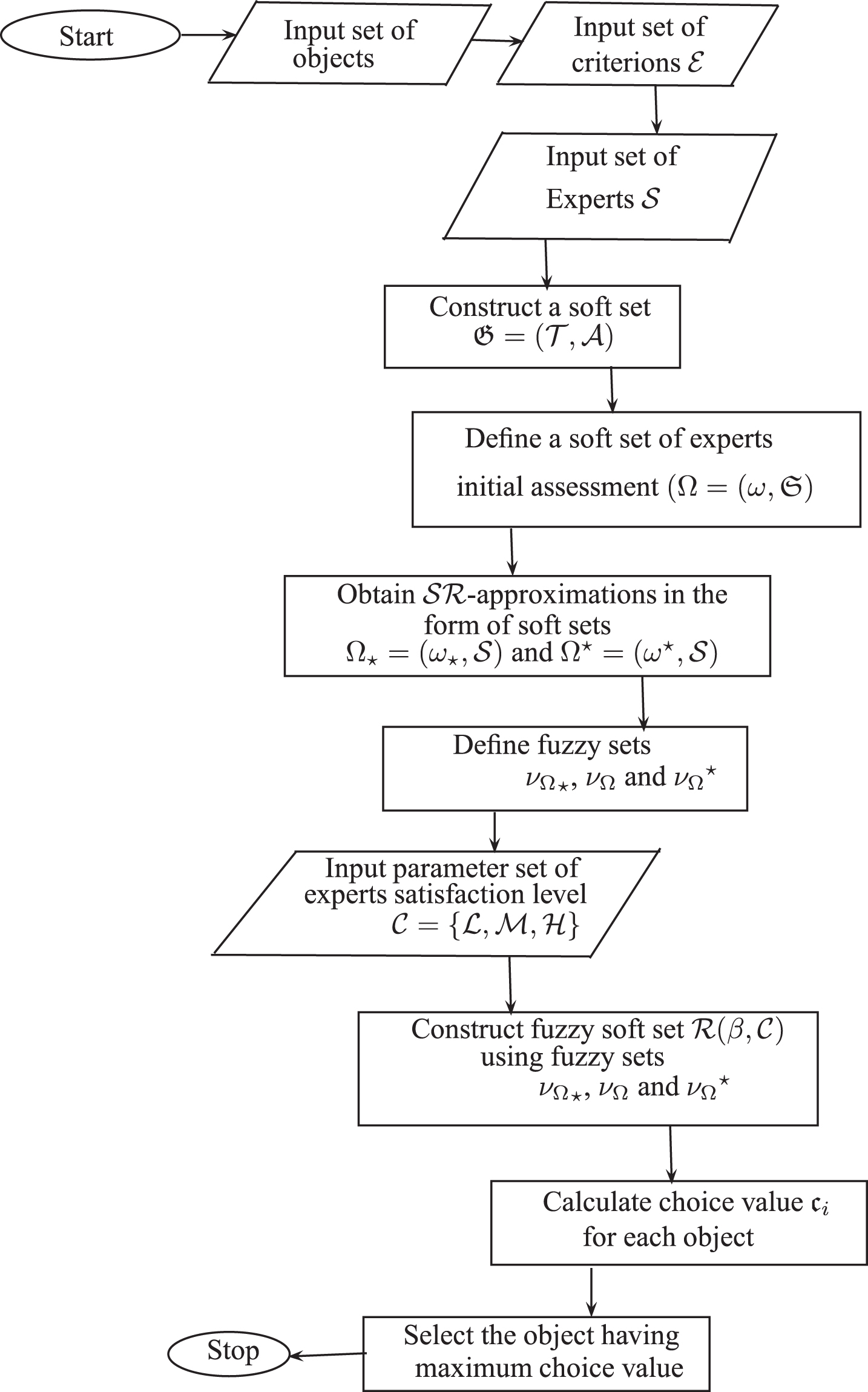
At the end we are able to select the optimal alternative having maximum choice value . Algorithm 1 The scheme of the algorithm is given as: InputStep-1: Write the soft set which describes the given data. Step-2: Based on initial assessment results of the group of analyst , define a soft set. Step-3: Obtain -approximations in the form of soft sets and . Step-4: Define fuzzy sets νΩ★, νΩ and νΩ★ corresponding to the soft sets , and . Step-5: Characterize the satisfaction level of experts in the form of parameter set . Step-6: Define fuzzy soft set over using fuzzy sets νΩ★, νΩ and νΩ★. OutputStep-7: Calculate choice value for each object. Choose the object having maximum choice value.
Graphical representation of Algorithm 1.
Example 5.1. Consider a set of Football players for the selection in the national football team. Let be the set of qualities considered by the selection team where ξ1 represents “physical fitness”, ξ2 represents “confidence”, ξ3 represents “skill application under pressure” and ξ4 represents “sportsman spirit”. Construct a soft set which specify the abilities of players given in Table 3.
Soft set
ϱ1
ϱ2
ϱ3
ϱ4
ϱ5
ϱ6
ξ1
0
0
1
0
1
0
ξ2
1
0
0
0
1
0
ξ3
0
0
1
0
0
1
ξ4
0
1
0
1
0
0
Consider a team of selection members to evaluate the players in . Let Xi be the initial assessment result of the expert’s team. We represent this evaluation by means of soft set whose tabular representation is given by Table 4.
Soft set
ϱ1
ϱ2
ϱ3
ϱ4
ϱ5
ϱ6
D1
0
0
1
0
1
0
D2
0
1
0
1
0
0
D3
1
0
1
0
0
1
From this soft set primary evaluation result of experts are
Now, we find the -approximations as
and
Following these -approximations, we get two soft sets and where, and . Tabular representation of these soft sets are given in Tables 5 and 6.
Soft set Ω★
ϱ1
ϱ2
ϱ3
ϱ4
ϱ5
ϱ6
D1
0
0
1
0
1
0
D2
0
1
0
1
0
0
D3
0
0
1
0
0
1
Soft set Ω★
ϱ1
ϱ2
ϱ3
ϱ4
ϱ5
ϱ6
D1
1
0
1
0
1
1
D2
0
1
0
1
0
0
D3
1
0
1
0
1
1
Now, we define fuzzy soft set νΩ★ (ϱk), νΩ (ϱk) and νΩ★ (ϱk) as follows:
Thus, we have
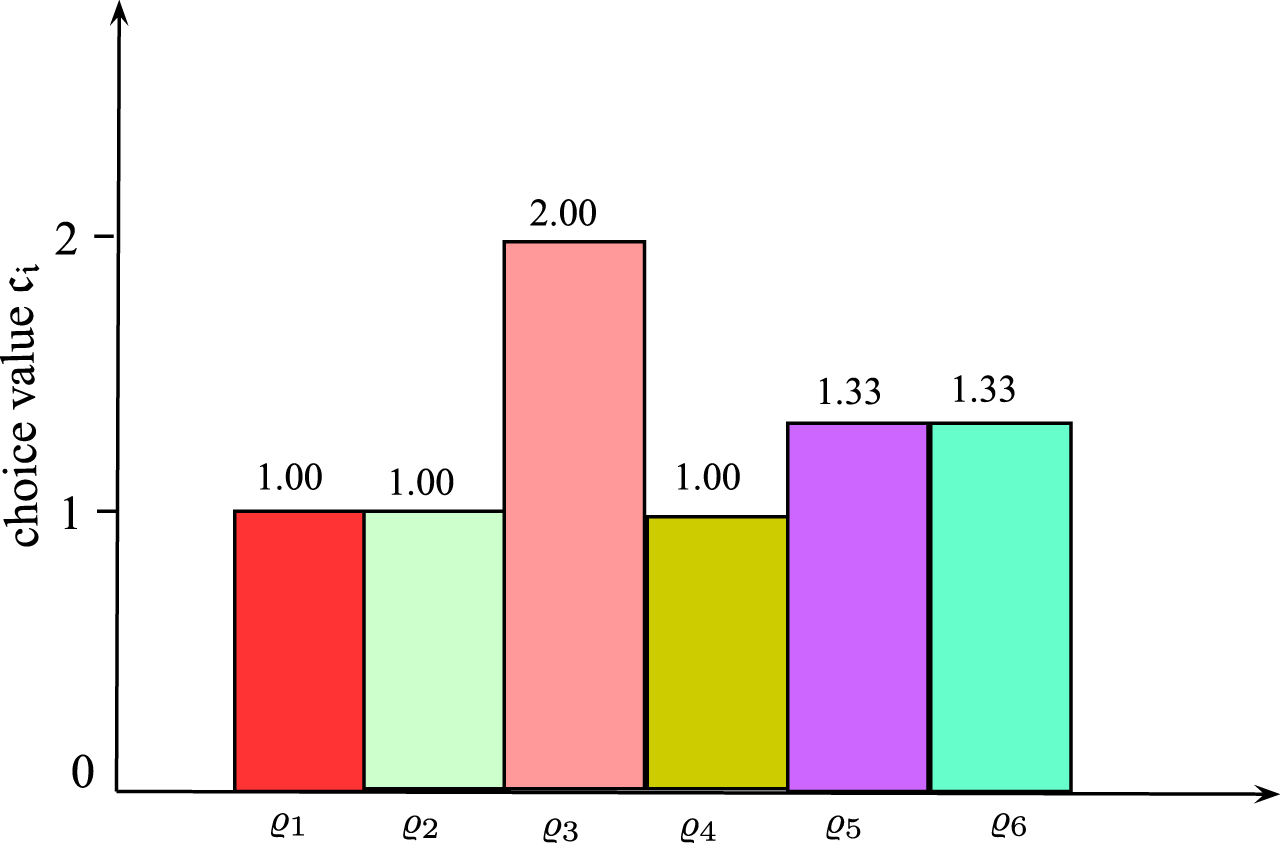
Let be the set of parameters by experts which represents ‘low satisfaction’, ‘medium satisfaction’ and ‘high satisfaction’. Then we get the fuzzy soft set over by setting , and . Calculating choice value corresponding to each player. Fuzzy soft set with assessment values is given in Table 7.
Soft set
ϱ1
ϱ2
ϱ3
ϱ4
ϱ5
ϱ6
2/3
1/3
2/3
1/3
2/3
2/3
1/3
1/3
2/3
1/3
1/3
1/3
0
1/3
2/3
1/3
1/3
1/3
choice value
1
1
2
1
1.33
1.33
We can arrange all the alternatives according to their choice evaluation values:
Thus, ϱ3 is the player to be selected for the national football team.
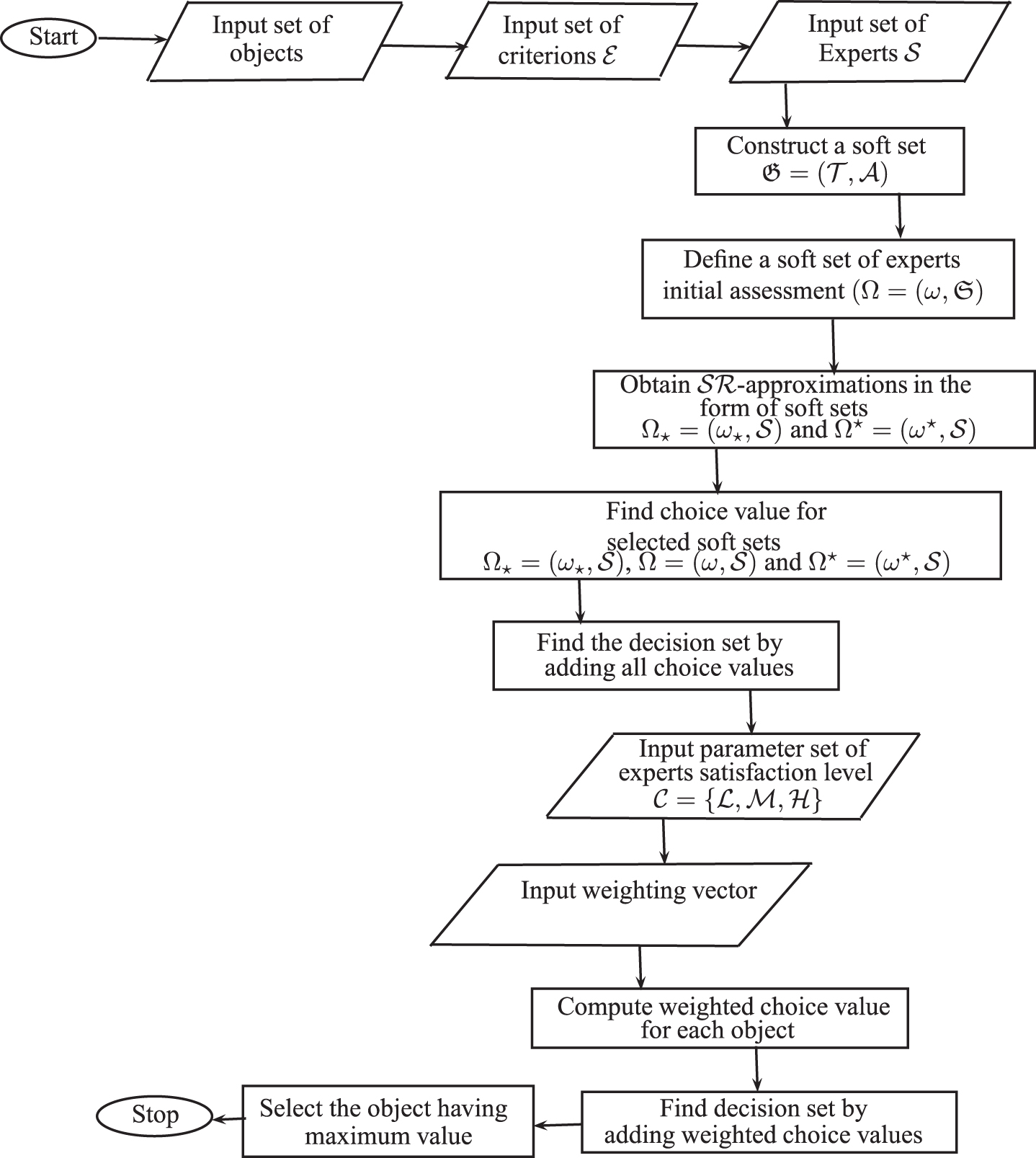
Algorithm 2 The scheme of the algorithm is given as: Step-1: Write the soft set which describes the given data.Step-2: Based on initial assessment results of the group of analyst , define a soft set. Step-3: Obtain -approximations in the form of soft sets and . Step-4: Find choice value for all selected soft sets , and . Step-5: Find the decision set by adding all the choice values of obtained soft sets. Step-6: Characterize the satisfaction level of experts in the form of parameter set .In put the weighting vector W = (wL, wM, wH) and compute the weighted evaluation value for each object. Step-7: Find the decision set by adding all the weighted values ∑iwi.Choose the object having maximum value.
Graphical representation of Algorithm 2.
Example 5.2. Consider Example 1. First three steps same as done by algorithm 1. Find choice value for all selected soft sets , and .
Now, we find the decision table by adding choice values for each player.
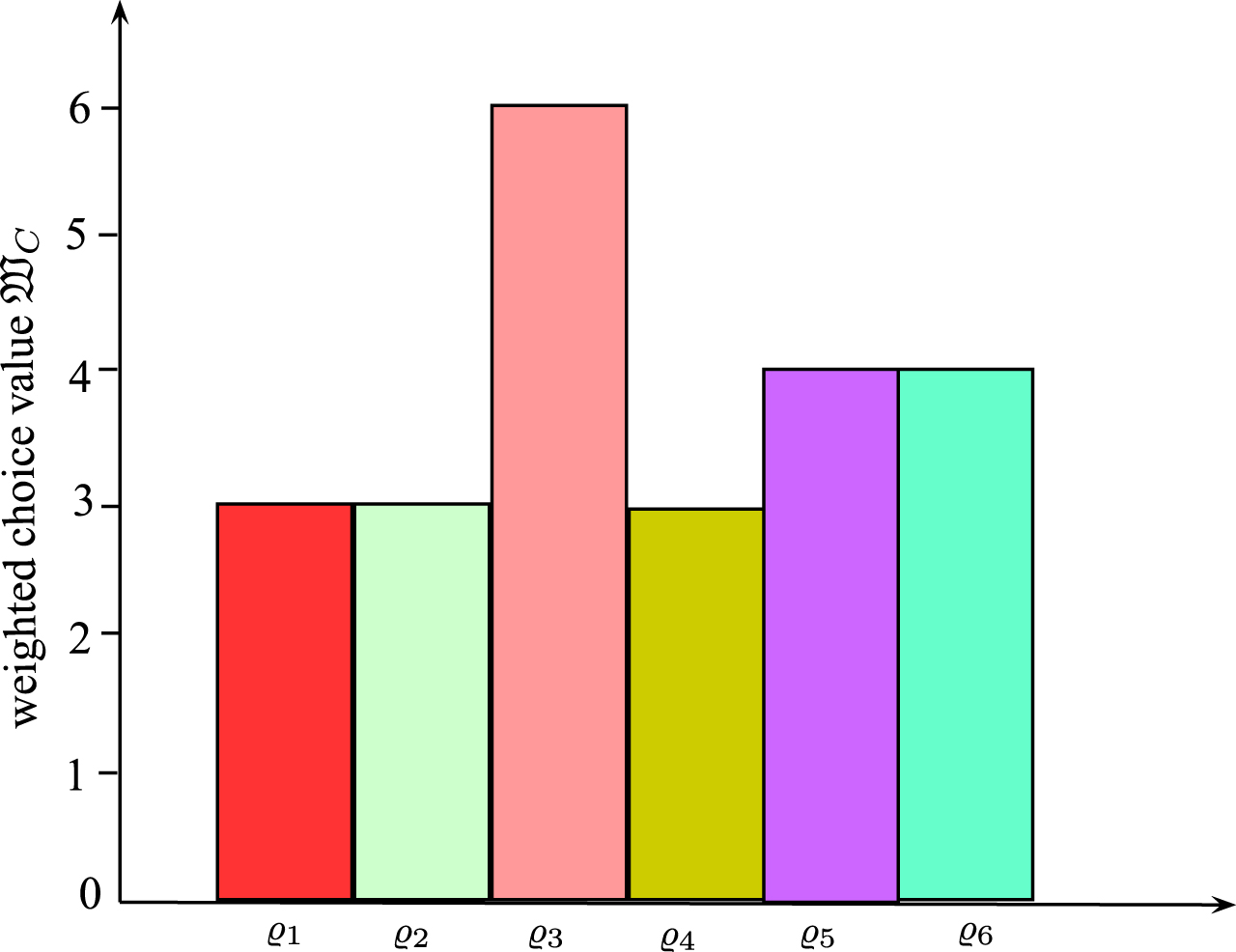
Let be the set of parameters by experts which represents ‘low satisfaction’, ‘medium satisfaction’ and ‘high satisfaction’. Assume that the weighting vector W = (wL, wM, wH) = (.2, . 3, . 5). Calculate weighted choice value for each player. Find the decision set by adding all the weighted values ∑iwi.
Choice value table for Soft set Ω★
ϱ1
ϱ2
ϱ3
ϱ4
ϱ5
ϱ6
D1
0
0
1
0
1
0
D2
0
1
0
1
0
0
D3
0
0
1
0
0
1
choice value
0
1
2
1
1
1
Choice value table for Soft set
ϱ1
ϱ2
ϱ3
ϱ4
ϱ5
ϱ6
D1
0
0
1
0
1
0
D2
0
1
0
1
0
0
D3
0
0
1
0
0
1
choice value
0
1
2
1
1
1
Choice value table for Soft set Ω★
ϱ1
ϱ2
ϱ3
ϱ4
ϱ5
ϱ6
D1
1
0
1
0
1
1
D2
0
1
0
1
0
0
D3
1
0
1
0
1
1
choice value
2
1
2
1
2
2
Choice value table
ϱ1
ϱ2
ϱ3
ϱ4
ϱ5
ϱ6
0
1
2
1
1
1
2
1
2
1
2
2
1
1
2
1
1
1
final choice value
3
3
6
3
4
4
Final decision table
ϱ1
ϱ2
ϱ3
ϱ4
ϱ5
ϱ6
(.2)
.6
.6
1.2
.6
.8
.8
(.3)
.9
.9
1.8
.9
1.2
1.2
(.5)
1.5
1.5
3
1.5
2
2
Final WC value
3
3
6
3
4
4
Choose the player having maximum final weighted choice value.
we can arrange all the players according to their choice evaluation values:
Thus, ϱ3 is the player to be selected for the national football team.
Remark
It is important to mention that both algorithms as given above give the same optimal result.
In the proposed models we can notice that the use of -technique refines the primary evaluation results and permit the selectors to choose the optimal alternative in a suitable manner. Particularly, -upper approximation can be used to add the optimal objects possibly neglected by the selectors in primary evaluation while - lower approximation can be used to remove the objects that are irregularly selected as optimal. Hence -sets reduce the error to some extent caused by subjective nature of analyst during group decision making.
-topology in multi-criteria decision-making
The idea of core in the selection of attributes to the rough set was given by Thivagar in [30]. In the next definition we extend this idea of core to the -set.
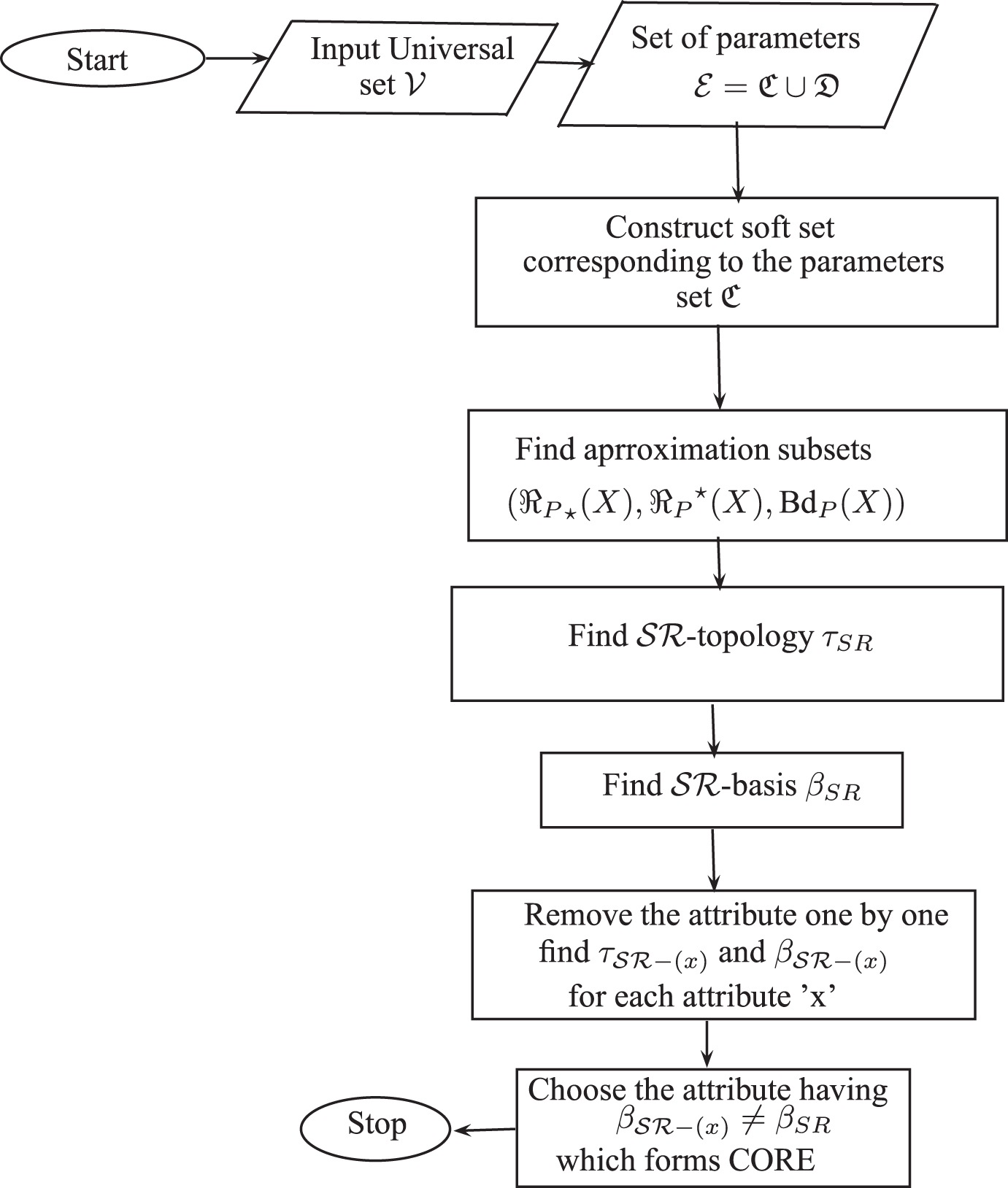
Definition 6.1. Suppose as set of objects, is the soft set and is the the corresponding soft approximation space. Let be an indiscernibility relation. Let be a -topology on and βSR be the basis defined for . Let be the subset of , is said to be core of if for each ’s’ in . i.e. a core of is the subset of attributes with the condition that if we remove any element from it will affect the classification power of the attributes. Algorithm:InputStep-1: Consider a universe of discourse (set of objects) , a set of attributes which can be classified into two categories of decision attributes and of condition attributes. Consider an indiscernibility relation on . Construct the soft set in tabular form corresponding to condition attributes and a subset of . The columns indicate the objects, rows indicate the attributes and entries of table give attribute values. OutputStep-2: Classify set and find the - approximation subsets w.r.t . Step-3: Define Soft Rough Topology on and find basis βSR. Step-4: By removing an attribute x from , find again the -approximation subsets w.r.t . Step-5: Generate -topology on ,define its basis . Step-6: Repeat step 4 and step 5 for each attribute in . Step-7: The attributes for which gives the .
Graphical representation of Algorithm.
In the next example we extend the idea of Bakier et al. and we use the notion of core to find the decision factors about Tuberculosis(TB).
Example 6.2. We apply the concept of -topology in Tuberculosis(TB). Consider the following information table which shows data about 6 patients. The rows of the table represents the objects(patients). Let be the set of patients and , where ζ1 stands for ‘Fever’, ζ2 stands for ‘Cough’, ζ3 stands for “Weight Loss” and ζ4 stands for “Loss of Appetite”. Let is the soft set over shown by Table 8,corresponding soft approximation space . For and indiscernibility relation ’TB’ we have , and .
γ1
γ2
γ3
γ4
γ5
γ6
ζ1
1
1
0
0
1
1
ζ2
0
1
0
1
0
0
ζ3
0
0
1
0
1
1
ζ4
1
1
1
0
0
0
TB
1
0
0
0
1
1
So we define -topology as and its basis . If we remove the attribute “Fever”, then we have
is a -topology and its basis is
If we remove the attribute ‘Cough’, then we have
is a -topology and its basis is
If we remove the attribute ’Weight Loss’, then we have
is a -topology and its basis is
If we remove the attribute ‘Loss of appetite’, then we have
is a -topology and its basis is
Thus, CORE (SR) = {ζ2, ζ3}, i.e., ‘Cough’ and ‘Weight Loss’ are the deciding attributes of the chronic disease Tuberculosis(TB).
Conclusion
We studied soft rough sets (-sets) and topological structure on -set. We defined -open set, -closed set, -interior, -closure, -frontier, -neighbourhood and -limit point. We presented an algorithm for modeling uncertainties in the multi-criteria group decision making (MCGDM) using set and another algorithm for modeling uncertainties in the multi-criteria decision making (MCDM) by using -topology.
References
1.
M.I.Ali, F.Feng, X.Y.Liu, W.K.Min and M.Shabir, On some new operations in soft set theory, Computers and Mathematics with Applications57(2009), 1547–1553.
2.
M.I.Ali, A note on soft sets, rough soft sets and fuzzy soft sets, Applied Soft Computing11(2011), 3329–3332.
3.
H.Aktas and N.Çaėman, Soft sets and soft group, Information Sciences177(13)(2007), 2726–2735.
4.
M.Y.Bakier, A.A.Allam and SH.S.Abd-Allah, Soft rough topology, Annals of Fuzzy Mathematics and Informatics11(2)(2016), 4–11.
5.
N.Çagman, S.Karataş and S.Enginoglu, Soft topology, Computers and Mathematics with Applications62(2011), 351–358.
6.
D.Chen, The parametrization reduction of soft sets and its applications, Computers and Mathematics with Applications49(2005), 757–763.
7.
F.Feng, C.Li, B.Davvaz and M.I.Ali, Soft sets combined with fuzzy sets and rough sets: a tentative approach, Soft Computing14(2010), 899–911.
8.
F.Feng, X.Liu, V.L.Fotea and Y. B.Jun, Soft sets and Soft rough sets, Information Sciences181(2011), 1125–137.
9.
M.Kryskiewicz, Rough set approach to incomplete information systems, Information Sciences112(1998) 39–49.
10.
X.Ma, Q.Liu and J.Zhan, A survey of decision making methods based on certain hybrid soft set models, Artificial Intelligence Review47(2017), 507–530.
11.
X.Ma, Q.Liu, J.Zhan, M.I.Ali and N.Mehmood, A survey of decision making methods based on two classes of hybrid soft set models, Artificial Intelligence Review, 49(4)(2018), 511–529.
12.
T.J.Mathew, E.Sherly and J.C.R.Alcantud, A multimodal adaptive approach on soft set based diagnostic risk prediction system, Journal of Intelligence and Fuzzy Systems34(3)(2018), 1609–1618.
13.
P.K.Maji, A.R.Roy and R.Biswas, An application of soft sets in a decision making problem, Computers and Mathematics with Applications, 44(8-9)(2002), 1077–1083.
14.
P.K.Maji, A.R.Roy and R.Biswas, Soft set theory, Computers and Mathematics with Applications, 45(4-5)(2003), 555–562.
15.
D.Molodtsov, Soft set theoty-first results, Computers and Mathematics with Applications, 37(4-5)(1999), 19–31.
16.
Z.Pawlak, Rough sets, International Journal of Information and Computer Science11(1982), 341–356.
17.
Z.Pawlak and A.Skowron, Rough sets: Some extensions, Information Sciences177(2007) 28–40.
18.
D.Pie and D.Miao, From soft sets to information system, Granular Computing, IEEE International Conference2(2005) 617–621.
19.
M.Riaz and K.Naeem, Measurable Soft Mappings, Punjab University Journal of mathematics48(2)(2016), 19–34.
20.
M.Riaz, K.Naeem and M.O.Ahmad, Novel Concepts of Soft Sets with Applications, Annals of Fuzzy Mathematics and Informatics13(2)(2017), 239–251.
21.
M.Riaz and Z.Fatima, Certain properties of soft metric spaces, Journal of Fuzzy Mathematics25(3)(2017), 543–560.
22.
M.Riaz and M.R.Hashmi, Certain applications of fuzzy parameterized fuzzy soft sets in decision-making problems, International Journal of Algebra and Statistics5(2)(2016), 135–146.
23.
M.Riaz and M.R.Hashmi, Fuzzy parameterized fuzzy soft topology with applications, Annals of Fuzzy Mathematics and Informatics13(5)(2017),593–613.
24.
M.Riaz and M.R.Hashmi, Fuzzy Parameterized Fuzzy Soft Compact Spaces with Decision-Making, Punjab University Journal of mathematics50(2)(2018),131–145.
25.
M.Riaz, M.R.Hashmi, Fixed points of fuzzy neutrosophic soft mapping with decision-making, Fixed point theory and applications7(2018), 1–10.
26.
M.Riaz, M. R.Hashmi and A.Farooq, Fuzzy Parameterized Fuzzy Soft Metric spaces, Journal of Mathematical Analysis9(2)(2018), 25–36.
27.
R.Roy and P.K.Maji, A fuzzy soft set theoretic approach to decision making problems, Journal of Computational and Applied Mathematics203(2)(2007), 412–418.
28.
A.S.Salama, Some Topological Properies of Rough Sets with Tools for Data Mining, International Journal of Computer Science Issues8(3)(2011), 588–595.
29.
M.Shabir and M.Naz, On soft topological spaces, Computers and Mathematics with Applications61(2011), 1786–1799.
30.
M.L.Thivagar, C.Richard and N.R.Paul, Mathematical Innovations of a Modern Topology in Medical Events, International Journal of Information Science2(4)(2012), 33–36
31.
L.A.Zadeh, Fuzzy sets, Information and Control8(1965), 338–353.
32.
J.Zhan, Q.Liu and T.Herawan, A novel soft rough set: soft rough hemirings and its multicriteria group decision making, Applied Soft Computing54(2017), 393–402.
33.
J.Zhan, M.I.Ali and N.Mehmood, On a novel uncertain soft set model: Z-soft fuzzy rough set model and corresponding decision making methods,Applied Soft Computing56(2017), 446–457.
34.
J.Zhan and J.C.R.Alcantud, A novel type of soft rough covering and its application to multicriteria group decision making, Artificial Intelligence Review (2018), https://doi.org/10.1007/s10462-018-9617-3.
35.
L.Zhang, J.Zhan, Fuzzy soft β-covering based fuzzy rough sets and corresponding decision-making applications,International Journal of Machine Learning and Cybernatics (2018), https://doi/10.1007/s13042-018-0828-3.
36.
L.Zhang, J.Zhan, Novel classes of fuzzy soft;-coverings-based fuzzy rough sets with applications to multi-criteria fuzzy group decision making, Soft Computing (2018), https://doi.org/10.1007/s00500-018-3470-9.
37.
L.Zhang, J.Zhan, Z.X.Xu, Covering-based generalized IF rough sets with applications to multi-attribute decision-making, Information Sciences478(2019), 275–302.