Skew lattice theory and rough set theory are relatively independent. In this paper, we focus on the relationship between rough sets and skew lattices, a non-commutative generalization of lattices. Motivated by the study on rough ideals in algebraic structures such as lattices, groups and gamma semigroups, we investigate rough substructures of skew lattices, including rough sub-skew lattices and rough sublattices, rough ideals and rough filters, as well as rough s-ideals and rough s-filters.
Rough set theory, proposed by Pawlak [20], is a mathematical tool for dealing with uncertainty and vagueness that has been widely applied to various fields such as pattern recognition, data mining and automated knowledge acquisition (see [14–18, 22]). Using the equivalence classes of an equivalence relation on a universe, Pawlak constructed a lower and an upper approximation for every subset of that universe. Rough set theory can be viewed as the extension of ZF set theory described by Mani [19].
Skew lattices were introduced by J. Leech [13] in 1989, which are one of the most successful non-commutative generalizations of lattices. Many researchers have contributed to skew lattice theory in recent years. In general, a skew lattice S is an algebra (S, ∨ , ∧), where S is a non-empty set, and both ∨ and ∧ are binary operations on S satisfying associative, idempotent and two special absorption laws. If S is also commutative, then it is a lattice. Although, a skew lattice has a natural quasi-order “⪯” (y ⪯ x ⇔ x ∨ y ∨ x = x or y ∧ y ∧ y = y) and a natural partial order “≤” (y ≤ x ⇔ x ∨ y = y ∨ x = x or x ∧ y = y ∧ x = y), it is generally not an ordered structure in which its binary operations ∨ and ∧ cannot be determined by either order relation. From the perspective of semigroup theory, both the algebraic reducts (S, ∨) and (S, ∧) of a skew lattice S are bands, that is, semigroups in which every element is idempotent. Hence, a number of basic concepts and results from semigroup theory have been passed on to skew lattice theory. For example, in the skew lattice, the equivalence relations , and are generalizations of Green’s Relations arising in semigroup theory, which are of critical importance in investigating different subvarieties of skew lattices. In particular, they have been useful in analyzing properties (and their corresponding subvarieties) such as distributivity, cancelation, normally and symmetry. On the other hand, as some of these topics indicate, there has also been a focus on extending concepts and results about lattices to skew lattices. It is worth noting that the papers [1, 11] provide non-commutative versions of Stone duality for Boolean lattices and Priestly duality for bounded distributive lattices with the help of sheaf theory and category theory. Skew lattices have demonstrated in their relevance in Econometrics, Computer Science, Logic and elsewhere [3–5, 23].
The main purpose of this paper is to discuss the rough substructures of skew lattices. Actually, rough substructures of algebraic systems were the interesting topics for many scholars. For example: Jun investigated the properties of lower and upper approximation in gamma semigroups in [10]. Biswas and Nanda [6] proposed the notion of rough subgroups and discussed their basic properties. Zhan and Davvaz studied the notions of rough soft sets and rough soft rings [9, 28]. Kuroki [12] and Xiao [24] respectively introduced the notions of rough ideals and rough prime ideals in a semigroup; Xiao and Li [25, 26] considered rough ideals of a lattice and rough subsets induced by ideals. In this paper, six substructures of a skew lattice are studied in connection with rough approximations: sub-skew lattices and sublattices, ideals and filters, as well as s-ideals and s-filters.
The paper is organized as follows: In Section 2, we introduce some basic concepts and results on rough sets and skew lattices. In Section 3, we discuss the properties of rough subsets of skew lattices relative to a given congruence relation θ. Section 4 proposes upper (lower) rough sub-skew lattices, upper (lower) rough ideals and their duals, upper (lower) rough filters, upper (lower) rough s-ideals and s-filters, and upper (lower) rough sublattices. We study their properties relative to an arbitrary congruence and to the three special congruence relations , and in particular. In Section 5, we extend some of these properties to products and quotients of skew lattices. In Section 6, homomorphic images of rough substructures are considered. We give a conclusion inSection 7.
Some preliminaries on rough sets and skew lattices
In this section, we will recall some elementary concepts about skew lattices and rough sets, and some important results which will be widely used in the following sections.
A skew lattice is an algebra (S, ∨ , ∧), where S is a non-empty set, both ∨ and ∧ are binary operations on S, called the meet and join, respectively, which are closed in S, and satisfy the following identities:
: (x ∨ y) ∨ z = x ∨ (y ∨ z) and (x ∧ y) ∧ z = x ∧ (y ∧ z);
: x ∨ x = x and x ∧ x = x;
: x ∨ (x ∧ y) = x = x ∧ (x ∨ y) and (x ∨ y) ∧ y = y = (x ∧ y) ∨ y;
: x ∨ y = y ⇔ x ∧ y = x and x ∨ y = x ⇔ x ∧ y = y.
The identities introduced above in SL1 ∼ SL3 are known as the associative laws, the idempotent laws and the absorption laws. Especially, the condition SL3 and the condition are equivalent in skew lattices. Clearly, a lattice is in fact a skew lattice satisfying the commutaive laws:
: x ∨ y = y ∨ x and x ∧ y = y ∧ x.
Definition 2.1. Let (S, ∨ , ∧) be a skew lattice. A relation θ on the S is called left compatible, if
and right compatible, if
It is called compatible, if
∀ s, t, s′, t′ ∈ S, (s, s′) ∈ θ,(t, t′) ∈ θ ⇒
(s ∨ t, s′ ∨ t′) ∈ θ, (s ∧ t, s′ ∧ t′) ∈ θ .
A left [right] compatible equivalence relation is called a left [right] congruence relation. A compatible equivalence relation is called a congruence relation.
From Definition 2, we know that a relation θ on a skew lattice S is a congruence relation if and only if it is both a left and a right congruence relation.
Like a lattice, a skew lattice has a natural partial order “≤” defined between elements as follows:
and a natural quasi-order “⪯” defined as follows:
The algebraic reducts of a skew lattice (S, ∨) and (S, ∧) are regular bands, which satisfy the identities:
By using the quasi-order, an equivalence relation can be induced, denoted by , which is an important equivalence relation in skew lattice theory together with the equivalence relations and . The three equivalence relations above are respectively defined as follows:
and x ⪯ y ⇔ x ∨ y ∨ x = x and y ∨ x ∨ y = y ⇔ y ∧ x ∧ y = y and x ∧ y ∧ x = x;
and y ∧ x = x ⇔ x ∨ y = x and y ∨ x = y;
and x ∧ y = x ⇔ y ∨ x = x and x ∨ y = y.
The three equivalence relations presented above are skew lattice congruences that were derived from the Green’s Relations in semigroup theory. The relations and refine , with , , where Δ denotes the identity relation. Among the three congruence relations, the blocks of the quotient algebra are rectangular skew lattices, in which for any two elements x, y in the same block, x ∨ y ∨ x = x and y ∨ x ∨ y = y, and likewise y ∧ x ∧ y = y and x ∧ y ∧ x = x.
The following Decomposition Theorems for skew lattices are the frameworks of fundamental theory of skew lattices.
Theorem 2.2. [First Decomposition Theorem](J. Leech, 1989) Let (S, ∨ , ∧) be a skew lattice. Then the equivalence relation as defined above forms a congruence relation. The equivalence classes are the maximal rectangular subalgebras of S, while the quotient algebra is the maximal lattice image of S.
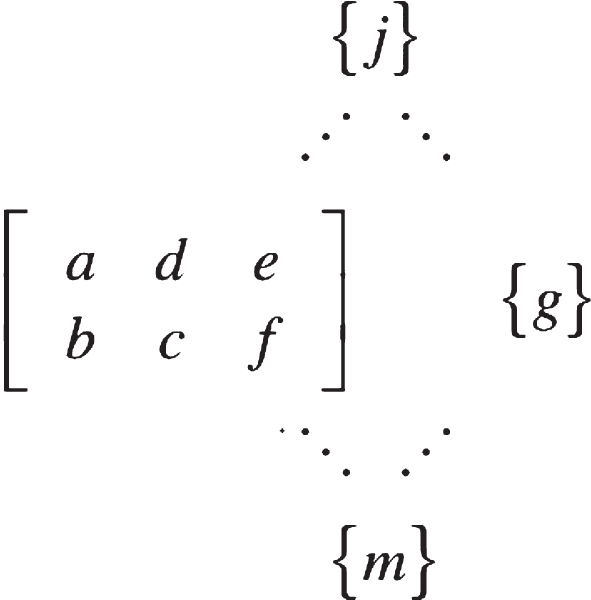
From the above theorem, we know that every skew lattice is a lattice of sub-rectangular skew lattices of itself. For some insight, we consider a skew diamond consisting of a pair of incomparable -classes, A and B, their join class J and their meet class M in the lattice of -classes .
Theorem 2.3. [13] Let (S, ∨ , ∧) be a skew lattice and A and B equivalence classes in S. Suppose that A ≤ B in , then for each a in A, there exists b in B such that a ≤ b, and dually, for each b in B, there exists a in A such that a ≤ b. In general, let J and M be equivalence classes such that J = A ∨ B, and M = A ∧ B in . Let j ∈ J be given and pick a ∈ A and b ∈ B such that a, b ≤ j in S. Then j = a ∨ b = b ∨ a in S. Thus, in S, J = {a ∨ b ∣ a ∈ A, b ∈ B, and a ∨ b = b ∨ a}. Similar remarks hold for M and ∧.
Remark 2.4. Clearly, in Theorem 2 the equivalence class J contains all individual joins a ∨ b and b ∨ a for an a in the class A and an b in the class B, with a ∨ b = b ∨ a in some cases. It turns out that every member of J can be expressed as some commuting join. Similar remarks hold for M and ∧.
In universal algebras, skew lattices form a variety of algebras. Two particular subvarieties arise in a fundamental decomposition of skew lattices. Right handed skew lattices are the skew lattices that satisfy the identities:
Dually, the left handed skew lattices are the skew lattices satisfy the identities:
The following theorem, called the Second Decomposition Theorem for skew lattices, describes another decomposition that is related to the congruences and .
Theorem 2.5. [13] [Second Decomposition Theorem](J. Leech, 1989) Let (S, ∨ , ∧) be a skew lattice. Then S is biregular. Thus is a congruence relation on S and is the maximal left handed image of S, with the induced homomorphism being bijective between corresponding -classes. Dually, is also a congruence relation and forms the maximal right handed image of S, with the induced homomorphism being bijective between corresponding R-classes. To within isomorphism, every skew lattice uniquely decomposes as the fibred product of a right handed skew lattice with a left handed skew lattice over a common underlying maximal image .
In what follows, we recall the definitions of some substructures of a skew lattice.
Definition 2.6. [13] Let S be a skew lattice and ∅ ≠ I ⊆ S. Then I is a sub-skew lattice if it is closed under ∨, ∧.
Definition 2.7. [13] Let S be a skew lattice and ∅ ≠ A ⊆ L. Then A is a sublattice if a, b ∈ A imply b ∨ a = a ∨ b ∈ A, a ∧ b = b ∧ a ∈ A.
Definition 2.8. An s-idealI of S is a sub-skew lattice of S such that for all a ∈ S and b ∈ I, a ⪯ b implies a ∈ I; Duality, an s-filterF of S is also a sub-skew lattice of S such that for all b ∈ S and a ∈ I, a ⪯ b implies b ∈ I.
Definition 2.9. [13] An idealI of S is a sublattice of S such that for all a ∈ S and b ∈ I, a ≤ b implies a ∈ I. Dually, a filterF of S is also a sublattice of S such that for all b ∈ S and b ∈ I, a ≤ b impliesb ∈ I.
We denote the collection of all s-ideals in a skew lattice S by and the collection of all ideals of S by . Dually, we denote the collection of all s-filters in a skew lattice S by and the collection of all filters of S by .
Next, we will recall some basic concepts in rough set theory.
Definition 2.10. A skew lattice S is normal if it satisfies the identity x ∧ y ∧ z ∧ w = x ∧ z ∧ y ∧ w; equivalently, S is normal if for any x ∈ S, its down set, ↓ x = {u ∈ S ∣ u ≤ x} is a sublattice, and in particular is commutative. More generally, if A is sublattice of a normal skew lattice S, then ↓A = {u ∈ S ∣ ∃ x ∈ A suchthat u ≤ x} is also a sublattice of S.
In the dual fashion, a conormal skew lattice is defined in terms of ∨. Here, if A is a sublattice of S, then ↑A = {u ∈ S ∣ ∃ x ∈ A suchthat x ≤ u} is also a sublattice of S.
Example 2.11. (1) The centerZS of a skew lattice is the set of all elements that both ∨-commutative and ∧-commutative with each element of S. ZS turns out to be the union of all singleton -classes in S (and thus could be empty!). If S is normal, then ZS is in fact an s-ideal of S (and thus an ideal). But if S is conormal, then ZS is an s-filter of S (and thus a filter). (2) A lattice section of a skew lattice S is a sublattice S0 that intersects uniquely with each -class of S. A lattice section of S, if it exists, is an internal copy of the maximal lattice image of S.
Definition 2.12. An approximation space is a pair (X, θ), where X is a non-empty set and θ is an equivalence relation on X. Let A be a non-empty subset of X, θ- (A) = {x ∈ X ∣ [x] θ ⊆ A} and θ- (A) = {x ∈ X ∣ [x] θ ∩ A ≠ ∅}, then θ- (A) and θ- (A) are called, respectively, the θ-lower and θ-upper approximations of A. (θ- (A) , θ- (A)) is called a rough set with respect to θ, if θ- (A) ≠ θ- (A). If a subset A ⊆ X satisfies θ- (A) = θ- (A), then A is called a definable set of (X, θ). We denote all the definable sets of (X, θ) by . It’s clear that and forms a Boolean algebra under ∩, ∪, \, ∅.
Furthermore, it would be worth to mentioning that a subset A is definable set of (X, θ) precisely, when it is a union of θ-equivalence classes. Thus, θ- (A) is the unique maximal θ-definable subset of A while θ- (A) is the unique minimal θ-definable subset containing A.
Example 2.13. For the Green’s equivalence relations , and : The center ZS is definable relative to , being the union of all singleton -classes. If S has a lattice section S0, then and . Also, and . Similarly, and . Here, and denote respectively and congruence classes of x.
Theorem 2.14.Let θ and η be equivalence relations on a non-empty set X. If A and B are non-empty subsets of X, then:
θ- (A) ⊆ A ⊆ θ- (A); if either ⊆ is =, then so is the other and A is definable;
θ- (A ∪ B) = θ- (A) ∪ θ- (B);
θ- (A ∩ B) = θ- (A) ∩ θ- (B);
A ⊆ B implies θ- (A) ⊆ θ- (B) and θ- (A) ⊆ θ- (B);
θ- (A ∪ B) ⊇ θ- (A) ∪ θ- (B);
θ- (A ∩ B) ⊆ θ- (A) ∩ θ- (B);
θ ⊆ η implies θ- (A) ⊇ η- (A) and θ- (A) ⊆ η- (A);
θ- (θ- (A)) = θ- (A); θ- (θ- (A)) = θ- (A);
forms a complete atomic Boolean algebra under ∩, ∪, \, ∅.
Rough subsets in skew lattices
In what follows, let A be a non-empty subset of the skew lattice S. Then (θ- (A) , θ- (A)) is a rough subset of S with respect to an equivalence relation θ, where θ- (A) ≠ θ- (A). In this section, we denote the join and meet of two subsets A and B in a skew latticeby
and for families of subsets of the skew lattice S, {Ai ∣ i ∈ I}, {Bj ∣ j ∈ J},
We say that a congruence relation θ on a skew lattice S is join-complete, if
Dually, θ is said to be meet-complete, if
A congruence relation θ is said to be complete, if it is both join-complete and meet-complete. It is obvious that the congruence relation is complete based on Theorem 2 and Theorem 2. Some important instances of complete congruences are:
Theorem 3.1., , are complete congruences on any skew lattice S.
Proof. That is complete is clear from Theorem 2.
We show that is meet complete. That it is join complete and that is both meet and join complete are shown similarly. So, let be the canonical epimorphism. on and π is bijective between corresponding -classes.
Given a, b ∈ S, is at least contained in . Thus, is at least contained in . Moreover, conditional equality holds in which if and only if . But from
and the bijectivity of π on -classes, follows. Thus, is meet complete and similarly it is join complete, and likewise for . ■
We know that lattices can be viewed as a special case of skew lattices. Hence, many properties of rough sets in lattices can be generalized to skew lattices. We will show several results of the generalizations in the following.
Proposition 3.2.Let θ be a congruence relation on a skew lattice S, A and B non-empty subsets of S. Then
θ- (A) ∨ θ- (B) ⊆ θ- (A ∨ B);
θ- (A) ∧ θ- (B) ⊆ θ- (A ∧ B);
If θ is join-complete, then θ- (A) ∨ θ- (B) = θ- (A ∨ B) and θ- (A) ∨ θ- (B) ⊆ θ- (A ∨ B);
If θ is meet-complete, then θ- (A) ∧ θ- (B) = θ- (A ∧ B) and θ- (A) ∧ θ- (B) ⊆ θ- (A ∧ B).
Proof. We only prove (1) and (3). (2) and (4) can be proved similarly.
(3) The first assertion follows upon replacing the ⊆ with =. The second assertion follows from observing that [a] θ ⊆ A and [b] θ ⊆ B imply [a ∨ b] θ = [a] θ ∨ [b] θ ⊆ A ∨ B. ■
Corollary 3.3.For any skew lattice S and subsets A and B:
and ;
and ;
Similar remarks hold for and .
Proposition 3.4.Let θ1, θ2 be congruence relations on a skew lattice S and A a non-empty subset of S. Then
;
(θ1 ∩ θ2) - (A) ⊇ θ1- (A) ∪ θ2- (A).
Proof. (1), (2) are obvious by Theorem 2 (7). ■
Remark 3.5. In any variety of algebras it is well-known that if θ ∘ η = η ∘ θ, then η ∨ θ = η ∘ θ. This holds in particular for skew lattices.
Theorem 3.6.Let θ, η be congruence relations on a skew lattice S such that θ ∘ η = η ∘ θ. If A is a sub-skew lattice of S, then
Proof. (1) If c ∈ θ- (A) ∨ η- (A), then c = a ∨ b with a ∈ θ- (A), b ∈ η- (A). Thus, there exist x, y ∈ A such that x ∈ [a] θ ∩ A, y ∈ [b] η ∩ A. Since A is a non-empty sub-skew lattice of S, we have x ∨ y ∈ A. Thus, x ∨ y ≡ a ∨ y (mod θ); a ∨ y ≡ a ∨ b (mod η) which imply x ∨ y ≡ a ∨ b (mod η ∘ θ). Hence, a ∨ b ∈ (η ∨ θ) - (A). The proof of the second inclusion is similar.
The skew lattice S9.
(2) The proof is similar to (1). ■
In particular, corresponding statements hold for sublattices, ideals, filters, etc.
The example below shows that the converse of Theorem 3 do not hold in general.
Example 3.7. Let S9 be the skew lattice with operations defined on S = {a, b, c, d, e, f, g, m, j} by the Cayley tables below. , Δ be congruence relations on S9. A={a}, , ; ; ={{j} , {a, b, c, d, e, f} , {g} , {m}}; S/Δ = {{j} , {a} , {d} , {e} , {b} , {c} , {f} , {g} , {m}}; Δ- (A) = {a}; ={a, b}; . But, ; . We also can get the similar results with . So, the inverse inclusions about sublattice which is similar as Theorem 3 also do not hold in general, too.
Theorem 3.8.Let θ, η be congruence relations on a skew lattice S and A is a non-empty subset of S.
If θ ∘ η = η ∘ θ, then θ- (η- (A)) = η- (θ- (A)).
θ ∘ η = η ∘ θ if and only if θ- (η- (A)) = η- (θ- (A)).
Proof. (1) The proof is similar as that of statement (2), we show that in the following.
The operator "∨" of skew lattice S9
∨
a
b
c
d
e
f
g
m
j
a
a
a
d
d
e
e
j
a
j
b
b
b
c
c
f
f
j
b
b
c
b
b
c
b
j
f
j
c
j
d
a
a
d
d
e
e
j
d
j
e
a
a
d
d
e
e
j
e
j
f
b
b
c
c
f
f
j
j
j
g
j
j
j
j
j
j
g
j
j
m
a
b
c
d
e
f
g
m
j
j
j
j
j
j
j
j
j
j
j
The operator "∧" of skew lattice S9
∧
a
b
c
d
e
f
g
m
j
a
a
b
b
a
a
b
m
m
a
b
a
b
b
a
a
b
m
m
b
c
d
c
c
d
d
c
m
m
c
d
d
c
c
d
d
c
m
m
d
e
e
f
f
e
e
f
m
m
e
f
e
f
f
e
e
f
m
m
f
g
m
m
m
m
m
m
g
m
g
m
m
m
m
m
m
m
m
m
m
j
a
b
c
d
e
f
g
m
j
(2) Suppose x ∈ θ- (η-) (A), there exists y ∈ η- (A) such that x ≡ y (mod θ). It follows that there exists z ∈ A such that y ≡ z (mod η). Thus, x ≡ z (mod θ ∘ η). Since θ ∘ η = η ∘ θ, there exists y0 ∈ S such that x ≡ y0 (mod η) and y0 ≡ z (mod θ). So, y0 ∈ θ- (A). Thus, x ∈ η- (θ-) (A). Therefore, θ- (η- (A)) ⊆ η- (θ-) (A). Similarly, it can be proved that η- (θ-) (A) ⊆ θ- (η- (A))
Conversely, Let (a, b) ∈ θ ∘ η, we have a ∈ θ- (η- ({b})) = η- (θ-) ({b}). Then, there exists y ∈ θ- ({b}) such that (a, y) ∈ η. So, (y, b) ∈ θ. Thus, we obtain (a, b) ∈ η ∘ θ. ■
Short examples about commuting congruences on skew lattices can be easily found in the following: For any skew lattice S, are congruences on S, it follows that and .
Rough ideals (filters) in skew lattices
Let θ be a congruence relation and A a non-empty subset of S. A is said to be an upper rough s-ideal [ideal, sublattice, sub-skew lattice] of S, if θ- (A) is an s-ideal [ideal, sublattice, sub-skew lattice]. A is said to be a lower rough s-ideal [ideal, sublattice, sub-skew lattice] of S, if θ- (A) is an s-ideal [ideal, sublattice, sub-skew lattice]. A is said to be a rough s-ideal [ideal, sublattice, sub-skew lattice] of S, if both θ- (A) and θ- (A) are s-ideals [ideals, sublattices, sub-skew lattices]. We denote the set of all upper [lower] rough s-ideals with respect to a congruence relation θ of S by .
Theorem 4.1.Let S be a skew lattice with a bottom element 0 (with respect to the preorder “⪯”), then is a topped ∩-structure.
Proof. It is easily to show that S is an s-ideal, i.e., . Let , then 0∈ ⋂ i∈IAi ≠ ∅. Thus, it is easy to know that ⋂i∈IAi is an s-ideal. ■
Theorem 4.2.Let S be a skew lattice with a bottom element and θ is a congruence relation on S. Then is a topped ∩-structure.
Proof. Let , then θ- (Si) is an s-ideal of S for any i ∈ I. Since θ- (⋂ i∈ISi) = ⋂ i∈Iθ- (Si), θ- (⋂ i∈ISi) is also an s-ideal of S. Thus . It is clear that . So, is a topped ∩-structure. ■
Theorem 4.3.Let θ be a congruence relation on a skew lattice S. Then relative to θ: If A is a sub-skew lattice of S, then A is an upper rough sub-skew lattice, In particular:
If A is a sublattice of S, then A is an upper rough sub-skew lattice;
If A is an s-ideal of S, then A is an upper rough s-ideal relative to θ;
If A is an s-filter of S, then A is an upper rough s-filter relative to θ.
Proof. Let π : S → S/θ be the canonical homomorphism onto S/θ. The theorem’s main statement and (1) follow from the following basic facts about sub-skew lattices. (2) and (3) follow from similar basic facts about s-ideals and s-filters:
If A is a sub-skew lattice (s-ideal) of S, then π [A] is a sub-skew lattice (s-ideal) of π [S];
If B is a sub-skew lattice (s-ideal) of π [S], then π-1 [B] is a sub-skew lattice (s-ideal) of S;
θ- (A) = π-1 [π [A]].
■
Since sub-skew lattices and sublattices are upper rough sub-skew lattices relative to θ, and s-ideals (s-filters) are upper rough s-ideals (s-filters) relative to θ, respectively. A nature question is whether the ideals (filters) are upper rough s-ideals (s-filters) relative to θ. In general the answer is no.
Example 4.4. Consider the rectangular skew lattice on {a, b} and determined by a ∧ b = b = b ∨ a. Trivially {a} forms an ideal (filter). But is not an s-ideal (s-filter).
However:
Corollary 4.5. If A is an ideal of S, then A is an upper rough s-ideal relative to the congruence .
Proof. It is easy to know that is an s-ideal, hence the corollary above is straightforward. ■
Theorem 4 shows that the upper approximation of a sub-skew lattice [s-ideal] is a sub-skew lattice [s-ideal], but the case of the lower approximation does not hold in general because if [a] θ ⊆ A, [b] θ ⊆ A, then [a] θ ∨ [b] θ ⊆ A. However, [a] θ ∨ [b] θ ⊆ [a ∨ b] θ only imply that [a∨ b] θ ∩ A ≠ ∅. We can not get [a ∨ b] θ ⊆ A in general.
Theorem 4.6.Let θ be a complete congruence relation on a skew lattice S and A be a non-empty subset of S.
If A is a sub-skew lattice of S, then θ- (A) is, if it is nonempty, a sub-skew lattice of S;
If A is a sublattice of S, then θ- (A) is, if it is nonempty, a sublattice of S;
If A is an s-ideal of S, then θ- (A) is, if it is nonempty, an s-ideal of S;
If A is an ideal of S, then θ- (A) is, if it is nonempty, an ideal of S;
If A is an s-filter of S, then θ- (A) is, if it is nonempty, an s-filter of S;
If A is a filter of S, then θ- (A) is, if it is nonempty, a filter of S.
Proof.
(1) Suppose a, b ∈ θ- (A), then [a] θ ⊆ A and [b] θ ⊆ A. Now that θ is both join-complete andmeet-complete, we have {x ∨ y ∣ x ∈ [a] θ, y ∈ [b] θ} = [a] θ ∨ [b] θ = [a ∨ b] θ and {x ∧ y ∣ x ∈ [a] θ, y ∈ [a] θ} = [a] θ ∧ [b] θ = [a ∧ b] θ. Since A is a sub-skew lattice, we have {x ∨ y ∣ x ∈ [a] θ, y ∈ [a] θ} ⊆ A and {y ∨ x ∣ x ∈ [a] θ, y ∈ [a] θ} ⊆ A; {x ∧ y ∣ x ∈ [a] θ, y ∈ [a] θ} ⊆ A and {y ∧ x ∣ x ∈ [a] θ, y ∈ [a] θ} ⊆ A. So, [a ∨ b] θ, [b ∨ a] θ, [a ∧ b] θ, and [b ∧ a] θ ⊆ A. It follows that b ∨ a, a ∨ b, b ∧ a, a ∧ b ∈ θ- (A). Therefore, θ- (A) is a sub-skew lattice.
(2) If a, b ∈ θ- (A), then [a] θ ⊆ A and [b] θ ⊆ A.Now that A is a sublattice, we have x ∨ y = y ∨ x and x ∧ y = y ∧ x for any x ∈ [a] θ, y ∈ [b] θ. Since θ is both join-complete and meet-complete, we have [a ∨ b] θ = [a] θ ∨ [b] θ = {x ∨ y ∣ x ∈ [a] θ, y ∈ [b] θ} = {y ∨ x ∣ x ∈ [a] θ, y ∈ [b] θ} = [b ∨ a] θ ⊆ A ; [a ∧ b] θ = [a] θ ∧ [b] θ = {x ∧ y ∣ x ∈ [a] θ, y ∈ [b] θ} = {y ∧ x ∣ x ∈ [a] θ, y ∈ [b] θ} = [b ∧ a] θ ⊆ A. Therefore, b ∨ a = a ∨ b, b ∧ a = a ∧ b ∈ θ- (A). Thus, it follows that θ- (A) is a sublattice.
(3) Since A is an s-ideal, then A is an sub-skew lattice. According to (1), a ∨ b, b ∨ a ∈ θ- (A) hold, for all a, b ∈ θ- (A). Let x ∈ S, y ∈ θ- (A) and x ⪯ y, then [x] θ ⊆ S, [y] θ ⊆ A. Since θ is meet-complete, we have [x ∧ y ∧ x] θ = [x] θ ∧ [y] θ ∧ [x] θ = {a ∧ b ∧ c ∣ a, c ∈ [x] θ, b ∈ [y] θ}. It is easy to see that a ∧ b ∧ c ⪯ b for all a ∧ b ∧ c ∈ {a ∧ b ∧ c ∣ a, c ∈ [x] θ, b ∈ [y] θ}. Hence, [x ∧ y ∧ x] θ = {a ∧ b ∧ c ∣ a, c ∈ [x] θ, b ∈ [y] θ} ⊆ A by the definition of s-ideal. Since x ⪯ y, then [x] θ ⊆ A, which implies x ∈ θ- (A). Thus, θ- (A) is an s-ideal.
(4) Let A be an ideal, then A is a sublattice in skew lattices. By (2), we have a ∨ b = b ∨ a ∈ θ- (A) for all a, b ∈ θ- (A). Let x ∈ S, y ∈ θ- (A) and x ≤ y, then [x] θ ⊆ S, [y] θ ⊆ A. Since θ is meet-complete, we have [y ∧ x ∧ y] θ = [y] θ ∧ [x] θ ∧ [y] θ = {b ∧ a ∧ c ∣ b, c ∈ [y] θ, a ∈ [x] θ}. So, b ∨ c = c ∨ b ∈ A for all b, c ∈ [y] θ ⊆ A because that A is an ideal of S. Thus, for all b ∧ a ∧ c ∈ {b ∧ a ∧ c ∣ b, c ∈ [y] θ, a ∈ [x] θ}, b ∧ a ∧ c ≤ b ∨ c implies b ∧ a ∧ c ∈ A. Therefore, [x] θ = [y ∧ x ∧ y] θ = {b ∧ a ∧ c ∣ b, c ∈ [y] θ, a ∈ [x] θ} ⊆ A. Thus, θ- (A) is an ideal.
The proofs of (5), (6) are similar to (3), (4). ■
From Theorems 4 to 4, we know that a sub-skew lattice [s-ideal] of a skew lattice is a rough sub-skew lattice [s-ideal] with respect to a complete congruence relation. But a sublattice or an ideal may not be a rough sublattice [ideal] under a general congruence relation, because if A is a sublattice of S, and θ is a congruence relation on S, then we can only get [a ∨ b] θ = [b ∨ a] θ, [a ∧ b] θ = [b ∧ a] θ, but not a ∨ b = b ∨ a, a ∧ b = b ∧ a in θ- (A) for any a, b ∈ θ- (A). In what follows, we will consider the rough properties of ideals and sublattices based on Green’s relations, the special congruence relations on skew lattices. Notice that any singleton subset of a skew lattice is a sublattice, it is easy to show the following theorem.
Theorem 4.7.Let S be a skew lattice and ∅ ≠ A ⊆ S a sublattice, the equivalence relations and the congruence relations on S.
A is an upper rough sublattice relative to if and only if is a right-handed skew lattice.
A is an upper rough sublattice relative to if and only if is a left-handed skew lattice.
A is an upper rough sublattice relative to if and only if is a lattice.
Proof. We only need to show that the statement (1) holds. The statements (2), (3) are shown similarly, so we omit their proofs.
Suppose that a ∈ S and {a} = A ⊆ S, then A is a sublattice of S. Since A = {a} is an upper rough sublattice relative to , it follows that . So, , which implies that S is a right-handed skew lattice. Therefore, is a right-handed skew lattice.
Conversely, it is straightforward by the definition of right-handed skew lattices. ■
Since every ideal in a skew lattice is a sublattice, the corollary is obvious from the above theorem. We omit the proof.
Corollary 4.8. Let S be a skew lattice and ∅ ≠ A ⊆ S an ideal, , and be congruence relations on S.
If S be a right handed skew lattice with congruence , then A is a definable ideal.
If S be a left handed skew lattice with congruence , then A is a definable ideal.
If S is a lattice with congruence , then A is a definable ideal.
Theorem 4.9.Let θ1 and θ2 be congruence relations on a skew lattice S.
If A is an s-ideal of S, then ;
If A is an ideal of S, then .
If A is an s-filter of S, then ;
If A is a filter of S, then .
Proof. (1) By Theorem 2 (7), we know that . We only need to prove that . Suppose that , then [x] θ1∩ A ≠ ∅, [x] θ2∩ A ≠ ∅. Take a ∈ [x] θ1 ∩ A and b ∈ [x] θ2 ∩ A, i.e., a ≡ x (mod θ1), b ≡ x (mod θ2), it is easy to see that x ∧ (a ∨ b) ∧ x ≡ x (mod θ1), x ∧ (a ∨ b) ∧ x ≡ x (mod θ2). Thus, x ≡ x ∧ (a ∨ b) ∧ x (mod (θ1 ∩ θ2)). Obviously, x ∧ (a ∨ b) ∧ x ⪯ a ∨ b. Since A is an s-ideal and a, b ∈ A, we have a ∨ b ∈ A. Hence x ∧ (a ∨ b) ∧ x ∈ A which implies [x] θ1∩θ2∩ A ≠ ∅, i.e., x ∈ (θ1 ∩ θ2) - (A). Therefore, .
(2) We only need to prove that by Theorem 2 (7). Let , then [x] θ1∩ A ≠ ∅, [x] θ2∩ A ≠ ∅. Take a ∈ [x] θ1 ∩ A and b ∈ [x] θ2 ∩ A, i.e., a ≡ x (mod θ1), b ≡ x (mod θ2), it is easy to see that (b ∨ a) ∧ x ≡ x (mod θ1), x ∧ (a ∨ b) ≡ x (mod θ1) and (a ∨ b) ∧ x ≡ x (mod θ2), x ∧ (b ∨ a) ≡ x (mod θ2). Thus, (a ∨ b) ∧ x ∧ (a ∨ b) ≡ x (mod θ1), (a ∨ b) ∧ x ∧ (a ∨ b) ≡ x (mod θ2) since a ∨ b = b ∨ a follows from a, b ∈ A and A is an ideal. So, x ≡ (a ∨ b) ∧ x ∧ (a ∨ b) (mod (θ1 ∩ θ2)). We have (a ∨ b) ∧ x ∧ (a ∨ b) ∈ A by (a ∨ b) ∧ x ∧ (a ∨ b) ≤ a ∨ b. Hence, [x] θ1∩θ2∩ A ≠ ∅, i.e., x ∈ (θ1 ∩ θ2) - (A). Thus, .
The proofs of (3), (4) are similar to (1), (2). ■
Theorem 4.10.Let θ be congruence relation on a skew lattice S.
If A and B are s-ideals of S, then θ- (A ∩ B) = θ- (A) ∩ θ- (B).
If A and B are s-filters of S, then θ- (A ∩ B) = θ- (A) ∩ θ- (B).
Proof. (1) According to Theorem 2 (4), (6), we only need to prove that θ- (A ∩ B) ⊇ θ- (A) ∩ θ- (B). Suppose that x ∈ θ- (A) ∩ θ- (B). Take a∈ [x] θ ∩ A ≠ ∅ and b∈ [x] θ ∩ B ≠ ∅, then a ∧ b ≡ x (mod θ). Since A, B are s-ideals, a ∈ A, b ∈ B and a ∧ b ⪯ a, a ∧ b ⪯ b, we have a ∧ b ∈ A, a ∧ b ∈ B. Therefore, a ∧ b ∈ A ∩ B, which implies [x] θ∩ (A ∩ B) ≠ ∅. Thus, θ- (A ∩ B) ⊇ θ- (A) ∩ θ- (B).
(2) The proof is similar to (1). ■
Theorem 4.11.Let θ be a congruence relation on a skew lattice S.
If A and B are ideals of S and θ is meet complete, then θ- (A ∧ B) = θ- (A) ∧ θ- (B);
If A and B are s-ideals of S and θ is meet complete, then θ- (A ∧ B) = θ- (A) ∧ θ- (B),
If A and B are filters of S and θ is join complete, then θ- (A ∨ B) = θ- (A) ∨ θ- (B);
If A and B are s-filters of S and θ is join complete, then θ- (A ∨ B) = θ- (A) ∨ θ- (B).
Proof. For any t ∈ θ- (A ∧ B), [t] θ∩ (A ∧ B) ≠ ∅. Take a ∧ b ∈ [t] θ ∩ (A ∧ B), then t ∈ [a ∧ b] θ, a ∈ A, b ∈ B. Since θ is a meet complete congruence relation, then [a ∧ b] θ = [a] θ ∧ [b] θ which implies t ∈ [a] θ ∧ [b] θ. Therefore, there exist m ∈ [a] θ, n ∈ [b] θ, t = m ∧ n, so t ∈ θ- (A) ∧ θ- (B). Thus, θ- (A ∧ B) ⊆ θ- (A) ∧ θ- (B);
Conversely, for any t ∈ θ- (A) ∧ θ- (B), there exist m ∈ θ- (A), n ∈ θ- (B) such that t = m ∧ n. Then, there exist a ∈ A and b ∈ B such that a ∈ [m] θ, b ∈ [n] θ. Thus, m ∈ [a] θ, n ∈ [b] θ which imply t = m ∧ n ∈ [a] θ ∧ [b] θ. Since θ is a meet complete congruence relation, we have t = m ∧ n ∈ [a ∧ b] θ. Hence, t ∈ θ- (A ∧ B).
Therefore, θ- (A ∧ B) = θ- (A) ∧ θ- (B).
(2) Similar to (1).
The proofs of (3), (4) are similar as above. ■
Rough sets in products and quotients of skew lattices
In this section, we study the properties of the product and quotient of rough sets in skew lattices. In universal algebras, we know that the products of skew lattices and the quotients of skew lattices are still skew lattices.
Lemma 5.1. Let S and T be skew lattices. Two binary operations ∨ and ∧ can be defined on S × T as follows (for any (a1, b1) , (a2, b2) ∈ S × T):
Then, (S × T, ∨ , ∧) is a skew lattice and the natural partial order ≤ and the natural quasi-order ⪯ on S × T is (for any (a1, b1) , (a2, b2) ∈ S × T):
Theorem 5.2.Let S and T be skew lattices, θ1, θ2 be congruence relations on skew lattices S and T, respectively. Define (s1, k1) ≡ (s2, k2) (mod θ) if and only if s1 ≡ s2 (mod θ1), k1 ≡ k2 (mod θ2) for any s1, s2 ∈ S, k1, k2 ∈ T. If A, B are non-empty subsets of S and T, respectively. Then
θ is a congruence relation on S × T;
, θ- (A × B) = θ1- (A) × θ2- (B);
A × B is a rough sub-skew lattice of S × T if and only if A and B are rough sub-skew lattices of S and T, respectively;
A × B is a rough s-ideal of S × T if and only if A and B are rough s-ideal of S and T, respectively;
A × B is a lower rough sublattice of S × T if and only if A and B are lower rough sublattices of S and T, respectively;
A × B is a lower rough ideal of S × T if and only if A and B are lower rough ideals of S and T, respectively.
Proof. (1), (2) Straightforward by Theorem 5.1 in [26].
(3) By the lemma above, we have got the conclusion easily.
(4) Assume that θ- (A × B) is an s-ideal of S × T. Let and . So that (x, y) ∈ S × T, and (x, y) ⪯ (x1, y1). Since θ- (A × B) is a s-ideal, (x, y) ∈ θ- (A × B) which implies . So, , respectively. The converse conclusion is easy to get.
(5) By the lemma above, we have got the conclusion easily.
(6) Assume that θ- (A × B) is an ideal of S × T. Let x ∈ S, x ≤ x1, x1 ∈ θ1- (A) and y ∈ T, y ≤ y1, . So that (x, y) ∈ S × T, (x1, y1) ∈ θ1- (A) × θ2- (B) = θ- (A × B) and (x, y) ≤ (x1, y1). Since θ- (A × B) is an ideal, (x, y) ∈ θ- (A × B) which implies (x, y) ∈ θ1- (A) × θ2- (B), So x ∈ θ1- (A) , y ∈ θ2- (B), respectively. The converse is clear. ■
Let θ be a congruence relation on a skew lattice S. Define binary operations ∨, ∧ on the quotient set S/θ : = {[a] θ ∣ a ∈ S} as follows: [a] θ ∨ [b] θ = [a ∨ b] θ, [a] θ ∧ [b] θ = [a ∧ b] θ, for any a, b ∈ S. Then (S/θ, ∨ , ∧) is a skew lattice and [a] θ ⪯ [b] θ if and only if a ∧ b ∧ a ≡ a (mod θ); [a] θ ≤ [b] θ if and only if a ∧ b ≡ a ≡ b ∧ a (mod θ). Obviously,
It is easy to know that
Hence, another form of lower and upper approximations is presented as follows:
Theorem 5.3.Let θ be a congruence relation on a skew lattice S, then
A is a lower [an upper] rough sub-skew lattice of S if and only if θ- (A)/θ [θ- (A)/θ] is a sub-skew lattice of S/θ;
A is a lower [an upper] rough s-ideal of S if and only if θ- (A)/θ [θ- (A)/θ] is an s-ideal of S/θ;
If A is a lower rough sublattice of S, then θ- (A)/θ is a sublattice of S/θ;
If A is a lower rough ideal of S, then θ- (A)/θ is an ideal of S/θ.
Proof. (1) Suppose that A is a lower rough sub-skew lattice of S, then θ- (A) is a sub-skew lattice of S. If [x] θ, [y] θ ∈ θ- (A)/θ, then x, y ∈ θ- (A). Now that A is a lower rough sub-skew lattice of S, we have x ∨ y, y ∨ x ∈ θ- (A), x ∧ y, y ∧ x ∈ θ- (A). It follows that [x] θ ∨ [y] θ = [x ∨ y] θ ∈ θ- (A)/θ, [y] θ ∨ [x] θ = [y ∨ x] θ ∈ θ- (A)/θ. Analogously, [x] θ ∧ [y] θ = [x ∧ y] θ ∈ θ- (A)/θ, [y] θ ∧ [x] θ = [y ∧ x] θ ∈ θ- (A)/θ. Thus, θ- (A)/θ is a sub-skew lattice of S/θ.
Conversely, assume that θ- (A)/θ is a sub-skew lattice of S/θ. If x, y ∈ θ- (A), then [x] θ, [y] θ ∈ θ- (A)/θ. Now that θ- (A)/θ is a sub-skew lattice, which implies [x ∨ y] θ = [x] θ ∨ [y] θ ∈ θ- (A)/θ, [y ∨ x] θ = [y] θ ∨ [x] θ ∈ θ- (A)/θ. So, x ∨ y, y ∨ x ∈ θ- (A). Similarly, x ∧ y, y ∧ x ∈ θ- (A). Thus, θ- (A) is a sub-skew lattice of S.
The case of upper approximation can be showed similarly.
(2)Suppose that A is a lower rough s-ideal of S. Let [x] θ ∈ θ- (A)/θ, [y] θ ∈ S/θ such that [y] θ ⪯ [x] θ. By x ∈ θ- (A) and y ≡ y ∧ x ∧ y (mod θ), we have y ∧ x ∧ y ⪯ x. Thus, y ∧ x ∧ y ∈ θ- (A) and [y] θ = [y ∧ x ∧ y] θ ⊆ A. So, [y] θ ⊆ A. Therefore, [y] θ ∈ θ- (A)/θ. Combined with (1), we conclude that θ- (A)/θ is an s-ideal of S/θ.
Conversely, assume that θ- (A)/θ is an s-ideal of S/θ. Let x ∈ θ- (A), y ∈ S and y ⪯ x, then [x] θ ∈ θ- (A)/θ, [y] θ ∈ S/θ and y = y ∧ x ∧ y imply [y] θ ⪯ [x] θ. Since θ- (A)/θ is an s-ideal, we have [y] θ ∈ θ- (A)/θ. Hence, y ∈ θ- (A). Combined with (1), we have A is an s-ideal of S.
The case of upper approximation can be proved in a similar way.
(3) Suppose that A is a lower rough sublattice of S. If [x] θ, [y] θ ∈ θ- (A)/θ, then x, y ∈ θ- (A). Now that A is a lower rough sublattice of S, it follows that x ∨ y = y ∨ x ∈ θ- (A). Then [x ∨ y] θ = [y ∨ x] θ ∈ θ- (A)/θ, which implies that [x] θ ∨ [y] θ = [y] θ ∨ [x] θ ∈ θ- (A)/θ. Similarly, [x] θ ∧ [y] θ = [y] θ ∧ [x] θ ∈ θ- (A)/θ. Therefore, θ- (A)/θ is a sublattice of S/θ.
(4) Assume that A is a lower rough ideal of S, then A is a lower rough sublattice of S. Thus, let [x] θ, [y] θ ∈ θ- (A)/θ, then [x] θ ∨ [y] θ = [y] θ ∨ [x] θ ∈ θ- (A)/θ by (3). Let [x] θ ∈ θ- (A)/θ, [y] θ ∈ S/θ and [y] θ ≤ [x] θ, then x ∈ θ- (A) , y ∈ S and y ∧ x = x ∧ y ≡ y (mod θ). Thus, y ∧ x ∈ θ- (A) by y ∧ x ≤ x, which imply [y] θ = [y ∧ x] θ ∈ θ- (A)/θ. Hence, θ- (A)/θ is an ideal. ■
From the above Theorem 5 (3), (4), we know that the lower rough ideals [sublattices] in a skew lattice S can induce the ideals [sublattices] in the S/θ. But, conversely, if θ- (A)/θ is an ideal [sublattice] of S/θ, θ- (A) may not be an ideal [sublattice]. Because, in the S/θ, we can’t get x ∨ y = y ∨ x by [x] θ ∨ [y] θ = [y] θ ∨ [x] θ, similarly for [x] θ ∧ [y] θ = [y] θ ∧ [x] θ and [x] θ ≤ [y] θ.
Rough approximations and homomorphisms
It’s well known that a skew lattice homomorphism f : S → T induces a congruence on S. In this part, we discuss the properties of rough sets between skew lattices with the related homomorphism which preserves basic operations on skew lattices. We begin our discussions in this section by introducing some basic definitions and concepts.
Definition 6.1. Let S be a skew lattice with 0 and 1 in S such that for any x ∈ S, x ⪯ 1 and 0 ⪯ x. Then S is called an s-bounded skew lattice. Let S be a skew lattice with 0 and 1 in S such that for any x ∈ S, x ≤ 1 and 0 ≤ x. Then S is called a bounded skew lattice.
Definition 6.2. Let S and T be skew lattices. A map f : S ⟶ T is a homomorphism if f is both join-preserving and meet-preserving, that is, f (a ∨ b) = f (a) ∨ f (b) and f (a ∧ b) = f (a) ∧ f (b), for all a, b ∈ S.
If S and T are bounded skew lattices, then the homomorphism f : S ⟶ T is called a {0, 1}-homomorphism if it also satisfies f (0) =0, f (1) =1.
The following two lemmas are well known, we omit the proofs.
Lemma 6.3. Suppose that f is a homomorphism from a skew lattice S to a skew lattice T. Then the relation θ, defined on S as: for all a, b ∈ S, a ≡ b (mod θ) ⇔ f (a) = f (b), is a congruence on S (We denote θ by ker f).
Lemma 6.4. Let f be a {0, 1}-homomorphism from bounded skew lattices S to T. Then f-1 (0) = {x ∈ S ∣ f (x) =0} is an s-ideal.
Theorem 6.5.Suppose that f : S → T is a homomorphism of skew lattices with ker f = θ. Let A be a subset of S. Then
f (θ- (A)) = f (A);
if f is one to one, then f (θ- (A)) = f (A).
Proof. (1) It is obvious that A ⊆ θ- (A), so f (A) ⊆ f (θ- (A)). Suppose that x ∈ θ- (A), then there exists an a ∈ A such that a∈ [x] θ ∩ A ≠ ∅. Thus, f (x) = f (a) by θ = ker f which implies f (A) ⊇ f (θ- (A)). Hence, f (θ- (A)) = f (A).
(2) If f is one-to-one, then θ is the identity congruence and the assertion is obvious. ■
Theorem 6.6.Suppose that f is a surjective homomorphism from a skew lattice S to a skew lattice T and A is a subset of S. Let θ2 be a congruence relation on T and θ1 = {(x1, x2) ∈ S × S ∣ (f (x1) , f (x2)) ∈ θ2}, then
θ1 is a congruence relation on S;
;
f(θ1- (A)) ⊆ θ2- (f (A)); furthermore, if f is one to one, then f (θ1- (A)) = θ2- (f (A)).
Proof. (1) The proof is straightforward.
(2) Suppose that , there exist x, a ∈ S such that f (x) = y and a ∈ [x] θ1 ∩ A. Then (f (x) , f (a)) ∈ θ2 by (a, x) ∈ θ1, i.e., (y, f (a)) ∈ θ2, which implies f (a) ∈ [y] θ2 ∩ f (A). Thus, . So, .
For any , there exist a ∈ A and x ∈ S such that f (x) = y and (y, f (a)) ∈ θ2. Then (x, a) ∈ θ1, which implies a ∈ [x] θ1 and . Thus, . So, .
Hence, we have .
(3) The conclusion is clear. If f is one to one, then it is an isomorphism so that equality is obvious. ■
Theorem 6.7.Suppose that f is a surjective homomorphism from a skew lattice S to a skew lattice T and A is a subset of S. Let θ2 be a congruence relation on T and θ1 = {(x1, x2) ∈ S × S ∣ (f (x1) , f (x2)) ∈ θ2}.
is a sub-skew lattice of S if and only if is a sub-skew lattice of T.
is an s-ideal of S if and only if is an s-ideal of T.
If f is one to one, then θ1- (A) is a sub-skew lattice [an s-ideal] of S if and only if θ2- (f (A)) is a sub-skew lattice [an s-ideal] of T.
Proof. (1) Suppose that is a sub-skew lattice of S and . According to Theorem 6 above, we have . It follows that there exist such that f (x1) = y1, f (x2) = y2. Now that is a sub-skew lattice, we have and . Thus, y1 ∨ y2 = f (x1) ∨ f (x2)=, , , . Therefore, is a sub-skew lattice of T.
Conversely, Let be a sub-skew lattice of T, then is a sub-skew lattice based on Theorem 6. If , then we have . Hence, , there exist such that f (t) = f (x1 ∨ x2). So, x1 ∨ x2 ≡ t (mod θ1), [x1∨ x2] θ1 ∩ A ≠ ∅. It follows that . Analogously, , . Therefore, is a sub-skew lattice.
(2) Suppose that is an s-ideal of S and such that y ⪯ t. According to Theorem 6, we have . It follows that there exists , m ∈ S such that t = f (x) , y = f (m). Now that y ⪯ t, we have y = y ∧ t ∧ y = f (m) ∧ f (x) ∧ f (m) = f (m ∧ x ∧ m). It is obvious that m ∧ x ∧ m ⪯ x and is an s-ideal, then , which implies that . So, . Thus, is an s-ideal.
Conversely, assume that is an s-ideal of T, , and y ⪯ t. We have by Theorem 6. So, it is obvious that f (y) ⪯ f (t) in T. Since is an s-ideal, we have . Thus, there exist an a ∈ A such that f (a) ∈ [f (y)] θ2 ∩ A, which implies that (f (a) , f (y)) ∈ θ2. So, (a, y) ∈ θ1 and . Hence, is an s-ideal.
(3) Again, f must to be an isomorphism and so the conclusion is obvious. ■
Theorem 6.8.Suppose that f is a surjective homomorphism from a skew lattice S to a skew lattice T and A is a subset of S. Let θ2 be a congruence relation on T and θ1 = {(x1, x2) ∈ S × S ∣ (f (x1) , f (x2)) ∈ θ2}.
If θ1- (A) is a sublattice of S, then θ2- (f (A)) is a sublattice of T.
If θ1- (A) is an ideal of S, then θ2- (f (A)) is an ideal of T.
If f is one to one, then θ1- (A) is a sublattice [an ideal] of S if and only if θ2- (f (A)) is a sublattice [an ideal] of T.
Proof. (1), (2) the proofs are straightforward.
(3) If f is one to one, from Theorem 6 we know that f (θ1- (A)) = θ2- (f (A)), then θ2- (f (A)) is a sublattice [an ideal].
Conversely, for any x1, x2 ∈ θ1- (A), there exist y1, y2 ∈ θ2- (f (A)) such that y1 = f (x1) and y2 = f (x2) since f is one to one. By the definition of a sublattice, we have y1 ∨ y2 = y2 ∨ y1 ∈ θ2- (f (A)) and y1 ∧ y2 = y2 ∧ y1 ∈ θ2- (f (A)). Thus, x1 ∨ x2 = x2 ∨ x1 and x1 ∧ x2 = x2 ∧ x1. That is, θ1- (A) is a sublattice. For any x ∈ θ1- (A), there exists y ∈ θ2- (f (A)) such that y = f (x). Suppose that t ∈ S and t ≤ x, then f (t) ≤ f (x), which implies that f (t) ∈ θ2- (f (A)). Since f is one to one, then t ∈ θ1- (A). Whence, θ1- (A) is an ideal. ■
Next, we shall consider the relation between the approximations of a set and the approximations of its preimage.
Corollary 6.9. Suppose that f is a bijective homomorphism from bounded skew lattices S to T, and B is a subset of T and f- (B) = {x ∈ S ∣ f (x) ∈ B, B ⊆ T}. Let θ1 be a congruence relation on S and θ2 = {(f (x1) , f (x2)) ∈ T × T ∣ (x1, x2) ∈ θ1}, then
is an s-ideal of S;
f-1 (θ2- (0)) is an s-ideal of S.
Proof. Now that f is a surjective homomorphism, we have x ∈ S such that f (x) =0. It is obvious that f (0 ∧ x ∧ 0) = f (0) ∧ f (x) ∧ f (0) =0. Similarly, we have f (1) =1. Hence, f is a {0, 1}-homomorphism.
(1) It is straightforward from Theorem 4, Lemma 6.
(2) Suppose that f-1 (θ2- (0)) is non-empty, then θ2- (0) is non-empty. Since θ2- (0) ⊆ {0}, it follows that θ2- (0) = {0}. So, according to Lemma 6 and Lemma 6, we know that f-1 (θ2- (0)) is an s-ideal of S. ■
Conclusion
In this paper, the notations of upper (lower) rough ideals and s-ideals, upper (lower) rough sublattices and sub-skew lattices are presented as the extensions of ideals and s-ideals, sublattices and sub-skew lattices in a skew lattices. We show that under some special congruences, some properties of rough subsets can be determined completely by the properties of the skew lattices. For example, a non-empty sublattice is an upper rough sublattice based on congruence () if and only if the skew lattice is a right (left) handed skew lattice. We also found that the properties of some rough substructures are related to both their quotient sets under congruence relations and their homomorphic images. Especially, a subset A is a lower rough sub-skew lattice (s-ideal) if and only if θ- (A)/θ is a sub-skew lattice (s-ideal) and is a sub-skew lattice (s-ideal) if and only if is a sub-skew lattice (s-ideal), where the congruence θ2 is induced by θ1 and the homomorphism f.
Footnotes
Acknowledgments
We would like to thank the anonymous referees for their professional comments and valuable suggestions. The work is supported by the National Natural Science Foundation of China (Grant No. 11771134) and Hunan Provincial Natural Science Foundation of China (Grant No. 2019JJ50041).
References
1.
BauerA. and Cvetko-VahK., Stone duality for skew Boolean algebras with intersections, Houston Journal of Mathematics39(1) (2011), 73–109.
2.
BauerA., Cvetko-VahK., MaiG., Van GoolS.J. and KudryavtsevaG., A non-commutative Priestley duality, Topology & Its Applications160(12) (2013), 1423–1438.
3.
BerendsenJ., JansenD.N., SchmaltzJ. and VaandragerF.W., The axiomatization of override and update, Journal of Applied Logic8(1) (2010), 141–150.
4.
BignallR.J., A non-commutative multiple-valued logic, International Symposium on Multiple-Valued Logic (1991), 49–54.
5.
BignallR.J. and SpinksM., Multiple-valued logic as a programming language, 227, 1997.
6.
BiswasR. and NandaS., Rough groups and rough subgroups, Bulletin of the Polish Academy of Sciences Mathematics42(42) (1994), 251–254.
7.
CarfiD. and Cvetko-VahK., Skew lattice structures on the financial events plane, Applied Sciences3 (2011), 9–20.
8.
DaveyB.A. and PriestleyH.A., Introduction to Lattices and Order. Cambridge University Press” (2002).
9.
DavvazB., ZhanJ. and LiuQ., A new rough set theory: rough soft hemirings, Journal of Intelligent & Fuzzy Systems28 (2015), 1687–1697.
10.
JunY.B., Roughness of gamma-subsemigroups/ideals in gamma-semigroups, Bulletin of the Korean Mathematical Society40 (3) (2003), 531–536.
11.
Kudryavtseva.G., A refinement of Stone duality to skew Boolean algebras, Algebra Universalis67(4) (2012), 397–416.
12.
KurokiN., Rough ideals in semigroups, Information Sciences100(1–4) (1997), 139–163.
13.
LeechJ., Skew lattices in rings, Algebra universalis26(1) (1989), 48–72.
14.
LiZ.W. and CuiR., Similarity of fuzzy relations based on fuzzy topologies induced by fuzzy rough approximation operators, Information Sciences305 (2015), 219–233.
15.
LiZ.W. and Cui.R.C., T-similarity of fuzzy relations and related algebraic structures, Fuzzy Sets & Systems275(C) (2015), 30–143.
16.
LiZ.W., LiQ.G., ZhangR.R. and XieN.X., Knowledge structures in a knowledge base: Li et al, Expert Systems the Journal of Knowledge Engineering33(6) (2016), 581–591.
17.
LiZ.W., LiuX.F., ZhangG.Q., XieN.X. and WangS.C., A multi-granulation decision-theoretic rough set method for distributed fc-decision information systems: An application in medical diagnosis, Applied Soft Computing56(C) (2017), 233–244.
18.
LiZ.W., LiuY.Y., LiQ.G. and QinB., Relationships between knowledge bases and related results, Knowledge & Information Systems49(1) (2015), 1–25.
19.
ManiA., Choice inclusive general rough semantics, Information Sciences181(6) (2011), 1097–1115.
20.
PawlakZ., Grzymala-BusseJ., SlowinskiR. and ZiarkoW., Rough sets, International Journal of Computer & Information Sciences38(11) (1995), 88–95.
21.
PolkowskiL. and Skowron.A., Rough mereology: A new paradigm for approximate reasoning, International Journal of Approximate Reasoning15(4) (1996), 333–365.
22.
SkowronA. and PolkowskiA., Rough mereological foundations for design, analysis, synthesis, and control in distributed systems, Information Sciences104(1) (1998), 129–156.
23.
VeroffR. and SpinksM., Axiomatizing the skew Boolean propositional calculus, Journal of Automated Reasoning37(1–2) (2006), 3–20.
24.
XiaoQ.M. and ZhangZ.L., Rough prime ideals and rough fuzzy prime ideals in semigroups, Information Sciences176(6) (2006), 725–733.
25.
XiaoQ.M., LiQ.G. and GuoL.K., Rough sets induced by ideals in lattices, Information Sciences271(7) (2014), 82–92.
26.
XiaoQ.M., LiQ.G. and ZhouX.N., Rough ideals in lattices, Neural Computing & Applications21(1) (2012), 245–253.
27.
ZhanJ. and DavvazB., A kind of new rough set: Rough soft sets and rough soft rings, Journal of Intelligent & Fuzzy Systems30 (2016), 475–483.
28.
ZhanJ. and DavvazB., Notes on roughness in rings, Information Sciences, 346–347 (2015), 488–490.