



Abstract
This paper proposes a self-recovery method of fragile watermarking. Generally, self-recovery methods embed two types of data into the original image: check-bits for tamper detection and reference data for image recovery. Generating reference data is the primary challenge of every self-recovery method for more tamper resiliency and higher reconstruction quality. The proposed Multi-Rate Reference Embedding (MRRE) method makes unique reference data with several redundancy rates, instead of generating multiple reference data. According to the proposed methodology, the image is compressed by a source coding algorithm and the compressed data is separated into ten parts. Each part is protected by a channel coding algorithm based on pre-assigned redundancy rates. A fuzzy-based rate allocation system is used to assign the redundancy rates based on the importance of data. The generated data is packetized and randomly embedded into an image block. For tamper detection purpose, check-bits are generated by an MD5 hash function for every block. Both reference data and check-bits are embedded into three least significant bits (LSB) of the image pixels. To increase restoration efficiency, the proposed MRRE method provides ten scales of image recovery named highly-scalable self-recovery. The simulation results show an improvement in both tamper tolerability and reconstruction quality in comparison with the most recent methods.
Keywords
Introduction
Every day, many images are sent and received via the internet and social networks, but despite the importance of images in human life, there are limited tools for image authentication. Conventional authentication methods such as digital-signature can only investigate the integrity of the image [1, 2]. Recent authentication methods not only localize the tampered area but also recover the manipulated image is recovered. In the self-recovery methods, two sets of data are generated and watermarked inside the original image; authentication data and reference data. At the receiver side, the authentication data is used for detecting the tampered regions, while the reference data is employed for image recovery. One of the main challenges of a self-recovery method is generating reference data because producing reference data should find an appropriate trade-off among three parameters, quality, robustness, and capacity [3]:
As a prior work, Fridrich and Goljan proposed two self-recovery methods: a fragile watermarking by embedding DCT coefficients into the LSBs of the original image, and a semi-fragile watermarking based on circular shift with decreased color depth [4]. Semi-fragile watermarking is apppplllicablr for non-strict authentication systems which permits some of the image modifications like compression [5]. On the contrast, fragile watermarking is applied for strict authentication systems which consider every image modification as a tamper [6–8].
To enhance the recovery performance, spatial domain watermarking is very beneficial, as it offers higher capacity for embedding the reference data, compared with other embedding scenarios [6–8]. Lin et al. [9] introduced a hierarchical tamper detection scheme based on fragile watermarking and a block mapping self-recovery method. The reference data consists of the average intensity of the block embedded into three LSBs of another block based on a block mapping technique. Singh et al. [10] proposed another block-based hierarchical self-recovery method, but they used the coefficients of a discrete cosine transform to make reference data for each block. They embedded the generated reference data for every block into another block. Three LSBs of the image pixels was used for watermarking 10-bits reference data and 2-bits authentication data (check-bits). In [11], the image is partitioned into 4×4 non-overlapping blocks, and each block is divided into four 2×2 sub-blocks. By generating 3-bits SVD-based authentication key for every sub-block, 12 bits authentication data are generated for the block. The average intensity of sub-blocks forms into 20-bits reference data for each block. The produced reference data is embedded into two LSBs of another block. The proposed SVD-based methods in [8, 11] are beneficial for detecting various types of tampering attack, such as a four-scanning, collage, and vector quantization attacks. However, the recovered image quality is not sufficient, as a result of low tamper resiliency of reference data.
A significant challenge in self-recovery methods is selecting the block size. Although small blocks can localize the tampered area more accurately, it moderates the self-recovery performance, for the reason of increasing the number of check-bits and restricting the reference data generation. For example, in [6], the reference data and check-bits are created for 4×4 non-overlapping blocks. The calculated 32-bit watermark consists of 28-bits reference data based on discrete wavelet transform, and 4-bits for authentication data based on intensity-relation check method. As an advantage, generating more reference data for each block provides higher reconstruction quality, but still, blocky artifacts are the severe problem in most block-based schemes [12]. A pixel-wise self-recovery method is proposed based on overlapping embedding strategy [13]. For reference generation, the mean value of each overlapping block is embedded into one or two LSBs of the image pixels. This method provides pixel-wise image recovery but block-wise tamper detection.
The main drawback of most self-recovery reviewed methods is weak robustness against tampers. Since the generated reference data for every block is embedded into another block, the tamper may destroy both the block and its back up at high tampering rates, and cause the coincidence problem [6, 14]. For better resistance, Lee et al. [15] proposed a dual watermarking scheme for protecting reference data against tampering based on embedding redundant data. Dual watermarking refers to embedding reference data of each block into two other blocks in different parts of the image. Therefore, there is a second chance for image recovery and coincidence is avoided. In this method, the average intensity value of every 2×2 block is calculated, and four higher significant bits of the data is embedded into two other blocks in different positions. The main disadvantage of the dual-watermarking scheme is generating redundant reference data, which restricts the number of check bits and the performance of tamper detection.
As a solution, Zhang et al. [16] used a compressive sensing algorithm to reduce non-essential redundancy. For reference data generation, the DCT coefficients of several 8×8 blocks are sampled using a pseudo-random sensing matrix. An MD5 hash-function makes 32-bits authentication data, which has an excellent performance for detecting various tampers. The generated watermark was embedded into three LSBs of the original image. As an advance, Reference interleaving mechanism proposed in [17] with adaptive selection of the embedding method, overlapping or overlapping-free. The method is evaluated for both intentional and unintentional tampers, but the self-recovery performance is limited to 20 percent tampering rate. Zhang et al. proposed two tamper recovery methods based on reference sharing mechanism [18]. One of them is a hierarchical self-recovery method which provides three levels of tamper recovery at 66%, 43%, and 26% tampering rates. The first level protects the image content at higher tampering rates but provides less restoration quality. On the other hand, the highest image quality is provided by the first level at low tampering rates. Qin et al. proposed another hierarchical self-recovery based on reference sharing mechanism [19]. In this method, upper MSB layers have higher priority to recover than lower MSB layers.
A new category of self-recovery methods introduced by Korus et al. [20], called source-channel coding (SCC), which models the self-recovery system as an erasure communication channel. The SCC scheme primarily was used in communication networks, where a message passes through a noisy channel. Similarly, in self-recovery systems, the reference data is embedded into the image, and the tamper destroys the embedded data. Therefore, Korus et al. used the source-channel coding technique for generating reference data to increase tamper tolerability. In this method, DCT coefficients of the 8×8 non-overlapping blocks are quantized to compress the raw image data and reduce unnecessary redundancy. The quantized data are protected using a random linear fountain code. 160-bits reference data and 32-bits hash data are embedded into three LSBs of the image. The reference data can resist up to 50 percent tampering rate with a constant reconstruction quality, but more tampers are nor tolerable. Sarreshtedari et al. [21] improved the SCC scheme and used the state-of-the-art Set Partitioning Hierarchical Tree (SPIHT) algorithm for source coding algorithm followed by a Reed-Solomon channel coding. The main advantage of [21] is using well-performing algorithms for generating reference data, leading to better performance and an improvement in the image quality and tamper resiliency. However, image recovery is limited to Tolerable Tampering Rate (TTR) as a result of assigning a fixed redundancy rate for the whole reference data.
According to the reviewed researches, there still remain considerable obstacles to overcome, including: (1) unbalanced quality-robustness performance, (2) producing redundant reference data, (3) single-rate reference data generation which causes restricted recovery performance, (4) blocky artifacts of the recovered image and (5) coincidence problem caused by low tamper resiliency.
In this paper, we proposed an MRRE self-recovery method based on SCC scheme using two well-performing algorithms: Embedded Zero Block Coding (EZBC) for source coding and Reed-Solomon (RS) for channel coding. MRRE generates unique reference data consists of several parts, protected with various redundancy rates. Our approach in multi-rate reference data provides several levels of image recovery as we name highly-scalable self-recovery. For more details, generating reference data is initiated by compressing the original image. The compressed data is partitioned, and each part is protected according to pre-defined redundancy rates. The redundancy rates are allocated using Fuzzy-Mamdani logic, in order to provide better recovery. The generated reference data is rearranged to form data packets. Each packet is randomly mapped to an image block for data embedding. Finally, the image is separated into non-overlapping blocks for embedding both reference and authentication data. For generating authentication data, the pixels’ five most significant bits in every block are encoded by MD5 hash function. The generated check-bits are embedded into the same block in three LSBs.
The main advantages of the proposed MRRE method compared with related methods are represented below: Multi-rate reference data: Single-rate reference data does not perform well at all tampering rates, and generating two or more reference data increases the redundancy of data, dramatically. In this paper, a multi-rate reference data is generated which consists of ten layers of recovery information with various redundancy rates. Each layer is designed to resist a tampering percentage. Highly-scalable recovery: Despite the conventional SCC schemes which provide just one scale of image recovery, the proposed method provides ten levels of reconstruction quality and tamper tolerability. The primary purpose is to avoid the all-or-nothing approach of previous methods and to offer a more reliable method. Fuzzy rate allocation: The problem of rate allocation is assigning higher redundancy rate to more critical data part. Since formulating the problem using a mathematical model is sophisticated and might not be accurate, fuzzy-based redundancy rate allocation is used in this paper. Fuzzy logic is one of the tools in artificial intelligence and simulates the process of the human thinking. The proposed fuzzy rate allocation improves the recovery performance with simple membership functions and Mamdani rules. Pixel-wise recovery: In this paper, the reference data is generated by EZBC as a global image compression algorithm. Therefore, the proposed MRRE method avoids block artifacts in the recovered image. High tamper tolerability: The proposed method can recover up to 90 percent tampering rates with good reconstruction quality. Robust reference data architecture: Each packet of reference data is embedded into one image block. The packets consist of an equal proportion of the layers of reference data. Therefore, missing a block due to image tampering affects the layers of reference data uniformly.
The remainder of our work breaks into three main sections: Section 2 represents the proposed MRRE method. The experimental results and the performance evaluations are given in section 3. Finally, conclusions are discussed in Section 4.
The proposed MRRE method
In this section, a self-recovery method based on fragile watermarking is proposed which represents a better architecture for the source-channel coding scheme. The proposed MRRE method employs EZBC source coding algorithm for image compression and RS channel coding algorithm for error protection. The proposed MRRE method provides multiple levels of image recovery, called highly-scalable self-recovery. Each scale is designable for the desired tampering percentage. MRRE provides higher reconstruction quality and higher tamper-tolerability. The proposed MRRE method includes two phases:
Data generation and embedding process
Figure 1 shows the block diagram of watermark generation and embedding the proposed MRRE method. For generating reference data, first, the image is compressed, and the bitstream is partitioned into ten parts. Each part is protected by the RS algorithm based on previously defined redundancy rates in order to form ten layers of reference data. Every layer consists of N symbols, where N equals the number of image blocks. Symbols with the same orders form a packet of data, embedding into a randomly selected block according to a security key (Key 1). For example in Fig. 1, the packet (j) includes the jth symbol of all layers, for embedding in the block i.
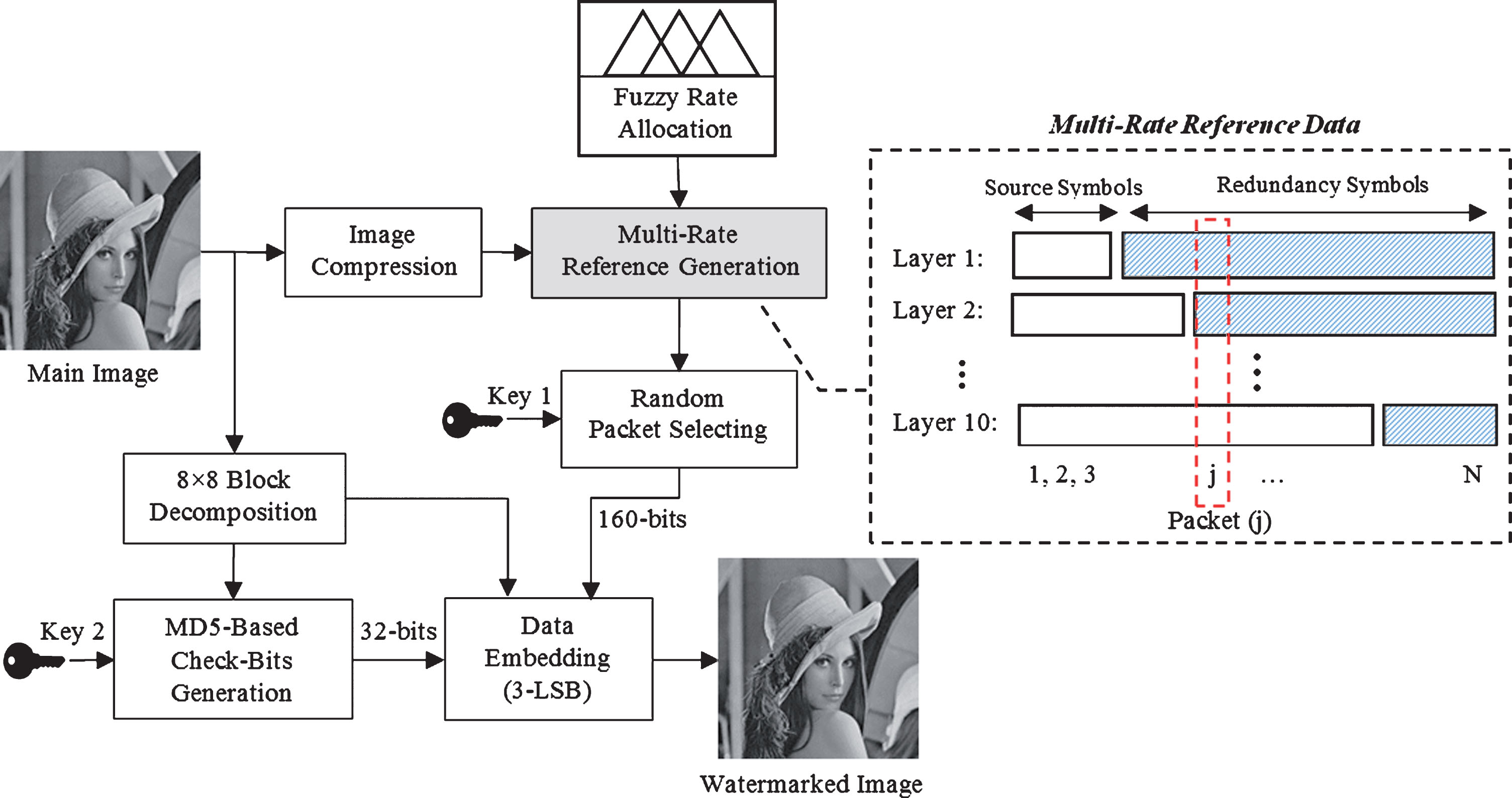
Block diagram of the watermark generation and embedding of the proposed MRRE method.
For generating check-bits, the image is decomposed into non-overlapping blocks, and the pixels’ intensity values are encoded by MD5 hash function to produce authentication data using a security key (Key 2). For more details, the embedding process is demonstrated by six steps, as follows:
Sarreshtedari et al. found that the redundancy rate is related to tamper resistance and by changing the redundancy rate, the Tolerable Tampering Rate (TTR) value is changed [21]. TTR is the tamper recovery threshold, where the reference data cannot endure more tampers. For example, an RS code with redundancy rate of 0.5, can be resisted against tampers below 50 percent of the image.
In this paper, a conventional Reed-Solomon is used over large Galois field GF (216) with 16-bits symbols. Since the length of output codeword equals to 216 - 1, it is punctured to N, by considering that the error correction capability is the same as the original code [21].
In this paper, a Mamdani’s fuzzy interface system (FIS) is used to assign a higher redundancy rate to more crucial data. In the proposed FIS, the importance of the reference layers is used as an input which varies from 0 to 1. According to Fig. 2, the input variable is fuzzified into five Gaussian membership functions. Also, the decision of assigning redundancy rate is fuzzified with five triangular membership functions. The associated linguistic labels for both input and output functions are “Very Low,” “Low,” “Medium,” “High,” and “Very High.”

The input variable and output decision of the proposed FIS.
Table 1 represents the fuzzy rules that have been employed in this paper. The result of the proposed fuzzy rate allocation is represented in Fig. 3. In this figure, the x-axis is the data rate, and the y-axis shows the layers of the reference data. Each layer is formed by two parts, source data labeled in black and redundancy data, in white. As expected, the first layer has the highest redundancy rate, and the last layer has the least. Also, the redundancy rate is gradually decreased to provide a smooth recovery performance.
Fuzzy rules
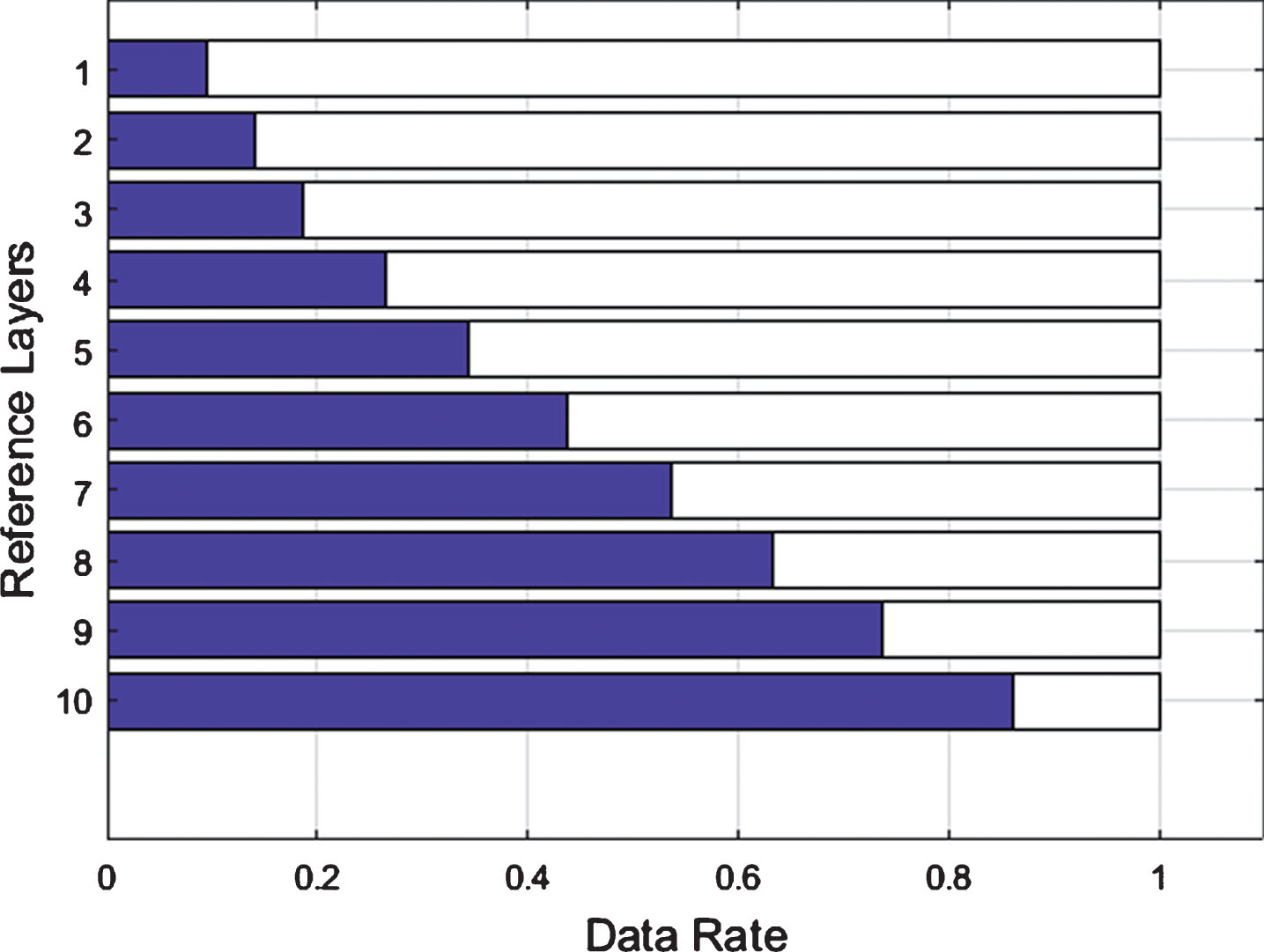
The results of the fuzzy-based redundancy rate allocation for ten layers of reference data.
Figure 4 shows the block diagram of tamper detection and recovery of the proposed MRRE method. In this diagram, the image is first decomposed into 8×8 non-overlapping blocks. For tamper detection and localization, the authentication data is calculated for each block using Key 2, just like the embedding process. Any mismatch between the produced and the extracted check-bits highlights the tampered blocks.
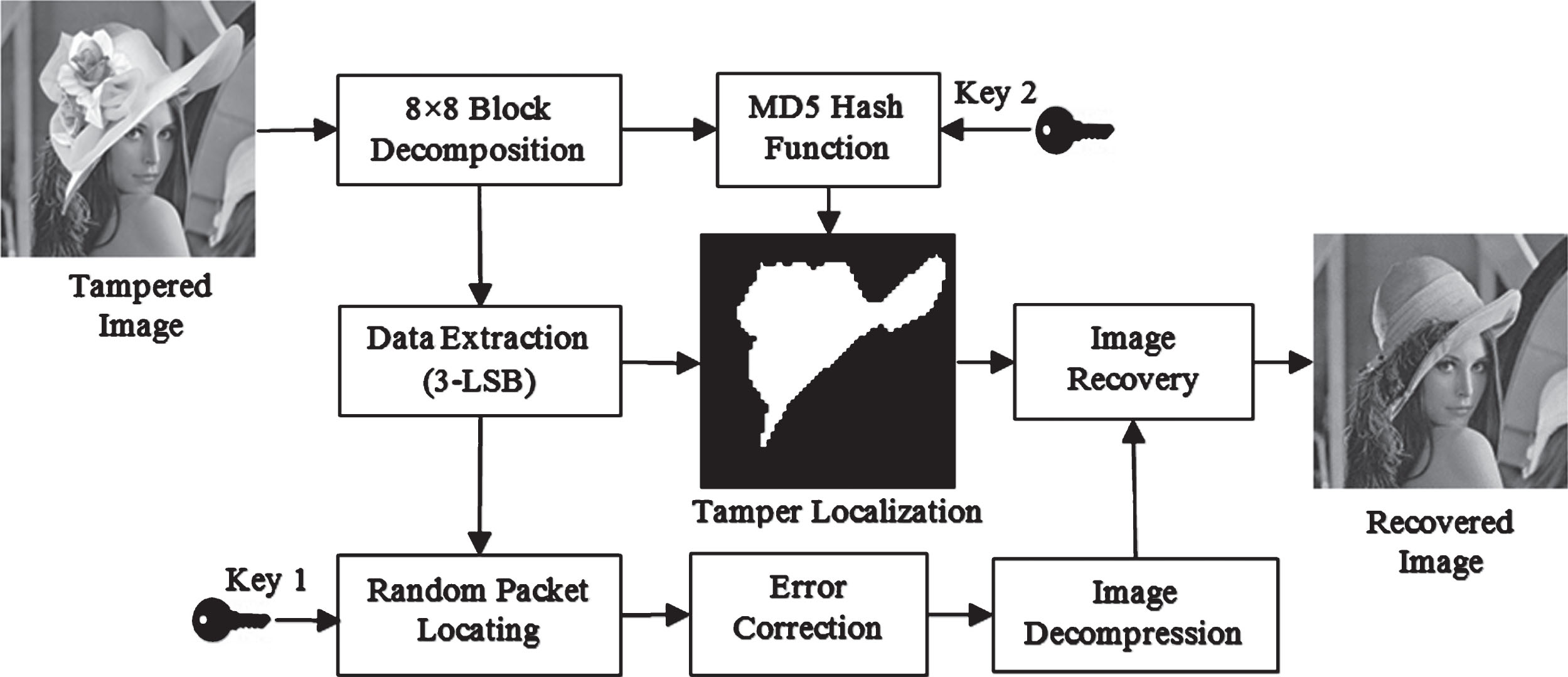
Block diagram of tamper detection and recovery of the proposed MRRE method.
For image recovery, the packets of the reference data are extracted and located in the right position according to Key 1. The layers of the reference data are error corrected separately and then; they are merged. The bitstream is decompressed to generate an image representation which is used for image recovery by content replacement.
The proposed MRRE method is evaluated by eight standard images, as shown in Fig. 5. The test images are 512×512 8-bit grayscale in a raw image format. According to the Section 2, the authentication and the reference data are generated and embedded into three LSBs of the original image. Table 2 shows the results of the embedding process which represents the quality of the watermarked images. In this table, Peak Signal to Noise Ratio (PSNR) is used as a measure for quality assessment which is common in related methods [11, 12]. Generally, the PSNR above 36 dB is not noticeable for the human vision system [21], and consequently, the watermarked image qualities in Table 2 are acceptable.
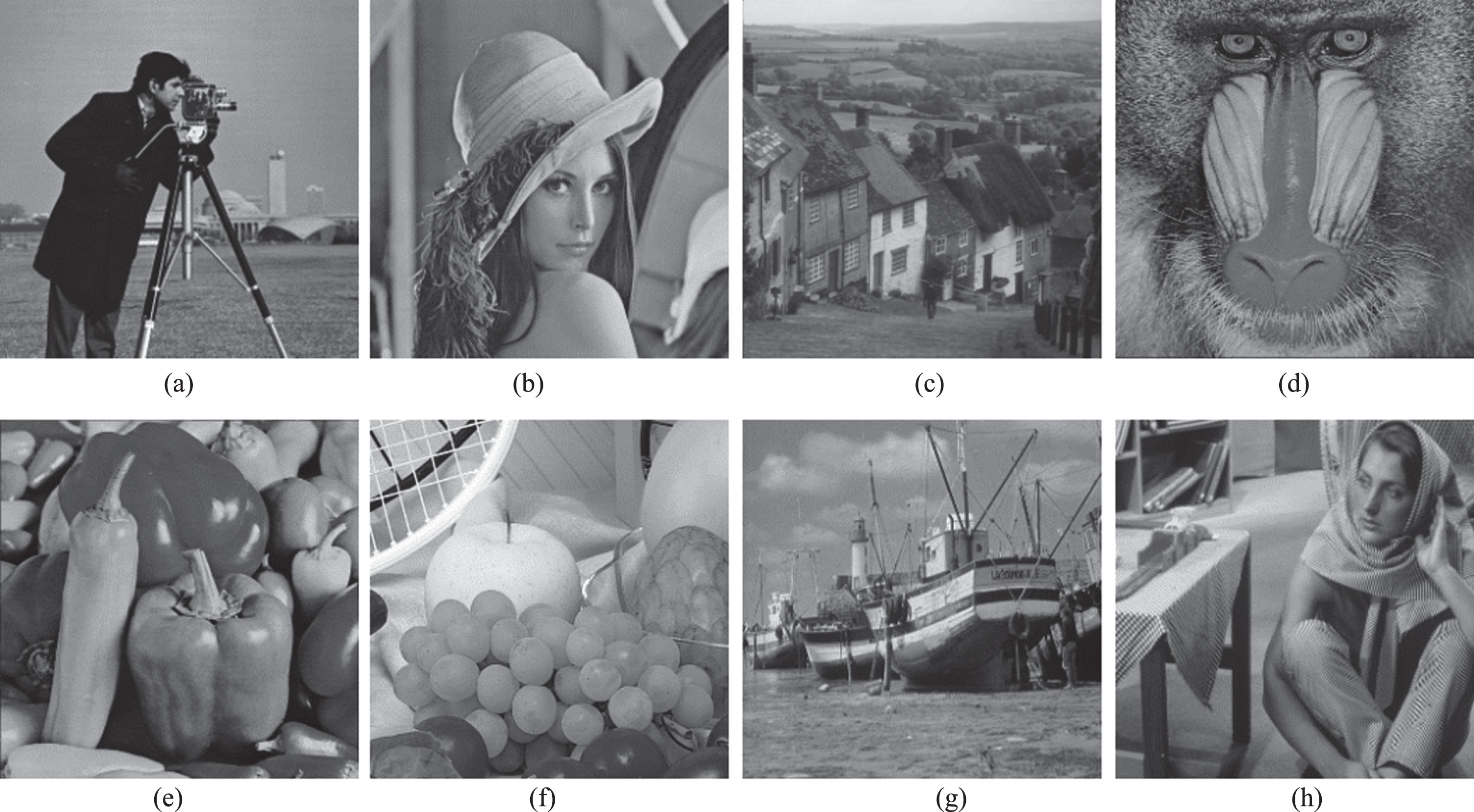
Eight standard test images used for performance evaluation; (a) Camera-Man, (b) Lena, (c) Gold-Hill, (d) Baboon, (e) Peppers, (f) Fruits, (g) Boat, (h) Barbara.
The quality of the watermarked image for the test images
Figure 6 shows four protected test images using the proposed MRRE embedding algorithm. In Fig. 7, the protected images are tampered with common tampering methods like content replacement and copy-move forgery. The result of tamper detection and localization are represented in Fig. 8. The white pixels of the tamper masks (in Fig. 8) show tampered regions of the image. Tampering rate is defined as the ratio of the tampered pixels to the total number of image pixels. The tampering rates are 42.43, 27.54, 21.48 and 18.38 percent in Fig. 8 (a-d), respectively. Finally, in Fig. 9, the tampered image are recovered and evaluated by reconstruction qualities. The reconstruction PSNRs are 40.35, 33.70, 37.63 and 34.98 dB for Fig. 9(a) to (d), respectively. The results show that MRRE can recover the tampered area without any block artifacts.
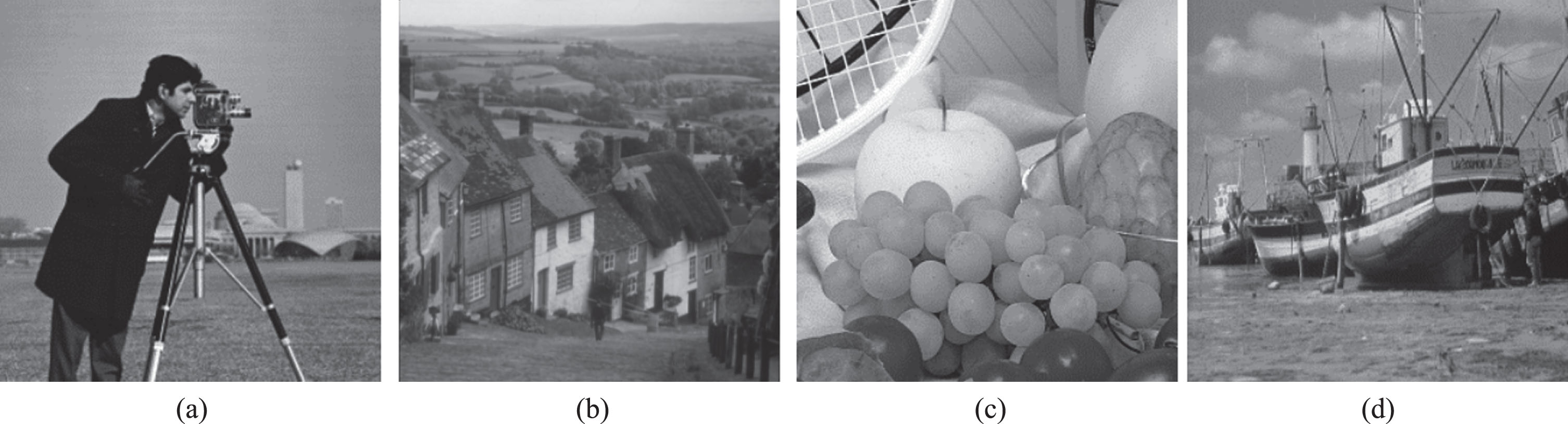
Four images from Fig. 5 which are protected by the proposed MRRE embedding algorithm.
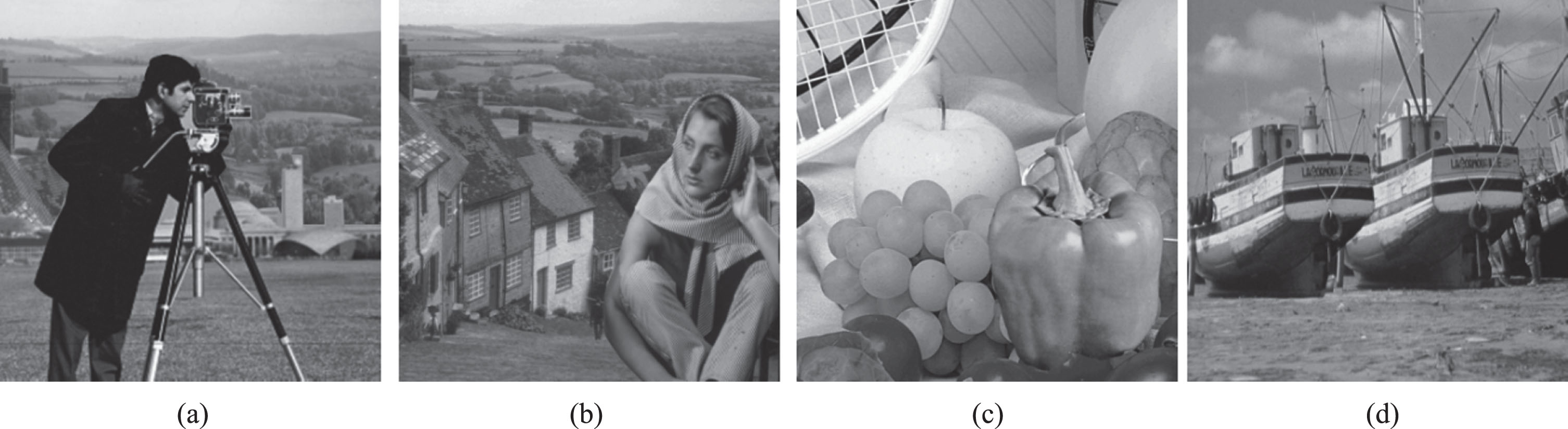
Four examples of image tampering based on content replacement and copy-move forgery.

The results of tamper detection and localization. The tampering rates are: (a) 42.43%, (b) 27.54%, (c) 21.48% and (d) 18.38%.
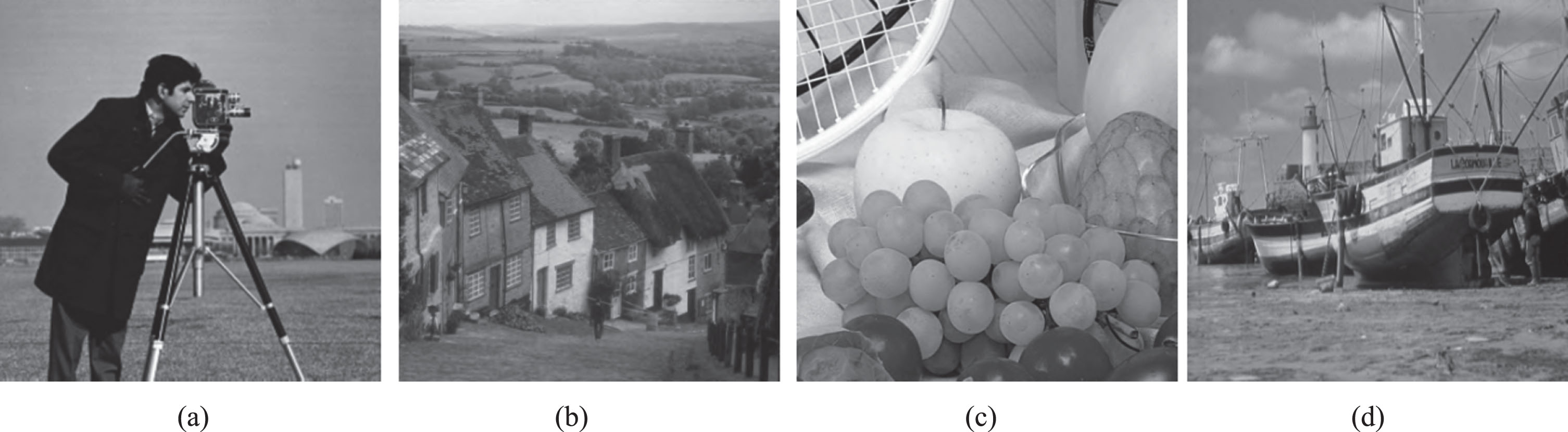
The recovered images with (a) 40.35 dB, (b) 33.70 dB, (c) 37.63 dB and (d) 34.98 dB reconstruction PSNR.
In Fig. 10, the performance of the proposed MRRE method is evaluated for all test images, and highly-scalable self-recovery approach of the proposed method is represented. In Fig. 10(a), the average reconstruction PSNR of the test images are compared with two related single-scale self-recovery methods [20, 21]. The self-recovery performance of the proposed MRRE method is step-wise (scalable) because each layer of reference data provide one scale of image recovery. In this figure, reconstruction PSNR is the quality of the reference image compared with the main image. Since the average PSNR does not reflect the self-recovery performance, the variations of reconstruction qualities for the recovery scales are represented in Fig. 10(b). This graph shows the range of reconstruction quality in each scale. Based on the experiments, the proposed MRRE performs better for the smooth and images with little texture like Camera-man. On the contrast, complex images decrease the reconstruction quality. This is the result of EZBC compression algorithm.

Table 3 compares the reconstruction PSNR of the proposed MRRE method in various tampering rates with novel self-recovery methods for all test images. Note that the results of the related methods are established by reported data from the contexts [11, 23]. This table clearly shows the mentioned self-recovery trade-off among capacity, quality, and robustness. For the fixed embedding capacity (3-LSB), the reconstruction qualities are listed at different tampering rates.
The recovered image PSNR of the proposed MRRE method compared with the related methods
In this paper, a novel MRRE method proposed for the purpose of highly-scalable recovery. MRRE is an improved version of the conventional source-channel coding scheme which takes advantage of fuzzy Mamdani for generating reference data. Generally, the proposed method is initiated by compressing the original image using EZBC algorithm. Then, the compressed bitstream is separated into ten parts, and each part receives redundancy data for tamper protection. RS channel coding algorithm produces redundancy based on allocated rates. Fuzzy-based rate allocation uses Mamdani rules to assign redundancy according to the importance of the data parts. Thus, the generated reference data consists of ten layers; each provides one scale of image recovery. At limited tampering rates, all ten layers participate for image recovery, and consequently, the image is recovered with ultimate quality. By increasing the tampering rate, the quality of the recovered image is decreased step-by-step, because the redundancy of the layer is not sufficient for correcting more tampers.
The innovations of the proposed MRRE method are: (1) Multi-rate reference generation: instead of generating multiple reference data for tamper resiliency, the proposed method generates one reference data with multiple redundancy rates. (2) Highly-scalable self-recovery: Unlike conventional source-channel coding schemes which provide single-scale recovery, the proposed MRRE provides ten scales of image recovery. The self-recovery performance is step-wise, and each step represents one scale of image recovery (see Fig. 10). (3) Fuzzy-based rate allocation: According to our best knowledge, this is for the first time that fuzzy logic as an artificial intelligence tool is used in SCC self-recovery scheme. (4) Robust reference data architecture: In this method, each packet of reference data is embedded into one image block. Since the packets consist of an equal proportion of the layers of reference data, tampering a block affects the layers of reference data in a uniform manner. (5) High tamper tolerability: Unlike conventional source-channel coding schemes, the proposed method can recover up to 90 percent tampering rates with good reconstruction quality.