In this paper, a notion of modified ⊤-convergence spaces (initially defined by Fang and Yue in FSS, 2017) is given. Then the relationships between the modified ⊤-convergence spaces and types of lattice-valued convergence spaces are established.
Under the framework of lattice-valued convergence spaces, based on stratified L-filter [11] (L-fuzzy subset of L-fuzzy power set), stratified L-generalized convergence space [13], L-ordered convergence space [4, 21] and stratified L-convergence space [6], were proposed. The theory of these spaces has been developed extensively in recent years by many researchers [3, 38].
Quite recently, when the lattice L to be a complete MV-algebra, by using of ⊤-filters (crisp subset of L-fuzzy power set), Fang [5, 34] introduced a kind of lattice-valued convergence spaces, namely ⊤-convergence spaces. Later, when the lattice L to be a complete Heyting algebra, Reid and Richardson connected ⊤-convergence spaces and stratified L-convergence spaces in [6]. Note that both complete MV-algebra and complete Heyting algebra are all special complete residuated lattices. In addition, many results about lattice-valued convergence spaces are discussed under the context of complete residuated lattices [19, 38].
In this paper, extending the lattice to be complete residuated lattice with the underlying lattice being meet-continuous (complete MV-algebra and complete Heyting algebra all satisfy the meet-continuous condition), we introduce a notion of modified ⊤-convergence spaces based on alternative ⊤-filter [10] (we will explain that why we using the alternative definition of ⊤-filter in Remark 2.5 and Remark 2.11). The modified ⊤-convergence spaces are equivalent to ⊤-convergence spaces in [5] when the lattice to be complete MV-algebra. Then we also establish the relationships between the modified spaces and stratified L-generalized convergence spaces [13], L-ordered convergence spaces [4, 21] and stratified L-convergence spaces [6].
The contents are arranged as follows. Section 2 recalls some basic notions as preliminary. Section 3 presents the main results: The modified ⊤-convergence spaces and their relationships to three types of lattice-valued convergence spaces stated above. We studied the relationships by constructing some natural Galois correspondences between considered categories of lattice-valued spaces. Section 4 makes a conclusion.
Preliminaries
A complete lattice L is said to be meet-continuous [9] (denoted as (MC) for short) if the binary meet operation ∧ distributes over directed joins. In this paper, if not otherwise specified, L = (L, ∗) is always a complete residuated lattice with the underlying lattice being meet-continuous. This is, L is a complete lattice with a top element ⊤ and a bottom element ⊥; ∗ is a binary operation on L such that (i) (L, ∗, ⊤) is a commutative monoid; and (ii) ∗ distributes over arbitrary joins. Since the binary operation * distributes over arbitrary joins, the function α * (-): L ⟶ L has a right adjoint α → (-): L ⟶ L given by α → β = ⋁ {γ ∈ L: α ∗ γ ≤ β}. The binary operation → is called the residuation with respect to *. We collect here some basic properties of the binary operations ∗ and → [11, 36].
(I1) ⊥∗ α = ⊥ and ⊤ → α = α;
(I2) α → β = ⊤ ⇔ α ≤ β;
(I3) α ∗ (α → β) ≤ β;
(I4) α → (β → r) = (α ∗ β) → r = β → (α → r);
(I5) α ≤ (α → β) → β;
(I6) (⋁ j∈Jαj) → β = ⋀ j∈J (αj → β);
(I7) α → (⋀ j∈Jβj) = ⋀ j∈J (α → βj).
A complete residuated lattice is called a complete Heyting algebra or a frame if ∗ =∧. A complete residuated lattice L is called a complete MV-algebra if it satisfies the condition.
(MV) α ∨ β = (α → β) → β for all α, β ∈ L.
Let L be a complete MV-algebra. Then the following two properties hold.
(M1) (α → ⊥) → ⊥ = α,
(M2) β ∧ (⋁ j∈Jαj) = ⋁ j∈J (β ∧ αj).
Obviously, either a complete MV-algebra or a frame is meet-continuous.
We call a function μ: X → L as an L-fuzzy subset in X. We use LX to denote the set of all L-fuzzy subsets in X and call it the L-fuzzy power set on X. The operators ∨, ∧, ∗, → on L can be translated onto LX in a pointed wise. That is, for any μ, ν, μt (t ∈ T) ∈ LX,
Let μ, ν be L-fuzzy subsets in X. The subsethood degree [2, 41] of μ, ν, denoted as SLX (μ, ν), is defined by
We make no difference between a constant function and its value since no confusion will arise.
Let f: X ⟶ Y be a function. We define f→: LX ⟶ LY and f←: LY ⟶ LX [11] by f→ (μ) (y) = ⋁ f(x)=yμ (x) for μ ∈ LX and y ∈ Y, and f← (ν) (x) = ν (f (x)) for ν ∈ LY and x ∈ X.
Finally, we recall some categoric notions from [1]. A concrete category is a pair (A, U), where A is a category and U: A ⟶ Set is a faithful functor. A concrete functor F: (A, U) ⟶ (B, V) between concrete categories is a functor F: A ⟶ B such that U = V ∘ F. That means, F only changes the structures on the underlying sets, leaving the underlying sets and morphisms untouched. All the categories and functors considered in this paper are concrete ones.
Definition 2.2. ([1]) Suppose that A and B are concrete categories; F: A ⟶ B and G: B ⟶ A are concrete functors. The pair (F, G) is called a Galois correspondence if F ∘ G ≤ id in the sense that for each Y ∈ B, idY: F ∘ G (Y) ⟶ Y is a B-morphism; and id ≤ G ∘ F in the sense that for each X ∈ A, idX: X ⟶ G ∘ F (X) is an A-morphism.
⊤-filters and L-filters.
Definition 2.3. [10, 11] A nonempty subset is called a ⊤-filter on the set X whenever:
(TF1) SLX (λ, ⊥) = ⊥ for all ,
(TF2) for all ,
(TF3) if λ ∈ LX such that , then .
The set of all ⊤-filters on X is denoted as .
Definition 2.4. [11] A nonempty subset is called a ⊤-filter base on the set X provided:
(TB1) SLX (λ, ⊥) = ⊥ for all ,
(TB2) if , then .
Remark 2.5. Let L satisfy the condition (M1). Then
(1) (TF1) is equivalent to (TF1*): for all ; and
(2) (TB1) is equivalent to (TB1*): for all .
Note that in [5, 35], the researchers used (TF1*) and (TB1*) to define ⊤-filter and ⊤-filter base.
Lemma 2.6.Each ⊤-filter base on X generates a ⊤-filter defined by
Proof. (TF1): Let . Then . It follows by (TB1) that
Let be a ⊤-filter and with . Then must a ⊤-filter base, and so it is called a ⊤-filter base of . In this terminology, a ⊤-filter base must be a ⊤-filter base of [5].
Example 2.7. [5, 11] Let f: X ⟶ Y be a function and . Then
(1) The family forms a ⊤-filter base on Y, and the ⊤-filter generated by it is called the image of under f. It is easily seen that .
(2) For any x ∈ X, the family [x] ⊤ =: {λ ∈ LX|λ (x) = ⊤} is a ⊤-filter on X, called the principal ⊤-filter on X generated by x. In addition, f⇒ ([x] ⊤) = [f (x)] ⊤.
(3) For any , we have .
Definition 2.8. [11] A stratified L-filter on a set X is a function ℱ : LX ⟶ L such that for each λ, μ ∈ LX and each α ∈ L,
(LF1) ℱ (⊥) = ⊥, (LF2) ℱ (⊤) = ⊤;
(LF3) ℱ (λ) ∧ ℱ (μ) = ℱ (λ ∧ μ);
(LFs) ℱ (α ∗ λ) ≥ α ∗ ℱ (λ).
The set of all stratified L-filters on X is denoted as .
Lemma 2.9. [5, 11] Letf: X ⟶ Ybe a function and . then
(1) The functionf⇒ ( ℱ): LY ⟶ Ldefined byμ ↦ ℱ (μ ∘ f) is a stratifiedL-filter onYcalled the image of ℱ underf.
(2) For anyx ∈ X, the function [x]: LX ⟶ L, [x] (λ) = λ (x) is a stratifiedL-filter on X, called the principal L-filter generated byx. In addition, f⇒ ([x]) = [f (x)].
(3) Letbe a family of stratifiedL-filters onX, thenis also a stratifiedL-filter onX. Letdenote the meet of all stratifiedL-filters onX, i.e., the smallest stratifiedL-filter onX.
Lemma 2.10.Let f: X ⟶ Ybe a function and , . Then
(1) The functiondefined asis a stratifiedL-filter onX.
(2) The familyis a ⊤-filter onX.
(3) and .
(4)
(5)
Proof. (1)–(4) have been proved in [10, 35] for ⊤-filter defined by (TF1*). We check only (5) and the correspondence between (TF1) and (LF1).
By SLX (μ, ⊥) = ⊥ for all μ ∈ TF we have .
By ℱ (⊥) = ⊥ we have ℱ (⊥) = ⋁ μ∈LX (ℱ (μ) ∗ SLX (μ, ⊥)) = ⊥. It follows that if λ ∈ Γ ( ℱ) then SLX (μ, ⊥) = ⊥.
(5). Let λ ∈ LX. Then
□
Remark 2.11. The connection between T-filters and stratified L-filters is foundation of the connection between T-convergence spaces and lattice-valued convergence spaces based on stratified L-filters. It is easily seen that ℱ (⊥) = ⊥ does not guarantee that Γ(ℱ) satisfies (TF1*), i.e., Γ(ℱ) may be not a T-filter in [5]. That is why we use (TF1) to define T-filters.
Three types of lattice-valued convergence spaces and their relationships
Definition 2.12. [6] A collection ,
where qα: , is called a stratified L- convergence structure on X if it satisfies:
for each x ∈ X,
implies ,
implies whenever β ≤ α.
The notation means that x ∈ qα(ℱ). The pair (X, ) is called a stratified L-convergence space.
A function f: X → Y between stratified L- convergence spaces (X, ) and (Y, ) is continuous if implies for each , α ∈ L, x ∈ X. The category of stratified L- convergence spaces and continuous functions is denoted by SL-CS. If the identity idX: (X, ) → (X, ) is continuous then we denote .
Definition 2.13. (Jager [13] and Yao [37]) A stratified L-generalized convergence structure on a set X is a function limq: satisfying
(LC1) limq[x](x) = 1 for every x ∈ X; and
(LC2)
The pair (X, limq) is called a stratified L- generalized convergence space.
A function f: X → Y between stratified L- generalized convergence spaces (X, limq) and (Y, limp) is continuous if limqℱ(x) ≤ limpf⇒ (ℱ)(f (x)) for each and each x ∈ X. The category of stratified L-generalized convergence spaces and continuous functions is denoted by SLG-CS. If the identity idX: (X, limq) → (X, limp) is continuous then we denote limq ≤ limp.
In [4], a notion of stratified L-ordered convergence space (or stratified L-convergence space in [21]) was proposed, and it was defined as a function limq: satisfying (LC1) and
(LC2′) ∀F, .
Obviously, (LC2′) ⇒ (LC2). The full subcategory of SLG-CS consisting of L-ordered objects is denoted by SLO-CS.
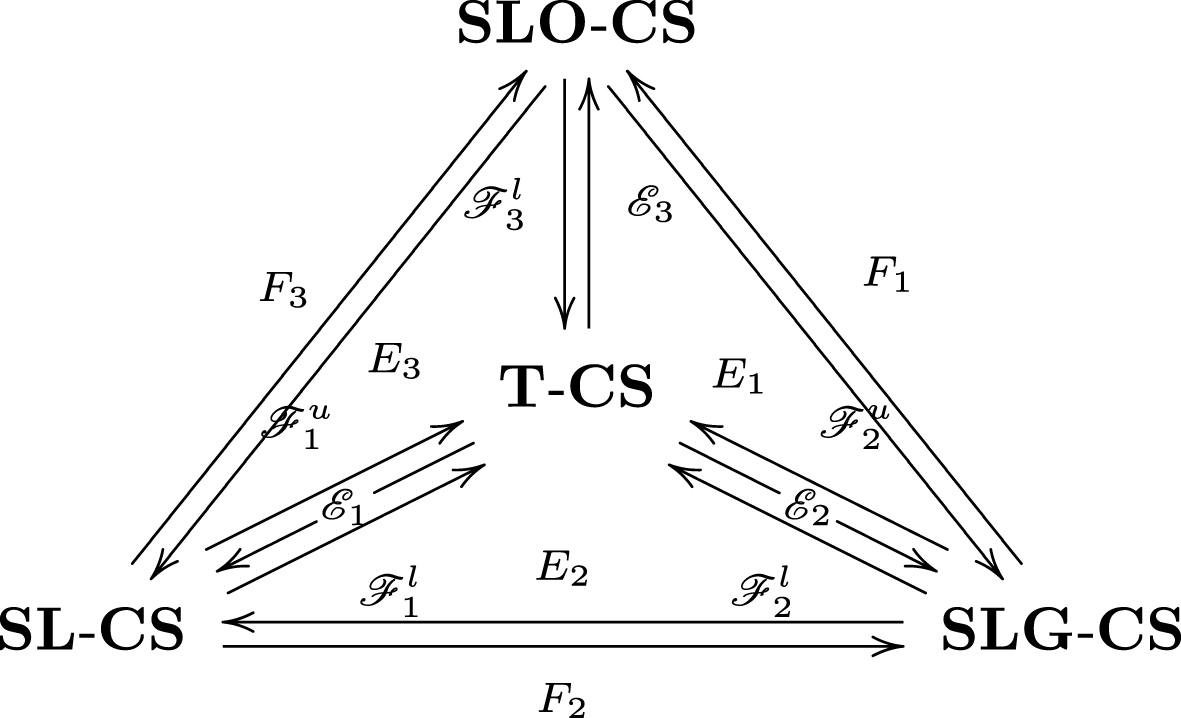
For L a frame, the relationship between SL-CS and SLG-CS was given in [6]; the relationship between SLO-CS and SLG-CS was discussed in [4]. For L a complete residuated lattice, a systemical study on the relationships between the above categories was presented in [19]. We summarize them by the following diagram.
Ei, Fi(i = 1, 2, 3) are all concrete functor. Given (X, ) ∈ SL-CS, (X, limq) ∈ SLG-CS.
E1(X, limq) = (X, limq),
F1(X, limq): .
E2(X, limq): ,
F2(X, ): .
E3(X, limq): ,
F3(X, ):
The pair (Fi, Ei) is a Galois correspondence and Fi is a left inverse of Ei. Thus
(1) SLO-CS embedding in SLG-CS as a reflective subcategory;
(2) SLG-CS embedding in SL-CS as a reflective subcategory;
(3) SLO-CS embedding in SL-CS as a reflective subcategory.
Modified T-convergence spaces and their relationships to types of lattice-valued convergence spaces
In this section, we shall present a notion of modified T-convergence spaces and their relationships to three types of lattice-valued convergence spaces stated above.
Modified T-convergence spaces
Definition 3.1. A T-convergence structure on a set X is a function satisfying
(TC1) for every x ∈ X; and
(TC2) if and , then
Note that is shorthand for . The pair (X, q) is called a -convergence space.
Remark 3.2. By Remark 2.5 and Remark 2.11, it is easily seen that a T-convergence is precise a T- convergence space in [5] when L being a complete MV-algebra.
A function f: X → Y between two T- convergence spaces (X, q), (Y, p) is called continuous if whenever . The category T-CS has as objects all T-convergence spaces and as morphisms the continuous functions.
Proof. The proof is similar to Theorem 3.2 in [33]. For a given source , the initial structure,q on X is defined by . □
Let X be a nonempty set and let T(X) denote the set of all T-convergence structures on X. If the identity idX: (X, q) → (X, p) is continuous then we denote q ≤ p. It is easily observed that (T(X), ≤) forms a completed lattice, and the discrete (resp., indiscrete) structure 8 (resp., ɩ) is the bottom (resp., top) element of (T(X), ≤), where δ is given by iff [x]T; and ɩ is given by for all , x ∈ X.
Let (X, q) bea T-convergence space. Then for any x ∈ X, the -filter
is called the T-neighborhood w.r.t. q at x. Then the family is called the system of T-neighborhoods w.r.t. q on X [5].
Lemma 3.4. [5] Let be the system of T-neighborhoods of (X, q). Then the familyis a T-filter on X, where
Proof. We prove only that satisfies (TF1). Indeed for any , i.e., , we have . By
we get
□
In [34], Fang and Yue defined the so called topological ⊤-convergence spaces and proved that these spaces correspond bijectively to strong L-topological spaces when L being a complete MV-algebra. We define a similar notion for modified ⊤-convergence spaces.
Definition 3.5. A ⊤-convergence space (X, q) is called principal topological if it satisfies
(TP): ∀x ∈ X, .
A principal ⊤-convergence space is called topological if it satisfies
(TU): ∀x ∈ X, .
Similar to [5], we can also define a Fischer’s diagonal condition and prove that condition can characterize topological ⊤-convergence space. But up to know, we have not known that for complete residuated lattice being meet-continuous, the topological ⊤-convergence spaces characterize which kind of L-topological spaces. We shall consider this question in future work. Now, we turn our attention to the relationships between ⊤-convergence spaces and three types of lattice-valued convergence spaces based on stratified L-filters.
Galois correspondence between T-CS and SL-CS
In this subsection, we shall construct two pairs of Galois correspondences between T-CS and SL-CS, and then prove by them that T-CS can embed in SL-CS as both a reflective and coreflective subcategory.
Definition 3.6. Given (X, q)∈ T-CS, we define as
(i) if and only , and
(ii) for α> ⊥, if and only if there exists such that .
Then SL-CS.
Similar to Lemma 3.3 in [35], it is easily seen that the correspondence defines a concrete functor: .
Definition 3.7. Given SL-CS, we define and as:
(1) if and only if .
(2) if and only if there exists α> ⊥, such that .
Then T-CS.
Proof. We prove T-CS. Note that [x] ⊤ = Γ ([x]). Then it follows by that . Obviously, satisfies (TC2). Thus T-CS. That T-CS can be proved similarly.□
Lemma 3.8.The correspondences and define two concrete functors: .
Proof. We prove is a concrete functor. Let be a continuous function in SL-CS. Then for any , there exists α> ⊥, such that TF ⊇ Γ ( ℱ). By continuity of f and Lemma 2.10 (5) we have and f⇒ (TF) ⊇ f⇒ (Γ ( ℱ)) = Γ (f⇒ ( ℱ)). It follows that . Thus is a continuous function in T-CS. That is a concrete functor can be proved similarly.
Theorem 3.9.The pair is a Galois correspondence and is a left inverse of . Thus the category T-CS can be embedded in the category SL-CS as a reflective subcategory
Proof. Given (X, q)∈ T-CS and SL-CS. We prove below that and . Then it follows immediately that the pair is a Galois correspondence and is a left inverse of .
(1) . Let . Then there exists α> ⊥, such that TF ⊇ Γ ( ℱ). By we have that there exists such that ℱ ≥ Λ (TG). It follows immediately that TF ⊇ Γ ( ℱ) ⊇ Γ ∘ Λ (TG) = TG. Thus . Conversely, let . Then and so .
(2) . For any α> ⊥ and any , we have . Then it follows by ℱ ≥ Λ ∘ Γ ( ℱ) that as desired.
Theorem 3.10.The pair is a Galois correspondence and is a left inverse of . Thus the category T-CS can be embedded in the category SL-CS as a coreflective subcategory.
Proof. Given (X, q)∈ T-CS and SL-CS. It is easily seen that and . Then it follows immediately that the pair is a Galois correspondence and is a left inverse of .□
It follows by the above two theorems we have
Corollary 3.11.The category T-CS can be embedded in the category SL-CS as both a reflective and coreflective subcategory.
Remark 3.12. For L being a frame, Theorem 3.10 has been proved in [35] for ⊤-convergence spaces in [5].
Galois correspondence between T-CS and SLG-CS
In this subsection, we shall construct two pairs of Galois correspondences between T-CS and SLG-CS, and then prove by them that T-CS can embed in SLG-CS as both a reflective and coreflective subcategory.
Definition 3.13. Given (X, q)∈ T-CS, we define as
Then SLG-CS. It is easily seen that the correspondence defines a concrete functor: .
Definition 3.14. Given SLG-CS, we define and as:
(1) if and only if .
(2) if and only if there exists such that TF ⊇ Γ ( ℱ).
Then T-CS.
Proof. We prove T-CS. Note that [x] ⊤ = Γ ([x]). Then it follows by that . Obviously, satisfies (TC2). Thus T-CS. That T-CS can be proved similarly.□
Lemma 3.15.The correspondences and define two concrete functors: .
Proof. We prove is a concrete functor. Let f: (X, lim q) ⟶ (Y, lim p) be a continuous function in SLG-CS. Then for any , there exists such that TF ⊇ Γ ( ℱ). By continuity of f and Lemma 2.10 (5) we have and f⇒ (TF) ⊇ f⇒ (Γ ( ℱ)) = Γ (f⇒ ( ℱ)). It follows that . Thus is a continuous function in T-CS. That is a concrete functor can be proved similarly.
Theorem 3.16.The pair is a Galois correspondence and is a left inverse of . Thus the category T-CS can be embedded in the category SL-CS as a reflective subcategory
Proof. Given (X, q)∈ T-CS and (X, lim q)∈ SL-CS. We prove below that and . Then it follows immediately that the pair is a Galois correspondence and is a left inverse of .
(1) . Let . Then there exists such that TF ⊇ Γ ( ℱ). By we have that there exists such that ℱ ≥ Λ (TG). It follows that TF ⊇ Γ ( ℱ) ⊇ Γ ∘ Λ (TG) = TG. Thus . Conversely, let . Then and so .
(2) . For any , we have . Then it follows by ℱ ≥ Λ ∘ Γ ( ℱ) that as desired.□
Theorem 3.17.The pair is a Galois correspondence and is a left inverse of . Thus the category T-CS can be embedded in the category SLG-CS as a coreflective subcategory.
Proof. Given (X, q)∈ T-CS and (X, lim q)∈ SLG-CS. It is easily seen that and . Then it follows immediately that the pair is a Galois correspondence and is a left inverse of .□
It follows by the above two theorems we have.
Corollary 3.18.The category T-CS can be embedded in the category SLG-CS as both a reflective and coreflective subcategory.
Galois correspondence between T-CS and SLO-CS
In this subsection, we shall construct a pair of Galois correspondence between T-CS and SLO-CS. Then we prove that T-CS can embed in SLO-CS as a coreflective subcategory if ⊤ is isolated in L [9] (that is, there exists no A ⊆ L - {⊤} such that ∨A =⊤).
Definition 3.19. Given (X, q)∈ T-CS, we define as
Then SLO-CS. Indeed, for any x ∈ X,
For any ,
It is easily seen that the correspondence defines a concrete functor: . In addition, we denote the functor (resp., ) as the restriction of (resp., ) on SLO-CS.
Theorem 3.20.The pair is a Galois correspondence. If ⊤ is isolated in L then is a left inverse of and so the category T-CS can be embedded in the category SLO-CS as a coreflective subcategory.
Proof. Given (X, q)∈ T-CS and (X, lim q)∈ SLO-CS. It is easily seen that and . Then it follows immediately that pair is a Galois correspondence. We check below that if ⊤ is isolated in L. Then it follows that is a left inverse of . Indeed, let . Then
Since is isolated in L then there exists
such that i.e., . So, as desired.
Some commutative diagrams
In this subsection, we shall prove that the considered functors satisfy some natural commutative diagrams. This shows that the related ategories have good compatibility.
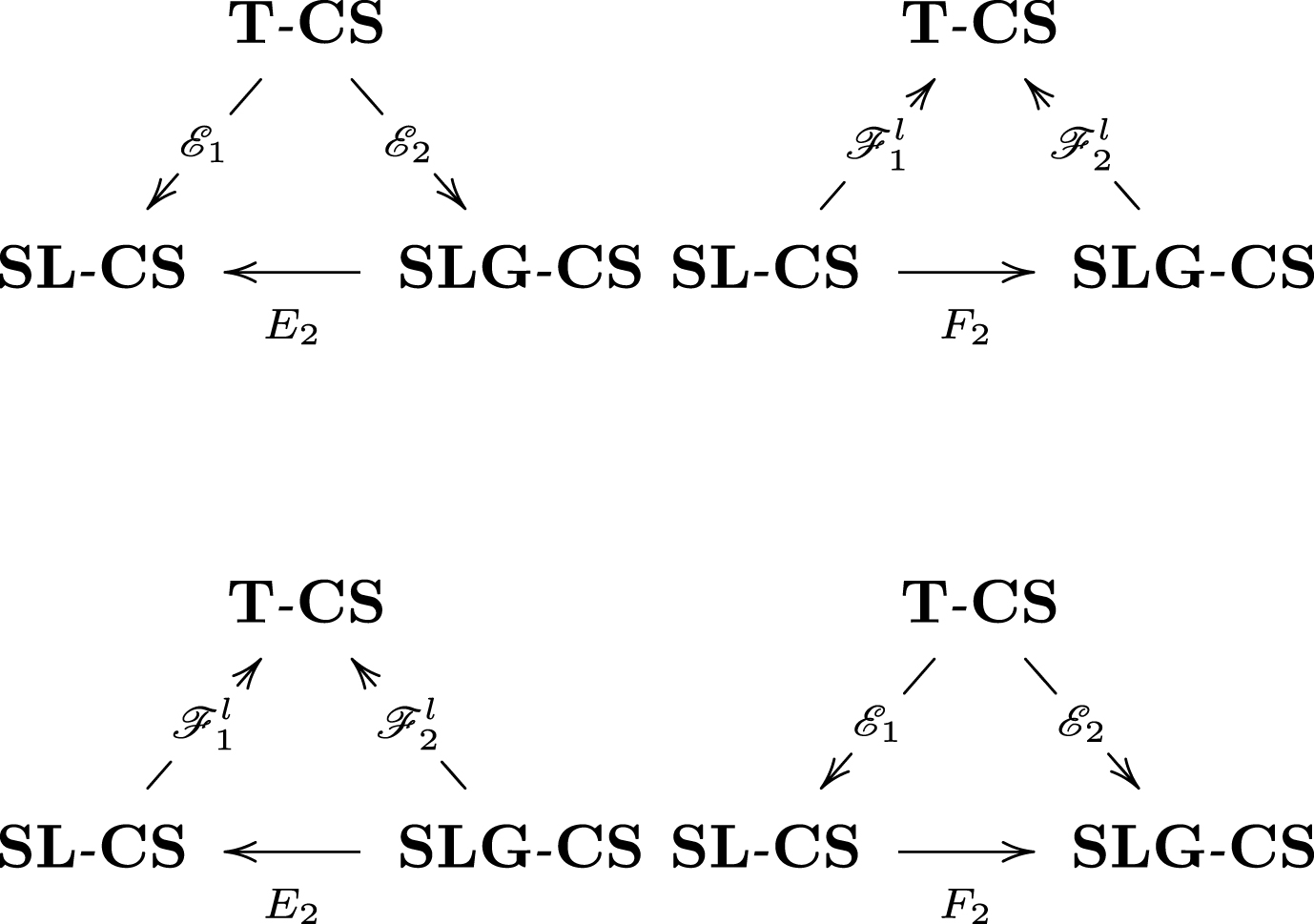
Theorem 3.21. (1) andandThis shows that there exist four commutative diagrams:
Proof. (1) Given (X, q) ∈ T.-CS. Then for any α > ⊥
It follows that .
Given (X, ) ∈ SL-CS. Then
It follows that .
(2) Given (X, limq) ∈ SLG-CS. Then
Given (X, q)∈ T-CS. Then
□
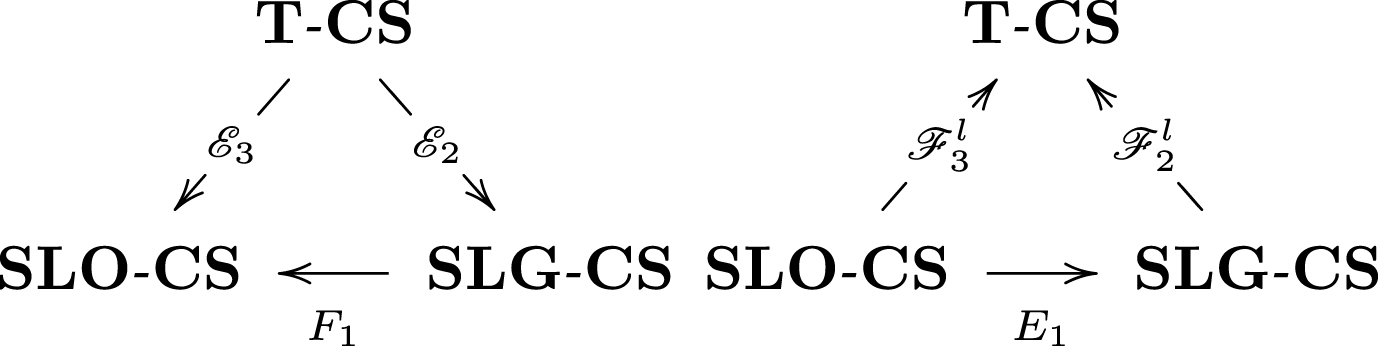
Theorem 3.22. and . This shows that there exist two commutative diagrams:
Proof. (1) Given (X, q)∈ T-CS. Then
The equality follows immediately from that is the restriction of on SLO-CS.□
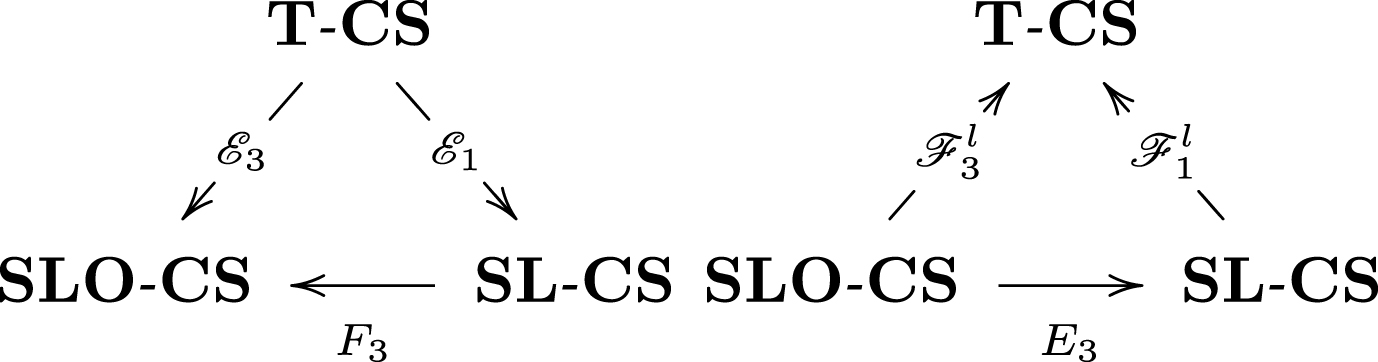
Theorem 3.23. and . This shows that there exist two commutativediagrams:
Proof. (1) Given (X, q)∈ T-CS. Then
The equality follows immediately from that is the restriction of on SLO-CS.□
Conclusions
In this paper, a category of modified ⊤-convergence spaces is given and the relationships between this category and three categories of lattice-valued convergence spaces are established. The results can be summarized through the following diagram:
•Five pairs of Galois correspondences: , (i = 1, 2), .
•Three embeddings:
T-CS embedding in SL-CS as both a reflective and coreflective subcategory.
T-CS embedding in SLG-CS as both a reflective and coreflective subcategory.
T-CS embedding in SLO-CS as a coreflective subcategory.
•Eight commutative diagrams.
These commutative diagrams show that as the lattice-valued extensions of category of crisp convergence spaces [33], the considered categories have good compatibility.
Footnotes
Acknowledgments
The author thank the reviewers and the associated editor Prof. Esteban Indurain for their valuable comments and suggestions. This work is supported by National Natural Science Foundation of China (No. 11501278, 11471152).
References
1.
AdámekJ.
, HerrlichH.
, StreckerG.E.Abstract and Concrete Categories, Wiley, New York, 1990.
2.
Bělohlávek R.
, Fuzzy Relational Systems: Foundations and Principles, Kluwer Academic Publishers, New York, 2002.
3.
BoustiqueH. and RichardsonG.
, A note on regularity, Fuzzy Sets and Systems162 (2011), 64–66.
FangJ.M. and YueY.L.
, T-diagonal conditions and Continuous extension theorem, Fuzzy Sets and Systems321 (2017), 73–89.
6.
FloresP.V.
, MohapatraR.N. and RichardsonG.
, Lattice-valued spaces: Fuzzy convergence, Fuzzy Sets and Systems157 (2006), 2706–2714.
7.
FloresP.V. and RichardsonG.
, Lattice-valued convergence: Diagonal axioms, Fuzzy Sets and Systems159 (2008), 2520–2528.
8.
GaoX.Y.
, PangB. and YangX.F.
, Extensional L-fuzzy Q-convergence structures, Journal of Intelligent and Fuzzy Systems31(3) (2016), 1701–1708.
9.
GierzG.
, HofmannK.H.
, KeimelK.
, LawsonJ.D.
, MisloveM.W.
, ScottD.S.Continuous Lattices and Domains, Cambridge University Press, Cambridge, 2003.
10.
GutiérrezJ.
, García, On stratified L-valued filters induced by T-filters, Fuzzy Sets and Systems157 (2006), 813–819.
11.
HöhleU.
, ŠostakA.Axiomatic foundations of fixed-basis fuzzy topology, HöhelU.
, RodabaughS.E.
(Eds.), Mathematics of Fuzzy Sets: Logic, Toology and Measure Theory, The Handbooks of Fuzzy Sets Series, Vol. 3, Kluwer Academic Publishers, Boston, Dordrecht, London, 1999, pp. 123–273.
12.
HuK. and LiJ.Q.
, The entropy and similarity measure of interval valued intuitionistic fuzzy sets and their relationship, International Journal of Fuzzy Systems15(3) (2013), 279–288.
13.
JägerG.
, A category of L-fuzzy convergence spaces, Quaestiones Mathematicae24 (2001), 501–517.
14.
JägerG.
, Gähler’s neighbourhood condition for lattice-valued convergence spaces, Fuzzy Sets and Systems204 (2012), 27–39.
15.
JägerG.
, Stratified LMN-convergence tower spaces, Fuzzy Sets and Systems, Fuzzy Sets and Systems282 (2016), 62–73.
16.
JägerG.
, Connectedness and local connectedness for latticevalued convergence spaces, Fuzzy Sets and Systems300 (2016), 134–146.
17.
JinQ. and LiL.Q.
, One-axiom characterizations on lattice-valued closure (interior) operators, Journal of Intelligent and Fuzzy Systems31 (2016), 1679–1688.
18.
JinQ.
, LiL.Q.
, LvY.R.et al., Connectedness for lattice-valued subsets in lattice-valued convergence spaces, Quaestiones Mathematicae, 10.2989/16073606.2018.1441920
19.
JinQ.
, LiL.Q. and MengG.W.
, On the relationships between types of L-convergence spaces, Iranian Journal of Fuzzy Systems1 (2016), 93–103.
20.
LiL.Q.
, On the category of enriched (L, M)-convex spaces, Journal of Intelligent and Fuzzy Systems33 (2017), 3209–3216.
21.
LiL.Q. and JinQ.
, On adjunctions between Lim, S)-Top, and S)-Lim, Fuzzy Sets and Systems182 (2011), 66–78.
22.
LiL.Q. and JinQ.
, On stratified}-convergence spaces: Pretopological axioms and diagonal axioms, Fuzzy Sets and Systems204 (2012), 40–52.
23.
LiL.Q. and JinQ.
, p-Topologicalness and p-Regularity for latticevalued convergence spaces, Fuzzy Sets and Systems238 (2014), 26–45.
24.
LiL.Q.
, JinQ. and HuK.
, On stratified L-convergence spaces: ’s diagonal axiom, Fischer’s Fuzzy Sets and Systems267 (2015), 31–40.
25.
LiL.Q.,
JinQ. and HuK., Lattice-valued convergence associated with CNS spaces, Fuzzy Sets and Systems (2018), 10.1016/j.fss.2018.05.023
26.
LiL.Q.
, JinQ.
, HuK. and ZhaoF.F.
, The axiomatic characterizations on L-fuzzy covering-based approximation operators, International Journal of General Systems46 (2017), 332–353.
27.
LiL.Q.
, JinQ.
, MengG.W.et al.The lower and upper p-topological (p-regular) modifications for lattice-valued convergence spaces, Fuzzy Sets and Systems282 (2016), 47–61.
28.
LiL.Q. and LiQ.G.
, On enriched L-topologies: Base and subbase, Journal of Intelligent and Fuzzy Systems28 (2015), 2423–2432.
29.
LiL.Q. and LiQ.G.
, A new regularity (p-regularity) of stratified-generalized convergence spaces, Journal of Computational Analysis and Applications2 (2016), 307–318.
30.
OrpenD. and JägerG.
, Lattice-valued convergence spaces: Extending the lattices context, Fuzzy Sets and Systems190 (2012), 1–20.
31.
PangB. and ZhaoY.
, L-fuzzy N-convergence structures, Journal of Intelligent and Fuzzy Systems30(5) (2016), 3033–3043.
32.
PangB. and ZhaoY.
, Several types of enriched (L,M)-fuzzy convergence spaces, Fuzzy Sets and Systems321 (2017), 55–72.
33.
PreussG.
, Fundations of Topology, Kluwer Academic Publishers, London, 2002.
34.
QiuY. and FangJ.M.
, The category of all T-convergence spaces and its cartesian-closedness, Iranian Journal of Fuzzy Systems14(3) (2017), 121–138.
35.
ReidL. and RichardsonG.
, Connecting T and Lattice-Valued Convergences, Iranian Journal of Fuzzy Systems (in press).
36.
RosenthalK.I.
, Quantales and Their Applications, Longman Scientific & Technical, 1990.
37.
SunS.B.
, XiuZ.Y. and LiQ.L.
, On fuzzifying matroids: Dual matroids and spanning, Journal of Intelligent and Fuzzy Systems3 (2015), 1435–1440.
38.
YaoW.
, On many-valued stratified L-fuzzy convergence spaces, Fuzzy Sets and Systems159 (2008), 2503–2519.
39.
ZhangD.X.
, An enriched category approach to many valued topology, Fuzzy Sets and Systems158 (2007), 349–366.
40.
ZhangX.F.
, LiL.Q. and MengG.W.
, A modified uncertain entailment model, Journal of Intelligent and Fuzzy Systems27(1) (2014), 549–553.
41.
ZhaoF.F.
, JinQ. and LiL.Q.
, The axiomatic characterizations on L-generalized fuzzy neighborhood system-based approximation operators, International Journal of General Systems47(2) (2018), 155–173.