



Abstract
Single-valued neutrosophic hesitant fuzzy sets (SVNHFSs) have recently become a subject of great interest for researchers, and have been applied widely to multi-criteria decision-making (MCDM) problems. In this paper, the single-valued neutrosophic hesitant fuzzy geometric weighted Choquet integral Heronian mean operator, which is based on the Heronian mean and Choquet integral, is proposed, and some special cases and the corresponding properties of the operator are discussed. Moreover, based on the proposed operator, an MCDM approach for handling single-valued neutrosophic hesitant fuzzy information where the weights are unknown is investigated. Furthermore, an illustrative example to demonstrate the applicability of the proposed decision-making approach is provided, together with a sensitivity analysis and comparison analysis, which proves that its results are feasible and credible.
Keywords
Introduction
In order to describe the inaccurate, uncertain, or incomplete information accurately, fuzzy sets (FSs) and their extensions has been developed and used to resolve multi-criteria decision-making (MCDM) problems [1–6]. But some types of uncertainties, such as the indeterminate information and inconsistent information, cannot be handled. Then Smarandache [7, 8] proposed neutrosophic logic and neutrosophic sets (NSs). Rivieccio [9] pointed out that an NS is a set where each element of the universe has a degree of truth, indeterminacy and falsity respectively and it lies in ] 0-, 1+ [, the non-standard unit interval. However, without specific description, NSs are difficult to apply in real-life situations. Hence, single-valued neutrosophic sets (SVNSs) was proposed, which can be described by three real numbers in the real unit interval [0,1] [10–12]. Apparently, SVNSs are the extension of the standard interval [0, 1] of intuitionistic fuzzy sets (IFSs) [3]. Nowadays SVNSs and other extensions of NSs have been widely used in many fields including medical, graph and engineering and so on [13–17]. Furthermore, decision-makers can also be hesitant when expressing their evaluation values for each parameter in SVNSs. It was for this reason that Wang and Li [18] and Ye [19] provided a definition of multi-valued neutrosophic sets (MVNSs) and single-valued neutrosophic hesitant fuzzy sets (SVNHFSs) respectively, which are both extensions of SVNSs and the hesitant fuzzy sets (HFSs) introduced by Torra and Narukawa [20] and Torra [21]. Moreover, both MVNSs and SVNHFSs are represented by truth-membership, indeterminacy-membership and falsity-membership functions, which have a set of crisp values between zero and one. However, MVNSs is different form neutrosophic multiset. So in order not to cause confusion between two extensions of neutrosophic sets, the expression of SVNHFSs is more reasonable than MVNSs. Motivated by the definition of MVNSs, Peng et al. [21–23] further defined multi-valued neutrosophic preference, aggregation operators and outranking relations, and applied them to resolve MCDM problems. Ji et al. [24] developed a projection-based an acronym in Portuguese of interactive and multi-criteria decision-making (TODIM) method with multi-valued neutrosophic information. Moreover, Peng et al. [25] defined probability multi-valued neutrosophic numbers, which are also an extension of MVNSs. Finally, Wang and Li [26] developed generalized single-valued neutrosophic hesitant fuzzy prioritized aggregation operators.
The Choquet integral [27] and Heronian mean (HM) [28] are powerful tools for solving MCDM problems with correlated information in the decision-making process. The Choquet integral can focus on changing the weight vector of the aggregation operator, while the HM can capture the interrelationships of individual data. Recently, the two methods have been applied widely to solve various MCDM problems [29–34].
Based on the aforementioned studies, some attempts have been made to define outranking relations, preference, aggregation operators and cross-entropy measures of SVNHFSs. However, these methods cannot reflect the interrelationships between the weights and individual data simultaneously. Moreover, for some actual decision-making problems, each criterion has a relationship with the other criteria. For example, if we want to select an investment project, we may consider the basic criteria to be risk and profit. As is well known, the higher the risk, the bigger the profit; therefore, the two criteria are correlated with each other. Clearly, the existing methods presented above cannot resolve this type of decision-making problem. In order to address this shortcoming, we extended the HM operator and Choquet integral to handle single-valued neutrosophic hesitant fuzzy information. Consequently, a new approach is established by combining the advantages of the HM operator and Choquet integral to deal with single-valued neutrosophic hesitant fuzzy MCDM problems where the weight information is completely unknown. An illustrative example is also provided to demonstrate the applicability of the proposed method.
The rest of paper is organized as follows. In Section 2, fuzzy measure and Choquet integral are introduced firstly. The concept of SVNHFSs and the operations of single-valued neutrosophic hesitant fuzzy numbers (SVNHFNs) are briefly reviewed as well. Then in Section 3, the single-valued neutrosophic hesitant fuzzy geometric weighted Choquet integral Heronian mean (SVNHFGWCIHM) operator is proposed and some of the operator’s special cases and corresponding properties are discussed. In Section 4, the way in which the extended method can solve MCDM problems using SVNHFNs is outlined. In Section 5, an illustrative example is presented to verify the proposed approach. Finally, conclusions are drawn in Section 6.
Preliminaries
This section introduces the fuzzy measure and Choquet integral, and reviews SVNHFSs. Additionally, some operations of SVNHFNs, which will be utilized in the later analysis, are also included.
The fuzzy measure and Choquet integral
Assume X ={ x1, x2, …, x n } is the set of the criteria and P (X) is the power set of X.
(1) μ (φ) = 0, μ (X) = 1;
(2) if B1 ⊆ B2 ⊆ X, then μ (B1) ≤ μ (B2);
(3) μ (B1 ∪ B2) = μ (B1) + μ (B2) + ρμ (B1) μ (B2), for ∀B1, B2 ⊆ X, B1 ∩ B2 = φ, where ρ ∈ (-1, + ∞).
If ρ = 0, then axiom (3) is reduced to the additive measure: ∀B1, B2 ⊆ X, and B1 ∩ B2 = φ, μ (B1 ∪ B2) = μ (B1) + μ (B2).
If the elements of B
i
are independent, then
If X is a finite set, then the ρ -fuzzy measure is represented as:
Here ρ is determined from μ (X) = 1, i.e.,
In this section, the definitions and operations of SVNHFNs, which will be utilized in the latter analysis, are introduced.
If X has only one element, then ψ is called an SVNHFN, denoted by
Here
(1) If s (ψ1) > s (ψ2) or s (ψ1) = s (ψ2) and a (ψ1) > a (ψ2), then ψ1 is superior to ψ2, denoted by ψ1 ≻ ψ2;
(2) If s (ψ1) = s (ψ2) and a (ψ1) = a (ψ2), then ψ1 is indifferent to ψ2, denoted by ψ1 ∼ ψ2;
(3) If s (ψ1) = s (ψ2) and a (ψ1) < a (ψ2) or s (ψ1) < s (ψ2), then ψ1 is inferior to ψ2, denoted by ψ1 ≺ ψ2;
Based on the HM and Choquet integral, the SVNHFGWCHM operator is now proposed.
Here p, q ≥ 0, p and q are not equal to zero simultaneously. m is the balance parameter. (σ (1) , σ (2) , …, σ (n)) is a permutation of (1, 2, …, n), such that ψσ(1) ≤ ψσ(2) ≤ … ≤ ψσ(n), Bσ(i) = (σ (i) , …, σ (n)), and Bσ(n+1) =∅.
Here (σ (1) , σ (2) , …, σ (n)) is a permutation of (1, 2, …, n), such that ψσ(1) ≤ ψσ(2) ≤ … ≤ ψσ(n), Bσ(j) = (σ (j) , … σ (n)), and Bσ(n+1) =∅.
The process of proof is omitted here.
Some special cases of the SVNHFGWCIHM operator are now discussed.
Thus, Equation (9) is reduced to a single-valued neutrosophic hesitant fuzzy weighted geometric Heronian mean (SVNHFWGHM) operator:
(2) If
(3) If
(4) In particular, if
(2) If p = q = 1, then the SVNHFGWCIHM operator, i.e. Equation (9), is reduced to:
(3) If q → 0, then the SVNHFGWCIHM operator, i.e. Equation (9), is reduced to:
Some desirable properties of the SVNHFGWCIHM operator can be obtained.
In this section, an approach is proposed to resolve the MCDM problems where the data are expressed by SVNHFNs.
Assume there are n alternatives denoted by A = {α1, α2, …, α
n
} and m criteria denoted by C = {c1, c2, …, c
m
}, and w = (w1, w2, …, w
m
)
T
is the weight vector of criterion c
j
(j = 1, 2, …, m), where w
j
≥ 0 (j = 1, 2, …, m), and
Each criterion can be divided into two types, including maximizing which means the larger the better, and cost-type which means the smaller the better. For the benefit-type criteria, nothing is done; whereas for the minimizing criteria, the criterion values can be transformed into maximizing criteria as follows:
Here (α ij ) c is the complement of α ij as defined in Definition 5.
In the following steps, a procedure to rank and select the most desirable alternative(s) is provided.
According to Equation (17), the single-valued neutrosophic hesitant fuzzy decision matrix R = (α
ij
) n×m can be transformed into a normalized single-valued neutrosophic hesitant fuzzy decision matrix
For the minimizing criteria, the normalization formula is
Based on the fuzzy measures and criteria set C, the weight of the criterion can be obtained as follows:
Here, (σ (1) , σ (2) , …, σ (m)) is a permutation of (1, 2, …, m). Then the corresponding weight of criteria can be obtained.
Based on Step 2, we can aggregate all the performance values β ij of each alternative and obtain the overall values β i corresponding to the alternative α i (i = 1, 2, …, m) by using the SVNHFGWCIHM operator as follows:
According to the score function and accuracy function in Def. (3), we can obtain the final ranking and select the best one(s).
In this section, an example is adapted from Wang et al. [40] for further illustration. Hunan Nonferrous Metals Holding Group Co. Ltd. is a large state-owned company whose main business is producing and selling nonferrous metals. It is also the largest manufacturer of multi-species nonferrous metals in China, with the exception of aluminum. In order to expand its main business, the company is always engaged in overseas investment, and a department which consists of executive managers and several experts in the field has been established specifically to make decisions on global mineral investment. Recently, the overseas investment department has decided to select a pool of alternatives from several foreign countries based on preliminary surveys. Subsequently, the projects in those countries are to be investigated in detail. In this survey, the focus is on the first step of finding suitable candidate countries. Three countries (alternatives) are taken into consideration, which are denoted by α1, α2, α3, α4, α5. During the assessment, four factors, namely: c1: resources (such as the suitability of the minerals and their exploration potential); c2: politics and policy (such as corruption and political risks); c3: economy (such as development vitality and stability); and c4: infrastructure (such as railway and highway facilities) are considered according to the department’s previous investment projects. The evaluation of five candidates α i (i = 1, 2, 3, 4, 5) is performed using SVNHFNs by the three decision-makers under the criterion c k (k = 1, 2, 3, 4). One decision-maker could give several evaluation values for three membership degrees. In particular, in the case where two decision-makers set the same value, it is counted only once. Then the single-valued neutrosophic hesitant fuzzy decision matrix R = (α ij ) 5×4 is constructed and shown as follows:
An illustration of the proposed approach
The procedures for obtaining the optimal alternative using the proposed method are shown in the following steps.
Because all the criteria are of a maximizing type and have the same measurement unit, there is no need for normalization; thus,
Assume that μ (c1) =0.40, μ (c2) =0.27, μ (c3) =0.35 and μ (c4) =0.30, then ρ = -0.58 can be obtained. According to Equation (1), μ (c1, c2) =0.55, μ (c1, c3) =0.67, μ (c1, c4) = 0.63, μ (c2, c3) =0.57, μ (c2, c4) =0.52, μ (c3, c4) =0.59, μ (c1, c2, c3) =0.83, μ (c1, c2, c4) =0.80, μ (c2, c3, c4) =0.78, μ (c1, c3, c4) =0.85 and μ (c1, c2, c3, c4) = 1 can be determined.
Take β5j (j = 1, 2, 3, 4) for example,
Obviously,
Which implies β51 < β52 < β54 < β53 such that
Then
So ω5 = (0.22, 0.19, 0.35, 0.24).
Thus, the corresponding weight matrix can be obtained as:
Utilizing the operator i.e., Equation (19), to aggregate the criterion values for each alternative and p = q = 2, then the comprehensive values can be obtained as follows:
The score values of each alternative(s) can be obtained as:
Then s (α5) > s (α1) > s (α4) > s (α2) > s (α3) can be obtained. Therefore, the final ranking is α5 ≻ α1 ≻ α4 ≻ α2 ≻ α3. The best alternative is α5 while the worst is α3.
A sensitivity analysis
In this subsection, the influence of different parameters on the ranking of alternatives is investigated by using the SVNHFGWCIHM operator. Since the evaluation values for three memberships in SVNHFNs are sets of precise values in [0, 1], the different values of p, q ∈ (0, 10] are considered to conduct a sensitivity analysis. The results are represented in Table 1 and Fig. 1 – Fig. 3. From the results, we can see that the final rankings may be different for the different parameters p, q ∈ (0, 10], which can be considered as a reflection of the decision makers’ preferences. The best alternative is always α5, α4 or α1; while the worst alternative is always α3 or α2. Generally speaking, the greater the values of p and q, the more emphasized the interactions of criterion values. However, if the values of parameters are too big, then the difference between the scores of alternatives will not be so distinct. In other words, this will influence the accuracy of the final results. Therefore, we can determine the simple values for the ease of computation. Moreover, the SVNHFGWCIHM operator can provide the decision-makers with more choices regarding the different values of the parameter, which are provided according to the decision-makers’ preferences.
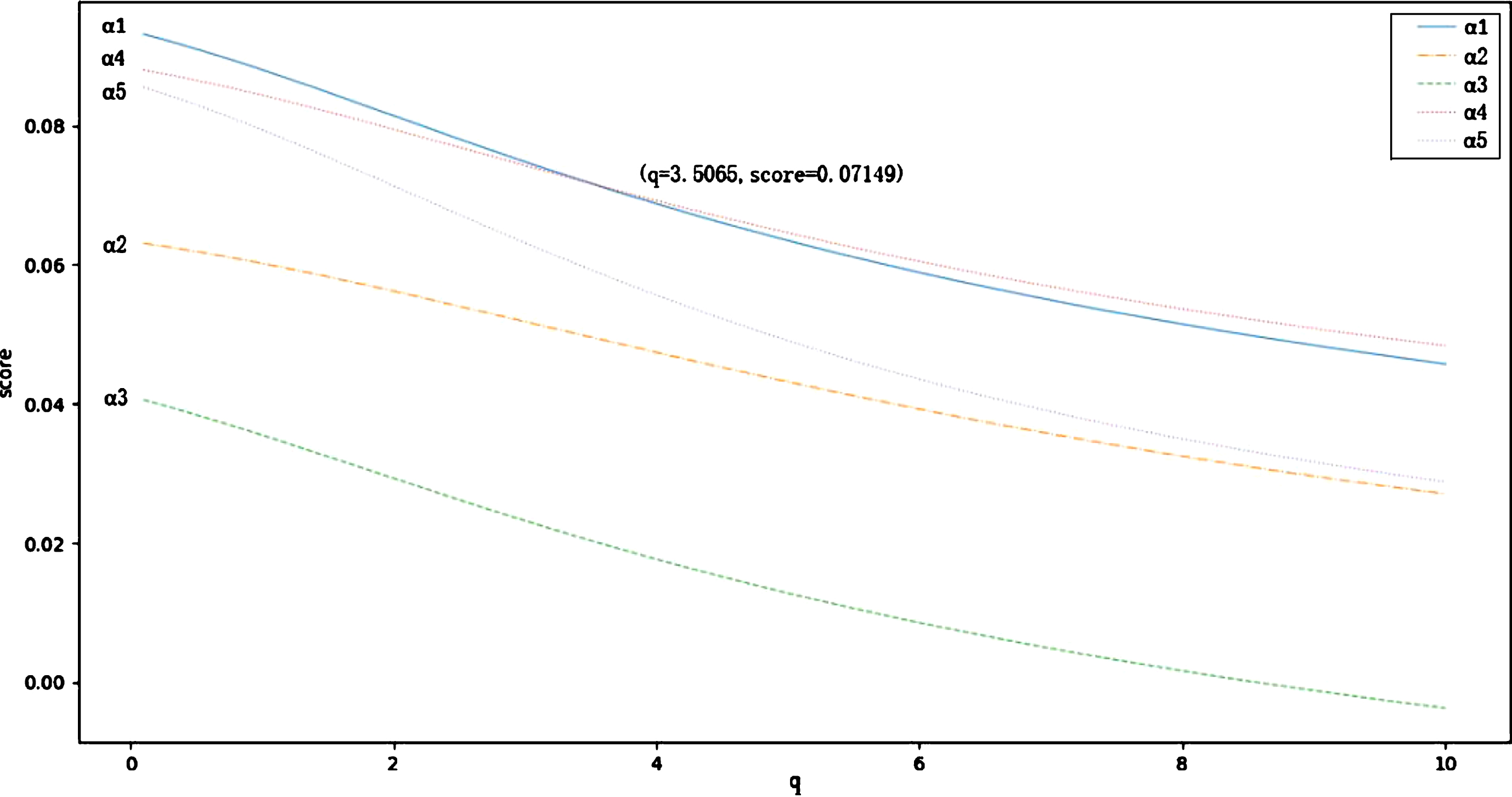
The score values of alternatives and p = 0 and q ∈ (0, 10] .
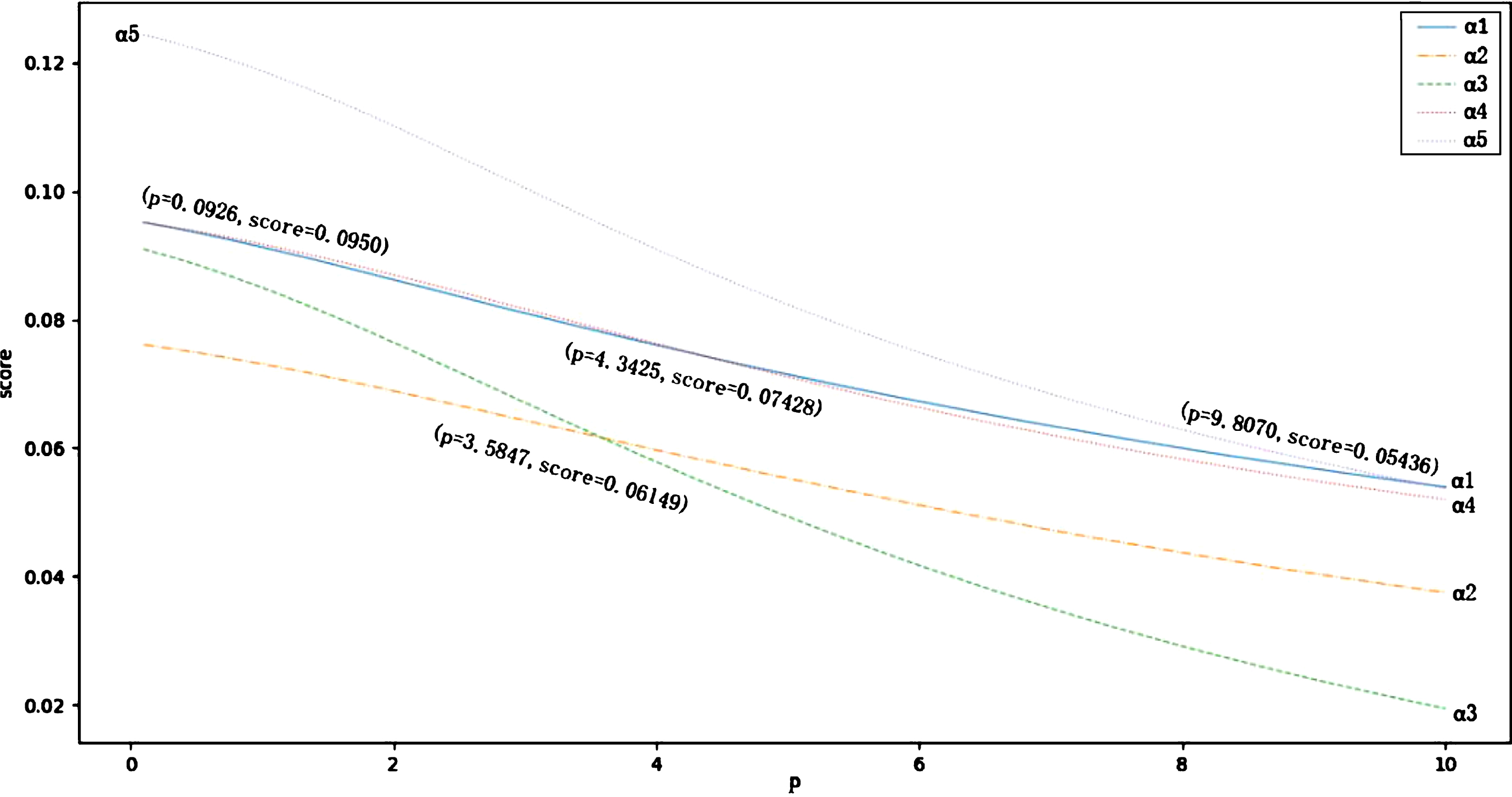
The score values of alternatives and p ∈ (0, 10] and q = 0.
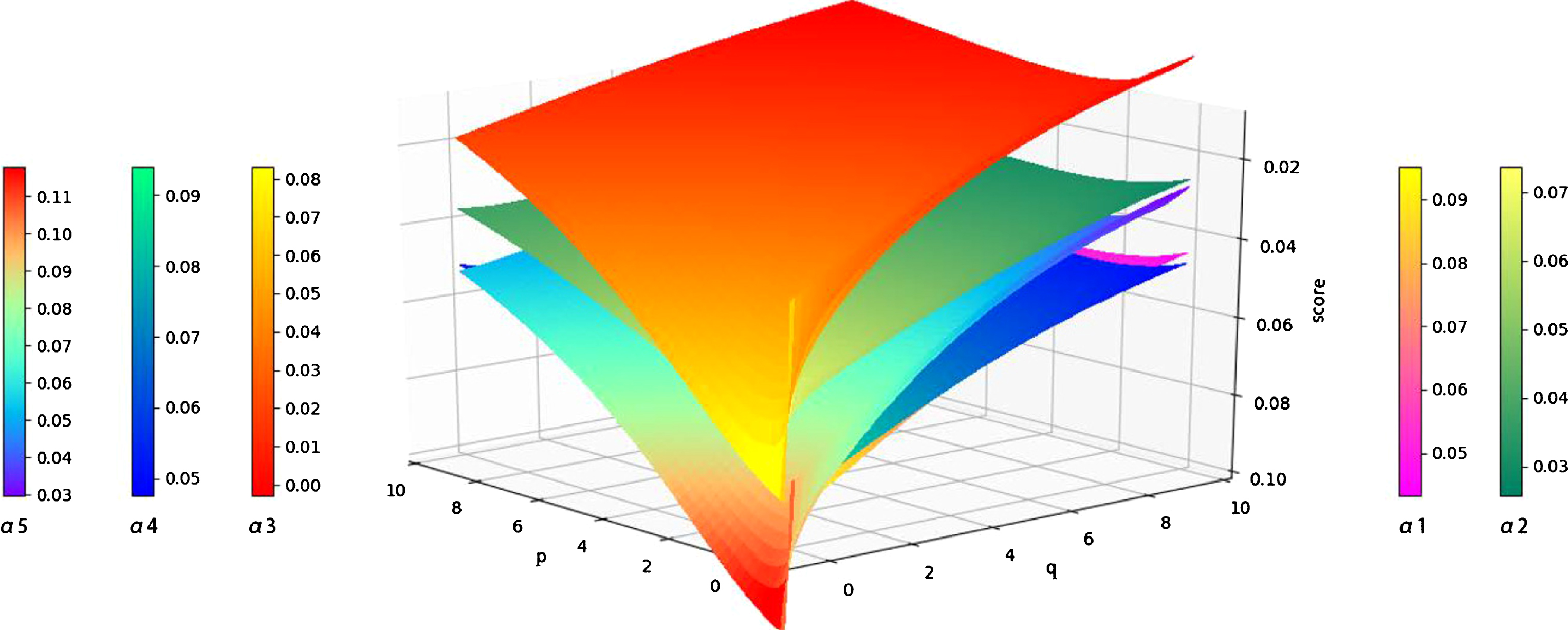
The score values of alternatives and p ∈ (0, 10] and q ∈ (0 , 10].
The results by using the different parameters
In order to validate the feasibility of the proposed decision-making method, a comparative study was conducted with other methods; specifically those in Ye [19], Peng et al. [21–23], Wang and Li [26] and Liu and Zhang [34].
To facilitate a comparison analysis, the same example that was used in Section 5 is used here as well. Since the compared methods presented above cannot handle single-valued neutrosophic hesitant fuzzy information where the weight is completely unknown, we now use the same example but with the weights of criteria determined as w = (0.25, 0.21, 0.35, 0.19). Subsequently, the proposed method is reduced to the methods used in Liu and Zhang [34]. For the proposed method, we can use the determined weight directly in Step 3 in Subsection 5.1 and p = q = 2. Then for the method in Ye [19] and Peng et al. [21], the weighted averaging operator and the weighted arithmetic power averaging operator are utilized respectively. For the method in Wang and Li [26], we assume that the criterion satisfy C1 ≻ C2 ≻ C3 ≻ C4 and λ = 1. Moreover, the generalized single-valued neutrosophic hesitant fuzzy prioritized weighted geometric operator is used to deal with the same example. Consequently, the final results can be obtained as shown in Table 2.
The results obtained by utilizing the different methods
The results obtained by utilizing the different methods
Based on the results presented in Table 2, we can see that the results from the proposed approach are consistent with those that use the methods in Ye [19], Peng et al. [21], Wang and Li [26] and Liu and Zhang [34]; the best alternative is α5 while the worst is α3. For the other compared methods presented in Refs. [22, 23], although there is a slight difference in the final rankings of these methods, the alternative α1 is always the best one(s).
Based on the results presented above, some conclusions can be drawn and these are now discussed. Firstly, although the result of the proposed approach is consistent with that using the method of Ye [19], Peng et al. [21], Wang and Li [26] and Liu and Zhang [34], these four methods are unable to consider the data interrelationships of the criterion. Secondly, the compared methods mentioned above cannot resolve single-valued neutrosophic hesitant fuzzy problems where the weight information is completely unknown. Thirdly, the methods developed by Peng et al. [22] can only resolve MCDM problems in which the number of criteria clearly exceeds the number of alternatives; while the method in Peng et al. [23] is better used in resolving problems with a large number of alternatives and few criteria. Otherwise, the final results cannot be obtained directly. However, the approach proposed in this paper is the optimal method for MCDM problems where the weight of criteria is completely unknown, and the relationships between the criteria and data should be considered. Therefore, the main advantages of the proposed approach are not only its ability to deal effectively with the preference information expressed by SVNHFNs, but also its consideration that the weights of the criteria and individual data are interrelated, which makes the final results correspond better with actual decision-making problems.
For real decision-making problems, the criteria and an individual’s evaluation are always interrelated. SVNHFNs can be used widely to deal effectively with uncertain, imprecise and inconsistent information. Based on the HM and Choquet integral, the SVNHFGWCIHM operator has been proposed in this paper, and some special cases and the corresponding properties of the operator were discussed. Moreover, based on the SVNHFGWCIHM operator, a single-valued neutrosophic hesitant fuzzy approach was investigated to resolve MCDM problems where the data is in the form of SVNHFNs and the weights of criteria are completely unknown. Additionally, an illustrative example demonstrated the application of the proposed decision-making approach, and proved that its results are feasible and credible. The main advantages of the proposed approach are its ability to consider effectively the interrelationships of the criteria and data and that the weights of the criteria are completely unknown, which makes the final results better correspond with actual decision-making problems. In future research, the measures of SVNHFNs will be further investigated.
Conflict of interest
The authors declare that there is no conflict of interest regarding the publication of this paper.
Footnotes
Acknowledgments
This work is supported by the National Natural Science Foundation of China (Nos. 71701065 and 71571193), the Postdoctoral Science Foundation of China (No. 2017M610511), the Humanities and Social Sciences Foundation of Ministry of Education of China (No. 15YJCZH127), and the Natural Science Foundation of Hubei Province (No. 2017CFC852).