



Abstract
This study presents a possible relationship between two main objects, which are three-dimensional copulas (3D-Cs) and geometric picture fuzzy numbers (GPFNs). This opens up a potential field for future studies for these two objects that three-dimensional copulas can become useful tools for handling uncertainty information in the form of a picture fuzzy set (PFS). Specifically, we define a GPFN as a base element of the PFS and a defined domain of three-dimensional copulas that contains a set of GPFNs, then we show some examples of three-dimensional copulas identified on this domain. In this framework, we present the theorems related to these two objects. At the same time, we provide some examples for three-dimensional semi-copulas, three-dimensional quasi-copulas, and three-dimensional empirical copulas defined on D, which is a defined domain of a three-dimensional copula and contains a set of GPFNs
Keywords
Introduction
Since 1951, Frechet studied distribution functions of random variables defined on the probability space. He studied the following problem: Given d random variables, defined the marginals F1, F2, . . . , F d and an joint distribution function H (F1, F2, . . . , F d ) . The problem is hence related to the determination of random sets X1, X2, . . . , X d (see Frechet [15], 1951). Many studies about this problem were conducted by Feron for three-dimensional distribution functions (see [14]1956), by Frechet for multidimensional distribution functions (see [16],1956), by Marshall and Olkin for generalized bivariate exponential distribution (see [24], 1996). The marginals and joint distribution functions can be applied to statistical modelling (see [6], 2003).
The history of copulas began in 1959 with Sklar’s Theorem [30]. The proof of this theorem was not given in 1959. It’s was provided by Sklar in 1973 [31]. The copulas are the mathematical tool for combining for the joint distribution functions. The most results concerning copulas were obtained in: the statistical community by Scheizer and Wolff (see [29],1981); the finance by Genest et all (see [17], 2009) and Jaworski et all (see [20], 2013); the enviromental scince by Genest and Favre (see [18], 2007) and Salvadori (see [28], 2007); the biostatistics by Hougaard (see [19], 2000) and Song (see [35], 2007); the decision scince by Clemen and Reilly (see [5], 1999); the machine learning by Elidan (see [13], 2013);
Nowadays, the interest in copulas is investigated in both tend the basis on copulas and the applications to the many fields in finance and risk management.
The concept of fuzzy sets (FSs) was introduced in 1965 by L.A. Zadeh [42], a lot of research was investigated to make the foundations of this new notion, in algebraic logic. The t-norms started with Menger (see [25], 1985), whose idea was to construct metric spaces when probability distribution functions (pDFs) were used to describe the distance between elements. The t-norms are played an important role in the Fuzzy set theory. Almost all of the studies of t-norms based operations on fuzzy numbers. The t-norms and t-conorms are the mathematical operators for combining information by Dubois, Prade (see [11], 1981), and Klement (see [21], 1982). The properties of t-norms for possible use in the development of intelligent systems were studied by Bonissone (see [3], 1985). The t-norms have also been used in the design of fuzzy controllers, in modeling, and in the decision marking problems, such that satisfy some properties of the copulas (can see in [30]).
In 2014, Cuong [7] introduced the concept of picture fuzzy sets (PFS), which is a generalization of the traditional fuzzy sets (FS) and the intuitionistic fuzzy sets (IFS). Then, some operations on PFS with some properties are considered and the basic preliminaries of PFS Theory are presented [8]. In literature, the results on PFS connectives almost have algebraic, logical operations [36], and fuzzy clustering [33]. Recently, L.H. Son [34] proposed a generalized picture distance measure and integrate it into a novel hierarchical picture fuzzy clustering method. Based on the idea of "picture fuzzy sets", we define the concept of the geometric picture fuzzy numbers as an ordered set which consists of a membership degree, a neutral membership degree, and a non-membership degree. Similar to the intuitionistic fuzzy numbers, the geometric picture fuzzy numbers have a great potential for application in multi-criteria decision making (MCDM) methods. MCDM methods are a tool to reduce the subjectivity of decision making by creating a series of filter options and helping to make a selection out of complex alternatives. Many interesting studies have been done, for example, Badi and his colleagues [4] used a new method (called combinative distance-based assessment - CODAS) to handle MCDM problems for a steelmaking company in Libya, Mukhametzyanov and Pamucar [23] provided a model for result consistency evaluation of MCDM methods and presented the results of an analysis of the sensitivity of decision-making based on the rank methods, Liu et al. [22] presented a new multicriteria model of the selection that significantly influences its further flow is decision-making about the choice of the most favorable transport provider. Wang et al. [37] formulated a hybrid fuzzy multi-criteria decision-making framework, which not only considers the interrelationship among criteria but also considers the decision-maker’s bounded rationality and behavioural psychology, with picture fuzzy information to rank the risk factors of energy performance contracting projects. Zhang et al. [41] presented the picture fuzzy evaluation based on distance from the average solution (EDAS) model for multiple-criteria group decision-making based on the traditional EDAS model and some fundamental theories of picture 2-tuple linguistic numbers. R. Wang et al. [38] studied on multiple attribute decision-making (MADM) problems with picture fuzzy numbers information and adopted the PFWMM and picture fuzzy weighted dual Muirhead mean operators to build a decision-making model to handle picture fuzzy MADM problems. Wei et al. [39] used the q-rung orthopair fuzzy weighted dual Maclaurin symmetric mean operator to develop an approach to solve the q-rung orthopair fuzzy multiple-attribute decision-making problems. G. Wei and Z. Zhang [40] utilized power aggregation operators and Bonferroni mean to develop some single-valued neutrosophic Bonferroni power aggregation operators and single-valued neutrosophic geometric Bonferroni power aggregation operators and used the SVNWBPM and SVNWGBPM operators to solve the single-valued neutrosophic multiple-attribute decision-making problems. Peng [27] utilized induced ordered weighted geometric operator to develop picture fuzzy induced ordered weighted geometric operators and used the picture fuzzy induced ordered weighted geometric to solve the picture fuzzy multiple attribute decision-making problems.
If t-norms (see [25]) are the mathematical tool for combining membership degrees of fuzzy sets, the copulas (see [30]) are the mathematical tool for illustration of probability marginals and joint distribution functions. Both the distribution functions and the copulas have similarities: there are copulas are distribution functions and vice versa. Many problems in the financial and economic fields, such as risk management, derivative valuation, stock market options, stock portfolio optimization, market spread, and financial, are based on the investigation of several important function classes: the marginals, the joint distribution functions (jDFs) with copula-like structure (Copulas), logical operations or t-norms (t-N) and more recently intuitionistic fuzzy numbers (IFNs).
In recent results, Dolati and his colleagues [9] introduced a new family of fuzzy implication operators which are based on the conditional version of a copula function. In [2], the authors introduced a method of defining commutative semicopulas from fuzzy negations. Most recently, Sun and his colleagues [32] proposed a fuzzy copula model to recognize the possibilistic uncertainty of wind speed correlation. As we know, the copula theory, the fuzzy theory or the Picture fuzzy theory have developed independently of each other. Some cited above shows that many researchers began to consider the relationship between the copula theory and the fuzzy theory, but the relationship between the copula theory and the Picture fuzzy theory is very new. In 2004, Deschrijver and his colleagues ([10]) built the t-norms and t-conorms on L* (it is the place in which the intuitionistic fuzzy sets take the value and this value is the intuitionistic fuzzy numbers). From the visual relationships of t-norms and copula. Along with some of the results built the t-norms and t-conorms on L* (can see in [10]). We notice that the problem of developing the copula on
This paper includes: In section 2, we recall some notations and concepts presented in detail in series of researches about marginals, three-dimensional joint distribution functions (3D-jDFs), semi-copulas (S-Copulas), quasi-copulas (Q-Copulas), three-dimensional copulas (3D-Cs). At the same time, we also present the concept of a geometric picture fuzzy numbers (GPFNs), the set of the GPFNs and the additional set of GPFNs. In section 3, we present a few theorems and examples about the existence of some three-dimensional (3D) semi-copulas, 3D-quasi-copulas, and 3D-copulas. In section 4, we introduce a non-linear programming approach.
Preliminaries and notation
We recall some notations and concepts presented in detail in a series of researches about three-dimensional joint distribution functions (3-jDFs), three-dimensional copulas (3D-Cs), and the picture fuzzy sets (PFSs).
The three-dimensional distribution functions
Let
Con (0, x2, x3) = Con (x1, 0, x3) = Con (x1, x2, 0) =0 ;
Con (1, 1, 1) =1 .
Con (0, x2, x3) = Con (x1, 0, x3) = Con (x1, x2, 0) =0 ;
C1 (1, 1, 1) =1 ;
C1 (x1, 1, 1) = C1 (1, x1, 1) = C1 (1, 1, x1) = x1 .
C2 (x1, 0, 0) = C2 (0, x2, 0) = C2 (0, 0, x3) =0 ;
C2 (1, 1, 1) =1 ;
C2 (x
k
, 1, 1) = C2 (1, x
k
, 1) = C2 (1, 1, x
k
) = x
k
at lear index k ∈ {1, 2, 3} .
We can see a description of f (x1, x2, x3) is 3D-increasing on [0, 1] (in Figure 1). Assume that the volume of the boxes in Figure 1 corresponds to the value of the functions as follows:
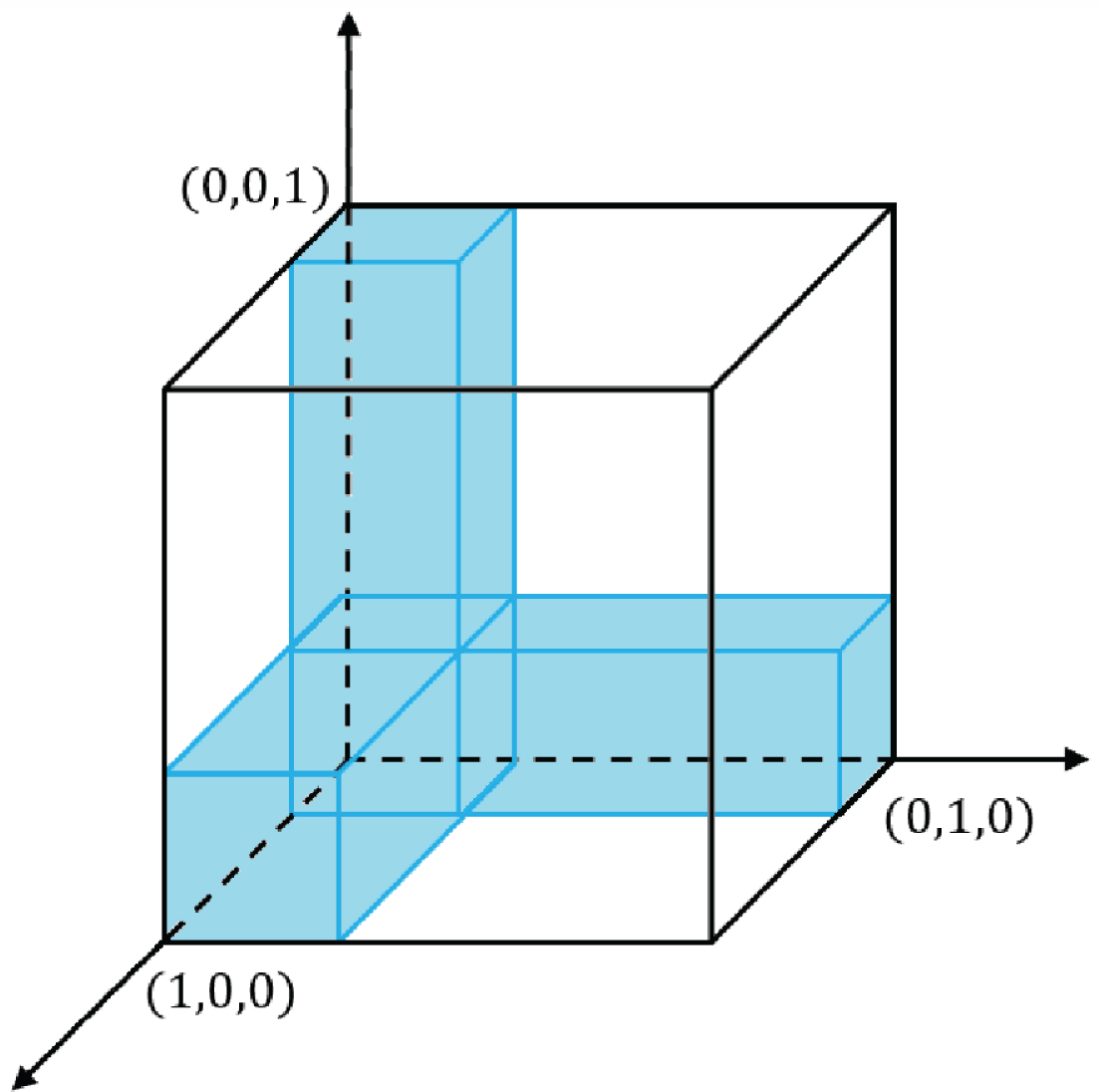
A description of f (x1, x2, x3) is 3D-increasing on [0, 1] .
B
x
(x1, x2, x3) = x1x2x3 = f (x1, x2, x3) ;
B
y
(y1, y2, y3) = y1y2y3 = f (y1, y2, y3) ;
B
y
1
(y1 - x1, x2, x3) = (y1 - x1) x2x3 = f (y1 - x1, x2, x3) ;
B
y
2
(x1, y2 - x2, x3) = x1 (y2 - x2) x3 = f (x1, y2 - x2, x3) ;
B
y
3
(x1, x2, y3 - x3) = x1x2 (y3 - x3) = f (x1, x2, y3 - x3) ,
such that, we have
[a/] C (x1, x2, x3) =0 if x k = 0 at index k∈ {1, 2, 3} ; em [b/] C (1, 1, 1) =1 ; em [c/] C (x k , 1, 1) = C (1, x k , 1) = C (1, 1, x k ) = x k at index k∈ {1, 2, 3} ; em [d/] C (x1, x2, x3) is 3D-increasing on [0, 1] .
We recall some notations and concepts presented in detail in a series of researches about fuzzy sets and its extended (see [1, 42]).
In [1], Atanassov introduced the concept of intuitionistic fuzzy set (IFS), characterized by a membership function and a non-membership function, which is a generalization of fuzzy set.
In 2014, Cuong [7] introduced the concept of picture fuzzy set (PFSs), characterized by a membership function, a neutral membership function and a non-membership function, which is a direct extension of the fuzzy sets (FS) and the intuitionistic fuzzy sets (IFS).
From Definition 9, let A ={ (u, μ
A
(u) , η
A
(u) , ν
A
(u)) |u ∈ U } be a picture fuzzy set with 0 ⩽ μ
A
(u) + η
A
(u) + ν
A
(u) ⩽1, putting x = (x1, x2, x3) = (μ
A
(u) , η
A
(u) , ν
A
(u)) then we have a box
where x1 corresponding to membership degree, x2 corresponding to neutral membership degree and x3 corresponding to non-membership degree and each element
If

Geometric interpretation of
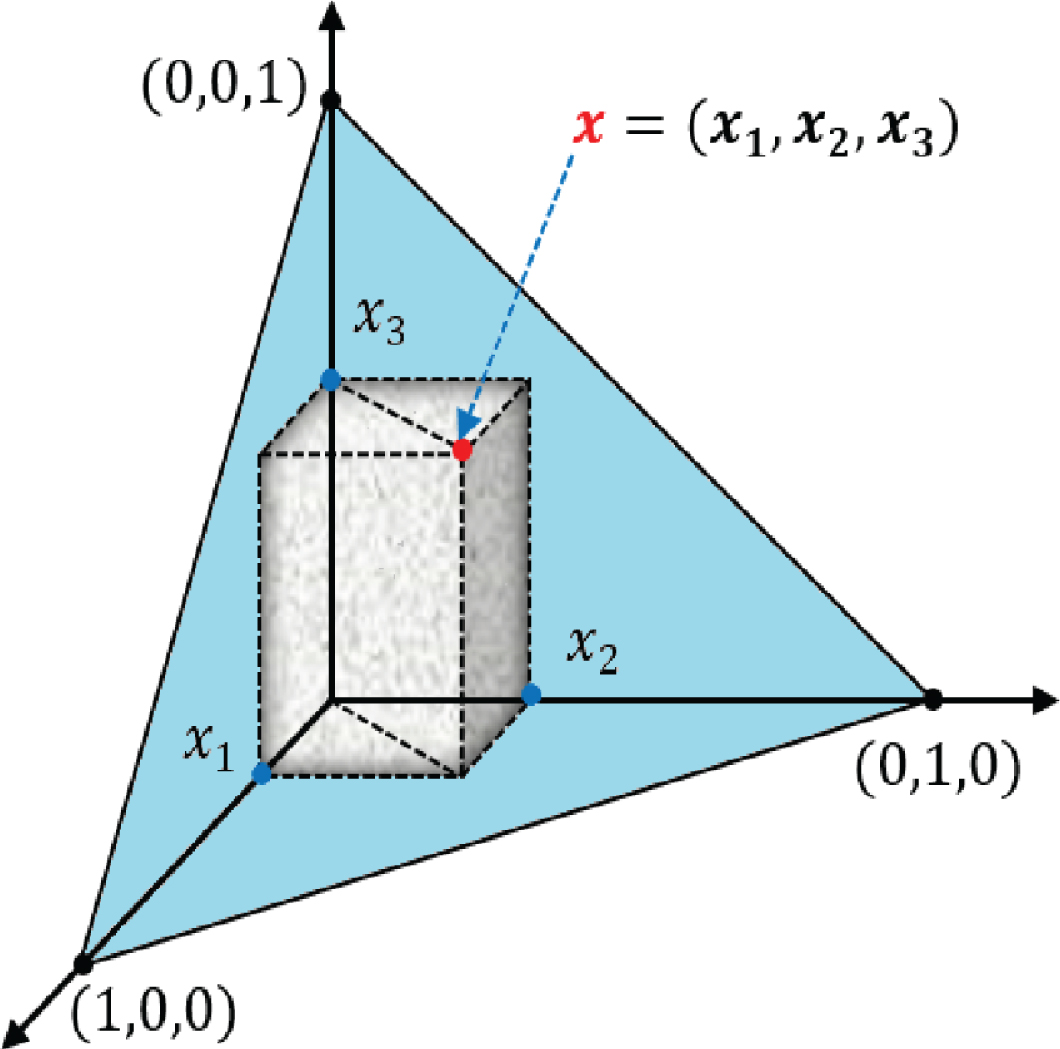
The box B
x
and a geometric interpretation of geometric picture fuzzy number (GPFN) x = (x1, x2, x3) in
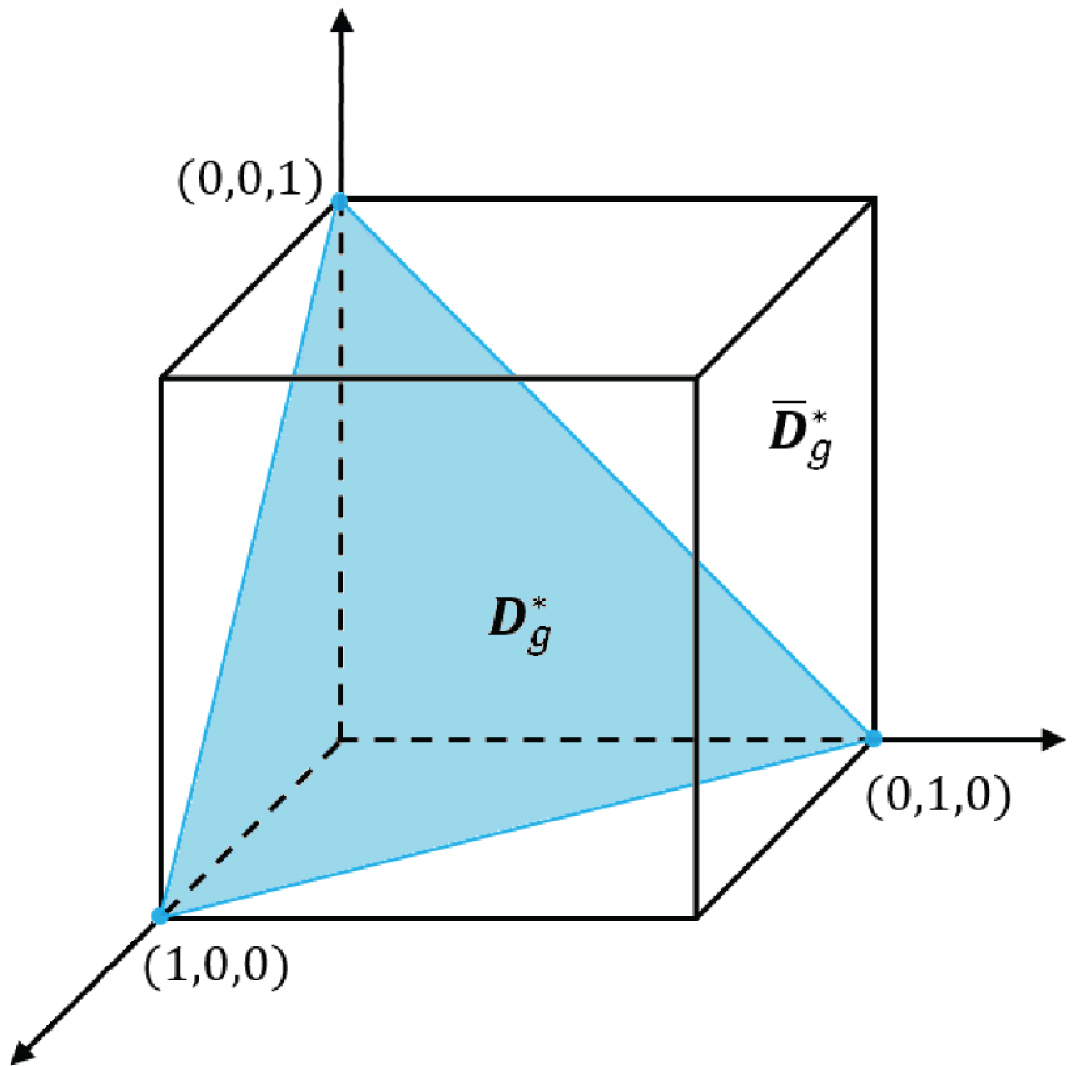
Picture description of the additional set of geometric picture fuzzy numbers (Ad-GPFNs)
C1 (x1, x2, x3) = x1 . x2 . x3 ;
C1 (x1, x2, x3) is 3D-Conjunctor, which means that it is a function Con : [0, 1] × [0, 1] × [0, 1] → [0, 1] with all x1, x2, x3 ∈ [0, 1] the following axioms are satisfied
C1 (1, x2, 1) = x2 and C1 (x1, 1, 1) = x1, C1 (1, 1, x3,) = x3, with 1 as a neutral element.
By direct inspection, we see that all kinds of C1 (x1, x2, x3) in the Theorem 2 are the 3D-semi-copulas.
C2 (x1, x2, x3) = x1+ x2 + x3 - 1 + C1 (1 - x1, 1 - x2, 1 - x3) ;
C2 (x1, x2, x3) = x1+ x2 + x3 - 1 + C1 (1 - x1, 1 - x3, 1 - x2) ;
C2 (x1, x2, x3) = x1+ x2 + x3 - 1 + C1 (1 - x2, 1 - x1, 1 - x3) ;
C2 (x1, x2, x3) = x1+ x2 + x3 - 1 + C1 (1 - x2, 1 - x3, 1 - x1) ;
C2 (x1, x2, x3) = x1+ x2 + x3 - 1 + C1 (1 - x3, 1 - x1, 1 - x2) ;
C2 (x1, x2, x3) = x1 + x2 + x3 - 1 + C1 (1 - x3, 1 - x2, 1 - x1) .
C2 (x1, x2, x3) = x1+ x2 + x3 - 2 + C1 (1 - x1, 1 - x2, 1 - x3) ;
C2 (x1, x2, x3) = x1+ x2 + x3 - 2 + C1 (1 - x1, 1 - x3, 1 - x2) ;
C2 (x1, x2, x3) = x1+ x2 + x3 - 2 + C1 (1 - x2, 1 - x1, 1 - x3) ;
C2 (x1, x2, x3) = x1+ x2 + x3 - 2 + C1 (1 - x2, 1 - x3, 1 - x1) ;
C2 (x1, x2, x3) = x1+ x2 + x3 - 2 + C1 (1 - x3, 1 - x1, 1 - x2) ;
C2 (x1, x2, x3) = x1 + x2 + x3 - 2 + C1 (1 - x3, 1 - x2, 1 - x1) .
With x1 + x2 + x3 > 2 :
C1 (x1, x2, x3) is 3D-semi-copula in
C2 (x1, x2, x3) that is 1-Lipschitz in both variables.
By direct inspection, we see that all kinds of C2 (x1, x2, x3) in the Theorem 3 are the 3D-quasi-copulas.
Let
C2 (x1, x2, x3) = x1+ x2 + x3 - 1 + C1 (1 - x1, 1 - x2, 1 - x3) ;
C2 (x1, x2, x3) = x1 + x2 + x3 - 1 + C1 (1 - x1, 1 - x3, 1 - x2) .
C2 (x1, x2, x3) = x1+ x2 + x3 - 1 + C1 (1 - x2, 1 - x1, 1 - x3) ;
C2 (x1, x2, x3) = x1+ x2 + x3 - 1 + C1 (1 - x2, 1 - x3, 1 - x1) ;
C2 (x1, x2, x3) = x1+ x2 + x3 - 1 + C1 (1 - x3, 1 - x1, 1 - x2) ;
C2 (x1, x2, x3) = x1 + x2 + x3 - 1 + C1 (1 - x3, 1 - x2, 1 - x1) .
C2 (x1, x2, x3) = x1+ x2 + x3 - 2 + C1 (1 - x1, 1 - x2, 1 - x3) ;
C2 (x1, x2, x3) = x1 + x2 + x3 - 2 + C1 (1 - x1, 1 - x3, 1 - x2) .
C2 (x1, x2, x3) = x1+ x2 + x3 - 2 + C1 (1 - x2, 1 - x1, 1 - x3) ;
C2 (x1, x2, x3) = x1+ x2 + x3 - 2 + C1 (1 - x2, 1 - x3, 1 - x1) ;
C2 (x1, x2, x3) = x1+ x2 + x3 - 2 + C1 (1 - x3, 1 - x1, 1 - x2) ;
C2 (x1, x2, x3) = x1+ x2 + x3 - 2 + C1 (1 - x3, 1 - x2, 1 - x1) ;
If x1 + x2 + x2 > 2 then:
By direct inspection, we see that the 3D-empirical-copulas denotes by (12), which satisfies Definition 6.
[a/] C (t, 0, 0) = C (0, t, 0) = C (0, 0, t) =0, ∀ t ∈ [0, 1] ; em [b/] C (1, 1, 1) =1 ; em [c/] C (t, 1, 1) = C (1, t, 1) = C (1, 1, t) = t, ∀ t ∈ [0, 1] ; em [d/] C (x1, x2, x3) is 3D-increasing on [0, 1] .
In
[i/] C (1, 1, 1) =1 ; em [ii/] C (t, 1, 1) = C (1, t, 1) = C (1, 1, t) = t, ∀ t ∈ [0, 1] ; em [iii/] C (x1, x2, x3) is 3D-increasing on [0, 1] .
Many practical and theoretical problems can be modeled as linear programming. Linear programming assumptions or approximations may also lead to appropriate problem representations over the range of decision variables being considered. However, in general, nonlinearities in the form of either nonlinear objective functions or nonlinear constraints are crucial for representing an application properly as a mathematical program. Non-linear programming studies the general case when the objective function or constraints or both contain non-linear components. This subsection provides an initial approach for non-linear objective functions as joint distribution functions of three random variables taking values in D. To cope with such nonlinearities, first by defining a three-dimensional empirical copula of the sample sets and then by based on the above results that can be defined these objective functions as an empirical 3D-copula. As a consequence, the technique to be presented is primarily algebra-based.
Let’s consider three random variables X1, X2, X3, we have 3-dimensional objects: the marginals, joint distribution functions, three-dimensional copulas. Then a three-dimensional empirical copula of the sample sets is denoted by
On the other hand, we can also step by step determine the marginals of the sample sets F1 (x1) = x1, F2 (x2) = x2, F3 (x3) = x3 with (x1, x2, x3) ∈ D and joint distribution functions
For example, we consider the non-linear fuzzy programming problem for the joint distribution function H (x1, x2, x3) for the random variables X1, X2, X3 with X
k
⩽ x
k
, k = 1, 2, 3, whose marginals F1 (x1) = x1, F2 (x2) = x2, F3 (x3) = x3 with
Assume that one of the 3D- semi-copulas is In
In In In In In In
In this case, we have
The concept of copula has been put into statistical probability by Abe Sklar since 1959, but only in the last two decades has the copula theory flourished, due to the need to apply it in financial risk management. In probability, it is used in the sense that a function connects the probability distributions of a set of random variables together or describes the dependence between random variables. The copula is special functions with many interesting properties, and when we know copula, it is also possible to calculate the dependence of random variables. As we know, the copula theory, the fuzzy theory or the Picture fuzzy theory have developed independently of each other. In recent results, Copula functions and fuzzy theory have been also studied from the theoretical point of view and many authors have devoted their research to this topic. Dolati and his colleagues [9] introduced a new family of fuzzy implication operators which are based on the conditional version of a copula function. They want to introduce a new tool to perform fuzzy implications due to the fact that the choice of implication cannot be made independently of the inference rule that is going to be applied. In [2], the authors introduced a method of defining commutative semicopulas from fuzzy negations. they want to construct new binary aggregation functions from fuzzy negations in general. simultaneously, they proved that aggregation functions constructed by this method are always commutative semicopulas and it will be characterized when the constructed functions are in fact, copulas or quasi-copulas. Moreover, the general properties of the constructed semi-copulas are quite similar to those of nilpotent t-norms and so they can be interpreted as a non-associative generalization of t-norms having a non-trivial zero-region. In fact, several examples (can see in [2]) are given that lead to a t-norm and so it is also investigated when the constructed semicopula is a t-norm. Sun and his colleagues [32] proposed a fuzzy copula model to recognize the possibilistic uncertainty of wind speed correlation. In this model, the distribution of multivariate wind speeds is described by a copula function and the copula parameters can be interval numbers, triangular or trapezoidal fuzzy numbers. A complete decision rule and interval estimation method are proposed to determine the format of copula parameters based on cumulative probability and probability distributions of correlated wind speeds. Some cited above shows that many researchers began to consider the relationship between the copula theory and the fuzzy theory, but the relationship between the copula theory and the Picture fuzzy theory is very new. In 2004, Deschrijver and his colleagues ([10]) built the t-norms and t-conorms on L* (it is the place in which the intuitionistic fuzzy sets take the value and this value is the intuitionistic fuzzy numbers). They extended the notion of triangular norm and conorm to intuitionistic fuzzy set theory and generalized said representation theorems to these intuitionistic fuzzy connectives. From the visual relationships of t-norms and copula that the copulas and t-norms are operations on the unit interval, and many important copulas are also t-norms, as many t-norms turn out to be copulas. Along with some of the results built the t-norms and t-conorms on L* (can see in [10]). We notice that the problem of developing the copula on
Conclusions
In this paper, we outlined the idea of connecting between the two objects which are the three-dimensional copulas and the geometric picture fuzzy numbers. We define a GPFN as a base element of the PFS and give some concepts prepared for defining a defined domain of three-dimensional copulas that contains a set of GPFNs. From the definitions of the set of GPFNs, which is denoted by
Footnotes
Acknowledgments
The authors are very grateful to the anonymous reviewers, associate editor, and editor for their insightful and constructive suggestions that have led to an improved version of this manuscript.