



Abstract
Dempster-Shafer theory (DST) of evidence has wide application prospect in the fields of information aggregation and decision analysis. To solve the issues of interval evidence combination and normalization, we have reinvestigated the methods provided for interval evidence combination within the frameworks of DST and evidential reasoning (ER) approach, respectively, and pointed out the shortcomings of existing methods. A more general interval evidence combination approach based on the ER rule is constructed. Numerical examples are provided to indicate that the proposed method not only suitable to the conflict-free interval evidence combination, but also to the conflicting interval evidence combination, and interval evidence specificity can be kept intact in the interval evidence combination process. Moreover, the interval evidence combination methods based on DST or ER are special cases of the proposed method in some cases.
Introduction
The Dempster-Shafer theory (DST) of evidence was first developed by Dempster [1], and then extended to its present form by Glenn Shafer [2]. The DST has been successfully extended to areas such as audit risk assessment [3], target recognition [4], expert systems [5], knowledge reduction [6–9], information fusion [10], global positioning system [11], reliability analysis [12], classification [13, 14], environmental impact assessment (EIA) [15], decision analysis [16–26], e-commerce security [27], data mining [28–30], water distribution systems [31], safety analysis [32, 33], and regression analysis [34, 35] and so on.
The original DST was developed for combination of precise (crisp) belief degrees or belief structures. However, due to the uncertainty of decision makers’ (DMs) subjective judgments, linguistic ambiguity and the lack of information, probability masses assigned to propositions can be uncertain or imprecise. For example, when diagnosing and reasoning disease, a doctor may be unable to give a precise judgment about the disease if he/she cannot definitely confirm his/her diagnosis. In this situation, the belief degree expressed in the form of interval numbers rather than a crisp number may be easier for him/her. In the problem of group decision making (GDM), belief degrees may be provided by different DMs or experts, although these belief degrees can be synthesized to get a precise point estimate, it will inevitably results in information loss. Therefore, the interval-valued belief structure (IBS) can be used as an ideal choice for information expression, which can not only preserve the views of different DMs or experts, but also express the uncertainty about the opinions of DMs or experts.
Although many studies devoted to extend DST to IBSs, and interested readers can refer to Lee and Zhu [36], Denoeux [37, 38], Yager [39], Wang et al. [40, 41], Sevastianov et al. [42], Song et al. [43] and Chen et al. [44] for details, the problems for combining and normalizing of IBSs have not been fully resolved. Existing approaches are mainly divided into two categories: one type is based on interval arithmetic operations [36, 43] and the other type is based on programming models [37, 44].
Wang et al. [40, 41] reinvestigated most of the existing approaches and pointed out the shortcomings of these methods, and they provided true intervals of the combination results by a new logically correct optimality approach. Furthermore, they extended ER approach to combine interval uncertainty information including interval data and interval-valued belief degrees, which could be incurred in GDM problems or experts systems. However, using their approaches may lead to counter-intuitive behaviors or change the specificity of the original interval evidence in some cases. Since the two methods are based on DST and ER respectively, which do not discriminate the difference between the ignorance and residual support, whilst the former is an intrinsic property of the evidence and the latter reflects its extrinsic feature related to its relative importance compared with other evidence [45]. This indiscrimination will changes the specificity of interval evidence, even if all pieces of interval evidence do not have any global ignorance before combination their combined results for the frame of discernment will still have global ignorance. Moreover, the existing approaches focus mainly on non-conflicting interval evidence combination. However, when the interval evidence encountered conflict, especially when there is a high conflict among them, the combination results can be counter-intuitive or irrational using these existing approaches in some cases.
Recently, Sevastianov et al. [42] proposed a new framework for rule-base ER in the interval setting and applied to diagnosing type 2 diabetes, unfortunately, this method is not suitable for conflicting interval evidence combination. Song et al. [43] developed a novel combination approach which is based on the operation on intuitionistic fuzzy set, elicited by DST. However, similar to Sevastianov’s method, the method is suitable for non-conflicting interval evidence combination and information loss occurs during the combination process. Chen et al. [44] studied the issues of combination and normalization of conflicting interval evidence, but, the Chen’s method [44] is one type of evidence discounting combination method in the framework of DST, and the specificity of the interval evidence will be changed by using Chen’s method [44]. It can be seen from the above review of the literatures about the interval evidence combination that the existing methods cannot truly solve the problem of interval evidence combination, so it is necessary to further study this problem.
The aim of this paper is to reinvestigate the problems of interval evidence combination and to provide a more general combination approach for combining interval evidence, regardless of whether there is a conflict among them. The proposed method is based on the ER rule, in a relative effective and reasonable way.
The paper is organized as follows. Section 2 introduces the relevant concepts of DST and the ER rule with evidence weight. Section 3, we analyze the representative approaches together with the latest approach for combining and normalizing IBSs and point out the counter-intuitive behaviors and non-specificity of these approaches. A more general approach for combining and normalizing IBSs is developed in Section 4. Section 5, Numerical examples are provided throughout the paper. Section 6, discusses the advantages of the proposed method over other methods, and Section 7 concludes the paper.
Background
The relevant conceptions of the DST and the ER rule are briefly introduced in this section as a basis for subsequent discussions.
The DST is modeled based on a fixed set of N mutually exclusive and exhaustive elements, called the frame of discernment (FOD) denoted by Θ. 2 Θ is the power set of Θ, contains all possible propositions of the elements in Θ, can be denoted as: 2 Θ = {∅, {H1}., …, {H N }, {H1, H2}, …, {H1, H N }, …,. Θ}. The core definitions in DST are as follows.
Where ∅ denotes empty set, the mass function m (A) called the basic probability mass of A. It measures the belief exactly assigned to A and represents how strongly the evidence supports A. Each subset A ⊆ Θ with m (A) > 0 is called a focal element of m. All the related focal elements are collectively called the body of evidence (BOE), abbreviated to evidence.
The core of DST is Dempster’s combination rule, which assumes that evidence from different sources are independent and combines multiple pieces of evidence using orthogonal sum. Assuming m1, m2, . . . , m
n
are BPAs sourced from multiple pieces of independent evidences and their orthogonal sum m = m1 ⊕ m2 … ⊕ m
n
, where ⊕ denotes the operator of combination. With two BPAs, Dempster’s combination rule is defined as follows:
Where w
i
= 0 means that it is not important at all and w
i
= 1 means that it is the most important. The term mθ,i are generated as basic probability mass for θ from e
i
. It is obviously that the specificity of belief degree does not be changed. The weighted belief distribution (WBD) of e
i
, denoted by m
i
, is given as follows
There are two terms in Equation (6c): the left one [(1 - w2) mθ,1 + (1 - w1) mθ,2] is called bounded sum of individual support (BSIS) and the right one ∑B∩C=θmB,1mC,2 is called orthogonal sum of collective support (OSCS) in the ER rule. According to Equation (6b–6d), the ER rule can be used recursively for aggregating multiple pieces of evidence. At the end of the recursive process, Equation (6a) is employed only once after all pieces of evidence are combined. It can be proved that there always exists 0 ≤ p θ ≤ 1, ∀θ ⊆ Θ and ∑θ⊆Θp θ = 1.
In recent years, researchers have become increasingly interested in the combination approaches with IBSs. In this paper, we reinvestigate several representative approaches together with the latest approach for combining interval evidence, and these interval evidence combination approaches will be thoroughly analyzed to highlight the research motivation of this paper.
To obtain the true interval probability mass for each combined proposition, Wang et al. [40, 41] proposed a new logically correct optimality approach by taking into account the combination and normalization of two IBSs at the same time and optimizing them together rather than separately. They defined the IBS of m1 ⊕ m2 as:
Moreover, multiple IBSs can be combined by this optimality approach simultaneously. Their combination, denoted by m1 ⊕ m2 ⊕ … ⊕ m N , is also an IBS as:
Although they illustrate the superiority of the method through examples, Wang’s method [40] is a combination method of interval evidence in the framework of DST. In fact, using Dempster’s combination rule to combine interval evidence may also result in counter-intuitive behaviors in some cases, such as conflicting interval evidence combination.
In order to solve practical application problems, Wang et al. [41] extend the ER approach to combine interval uncertainty information, which are frequently used forms of information expression in GDM problems. They constructed optimization models to capture the combined belief degrees and expected utilities for each alternative. However, the ER approach is generally used to solve the multiple attribute decision analysis (MADA) problems with uncertainties, by which assumed that all evidence have no local ignorance.
To overcome the defects of existing approaches of interval evidence combination, Sevastianov et al. [42] developed a new framework for rule-base ER in the interval setting. The IBSs from different sources were combined by the so-called “interval extended zero” method, which was based on the interval arithmetic operations. Unfortunately, this method is not suitable for conflicting interval evidence combination. Song et al. [43] proposed a novel combination approach which is based on the operation on intuitionistic fuzzy set, elicited by DST. However, similar to Sevastianov’s method [42], the method is suitable for non-conflicting interval evidence combination and information loss occurs during the combination process. Chen et al. [44] recently proposed a new interval evidence combination approach for the issues of combination and normalization of conflicting interval evidence, which is a kind of interval evidence discounting method in the framework of DST. Although Chen’s method [44] can effectively solve the counter-intuitive behaviors of interval evidence combination, it may result in the specificity of the original interval evidence to be changed. Moreover, when the relative importance weights of the interval evidence are all equal, Chen’s method [44] will degrade into the Wang’s method [40]. Therefore, Chen’s method [44] does not really effectively solve the problems of interval evidence combination.
The above review indicated that these representative methods do not solve the problem of interval evidence combination well, thus, it is urgent necessary to reinvestigate them. We aim to generalize the interval-valued probability masses calculation method proposed in Wang’s approach [40, 41]. First of all, it is an urgent necessary to distinguish the difference between the degree of global ignorance and residual support for interval-valued probability masses calculation and interval evidence combination process. Because the former is the inherent property of the evidence itself and has nothing to do with other evidence, while the latter is the external feature of the evidence is obtained by comparing the relative importance with other evidence. That is, the residual support of evidence e i is measured by mP(Θ),i = 1 - w i , which is not assigned to Θ in both interval-valued probability masses calculation and interval evidence combination process. Then, in the following section, we will construct a more general combination approach for combining and normalizing IBSs in the ER rule framework.
We first introduce the following definitions, which are based on the published works of Denoeux [37] and Wang et al. [40, 41]. In addition, a more general combination approach for combining IBSs based on ER rule is proposed.
IBSs
a
i
≤ m (F
i
) ≤ b
i
, where 0 ≤ a
i
≤ b
i
≤ 1 for i = 1, …, n;
m (A) = 0, ∀A∉ { F1, …, F
n
}.
If
Note that Equation (18) quite different from Equation (8), the above optimization models distinguish the difference between the degree of global ignorance and residual support and at the same time consider the interval evidence relative importance weights together in interval-valued probability masses calculation and interval evidence combination process. The advantages for doing so are that the interval evidence specificity can be kept intact in the interval evidence combination process by our proposed method.
In addition, the proposed approach can be extended to combine or aggregate multiple IBSs correctly and efficiently. The following definition shows how to combine them.
Where pθ,e(i) denotes the combined degree of belief to which n pieces of interval evidence e (i) with weights w i (i = 1, 2, …, n), which are not necessarily normalized, 0 ≤ mθ,e(i), mP(Θ),e(i) ≤ 1 and ∑θ⊆Θmθ,e(i) + mP(Θ),e(i) = 1 for i = 2, …, n recursively. mθ,e(i) is the interval-valued probability mass to which θ is supported jointly by e (i), with mθ,e(1) = mθ,1 and mP(Θ),e(1) = mP(Θ),1. It is worth noting that the above optimization models consider both the combination and normalization problems in the process of multiple pieces of interval evidence recursive combination to obtain the true probability interval for each combined focal element. Moreover, the probability masses must be normalized within the framework of ER rule.
The effectiveness and rationality of the proposed method was verified by taking three examples. In Example 1, two pieces of conflicting interval evidence were selected. A group of typical interval evidence was selected in Example 2, and the proposed method was applied for combining a group of conflicting interval evidence in Example 3, and we mainly compare with several representative approaches through following examples, together with the latest approach.
m1 (H1) = [0.98, 1], m1 (H2) = [0.01, 0.02],
m1 (H3) = [0, 0],
m2 (H1) = [0, 0], m2 (H2) = [0.01, 0.02],
m2 (H3) = [0.98, 1].
It can be seen from the interval evidence m1, the interval-valued probability mass of proposition H1 is approximate to 1, the interval-valued probability mass of proposition H2 is approximate to 0, and the interval-valued probability mass of proposition H3 is equal to 0. In the interval evidence m2, the interval-valued probability mass of proposition H1 is equal to 0, the interval-valued probability mass of proposition H2 is approximate to 0, and the interval-valued probability mass of proposition H3 is approximate to 1. Therefore, the two pieces of interval evidence m1 and m2 are in conflict with each other.
We assume that the weights of interval evidence m1 and m2 are w1 = 0.2, w2 = 0.8, respectively. The combined results of these two pieces of conflicting interval evidence by the five different methods are presented in Table 1.
Combination results obtained by different methods (w1 = 0.2, w2 = 0.8)
Combination results obtained by different methods (w1 = 0.2, w2 = 0.8)
For interval evidence m1 and m2, the interval-valued probability masses of proposition H2 are both approximate to 0. However, the interval-valued probability mass of proposition H2 in the combined results using Wang’s method [40] and Song’s method [43] are approximate to 1, which are obviously counter-intuitive. Although Chen’s method [44] can overcome the counter-intuitive behavior for conflicting interval evidence combination in this example, it changes the specificity of the original interval evidence. For interval evidence m1 and m2 do not have any global ignorance before combination, but after using Chen’s method [44] there is m (Ω) = [0.190, 0.190] as shown in the Ω column and the fifth row of Table 1, it is obviously irrational. The degree of global ignorance generated by Chen’s method [44] is entirely due to the use of the discounting method, which changes the specificity of the original interval evidence. According to Table 1, the combined results obtained by Wang’s method [41] and the proposed method are conform to intuitive and reasonable, and the proposed method degrade into Wang’s method [41].
m1 (A1) = [0.2, 0.4], m1 (A2) = [0.3, 0.5], m1 (A3) = [0.1, 0.3], m1 (Ω) = [0, 0.4], m2 (A1) = [0.3, 0.4], m2 (A2) = [0.1, 0.2], m2 (A3) = [0.2, 0.3], m2 (Ω) = [0.1, 0.4], m3 (A1) = [0.2, 0.3], m3 (A2) = [0.3, 0.4], m3 (A3) = [0.4, 0.5], m3 (Ω) = [0, 0.1].
We assume that the three pieces of interval evidence m1, m2 and m3 are equally weighted, namely, w1 = w2 = w3 = 1/3. The combined results of these three pieces of interval evidence by the five different methods are shown in Table 2.
Combination results obtained by different methods
As can be seen from Table 2, the combined results obtained by these five different methods are all conform to intuitive and reasonable. The Chen’s method [44] is one type of discounting method in the framework of DST, when the three pieces of interval evidence are equally weighted, Chen’s method [44] will degenerate into the Wang’s method [40], and the proposed method will degenerate into Wang’s method [41], when it is assumed that the weights of the three piece of interval evidences are all equal to 1, the proposed method will degenerate into Wang’s method [40] and Chen’s method [44].
BPA value of each piece of interval evidence
It can be concluded that these five pieces of interval evidence meet the conditions in Definition 6, so, they are all normalized. We assume that the five pieces of interval evidence m1, m2, m3, m4 and m5 are equally weighted, namely, w1 = w2 = w3 = w4 = w5 = 0.2. The results of combining these five pieces of interval evidence by the five different methods are shown in Table 4 and Fig. 1.
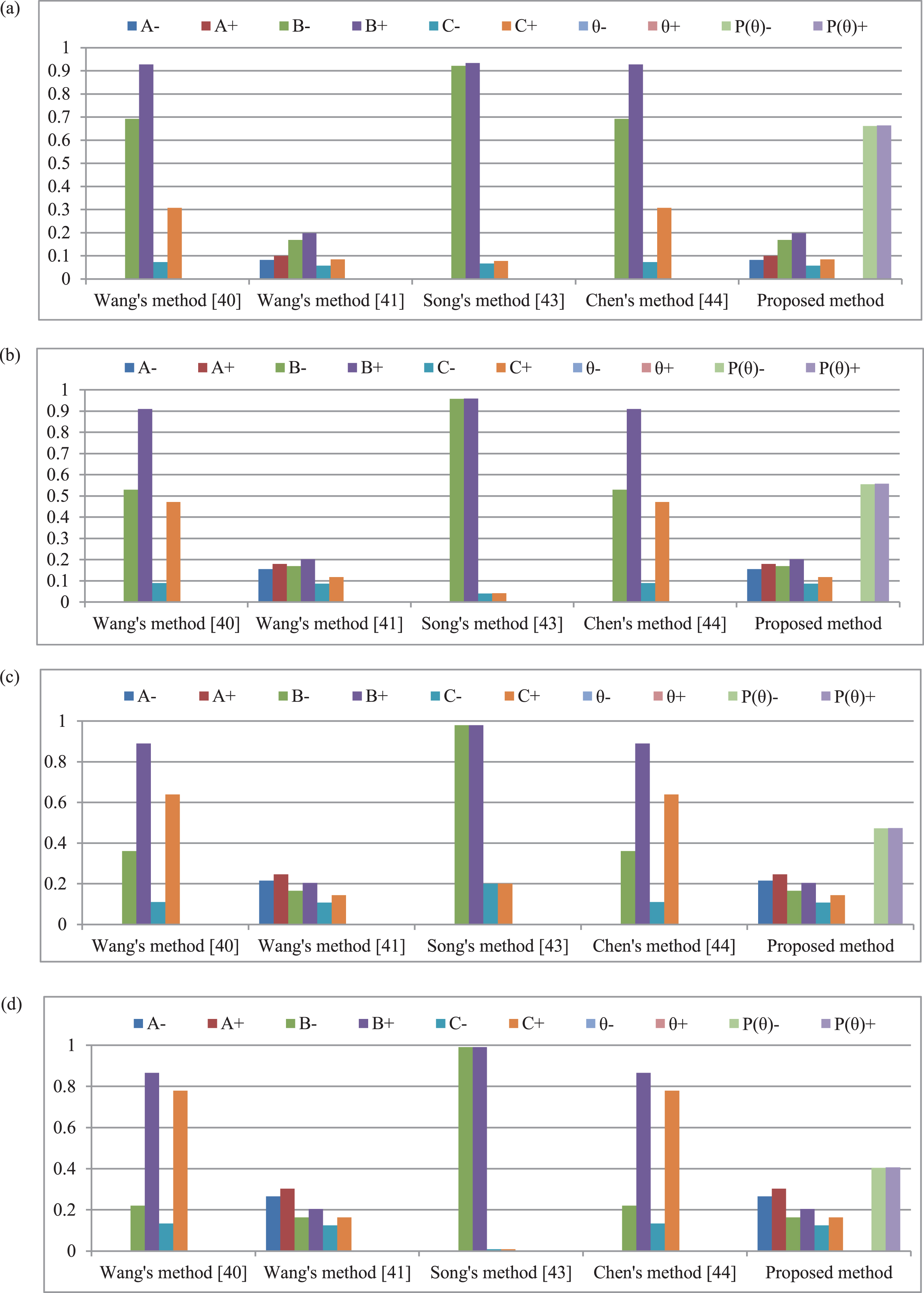
The Combined results obtained by different methods (A–and A+ represent the lower and upper bounds of the combined results of the proposition A, respectively, and others are analogous). (a) Combination of the first two pieces of interval evidence, (b) Combination of the first three pieces of interval evidence, (c) Combination of the first four pieces of interval evidence, (d) Combination of the first five pieces of interval evidence.
According to Wang’s method [40] and Song’s method [43], the combined results indicate that if either of pieces of interval evidence does not support a proposition, then the proposition will no longer be supported at all, no matter how strongly the other piece of interval evidence supports this proposition, it is obviously counter-intuitive.
As shown in Table 3, it is evident that four pieces of interval evidence m1, m3, m4, and m5 mainly support the proposition A. Obviously, interval evidence m2 is an abnormal piece of interval evidence, which strongly supports the proposition B. Thus, interval evidence m2 is in conflict with the others.
Similar to Wang’s method [40], the Chen’s method [44] is one type of discounting method in the framework of DST. It is worth noting that when these five pieces of interval evidence are equally weighted, Chen’s method [44] will degenerate into the Wang’s method [40], it is obviously irrational.
According to Table 4, the combined results obtained by Wang’s method [41] and the proposed method are conform to intuitive and reasonable, and when these five pieces of interval evidence are equally weighted, the proposed method will degenerate into the Wang’s method [41]. At the same time, from Table 4, it can be seen that Wang’s method [40], Song’s method [43] and Chen’s method [44] have deviated from the reasonable combination results, regardless of the first few pieces of interval evidence are combined. However, when the first two pieces of interval evidence are combined, Wang’s method [41] and the proposed method have shown that the focal element B has the highest interval-valued probability masses. But, when the third piece of interval evidence m3 is combined, the focal element A has the highest interval-valued probability masses, and the combined result of focal element A is consistent with the final fusion result. Therefore, in the case of interval evidence conflicts, Wang’s method [41] and the proposed method can effectively suppress counter-intuitive behaviors, and the combined results obtained by these two methods are conform to intuitive and reasonable.
Combination results obtained by different methods (w i = 0.2)
To illustrate the generality of the proposed method in this paper, we assume that the weights of these five pieces of interval evidence m1, m2, m3, m4 and m5 are all equally to 1, namely, w1 = w2 = w3 = w4 = w5 = 1. The results of combining these five pieces of interval evidence by the previous methods except for Wang’s method [41] and Song’s method [43], are presented in Table 5. According to Table 5, when these five pieces of interval evidence are equally weighted and equal to 1, the proposed method will degenerate into the Wang’s method [40] and Chen’s method [44].
Combination results obtained by different methods (w i = 1)
By comparing and analyzing the above three examples, the advantages of the proposed approach compared with the above representative methods can be summarized as follows. The method proposed in this paper can effectively solve the counter-intuitive behaviors in the process of interval evidence combination by considering the relative importance of interval evidence weights. The proposed method is not only suitable for the interval evidence combination without conflict, but also for the interval evidence combination with conflict. The specificity of interval evidence can be kept intact in the interval evidence combination process by our proposed method. Within the framework of DST, the residual support is assigned to the frame of discernment. Due to the degree of global ignorance and the residual support are not distinguished within the framework of DST, it will inevitably result in the change of the interval evidence specificity. The method proposed in this paper is more general than others. When considering the relative importance of interval evidence weights, Wang’s method [41] becomes a special case of the proposed method. When the weights of interval evidence are very important and have the same maximum importance, Wang’s methods [40] and Chen’s method [44] became special cases of the proposed method. It can be seen from Definition 1 that the Dempster’s combination rule provides a process for multiple pieces of non-compensatory evidence combination. This means that if either of pieces of evidence does not support a proposition, then the proposition will no longer be supported at all, no matter how strongly the other piece of evidence supports this proposition. The ER approach is mainly used to solve the MADA problems, their BDs only consider the singleton proposition and the global ignorance, which cannot solve the proposition with local ignorance. However, both local ignorance and global ignorance are taken into account by the ER rule, and the global ignorance and residual support are discriminated in the process of evidence combination, therefore, the combined results obtained in the ER rule framework are both intuitive and reasonable.
Conclusions
Interval information is ubiquitous in real-world decision making. The purpose of this paper is to construct a more general combination approach for combining interval evidence. We have reinvestigated the methods provided for interval evidence combination within the frameworks of DST and ER, respectively, and pointed out the shortcomings of existing methods. A more general interval evidence combination method is constructed which is based on the ER rule. The method is effective and more reasonable than existing approaches. The results of numerical examples indicated that the method proposed in this paper is not only suitable to the conflict-free interval evidence combination, but also to the conflicting interval evidence combination, and the interval evidence combination methods based on DST or ER can be regarded as special cases of the proposed method in some cases. In future work, the proposed approach will be further developed to areas with interval information fusion such as MADA problems and GDM problems [46–50].
Footnotes
Acknowledgments
This work was supported by the National Natural Science Foundation of China (Grant No. 61773123), Social Sciences Foundation of Ministry of Education of China (Grant No. 16YJC630008 and 19YJC630022), New Century Excellent Talents Support Program of Fujian Higher Education Institutions (Fujian education department [2018] No.47).