The interval-valued Pythagorean fuzzy set (IVPFS), as a new generalization of Pythagorean fuzzy set, which can be used to model complex uncertainty in the real multiple attribute group decision making (MAGDM) problems. This paper aims to develop some new operators for dealing with MAGDM issue with interval-valued Pythagorean fuzzy information, such as continuous interval-valued Pythagorean fuzzy ordered weighted quadratic averaging (C-IVPFOWQA) operator, weighted C-IVPFOWQA operator, ordered weighted C-IVPFOWQA operator and hybrid C-IVPFOWQA operator. The proposed operators not only improve the accuracy of decision making but also can reflect the decision makers’ risk preferences. Additionally, some desirable properties and special cases of these operators are investigated in detail. Later, we present a MAGDM method based on the hybrid C-IVPFOWQA operator. Finally, a numerical example is presented to illustrate the proposed method and comparison analysis is given to demonstrate the practicality and effectiveness.
Atanassov [1] introduced the concept of intuitionistic fuzzy set (IFS), which is a successfully generalization of the concept of fuzzy set (FS) [2]. IFS is characterized by a membership degree and a nonmembership degree satisfying the condition that the sum of these two degrees is equal to or less than 1. Therefore, it can express the fuzzy character of data more comprehensively and specifically. Since IFS was first introduced in 1986, it has received widely attentions and has been successfully applied to the multiple attribute decision making (MADM) problems or multiple attribute group decision making (MAGDM) problems [3–22]. Considering various types of score functions, Chen [23] gave a comparative analysis of score functions for MADM problems in intuitionistic fuzzy environment. Li et al. [24] developed a linear programming method for MAGDM problems with intuitionistic fuzzy number (IFS), where the information about attribute weights is unknown, and the group consistency and inconsistency indices, generalizations or specializations of the linear programming model are investigated. Xu and Yager [25] proposed dynamic intuitionistic fuzzy weighted averaging (DIFWA) operator and uncertain dynamic intuitionistic fuzzy weighted averaging (UDIFWA) operator for the intuitionistic fuzzy MADM problems at different period. Tan and Chen [26] introduced two new operational laws on IFSs and proposed intuitionistic fuzzy Choquet integral operator.
However, sometimes the sum of the membership degree and the nonmembership degree provided by the decision maker (DM) may be greater than 1,for instances, if DM gives the membership degree about the support to an alternative is 0.7 and his against membership degree is 0.5, it can be seen that 0.7 + 0.5 > 1 and 0 . 72 + 0 .52 < 1, so, IFS is invalid to handle this decision information. To overcome this shortcoming, Yager [27, 28] developed the concept of Pythagorean fuzzy set (PFS), which is an effective extension of IFS. Similar to the IFS, the PFS is also characterized by a membership degree and a nonmembership degree satisfying the condition that the square sum of these two degrees is equal to or less than 1, while the sum of these two degrees can be more than 1. Obviously, the PFS is more capable than IFS to represent and model complex uncertainty in the real decision making problems. Zhang and Xu [29] introduced the concept of Pythagorean fuzzy number (PFN) and extended the technique for order preference by similarity to ideal solution (TOPSIS) method to handle with PFN in MADM. Peng and Yang [30] developed a Pythagorean fuzzy superiority and inferiority ranking method for MAGDM problems. Zeng et al. [31] proposed a hybrid method for Pythagorean fuzzy MAGDM problems. Garg [32] proposed a correlation coefficient for PFSs and applied to decision making problems. Gou et al. [33] investigated the continuity, derivability and differentiability of PFNs. Based on the entropy theory, Xue et al. [34] proposed a linear programming technique for multidimensional analysis of preference (LINMAP) method to handle the railway project investment decision making with PFSs. Yager [27] developed the Pythagorean fuzzy weighted averaging (PFWA) operator and Pythagorean fuzzy weighted geometric (PFWG) operator, and utilized these to handle MADM problems. Ma and Xu [35] proposed the symmetric Pythagorean fuzzy weighted geometric/averaging operators. Garg [36] developed Pythagorean fuzzy Einstein weighted averaging (PFEWA), Pythagorean fuzzy Einstein ordered weighted averaging (PFEOWA), generalized Pythagorean fuzzy Einstein weighted averaging (GPFEWA) and generalized Pythagorean fuzzy Einstein ordered weighted averaging (GPFEOWA) operators, and applied them to Pythagorean fuzzy MADM problems. Zhang [37] presented new PFWA operator and Pythagorean fuzzy ordered weighted averaging (PFOWA) operator to aggregate PFSs. Peng and Yang [38] developed a Pythagorean fuzzy Choquet integral operator in MAGDM. Wei and Lu [39, 40] presented some Pythagorean fuzzy Maclaurin symmetric mean operators and Pythagorean fuzzy power aggregation operators in MADM, respectively. Additionally, Zeng et al. [41] proposed the Pythagorean fuzzy induced ordered weighted averaging weighted average (PFIOWAWA) operator and applied it to solve MAGDM problems with Pythagorean fuzzy information.
After the introduction of PFS, Zhang [42] extended the concept of PFS to interval-valued Pythagorean fuzzy set (IVPFS) whose membership degree and nonmembership degree can be represented by an interval value within [0, 1] instead of a crisp value. Since IVPFS appears, it has received increasing attention in MADM or MAGDM. For instance, Peng and Yang [43] proposed an interval-valued Pythagorean fuzzy elimination and choice translating reality (ELECTRE) method for interval-valued Pythagorean fuzzy MAGDM problems, meanwhile, some aggregation operators were developed, such as interval-valued Pythagorean fuzzy weighted average (IVPFWA) operator, interval-valued Pythagorean fuzzy weighted geometric (IVPFWG) operator, and interval-valued Pythagorean fuzzy point weighted averaging (IVPFPWA) operator. Liang [44] proposed a maximizing deviation method to handle the MAGDM problems with interval-valued Pythagorean fuzzy information. Garg [45] developed a novel accuracy function for ranking the interval-valued Pythagorean fuzzy numbers (IVPFNs), and an improved accuracy function was also presented by Garg [46]. Chen [47] developed a closeness-based assignment method for MADM problems with interval-valued Pythagorean fuzzy information. Based on the basic operational laws of IVPFNs [42], another type of interval-valued Pythagorean fuzzy weighted average (IVPF-WAA) operator was developed by Liang et al. [44], and another type of interval-valued Pythagorean fuzzy weighted geometric (IPFWG) operator was developed by Garg [45]. Based on the Bonferroni mean, Liang et al. [48] introduced interval-valued Pythagorean fuzzy extended Bonferroni mean (IVPFEBM), weighted interval-valued Pythagorean fuzzy extended Bonferroni mean (WIVPFEBM) operators, and applied WIVPFEBM operator to solve MADM problems. Garg [49] introduced new exponential operational laws for IVPFSs and presented some new weighted aggregation operators.
In the process of decision making, the aggregation operators is an interesting and important research topic. A variety of operators have been proposed in the past decades, among them the ordered weighted averaging (OWA) operator [50] is the well known one, which aggregates multi-dimension crisp evaluation values into collective crisp values. Based on the OWA operator, Merigó and Casanovas [51] introduced generalized OWA operator. In order to aggregate the continuous interval value, Yager [52] developed the continuous ordered weighted averaging (C-OWA) operator, which is an important extension of the OWA operator. The main advantage of the C-OWA operator is that it can aggregate interval value into different crisp value according to the attitudinal character of BUM function Q. Based on the C-OWA operator, some extensions are developed, for instance, the continuous ordered weighted geometric (C-OWG) operator [53], the continuous generalized OWA (C-GOWA) operator [54], the continuous Quasi-OWA operator [55]. Additionally, Zhou et al. [56] developed the continuous interval-valued intuitionistic fuzzy ordered weighted averaging (C-IVIFOWA) operator to handle MAGDM problems with interval-valued intuitionistic fuzzy information. Lin and Zhang [57] revised the flaws of C-IVIFOWA operator. Peng et al. [58] introduced the continuous hesitant fuzzy averaging/geometric aggregation operators, and applied them to solve MADM problems. Continuous ordered weighted quadratic averaging (C-OWQA) operator was developed by Liu et al. [55], which is a new form of the extension of OWA operator and the special cases of continuous Quasi-OWA operator.
From above analysis, we can see that the existing interval-valued Pythagorean fuzzy aggregation operators only focus on the endpoints of the closed interval, while all the values contained in IVPFSs are not full considered. Meanwhile, the C-OWQA operator can aggregate interval values into different crisp value. So it’s very necessary to utilize the C-OWQA operator to handle interval-valued Pythagorean fuzzy information. Therefore, in this paper, based on the C-OWQA operator, we developed the continuous interval-valued Pythagorean fuzzy aggregation operators and applied them to solve MAGDM problems.
The remainder of the paper is organized as follows: In Section 2, we briefly review some basic concepts of IFS, PFS, IVPFS, OWA operator, Pythagorean fuzzy OWA operator, C-OWA operator and C-OWQA operator. In Section 3, we develop the continuous interval-valued Pythagorean fuzzy ordered weighted quadratic averaging (C-IVPFOWQA) operator, new score function and accuracy function of the IVPFSs are defined based on the C-IVPFOWQA operator, meanwhile, some properties of the C-IVPFOWQA operator are investigated, such as, boundedness, identity and monotonicity. Some extended C-IVPFOWQA operators, such as the weighted C-IVPFOWQA (WC-IVPFOWQA) operator, the ordered weighted C-IVPFOWQA (OWC-IVPFOWQA) operator and the hybrid C-IVPFOWQA (HC-IVPFOWQA) operator are developed in Section 4, additionally, their desirable properties and special cases are investigated. In Section 5, we develop a method for solving the MAGDM problems using the HC-IVPFOWQA operator. In Section 6, a numerical example is given to demonstrate the applicability and effectiveness of the proposed methods and compare it with some of the existing operators. The paper is concluded in Section 7.
Preliminaries
Basic concepts of IFS [1], PFS [27, 28], IVPFS [42, 43], The OWA operator [50], the PFOWA operator [37], the C-OWA operator [52] and the C-OWQA operator [55] are briefly reviewed in this section.
Pythagorean fuzzy set
Definition 1. [1] Let X be a fixed set. An IFS A is defined as:
where the functions μA (x) , νA (x) : X → [0, 1] satisfy the condition: (μA (x) + νA (x)) ⊆ [0, 1] . μA (x) , vA (x) denote, respectively, the degree of membership and the degree of non-membership of the element x ∈ X to the set A. The degree of indeterminacy πA (x) =1 - μA (x) - νA (x).
Definition 2. [27, 28]. Let X be a fixed set. A PFS P is defined as:
where the functions μP (x) , νP (x) : X → [0, 1] satisfy the condition: μP (x) , vP (x) denote, respectively, the degree of membership and the degree of non-membership of the element x ∈ X to the set P. The degree of indeterminacy .
For convenience, Zhang and Xu [29] defined α = (μα, να) as the Pythagorean fuzzy number (PFN), where μα ∈ [0, 1] , να ∈ [0, 1] and . Some operational laws for PFNs were defined as follows:
Definition 3. [28, 29]. Let α = (μα, να) , α1 = (μα1, να1) and α2 = (μα2, να2) be three PFNs, then
Zhang and Xu [29] also defined the following laws of comparison.
Definition 4. Let α = (μα, να) be a PFN, and denote the score and the accuracy degree of α, respectively. For two PFNs α1 = (μα1, να1) , α2 = (μα2, να2),
If s (α1) > s (α2), then α1 > α2;
If s (α1) = s (α2), then:
If h (α1) > h (α2), then α1 > α2;
If h (α1) = h (α2), then α1 = α2.
Interval-valued Pythagorean Fuzzy Set
Definition 5. [42, 43]. Let X be a fixed set. An IVPFS can be defined as:
where the functions satisfy , The degree of indeterminacy, , where and If and , then the IVPFS reduces to the PFS.
Zhang [42] defined , , , , as the interval-valued Pythagorean fuzzy number (IVPFN), where For convenience, the pair is often denoted by ([a, b] , [c, d]), where [a, b] ⊆ [0, 1] , [c, d] ⊆ [0, 1], and 0 ≤ b2 + d2 ≤ 1.
Definition 6. [42] Let and be three IVPFNs, then:
Definition 7. [42, 43] Let be an IVPFN, and denote the score and the ccuracy degree of , respectively. For two IVPFNs , the following comparison laws can be given:
If , then ;
If , then:
If , then ;
If , then .
An improved score function for IVPFNs was developed by Garg [59] and Garg [60].
For simplicity, we denote that Θ is the set of all Pythagorean fuzzy values and that Ω is the set of all interval-valued Pythagorean fuzzy values.
The OWA operator
Ordered weighted averaging (OWA) operator was introduced by Yager [50], which can be defined as follows:
Definition 8. An OWA operator of dimension n is a mapping OWA : Rn → R that has an associated weighting ω = (ω1, ω2, …, ωn) T with ωj ∈ [0, 1] and such that
where bj is jth largest of the arguments ai and (a1, a2, . . . , an) is a finite collection of argument.
The OWA operator is bounded, idempotent, commutative and monotonic [50].
The Pythagorean fuzzy OWA operator
Based on the operation of PFNs and the OWA operator, Zhang [37] introduced the Pythagorean fuzzy ordered weighted averaging (PFOWA) operator as follows:
Definition 9. [37] Let αj = (μαj, ναj) (j = 1, 2, ⋯, n) be a collection of PFNs, a PFOWA operator of dimension n is a mapping PFOWA : Θn → Θ that has an associated weighting ω = (ω1, ω2, …, ωn) T with ωj ∈ [0, 1] and such that
where (σ (1) , σ (2) , …, σ (n)) is a permutation of (1, 2, …, n) such that ασ(j-1) ≥ ασ(j) for all j.
The C-OWA operator
A continuous ordered weighted averaging (C-OWA) operator was developed by Yager [52], which is the generalization of the OWA operator, the C-OWA operator can be defined as follows:
Definition 10. A C-OWA operator is a mapping φ : K → R+ associated with a BUM function Q such that
where [a, b] ∈ K, K is the set of all nonnegative interval numbers, and the basic unit interval monotonic (BUM) function Q satisfies Q (0) =0, Q (1) =1 and Q (x) ≥ Q (y) for any x ≥ y.
The C-OWQA operator
Based on the Definition 10, Liu et al. [55] developed continuous ordered weighted quadratic averaging(C-OWQA) operator, which can be defined as follows:
Definition 11. A continuous ordered weighted quadratic averaging(C-OWQA) operator f : K → R+ associated with a BUM function Q such that
where the concepts K and Q are the same as in Definition 10.
If is the attitudinal character of Q, then fQ ([a, b]) can be expressed as
In the following, we will introduce the continuous interval-valued Pythagorean fuzzy ordered weighted quadratic averaging (C-IVPFOWQA) operator based on the operations of IVPFNs and C-OWQA operator.
Definition 12. A C-IVPFOWQA operator is a mapping g : Ω → Θ, which has associated with it a BUM function Q : [0, 1] → [0, 1] having the properties: (1) Q (0) =0; (2) Q (1) =1; and (3) Q (x) ≥ Q (y) for any x ≥ y, such that
where .
For convenience, gQ is also denoted by gλ. Based on Equation (9) and Definition 11, we can drive the following result:
Theorem 1.Let be an IVPFN, if λ is the attitudinal character of Q, then the aggregated value by using Equation (9) is a PFN and
Proof. Since is an IVPFN, by Definition of IVPFN, we have 0 ≤ a, b, c, d ≤ 1, a ≤ b, c ≤ d and 0 ≤ b2 + d2 ≤ 1. Therefore, for a given λ, we obtain , ,
Moreover,
Hence, the theorem is proved □.
Example 1. Let and Q (y) = y3, then . By Equation (10), we get
In order to compare any two IVPFNs, we also can introduce the new concepts of score function and accuracy function based on the C-IVPFOWQA operator, which are defined as follows:
Definition 13. Let be an IVPFN, for a given λ
and
are called, respectively, the score function and the accuracy function of an IVPFN with respect to λ, where λ is the attitudinal character of BUM function Q.
Specially, if λ = 1/2, then we get
and
It can be seen that the in Equation (13) and in Equation (14) reduce to the score function and accuracy function, respectively, developed by Peng and Yang [43].
Based on the attitudinal character λ, we can propose a method for the comparison between two IVPFNs, which can be defined as follows:
Definition 14. Let and be two IVPFNs, and be the scores of and with respect to λ, respectively, and let and be the accuracy degrees of and with respect to λ, respectively, then if , then ; if , then (1) If , then , with respect to λ; (2) If , then , with respect to λ.
If λ is the attitudinal character of Q, it satisfies 0 ≤ λ ≤ 1, then we can drive the following result:
Theorem 2.(Boundedness) Let be an IVPFN, and let gλ be the C-IVPFOWQA operator and λ be the attitudinal character of BUM function Q, then for a given λ,
Proof. From Equation (10), , since 0 ≤ a ≤ b ≤ 1, 0 ≤ c ≤ d ≤ 1, so.
and
Thus, the proof is completed.
Theorem 3.(Identity) Let = , = ([a, b] , [c, d]) be an IVPFN, and let gλ be the C-IVPFOWQA operator and λ be the attitudinal character of BUM function Q. If a = b = μ and c = d = ν, then for a given λ,
Proof. Since a = b = μ and c = d = ν, then we obtain
Therefore, the proof is completed.
Theorem 4.(Monotonicity with respect to IVPFN ) Let and be two IVPFNs, and let gλ be the C-IVPFOWQA operator and λ be the attitudinal character of BUM function Q. If with respect to λ, then
Proof. For a given attitudinal character λ, the proof can be divided into two cases:
Case 1: If < , from Equation (11), we have - < - , because = , and = , , by Definition 14, we obtain < ;
Case 2: If but , from Definition 13, we have and By Definition 14, we obtain .
According to Case 1 and Case 2, the proof is completed.
Theorem 5.(Monotonicity with respect to attitudinal character λ) Let be an IVPFN and gλ be the C-IVPFOWQA operator, and let and , if λ1 ≤ λ2, then
Proof. Since
From Definition 4, we have
When λ1 ≤ λ2, thus we can get
Therefore, .
Extended C-IVPFOWQA operators
The C-IVPFOWQA operator can only aggregate single IVPFN, which can’t be suitable for dealing with group decision making. In order to aggregate multiple IVPFNs, we shall present some extend C-IVPFOWQA operators, such as the weighted C-IVPFOWQA (WC-IVPFOWQA) operator, the ordered weighted C-IVPFOWQA (OWC-IVPFOWQA) operator and the hybrid C-IVPFOWQA (HC-IVPFOWQA) operator.
Weighted C-IVPFOWQA operator
Definition 15. Let = , = ([aj, bj] , [cj, dj]) (j = 1, 2, …, n) be a collection of IVPFNs, a WC-IVPFOWQA operator of dimension n is a mapping WC - IVPFOWQA : Ωn → Θ that has an associated weighting ω = (ω1, ω2, …, ωn) T with ωj ∈ [0, 1] and such that
where λ is the attitudinal character of BUM function Q and gλ is the C-IVPFOWQA operator.
Theorem 6.Let (j = 1, 2, …, n) be a collection of IVPFNs, ω = (ω1, ω2, …, ωn) T be the weight vector of with ωj ∈ [0, 1] and , then the aggregated value deduced from WC-IVPFOWQA operator is a PFN, and
Proof. Based on the Equation (10) and the results of Ref.37, we know that Theorem 6 holds.
Example 2. Let , , , and be four IVPFNs and ω = (0.2, 0.3, 0.1, 0.4) T be the weight vector of . Let the BUM function Q (y) = y2, then . Here we use the WC-IVPFOWQA operator to aggregate these four IVPFNs, from Equation (10), we have
Based on the Theorem 6, the WC-IVPFOWQA operator satisfies the properties of the idempotency, boundedness and monotonicity, which can be demonstrated as the following theorems.
Theorem 7.(Idempotency) Let (j = 1, 2, …, n) be a collection of IVPFNs and hλ be the WC-IVPFOWQA operator. If for all j, thenwhere λ is the attitudinal character of BUM function Q and gλ is the C-IVPFOWQA operator.
Proof. If for all j, then based on Theorem 6, we obtain
The proof is completed.
Theorem 8.(Boundedness) Let (j = 1, 2, …, n) be a collection of IVPFNs and hλ be the WC-IVPFOWQA operator, then
where , , , and λ is the attitudinal character of BUM function Q.
Theorem 9.(Monotonicity) Let and = , = , , , (j = 1, 2, …, n) be two collections of IVPFNs, hλ be the WC-IVPFOWQA operator. If and for all j, then
Ordered weighted C-IVPFOWQA operator
Ordered weighted C-IVPFOWQA (OWC-IVPFOWQA) operator is an extension of the WC-IVPFOWQA operator, which can be defined as follows:
Definition 16. Let = , = ([aj, bj], [cj, dj]) (j = 1, 2, …, n) be a collection of IVPFNs, an OWC-IVPFOWQA operator of dimension n is a mapping OWC - IVPFOWQA : Ωn → Θ that has an associated weighting ω = (ω1, ω2, …, ωn) T with ωj ∈ [0, 1] and such that
where λ is the attitudinal character of BUM function Q and gλ is the C-IVPFOWQA operator, (σ (1) , σ (2) , …, σ (n)) is a permutation of (1, 2, …, n) such that for all j = 1, 2, …, n.
Similarly to the Theorem 6, we have the following Theorem.
Theorem 10.Let = , = ([aj, bj], [cj, dj]) (j = 1, 2, …, n) be a collection of IVPFNs, ω = (ω1, ω2, . . . , ωn) T be the weight vector of with ωj ∈ [0, 1] and , then the aggregated value deduced from OWC-IVPFOWQA operator is a PFN, and
Example 3. Let = ([0.2, 0.8], [0.4, 0.5]), = ([0.3, 0.7], [0.1, 0.6]), = ([0.1, 0.3], [0.2, 0.8]), and = ([0.4, 0.7], [0.2, 0.5]) be four IVPFNs and ω = (0.4, 0.2, 0.3, 0.1) T be the weight vector of , …, 4). Let the BUM function Q (y) = y2, then . Here we use the OWC-IVPFOWQA operator to aggregate these four IVPFNs, by Equation (9), we get
The OWC-IVPFOWQA operator has similar properties to the WC-IVPFOWQA operator.
Theorem 11.(Idempotency) Let (j = 1, 2, …, n) be a collection of IVPFNs and gλ be the C-IVPFOWQA operator. If for all j, then
Theorem 12.(Boundedness) Let (j = 1, 2, …, n) be a collection of IVPFNs,thenwhere , , , .
Theorem 13.(Monotonicity) Let and , = , , , (j = 1, 2, …, n) be two collections of IVPFNs. If ≥ and ≤ for all j, then
Theorem 14.(Commutativity) Let (j = 1, 2, …, n) be a collection of IVPFNs, thenwhere is any permutation of .
Proof. Since is any permutation of , then for all j, according to the Definition of OWC-IVPFOWQA operator in Equation (24), we obtain
Thus, the proof is completed.
Besides the above theorems, the following desirable property can be easily obtained.
Property 1.Let (j = 1, 2, …, n) be a collection of IVPFNs, ω = (ω1, ω2, …, ωn) T be the weight vector of (j = 1, 2, …, n) with ωj ∈ [0, 1] and . Then
1) If ω = (1, 0, …, 0) T, then , , …, =
2) If ω = (0, 0, …, 1) T, then , , …, =
3) If ωi = 1, ωj = 0 and i ≠ j, then
where is the ith largest value of .
Hybrid C-IVPFOWQA operator
Since WC-IVPFOWQA operator focuses on the IVPFNs only while OWC-IVPFOWQA operator considers the ordered positions of them, in order to weigh both the given argument and its ordered position, we propose the hybrid C-IVPFOWQA (HC-IVPFOWQA) operator.
Definition 17. Let = , = ([aj, bj], [cj, dj]) (j = 1, 2, …, n) be a collection of IVPFNs, a HC-IVPFOWQA operator of dimension n is a mapping: HC - IVPFOWQA : Ωn → Θ that has an associated weighting ω = (ω1, ω2, …, ωn) T with ωj ∈ [0, 1] and such that
where λ is the attitudinal character of BUM function Q and gλ is the C-IVPFOWQA operator, (σ (1) , σ (2) , …, σ (n)) is a permutation of (1, 2, …, n) such that for all j. is the jth largest value of the weighted PFNs , n is the balancing coefficient, and w = (w1, w2, …, wn) T is the weight vector of (j = 1, 2, …, n) with wj ∈ [0, 1] and .
Theorem 15.Let = , = ([aj, bj], [cj, dj]) (j = 1, 2, …, n) be a collection of IVPFNs, ω = (ω1, ω2, . . . , ωn) T be the weight vector with ωj ∈ [0, 1] and , then
Proof. The proof is similar to Theorem 6, so it is omitted here.
From Equation (31), we know that the aggregated value by utilizing HC-IVPFOWQA operator is also a PFN.
Example 4. Utilizing the information in Example 3 and let w = (0.15, 0.34, 0.28, 0.23) T, based on Definition 3, we have
and Sλ = -0 . 2513, Sλ = 0 . 1446, Sλ - 0 . 3577, Sλ = 0 . 0449,
Since, Sλ > Sλ > Sλ > Sλ, then gλ > gλ > gλ > gλ and gλ = = (0.5393, 0.3825), gλ = gλ = (0.5014, 0.4544), gλ = = (0.3896, 0.6349), gλ = = (0.2024, 0.6314), By Equation (31), it follows that
It can be easily proved that the HC-IVPFOWQA operator has the following properties.
Property 2.If the weight vector ω = (1/n, 1/n, …, 1/n), then the HC-IVPFOWQA operator is reduced to the WC-IVPFOWQA operator.
Property 3.If the weight vector w = (1/n, 1/n, …, 1/n), then the HC-IVPFOWQA operator is reduced to the OWC-IVPFOWQA operator.
An approach to MAGDM based on the extended C-IVPFOWQA operators
In this section, we will utilize the extended C-IVPFOWQA aggregation operators to MAGDM with interval-valued Pythagorean fuzzy information. Let A = {A1, A2, …, Am} be a discrete set of alternatives, and C = {C1, C2, …, Cn} be the set of attributes, and ω = (ω1, ω2, …, ωn) T be the weight vector of attribute Cj (j = 1, 2, …, n) with ωj ∈ [0, 1] and . Let E = {e1, e2, …, el} be the set of decision makers whose weight vector is ρ = (ρ1, ρ2, …, ρl) T with ρk ∈ [0, 1] and . Assume that is an interval-valued Pythagorean fuzzy decision matrix, where is attribute value given by decision maker ek ∈ E for the alternative Ai ∈ A with respect to the attribute Cj ∈ C, indicates the degree that the alternative Ai satisfies the attribute Cj given by the decision maker ek, indicates the degree that the alternative Ai does not satisfy the attribute Cj given by the decision maker ek, , and .
In the following, a novel MAGDM approach is developed with interval-valued Pythagorean fuzzy information based on the extended C-IVPFOWQA aggregation operators.
Step 1. Aggregate interval-valued Pythagorean fuzzy decision matrix into the overall decision matrix R = (rij) m×n based on HC-IVPFOWQA operator
Step 2. Utilize the decision matrix R = (rij) m×n and the PFOWA operator
to drive the overall preference values ri (i = 1, 2, …, m) for each alternative Ai (i = 1, 2, …, m).
Step 3. Calculate the score values S (ri) (i = 1, 2, …, m) of the collective overall values ri (i = 1, 2, …, m) to rank all the alternatives Ai (i = 1, 2, …, m). If there is no difference between two scores S (ri) and S (rj) , then we need to calculate the accuracy degrees H (ri) and H (rj) of the collective overall values ri and rj, respectively.
Step 4. Rank all the alternatives Ai (i = 1, 2, …, m) and select the most desirable one(s) in accordance with S (ri) and H (ri) (i = 1, 2, …, m).
Step 5. End.
Numerical example
In this section, we are going to present a numerical example to show the risk evaluation of technological innovation in high-tech enterprises with interval-valued Pythagorean fuzzy information (adapt from Ref.44).
A management committee wants to select the best high-tech enterprise with the lowest risk of technologic innovation. Three experts {e1, e2, e3} form a committee to act as decision makers, whose weight vector is ρ = (0.4, 0.35, 0.25) T, after careful reviewing of the information, they choose four possible alternatives {A1, A2, A3, A4}. Management committee selects six attributes to evaluate the four possible high-tech enterprises (1) C1 is policy risk; (2) C2 is financial risk; (3) C3 is technological risk; (4) C4 is production risk; (5) C5 is market risk and (6) C6is managerial risk, and ω = (0.1894, 0.1841, 0.1361, 0.1257, 0.1753, 0.1894) T is the weight vector of them. As the environment is uncertain, the three experts ek (k = 1, 2, 3) evaluate the high-tech enterprise Ai (i = 1, 2, …, 4) with respect to the attributes Cj (j = 1, 2, …, 6) and construct the following three interval-valued Pythagorean fuzzy decision matrixs in Tables 1–3.
The interval-valued Pythagorean fuzzy decision matrix for e1
C1
C2
C3
C4
C5
C6
A1
([0.8, 0.9],
([0.5, 0.7],
([0.7, 0.9],
([0.7, 0.8],
([0.8, 0.9],
([0.4, 0.6],
[0.2, 0.3])
[0.4, 0.5])
[0.3, 0.4])
[0.4, 0.5])
[0.2, 0.3])
[0.5, 0.7])
A2
([0.6, 0.7],
([0.6, 0.8],
([0.7, 0.9],
([0.8, 0.9],
([0.5, 0.6],
([0.8, 0.9],
[0.3, 0.5])
[0.4, 0.5])
[0.2, 0.3])
[0.2, 0.3])
[0.1, 0.3])
([0.1, 0.3],
A3
([0.5, 0.6],
([0.7, 0.8],
([0.6, 0.7],
([0.7, 0.9],
([0.4, 0.6],
([0.7, 0.8],
[0.4, 0.5])
[0.4, 0.5])
[0.3, 0.4])
[0.1, 0.3])
[0.2, 0.3])
[0.4, 0.5])
A4
([0.4, 0.6],
([0.8, 0.9],
([0.7, 0.8],
([0.6, 0.8],
([0.5, 0.6],
([0.8, 0.9],
[0.3, 0.5])
[0.2, 0.3])
[0.4, 0.5])
[0.4, 0.5])
[0.1, 0.3])
[0.2, 0.3])
The interval-valued Pythagorean fuzzy decision matrix for e2
C1
C2
C3
C4
C5
C6
A1
([0.6, 0.7],
([0.6, 0.9],
([0.4, 0.5],
([0.8, 0.9],
([0.5, 0.7],
([0.5, 0.7],
[0.2, 0.3])
[0.1, 0.3])
[0.4, 0.6])
[0.2, 0.3])
[0.2, 0.4])
[0.4, 0.5])
A2
([0.5, 0.7],
([0.5, 0.6],
([0.5, 0.8],
([0.5, 0.6],
([0.6, 0.8],
([0.8, 0.9],
[0.4, 0.5])
[0.3, 0.5])
[0.4, 0.6])
[0.1, 0.3])
[0.4, 0.5])
[0.2, 0.3])
A3
([0.5, 0.6],
([0.8, 0.9],
([0.5, 0.6],
([0.6, 0.7],
([0.8, 0.9],
([0.6, 0.7],
[0.4, 0.5])
[0.2, 0.3])
[0.4, 0.5])
[0.4, 0.6])
[0.2, 0.3])
[0.4, 0.6])
A4
([0.7, 0.9],
([0.7, 0.8],
([0.6, 0.8],
([0.4, 0.6],
([0.7, 0.9],
([0.5, 0.7],
[0.1, 0.3])
[0.4, 0.5])
[0.4, 0.5])
[0.2, 0.3])
[0.1, 0.3])
[0.4, 0.5])
The interval-valued Pythagorean fuzzy decision matrix for e3
C1
C2
C3
C4
C5
C6
A1
([0.8, 0.9],
([0.7, 0.9],
([0.5, 0.7],
([0.6, 0.8],
([0.6, 0.8],
([0.6, 0.7],
[0.2, 0.3])
[0.1, 0.3])
[0.2, 0.5])
[0.3, 0.4])
[0.4, 0.5])
[0.4, 0.5])
A2
([0.6, 0.7],
([0.4, 0.6],
([0.8, 0.9],
([0.8, 0.9],
([0.7, 0.8],
([0.8, 0.9],
[0.1, 0.3])
[0.1, 0.3])
[0.2, 0.3])
[0.2, 0.3])
[0.2, 0.5])
[0.2, 0.3])
A3
([0.6, 0.8],
([0.8, 0.9],
([0.7, 0.9],
([0.6, 0.8],
([0.6, 0.7],
([0.7, 0.8],
[0.4, 0.5])
[0.2, 0.3])
[0.1, 0.3])
[0.4, 0.5])
[0.4, 0.6])
[0.4, 0.5])
A4
([0.8, 0.9],
([0.7, 0.8],
([0.6, 0.8],
([0.8, 0.9],
[0.4, 0.5])
([0.5, 0.6],
[0.2, 0.3])
[0.4, 0.5])
[0.4, 0.5])
[0.2, 0.3])
[0.4, 0.6])
[0.4, 0.5])
Decision procedure based on HC-IVPFOWQA operator
To select the best high-tech enterprise, the computation steps are presented as follows:
Step 1. Utilize the HC-IVPFOWQA operator and the weight ρ = (0.4, 0.35, 0.25) T to aggregate interval-valued Pythagorean fuzzy decision matrix into the overall decision matrix R = (rij) 4×6, and the aggregating results are shown in Table 4. Assume that w = (0.37, 0.33, 0.3) T and BUM function in Equation (31).
The Pythagorean fuzzy collective decision matrix R
C1
C2
C3
C4
C5
C6
A1
(0.8512,0.2116)
(0.8170,0.2027)
(0.7575,0.3214)
(0.8278,0.2987)
(0.8090,0.2583)
(0.6434,0.4457)
A2
(0.7958,0.2695)
(0.6185,0.2790)
(0.8497,0.2511)
(0.7968,0.1967)
(0.8316,0.2359)
(0.8308,0.1998)
A3
(0.6630,0.4105)
(0.8570,0.2588)
(0.7542,0.2525)
(0.8029,0.2739)
(0.7657,0.2534)
(0.7555,0.4167)
A4
(0.8213,0.2159)
(0.8361,0.3085)
(0.7755,0.4085)
(0.7891,0.2728)
(0.7305,0.1979)
(0.7849,0.3085)
Step 2. Utilize the PFOWA operator and ω = (0.1894, 0.1841, 0.1361, 0.1257, 0.1753, 0.1894) T to drive the overall preference values of each alternative:
Step 3. Calculate the score values S (ri) (i = 1, 2, …, 4) of the collective overall values ri (i = 1, 2, …, 4). S (r1) =0 . 5497, S (r2) =0 . 5794, S (r3) =0 . 5085, S (r4) =0 . 5536.
Then we have S (r2) > S (r4) > S (r1) > S (r3).
Step 4. Rank all the alternatives Ai (i = 1, 2, …, 4) according to S (ri) (i = 1, 2, …, 4) A2 ≻ A4 ≻ A1 ≻ A3.
Thus, the most desirable alternative is A2. It is noted that “≻” means “preferred to”.
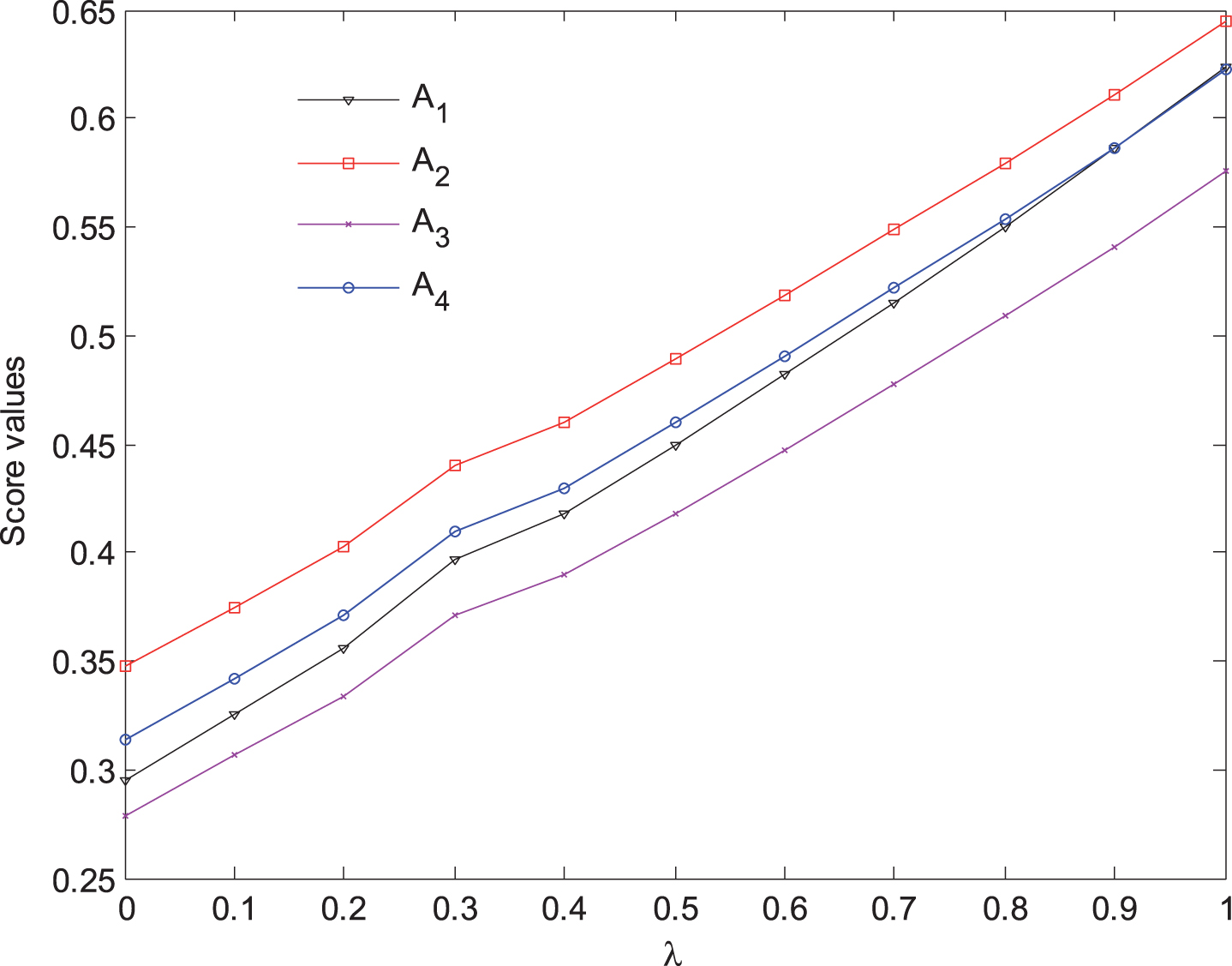
The attitudinal characterλplays an important role during the computation process of the HC-IVPFOWQA operator. In what follows, we study the impact on the scores and the ranking with the attitudinal character λ changes from 0 to 1 with step length 0.1. The scores of collective overall values of alternatives and corresponding ranking results are shown in Table 5.
The scores and ranking results with different attitudinal character λ
λ
Score function
Ranking results
S (r1)
S (r2)
S (r3)
S (r4)
0
0.2953
0.3476
0.2787
0.3133
A2 ≻ A4 ≻ A1 ≻ A3
0.1
0.3257
0.3750
0.3062
0.3422
A2 ≻ A4 ≻ A1 ≻ A3
0.2
0.3562
0.4027
0.3338
0.3712
A2 ≻ A4 ≻ A1 ≻ A3
0.3
0.3973
0.4400
0.3709
0.4102
A2 ≻ A4 ≻ A1 ≻ A3
0.4
0.4181
0.4594
0.3898
0.4301
A2 ≻ A4 ≻ A1 ≻ A3
0.5
0.4496
0.4887
0.4180
0.4600
A2 ≻ A4 ≻ A1 ≻ A3
0.6
0.4816
0.5184
0.4475
0.4903
A2 ≻ A4 ≻ A1 ≻ A3
0.7
0.5150
0.5485
0.4776
0.5215
A2 ≻ A4 ≻ A1 ≻ A3
0.8
0.5497
0.5794
0.5085
0.5536
A2 ≻ A4 ≻ A1 ≻ A3
0.9
0.5859
0.6113
0.5407
0.5868
A2 ≻ A4 ≻ A1 ≻ A3
1.0
0.6242
0.6451
0.5753
0.6224
A2 ≻ A1 ≻ A4 ≻ A3
The result in Table 5 indicates that all scores of collective overall values of alternatives are increasing with an increasing λ. For each attitudinal character λ in unit interval [0,1], the most desirable alternative is always A2.
Furthermore, to provide a better view of the change results in regard to λ, the results of the scores of alternatives are described in Fig. 1. From Fig. 1, we obtain the ranking of the alternatives which is A2 ≻ A4 ≻ A1 ≻ A3 if λ ∈ [0, 0.9335], and A2 ≻ A1 ≻ A4 ≻ A3 if λ ∈ [0 . 9335, 1], the slightly difference is the ranking order between A1 and A4, the former order is A4 ≻ A1, whereas the latter order is A1 ≻ A4. Moreover, it can be seen from Fig. 1 that no matter what value the attitudinal character λ takes, A2 is still the most desirable alternative.
The results of HC-IVPFOWQA with different attitudinal character λ.
Comparison analysis
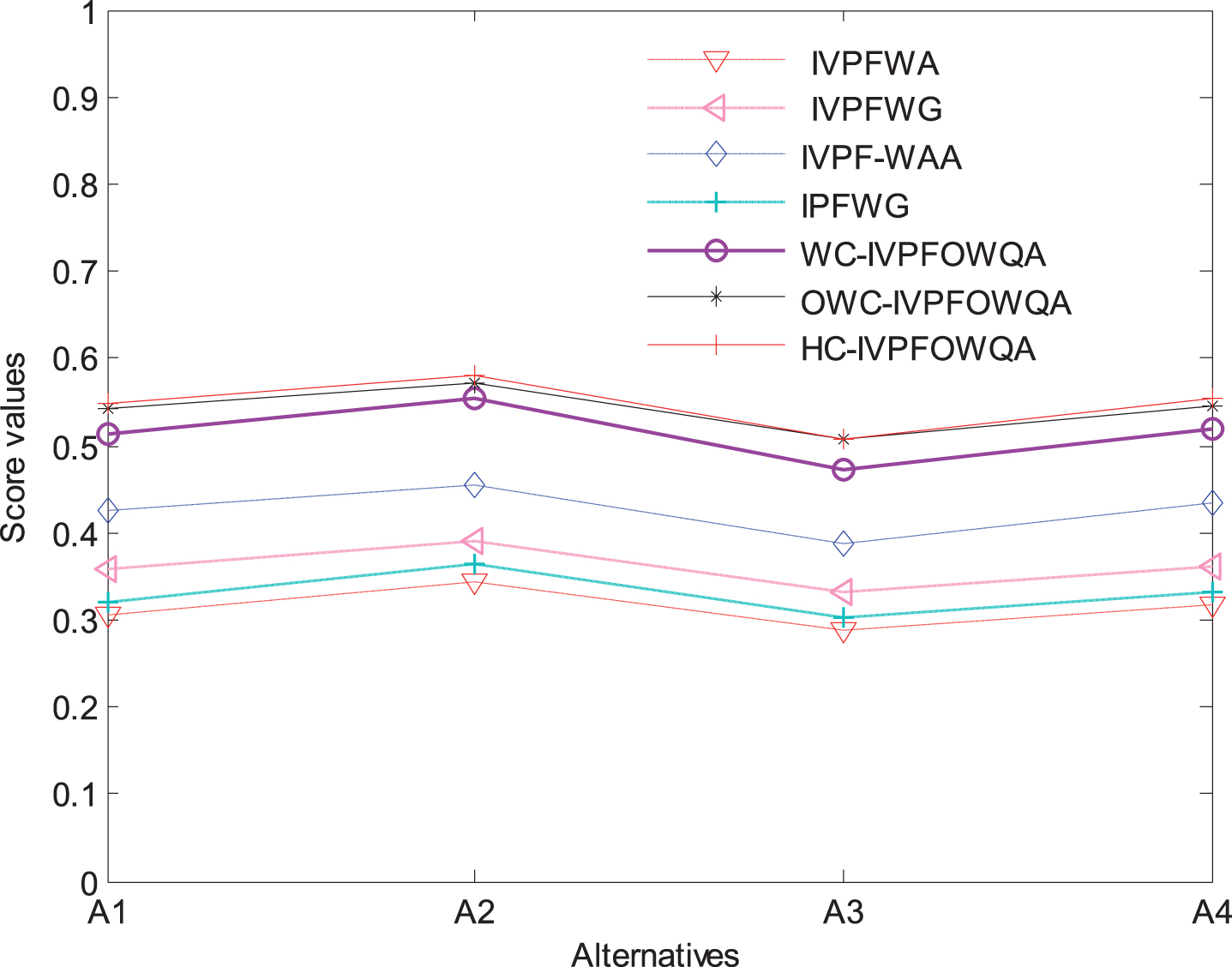
The prominent characteristic of the proposed operators is that they not only improve the accuracy of decision making but also can reflect the decision makers’ risk preferences. To demonstrate the advantages, we discussed some comparative analyses with some existing operators: IVPFWA operator [43], IVPFWG operator [43], IVPF-WAA operator [44], IPFWG operator [45], and proposed operators: WC-IVPFOWQA operator and OWC-IVPFOWQA operator. The aggregating results and ranking results by different methods are shown in Table 6.
From Table 6, we can see that although the aggregating results are different, the ranking results of alternatives derived from the IVPFWA operator [43], IVPFWG operator [43], IVPF-WAA operator [44] and the IPFWG operator [45] are the same as obtained by our proposed method, that is A2 ≻ A4 ≻ A1 ≻ A3, and A2 is the most desirable alternative, which shows that the proposed method is reasonable and effective.
The discrimination of different methods.
(1) Although many operators have been proposed to aggregate interval-valued Pythagorean fuzzy information [43–45, 49], all these existing interval-valued Pythagorean fuzzy aggregation operators only focus on the endpoints of the closed interval, while all the values contained in IVPFSs are not full considered, which indicate that much useful information may be lost. Our aggregation operators have the ability to overcome this and improve the accuracy of decision making. Therefore, they are the more suitable operators to handle problems.
(2) From Table 5 and Fig. 1, it is concluded that the HC-IVPFOWQA operator can aggregate the IVPFNs into different the PFN according to attitudinal character λ, that is to say, our operators consider the DMs’ risk preferences by parameter λ, which are very suitable for the MAGDM problems. Zhou et al. [56] developed the combined continuous interval-valued intuitionistic fuzzy ordered weighted averaging (CC-IVIFOWA) operator, which can also reflect the DMs’ risk preferences, but the CC-IVIFOWA operator is invalid to handle interval-valued Pythagorean fuzzy information. From the managerial implication, parameter λ expresses the optimistic character of DMs. 0 ≤ λ < 0.5, λ = 0.5 and 0.5 < λ ≤ 1 denotes the DMs’ attitude in regard to pessimistic tendency, neutral and optimistic tendency, respectively. According to the practical application, the DMs can flexibly select the appropriate values of parameter λ respectively.
Moreover, it is possible to check the discrimination of these methods, and the results are shown in Fig. 2. From Fig. 2 we can see that results by IVPFWA operator [43], IVPFWG operator [43], IVPF-WAA operator [44] and IPFWG operator [45] are quite close, these results of decision values can’t clearly distinguish. On the contrary, our proposed method is clearly distinguished.
Conclusions
In this paper, by combining IVPFNs and C-OWQA operator, we have provided an interesting topic about continuous interval-valued Pythagorean fuzzy aggregation operators. The major contributions in this paper can be summarized as follows: (1) We proposed the C-IVPFOWQA operator; (2) We defined some new score function, accuracy function and comparison rules of IVPFSs based on C-IVPFOWQA operator; (3) We developed WC-IVPFOWQA operator, OWC-IVPFOWQA operator and HC-IVPFOWQA operator, and discussed their some desirable properties and special cases; (4) We introduced an effective interval-value Pythagorean fuzzy MAGDM method; and (5) The proposed method is applied to address the risk evaluation problem of high-tech enterprises, and comparison analysis is also given.
In the future, we will extend the proposed method to deal with large-scale group decision making problems [61, 62] and many other fields under uncertain environment, such as hesitant fuzzy linguistic, probabilistic interval-valued Pythagorean fuzzy set, interval-valued Pythagorean fuzzy linguistic variable set, and so on [63–69].
Footnotes
Acknowledgments
The authors are very grateful to the anonymous reviewers for their valuable comments and constructive suggestions that greatly improved the quality of this paper. The work was partly supported by the National Natural Science Foundation of China (No. 61304173).
Appendix
Theorem 8.(Boundedness) Let (j = 1, 2, …, n) be a collection of IVPFNs and hλ be the WC-IVPFOWQA operator, then
where , , , and λ is the attitudinal character of BUM function Q.
Proof. Assume that . For all j, we have , since , then we obtain
and
It follows that
Similarly, we obtain
From Definition 14, we have
Then S (α-) ≤ S (α) ≤ S (α+).
If S (α-) < S (α) < S (α+), from Definition 14, we obtain , the result holds.
If S (α) = S (α-), then , so , , from Definition 14, we obtain , hence α = α-, the result holds.
If S (α) = S (α+), then , , from Definition 14, we obtain , hence α = α+, the result holds.
Theorem 9.(Monotonicity) Let and (j = 1, 2, …, n) be two collections of IVPFNs, hλ be the WC-IVPFOWQA operator. If and for all j, then
Proof. Since and . For all j, we have , ,Then
Furthermore,
Assume that , , from Definition 14, we have S (α) ≥ S (β). If S (α) > S (β), then α > β, the result holds.
If S (α) = S (β), then
Since and , we have
Thus
Therefore, H (α) = H (β), which implies that α = β, so the result holds.
References
1.
K.T.Attanassov, Intuitionistic fuzzy sets, Fuzzy sets and systems20 (1986), 87–96.
2.
L.A.Zadeh, Fuzzy sets, Information and control, 8(3) (1965), 338–353.
3.
G.W.Wei, GRA method for multiple attribute decision making with incomplete weight information in intuitionistic fuzzy setting, Knowledge-Based Systems, 23 (2010), 243–247.
4.
G.W.Wei, Some induced geometric aggregation operators with intuitionistic fuzzy information and their application to group decision making, Applied Soft Computing, 10 (2010), 423–431.
5.
Z.S.Xu and X.Q.Cai, Nonlinear optimization models for multiple attribute group decision making with intuitionistic fuzzy information, International Journal of Intelligent Systems, 25(6) (2010), 489–513.
6.
Y.J.Zhu and D.F.Li, A new definition and formula of entropy for intuitionistic fuzzy sets, International Journal of Intelligent Systems, 30(6) (2016), 3057–3066.
7.
E.Szmidt, J.Kacprzyk and P.Bujnowski, How to measure the amount of knowledge conveyed by Atanassov's intuitionistic fuzzy sets, Information Science, 257 (2014), 276–285.
8.
J.Ye, Fuzzy decision-making method based on the weighted correlation coefficient under intuitionistic fuzzy environment, European Journal of Operational Research, 205 (2010), 202–204.
9.
W.L.Hung and M.S.Yang, On similarity measures between intuitionistic fuzzy sets, International Journal of Intelligent Systems, 23(3) (2008), 364–383.
Z.S.Xu and R.R.Yager, Some geometric aggregation operators based on intuitionistic fuzzy sets, International Journal of General Systems, 35(4) (2006), 417–433.
12.
X.F.Zhao and G.W.Wei, Some intuitionistic fuzzy Einstein hybrid aggregation operators and their application to multiple attribute decision making, Knowledge-Based Systems, 37 (2013), 472–479.
13.
H.Zhao, Z.S.Xu and M.F.Ni, Generalized aggregation operators for intuitionistic fuzzy sets, International Journal of Intelligent Systems, 25(1) (2010), 1–30.
14.
Z.S.Xu and R.R.Yager, Intuitionistic fuzzy Bonferroni means, IEEE Transactions on Systems Man & Cybernetics Part B., 41 (2011), 568–578.
15.
D.F.Li, Multi-attribute decision making method based on generalized OWA operators with intuitionistic fuzzy sets, Expert Systems with Applications, 37(12) (2010), 8673–8678.
16.
F.Blanco-Mesa, J.M.Merigó and A.M.Gil-Lafuente, Fuzzy decision making: A bibliometric-based review, Journal of Intelligent and Fuzzy Systems, 32(3) (2017), 2033–2050.
17.
J.M.Merigó, Fuzzy decision making with immediate probabilities, Computers and Industrial Engineering, 58(4) (2010), 651–657.
18.
H.Garg, An improved cosine similarity measure for intuitionistic fuzzy sets and their applications to decision-making process, Hacettepe Journal of Mathematics and Statistics, 47(6) (2018), 1585–1601.
19.
H.Garg and K.Kumar, A novel exponential distance and its based TOPSIS method for interval-valued intuitionistic fuzzy sets using connection number of SPA theory, Artificial Intelligence Review, (2018), 1–30, doi: 10.1007/s10462-018-9668-5.
20.
H.Garg, A new generalized improved score function of interval-valued intuitionistic fuzzy sets and applications in expert systems, Applied Soft Computing, 38 (2016), 988–999.
21.
H.Garg, Novel intuitionistic fuzzy decision making method based on an improved operation laws and its application, Engineering Applications of Artificial Intelligence, 60 (2017), 164–174.
22.
H.Garg, Generalized intuitionistic fuzzy interactive geometric interaction operators using Einstein t-norm and t-conorm and their application to decision making, Computers and Industrial Engineering, 101 (2016), 53–69.
23.
T.Y.Chen, A comparative analysis of score functions for multiple attribute decision making in intuitionistic fuzzy setting, Information Science, 181(17) (2011), 3652–3676.
24.
D.F.Li, G.H.Chen and Z.G.Huang, Linear programming method for multi-attribute group decision making using IF sets, Information Science, 180(9) (2010), 1591–1609.
25.
Z.S.Xu and R.R.Yager, Dynamic intuitionistic fuzzy multi-attribute decision making, International Journal of Approximate Reasoning, 48(1) (2008), 246–262.
26.
C.Q.Tan and X.H.Chen, Intuitionistic fuzzy Choquet integral operator for multi-attribute decision making, Expert Systems with Applications, 37 (2010), 149–157.
27.
R.R.Yager.Pythagorean fuzzy subsets, In Proc. Joint IFSA World Congress and NAFIPS Annual Meeting, Edmonton, Canada, (2013). pp 57–61.
28.
R.R.Yager, Pythagorean membership grades in multi-attribute decision making, IEEE Transactions on Fuzzy Systems, 22 (2014), 958–965.
29.
X.L.Zhang and Z.S.Xu, Extension of TOPSIS to multiple attribute decision making with Pythagorean fuzzy sets, International Journal of Intelligent Systems, 29 (2014), 1061–1078.
30.
X.D.Peng and Y.Yang, Some results for Pythagorean fuzzy sets, International Journal of Intelligent Systems, 30(11) (2015), 1133–1160.
31.
S.Z.Zeng, J.P.Chen and X.S.Li, A hybrid method for Pythagorean fuzzy multiple attribute decision making, International Journal of Information Technology and Decision Making, 15(2) (2016), 403–422.
32.
H.Garg, A novel correlation coefficients between Pythagorean fuzzy sets and its applications to decision making processes, International Journal of Intelligent Systems, 31(12) (2016), 1234–1252.
33.
X.J.Gou, Z.S.Xu and P.J.Ren, The properties of continuous Pythagorean fuzzy information, International Journal of Intelligent Systems, 31(5) (2016), 401–424.
34.
W.T.Xue, Z.S.Xu and X.L.Zhang, Pythagorean fuzzy LINMAP method based on the entropy theory for railway project investment decision making, International Journal of Intelligent Systems, 33(1) (2018), 93–125.
35.
Z.M.Ma and Z.S.Xu, Symmetric Pythagorean fuzzy weighted geometric/averaging operators and their application in multi-attribute decision-making problems, International Journal of Intelligent Systems, 31(12) (2016), 1198–1219.
36.
H.Garg, A new generalized Pythagorean fuzzy information aggregation using Einstein operations and its application to decision making, International Journal of Intelligent Systems, 31 (2016), 886–920.
37.
X.L.Zhang, A novel approach based on similarity measure for Pythagorean fuzzy multiple attribute group decision making, International Journal of Intelligent Systems, 31(6) (2016), 593–611.
38.
X.D.Peng and Y.Yang, Pythagorean fuzzy Choquet integral based MABAC method for multiple attribute group decision making, International Journal of Intelligent Systems, 31(10) (2016), 989–1020.
39.
G.W.Wei and M.Lu, Pythagorean fuzzy Maclaurin symmetric mean operators in multiple attribute decision making, International Journal of Intelligent Systems, 33(6) (2017), 1–28.
40.
G.W.Wei and M.Lu, Pythagorean fuzzy power aggregation operators in multiple attribute decision making, International Journal of Intelligent Systems, 33 (2018), 169–186.
41.
S.Z.Zeng, Z.M.Mu and T.Balezentis, A novel aggregation method for Pythagorean fuzzy multiple attribute group decision making, International Journal of Intelligent Systems, 33(3) (2018), 573–585.
42.
X.L.Zhang, Multi-attribute Pythagorean fuzzy decision analysis: a hierarchical QUALIFLEX approach with the closeness index-based ranking methods, Information Science, 330 (2016), 104–124.
43.
X.D.Peng and Y.Yang, Fundamental properties of interval-valued Pythagorean fuzzy aggregation operators, International Journal of Intelligent Systems, 31(5) (2016), 444–487.
44.
W.Liang, X.L.Zhang and M.F.Liu, The maximizing deviation method based on interval-valued Pythagorean fuzzy weighted aggregating operator for multiple attribute group decision analysis, Discrete Dynam Nature Soc, (2015), 2015: 746572. https://doi.org/10.1155/2015/746572.
45.
H.Garg, A novel accuracy function under interval-valued Pythagorean fuzzy environment for solving multi-attribute decision making problem, Journal of Intelligent and Fuzzy Systems, 31(1) (2016), 529–540.
46.
H.Garg, A novel improved accuracy function for interval valued Pythagorean fuzzy sets and its applications in decision making process, International Journal of Intelligent Systems, 31(12) (2017), 1247–1260.
47.
T.Y.Chen, An interval-valued Pythagorean fuzzy outranking method with a closeness-based assignment model for multiple attribute decision making, International Journal of Intelligent Systems, 33(1) (2018), 126–168.
48.
D.C.Liang, A.P.Darko and Z.S.Xu, Interval-valued Pythagorean fuzzy extended Bonferroni mean for dealing with heterogenous relationship among attributes, International Journal of Intelligent Systems, 33 (2018), 1381–1411.
49.
H.Garg, New exponential operational laws and their aggregation operators for interval-valued Pythagorean fuzzy multi-attribute decision making, International Journal of Intelligent Systems, 33(3) (2018), 653–683.
50.
R.R.Yager, On ordered weighted averaging aggregation operators in multi-attribute decision making, IEEE Transactions on Systems Man & Cybernetics Part B, 18 (1988), 183–190.
51.
J.M.Merigó and M.Casanovas, The fuzzy generalized OWA operator and its application in strategic decision making, Cybernetics and Systems, 41(5) (2010), 359–370.
52.
R.R.Yager, OWA aggregation over a continuous interval argument with applications to decision making, IEEE Transactions on Systems Man & Cybernetics Part B, 34 (2004), 1952–1963.
53.
R.R.Yager and Z.S.Xu, The continuous ordered weighted geometric operator and its application to decision making, Fuzzy sets and systems, 157 (2006), 1393–1402.
54.
L.G.Zhou and H.Y.Chen, Continuous generalized OWA operator and its application to decision making, Fuzzy sets and systems, 168 (2011), 18–34.
55.
J.P.Liu, S.Lin and H.Y.Chen, The continuous quasi-OWA operator and its application to group decision making, Group Decision & Negotiation, 22(4) (2013), 715–738.
56.
L.G.Zhou, Z.F.Tao and H.Y.Chen, Continuous interval-valued intuitionistic fuzzy aggregation operators and their applications to group decision making, Applied Mathematical Modelling, 38(8) (2014), 2190–2205.
57.
J.Lin and Q.Zhang, Note on continuous interval-valued intuitionistic fuzzy aggregation operator, Applied Mathematical Modelling, 34 (2017), 670–677.
58.
D.H.Peng, T.D.Wang and C.Y.Gao, Continuous hesitant fuzzy aggregation operators and their application to decision making under interval-valued hesitant fuzzy setting, The Scientific World Journal 2014, (2014), 897304. https://dx-doi-org.web.bisu.edu.cn/10.1155/2014/897304.
59.
H.Garg, A linear programming method based on an improved score function for interval-valued Pythagorean fuzzy numbers and its application to decision-making, International Journal of Uncertainty, Fuzziness and Knowledge-Based Systems, 26(1) (2018), 67–80.
60.
H.Garg, A new improved score function of an interval-valued Pythagorean fuzzy set based TOPSIS method, International Journal for Uncertainty Quantification, 7(5) (2017), 463–474.
61.
Z.Zhang, C.H.Guo and L.Martínez, Managing multigranular linguistic distribution assessments in large-scale multiattribute group decision making, IEEE Transactions on Systems Man & Cybernetics Systems, 47(11) (2017), 3063–3076.
62.
Y.C.Dong, S.H.Zhao, H.J.Zhang, F.Chiclana and E.Herrera-Viedma, A self-management mechanism for noncooperative behaviors in large-scale group consensus reaching processes, IEEE Transactions on Fuzzy Systems, 26(6)(2018), 3276-3288.
63.
Z.Zhang, X.Y.Kou, W.Y.Yu and C.H.Guo, On priority weights and consistency for incomplete hesitant fuzzy preference relations, Knowledge-Based Systems, 143 (2018), 115–126.
64.
W.Y.Yu, Z.Zhang, Q.Y.Zhong and L.L.Sun, Extended TODIM for multi-criteria group decision making based on unbalanced hesitant fuzzy linguistic term sets, Computers and Industrial Engineering, 114 (2017), 316–328.
65.
Y.Liu, Y.Qin and Y.Han, Multiple attribute decision making with probabilities interval-valued Pythagorean fuzzy setting, International Journal of Fuzzy Systems, 20(2) (2018), 558–571.
66.
Y.Q.Du, F.J.Hou and W.Zafar, A novel method for multi-attribute decision making with interval-valued Pythagorean fuzzy linguistic information, International Journal of Intelligent Systems, 32(10) (2017), 1085–1112.
67.
H.Garg, New logarithmic operational laws and their aggregation operators for Pythagorean fuzzy set and their applications, International Journal of Intelligent Systems, 34(1) (2019), 82–106.
68.
H.Garg, Hesitant Pythagorean fuzzy Maclaurin symmetric mean operators and its applications to multiattribute decision-making process, International Journal of Intelligent Systems, (2018), doi: 10.1002/int.22067.
69.
G.W.Wei, H.Garg, H.Gao and C.Wei, Interval-valued Pythagorean fuzzy Maclaurin symmetric mean operators in multiple attribute decision making, IEEE Access, 6(1) (2018), 67866–67884.