In this paper, the free join- and meet-completions of an L-ordered set are built and characterized. Then we give the definitions of Δ1-directed objects and intermediate structures, and show that the Δ1-directed object precisely is the Dedekind-MacNeille completion of the intermediate structure in the bounded L-lattice case.
Completions play an important role in the theory of lattices and theoretical computer science. Given a poset P, in order to solve the lack of some completeness of P, we usually extend P to a corresponding completion preserving certain properties. Perhaps the best known completion is the Dedekind-MacNeille completion by cuts [19]. Meanwhile, many kinds of completions have been built and characterized, such as the free join-completion of posets [7]. A pair (Y, α) is called a free join-completion of the poset X if Y is a dcpo and α is an order-embedding from X into Y such that every element of Y is a directed join of elements from α (X) and every element of α (X) is a compact element. In [7], Gehrke and Priestley showed that the free join-completion of posets are useful in the construction of canonical extensions [5, 14] which play a functional role in completeness theorems for various extensions of classical logic such as modal logics [10].
In order to further enrich the theory of fuzzy logic, in this paper, we shall generalize the free join-completions of ordinary posets to L-ordered sets which may lay a foundation for the extension of fuzzy logic. Concretely, we shall prove that the free join-completion of an L-ordered set may be obtained as the L-ordered set of all L-ideals of the L-ordered set. Furthermore, we show that for an L-ordered set X the L-order induced on the union of its free join- and meet-completions in is the same as the oneinduced in . Finally, we give the definitionsof Δ1-directed objects and intermediate structures, and prove that the Δ1-directed object precisely is the Dedekind-MacNeille completion of the intermediate structure in the bounded L-lattice case.
Preliminaries
In this part, we recall some concepts and results employed in the rest of the paper. We refer to [9, 13] for fuzzy set theory and to [4, 8] for lattice theory.
A frame is a complete lattice L satisfying the following infinite distributive law:
a ∧ (⋁ B) = ⋁ {a ∧ b ∣ b ∈ B} , ∀ a ∈ L, B ⊆ L.
In fact, a frame is exactly a complete Heyting algebra from the point of view of logic. Moreover, from the definition one can easily see that a frame is a strictly two-sided, unital, commutative quantale with ∧ as the tensor, and the top element ⊤ as the unit. In this paper, unless otherwise stated, L always denotes a frame. Let X be a set. LX denotes the set of all L-subsets of X, that is, the set of all mappings from X to L.
Proposition 2.1.[2, 11] Suppose L is a frame. Then for all a, b, c ∈ L, {aj} j∈J ⊆ L, the following conditions hold:
(1) ⊤ → a = a;
(2) (a → b) ∧ (b → c) ≤ a → c;
(3) (⋁ j∈Jaj) → b = ⋀ j∈J (aj → b);
(4) a → (⋀ j∈Jaj) = ⋀ j∈J (a → aj);
(5) a → (b → c) = (a ∧ b) → c;
(6) a ≤ (a → b) → b.
Definition 2.2. [1, 6] A fuzzyorder (or an L-order) on a set X is a mapping e : X × X ⟶ L such that for all x, y, z ∈ X,
(E1) e (x, x) =⊤;
(E2) e (x, y) ∧ e (y, z) ≤ e (x, z);
(E3) e (x, y) = e (y, x) =⊤ implies x = y.
The pair (X, e) is called an L-ordered set. We often write simply X for an L-ordered set (X, e) if there would be no confusion about the L-order e.
Example 2.3. (1) Let (X, e) be an L-ordered set. For all x, y ∈ X, let eop (x, y) = e (y, x). Then (X, eop) is also an L-ordered set, called the dual of X.
(2) Let (X, e) be an L-ordered set and Y ⊆ X. Then (Y, e ∣ Y) is an L-ordered set, where e ∣ Y is the restriction of e to Y × Y.
(3) Let X be a set. For all A, B ∈ LX, the subsethood degree of A in B ([9]) is defined by subX (A, B) = ⋀ x∈X (A (x) → B (x)) . Then (LX, subX) is an L-ordered set [1].
Definition 2.4. [23] Let (X, e) be an L-ordered set, x0 ∈ X and A ∈ LX. The element x0 is called a join (meet) of A, in symbols x0 = ⊔ A (x0 = ⊓ A), if for all x ∈ X,
(1) A (x) ≤ e (x, x0) (A (x) ≤ e (x0, x));
(2) ⋀y∈X (A (y) → e (y, x)) ≤ e (x0, x) (⋀ y∈X (A (y) → e (x, y)) ≤ e (x, x0)).
It is easy to verify by (E3) that if x1, x2 are two joins (or meets) of A, then x1 = x2. That is, each A ∈ LX has at most one join (or meet).
Proposition 2.5.[1, 21] Let (X, e) be an L-ordered set and A ∈ LX. Then x0 = ⊔ A (x0 = ⊓ A) iff for all x ∈ X, e (x0, x) = ⋀ y∈X (A (y) → e (y, x)) (e (x, x0) = ⋀ y∈X (A (y) → e (x, y))).
Definition 2.6. [1, 24] An L-ordered set (X, e) is called a completelylatticeL-orderedset (or simply, completeL-lattice) if ⊔A and ⊓A exist for all A ∈ LX.
Proposition 2.7.[1, 24] Let (X, e) be an L-ordered set. The following statements are equivalent:
(1) (X, e) is a complete L-lattice;
(2) for each A ∈ LX, ⊔ A exists;
(3) for each A ∈ LX, ⊓ A exists.
Proposition 2.8.[1, 21] Let (X, eX) , (Y, eY) be L-ordered sets. Then a mapping f : X ⟶ Y is said to be
(1) an L-orderpreservingmapping if eX (x, y) ≤ eY (f (x) , f (y)) for all x, y ∈ X;
(2) an L-orderembedding if eX (x, y) = eY (f (x) , linebreak [4] f (y)) for all x, y ∈ X;
(3) an L-orderisomorphism if it is an L-orderembedding which maps X onto Y. In this case, we say that X and Y are isomorphic.
Let (X, e) be an L-ordered set and A ∈ LX. A is called a lowerL-subset (upperL-subset) of X if A (x) ∧ e (y, x) ≤ A (y) (A (x) ∧ e (x, y) ≤ A (y)) for all x, y ∈ X. Let Low (X) , Upp (X) denote, respectively, the collection of all lower L-subsets of X, the collection of all upper L-subsets of X. Let (X, e) be an L-ordered set and x ∈ X. Define two mappings ιx, μx : X ⟶ L by for all y ∈ X, ιx (y) = e (y, x) , μx (y) = e (x, y). Clearly, we have ⊔ιx = ⊓ μx = x for all x ∈ X. For A ∈ LX, define ↓A, ↑ A ∈ LX asfollows: for each y ∈ X,
Proposition 2.9.[23] Let (X, e) be an L-ordered set. Then for all A ∈ LX,
(1) ↓A ∈ Low (X) and ↑A ∈ Upp (X);
(2) if ⊔A exists, then ⊔ ↓ A exists and ⊔A = ⊔ ↓ A; if ⊓A exists, then ⊓ ↑ A exists and ⊓A = ⊓ ↑ A.
Definition 2.10. [16, 22] Let (X, e) be an L-ordered set and D ∈ LX. D is called an updirectedL-subset (or simply, directedL-subset) of X if
(1) ⋁x∈XD (x) =⊤;
(2) for all x, y ∈ X, D (x) ∧ D (y) ≤ ⋁ z∈XD (z) ∧ e (x, z) ∧ e (y, z).
Similarly, we can give the definition of downdirectedL-subsets of X.
A directed L-subset I is called an L-ideal, if I is also a lower L-subset. A down directed L-subset F is called an L-filter, if F is also an upper L-subset. Let denote, respectively, the collection of all directed L-subsets of X, downdirected L-subsets of X, L-ideals of X, L-filters of X. Clearly, for all . For all , if the join of D exists, then we write the join by ⊔↑D. For all , if the meet of F exists, then we write the meet by ⊓↓F.
Definition 2.11. [16, 22] Let (X, e) be an L-ordered set. (X, e) is called an L-dcpo if ⊔↑D exists for all . (X, e) is called a dualL-dcpo if ⊓↓F exists for all .
Let (X, e) be an L-ordered set. Then is an L-dcpo.
Definition 2.12. [16, 22] Let (X, eX) be an L-dcpo. For each x ∈ X, we define ⇓x ∈ LX as follows:
.
For each x ∈ X, x is called an L-compact element of X if ⇓x (x) =⊤.
Let f : X ⟶ Y be a mapping from a set X to an L-ordered set (Y, eY). Then we define the forward fuzzy powerset operators by for all A ∈ LX, y ∈ Y, f→ (A) (y) = ⋁x∈XA (x) ∧ eY (y, f (x)), (A) (y) = ⋁x∈XA (x) ∧ eY (f (x) , y).
Proposition 2.13.[22] Let (X, eX) , (Y, eY) be L-ordered sets. If f : X ⟶ Y is an L-order preserving mapping, then for all .
Let (X, eX) , (Y, eY) be L-ordered sets. A mapping f : X ⟶ Y is said to be join-preserving if itsatisfies f (⊔ A) = ⊔ f→ (A) for all A ∈ LX, and said to be meet-preserving if it satisfies for all A ∈ LX. Similarly, f is called directed-join-preserving if it satisfies f (⊔ ↑D) = ⊔ ↑f→ (D) for all , and called down-directed-meet-preserving if it satisfies for all .
Remark 2.14. Every directed-join-preserving mapping is L-order preserving.
Let A ∈ LX. The support set of A is the subset {x ∈ X|A (x) ≠0}. A is said to be of finite support if its support set is finite, in this case we say A is a finite L-subset. If the support set of A is the empty set then A is denoted by .
Proposition 2.15.[25] Let (X, e) be an L-ordered set. Then (X, e) is a join L-semilattice iff each finite L-subset has a join; (X, e) is a meet L-semilattice iff each finite L-subset has a meet.
Definition 2.16. [25] An L-ordered set is called an L-lattice if it is simultaneously a join L-semilattice and a meet L-semilattice.
If X is an L-ordered set such that exists, denote , then e (0, x) =⊤ for all x ∈ X and I (0) =⊤ for all . Similarly, if X is an L-ordered set such that exists, denote , then e (x, 1) =⊤ for all x ∈ X and F (1) =⊤ for all .
Definition 2.17. [25] An L-lattice is said to be bounded if both and exist.
Let (X, e) be an L-ordered set. Define a binary relation ≤ on X as follows: ∀ x, y ∈ X, x ≤ y ifandonlyif e (x, y) = ⊤ . Then (X, ≤) is a poset.
Proposition 2.18.[18] Let (X, e) be an L-ordered set, A ⊆ X. is the characteristic function of A, that is if x ∈ A, otherwise . If exists, then ⋁A exists in (X, ≤) and . If exists, then ⋀A exists in (X, ≤) and .
Proposition 2.19.[18] If (X, e) is a join L-semilattice and exists, then an L-lower set I ∈ LX is an L-ideal iff I (0) =⊤ and I (x) ∧ I (y) ≤ I (x ∨ y) for all x, y ∈ X, where the join ∨ is computed in (X, ≤).
Free join-completions
Definition 3.1. Let (Y, eY) be an L-dcpo and X ⊆ Y. We say that Y is ⊔↑-generated by X if for all y ∈ Y, there exists such that y = ⊔ ↑i→ (A) where i : X ⟶ Y is an inclusion mapping.
Example 3.2. Let Y = {yi|i ∈ [0.4, 0.5]} ∪ {y0}. Define eY : Y × Y ⟶ [0, 1] by eY (y0, y0) =1, eY (y0, yi) = i, eY (yi, y0) =0.5 and for all i, j ∈ [0.4, 0.5]. Then (Y, eY) is an L-dcpo and Y is ⊔↑-generated by {y0, y0.4}. In fact, yi = ⊔ ↑i→ (Ai) for all i ∈ [0.4, 0.5] where Ai (y0) = i, Ai (y0.4) =1 and , y0 = ⊔ ↑i→ (A0) where A0 (y0) =1, A0 (y0.4) =0.5 and .
Definition 3.3. Let (X, eX) be an L-ordered set. If (Y, eY) is an L-ordered set and α : X ⟶ Y is an L-order embedding, then we say that (Y, eY) is anextension of (X, eX), denoted by ((Y, eY) , α).Such an extension is said a directedjoin-extension of (X, eX) if Y is ⊔↑-generated by α (X).
Consider Example 3.2, we have that ((Y, eY) , i) is a directed join-extension of ({y0, y0.4} , eY|{y0,y0.4}) where i : {y0, y0.4} ⟶ Y is an inclusion mapping.
Definition 3.4. Let (X, eX) be an L-ordered set. If ((Y, eY) , α) is a directed join-extension of (X, eX) and (Y, eY) is an L-dcpo, then we say that ((Y, eY) , α) is a directedjoin-completion of (X, eX). Such a completion is said to be compact if ⇓α (x) (α (x)) =⊤ for all x ∈ X, we shall refer to this compact directed join-completion as a freejoin-completion of X.
Example 3.5. Let X = {x1, x2}. Define eX : X × X ⟶ [0, 1] by eX (x1, x1) = eX (x2, x2) =1, eX (x1, x2) =0.5 and eX (x2, x1) =0.4, then (X, eX) is an L-ordered set. Let (Y, eY) be the L-ordered set given in Example 3.2. Define α : X ⟶ Y by α (x1) = y0.4 and α (x2) = y0. Then ((Y, eY) , α) is a free join-completion of (X, eX).
Lemma 3.6.Let (X, eX) be an L-ordered set. Then ιx is an L-compact element of for all x ∈ X.
Theorem 3.7.Let (X, eX) be an L-ordered set and let ((Y, eY) , α) be a directed join-completion of (X, eX). Then the following statements are equivalent:
(1) ((Y, eY) , α) is a free join-completion of (X, eX);
(2) whenever (Y′, eY′) is an L-dcpo and f : X ⟶ Y′ is an L-order preserving mapping, then there exists a unique directed-join-preserving mapping such that ;
(3) there exists an L-order isomorphism with η (α (x)) = ιx for all x ∈ X.
Proof. (1) ⇒ (2): Suppose ((Y, eY) , α) is a free join-completion of (X, eX). Define by for all y ∈ Y,
where Ay ∈ LX and Ay (a) = eY (α (a) , y) for all a ∈ X. Define by for all b ∈ α (X). Then , where i : α (X) ⟶ Y is an inclusion mapping. Clearly, for all x ∈ X. Since ((Y, eY) , α) is a directed join-completion of (X, eX), there exists such y = ⊔ ↑i→ (Iy).
Step 1. is well defined. On the one hand, since , then . On the other hand, since ((Y, eY) , α) is a free join-completion of (X, eX), then eY (b, ⊔ i→ (Iy)) = i→ (Iy) (b) for all b ∈ α (X). For all b1, b2 ∈ α (X), we have
These show . Clearly, is a lower L-subset, then . Since X ≅ α (X) and for all x ∈ X, then . Thus and is well defined.
Step 2. For all x ∈ X, y′ ∈ Y′,
Then for all x ∈ X, hence .
Step 3. We prove that is a directed-join-preserving mapping. Since ((Y, eY) , α) is a free join-completion of (X, eX), we have for all ,
Hence .
Step 4. Suppose g : Y ⟶ Y′ is a directed-join-preserving mapping and g ∘ α = f. Then for all y ∈ Y. Thus the uniqueness of is proved. (2) ⇒ (3): Define a mapping by for all x ∈ X, f (x) = ιx. Clearly, f is an L-order preserving mapping. Since is an L-dcpo, then there exists a unique directed-join-preserving mapping such that η ∘ α = f. Define a mapping by for all , σ (I) = ⊔ α→ (I). Clearly, σ is well defined. For all , we have
Then ⊔f→ (I) = I, and thus (η ∘ σ) (I) = η (⊔ α→ (I)) = ⊔ (η ∘ α) → (I) = ⊔ f→ (I) = I. This means that . For each y ∈ Y, there exists
such y = ⊔ ↑i→ (Iy). We can easily prove . For all ,
Then ⊔↑ (η ∘ i) → (Iy) = ⋁ x∈XIy (α (x)) ∧ ιx. For all d ∈ Y,
Then ⊔↑α→ (⋁ x∈XIy (α (x)) ∧ ιx) = y. We conclude that (σ ∘ η) (y) = (σ ∘ η) (⊔ ↑i→ (Iy)) = σ (⊔ ↑ (η ∘ i) → (Iy)) = σ (⋁ x∈XIy (α (x)) ∧ ιx) = ⊔ α→ (⋁ x∈XIy (α (x)) ∧ ιx) = y. Then σ ∘ η = idY, and thus η is an L-order isomorphism and . Clearly, η (α (x)) = (η ∘ α) (x) = f (x) = ιx for all x ∈ X. (3) ⇒ (1): Clearly, is adirected join-completion of (X, eX). By Lemma3.6 we have is a freejoin-completion of (X, eX). Hence ((Y, eY) , α) is a free join-completion of (X, eX).□
Example 3.8. Let (X, eX) be the L-ordered set given in Example 3.5. Then and is an L-dcpo. Define by f (x) = ιx for all x ∈ X. Then is a free join-completion of (X, eX). Let ((Y, eY) , α) be the free join-completion of (X, eX) given in Example 3.5. Define by η (yi) = Ii where Ii (x1) =1 and Ii (x2) = i for all i ∈ [0.4, 0.5], η (y0) = I0 where I0 (x1) =0.5 and I0 (x2) =1, then η is an L-order isomorphism and η ∘ α = f.
Remark 3.9. Every L-ordered set has one, and up to isomorphism only one, free join-completion. Wedenote the free join-completion of X by and the embedding of X into by αX in this paper.
Proposition 3.10.Let (X, eX) be an L-ordered set. Then preserves existing meets.
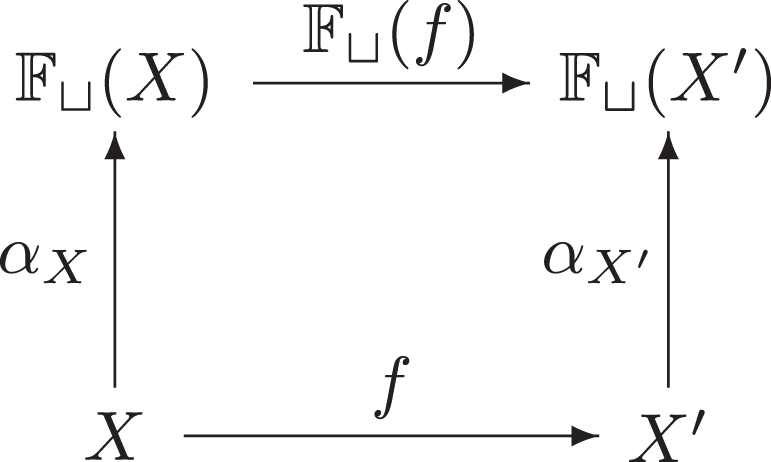
Proposition 3.11.Let (X, eX) and (X′, eX′) be L-ordered sets, and let f : X ⟶ X′ be an L-order preserving mapping. Then we have a unique directed-join-preserving mapping such that the diagram in Fig. 1 commutes.
The commutative diagram for the free-join completions
We can, and sometimes will, suppress the embedding of an L-ordered set into its free join-completion and regard X as a subposet of . When this done, the formula for takes the form
for all ,
where Ay ∈ LX and for all a ∈ X.
Proposition 3.12.Let (X, eX) and (X′, eX′) be L-ordered sets, and let f : X ⟶ X′ be an L-order preserving mapping. Then the following statements hold:
(1) is the unique extension of f that preserves directed-join;
(2) if f is an L-order embedding, then is an L-order embedding.
Proof. (1) Clearly, is the unique directed-join-preserving mapping. For all , since
we have . Hence is anextension of f.
(2) For all , since f is an L-orderembedding, we have
Hence is an L-order embedding. □
We have order dual versions of all of the aboveconstructions and properties. We denote the free meet-completion of an L-ordered set X by , and the embedding of X into by βX. We write for the down-directed-meet-preserving extension of an L-order preserving mapping f : X ⟶ Y. It is given by
for all ,
where By ∈ LX and for alla ∈ X. We iterate the above constructions to form and and so on. This enablesus to form an infinite hierarchy of completions byalternating free join- and free meet-completions. In the next part we investigate this hierarchy.
Δ1-directed objects and intermediate structures
Fig. 2 shows the hierarchy of completions of an L-ordered set (X, eX). In this section we want to identify the common part of and , and the common part is called the Δ1-directed object. If and are subsets of some common set Y, then we would simply take thecommon part to be their intersection. In the absence of such an Y, a natural substitute is to ask for a greatest interpolant Q in Fig. 2. Specifically, in the diagram we want all the maps to be embeddings and the compositions along the upward and downward diagonals to be and , respectively. And we want thediagram to commute. We now embark on showing how to construct the required interpolant Q.
The hierarchy of completions of X
Theorem 4.1.Let (X, eX) be an L-ordered set. Then the L-order induced on
in is the same as that of . For z1, z2 ∈ Int (X) it is given by
(1) if , then ;
(2) if , then ;
(3) if , then ;
(4) if , then .
Proof. We write simply for , respectively.
(1) Let and consider their embeddings in , namely and . Since is an embedding, we have
Similarly,
(2) Let . Similar to (1), we can get
(3) Let and and consider their embeddings in , namely and . By Proposition 3.10 and 3.12, preserves meets and preserves directed-joins, it follows that and where and
for all b ∈ βX (X), and for all a ∈ αX (X). Since , we have
Similarly, .
(4) Let and and consider their embeddings in , namely and . Since , we have
Similarly, □
According to the statement in Theorem 4.1, αX (x) = βX (x) in Int (X) for all x ∈ X. Hence we can regard Int (X) as being L-ordered and as containing X as a subset. We refer to Int (X) as the intermediate structure of X.
Let (X, e) be an L-ordered set and P ⊆ X. P is said to be join-dense in X if for every x ∈ X there is an L-subset A of P such that x = ⊔ i→ (A), and it is said to be meet-dense if for every x ∈ X there is an L-subset B of P such that , where i : P ⟶ X is an inclusion mapping.
Proposition 4.2.Let (X, eX) be an L-ordered set. Then is meet-dense in Int (X) and is join-dense in Int (X).
Proposition 4.3.Let (X, eX) be an L-ordered set. Then for all , ⊔↑D exists in Int (X), and may be regard as being calculated either in or in Int (X). Dual assertion holds for ⊓↓F where
Proof. For all , we have for all z ∈ Int (X),
(1) if , then
(2) if , then
Hence for all . □
Now we have established that Int (X) works as an interpolant, but we would like to find the Δ1-directed object in L-ordered set. In order to light the notations, sometimes we will regard X as a subposet of Y if X can embed into Y. Let DM (X) denote the Dedekind-MacNeille completion of X.
Let (X, e) be an L-ordered set. Define Xδ by where and Du (y) = eDM (y, u) for all , and Fu (z) = eDM (u, z) for all .
Proposition 4.4.Let (X, e) be an L-ordered set. Then Xδ is the Δ1-directed object.
Proof. Suppose Q is an interpolant as in Fig. 2. For each q ∈ Q, since Q embeds in we define by for all , , then and q = ⊔ i→ (Dq). Similarly, we define by for all , , then and . Then Int (X) is both join-dense and meet-dense in Q, hence Q is a subposet of the Dedekind-MacNeille completion DM (Int (X)). Since embedsinto DM (Int (X)) and embeds into DM (Int (X)), then for each q ∈ Q,
for all ,
for all .
Then Xδ is the greatest interpolant Q in Fig. 2. Hence Xδ is the Δ1-directed object. □
Proposition 4.5.[21] Let (X, e) be an L-ordered set. If ((DM (X) , sub) , f) is a Dedekind-MacNeillecompletion of (X, e), then f preserves all meets of L-ordered sets which exist in X.
Proposition 4.6.Let (X, e) be a bounded L-lattice. Then exists and for all x, y ∈ X.
Proof. For all x, y ∈ X, since (X, e) is a bounded L-lattice, then exists and for all b ∈ X. We can easily prove for all. For all ,
Hence . □
Clearly, is a poset under the pointwise order. Define an order on as follows:
iff η (x) ≤ η (y),
where is an L-order isomorphism.
Proposition 4.7.If (X, e) is a join L-semilattice and exists, then , is a complete lattice.
Proof. Since , we only need to prove that is a complete lattice. Define I0 ∈ LX by for all x ∈ X, I0 (x) =⊤. Clearly, . For all ,
(1) if K =∅, then⋀k∈KIk = I0;
(2) if K≠ ∅, it is easy to see that (⋀ k∈KIk) (0) = ⊤. For all x, y ∈ X, (⋀ k∈KIk) (x) ∧ e (y, x) ≤ ⋀ k∈K (Ik (x) ∧ e (y, x)) ≤ (⋀ k∈KIk) (y). By Proposition 2.19, we have (⋀ k∈KIk) (x) ∧ (⋀ k∈KIk) (y) = (⋀ k∈KIk (x)) ∧ (⋀ k∈KIk (y)) ≤ ⋀ k∈K (Ik (x) ∧ Ik (y)) ≤ ⋀ k∈KIk (x ∨ y) = (⋀ k∈KIk) (x ∨ y). Then . Thus is a complete lattice.
Proposition 4.8.Let (X, e) be a bounded L-lattice. Then exists and for all , where the meet ⋀ is computed in , .
Proof. Since , we only prove that exists and for all , where the meet ⋀ is computed in . By Proposition 4.7, we have . Clearly, for all . For all ,
Hence exists and . □
Lemma 4.9.Let (X, eX) be a bounded L-lattice. Then for all , where the meet ∧ is computed in , .
Proof. By Proposition 4.8, we know that exists and for all , where the meet ∧ is computed in , . For all z ∈ Int (X),
(1) if , on the one hand, for all m ∈ Int (X). One the otherhand, by the order dual version of Proposition 4.6, we have exists and for all p1, p2 ∈ X. Hence . By Proposition 3.10, αX. Then
(2) if , then . Hence exists and . By Proposition 4.5, we have .
Hence . □
Theorem 4.10.Let (X, e) be a bounded L-lattice. Then the Δ1-directed object precisely is DM (Int (X)).
Proof. For each u ∈ DM (Int (X)), we define by for all , Fu (y) = eDM (u, y).
(1) .
(2) For all , by Lemma 4.9, we have that , where the meet ∧ is computed in , . Then
Hence . Similarly, we can define by for all , Du (z) = eDM (z, u). Then . Thus Xδ = DM (Int (X)). By Proposition 4.4, we have that the Δ1-directed object of (X, e) precisely is DM (Int (X)). □
Conclusion
In this paper, we build and characterize the free join- and meet-completions of an L-ordered set and prove that the free join-completion of an L-ordered set may be obtained as the L-ordered set of all L-ideals of the L-ordered set. Then we show that for an L-ordered set X the L-order induced on the union of its free join- and meet-completions in is the same as the one induced in . Finally, we give thedefinitions of Δ1-directed objects and intermediate structures, and prove that the Δ1-directed object precisely is the Dedekind-MacNeille completion of the intermediate structure in the bounded L-lattice case. In the future, we can try to consider the applications of free join-completions to other fields, such as fuzzy logic [3], many valued topology [15, 17] and theoretical computer science [20].
Footnotes
Acknowledgements
The authors gratefully acknowledge the financial support of the National Natural Science Foundation of China(11531009), and the authors also wish to express their sincere thanks to the anonymous referees for their careful reading and helpful comments which have improved the quality of the paper.
BělohlávekR., Some properties of residuated lattices, Czechoslovak Mathematical Journal53 (2003), 161–171.
3.
BělohlávekR., Concept lattices and order in fuzzy logic, Annals of Pure and Applied Logic128 (2004), 277–298.
4.
DaveyB.A. and PriestleyH.A., Introduction to Lattices and Order, Cambridge University Press, Cambridge, 2002.
5.
DunnJ.M., GehrkeM. and PalmigianoA., Canonical extensions and relational completeness of some substructural logics, Journal of Symbolic Logic70 (2005), 713–740.
6.
FanL., A new approach to quantitative domain theory, Electronic Notes in Theoretical Computer Science45 (2001), 77–87.
7.
GehrkeM. and PriestleyH.A., Canonical extensions and completions of posets and lattices, Reports on Mathematical Logic43 (2008), 133–152.
8.
GierzG., HofmannK.H., KeimelK., LawsonJ.D., MisloveM.W. and ScottD.S., Continuous Lattices and Domains, Cambridge University Press, Cambridge, 2003.
9.
GoguenJ.A., L-fuzzy sets, Journal of Mathematical Analysis and Applications18 (1967), 145–174.
10.
GoldblattR., Varieties of complex algebras, Annals of Pure and Applied Logic44 (1989), 173–242.
11.
HájekP., Metamathematics of Fuzzy Logic, Kluwer Academic Publishers, Dordrecht, 1998.
12.
HöhleU., On the fundamentals of fuzzy set theory, Journal of Mathematical Analysis and Applications201 (1996), 786–826.
13.
HöhleU. and RodabaughS.E., Mathematics of Fuzzy Sets: Logic, Topology, and Measure Theory, Kluwer Academic Publishers, Boston, Dordrecht, London, 1999.
14.
JónssonB. and TarskiA., Boolean algebras with operators, I, American Journal of Mathematics73 (1951), 891–939.
15.
LaiH.L. and ZhangD.X., Fuzzy preorder and fuzzy topology, Fuzzy Sets and Systems157 (2006), 1865–1885.
16.
LaiH.L. and ZhangD.X., Complete and directed complete Ω-categories, Theoretical Computer Science388 (2007), 1–25.
LiuM., WangK.Y. and ZhaoB., A note on completeness of L-partially ordered sets, in: Proceedings of the 3rd International Conference on Quantitative Logic And Soft Computing, 2012, pp. 520–527.
19.
MacNeilleH.M., Partially ordered sets, Transactions of the American Mathematical Society42 (1937), 416–460.
20.
WagnerK.R., Solving recursive domain equations with enriched categories, Ph.D. Thesis, School of Computer Science, Carnegie Mellon University, Technical Report CMU-CS-94-159, 1994.
21.
XieW.X., ZhangQ.Y. and FanL., The Dedekind-MacNeille completions for fuzzy posets, Fuzzy Sets and Systems160 (2009), 2292–2316.
22.
YaoW., Quantative domains via fuzzy sets: Part I: Continuity of fuzzy directed complete posets, Fuzzy Sets and Systems161 (2010), 973–987.
23.
ZhangQ.Y. and FanL., Continuity in quantitative domains, Fuzzy Sets and Systems154 (2005), 118–131.
24.
ZhangQ.Y., XieW.X. and FanL., Fuzzy complete lattices, Fuzzy Sets and Systems160 (2009), 2275–2291.
25.
ZhaoH.B. and ZhangD.X., Many valued lattices and their representations, Fuzzy Sets and Systems159 (2008), 81–94.