



Abstract
In this work, we propose some two-layer preference models that can be appropriately applied in management problems such as the group decision making about predicting the future market share of certain product. By introducing the convex IOWA operator paradigm and some related properties and definitions, we list some detailed preference and inducing preference models to demonstrate and exemplify the proposed conceptual frame of two-layer preference model. The convex IOWA operator paradigm facilitates the modeling process and, from mathematical view, makes it stricter. When relevant inducing information and aggregation selection change, the proposed models can be easily adapted to accommodate more different applications in decision making and evaluation.
Keywords
Glossary for notations
<1> S (n) = {1, 2, . . . , n}:
The cardinal set some inputs functions are based on.
<2> x : S (n) → [0, 1]:
The inputs function whose values will be aggregated using aggregation functions/operators.
<3>
The space of all possible inputs functions.
<4>
An aggregation function/operator that satisfies two special conditions.
<5>
The space of all possibly used aggregation operators involved in this article.
<6>
The mapping used for merging aggregation functions and returns back a single aggregation function.
<7> w : S (n) → [0, 1]:
A normalized weights function (with dimension n) such that
<8>
The space of all normalized weights functions.
<9>
The Normative form of Yager OWA operator with w (
<10> σ : S (n) → S (n):
A suitable permutation such that x (σ (i)) ⩾ x (σ (j)) whenever i < j for a certain x (
<11>
The space of all OWA operators.
<12>
The WA operator with w (
<13>
The space of all WA operators.
<14>
The commonly known set of natural numbers.
<15> a (
A constant function such that a (i) =1/n for all i ∈ S (n).
<16>
Generally a convex set in this article.
<17>
A function, called Value Information, whose values are to be aggregated under convex combination.
<18>
A function, called Inducing Information, that will conduct the aggregation process and induce the weights out for the convex combination.
<19>
A function, called Induced Input Information of dimension n, such that
<20>
The set of all induced input information of dimension n.
<21>
A normalized weights function, called Fair Form of w (for IOWA), that has some special relation to given normalized weights function w.
<22> card (·):
The denotation for the cardinality of any finite set.
<23>
The Convex IOWA operator with w (
<24>
The space of all convex IOWA operators.
Introduction
In numerous decision and evaluation scenarios, frequently multiple criteria or multi-sourced information are considered when making an evaluation for some certain object. Those multiple criteria or multi-sourced information may hinder decision maker from constructing a holistic and comprehensive perspective or assessment to that certain object under evaluation, especially when subjectivities and preferences of decision makers need also to be considered and involved. To alleviate some possible confusions or inconsistencies of decision makers, consciously or unconsciously, and to improve decision and evaluation efficiencies and validities, computational intelligent based decision aid models and information fusion methodologies gradually become some important parts of cornerstones and pillars of evaluation and decision making [2, 34].
Countless decision making practices are based on effective and efficient aggregation systems and methodologies, where aggregation operator theories and information fusion techniques play the pivotal roles [6– 9, 34]. Since the limitation of decision resources such as time, intellectual power and computing capability and capacity are often under consideration in decision making practices, then finding and exerting flexible and easily acceptable aggregation operators [2, 23] in evaluation and decision making are always appealing. Intelligent systems with the function of providing or suggesting appropriate aggregation operators can save plenty of decision resource for decision makers. In numerous decision making scenarios, very often the preference (e.g., optimistic/pessimistic preference) over some valuation under estimation is the condensed embodiment of the accumulated experiences and expertise of experts and decision makers. Therefore, it requires the corresponding intelligent systems or decision support systems to incorporate suitable preference suggestion and handling modules.
The well-known Ordered Weighted Averaging (OWA) operators [25] are powerful aggregation techniques that can, with remarkable flexibility and effectiveness, well model such optimistic/pessimistic of decision makers. OWA operators were introduced by Yager and nowadays, majorly due to its numerous methodological developments and theoretical extensions [1, 29– 32], are flourishing and applied in different areas including decision making and computational intelligence [4, 28].
However, those theoretical methods and applications mostly are only applied to problems and situations where some direct preference aggregations can well handle the related problems. When management and decision making problems become closer to real practices, we need some more complex and appropriate preference models and methods to better simulate the real problems and our preferences involved. Therefore, this study will propose some relevant preference models, e.g., some two-layer preference decision models, for certain decision making problems using stricter language, wherein convex IOWA operator paradigm will play a vital role.
The remainder of this work is organized as follows. In Section 2, along with the discussing on a detailed management decision problem, we propose the conceptual frame for two-layer preference decision model which will direct the correct usage of other related models in practical decision making. Section 3 rephrases Yager OWA operators using normative forms and proposes the Convex IOWA operator paradigm. In Section 4, using convex IOWA operators, we propose some detailed instances of two-layer preference model. Section 5 concludes and remarks this study.
The conceptual frame for two-layer preference decision model
In practice, decision makers are often faced with the information upon which some further decisions will be made. For example, planning is one crucial element in management, and the future market share of one certain product is directly linked to the decision on how many products will be planned to make. When market research tells decision maker with a sole value about the market share which is unbeknownst to him, it is easy to make corresponding decision on the quantity about product manufacturing. However, when the market research is made by several different investigators, they may return different values about possible market shares. In this circumstance, in order to eliminate the vagueness generated from multi-source investigations, decision maker is suggested to firstly use aggregation operators to melt the multi-source information and return a final aggregated result, and then make decision on manufacture quantity according to that final aggregated result which represents the most convincing value for future market share.
Suppose the multi-source information is expressed by a function defined on S (n) = {1, 2, . . . , n}, where S (n) is a cardinal set representing the set of n different investigators. Then, a function x : S (n) → [0, 1] is defined so that x (i)% is the predicted market share of certain product provided by investigator i. In this study, we denote by
(boundary conditions) A ((0, 0, . . . , 0)) = 0 and A ((1, 1, . . . , 1)) = 1;
(monotonicity) A (x) ⩽ A (y) whenever x < y and
In addition, in this work the space of all possibly used aggregation operators

Single-layer preference decision making process.
Frequently, a decision maker is not willing to fully believe in and deal with those directly investigated information from some first-line investigators. Instead, some subordinates or consultants of the decision maker will help to provide more convincing or suggestive information to him, which is also related to multi-source investigations x. The suggestive information, provided by m different consultants, will be represented by a sequence of aggregation operators
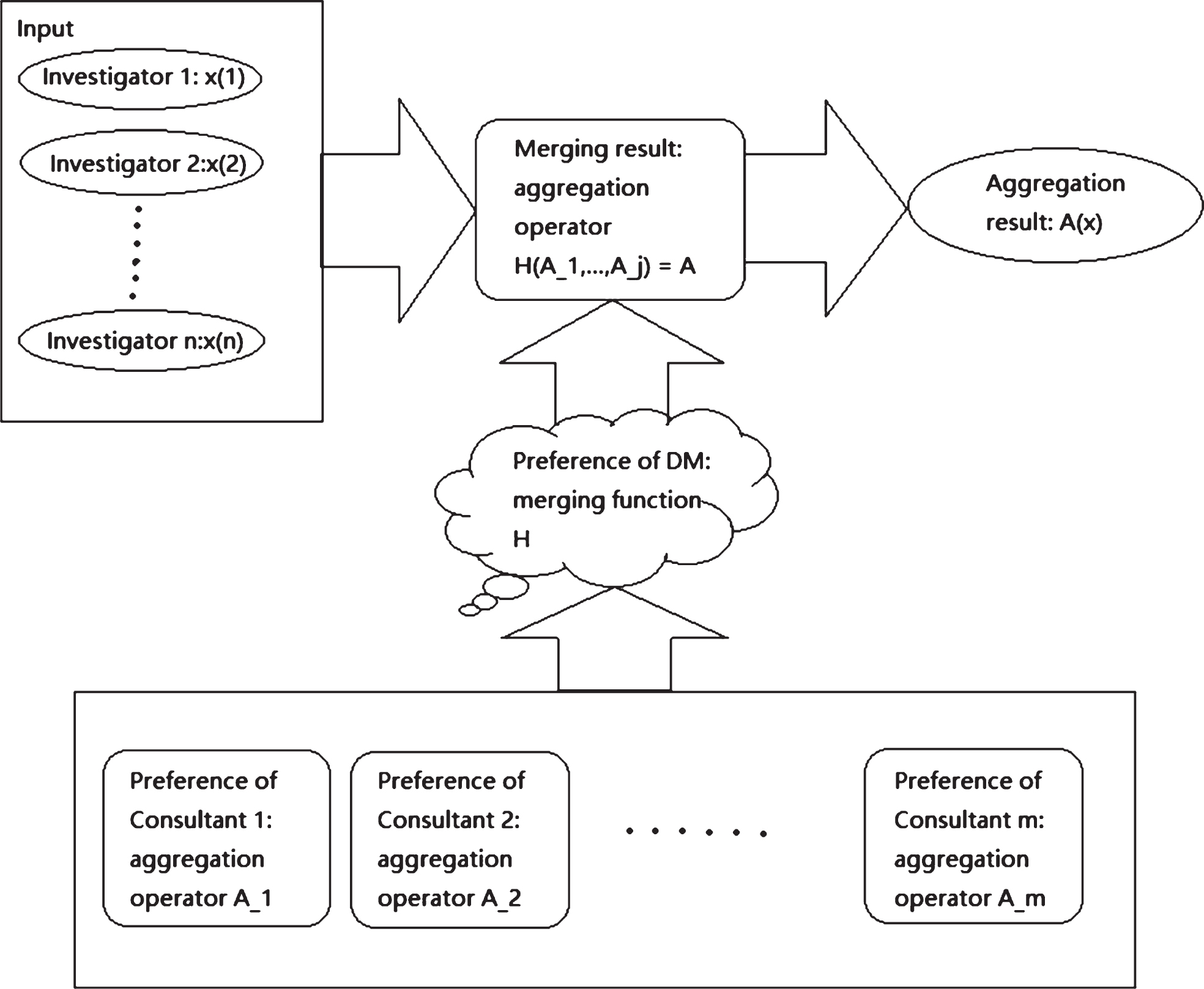
Two-layer preference decision making process.
Aggregation operators, also known as aggregation functions [13], have been deeply studied during the last several decades [2, 25]. According to the different inputs types, e.g., within [0, + ∞), (- ∞ , + ∞) or [0, 1], the definitions for aggregation operators will have slight difference. In this study, without loss of generality, the concerned discourse will be confined to unit interval [0, 1]. As one important class of aggregation operators, Averaging operators (also known as Mean) are widely used in almost every area where single valuation will be obtained from averagely considered given several valuations. As a general concept, if an aggregation operator of dimension n
The Ordered Weighted Averaging (OWA) operators as a special type of Averaging operators can well embody the optimistic/pessimistic preferences of decision makers when performing aggregation process over given inputs x.
In this section, we will present the normative forms of OWA and convex IOWA operators paradigm from the language of operators rather than of weights vectors, making OWA and IOWA operators stricter mathematical objects.
(ii) The space of all operators
Ever since Yager proposed OWA operators [25], very often scholars treated or identified OWA operators as their related weighting vectors, a way more acceptable by practitioners and engineers. Actually, from stricter mathematical view, OWA operators should not be regarded as those involved diverse weighting vectors, but as aggregation operators over certain vector space [13]. Therefore, in the next definition we review Yager OWA operators using some operator language called normative form.
One will notice the difference between OWA operators and Weighted Averaging (WA) operators which is reviewed below.
The space of all such WA operators is denoted by
We have the following statement revealing some relation between these two operators.
Yager [18, 22] also proposed the Induced Ordered Weighted Averaging (IOWA) operators as one very useful and powerful generalization of OWA operators, allowing this aggregation technique to be applied for a wider range of problems. Recently, Jin, Mesiar and Yager [10] provided a stricter paradigm for IOWA operators. Next, we generalize the definition for IOWA operators onto convex set using some stricter language and simplified form of the paradigm.
(I) Let
(II) Given
(III) Then the Convex IOWA operator with w,
The space of all such IOWA operators is denoted by
Yager [25] also defined the orness/andness of any OWA weights function. From the perspective of operator, the following renovated definition depicts the same spirit to what Yager defined for OWA aggregation process. One may note the difference between the orness/andness of OWA operator and the orness/andness of a weights function under which an OWA operator is used.break
(i) The orness of any OWA operator
(ii) As the dual case of orness, the andness of OWA operator
The definitions for orness/andness of IOWA operators are also formally listed as follows.
(i) The orness of any IOWA operator
(ii) As the dual case of orness, the andness of IOWA operator
Return to the Investigators-Consultants-Decision maker problem discussed in Section 2. The proposed two-layer preference decision making process is only a general conceptual frame, and next we will detail the process by using some special preference induced aggregation choices.
Suppose the predetermined information for the problem under discussing is listed from the following two sources:
(i) We suppose the investigated information about the possible market share returned by n consultants are represented by x : S (n) → [0, 1].
(ii) On the other hand, instead of directly performing aggregation with direct preference over values, x, decision maker will refer to the opinions from m consultants who are with distinct preferences over
x. That is, m different OWA operators,
Next, from different types of inducing preferences exhibited by decision maker, in the following we present some cases for induced aggregation by using Convex IOWA operator paradigm presented in Definition 4.
Induced Aggregation 1: Decision maker uses OWA operator
Since y (1) = OWA w 1 (x) =0.35, y (2) = OWA w 2 (x) = (0.3) (1) + (0) (0.3) + (0) (0.1) + (0.7) (0) = 0.3, y (3) = OWA w 3 (x) = (0.15) (1) + (0.3) (0.3) + (0.15) (0.1) + (0.4) (0) =0.255, then OWA v (y) = (0.5) (0.35) + (0.3) (0.3) + (0.2) (0.255) =0.316
Induced Aggregation 2. Decision maker uses IOWA operator
Since
Induced Aggregation 3. Decision maker uses IOWA operator
Since
Recall in [5], Jin, Mesiar and Yager defined a new measurement for OWA weights vector, called Normalized Preference Scatter. Here we review it by using normative forms for OWA operators and then also provide the Normalized Preference Scatter for IOWA operators.
(i) the Preference Scatter of OWA
w
is defined to be the function
(ii) the Normalized Preference Scatter of OWA
w
is a function
(i) the Preference Scatter of IOWA
w
is defined to be the function
(ii) the Normalized Preference Scatter of IOWA
w
is a function
Normalized Preference Scatter and Preference Scatter proved to be able to better embody the extent to which decision maker’s preference is distributed or scattered over all objects under consideration. The larger Normalized Preference Scatter or Preference Scatter, the more objects, perceivably and cognitively, will be taken into account (instead of only few of them being considered). For example,
if
if
if
and if
Induced Aggregation 4. Decision maker firstly chooses IOWA operator
Since
such that
Finally,
In view of the ever increasing importance of preference involved decision making in practical management administration problems, this study pointed out that traditional optimistic/pessimistic preference aggregation methods based on Yager OWA/IOWA operators sometimes are not sufficient to handle a number of decision making problems with more complexities and difficulties in problem formulating. Thus, some further elaborated preference decision making models, such as the two-layer preference models proposed in this study, are appealing and necessary for decision scientists, theorists and practitioners to refer to.
This work firstly introduced the conceptual frame of two-layer preference model with schematic figures, making possible for the further practical instances with preference in different forms. Secondly, we proposed the renovation forms of Yager OWA operators and introduced convex IOWA operator paradigm, from which the involved decision models can be built using stricter language. Lastly, several detailed instances of two-layer preference model were proposed in order to demonstrate the feasibility and convenience of the introduced conceptual frame. The whole work also provided a systematical view over Yager OWA/IOWA preference aggregations, offering some possible instructive avenues for researchers to more effectively and conveniently handle preference involved decision making and evaluation problems.
When decision environment and preference type change, the discussed methods in this study can easily be modified and applied in detailed contexts. In future works, we will further extend the current theories and models to cover more practical and real problems in managerial decision making. For example, we will concern their possible applications in large companies and organizations; we will also take into consideration some more environment variables and factors, such as uncertain information, that can effect the whole decision making problems.
Footnotes
Acknowledgments
The authors are most grateful to five anonymous reviewers and associated editor for their comments and suggestions which significantly improved the quality of this work. This work was partly supported under: Scientific Research Start-up Foundation with Grant 184080H202B165. This work was also partly supported from the Science and Technology Assistance Agency under contract No. APVV-17-0066.