



Abstract
This paper considers a two-stage supply chain consisting of one manufacturer and one retailer, exploring the impact of the fuzzy uncertainty of product yield and demand and the deciders’ risk attitudes on the optimal order quantity of the retailer. At the same time, this study tries to analyze the coordination problem in the two-stage supply chain with consideration of the retailer and the manufacturer’s risk attitudes. Firstly, this study develops a supply chain optimal decision model in a centralized decision framework. In the proposed model, the L-R fuzzy numbers are used to depict the yield and demand with fuzzy characteristics. Then, the coordination of quantity discount in a supply chain is studied. Consequently, this research further investigates a special case in which the market demand and yield are assumed to be triangular fuzzy numbers, and the optimal solution of the order quantity and the wholesale price are obtained. At last, this paper utilizes several numerical examples to validate the proposed model. The results show that the quantity discount contract can coordinate the supply chain in a fuzzy environment, and the optimal order quantity decreases with the increasing of the risk bias coefficient of the retailer and the manufacturer. It also suggests that risk-seeking retailer will order more products, in addition, the manufacturer tend to choose a risk-seeking retailer as partner and the retailer is more likely to choose a risk-seeking rather than risk-aversion manufacturer as partner.
Introduction
In recent years, the coordination in a supply chain has become a hot topic in both scientific research and application. Production yield and market demand are important for decision makers to determine the optimal order quantity. The existing studies on supply chain coordination model usually assumed the market demand or the yield is random, such as Giri et al. [1], Giri and Bardhan [2] and Zhou et al. [3]. In their research, it is assumed that the demand and production yield are random with a known distribution. However, in practice, it is difficult or impossible to estimate distributions for stochastic demand and stochastic production yield of a special product. For example, there is no historical data related to newly developed products, so it is very hard to obtain a random distribution of market demand. Similarly, the estimation of a distribution of demand for short life cycle products has faced the same problem since the demand is extremely volatile and highly uncertain. The yield of agricultural products is often uncertain due to the heavily impact of the natural environment such as weather, pest, diseases, etc. [4]. At the same time, due to the influence of human behavior (massive burning of fossil fuels, uncontrolled emission of greenhouse gases, excessive deforestation etc.), the natural environment gets worse with more uncertainty of the climate. At this point, it is difficult to accurately predict the distribution of the random production yield, and may not be feasible to adopt probability theory to study the uncertainty of the demand and production yield. At that time, it is necessary for the supply chain members to evaluate the yield and the demand based on their own judgment, previous experiences, subjective willingness and expert knowledge. They can only describe the demand and yield in vague terms such as “low output”, “high output”, “output is about q”, “the demand of a certain product is about d, not less than d l , not more than d h ” etc. At this time, only fuzzy uncertainty can be used to describe the market demand and production yield.
The fuzzy set theory proposed by Zadeh [5] could be adopted to deal with this kind of the fuzzy environmental problem. Since then, fuzzy set concept has been introduced to the supply chain management and considerable attention has been given to this issue in the literature. Most of these papers focus on the pricing decisions (e.g. Zhao et al. [6], Gupta et al. [7]) and coordination contract (e.g. Lian and Hua [8], Alamdar et al. [9]) of the supply chain under fuzzy demand or fuzzy cost. To the best of our knowledge, there is no study on the fuzzy supply chain coordination that the market demand and the production yield are all characterize by the fuzzy set. However, Giri and Bardhan [10] show that machine failure, shortage of raw materials, labor problems and other issues make production yield extremely uncertain in many industries. As a result, in practice, the supply chain members in some industries (such as agricultural products) will face the fuzzy uncertainty of both demand and yield. Therefore, this paper considers a supply chain under fuzzy yield and fuzzy demand environment, and analyzes the impact of the fuzzy degree on the supply chain decisions.
In addition, in the literature of the supply chain in fuzzy environments, it is generally assumed that the decision makers are risk neutral (e.g. Wei and Zhao [11], Zhao et al. [12]), and there are little existing studies focusing on the risk attitudes of the supply chain members in fuzzy environments (only Ye and Li [13] and Tang et al. [14]). And these existing literatures only consider the influence of decision makers’ risk attitudes on optimal decisions under fuzzy demand. However, the decision makers’ risk attitudes under fuzzy yield have not been considered. In fact, Chen and Yang [15] shown that uncertainty in production yield may lead to supply shortages, delays in customer delivery, economic losses, and increased stocks, etc. Hong, Lee and Nie [16] also pointed out that the supply chain usually faces the risk of uncertain yield. So, the supply chain members’ decisions are influenced by their risk attitudes in a high uncertain environment, as the manufacturer face production yield uncertainties and the retailer are exposed to market demand uncertainties. And the decision makers often are risk aversion or risk-seeking preferences. Therefore, different from the previous studies, this paper develops the supply chain coordination problem in fuzzy demand and yield environments, and explores the influence of the risk attitudes of the manufacturer and the retailer.
At last, through the design of supply chain contract, the double marginal problem in the decentralized decision can be eliminated, and the profit of supply chain can be maximized. Therefore, supply chain coordination has become one of the research hotspots in recent years. However, in the supply chain management, one of the most difficult issues is to design the contract and achieve coordination. Most of the scholars’ attention focused on the revenue sharing contract (e.g. Cai et al. [17]), the quantity flexible contract (e.g. Li et al. [18]), and the buyback contract(e.g. Zhao et al. [19]). However, Nie and Du [20] and Latha and Uthayakumar [21] choose the quantity discount contracts to overcome the problem of double marginalization existed in supply chain system. This is motivated by the consideration that quantity discount contracts are often used in customer-supplier relationships since their simplicity and operability in the real world [22].
The goal of this paper is to investigate the optimal quantity and the optimal quantity discount contract for coordination in a two-stage supply chain model facing fuzzy yield and fuzzy demand, and in this model the risk attitudes of the retailer and the manufacturer will be considered. Firstly, based on fuzzy demand and fuzzy yield, the supply chain decision model is established in this study under centralized and decentralized decision environment, where the Left-Right (L-R) type fuzzy numbers are used to describe the market demand and the production yield. Then, considering the risk attitudes of supply chain members, the supply chain coordination problem is studied and the quantity discount contract is designed to coordinate the supply chain. At last, different from the weighted possibilistic mean value in the literature [13], a weighted average value of the fuzzy numbers is introduced to sort the fuzzy expected returns of the manufacturer and the retailer, which can improve model solving efficiency and reduce computational cost. Some questions may arise naturally, such as,
How to design a quantity discount contract to coordinate the supply chain under fuzzy demand and fuzzy yield?
What are the impacts of the fuzzy degree of the parameter on the supply chain decisions?
How does the risk bias coefficient of the manufacturer and the retailer influence the optimal decision?
These questions will be addressed systematically in this paper. The structure of this study is organized as follows. Section 1 introduces the background of the problem. Section 2 reviews the literature. Section 3 introduces the theoretical knowledge and assumptions of the model, and builds the revenue function of the retailer, the manufacturer, and the supply chain. Section 4 obtained the optimal equilibrium solutions under the centralized and decentralized model under fuzzy demand and fuzzy yield. Section 5 designed a quantity discount contract to coordinate the supply chain. In Section 6, numerical examples are presented for sensitivity analysis. Section 7 conducts a brief conclusion.
Literature review
The literature on fuzzy environments in supply chains is limited. The literature related to this article mainly has the following directions: (1) the optimal decision of the supply chain under fuzzy environments; (2) the contract design of the supply chain under fuzzy environments; (3) the influence of decision makers’ risk attitudes under fuzzy environments; (4) fuzzy indicators for supply chain. This section will review the literature from the above directions.
The research referring to the supply chain optimal decisions under fuzzy environments has drawn considerable attentions over the past years. In the literature on fuzzy uncertainty, it is usually assumed that the market demand or production cost of the supply chain is uncertainty. Such as, Yang and Xiao [23] studied the pricing and green level decisions of the green supply chain with governmental interventions under fuzzy demand and cost; Soleimani [24] construct a centralized decision model and a decentralized decision model under the manufacturer-leader Stackelberg game based on a fuzzy dual-channel supply chain; Sang [25] studied the optimal pricing decisions of a fuzzy supply chain; At the same time, under the condition that manufacturing cost and market demand are fuzzy uncertainties, some literatures studied the optimal decisions of the alternative product supply chain. Such as, Wei and Zhao [11] investigated the optimal pricing decisions for substitutable products with horizontal and vertical competition in fuzzy environments. Wang [26] studied the optimal price decisions and warranty level of alternative products in fuzzy environments. Three game models of expectation value, optimistic value and pessimistic value are established and a closed solution for each model was obtained.
Research on supply chain coordination under fuzzy environments has achieved some results. Xu and Zhai [27] proposed a two-stage supply chain coordination model in which the customer demand has depicted by fuzzy numbers. Yu and Jin [28] studied the supply chain coordination problem, and the two models of information symmetry and asymmetry were discussed under the fuzzy demand. Zhao et al. [29] studied the coordination problem of two-echelon fuzzy closed-loop supply chain under symmetric and asymmetric information, in which the used products are collected by the retailer. Chou and Chen [30] proposed an integrated decision model with fuzzy demands and applied the genetic algorithm with a dynamically adaptive penalty function to solve the model. Sang [31] developed a supply chain model in a fuzzy environments and the fuzzy set theory was adopted to solve the fuzzy decision model. Liu and Fan [32] analyzed the VMI supply chain coordination problem with wholesale price contract.
The literature related to the risk attitudes of supply chain members in a fuzzy environment is as follows: Ye and Li [13] considered the optimization problem for single-period supply chain with fuzzy demand and took the retailer’s risk attitudes into consideration based on the weighted possibilistic mean value method. Tan et al. [14] investigated the price strategies of players with risk aversion in a Bertrand game under a fuzzy environment. Based on the risk aversion of the manufacturer and the retailer, Song et al. [33] studied optimal decisions for a fuzzy supply chain with shrinkage under VaR-criterion. Zhao et al. [34] proposed a buyback contract in the reverse supply chain under fuzzy demands which the supply chain’s member has different risk attitudes including pessimistic, optimistic, or risk-neutral.
In the literatures on the selection of fuzzy indicators in the supply chain, Hendiani et al. [35] adopted the triangular fuzzy membership function to transform the linguistic judgments and combined of sustainability indicators and fuzzy logic to integrate a novel approach for assessing the current sustainability level in supply chain. In terms of supplier selection, Aboutotab et al. [36] proposed a combination of Z-numbers and a BWM method and applied the combined method for supplier development purpose. Yadavalli et al. [37] used the combination of Z-numbers and a fuzzy-TOPSIS method for evaluation of suppliers. Based on interval-valued Pythagorean fuzzy environment, Yu et al. [38] developed a novel group decision making sustainable supplier selection approach. Jan et al. [39] studied the supply chain management problem using the framework of interval-valued Pythagorean fuzzy set. In terms of supply chain pricing and coordination under fuzzy environment, all the above-mentioned literatures select classical fuzzy numbers (triangular fuzzy numbers or L-R fuzzy numbers) to describe the uncertain variables in the fuzzy environments. This is because the key in the supply chain optimal decisions problem is to quantify the uncertain factors of the fuzzy environment, and then make decisions based on the profit maximization goal of the decision maker. Therefore, choosing classical fuzzy numbers to model has been able to achieve this goal. So, this paper also chooses the classic fuzzy number (L-R type fuzzy number) to describe the fuzzy uncertainty of yield and demand.
In summary, to the best of our knowledge, there is no study on the fuzzy supply chain coordination that the market demand and the production yield are all characterize by the fuzzy set. The articles similar to this paper are Xu and Zhai [27] and Ye and Li [13]. Xu and Zhai [27] focus on the analysis optimal decisions of a two-stage supply chain under fuzzy demand, but fuzzy yield and deciders’ risk attitudes have not been considered. Ye and Li [13] focus on the analysis of a single-period inventory control problem in a distributed supply chain under fuzzy demand and considering the deciders’ risk attitudes, but fuzzy yield and coordination problem have not been considered. This paper considers the impact of fuzzy uncertainty of the yield and demand on retailers’ optimal order quantity, and designs coordination mechanism to coordinate supply chain.
Problem descriptions
Notations and assumptions
The goal of this paper is to investigate the optimal order quantity and the quantity discount contract for coordination in a two-stage supply chain model facing fuzzy yield and fuzzy demand. Therefore, consider a two-stage supply chain with one manufacturer and one retailer, in which the manufacturer and the retailer are responsible for producing seasonal products and selling the product to consumers, respectively. Before the sales season, the manufacturer produces the product according to the order quantity. For the retailer, the order quantity is q, the selling price is p, the salvage value of unsold product is s. For the manufacturer, the wholesale price is ω, the marginal unit cost is c. The above parameters satisfy the following assumption.
The membership function is as following [40]:
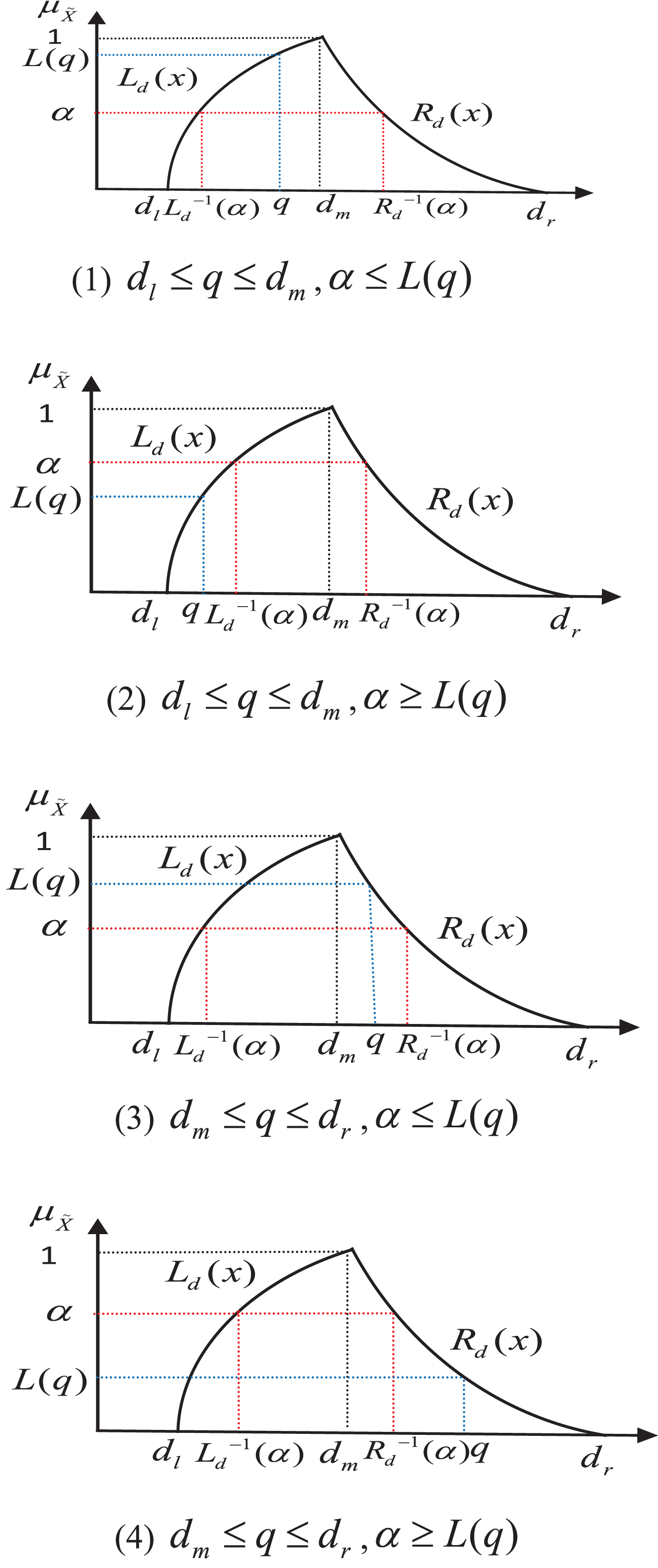
Relationship between
Furthermore, on the one hand, due to the influence of human behavior, the natural environment gets worse with more uncertainty of the climate, and it is difficult to accurately predict the production yield, such as agricultural products. On the other hand, it is difficult or impossible to forecast the distribution of the market demand for historical data missing. However, the manufacturer can use fuzzy uncertainty to describe the production yield and the retailer can use fuzzy uncertainty to describe the market demand. Therefore, this study assumed that the production yield and the market demand are L-R type fuzzy numbers. Moreover, the manufacturer will produce products according to the order quantity, so this paper makes the following assumption.
The membership function of
Clearly, the fuzzy yield
The goal of the retailer is to find the optimal order quantity q to maximize its profit under fuzzy market demand, so the profit
The goal of the manufacturer is to find the optimal wholesale price ω to maximize its profit under fuzzy production yield, so the fuzzy profit
Then, the total fuzzy profit of the supply chain systems can be calculated as follows:
Then, let X
α
is the α- cut set of
Case 1 If d
l
⩽ q ⩽ d
m
, then
Case 2 If d
m
⩽ q ⩽ d
r
, then
Similarly, let ɛ
α
is the α- cut set of
Case 1 If a
l
⩽ 1 ⩽ a
m
, then
Case 2 If a
m
⩽ 1 ⩽ a
r
, then
According to Carlsson and Fuller [43], let
Therefore, let
Let
Let
To maximize the fuzzy profit function of the supply chain and its members, the key is to choose the fuzzy ordering method, so that the fuzzy profit function is transformed into a clear and comparable function. Therefore, this paper adopts the fuzzy possibilistic mean value method proposed by Carlsson and Fuller [43] to rank fuzzy expected returns, and also consider the risk attitudes of the supply chain members. The definition is as follows:
Let
with λ ∈ [0, 1]. The different parameter λ represents the different possibilistic mean value interval position, and may be interpreted as a risk bias coefficient, which must be selected by the supply chain decision maker. The decision maker is more risk preference if the value of λ is smaller, and the decision maker is more risk aversion if the value of λ is larger. In particular, the decision maker is risk neutral if the value of λ is 0.5. According to the formula (6),(7),(12),(15), assume that the retailer bias coefficient is λ1, then the possibility means
Case 1 If d
l
⩽ q ⩽ d
m
, then
Case 2 If d
m
⩽ q ⩽ d
r
, then
Similarly, assume that the manufacturer bias coefficient is λ2 and the supply chain’s bias coefficient is λ, then the possibility means profit
This section analyzed the optimal ordering strategy of the supply chain under centralized and decentralized cases, and conducted comparative analysis.
Centralized model
In the centralized case, the manufacturer and the retailer form a unified whole, and the supply chain can be seen as a ‘super organization’ with centralized control. In that case, given p, s and v, the goal of the supply chain is to get the optimal order quantity q to maximize the total profit of the supply chain. So the goal of the supply chain is to get the optimal order quantity to maximize the possibility means
(2) If d
l
⩽ q ⩽ d
m
, and qa
m
⩽ q ⩽ qa
r
(a
m
⩽ 1 ⩽ a
r
), then the optimal order quantity with risk bias behavior under centralized system is:
(3) If d
m
⩽ q ⩽ d
r
, and qa
l
⩽ q ⩽ qa
m
(a
l
⩽ 1 ⩽ a
m
), then the optimal order quantity with risk bias behavior under centralized system is:
(4) If d
m
⩽ q ⩽ d
r
, and qa
m
⩽ q ⩽ qa
r
(a
m
⩽ 1 ⩽ a
r
), then the optimal order quantity with risk bias behavior under centralized system is:
The supply chain system’s risk bias coefficient is λ = λ1 η + λ2 (1 - η) where the risk bias coefficient of the retailer and the manufacturer can be denoted as λ1,λ2 respectively, and the weight of the retailer’s risk bias coefficient λ1 in the supply chain system’s risk bias coefficient λ can be denoted as η. The different η represent the different importance to the retailer and the manufacturer in the supply chain. A larger η implies the retailer’s dominant position; a smaller η implies the manufacturer’s dominant position respectively.
Theorem 1 has given the display solution of the optimal order quantity under the supply chain centralized decision model. It can be seen from Theorem 1 that when the supply chain system is risk-neutral (λ = 0 . 5), the yield is determined (a
l
= a
m
= a
r
) and the residual value, holding cost, and penalty cost for shortages of the product does not considered, the expression of the optimal order quantity in Theorem 1 is consistent with the literature [27]. Given the selling price p, the salvage value s, and extra unit cost v, when the supply chain makes a centralized decision, the manager can determine the order quantity under the fuzzy market demand and yield according to the expression of Theorem 1. However, since the specific expressions of L
d
(x), R
d
(x), L
a
(x) and R
a
(x) are not given, it is difficult to analyze the nature of the parameters from Theorem 1. Therefore, this paper considers a special case where the market demand and yield are triangular fuzzy numbers, let
(2) If qa
m
⩽ q ⩽ qa
r
(a
m
⩽ 1 ⩽ a
r
), t2 - s ⩾ 0, then the retailer’s optimal order quantity with risk bias behavior under centralized decision-making system is:
Where
According to Theorem 2, the properties of the optimal order quantity with respect to the parameters can be obtained as follows:
Theorem 2 and corollary 1 show that as the degree of risk bias coefficient increases, supply chain decisions are more conservative and will reduce the order quantity of products. As the product residual value and sales price increase, the order quantity of the product will increase. However, when production is insufficient, the impact of the additional cost v of purchasing supplemental products on the optimal order quantity is not determined and is related to the value of the membership function, such as, if qa l ⩽ q ⩽ qa m (a l ⩽ 1 ⩽ a m ), that is the product’s yield is relatively sufficient, in that case, the optimal order quantity decreases with the increase of v.
Decentralized model
In the decentralized decision model, the manufacturer and the retailer make decisions based on maximizing their own profits. This paper assumes that the Stackelberg game model can be built to describe the decentralized decision-making process. In the model, the manufacturer is the leader, and the retailer is the follower. The decision order of supply chain members is as follows: (1) The manufacturer determines the wholesale price ω; (2) Given the wholesale price ω, the retailer determines the order quantity q according to the estimated demand information. (3) Given the order quantity q, the manufacturer determines the production yield.
According to the inverse solution method and Equation (16), (17), to solve the expression
It can be seen from Theorem 3 that when the retailer is risk-neutral (λ1 = 0 . 5) and the residual value, holding cost, and penalty cost for shortages of the product does not considered, the expression of the optimal order quantity in Theorem 3 is consistent with the literature [27]. And, as the risk bias coefficient of the retailer increases, the optimal order quantity decreases. The increasing nature of the function L d (x) and the decreasing nature of the function R d (x) are used here. In addition, when production is determined, i.e. a l = a m = a r , and the manufacturer and the retailer are risk-neutral, i.e. λ1 = λ2 = λ, the literature [23] has demonstrated that the total return of the supply chain system under decentralized decision-making is less than the total return of the supply chain system under centralized decision-making. Therefore, this paper focuses on designing a contract to coordinate the supply chain in the next section.
The coordination mechanism
In this section, this paper chose the quantity discount contract to motivate the retailer to order more products, so that the supply chain can be coordinated. This is motivated by the consideration that quantity discount contracts are often used in customer-supplier relationships since their simplicity and operability in the real world. Let ω (q) represents the wholesale price under the quantity discount contract, and ω (q) be the decreasing continuous convex functions respect to q. A rational manufacturer will ensure that the transfer payments received from retailers increase as the retailer’s order quantity increases, so here let
The manufacturer’s profit is as follow:
Then, the optimal order quantity under the decentralized model of the quantity discount contract is first calculated. Similar to the Theorem 3, the following conclusion under the quantity discount contract can be got.
To achieve supply chain coordination, the order quantity in centralized decision-making system is the same as in the decentralized decision-making system, i.e.
(1) If qa
l
⩽ q ⩽ qa
m
(a
l
⩽ 1 ⩽ a
m
) and
(2) If qa
m
⩽ q ⩽ qa
r
(a
m
⩽ 1 ⩽ a
r
) and
(3) If qa
l
⩽ q ⩽ qa
m
(a
l
⩽ 1 ⩽ a
m
) and
(4) If qa
m
⩽ q ⩽ qa
r
(a
m
⩽ 1 ⩽ a
r
) and
According to the previous analysis, the supply chain cannot be coordinated without the quantity discount contract since the optimal wholesale price for supply chain coordination may be less than the manufacturer’s cost. After designing the quantity discount contract, a constant k i can be choosing to avoid the above results, such that the supply chain system to achieve coordination. At the same time, from the Theorem 5, the optimal wholesale price is jointly affected by the retailer’s risk bias coefficient λ1, the manufacturer’s risk bias coefficient λ2, the weight coefficient η and the optimal order quantity q.
In this section this study tries to illustrate the theoretical models established in the previous sections using a numerical example where assume that the parameter values can be estimated with
Sensitivity analysis of optimal decision with respect to λ1 in supply chain coordination
The impact of the retailer’s risk bias coefficient λ1 on the optimal order quantity
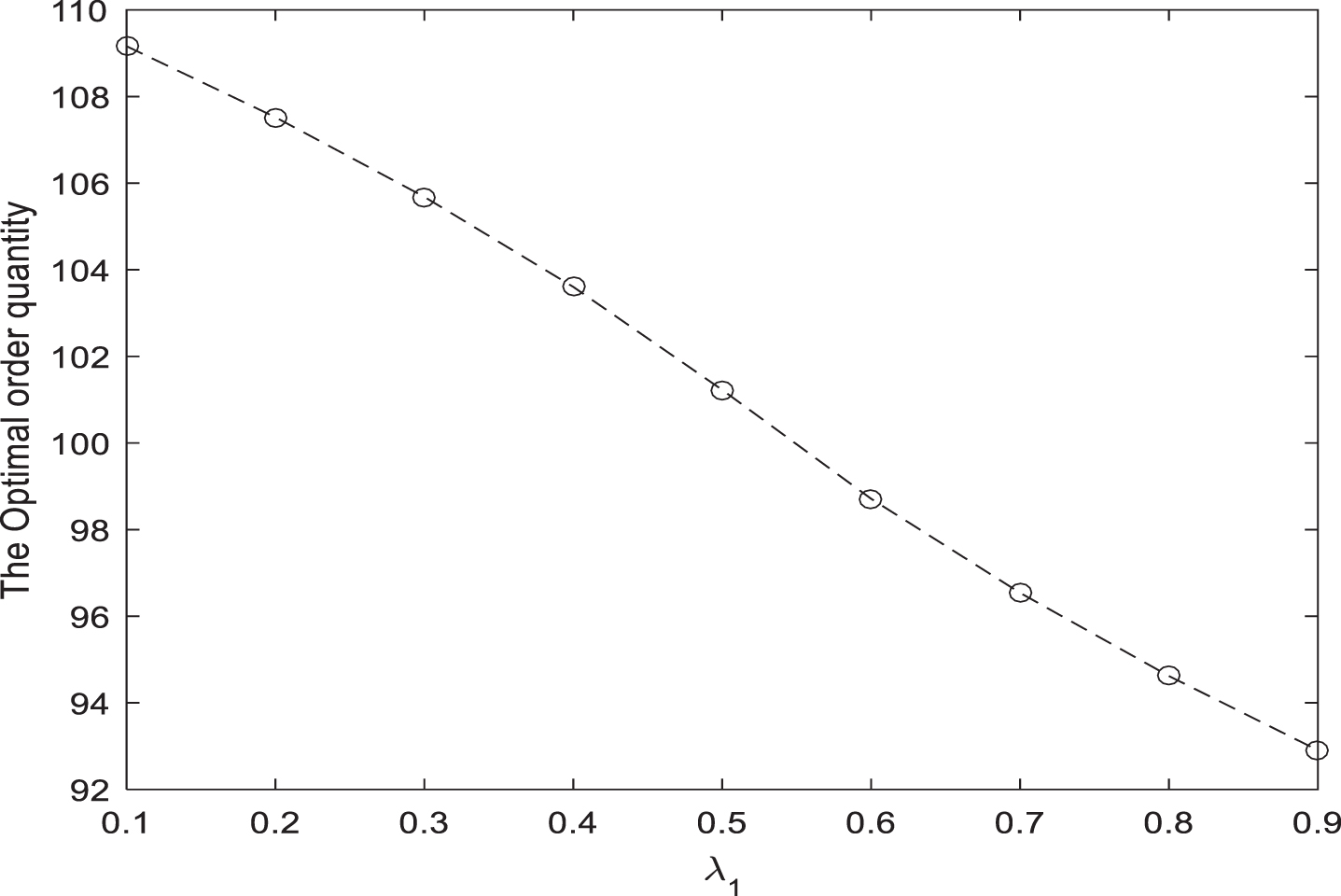
Sensitivity analysis of optimal order quantity with respect to λ1.
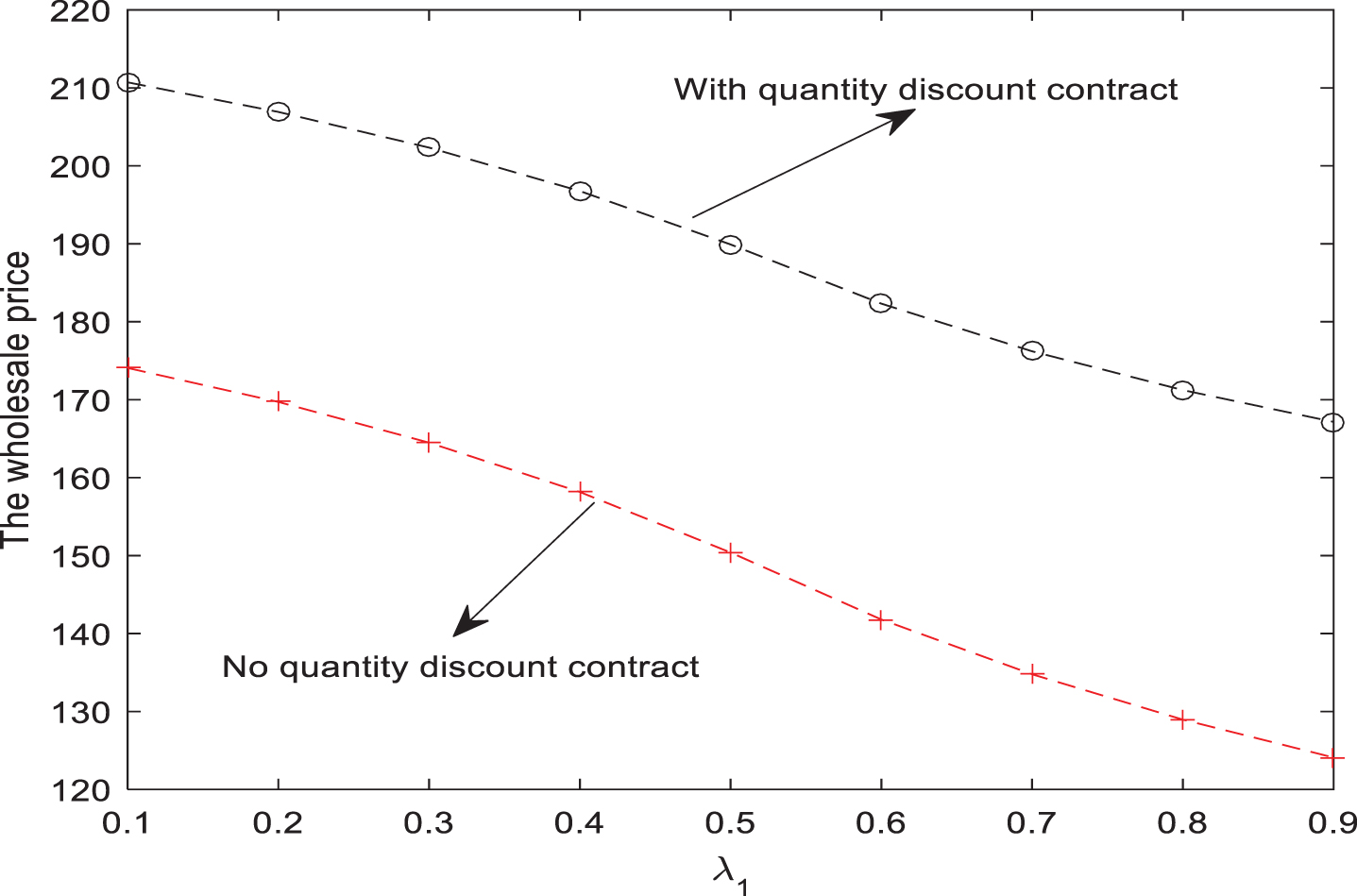
Sensitivity analysis of optimal wholesale price with λ1.
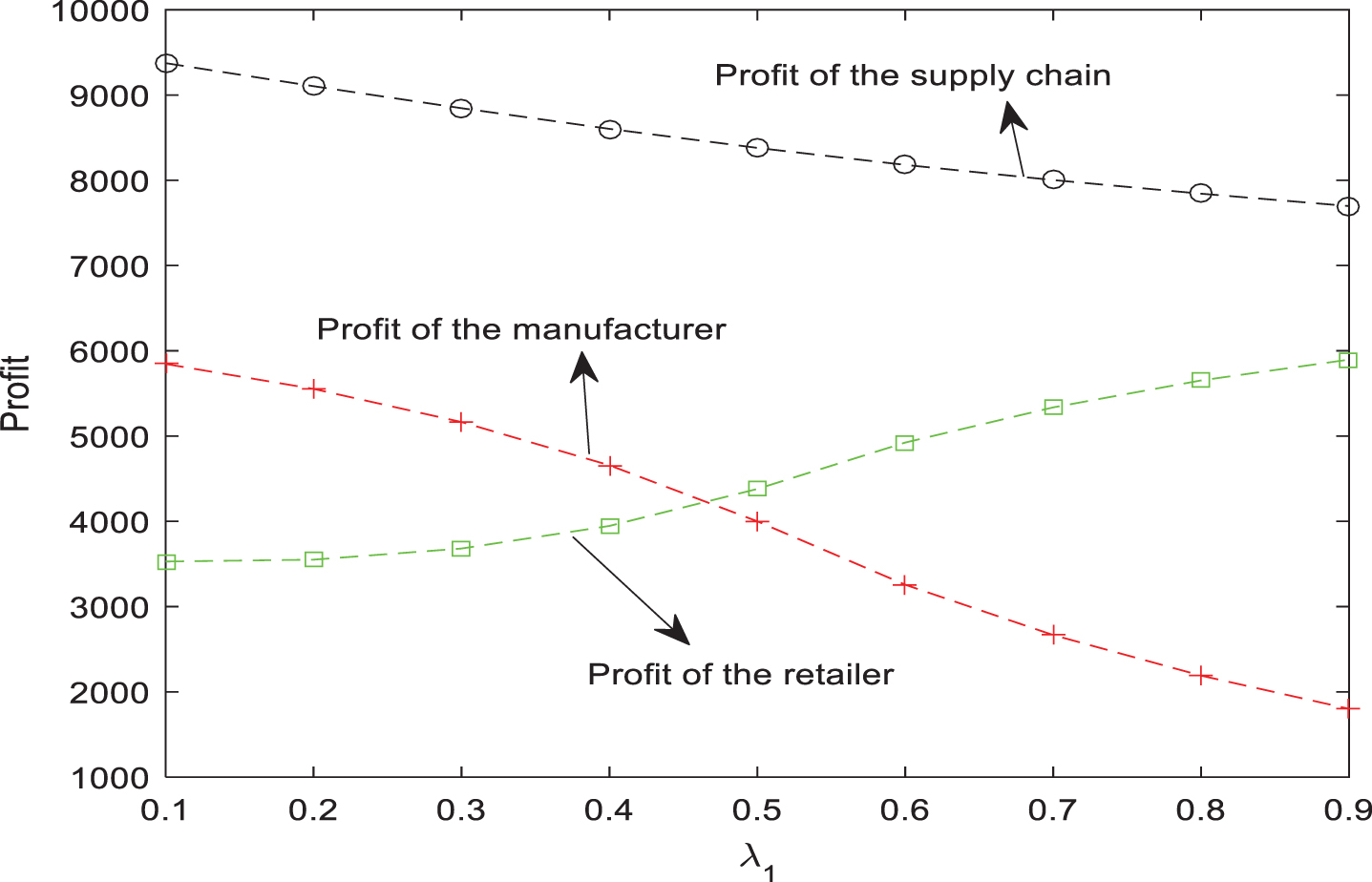
Profits with the different retailer’s risk bias coefficient λ1.
Figure 2 shows that the influence of the retailer’s risk bias coefficient on the retailer’s optimal order quantity under the supply chain coordination. It is obvious that the optimal retailer’s order quantity increases as the retailer’s risk bias coefficient decreases. This is consistent with the research conclusions in the literature [13].
Figure 3 shows that the influence of the retailer’s risk bias coefficient on the manufacturer’s optimal wholesale price. From the wholesale price curve in the absence of quantity discount contract, the optimal wholesale price of the manufacturer is mostly less than the cost c in order to coordinate the supply chain system. In that case, the manufacturer is unprofitable, so the supply chain system cannot be coordinated. From the wholesale price curve with quantity discount contract, it can be seen that there is a significant increase in the optimal wholesale price. Unlike the optimal wholesale price in literature [13], which will decrease first and then increase as the increase of the retailer’s risk bias coefficient, the research conclusion of this paper shows that when yield also has fuzzy uncertainty, the optimal wholesale price will decreased as the increase of the retailer’s risk bias coefficient.
Figure 4 shows the influence of the retailer’s risk bias coefficient on the retailer’s profit, the manufacturer’s profit and the total supply chain profit. Obviously, since the order quantity will be decreased as the increase of the retailer’s risk bias coefficient, the total supply chain return also will be decreased as the increase of the retailer’s risk bias coefficient. This is consistent with the research conclusions in the literature [13]. Then, the return of the retailer’s will be increased as the increase of the retailer’s risk bias coefficient, and the return of the manufacturer’s will be decreased as the increase of the retailer’s risk bias coefficient.
In summary, the risk attitude of the retailer will affect the decision-making and profit of the supply chain. The risk-aversion retailer will order fewer products, whereas the risk-seeking retailer will order more products. Accordingly, the manufacturer sets a low wholesale price for risk-aversion retailer to stimulate him to order more products, and sets the highest wholesale price when they face risk-seeking retailer under a quantity discount contract. For the retailer, his risk-aversion decisions can bring higher returns in fuzzy demand and production yield environments. For the manufacturer, the risk-seeking decisions of the retailer can bring higher returns in fuzzy demand and production yield environments, and it means that the manufacturer is willing to choose a risk-seeking retailer as his partner.
This paper considers the impact of the manufacturer’s risk bias coefficient λ2 on the optimal order quantity

The optimal wholesale price with the different λ2.
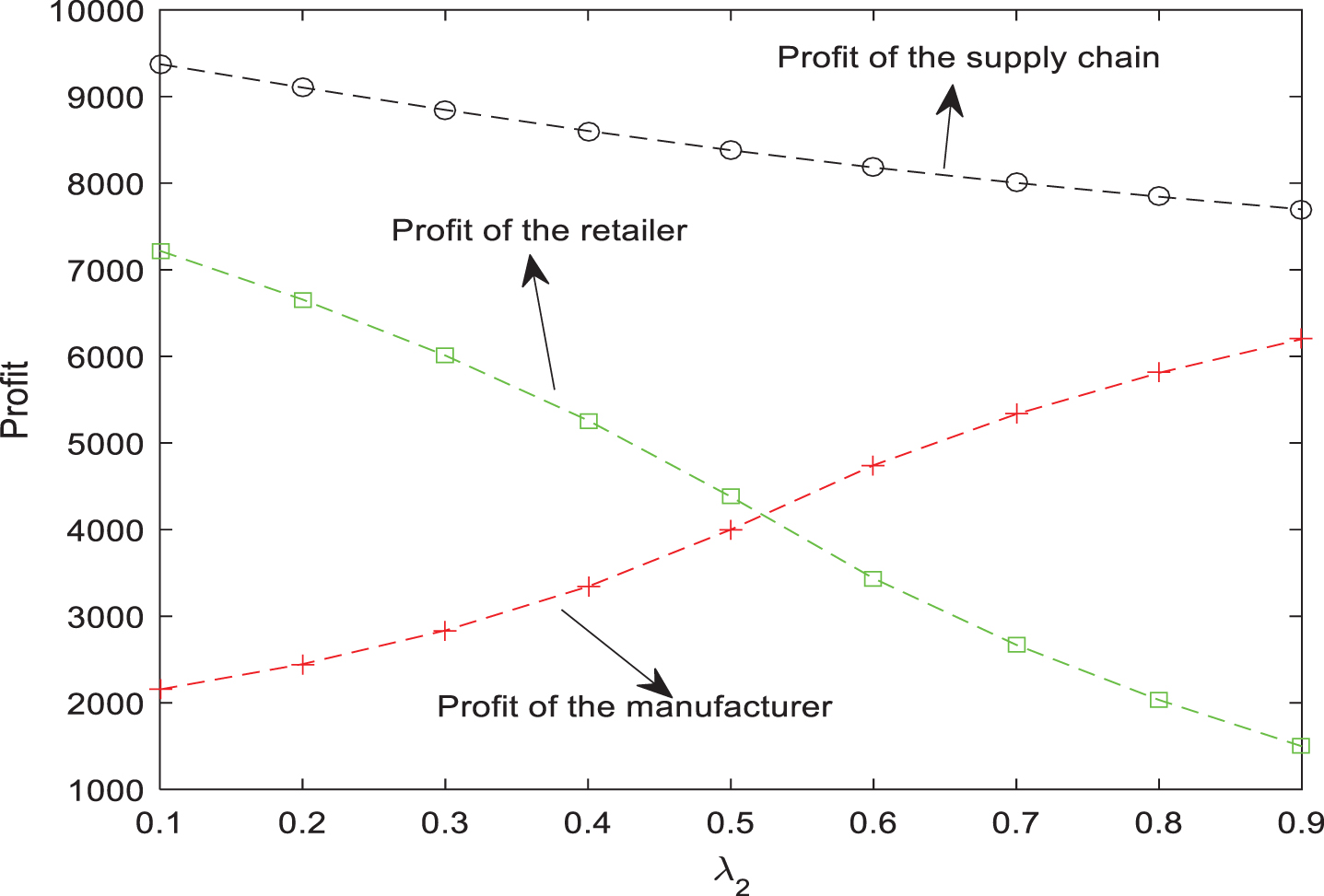
The optimal profits with the different λ2.
Figure 5 shows the influence of the manufacturer’s risk bias coefficient on the optimal wholesale price. It can be seen that the optimal wholesale price will be increased as the increase of the manufacturer’s risk bias coefficient.
Figure 6 shows the influence of the manufacturer’s risk bias coefficient on the profit of retailer and the supply chain. The supply chain return and the retailer’s return will be decreased as the increase of the retailer’s risk bias coefficient. However, the manufacturer’s return will be increased as the increase of the manufacturer’s risk bias coefficient.
In summary, the risk attitude of the manufacturer will affect the decision-making and profit of the supply chain. The risk-seeking manufacturer will set a lower wholesale price under a quantity discount contract, then the retailer orders more products, in this time, the return of the supply chain and retailer is the highest. However, the risk-aversion manufacturer will set a higher wholesale price under a quantity discount contract, then the retailer orders fewer products, in this time, the return of the supply chain and retailer is the lowest. Consequently, for the manufacturer, his risk aversion decisions can bring higher returns in fuzzy demand and production yield environments. For the retailer, the risk seeking decisions of the manufacturer can bring higher returns in fuzzy demand and production yield environments, and it means that the retailer is willing to choose a risk-seeking manufacturer as the partner under the quantity discount contract.
This paper considers the impact of the degree of uncertainty of market demand and yield on the optimal decisions and returns of the supply chain and its members. Assume that the parameter values can be estimated with
First, the impact of the fuzzy degree of market demand on the optimal decision has been studied. As the retailer is exposed to uncertain market demand, this paper analyses the combined effects of the retailer’s risk bias coefficient and market demand uncertainty. That is, let η = 0.5, λ1 = (0 . 1, 0 . 2, ⋯ 0 . 9), λ2 = 0 . 5. The results are shown in Fig. 7-8.
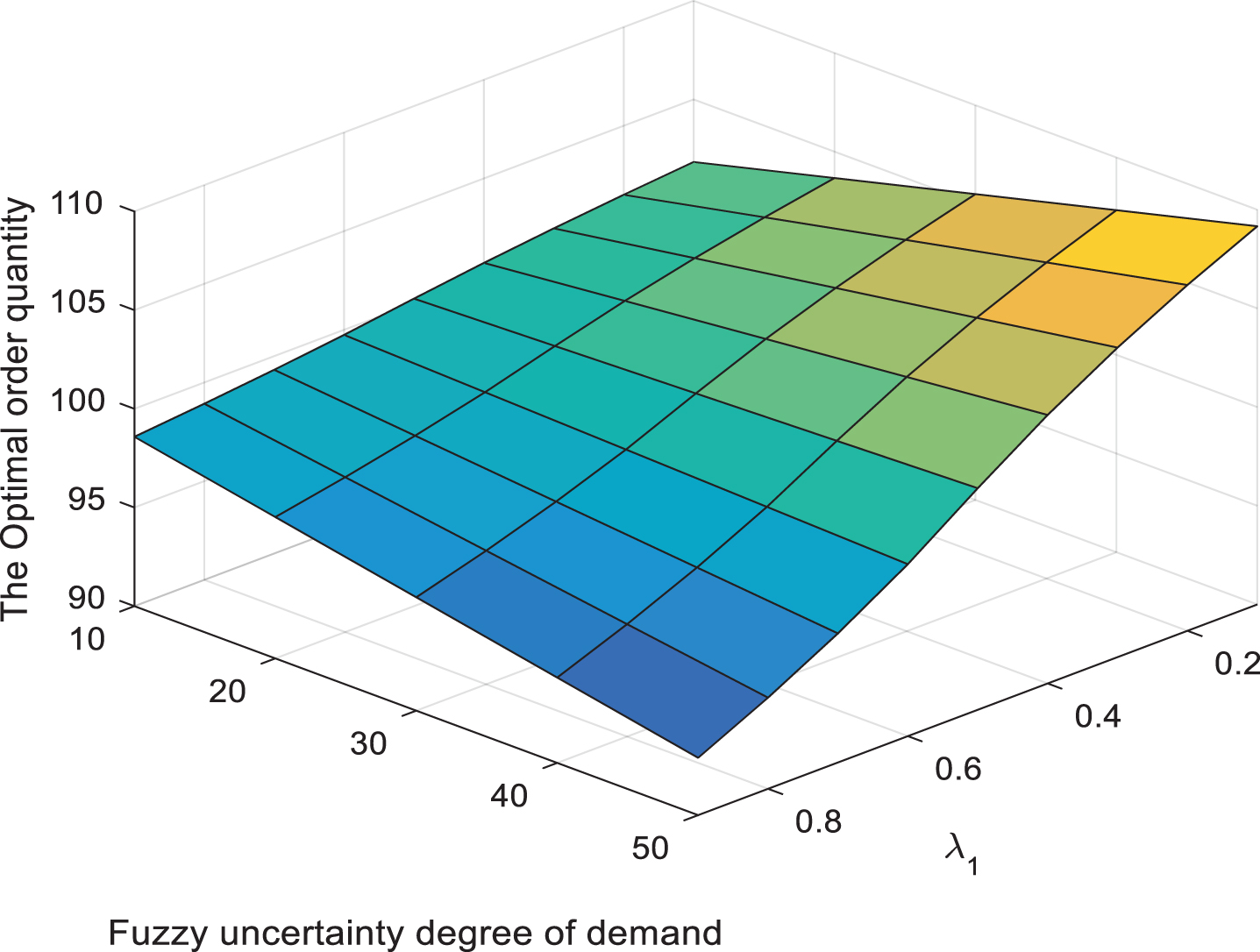
The optimal order quantity with different λ1 and α.
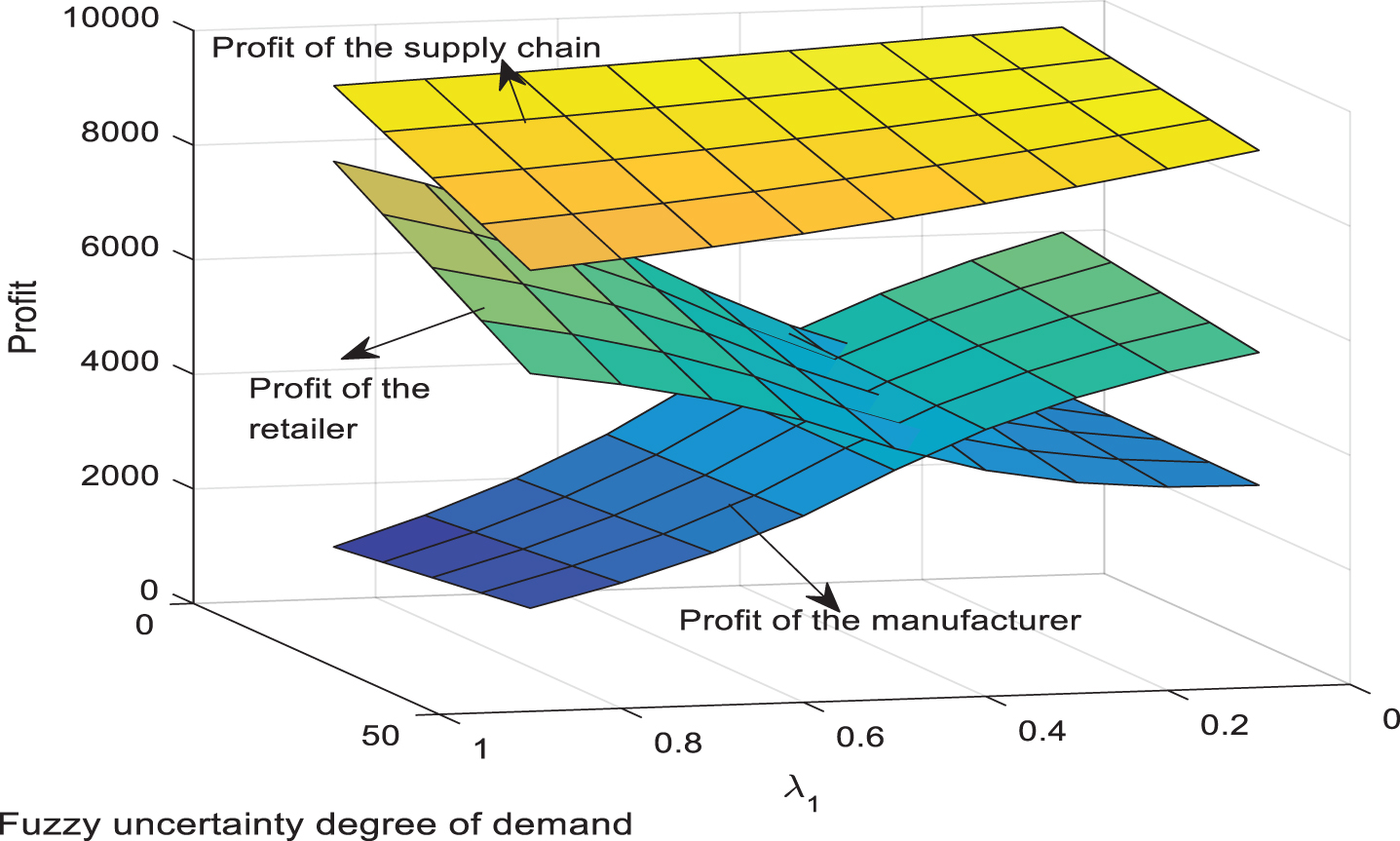
Profit of the supply chain with different λ1and α.
Figure 7 shows that the combined influence of the retailer’s risk bias coefficient and the uncertainty degree of market demand on the optimal order quantity under the supply chain coordination. The impact of the uncertainty degree of market demand on the optimal order quantity is related to the retailer’s risk bias coefficient. When the retailer’s risk bias coefficient is small, the optimal order quantity increases with the increase of the fuzzy degree of market demand, and when the retailer’s risk bias coefficient is large, the opposite conclusion is established.
Figure 8 shows that the combined influence of the retailer’s risk bias coefficient and the uncertainty degree of market demand on the profit of the supply chain and its members under the supply chain coordination. Regardless of the value of the retailer’s risk bias coefficient, the supply chain’s profit and the retailer’s profit decreases as the uncertainty degree of market demand increases. That is, when the retailer is a risk-seeking and the uncertainty degree of market demand is small, the total return of the supply chain is the largest. But when the retailer is a risk-aversion and the uncertainty degree of market demand is small, the total return of the retailer is the largest.
The impact of the uncertainty degree of market demand on the manufacturer’s profit is related to the retailer’s risk bias coefficient. When the retailer’s risk bias coefficient is small, the manufacturer’s profit decreases with the increase of the fuzzy degree of market demand, and when the retailer’s risk bias coefficient is large, the opposite conclusion is established.
In summary, on the one hand, when the retailer is risk-aversion, the increased uncertainty of market demand will reduce the order quantity, so that the revenue of the retailer and the supply chain will decrease. Since the value of profit reduction in the supply chain is less than the value reduced by the retailer, the profit of the manufacturer increases. However, in this numerical example it is assumed that the quantity discount factor is fixed. In practice, the coefficient is adjusted between the manufacturer and the retailer under different situation. Therefore, in the case of a reduction in the supply chain and retailer profits, the manufacturers’ profits will generally decrease. On the other hand, when the retailer is risk-seeking, the increased uncertainty of market demand will increase the order quantity. In this case, the uncertain increase in market demand may lead to an increase in product inventory, so the revenues of the retailer, the manufacturer and supply chain will decrease. Therefore, the uncertainty of fuzzy market demand is unfavorable to the supply chain and its members, and the retailer needs to collect as much market information as possible to reduce the uncertainty of market demand.
Second, the impact of the fuzzy degree of yield on the optimal decision has been studied. As the manufacturer is exposed to uncertain yield, this paper analysis the combined effects of the manufacturer’s risk bias coefficient and production yield uncertainty. Let η = 0.5 λ2 = (0 . 1, 0 . 2, ⋯ 0 . 9), λ1 = 0 . 5. The results are shown in Fig. 9-10.
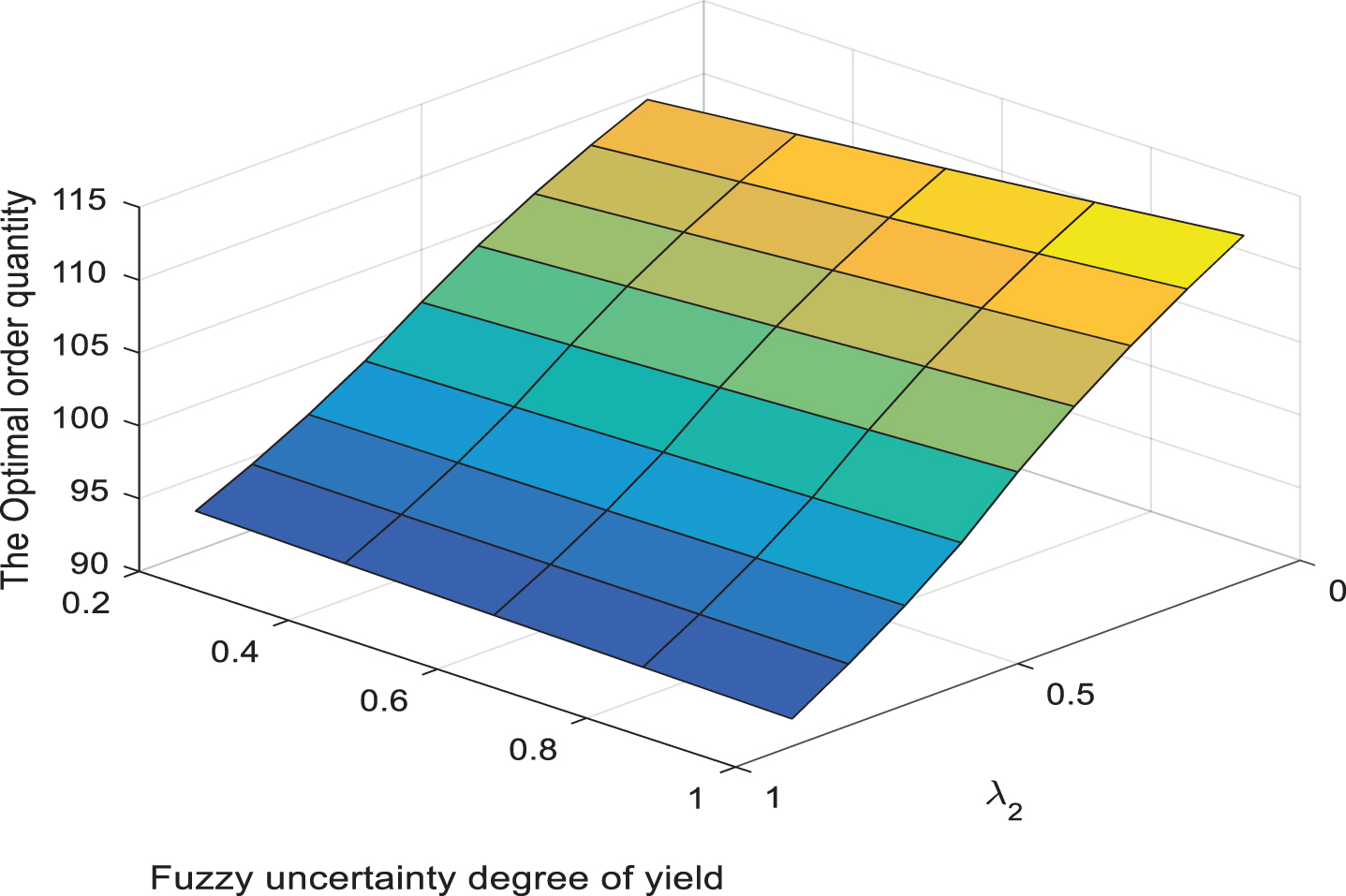
The optimal order quantity with different λ2 and β.
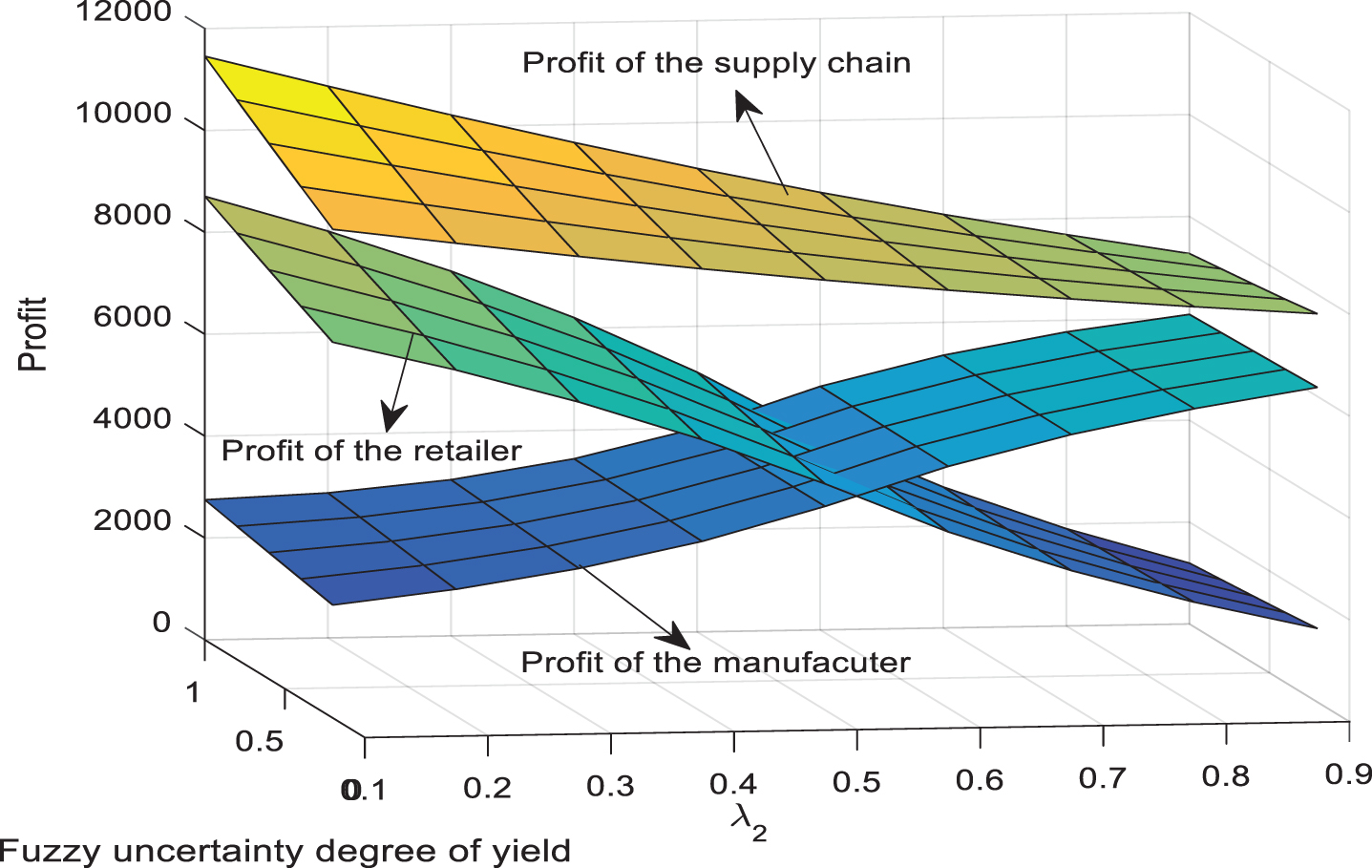
Profit of the supply chain with different λ2 and β.
Figure 9 shows that the combined influence of the manufacturer’s risk bias coefficient and the uncertainty degree of yield on the optimal orders quantity. The results are the same as Fig. 7.
Figure 10 shows that the combined influence of the manufacturer’s risk bias coefficient and the uncertainty degree of yield on the profit of the supply chain and its members under the supply chain coordination. The impact of the degree of uncertainty in yield on the profit of the supply chain and its members is related to the manufacturer’s risk bias coefficient. When the manufacturer’s risk bias coefficient is small, the profit of the supply chain and its members increase with the increase of the fuzzy degree of yield, and when the manufacturer’s risk bias coefficient is large, the opposite conclusion is established.
In summary, on the one hand, when the manufacturer is risk-aversion, the increased uncertainty of yield will reduce the order quantity, so that the revenue of the retailer, manufacturer and supply chain will decrease, in this case, the uncertainty of fuzzy yield is unfavorable to the supply chain and its members. On the other hand, when the manufacturer is risk-seeking, the increased uncertainty of yield will increase the order quantity, at this time, the uncertainty of market demand has not changed. So, the revenues of the retailer, manufacturer and supply chain will increase. In this case, the uncertainty of fuzzy yield is beneficial to the supply chain and its members. It is unexpected that the impact of the uncertainty degree of yield on the supply chain and its members is inconsistent with the uncertainty degree of market demand. This is because the uncertainty of yield mainly causes the supply of products to be insufficient, but the manufacturer can satisfy the supply by replenishing goods from other manufacturers, so the uncertainty of production will only lead to an increase in the cost of the manufacturer. In the case of the manufacturer is risk-seeking, the manufacturer will motivate the retailer to order more products through wholesale price under supply chain coordination, which will increase the revenue of the supply chain and its members.
This paper expands the literature [13] and literature [27], and designs coordination contracts under fuzzy demand and yield. Some theoretical and managerial implications can be obtained.
Firstly, from the perspective of the partner selection, the manufacturer can choose the risk-seeking retailer as his partner and the retailer can choose the risk-seeking manufacturer as the partner under the quantity discount contract. From the perspective of decision make’s profits, the decision of risk aversion can bring him higher profits.
Secondly, the uncertainty of fuzzy market demand is unfavorable to the supply chain and its members. In practice, the retailer needs to collect as much market information as possible to reduce the uncertainty of market demand.
Thirdly, different from the influence of fuzzy market demand uncertainty, when the manufacturer is risk-aversion, the uncertainty of fuzzy yield is unfavorable to the supply chain and its members. But when the manufacturer is risk-seeking, the uncertainty of fuzzy yield is beneficial to the supply chain and its members. In practice, when the uncertainty of production increases, manufacturers’ decisions can be more positive and aggressive.
There are some limitations in this article. Fist, the supply chain composed of a manufacturer and a retailer under fuzzy environment is taken into consideration in this paper. In the future, the optimal decision-making and coordination of supply chains with competing members in a fuzzy environment will be studied. Second, this paper assumes that when the manufacturer’s yield is insufficient, this assumption will be relaxed in future research. At last, for the convenience of calculation, this article assumes that the price of the product is exogenous. In the future, the impact of endogenous product prices on supply chain decisions and coordinated contracts will be studied.
Footnotes
Acknowledgments
We sincerely thank the editor and the anonymous reviewers for their insightful comments and suggestions that helped significantly improve this paper. This work was supported by the Chinese National Funding of Social Sciences (19BGL099), the Philosophy and Social Science Foundation of Hunan Province (18YBA446), the Fundamental Research Funds for the Central Universities of Central South University (2019zzts205) and the Scientific Research Foundation of Hunan Provincial Education Department (18C0879).