In this paper we propose a new approach to the fuzzification of lattices, which is defined from the view of algebraic structure. It is also called an M-hazy lattice. Some properties of M-hazy semilattices and M-hazy lattices are discussed. Besides, we also discuss its relations with M-fuzzifying interval spaces and M-fuzzifying convex spaces.
Introduction
As a special poset, lattice theory is an important part of mathematics. In the latter half of the 19th century, the concept of lattices are obtained by Dedekind and Schröder respectively from number theory and logic algebra. By the 1930s, through the common promotion of Birkhoff and Ore, lattice theory has become an independent discipline. Since then, lattice theory [4, 11] has been extensively studied and used in several areas of mathematics. The lattice theory with characteristic of order structure and algebraic structure has a close relation with modern mathematics such as topology and fuzzy mathematics. Lattice theory plays an important role in logic, computer science, algebra expression method and probability theory.
Being a helpful mathematical tool, convexity theory has been rapidly used in the study of extremum problems in recent years. The concept of convexity derives from thinking of some elementary geometric problems in Euclidean spaces [3]. To better examine the characteristics of convexity, a lot of specialists abstracted convexity away from Euclidean spaces and into the other mathematical structures such as posets, lattices, graphs, metric spaces, median algebras and topology. With the help of the idea of axiomatic method, scholars have achieved a description of the properties of convex sets that we regard fundamental, and the concept of convex structures were obtained [30]. In fact, the convex structures are studied in many aspects, such as product spaces, quotient spaces, convex invariants, separation and so on.
With the development of fuzzy mathematics, many mathematical structures have been combined with fuzzy set theory, such as fuzzy topological structures [17, 18]. The concept of fuzzy convex structures also has been generalized to the fuzzy setting. In 1994, Rosa first proposed the notion of fuzzy convex structures [24]. Later, Maruyama [16] further proposed the notion of L-convex structures, where L is a completely distributive lattice. Recently, Pang et al. [19–23] provided a categorical approach to L-convex structures and presented several characterizations of L-convex structures. Zhong and Shi [46] introduced L-ordered convex spaces, L-semilattice convex spaces, L-lattice convex spaces, L-standard convex spaces and obtained their corresponding L-convex hull formulae. One thing to point out is that each convex set was fuzzy and the convex structure is a crisp subset of L-powerset in these structures.
In 2014, Shi and Xiu [28] provided a new approach to the fuzzification of convex structures, which is called an M-fuzzifying convex structure. In this case, M-fuzzifying convex structures are actually an M-fuzzy subset of the powerset 2X. And then, the concept of M-fuzzifying restricted hull operators was introduced [27] in order to generalize the concept of restricted hull operators in classical convex structures to M-fuzzifying convex structures. Lately, Xiu and Shi [35] presented the notion of M-fuzzifying interval operators and discussed its relation with an M-fuzzifying convex structure. Moreover, Xiu and Pang studied the relations between M-fuzzifying convex structures and M-fuzzifying closure systems [34]. Furthermore, the theoretical natures of interval operators and convexities have been considered by many scientists, such as, [13, 37]. Recently Liu and Shi [15] introduced the concept of M-fuzzifying median algebras, which is defined by fuzzy binary operations. It is worth noting that a new kind of the fuzzy associative law in an M-fuzzifying median algebra was proposed. This gives us inspiration to discuss about the fuzzification of lattices.
So far, there have been many researches about the fuzzification of lattices [1, 29]. These researches can be grouped into two classes. One class is to define the fuzzy subsets of classical lattices such that they maintain ordering relations, meet operations and join operations over nonempty sets [1, 29]. The other class is to fuzzify ordering relations, meet operations and join operations over nonempty sets by means of many-valued equalities and many-valued equivalence relations [2, 6]. In the first class, the axiomatic definition of fuzzy lattices is not given, and the meet operations and join operations are in the classical sense. And in particular, a fuzzy lattice is defined by classical lattices satisfying some restrictions. The meet operations and join operations are not fuzzy. This implies that there is no direct relation among fuzzy lattices and the other fuzzy structures, for example, fuzzy convex structures and fuzzy topologies, and so on. The latter researches mainly the theory of fuzzy lattices based on many-valued equalities (B-fuzzy posets) and many-valued equivalence relations. Moreover, Fan and Zhang [9, 45] proposed the concept of FZ-fuzzy posets and obtained the concept of the supremum. Yao [39] showed that FZ-fuzzy posets are the same as B-fuzzy posets. Meanwhile, Yao [38, 40] also put forward the notion of complete lattices based on FZ-fuzzy posets. However, the concept of supremums on finite sets are not described and fuzzy lattices are not obtained in FZ-fuzzy posets. In addition, the supremum of a fuzzy set in [9, 45] is defined as a crisp point, which means there is no association between complete lattices and fuzzy posets in degree.
In this paper we shall present a new approach to the fuzzifiction of lattices and introduce the concept of M-hazy (semilattices) lattices, which is defined from the view of algebraic structure. Then we discuss some mapping properties of M-hazy (semilattices) lattices. Meanwhile, we study the notion of M-hazy supremums (infimums) based on M-fuzzy posets [29, 42] and discuss the relationship between M-hazy (semilattices) lattices and M-fuzzy posets. In the following, we obtain the M-fuzzifying interval spaces and M-fuzzifying convex spaces which are induced by the M-hazy (semilattices) lattices. Finally, we discuss the relations between M-hazy (semilattices) lattices and the M-fuzzifying convex spaces.
Preliminaries
Throughout this paper, (M, ∨ , ∧) denotes a completely distributive lattice. The smallest element and the largest element in M are denoted by ⊥ and ⊤, respectively. An element a in M is called a prime element if b ∧ c ≤ a implies b ≤ a or c ≤ a . An element a in M is called a co-prime element if a ≤ b ∨ c implies a ≤ b or a ≤ c . The set of non-unit prime elements in M is denoted by P (M) . The set of non-zero co-prime elements in M is denoted by J (M). From [10], we know that in a completely distributive lattice, each element is the supremum of a set of co-prime elements and the infimum of a set of prime elements.
For a nonempty set X, 2X denotes the powerset of X and MX denotes the set of all M-subsets on X. We say that {Ai} i∈Ω is a directed subset of 2X, denoted by , if for each Ai1, Ai2 ∈ {Ai} i∈Ω, there exists Ai3 ∈ {Ai} i∈Ω such that Ai1, Ai2 ⊆ Ai3. And as usual, [0, 1] denotes the unit interval of real numbers.
Let X, Y be two nonempty sets and f : X ⟶ Y be a mapping. Define f→ : 2X ⟶ 2Y, f← : 2Y ⟶ 2X, and as follows: ∀A ∈ 2X, f→ (A) = {f (x) ∣ x ∈ A}; ∀B ∈ 2Y, f← (B) = {x ∣ f (x) ∈ B}; ∀U ∈ MX, ∀y ∈ Y, ; ∀V ∈ MY, ∀x ∈ X, .
By the above definition, we can easily verify that and .
We define a residual implication in M by a → b = ⋁ {c ∈ M|a ∧ c ≤ b}. Also, we denote a ↔ b = (a → b) ∧ (b → a). Some properties of the implication operation are listed in the following lemma.
Lemma 2.1. ([12]) Let (M, ∨ , ∧) be a completely distributive lattice and let → be the implication operation corresponding to ∧. Then for alla, b, c ∈ M, {ai} i∈I, {bi} i∈I ⊆ M, the following statements hold.
⊤ → a = a.
(a → b) ≥ c ⇔ a ∧ c ≤ b.
a → b = ⊤ ⇔ a ≤ b.
b ≤ a → b.
a ∧ (a → b) = a ∧ b.
a → (b → c) = (a ∧ b) → c.
a ∧ (b → c) = a ∧ ((a ∧ b) → c).
a → (⋀ i∈Ibi) = ⋀ i∈I (a → bi), hencea → b ≤ a → cwheneverb ≤ c.
(⋁ i∈Iai) → b = ⋀ i∈I (ai → b), hencea → c ≤ b → cwhenevera ≤ b.
(a → c) ∧ (c → b) ≤ a → b.
We now review some basic notions about M-fuzzifying convex spaces, M-fuzzifying interval spaces and M-fuzzifying median algebras, which are the extensions of some definitions in Vel [30].
Definition 2.2. ([28]) A mapping is called an M-fuzzifying convexity on X if it satisfies the following conditions:
;
If {Ai|i ∈ Ω} ⊆2X is nonempty, then ;
If , then .
For an M-fuzzifying convex structure on X, the pair is called an M-fuzzifying convex space.
A mapping is called M-fuzzifying convexity preserving (M-CP, in short) provided that for each B ∈ 2Y; f is called M-fuzzifying convex-to-convex (M-CC, in short) provided that for each A ∈ 2X.
Definition 2.3. ([21, 35]) An M-fuzzifying interval operator on X is a mapping which satisfies:
;
Furthermore, is geometric provided the following hold:
For all a ∈ X, ;
For all a, b, c, d ∈ X, .
For an M-fuzzifying (geometric) interval operator on X, the is called an M-fuzzifying (geometric) interval space.
Definition 2.4. ([21]) An M-fuzzy function is called M-fuzzifying interval preserving (M-IP, in short) provided that
Proposition 2.5. ([31]) Letbe an M-fuzzifying interval space and defineas follows:
Then is an M-fuzzifying convex space.
Proposition 2.6. ([31]) Ifis an M-IP mapping, thenis an M-CP mapping.
Definition 2.7. ([29, 42]) A mapping e : X × X ⟶ M is called an M-fuzzy partial ordering on X if it satisfies the following conditions.
∀a ∈ X, e (a, a) =⊤.
∀a, b ∈ X, e (a, b) ∧ e (b, a) ≠ ⊥ ⇒ a = b.
∀a, b, c ∈ X, e (a, b) ∧ e (b, c) ⩽ e (a, c).
If e is an M-fuzzy partial ordering on X, then the pair (X, e) is called an M-fuzzy partially ordered set (or simply, M-fuzzy poset).
Remark 2.8. (1) When M = [0, 1], the definition of M-fuzzy partial ordering is agreement with fuzzy partial ordering given by Zadeh in [42].
(2) In [9, 45], e is called an M-fuzzy partial order provided it satisfies (ME1), (ME3) and the following (ME2)′: ∀a, b ∈ X, e (a, b) ∧ e (b, a) = ⊤ ⇒ a = b, and the pair (X, e) is called an FZ-fuzzy posets.
(3) It is easily seen that an M-fuzzy poset is an FZ-fuzzy poset, but the converse is not right in general. Through analysis and summary of the characteristic of the fuzzification of lattices, M-fuzzy partially ordered is selected as the main studying tool for this paper.
A mapping f : (X, eX) ⟶ (Y, eY) is called M-fuzzy order preserving (M-OP, in short) provided for all a, b ∈ X,
Definition 2.9. ([13]) Let be an M-fuzzifying geometric interval space. For all b ∈ X, let eb : X × X ⟶ MX be the mapping defined by
for all (u, v) ∈ X × X. Then eb is an M-fuzzy base-point partial ordering on X.
Definition 2.10. ([15]) An M-fuzzifying median operator on X is a mapping satisfying the following properties.
and ;
;
, where σ is any permutation of a, b and c;
.
For an M-fuzzifying median operator on X, the pair is called an M-fuzzifying median algebra.
Lemma 2.11. ([15]) Letbe an M-fuzzifying median algebra. DefinebyThenis an M-fuzzifying geometric interval operator onX.
Definition 2.12. ([11]) A semilattice is an algebra (S, ·) satisfying, for all a, b, c ∈ S,
a · a = a,
a · b = b · a,
(a · b) · c = a · (b · c).
In other words, a semilattice is an idempotent commutative semigroup.
Definition 2.13. ([11]) A lattice is an algebra (L, ∧ , ∨) satisfying, for all a, b, c ∈ L,
a ∧ a = a and a ∨ a = a,
a ∧ b = b ∧ a and a ∨ b = b ∨ a,
(a ∧ b) ∧ c = a ∧ (b ∧ c) and (a ∨ b) ∨ c = a ∨ (b ∨ c),
(a ∧ b) ∨ a = a and (a ∨ b) ∧ a = a.
The first three pairs of axioms say that (L, ∧ , ∨) is both a meet and join semilattice. The fourth pair (called the absorption laws) say that both operations induce the same order on L.
M-hazy lattices
We know that a semilattice is an idempotent commutative semigroup from the perspective of algebra. The fuzzification of groups can be traced back to the 1970s. In 1971, Rosenfeld [25] firstly introduced fuzzy sets to algebra field. For a given group (G, ·), a fuzzy subgroup of G is defined as a fuzzy subset of G satisfying some restrictions. Years later, Shen [26] introduced the concept of fuzzifying groups and investigated some of their algebraic properties. Zhan [43] proposed the generalized fuzzy interior ideals of semigroups and discussed some related properties. Some other fuzzy ideals in semigroups are studied by Khan [47–49]. However, the binary operations of these fuzzy groups are from the classic one. After that, Demirci [7, 8] introduced the vague binary operation and smooth binary operation based on fuzzy equalities, and obtained “vague group” and “smooth group”. Yuan [41] proposed a new kind of fuzzy group and discussed its properties. Recently, Liu and Shi [14] presented the notion of M-hazy groups, which is defined by a new fuzzy associative law.
In this paper, the definition of fuzzy semilattices are triggered by M-hazy groups [14], which is a new approach to the fuzzification of groups. The aim of using the word “hazy” is to distinguish our definition from the previous definitions in [7, 41]. For consistency, the fuzzification of semilattices and lattices is said to be M-hazy.
In order to investigate the the fuzzification of semilattices and lattices, we need to define the M-hazy infimum and the M-hazy supremum based on M-fuzzy posets. To this end, let’s review the concept of the infimum and the supremum in classical situation.
Let P be a poset, and let A be a subset of P. We say that an element x ∈ P is a lower bound for A if x ≤ a for all a ∈ A. A lower bound x need not belong to A. We say that x is the greatest lower bound for A if x is an lower bound for A and y ≤ x for every lower bound y of A. If the greatest lower bound of A exists, then it is unique. The greatest lower bound of A is also called the infimum or the meet of A and denoted by ⋀A. Upper bound and least upper bound are defined dually. The least upper bound of A is also called the supremum or the join of A and denoted by ⋁A.
We now generalize this definition to M-fuzzy setting based on the M-fuzzy posets.
Definition 3.1. Let e be an M-fuzzy partial ordering on X and let be a mapping. For A ⊆ X and x ∈ X, consider the following equation:
Then x is called an M-hazy infimum of A if it satisfies:
.
The dual notion is defined as follows.
Definition 3.2. Let e be an M-fuzzy partial ordering on X and let be a mapping. For A ⊆ X and x ∈ X, consider the following equation:
Then x is called an M-hazy supremum of A if it satisfies:
.
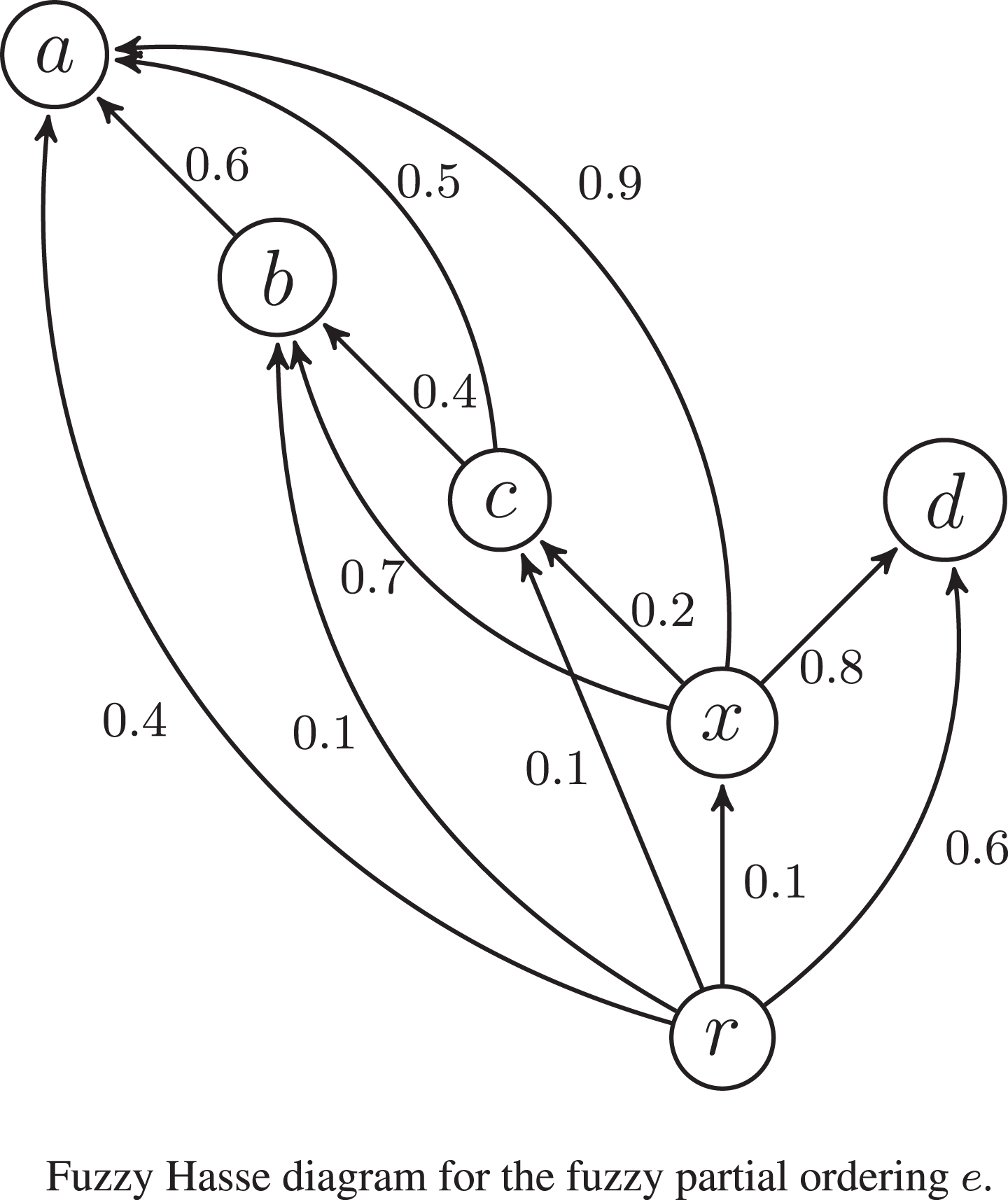
Example 3.3. Let X = {a, b, c, x, r} and the Hasse diagram for the fuzzy partial ordering e : X × X ⟶ [0, 1] is shown as follows:
Let A = {a, b, c}, one can calculate that
This shows that x is an M-hazy infimum of A. Similarly, we have , for all B ⊆ X. This means that e satisfies (MIn0).
Note that the nature of the condition (MIn0) is a kind of restriction to the M-fuzzy partial ordering e on X. The condition (MSu0) is similar to the condition (MIn0).
The following example shows that the condition (MIn0) in e is not always hold in general.
Example 3.4. Let X = {a, b, c, x, r} and the Hasse diagram for the fuzzy partial ordering e : X × X ⟶ [0, 1] is shown as follows:
Let A = {c, d}, one can calculate that
This means that e does not satisfy the conditions (MIn0).
Proposition 3.5.Let (X, e) be an M-fuzzy poset satisfying(MIn0). Then we have
Proof. According to Definition 3.1, we have
In a similar way, we obtain
This implies
This yields x = y since e is an M-fuzzy partial ordering on X.
The dual proposition is showed as follows:
Proposition 3.6.Let (X, e) be an M-fuzzy poset satisfying(MSu0). Then we have
The proof is omitted.
We write a1⊼e ⋯ ⊼ean = ⊼e {a1, …, an} and a1 ⊻ e ⋯ ⊻ ean = ⊻ e {a1, …, an}, respectively. When no ambiguity is possible, ⊼e is abbreviated as ⊼. This two definitions lead to the following fact of importance.
Proposition 3.7.Let (X, e) be an M-fuzzy poset satisfying(MIn0)and(MSu0). Then the following statements hold, for eacha, b, x ∈ X.
(a⊼b) (a) = (a ⊻ b) (b) = e (a, b).
a⊼a = a⊤anda ⊻ a = a⊤.
a⊼b = b⊼aanda ⊻ b = b ⊻ a.
(a⊼b) (x) ≤ (a ⊻ x) (a) and (a ⊻ b) (x) ≤ (a⊼x) (a).
Proof. (1) For each a, b ∈ X, by Definition 3.1,
Similarly, we have (a ⊻ b) (b) = e (a, b).
(2) For all a, b ∈ X, we have
Similarly, we have (a⊻ a) (a) = ⊤.
(3) The proof is simple and is omitted.
(4) For all a, b ∈ X, by (1) and (3), we have (a ⊻ x) (a) = e (x, a). Meanwhile,
Similarly, we have (a ⊻ b) (x) ≤ (a⊼x) (a).
Proposition 3.8.Let (X, e) be an M-fuzzy poset satisfying(MIn0). Then the following statements hold, for alla, b, c, x, y ∈ X.
e (a, b) ≤ ((a⊼c) (x) ∧ (b⊼c) (y)) → e (x, y);
((a⊼c) (x) → e (x, b)) ≤ ((a⊼c) (x) ∧ (b⊼c) (y)) → e (x, y);
((a⊼c) (x) → e (x, b)) ∧ e (b, a) ≤ ((a⊼c) (x) → (b⊼c) (x));
If ((a⊼c) (x)→ e (x, b)) ∧ e (b, a) ≠ ⊥, (a⊼c) (x)≠ ⊥ and (b⊼c) (y)≠ ⊥, thenx = y.
Proof. (1) Without loss of generality, we can assume that (a⊼c) (x)∧ (b⊼c) (y) ≠ ⊥. Then we have
(2) Without loss of generality, we can assume that (a⊼c) (x)∧ (b⊼c) (y) ≠ ⊥. Then we have
(3) It suffices to show that ((a⊼c) (x) → e (x, b)) ∧ e (b, a) ∧ (a⊼c) (x) ≤ (b⊼c) (x), that is, (a⊼c) (x) ∧ e (x, b) ∧ e (b, a) ≤ (b⊼c) (x). By (MS3), we have
This shows that (a⊼c) (x) ∧ e (b, a) ∧ e (x, b) ≤ (b⊼c) (x). (4) Let λ = ((a⊼c) (x) → e (x, b)) ∧ e (b, a). Then by (1) and (2), we have
If x ≠ y, then λ≤ ((a⊼c) (x) ∧ (b⊼c) (y)) → ⊥. This implies λ∧ ((a⊼c) (x) ∧ (b⊼c) (y)) = ⊥, a contradiction.□
Now we generalize the notion of semilattices to M-fuzzy setting.
Definition 3.9. An M-hazy semilattice operator on X is a mapping ∗ : X × X ⟶ MX satisfying the following properties, for all a, b, c ∈ X.
⋁x∈X (a∗ b) (x) ≠ ⊥ and (a ∗ b) (x) ∧ (a ∗ b) (y) ≠ ⊥ ⇒ x = y;
(a ∗ a) = a⊤;
a ∗ b = b ∗ a;
(a ∗ b) (x) ∧ (b ∗ c) (y) ≤ ⋀ z∈X ((x ∗ c) (z) ↔ (a ∗ y) (z)).
For an M-hazy semilattice operator ∗ on X, the pair (X, ∗) is called an M-hazy semilattice.
A mapping is called a hazy operator if it satisfies (MS0).
Proposition 3.10.If a mapping ∗ : X × X ⟶ MX satisfies (MS2), then the following statements are equivalent for all a, b, c ∈ X.
(a ∗ b) (x) ∧ (b ∗ c) (y) ≤ ⋀ z∈X ((x ∗ c) (z) ↔ (a ∗ y) (z)).
(a ∗ b) (x) ∧ (b ∗ c) (y) ≤ ⋀ z∈X ((x ∗ c) (z) → (a ∗ y) (z)).
(a ∗ b) (x) ∧ (b ∗ c) (y) ∧ (x ∗ c) (z) = (a ∗ b) (x) ∧ (b ∗ c) (y) ∧ (a ∗ y) (z).
Proof. (MS3) ⇒ (MS3a) is obvious.
(MS3a) ⇒ (MS3b) For all x ∈ X, by (MS3a), we have (a ∗ b) (x) ∧ (b ∗ c) (y) ∧ (x ∗ c) (z) ≤ (a ∗ y) (z), this implies (c ∗ b) (y) ∧ (b ∗ a) (x) ∧ (y ∗ a) (z) ≤ (c ∗ x) (z) when we replace a and c with each other, and by (MS2) we can obtain the result.
(MS3b) ⇒ (MS3) is obvious and it is omitted.□
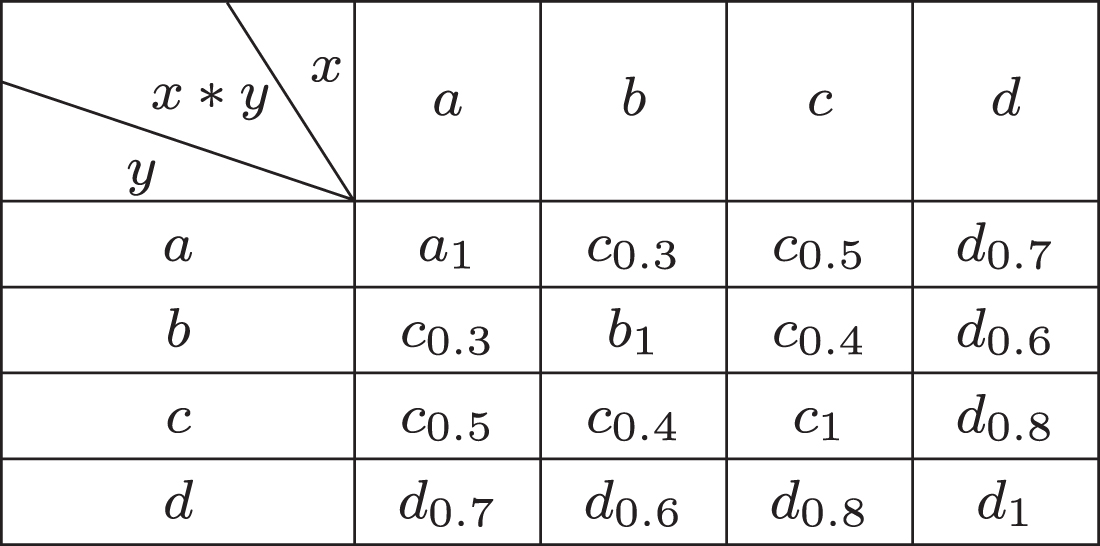
Example 3.11. Let X = {a, b, c, d} be a set with a mapping ∗ : X × X ⟶ [0, 1] X as follows:
Values of the [0, 1]-hazy operator ∗
One can verify that (X, ∗) is an M-hazy semilattice.
Definition 3.12. Let (X, ∗ X) and (Y, ∗ Y) be two M-hazy semilattices. Then the mapping f : (X, ∗ X) ⟶ (Y, ∗ Y) is called M-hazy semilattice homomorphism (M-SH, in short) provided that
Proposition 3.13.(1) Let (X, ∗) be an M-hazy semilattice. Then the identity mapping idX : (X, ∗) ⟶ (X, ∗) is M-SH too. (2) Let (X, ∗ X), (Y, ∗ Y) and (Z, ∗ Z) be M-hazy semilattice. If f : (X, ∗ X) ⟶ (Y, ∗ Y) and g : (Y, ∗ Y) ⟶ (Z, ∗ Z) are M-SH, then g ∘ f : (X, ∗ X) ⟶ (Z, ∗ Z) is also M-SH.
Proof. (1) The proof is simple and is omitted.
(2) According to Definition 3.12, we have
This means that g ∘ f is M-SH.
Theorem 3.14.In an M-hazy semilattice (X, ∗), define e∗ (a, b) = (a ∗ b) (a). Then (X, e∗) is an M-fuzzy poset which is called the M-fuzzy poset induced by M-hazy semilattice (X, ∗), and a ∗ b ≤ a⊼e∗b. Conversely, given an M-fuzzy poset (X, e) with the property of (MIn0). Then (X, ⊼e) is an M-hazy semilattice and e⊼e = e.
Proof. Let (X, ∗) be an M-hazy semilattice and define e∗ (a, b) = (a ∗ b) (a). First we check that e∗ is an M-fuzzy partial ordering on X.
(ME1)e∗ (a, a) = (a∗ a) (a) = ⊤.
(ME2) If e∗ (a, b)∧ e∗ (b, a) ≠ ⊥, then (a∗ b) (a) ∧ (b ∗ a) (b) = (a ∗ b) (a) ∧ (a ∗ b) (b) ≠ ⊥. Thus x = y.
(ME3) According to (MS3), we have
This shows e∗ (a, b) ∧ e∗ (b, c) ≤ e∗ (a, c).
Now we prove that a ∗ b ≤ a⊼e∗b.[-0.1pt] Since (a ∗ a) (y) ∧ (a ∗ b) (x) ≤ ⋀ z∈X ((y ∗ b) (z) ↔ (a ∗ x) (z)), we have
This means (a ∗ b) (x) ≤ e∗ (x, a). Similarly, we obtain (a ∗ b) (x) ≤ e∗ (x, b). Furthermore, for any r ∈ X, we have (r ∗ a) (y) ∧ (a ∗ b) (x) ≤ ⋀ z∈X ((y ∗ b) (z) ↔ (r ∗ x) (z)). It follows that
This shows e∗ (r, a) ∧ (a ∗ b) (x) ≤ e∗ (r, b) ↔ e∗ (r, x). Then (a ∗ b) (x) ≤ (e∗ (r, a) ∧ e∗ (r, b)) → e∗ (r, x) for all r ∈ X. Hence (a ∗ b) (x) ≤ e∗ (x, a) ∧ e∗ (x, b) ∧ ⋀ r∈X ((e∗ (r, a) ∧ e∗ (r, b)) → e∗ (r, x)) = (a⊼e∗b) (x).
Conversely, let (X, e) be an M-fuzzy poset with the property of (MIn0). It is easy to check that ⊼e satisfies (MS0)-(MS2). As to (MS3), by Proposition 3.10, it suffices to show that (a⊼eb) (x) ∧ (b⊼ec) (y) ∧ (x⊼ec) (z) ≤ (a⊼ey) (z), for all x ∈ X. Let λ = (a⊼eb) (x) ∧ (b⊼ec) (y) ∧ (x⊼ec) (z), without loss of generality, we assume λ ≠ ⊥. Now we prove that: (1) λ ≤ e (z, a) ∧ e (z, y), (2) λ ≤ (e (r, a) ∧ e (r, y)) → e (r, z) for all r ∈ X. As to (1), λ ≤ (x⊼ec) (z) ∧ (a⊼eb) (x) ≤ e (z, x) ∧ e (x, a) ≤ e (z, a). Meanwhile,
As to (2),
That is e (r, x) ∧ e (r, y) ∧ λ ≤ e (r, z). If there exists s ∈ X, such that
then there exists t ∈ P (M) such that e (s, x) ∧ e (s, y) ∧ λ ≤ e (s, z) ≤ t, but e (s, a) ∧ e (s, y) ∧ λnleqt or equivalently, e (s, a) nleqt and e (s, y) ∧ λnleqt, thus e (s, x) ≤ t (if not, e (s, x) nleqt and e (s, y) ∧ λnleqt, we have e (s, x) ∧ e (s, y) ∧ λnleqt). On the other hand, since λ ≤ e (y, b) and e (s, y) ∧ e (y, b) ≤ e (s, b), we have e (s, b) ∧ e (s, y) ∧ λ ≥ e (y, b) ∧ e (s, y) ∧ λ = e (s, y) ∧ λnleqt, this gives e (s, b) ∧ e (s, y) ∧ λnleqt, and hence e (s, b) nleqt. This shows that e (s, x) ≤ t and e (s, a) ∧ e (s, b) nleqt since t ∈ P (M). Observe that λ ≤ (a⊼eb) (x) ≤ (e (s, a) ∧ e (s, b)) → e (s, x) and hence that e (s, a) ∧ e (s, b) ∧ λ ≤ e (s, x) ≤ t, and then λ ≤ t since t ∈ P (M). This gives e (s, a) ∧ e (s, y) ∧ λ ≤ λ ≤ t, a contradiction.
The following example shows that the equation a ∗ b = a⊼e∗b of Theorem 3.14 can fail to hold in general.
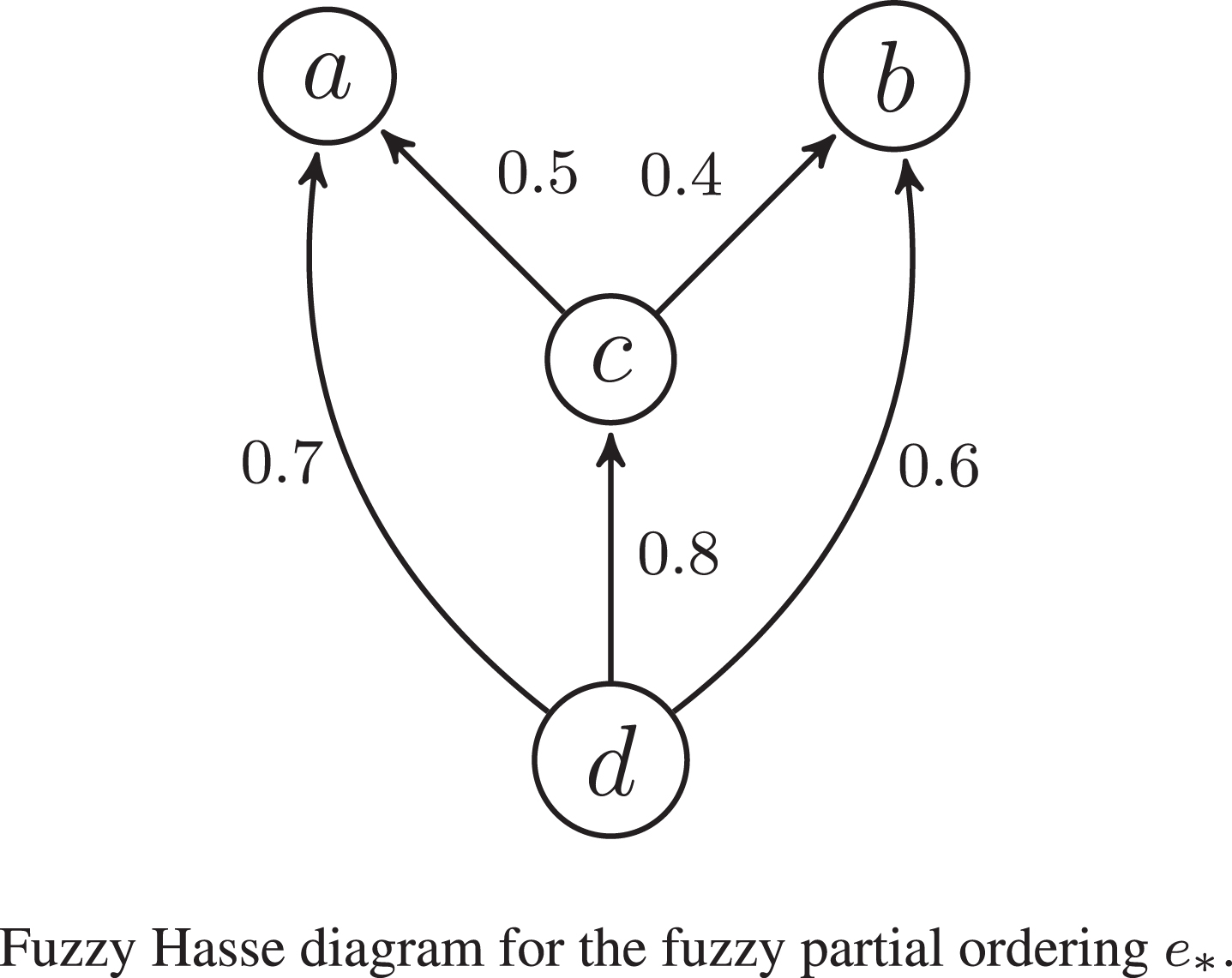
Example 3.15. Consider the M-hazy semilattice (X, ∗) in Example 3.11. Let e∗ (a, b) = (a ∗ b) (a), for all a, b ∈ X. According to Theorem 3.14, (X, e∗) is an [0, 1]-fuzzy poset. The corresponding Hasse diagram for (X, e∗) is shown as follows:
Then we can calculate that
This shows that (a ∗ b) (c) =0.3 < (a⊼e∗b) (c).
An M-hazy semilattice with the above M-fuzzy partial ordering is usually called an M-hazy meet semilattice. Sometimes it is more natural to use the dual situation, that is e∗ (a, b) = (a ∗ b) (b). In that case, (X, ∗) is referred to as an M-hazy join semilattice. In fact, we may refer to the following theorem.
Theorem 3.16.In an M-hazy semilattice (X, ∗), define e∗ (a, b) = (a ∗ b) (b). Then (X, e∗) is an M-fuzzy poset and a ∗ b ≤ a ⊻ e∗b. Conversely, given an M-fuzzy poset (X, e) with the property of (MSu0). Then (X, ⊻ e) is an M-hazy semilattice and e⊻e = e.
The proof is omitted.
Proposition 3.17.If (X, ∗ X) and (Y, ∗ Y) are two M-hazy meet (join) semilattices with e∗X (a, b) = (a ∗ Xb) (a) and e∗Y (a, b) = (a ∗ Yb) (a). If f : (X, ∗ X) ⟶ (Y, ∗ Y) is an M-SH mapping, then f : (X, e∗X) ⟶ (Y, e∗Y) is an M-OP mapping.
Proof. Let (X, ∗ X) and (Y, ∗ Y) be two M-hazy meet semilattices, then we have
This means that f is an M-OP mapping. A similar argument shows that the M-hazy join semilattice homomorphism is also an M-OP mapping.
Proposition 3.18.In an M-fuzzifying median algebra , define . Then (X, ∗ b) is an M-hazy semilattice and each M-fuzzy base-point partial ordering eb defined by is an M-fuzzy partial ordering induced by M-hazy meet semilattice, that is, eb (x, y) = (x ∗ by) (x) = e∗b (x, y).
Proof. It is easy to check that the operator ∗b satisfies (MS0)-(MS3). By Theorem 3.14, we have (X, e∗b) is an M-fuzzy poset induced by M-hazy meet semilattice (X, ∗ b) and e∗b (x, y) = (x ∗ by) (x).
In an M-fuzzifying median algebra , we know that and is an M-fuzzifying geometric interval operator by Lemma 2.11, then . This shows that by the definition of M-fuzzy base-point partial ordering. Meanwhile,
This shows that . So we obtain .
Definition 3.19. Let ⊙ : X × X ⟶ MX and ⊕ : X × X ⟶ MX be two mappings satisfying the following properties, for all a, b, c ∈ X.
⋁x∈X (a ⊙ b) (x) ≠ ⊥ and (a ⊙ b) (x) ∧ (a ⊙ b) (y) ≠ ⊥ ⇒ x = y, ⋁x∈X (a ⊕ b) (x) ≠ ⊥ and (a ⊕ b) (x) ∧ (a ⊕ b) (y) ≠ ⊥ ⇒ x = y.
(a ⊙ a) = a⊤ and (a ⊕ a) = a⊤;
a ⊙ b = b ⊙ a and a ⊕ b = b ⊕ a.
(1) (a ⊙ b) (x) ∧ (b ⊙ c) (y) ≤ ⋀ z∈X ((x ⊙ c) (z) ↔ (a ⊙ y) (z)), (2) (a ⊕ b) (x) ∧ (b ⊕ c) (y) ≤ ⋀ z∈X ((x ⊕ c) (z) ↔ (a ⊕ y) (z)).
(a ⊙ b) (x) ≤ (a ⊕ x) (a) and (a ⊕ b) (x) ≤ (a ⊙ x) (a).
Then the pair (X, ⊙ , ⊕) is called an M-hazy lattice.
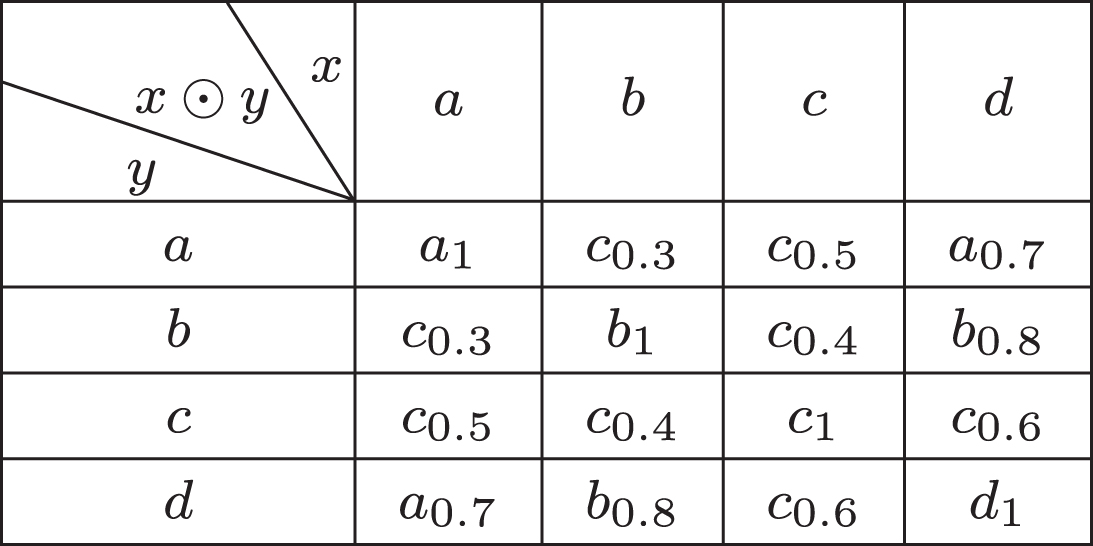
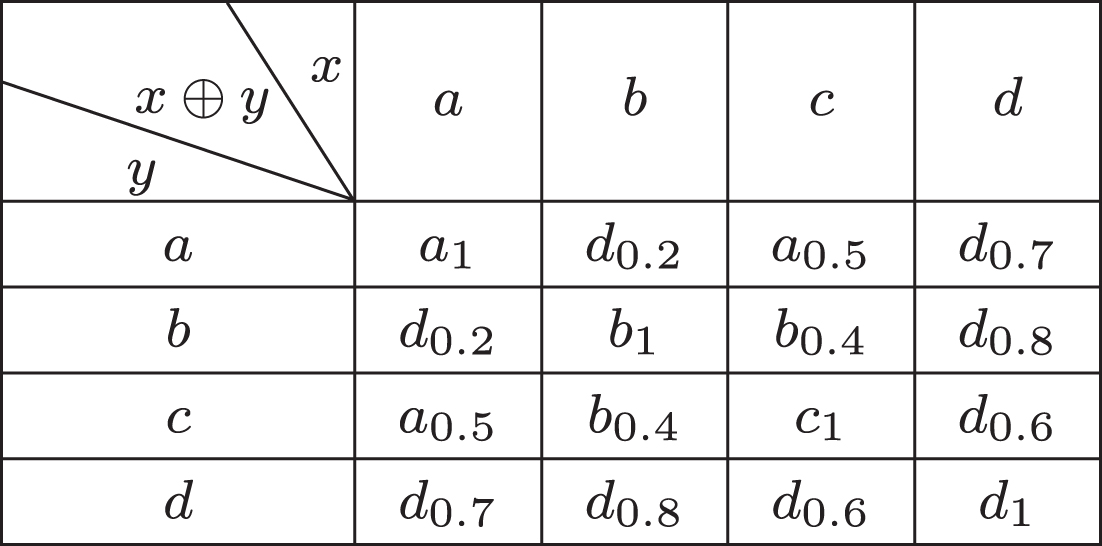
Example 3.20. Let X = {a, b, c, d} be a set with two mappings ⊙ : X × X ⟶ [0, 1] X and ⊕ : X × X ⟶ [0, 1] X as follows:
Values of the [0, 1]-hazy operator ⊙
Values of the [0, 1]-hazy operator ⊕
One can verify that (X, ⊙ , ⊕) is an M-hazy lattice.
Definition 3.21. If (X, ⊙ X, ⊕ X) and (Y, ⊙ Y, ⊕ Y) are two M-hazy lattices, then the mapping f : (X, ⊙ X, ⊕ X) ⟶ (Y, ⊙ Y, ⊕ Y) is called M-hazy lattice homomorphism (M-LH, in short) provided for all a, b ∈ X,
Theorem 3.22.In an M-hazy lattice (X, ⊙ , ⊕), define eL (a, b) = (a ⊙ b) (a). Then (X, eL) is an M-fuzzy poset with a ⊙ b ≤ a⊼eLb and a ⊕ b ≤ a ⊻ eLb. Conversely, given an M-fuzzy poset (X, e) with the properties of (MIn0) and (MSu0). Then (X, ⊼e, ⊻ e) is an M-hazy lattice and e⊼e = e⊻e = e.
Proof. Let (X, ⊙ , ⊕) be an M-hazy lattice and define eL (a, b) = (a ⊙ b) (a). According to (ML4), we obtain (a ⊙ b) (a) = (a ⊕ b) (b), combined with Theorem 3.14 and Theorem 3.16, yield the result.
Conversely, let (X, e) be an M-fuzzy poset with the properties of (MIn0) and (MSu0). Then by Proposition 3.7, Theorem 3.14 and Theorem 3.16 lead to the result.
Proposition 3.23.If (X, ⊙ X, ⊕ X) and (Y, ⊙ Y, ⊕ Y) are two M-hazy lattices and if f : (X, ⊙ X, ⊕ X) ⟶ (Y, ⊙ Y, ⊕ Y) is an M-LH, then f : (X, eX) ⟶ (Y, eY) is an M-OP mapping.
The proof is omitted.
M-fuzzifying convex spaces induced by M-hazy lattices
In this section, we will give two methods to induce M-fuzzifying convex spaces by M-hazy (semilattices) lattices. Some properties of these operations are also studied. Besides, we will study the relations between M-hazy lattices and M-fuzzifying convex spaces.
Proposition 4.1.In an M-hazy semilattice (X, ∗) with e∗ (a, b) = (a ∗ b) (a). DefinebyThenis an M-fuzzifying interval operator.
The proof is simple and is omitted.
Proposition 4.2.Let (X, e) be an M-fuzzy poset satisfying(MIn0). DefinebyIf for alla, b, d, x ∈ X, e (x, b)∧ e (b, a) ∧ e (x, d) ≠ ⊥ implies (b⊼d) (x) ≤ (a⊼d) (x) and if ⊥ is prime. Thenis an M-fuzzifying geometric interval operator.
Proof. It is easy to see that is an M-fuzzifying interval operator. (MG1) is obvious. As to (MG2), it suffices to show that . By (MS0), we may assume that (a⊼b) (r)≠ ⊥, (a⊼d) (y)≠ ⊥, (b⊼d) (x)≠ ⊥ and (b⊼c) (z)≠ ⊥. We will divide the proof into four cases, and prove the result case by case.
(1) Let λ = ((a⊼c) (r)→ e (r, b)) ∧ e (b, a) ∧ ((a⊼d) (y) → e (y, c)) ∧ e (c, a) ≠ ⊥, this yields r = c since ⊥ ≠ λ ≤ e (c, a) = (a⊼c) (c). Then we have
This means that λ ≤ e (b, a) ≤ ((b⊼d) (x) ∧ (b⊼d) (x)) → e (x, y) by Proposition 3.8. Meanwhile,
This implies that λ ≤ ((a⊼d) (y) ∧ (b⊼d) (x)) → (e (x, y) ∧ e (y, x)). If x ≠ y, then λ∧ (a⊼d) (y) ∧ (b⊼d) (x) ≤ e (x, y) ∧ e (y, x) = ⊥, a contradiction since ⊥ is prime. Thus x = y, and hence λ = e (c, b) ∧ e (b, a) ∧ ((a⊼d) (x) → e (x, c)). Observe that e (x, b)≠ ⊥ (if e (x, b) =⊥, then e (x, c)∧ e (c, b) ≤ e (x, b) = ⊥, this implies e (x, c) =⊥ since ⊥ is prime, and hence λ∧ (a⊼d) (x) ≤ e (x, c) = ⊥, a contradiction), and hence that e (x, b)∧ e (b, a) ∧ e (x, d) ≠ ⊥. Then we have λ ≤ (a⊼d) (x) → e (x, c) ≤ (b⊼d) (x) → e (x, c) by the condition. Finally, we have
(2) Let μ = ((a⊼c) (r)→ e (r, b)) ∧ e (b, a) ∧ ((a⊼d) (y) → e (y, c)) ∧ e (c, d) ≠ ⊥, by Proposition 3.8, we have r = z = y, and then
If x ≠ y, then μ≤ (b⊼d) (x) ∧ (a⊼d) (y) ∧ (b⊼c) (y) ≤ e (x, y) ∧ e (y, x) = ⊥, a contradiction. This means x = y = r. Note that e (x, b)≠ ⊥ (if e (x, b) =⊥, then μ ≤ (a⊼c) (x) → e (x, b) implies u∧ (a⊼c) (x) ≤ e (x, b) ≠ ⊥, a contradiction), hence e (x, b)∧ e (b, a) ∧ e (x, d) ≠ ⊥, then we have (b⊼d) (x) ≤ (a⊼d) (x). Thus
On the other hand, by Proposition 3.8, we have
Meanwhile, μ ≤ (a⊼c) (y) → e (y, b). Thus we have
Hence we obtain
(3) Let ν = ((a⊼c) (r)→ e (r, b)) ∧ e (b, c) ∧ ((a⊼d) (y) → e (y, c)) ∧ e (c, a) ≠ ⊥, then
Note that r = c since e (c, a) = (a⊼c) (c)≠ ⊥, and then
This implies e (c, b)≠ ⊥, and hence b = c since e (b, c)∧ e (c, b) ≠ ⊥. This gives
Finally, we have
(4) Let φ = ((a⊼c) (r)→ e (r, b)) ∧ e (b, c) ∧ ((a⊼d) (y) → e (y, c)) ∧ e (c, d) ≠ ⊥, then
Note that r = y by Proposition 3.8, then we have
Hence we have
Up to now, we have completed the proof of the proposition.
The following example illustrates that Propositions 4.2 is not true if (b⊼d) (x) ≤ (a⊼d) (x) fails to hold for some a, b, d, x ∈ X.
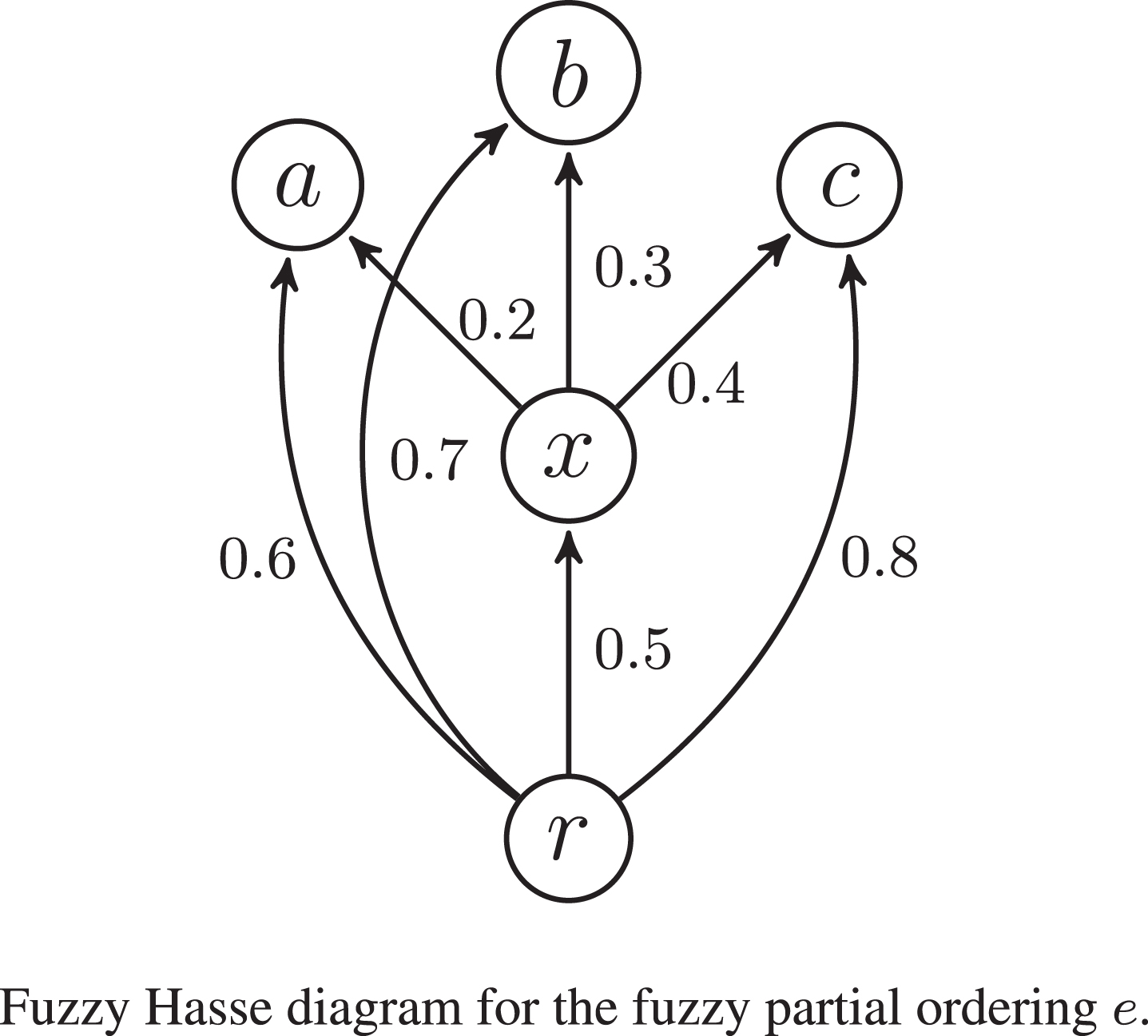
Example 4.3. Let X = {a, b, c, d, x, r} and the Hasse diagram for the fuzzy partial ordering e : X × X ⟶ [0, 1] is shown as follows:
Then we can verify that e satisfies (MIn0) and (b⊼d) (x) =0.7 > 0.1 = (a⊼d) (x). Moreover, we have
Similarly, we have , , . This shows that .
Combining Proposition 2.5 with Proposition 4.1, we obtain the following result.
Proposition 4.4.In anM-hazy semilattice (X, ∗) with e∗ (a, b) = (a ∗ b) (a). If for all A ⊆ X, we defineas follows:Thenis an M-fuzzifying convex space.
Proposition 4.5.Let (X, ∗ X) and (Y, ∗ Y) be two M-hazy semilattices withe∗X (a, b) = (a ∗ Xb) (a) and e∗Y (a, b) = (a ∗ Yb) (a). If f : (X, ∗ X) ⟶ (Y, ∗ X) is an M-SH mapping, thenis an M-IP mapping.
Proof. Note that f : (X, ∗ X) ⟶ (Y, ∗ X) is an M-SH mapping, this means that
By (MS0), we may assume that (a∗ Xb) (r) ≠ ⊥, and by Proposition 3.17, we have
Then , showing that is an M-IP mapping.
Proposition 2.6 and Proposition 4.5 lead to the following result.
Proposition 4.6.Let (X, ∗ X) and (Y, ∗ Y) be two M-hazy lattices with e∗X (a, b) = (a ∗ Xb) (a) and e∗Y (a, b) = (a ∗ Yb) (a). If f : (X, ∗ X) ⟶ (Y, ∗ Y) is an M-SH mapping, then is an M-CP mapping.
Note that only the propositions induced by M-hazy meet semilattices are presented here. Similar to the discussion above, the dual propositions can be obtained easily by M-hazy join semilattices and are omitted. In fact, the M-hazy lattices can also induce M-fuzzifying interval spaces and M-fuzzifying convex spaces.
Proposition 4.7.In anM-hazy lattice (X, ⊙ , ⊕) witheL (a, b) = (a ⊙ b) (a). DefinebyThenis an M-fuzzifying interval operator.
The proof is simple and is omitted.
Proposition 4.8.In anM-hazy lattice (X, ⊙ , ⊕) witheL (a, b) = (a ⊙ b) (a). If for allA ⊆ X, we defineas follows:Thenis an M-fuzzifying convex space.
Proposition 4.9.Let (X, ⊙ X, ⊕ X) and (Y, ⊙ Y, ⊕ Y) be two M-hazy lattices witheLX (a, b) = (a ⊙ Xb) (a) andeLY (a, b) = (a ⊙ Yb) (a). If f : (X, ⊙ X, ⊕ X) ⟶ (Y, ⊙ Y, ⊕ Y) is an M-LH mapping, thenis an M-IP mapping.
Proposition 4.10.Let (X, ⊙ X, ⊕ X) and (Y, ⊙ Y, ⊕ Y) be two M-hazy lattices with eLX (a, b) = (a ⊙ Xb) (a) and eLY (a, b) = (a ⊙ Yb) (a). If f : (X, ⊙ X, ⊕ X) ⟶ (Y, ⊙ Y, ⊕ Y) is an M-LH mapping, then is an M-CP mapping.
Now we give the other approach to induce M-fuzzifying convex spaces by M-hazy semilattices.
Proposition 4.11.Let (X, ∗) be an M-hazy semilattices and defineas follows:
Thenis an M-fuzzifying convex space.
Proof. It suffices to shows that satisfies (MC1)-(MC3). Actually,
(MC1).
(MC2) For each {Ai ∣ i ∈ Ω} ⊆2X, we have
(MC3) For each , we have
Proposition 4.12.If f : (X, ∗ X) ⟶ (Y, ∗ Y) is an M-SH mapping, then is an M-CP mapping.
Proof. Since f : (X, ∗ X) ⟶ (Y, ∗ Y) is an M-SH mapping, this means that
Then for all B ∈ 2Y, we have
This implies that is an M-CP mapping.
Proposition 4.13.Let (X, ∗) be an M-hazy meet semilattices withe∗ (a, b) = (a ∗ b) (a), then we haveis coarser than, that is
Proof. For all A ∈ 2X and a, b ∈ A. Now we prove that . Let (a∗ b) (x) ≠ ⊥,
Hence we have .
The following example shows that the “≤” in Proposition 4.13 is proper.
Example 4.14. Consider the M-hazy semilattice (X, ∗) in Example 3.11. Let e∗ (a, b) = (a ∗ b) (a), for all a, b ∈ X. Then we can calculate that
This shows that .
Conclusion
This paper proposes a new approach to the fuzzification of lattices, which is called an M-hazy lattice. Their properties with M-hazy semilattices and M-hazy lattices are discussed. Finally, we discuss its relations with M-fuzzifying interval spaces and M-fuzzifying convex spaces.
As an extension of this work, one could study M-hazy complete lattices, M-hazy modular lattice and other fuzzy lattices.
Footnotes
Acknowledgments
The project is supported by the National Natural Science Foundation of China (11871097).
References
1.
AjmalN. and ThomasK.V., Fuzzy lattices, Information Sciences79(3-4) (1994), 271–291.
2.
BělohlávekR.Fuzzy Relational Systems: Foundations and Principles, Kluwer Academic Publishers, 2002.
3.
BergerM., Convexity, American Mathematical Monthly97(8) (1990), 650–678.
4.
BirkhoffG.Lattice Theory, American Mathematical So, 1948.
5.
DemirciM., A theory of vague lattices based on many-valued equivalence relations-I: General representation results, Fuzzy Sets and Systems151(3) (2005), 437–472.
6.
DemirciM., A theory of vague lattices based on many-valued equivalence relations-II: Complete lattices, Fuzzy Sets and Systems151(3) (2005), 473–489.
7.
DemirciM., Smooth groups, Fuzzy Sets and Systems117(3) (2001), 431–437.
8.
DemirciM., Vague groups, Journal of Mathematical Analysis and Applications230 (1999), 142–156.
9.
FanL., A new approach to quantitative domain theory, Electronic Notes in Theoretical Computer Science45(4) (2001), 77–87.
10.
GierzG., HofmannK.H., KeimelK., LawsonJ.D., MisloveM.W. and ScottD.S.A Compendium of Continuous Lattices, Springer-Verlag, Berlin, 29(3) (1980), 189–224
.
11.
GrätzerG., General Lattice Theory, Academic Press, 1978.
12.
HöhleU. and ŠostakA.P., Axiomatic Foundations Of Fixed-Basis Fuzzy Topology, Mathematics of Fuzzy Sets, SpringerUS, (1999), pp. 123–272.
13.
KhanM.S.A., AbdullahS., JunY.B. and RahmanK., More generalized fuzzy subsemigroups/ideals in semigroups, Honam Mathematical Journal39(4) (2017), 527–559.
14.
KhanM.S.A., AbdullahS., RahmanK. and AbbasS.Z., Characterization of regular semigroup by (∈ , ∈ ∨ (k*, qk))-fuzzy ideals, Annals of Fuzzy Mathematics and Informatics13(3) (2017), 403–419.
15.
KhanM.S.A., RahmanK., FahmiA. and ShakeelM., Generalized (∈ , ∈ ∨ qk))-fuzzy quasi-ideals in semigroups, Punjab University Journal of Mathematics50(1) (2018), 35–53.
16.
LiE.Q. and ShiF.G., Some properties ofM-fuzzifying convexities induced by M-orders, Fuzzy sets and Systems350 (2018), 41–54.
17.
LiuQ. and ShiF.G., A new approach to the fuzzification of groups, Journal of Intelligent and Fuzzy Systems (accepted).
18.
LiuQ. and ShiF.G., M-fuzzifying median algebras and its induced convexities, Journal of Intelligent and Fuzzy Systems36(2) (2019), 1927–1935.
PangB., The category of stratified L-filter spaces, Fuzzy Sets and Systems247 (2014), 108–126.
21.
PangB., Categorical properties of L-fuzzifying convergence spaces, Filomat32(11) (2018), 4021–4036.
22.
PangB. and ShiF.G., Subcategories of the category of L-convex spaces, Fuzzy Sets and Systems313 (2017), 61–74.
23.
PangB. and ShiF.G., Fuzzy counterparts of hull spaces and interval spaces in the framework of L-convex spaces, Fuzzy Sets and Systems (2018). DOI: 10.1016/j.fss.2018.05.012.
24.
PangB. and XiuZ.Y., Lattice-valued interval operators and its induced lattice-valued convex structures, IEEE Transactions on Fuzzy Systems26(3) (2018), 1525–1534.
25.
PangB. and XiuZ.Y., An axiomatic approach to bases and subbases in L-convex spaces and their applications, Fuzzy Sets and Systems (2018). DOI: 10.1016/j.fss.2018.08.002.
26.
PangB. and ZhaoY., Characterizations of L-convex spaces, Iranian Journal of Fuzzy Systems13(4) (2016), 51–61.
27.
RosaM.V., On fuzzy topology fuzzy convexity spaces and fuzzy local convexity, Fuzzy Sets and Systems62(1) (1994), 97–100.
28.
RosenfeldA., Fuzzy groups, Journal of Mathematical Analysis and Applications35(3) (1971), 512–517.
29.
ShenJ.Z., Fuzzifying groups based on complete residuated lattice-valued logic, Information Sciences75(1-2) (1993), 165–186.
30.
ShiF.G. and LiE.Q., The restricted hull operator of M-fuzzifying convex structures, Journal of Intelligent and Fuzzy Systems30(1) (2016), 409–421.
31.
ShiF.G. and XiuZ.Y., A new approach to the fuzzification of convex structures, Journal of Applied Mathematics2014(5) (2014), 1–12.
32.
TepavčevićA. and TrajkovskiG.,
L-fuzzy lattices: An introduction, Fuzzy Sets and Systems123 (2001), 209–216.
33.
van de VelM.Theory of convex structures, North-Holland, New York, 1993.
34.
WangK. and ShiF.G., Fuzzifying interval operators, fuzzifying convex structures and fuzzy pre-orders, Fuzzy Sets and Systems (accepted).
35.
WuX.Y. and BaiS.Z., On M-fuzzifying JHC convex structures and M-fuzzifying Peano interval spaces, Journal of Intelligent and Fuzzy Systems30(4) (2016), 2447–2458.
36.
WuX.Y., LiE.Q. and BaiS.Z., Geometric properties of M-fuzzifying convex structures, Journal of Intelligent and Fuzzy Systems32(6) (2017), 4273–4284.
37.
XiuZ.Y. and PangB., M-fuzzifying cotopological spaces and M-fuzzifying convex spaces as M-fuzzifying closure spaces, Journal of Intelligent and Fuzzy Systems33 (2017), 613–620.
38.
XiuZ.Y. and ShiF.G., M-fuzzifying interval spaces, Iranian Journal of Fuzzy Systems14(1) (2017), 145–162.
39.
XiuZ.Y. and PangB., Base axioms and subbase axioms in M-fuzzifying convex spaces, Iranian Journal of Fuzzy Systems15(2) (2018), 75–87.
40.
YangS.J. and ShiF.G., M-fuzzifying independence spaces, Journal of Intelligent and Fuzzy Systems34 (2018), 11–21.
41.
YaoW., An approach to fuzzy frames via fuzzy posets, Fuzzy Sets and Systems166(1) (2011), 75–89.
42.
YaoW., Quantitative domains via fuzzy sets: Part I: Continuity of fuzzy directed complete posets, Fuzzy Sets and Systems161(7) (2010), 973–987.
43.
YaoW. and LuL.X., Fuzzy Galois connections on fuzzy posets, Mathematical Logic Quarterly55(1) (2009), 105–112.
44.
YuanX.H. and RenY.H., A new kind of fuzzy group, Journal of Liaoning Normal University (Natural Science Edition)25(1) (2002), 3–6.
45.
ZadehL.A., Similarity relations and fuzzy orderings, Information Sciences3 (1971), 177–200.
46.
ZhanJ. and JunY.B., Generalized fuzzy interior ideals of semigroups, Neural Computing and Applications19 (2010), 515–519.
47.
ZhangQ.Y. and FanL., Continuity in quantitative domains, Fuzzy Sets and Systems154(1) (2005), 118–131.
48.
ZhangQ.Y. and XieW.X., Section-retraction-pairs between fuzzy domains, Fuzzy Sets and Systems158(1) (2007), 99–114.
49.
ZhongY. and ShiF.G., Formulations of L-convex hulls on some algebraic structures, Journal of Intelligent and Fuzzy Systems33 (2017), 1385–1395.





 Then we can calculate that