



Abstract
Hesitant fuzzy sets (HFSs) play a dominant role in the decision making process. Different tools are developed to attract the decision makers (DMs) in making the effective decision, the hesitant fuzzy preference relation (HFPR) is one of the important implementation of them. Preference of an alternative over another alternative is a useful way to express the opinion of decision maker. In this paper, a hesitant fuzzy ranking (HFR) technique is established, constructed the hesitant fuzzy ranking from the HFPR in the group decision making situations. Secondly, a correlation between the alternatives is developed by using Spearman ranked correlation coefficient formula, which helps the DMs to identify the better alternative. The novelty of the proposed strategy is that it evades the need to compute the cooperative preference relations and approvals are generated for the individuals in their original domains.
Keywords
Introduction
For the last few decades, fuzzy sets have become a useful means to describe the imprecision and hesitation of real-life information through precise mathematical symbols. The fuzzy set theory was first presented by Zadeh [50] in 1965, which is the extension of the classical notion of a set. It has been effectively applied in many areas, such as fuzzy decision making [2, 48], fuzzy control [9], fuzzy preferences [6], fuzzy clustering [21] and fuzzy granular computing [4, 11]. Also, we can see the applications of fuzzy sets in many fields like artificial intelligence, computer science, medicine, control engineering, decision theory, expert systems, management science, operations research, pattern recognition and robotics. Torra [33] introduced the concept of hesitant fuzzy sets (HFSs), an extension of fuzzy sets. HFSs are a new idea that stipulates connection within a set by giving some hesitant values to each of its candidate. Consequently, the HFSs can define ambiguous belongings more conveniently than other fuzzy sets, and have ultimately received increasing attention. Furthermore, the scholars some have proposed some extensions of HFSs, such as the dual hesitant fuzzy set [60], generalized hesitant fuzzy set [27], trapezoidal-valued hesitant fuzzy sets [28], multi-hesitant fuzzy sets [26] and intuitionistic-valued hesitant fuzzy set [35].
Decision making process is a useful way in which decision makers feel happy to present his/her preferences by associating each pair and then established a preference relation. It is an effective and common expression of data collection of preference values, each of which is provided by a DM to express his/her view over a pair of elements by means of a already defined scale. By using different types of scales, a number of preference relations have been suggested, for example, the fuzzy preference relation [32], the linguistic preference relation [10, 12], the intuitionistic fuzzy preference relation [42, 43], the intuitionistic multiplicative preference relation [44], the interval-valued fuzzy preference relation [39], the interval-valued intuitionistic fuzzy preference relation [45, 46], the interval-valued intuitionistic multiplicative preference relation [47] and the triangular fuzzy preference relation [40]. Kacprzyk [15] derived a solution in GDM directly from the individual fuzzy preference relations. Nevertheless, all these preference relations do not cover the hesitant fuzzy environment because it cannot give all the possible data provided by the decision makers while comparing pairwise alternatives or criteria. In order to solve this issue, being motivated by HFSs, Zhu et al. [63] presented the concept of hesitant fuzzy preference relations (HFPRs) and then explored its distinct characteristics. In HFPRs, hesitant fuzzy elements (HFEs) describes which alternative or criteria is preferred. For example, in order to provide the grade to which an alternative a1 is preferred to another alternative a2, the first DM gives 0.3, the second DM gives 0.4, and the third DM gives 0.6, then the degree to which a1 is preferred to a2 is represented by a hesitant fuzzy element {0.3, 0.4, 0.6}. This representation preserves the original data instead of [0.3, 0.6]. Since hesitant fuzzy sets reduce the information loss. Therefore, a minimum loss of data occurs during the transformation of HFPRs into HFR. Moreover, the heterogeneous preference structure [52] is a significant tool which minimizes the loss of information in GDM. It is an effective tool to represent the preference information over alternatives for a group of decision makers, particularly when obscurity is essential to keep DM’s privacy or evade influencing each other. Furthermore, Zhu and Xu [62] developed a regression method to convert hesitant fuzzy preference relations into fuzzy preference relations (FPRs). Liao et al. [16] explored the multiplicative consistency of HFPRs and its application in group decision making. Zhang and Guo [55] implemented the consistency and consensus models for GDM with uncertain 2-tuple linguistic preference relations. Zhang et al. [56] developed a technique to derive the priority weight from an incomplete HFPR on the basis of logarithmic least squares methodology. Later on, Zhang et al. [57] described the best, worst and the average additive consistency indices to measure the consistency level of an HFPR. Consequently, Zhang and Guo [58] observed the deficiency in the already existing work about the consistency definition of an intuitionistic multiplicative preference relations (IMPR) and then suggested a novel definition to overcome these flaws. Group decision making (GDM) is an issue resolute movement through which a group of DMs mutually select the best alternative among the several existing options. A group decision making procedure comprises the assessment of the options and the decision of the most acceptable one, considering every one of the elements and opposing necessities and as indicated by the preferences of the larger part of the included specialists. Group decision making has been generally contemplated because it has many uses in numerous areas. A few methodologies have been developed so far for the portrayal of specialists’ inclinations, their aggregation,and the determination of the greatest alternative. Group decision making (GDM) helps the DMs to select the best alternative from a set of possible alternatives in accordance with the preferences that are provided by a group of decision makers [6, 34]. In GDM, every decision maker (DM) compares each pair of alternatives and provides a preference value of one alternative over another and all of which make up a preference relation. Zhan et al. [18] explored the regression method and feedback mechanism to increase the consistency and consensus for hesitant multiplicative preference relation (HMPRs) and developed it for a group decision making model with HMPRs. In the continuity of the previous article, Zhan et al. [19] also focused on the consistency and consensus for probabilistic hesitant multiplicative preference relations (PHMPRs) with the help of multiplicative preference relations and apply it for GDM. Zhang et al. [53] developed a consensus among the DMs and analyzed its effect and failure mode under the linguistic framework.
Correlation is a statistical technique that uses to estimate and study the level of association between two parameters. Correlation plays a dominant role in statistics and engineering sciences. By correlation analysis, the connection of two parameters can be observed with the help of a measure of dependency of the two variables. It measures the linear relationship between two factors. Many researchers have presented the idea of correlation about fuzzy sets. For instance, Yu [49] introduced the technique to find the correlation of fuzzy numbers, Nguyen et al. [23] presented the basics of statistics with fuzzy data. Hong and Hwang [13] developed the correlation coefficient of intuitionistic fuzzy sets in probability space by using the generalization of fuzzy sets. Chiang and Lin [7] claimed that belonging levels are tangible observational values based on the belonging functions of fuzzy sets to define fuzzy correlation coefficients. Chaudhuri and Bhattacharya [8] explored the correlation of two fuzzy sets on the same universal support. Hong [14], Ni and Cheung [22] recommended specific approaches for evaluating fuzzy correlations. Chen et al. [3] developed certain correlation coefficient formulae for HFSs and used these to cluster analysis under hesitant fuzzy situations. Arteaga et al. [1] not only expressed the quality of the connection between two hesitant fuzzy sets but also exhibited whether they are positively or negatively related. Zeng et al. [17] put forward a new correlation coefficient to evaluate the relationship between two HFSs and also introduced some new notions, for example, the average of a hesitant fuzzy elements (HFEs) and the variance of HFSs. Xia and Xu [38] described the properties of distance and correlation measures for hesitant fuzzy information in detail and then applied them in decision making problems. Recently, Zhou et al. [31] developed an innovative TOPSIS method based on hesitant fuzzy correlation coefficient in which they presented, two types of analogical factors. Based on these factors then discovered four kinds of relative closeness of the alternative and then implemented it to make the decision directly. Capuano et al. [5] presented the fuzzy ranking with respect to fuzzy preference relations (FPRs) which permits DMs to emphasis on two options at a time without reducing the entire problem so decreasing irregularities. In literature, many preference models already exist through which DMs can rank the options from top to lowest (ordinal ranking). Ordinal rankings are easy to use and help diminishing errors and irregularities. In some circumstances, specialists are unable to allocate an exact position in a level to the choices that are measured identical, or they might be essential to stipulate on what level an option is superior to the next or the ideal one.
Hesitant fuzzy preference relations (HFPRs) play a dominant role to select the best alternative from the set of options under the group decision making (GDM) situations, and a lot of work as stated in the present article, has been share to the literature by several scholars. The Spearman’s rank correlation coefficient is an important tool which gives the strength between the two ranks. Also, many experts have utilized it in their various articles under different environments as stated in the Section 7. The fuzzy rankings [5] permit the DMs to pay heed on two options simultaneously without changing the entire problem so that it can reduce the irregularities. Hence, inspired by the merits of the Spearman’s rank correlation coefficient, HFPRs and fuzzy ranking, we propose the hesitant fuzzy ranking model (the extension of fuzzy ranking [5]) for hesitant fuzzy preference relations. Since the existing techniques give the ordinal ranking of the alternatives of an HFPR, that is, from best to worst. Similar to normal rankings, DMs are requested to arrange options from top to the most inferior at the same time, utilizing particular separators. It is remarkable that decision making under the hesitant fuzzy framework got more attention and merited wide acknowledgment and further research. Moreover, by considering the merits of hesitant fuzzy relations and the fuzzy ranking model has motivated us to work with GDM based on hesitant fuzzy ranking under the environment of HFPRs. We can expand or reduce the gap among the consequent positions to strengthen the ordering connections. Similar data along with fractional rank is identified. The fractional ranks are valuable when a specialist cannot assess a few alternatives. Moreover, a fruitful discussion is presented to certify the efficiency and practicality of the said approach with the help of a numerical example.
The remaining part of the paper is organized in the following way. Section 2 introduces some basic knowledge of hesitant fuzzy preference relations and their consistency. Section 3 presents the related concepts of GDM with HFPRs. Sections 4 and 5 comprise the conversion algorithms from HFPRs to HFR and vice versa. A transformation of HFPRs into HFR is demonstrated in Section 6. Section 7 illustrates the Spearman’s rank correlation coefficient formula which is applied to find the strength between the alternatives. A numerical example illustrates the effectiveness and practicality of the said approach in Section 8. Finally, Section 9 points out some conclusions.
Some fundamental concepts
In the current segment, we present some fundamentals from the previous knowledge such as definition of fuzzy preference relations (FPRs), hesitant fuzzy sets and HFPRs.
In order to understand easily, Xia and Xu [41] represent the HFS mathematically as:
For simplicity, we can write b = b B (x) a hesitant fuzzy element (HFE) and B the set of all HFEs. HFSs can be calculated with the help of HFEs by using some operational laws or aggregation techniques or decision methods.
Motivated by HFSs and FPRs, Xia and Xu [37] presented the concept of hesitant fuzzy preference relations (HFPRs) as follows:
As in most of the information given by the DMs, the cardenality of HFEs is not same that is the numbers of distinct pairwise comparison elements in an HFPR may be not identical (
Description of GDM with HFPRs
A group decision making (GDM) issue is described by a group of decision makers D = {d1, d2, d3, . . . , d
l
}, each with his own data, thoughts, knowledge, and inspiration, that presents their inclinations on a limited arrangement of options X = {x1, x2, . . . , x
n
} to accomplish a mutual solution by considering the HFPRs matrices M
l
, where l denotes the number of DMs. As foreseen in Section 1, a few different manners to show and DMs’ model of inclinations have been offered. Amid these, we present underneath the most firmly identified with our work: normal or ordinal ranking and HFPR. Normal or ordinal ranking is one of the easiest inclination models. The normal positioning of the components of X may be represented as: xσ(1) ≻ xσ(2) ≻ . . . ≻ xσ(n-1) ≻ xσ(n) where σ : {1, …, n} → {1, …, k} is a permutation function. Otherwise it may be signified with a positioning assortment E = (e1, e2, . . . , e
n
) where all the component e
i
∈ N represents the location of i
th
option among the ranking. An HFPR stipulates the level to which each alternative x
i
∈ X is at least as better as any other alternative x
j
by means of a hesitant fuzzy relation
An HFPR can be suitably denoted as a n × n matrix
Occasionally, because of space unpredictability, constrained aptitude or strain to settle on a decision, DMs characterize incomplete HFPRs. In order to find the missing HFPR values, an additive transitivity and reciprocity properties is applied. According to the additive transitivity’s definition, we can evaluate the missing element
If
A collection of symbols F = {⪢ , > , ≥ , ≈} (where ⪢ is used for far superior than, > is superior than, ≥ is a slightly superior than and ≈ for identical to) introduced to distinguished the level of preference between successive terms or alternatives. The hesitant fuzzy ranking on a set of alternatives X ={ x1, x2, . . . , x
n
} can be defined as an arrangement
From hesitant fuzzy ranking To HFPR
If a hesitant fuzzy ranking (HFR)
Realistic values for the preference level and the relative strength related to ranking symbols:
Another technique is constructed to get an HFPR from a HFR. For this a relative strength |R
s
| is introduced for each symbol f
i
∈ F and given a HFR
f r (xσ(1)) = f r (xσ(i)) = {1} ⊕ ∑j=1i-1|R s j | = {1} ⊕ {0} = {1}
r (x4) = {1}
f r (xσ(2)) = {1} ⊕ ∑j=1i-1|R s j | = {1} + |R s 1 | = {1} ⊕ {2, 3}
r (x5) = {3, 4}.
Similarly other values can be evaluated, r (x2) = {3, 4} , r (x3) = {3.5, 4.75} and r (x1) = {4.5, 6.25}. By using Equation 5.1, a matrix
which is different from the Example 5.1, in which there is no need to complete the HFPR with the method given in Section 3. Furthermore we can see that the matrix
At times, it tends to be valuable to decipher the preferences represented with HFPR
Two methodologies can be then constructed to distinguish the symbols f1, f2, . . . , fn-1. According to first approach, for any two consecutive alternatives σ (x
i
) and σ (xi+1) in
Ψ
nf
(x1) = {-2.76} , Ψ
nf
(x2) = {-0.03} , Ψ
nf
(x3) = {-0.83} , Ψ
nf
(x4) = {3.56} and Ψ
nf
(x5) = {-0.03}. Based on these values of the net flow, the possible ordinal ranking R is: x4 ≻ x2 ≻ x5 ≻ x3 ≻ x1 and the corresponding HFR can be obtained by using Equation 6.1 as:
For any two consecutive alternatives xσ(i) and xσ(i+1) for a HFR
The Spearman’s rank correlation coefficient is the non-parametric statistical tool which use to contemplate the quality of relationship between the two positioned factors. This strategy is connected to the ordinal arrangement of numbers, which can be organized all together, i.e. in a steady progression with the goal that positions can be given to each. The Spearman’s rank relationship coefficient strategy is connected just when the underlying information is as positions, and number of observations are genuinely little, i.e. not more than 25 or 30.
Among the correlation coefficients proposed by Charles Spearman [29, 30] Spearman1,Spearman2 is a generally utilized nonparametric relationship measure that Maurice Kendall properly connected with Spearman’s name a fourth of a century later [20], and that is one of the most established insights in view of positions. The Spearman rank coefficient computed for a sample of data is typically designated as ρ. If the data has two or more identical fuzzy ranking values, the data is called an identical or similar data. The Spearman rank coefficient can be computed for such identical data as,
Consider an organization wants to appoint a manager for a particular job. The competent authority gave this task to the five decision makers to select an outstanding candidate out of five.
Let D = {d1, d2, d3, d4, d5} be the five DMs and X = {x1, x2, x3, x4, x5} be the set of candidates which are considered as the alternatives. The five DMs provide their HFPRs matrices, M1, M2, M3, M4 and M5, respectively according to their expertise.
From the received HFPRs matrices, based on Equation 3.3, obtain the ordinal ranking R1, R2, …, R5 as discussed in Section 6 and presented in Fig. 1. Then, formulate the hesitant fuzzy ranking (HFR),

Interpretation of ordinal ranking of
To find the HFR, first of all find the ordinal ranking among the alternatives x i , where i = 1, 2, …, 5 by using Equation 3.3 such that:
Ψ
nf
(x1) = {-2.4, - 1.8} = {-2.1} , Ψ
nf
(x2) = {-0.6, 0} = {0 - 0.3} , Ψ
nf
(x3) = {-1.2, - 0} = {-0.6} , Ψ
nf
(x4) = {1.8, 3} = {2.4} and Ψ
nf
(x5) = {-0.2, - 0.6} = {-0.4}. Then, the ordinal ranking R1 is x4 ≻ x2 ≻ x5 ≻ x3 ≻ x1. From the ordinal ranking, the HFR among the alternatives can be evaluated by using Definition 2.6 and Equation 6.1 as:
f r (xσ(1)) = r (x4) = {1} ⊕ ∑j=1i-1|R s j | = {1} ⊕ {0} = {1},
f r (xσ(2)) = r (x5) = {1} ⊕ |R s 1 | = {1} ⊕ {2, 3} = {3, 4},
f r (xσ(3)) = r (x2) = {1} ⊕ |R s 1 | ⊕ |R s 2 | = {1} ⊕ {2, 3} = {3, 4},
f r (xσ(4)) = r (x3) = {1} ⊕ |R s 1 | ⊕ |R s 2 | ⊕ |R s 3 | = {1} ⊕ {2, 3} ⊕ {0.5, 0.75} = {3.5, 4.75} and
f r (xσ(5)) = r (x1) = {1} ⊕ |R s 1 | ⊕ |R s 2 | ⊕ |R s 3 | ⊕ |R s 4 | = {1} ⊕ {2, 3} ⊕ {0.5, 0.75} ⊕ {1, 1.5} = {4.5, 6.25}.
Similarly remaining ordinal ranking, HFR and their fractional ranks can be found and written in the Table 2.
HFRs (R i , i = {1, 2, . . . , 5}) and the fractional ranks of each alternative:
As the Spearman’s rank correlation coefficient is utilized to measure the deviation among the opinions of different decision makers. Therefore, based on Equation 7.1, we can find out the Spearman’s rank correlation coefficient ρ such that:
From the Fig. 2, by comparing the five HFR, we can see that the hesitant fuzzy rankings,
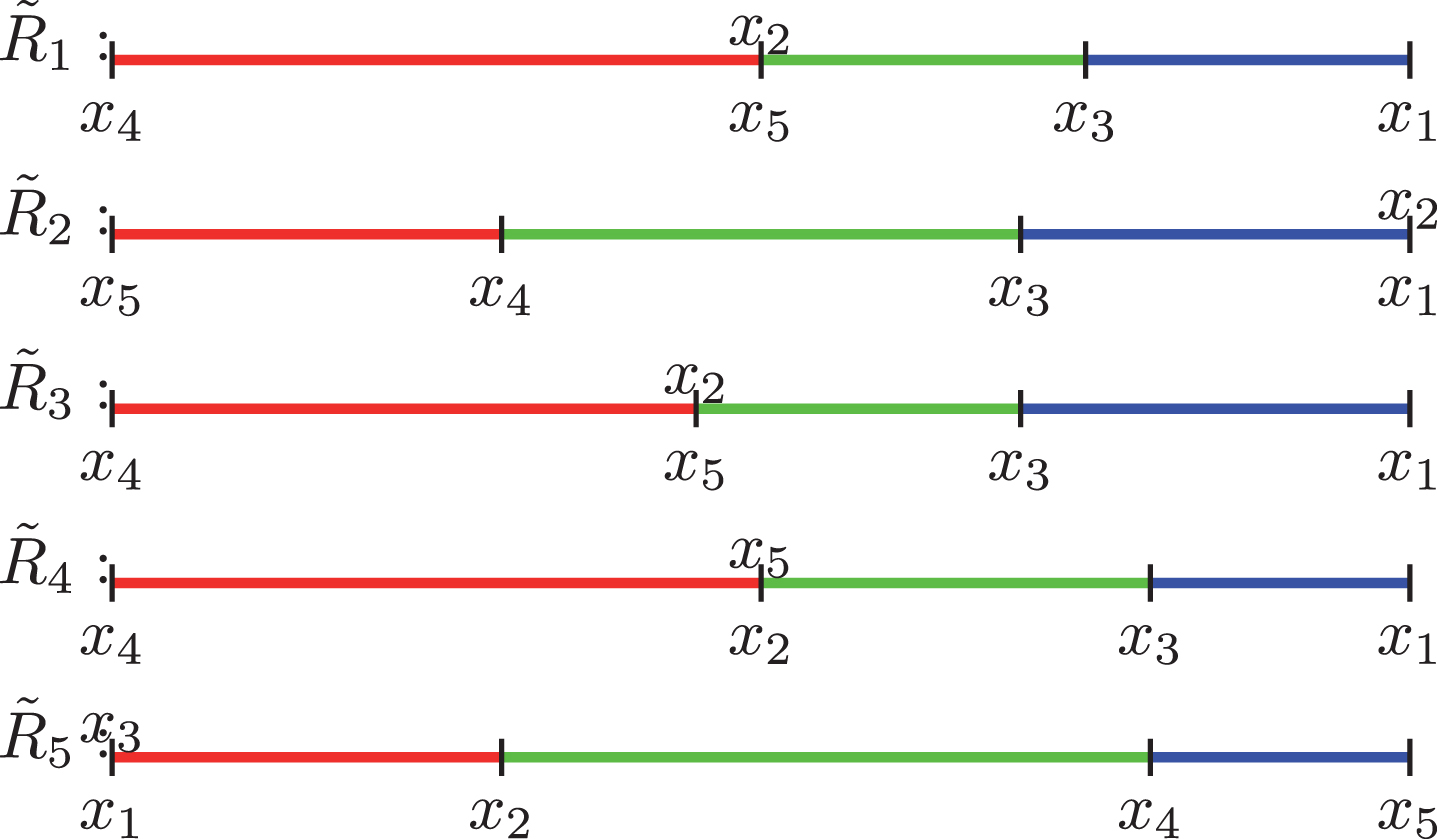
Interpretation of HFR
The present work exhibits a novel preference model for group decision making named as hesitant fuzzy ranking, which consolidates the ease of use of the ordinal ranking model. Then, the correlation between the alternatives is developed by using Spearman’s rank correlation coefficient, which helps the DMs to identify the strength among the hesitant fuzzy rankings. Similar to HFPRs, HFR permit DMs to concentrate on the two options simultaneously. Actually, some important symbols have been inserted among the alternatives. Hesitant fuzzy rankings are common speculation of ordinal rankings and might be utilized in situations when a DM is not sure about exact position of the given object. Additionally, the introduced approach can be utilized in GDM, as rankings given by some specialists can be effortlessly changed over into hesitant fuzzy ranking which is to be further assessed. The principal distinction with deference our model exist in the manner in which the ranking idea is fuzzyfied. Rather than permitting a similar object belongs to numerous situations, in real, our model permits to expand or reduce the gap between consequent positions to strengthen or diminish the ordering connection. Recently, consensus reaching processes [51, 59] and consensus measures [57, 54] have achieved much attention to develop a consensus between the DMs under the framework of fuzzy extensions. There are many prospects to work on HFR, using these concepts in the future.