On the initial value problem for random fuzzy differential equations with Riemann-Liouville fractional derivative: Existence theory and analytical solution
Available accessResearch articleFirst published online June 11, 2019
On the initial value problem for random fuzzy differential equations with Riemann-Liouville fractional derivative: Existence theory and analytical solution
In this paper, the existence and uniqueness results of an initial value problem for random fuzzy differential equations with Riemann-Liouville fractional derivative (RFFDEs) are introduced. A method to find analytical solution of RFFDEs is also proposed. Finally, some initial value problems of linear random fractional fuzzy differential equation and the fish proportional harvesting model in fuzzy environment are given to show the efficiency of the method.
In the current years, applications of the fuzzy differential equations in modeling dynamical systems with imprecise, incomplete, vague and imperfect properties are considered, and later these problems have been extended to the differential equations which combine two different kinds of uncertainties, i.e. fuzziness and randomness in order to describe the uncertain dynamical systems subjected to random forces (by Malinowski [37–45], and the related papers [48, 56]). The first concept of a fuzzy randomvariable was proposed by Kwakernaak [23] and used by Kruse, Meyer [22], and later the concept of differentiability by the Hukuhara difference for fuzzy set random variables (by Puri, Ralescu [52]), the concepts of measurability of fuzzy mappings (see [21, 52]), and the relations of different concepts of measurability for fuzzy random variables (by Colubi et al. [12], Terán Agraz [3], Puri and Ralescu [50]) were also introduced and discussed. By using the definition of fuzzy random variables which was introduced by Puri and Ralescu [51], Malinowski [37] studied the existence and uniqueness results of initial value problems of random fuzzy differential equations (RFDEs) with the fuzzy derivative by Hukuhara difference, and in [38, 39] author proposed twodifferent kinds of solutions to RFDE with respect to the geometrical properties, and under Lipschitz type conditions the existence and uniqueness results of solution for RFDE using the method of successive approximations were proved. Random fuzzy differential equations were also extended to stochastic fuzzy differential equations and random fuzzy differential equations with delay (see [41–45] and [48, 56]).
In recent studies, fractional calculus and fractional differential equation models have been applied in various areas of engineering, mathematics, physics and bioengineering, and other applied sciences. For some fundamental results in the theory of fractional differential equations involving Riemann-Liouville fractional derivative and Caputo derivative, we refer the reader to monographs of Podlubny [49] and Kilbas et al. [20] and the papers [11, 25] and the references therein. Recently, because of applications of fractional differential equations in real-world systems, and because of the existence of uncertainties and disturbances in dynamic systems subject, fuzzy fractional differential equations have emerged as the significant topic, and the topic of the fractional calculus and fractional dynamic systems in a fuzzy setting can be applied as an important mathematical tool for modeling of practical systems with the effects of uncertainties. For some fundametal results in the theory of fuzzy fractional differential equations involving fuzzy-type Riemann-Liouville fractional derivative and fuzzy-type Caputo fractional derivative, the existence and uniqueness results of solution to fuzzy fractional differential equations and the method to find analytical, numerical solutions for initial value problems of fuzzy fractional differential equations, we refer the reader to the recent papers [1, 54] and the references therein. Fractional fuzzy differential equations were also extended to random fuzzy integral and differential equations for investigating the existence and uniqueness results of solution to the given problems (see [33, 58]).
In this paper, by using the definition of fuzzy random variables which was introduced by Puri and Ralescu [51] we investigate the an initial value problem for random fuzzy differential equations with Riemann-Liouville fractional derivative. Our aim is to prove the existence and uniqueness of solutions of an initial value problem for random fuzzy differential equation with fractional order derivative; discuss a method to find analytical solution of an initial value problem for fractional random fuzzy differential equation; present an application in the fish proportional harvesting model with two kinds of uncertainties: fuzziness and randomness.
In Section 2, some fundamental theorems of fuzzy-valued fractional analysis are presented. In Section 3 and 4, we present the existence and uniqueness of solution to an initial value problems to fractional random fuzzy differential equations, and some initial value problems of linear fractional random fuzzy differential equation, the fish proportional harvesting models in fuzzy environment are given to show the efficiency of the method.
Fundamental theorems
We recall some preliminaries about the fuzzy numbers mentioned in [26]. Let E be the class of fuzzy numbers, i.e. normal, convex, upper semicontinuous and compactly supported fuzzy subsets of the real numbers. For r ∈ (0, 1] , denote and Then it is well-known that the r-level set of u, , is a bounded closed interval, for any r ∈ [0, 1]. For u1, u2 ∈ E, and , the sum u1 + u2 and the product λ · u1 are defined by [u1 + u2] = [u1] r + [u2] r, [λ · u1] r = λ [u1] r, ∀ r ∈ [0, 1] , where [u1] r + [u2] r means the usual addition of two intervals of and λ [u1] r means the usual product between a scalar and a real interval number. For u ∈ E, we define the diameter of the r-level set of u as Let u1, u2 ∈ E. If there exists u3 ∈ E such that u1 = u2 + u3, then u3 is called the Hukuhara difference of u1 and u2 and it is denoted by u1 ⊖ u2 . We note that u1 ⊖ u2 ≠ u1 + (-1) u2. The generalized Hukuhara difference of two fuzzy numbers u1, u2 ∈ E (gH-difference for short) is defined as follows:
It is well-known that in the r-levels we have that for all r ∈ [0, 1]
and the condition for the existence of in the case (i) is d ([u1] r) ≥ d ([u2] r) and the condition for the existence of in the case (ii) is d ([u2] r) ≥ d ([u1] r) .
Definition 2.1. The distance D0 [u1, u2] between two fuzzy numbers is defined as
where is the Hausdorff distance between [u1] r and [u2] r.
A function x : [a, b] → E is called d-increasing (d-decreasing) on [a, b] if for every r ∈ [0, 1] the function t ↦ d ([x (t)] r) is nondecreasing (nonincreasing) on [a, b]. If x is d-increasing or d-decreasing on [a, b], then we say that x is d-monotone on [a, b].
Definition 2.2. [10] Let x : (a, b) → E and t ∈ (a, b). The fuzzy function x is said generalized Hukuhara differentiable at t, if there exists an element DgHx (t) ∈ E such that
Denote by C ([a, b] , E) the set of all continuous fuzzy functions on the interval [a, b] with values in E, L ([a, b] , E) the set of all fuzzy functions x : [a, b] → E such that the functions belongs to L [a, b] (the space of all Lebesgue integrable real-valued functions on the bounded interval [a, b]), and AC ([a, b] , E) the set of all absolutely continuous fuzzy functions on [a, b] with value in E.
Definition 2.3. Let x ∈ L ([a, b] , E). The Riemann-Liouville fractional integral of order α > 0 of the fuzzy-valued function x is defined as follows:
where Γ (α) is the well-known Gamma function.
Definition 2.4. For a given fuzzy function x ∈ L ([a, b] , E) and α ∈ (0, 1). The fuzzy function x : (a, b) → E is said to be Riemann-Liouville generalized Hukuhara fractional differentiable at t ∈ (a, b) (or Riemann-Liouville gH-fractional differentiable) of order α ∈ (0, 1), if there exists an element such that
where the fuzzy function x1-α : (a, b] → E is defined by
Remark 2.1. (see [6]) Let x ∈ AC ([a, b] , E). Then:
If either x is d-increasing for all t ∈ [a, b] or x is d-increasing and x1-α is d-increasing on [a, b], then
If x1-α is d-decreasing for all t ∈ [a, b], then
In the above remark, is the Riemann-Liouville derivative of order α ∈ (0, 1) of the real function ψ ∈ L [a, b] defined by (see [17])
Definition 2.5. (see [17]) Let x ∈ L ([a, b] , E) be a fuzzy function such that , α ∈ (0, 1), exists on (a, b). Then, the Caputo generalized Hukuhara fractional derivative of the fuzzy function x is defined as follows:
Theorem 2.1.Letx : [a, b] → E be such that , α ∈ (0, 1), exists on (a, b).
If either x is d-monotone on [a, b] and x1-α is d-increasing on [a, b], then
If x1-α is d-decreasing on [a, b], then
Proof. Let us consider the constant fuzzy function y : [a, b] → E, given by y (t) : = x (a). Then , and so y1-α is d-increasing on [a, b].
If x is d-monotone and x1-α is d-increasing on [a, b], then we have
that is, (2.4).
If x1-α is d-decreasing on [a, b], then we get
that is, (2.5). □
Theorem 2.2. [27] Let be a continuous function on the interval [a, b] and satisfy where Assume that m (t) = m (t, a, z0) is the maximal solution of the initial value problem
existing on [a, b]. Then, if k (a) ≤ z0, we have k (t) ≤ m (t) , t ∈ [a, b] .
The existence and uniqueness
We recall some concepts of fuzzy random variables and fuzzy stochastic processes (see Malinowski [37]). Let be a complete probability space. A mapping x : Ω → E is said to be a fuzzy random variable, if for every r ∈ [0, 1]
A function x : [a, b] × Ω → E is called a fuzzy stochastic process, if x (t, ·) is a fuzzy random variable for any fixed t ∈ [a, b], and x (· , ω) is a fuzzy function with any fixed ω ∈ Ω. In [37], the x (· , ω) function is called a trajectory. A mapping x : [a, b] × Ω → E is called continuous, if for almost all ω ∈ Ω the trajectory x (· , ω) is a continuous function on [a, b]. Next, in this paper we use the notations and instead of and , respectively. Also the facts that and will be denoted by and , respectively.
In the sequel, we prove the existence and uniqueness theorems for a solution to an initial value problem for random fuzzy fractional differential equations. To this end, we assume that satisfies the following assumptions: (A1) f· (t, u) : Ω → E is a fuzzy random variable for (t, u) ∈ I × E and fω (· , u) : I → E is measurable for any u ∈ E, (A2) with the mapping fω (· , ·) : I × E → E belongs to L ([a, b] , E), i.e., there exists Ω0 ⊂ Ω with such that for every ω ∈ Ω0 the real function belongs to L [a, b] . (A3) with the mapping fω (· , ·) : [a, b] × E → E is a continuous fuzzy mapping at every point (t0, u0) ∈ I × E .
We consider the following initial value problem:
Using the results about the relationship between the Riemann-Liouville’s generalized Hukuhara derivative and Caputo’s generalized Hukuhara derivative as in Theorem 2, we observe that IVP (3.1) is equivalent to the IVP
where is the Caputo’s generalized Hukuhara derivative, and
where a.a. ω means almost all ω ∈ Ω . The following lemma shows the equivalence between IVP (3.1) and a random fractional fuzzy integral equation.
Lemma 3.1.Let the functionG satisfy (A1) and (A3). Then, a d-monotone fuzzy stochastic process x is a solution of initial value problem (3.1), if and only if x satisfies
and the function is d-increasing on [a, b] for a.a. ω .
Proof. The proof of this lemma is similar to the proof of Lemma 3.1 in [17]. □
Remark 3.1. Observe that:
if a continuous fuzzy stochastic process x is a unique d-monotone solution of (3.3) on [a, b], then the function is d-increasing on [a, b] for a.a. ω (see [17]). Furthermore, the function y may create two solutions of (3.3): a unique d-increasing solution of (3.3) and a unique d-decreasing solution of (3.3) on [a, b] for a.a. ω .
if a continuous fuzzy stochastic process x is a d-monotone solution of (3.1) on [a, b], then x is a solution of (3.3) on [a, b] , but the converse is not true if the function is not d-increasing on [a, b] for a.a. ω .
Let ρ > 0 be a given constant, and let S (x0, ρ) = {x ∈ E : D0 [u, x0] ≤ ρ}.
Theorem 3.1.Let G : Ω × [a, b] × S (x0, ρ) → E satisfy the conditions (A1), (A3) and assume that the following conditions hold: (i) there exists a positive constant M1 such that for every u ∈ E; (ii) the mapping is a crisp random variable for every (t, λ)∈ [a, b] × [0, 2ρ] ; with ; , , gω (t, λ) is nondecreasing in λ with for every t ∈ [a, b] and gω is such that the IVP
has only the solution λ (t, ω) ≡0 on I; (iii) with for every t ∈ [a, b] and every u, v ∈ S (x0, ρ) it holds
Then, the following successive approximations given by and for n = 1, 2, . . .∥
converge uniformly to a unique solution of problem (3.1) on some intervals for some provided that the function is d-increasing on for a.a. ω .
Proof. In this proof we shall use idea of successive approximations with conditions (i)-(iii). This idea is proposed in [14, 38]. Let M = max {M1, M2} and t* > a such that , and put Let be a set of continuous fuzzy stochastic processes x such that x (a, ω) = x0 (ω) for ω ∈ Ω and
Consider the sequence of continuous fuzzy stochastic processes given by:
+ Because and , where λ1 ≥ λ2 > 0 and u ∈ E, for any with t1 < t2, one has
Therefore, for any ɛ > 0 and any n ≥ 1, we have that
provided that It then follows that the functions are continuous with .
+ For all n ≥ 0, we observe that if and only if Suppose that for a given n ≥ 2. Then,
yields that
+ On the other hand, similar to the proof of Theorem 3.3 in [38], for every and for n ≥ 0, r ∈ [0, 1] the mappings is a measurable multifunction. Let r ∈ [0, 1] be fixed. By virtue of the definition of fuzzy integral and a theorem of Nguyen [47], for every we have
Because the integrand is a continuous multifunction in s and measurable in ω, the mapping is a measurable multifunction for each r ∈ [0, 1]. Therefore, for every , the sequence is a sequence of fuzzy random variable. Consequently, is a sequence of continuous fuzzy stochastic processes satisfying for all n ≥ 1.
Now let us define a sequence of successive approximations of (3.4) as follows:
Then, similar to Theorem 2.3 in [14] one has By using the condition (ii) and proceeding recursively, we also get
As M2, the sequence {λn} is uniformly bounded and equicontinuous with . Hence, we can conclude by the Arzela-Ascoli Theorem that uniformly on for almost every ω ∈ Ω and
Thus, and λ (t) is the solution of the initial value problem (3.4). From assumption (ii), we get λ (t, ω) ≡0. Next, by the condition (iii) and mathematical induction, we have
and so we also obtain, for and for n = 0, 1, 2, . . .,
It yields that, for m ≥ n,
Therefore, we obtain the Dini derivative of the function as follows:
Because uniformly converges to 0 with , then for almost every ω ∈ Ω and for every ɛ > 0 there exists a natural number n0 such that
From the fact that and by using Theorem 2, we have
where λɛ (t, ω) is the maximal solution to the following IVP:
Due to Proposition 2.2 in [55] one can infer that {λɛ (· , ω)} converges uniformly to the maximal solution λ (t, ω) ≡0 of (3.4) on as ɛ → 0 . Hence, by virtue of (3.8), we can find large enough such that for n, m > n0
As (E, D0) is a complete metric space and (3.9) holds, there exists Ω0 ⊂ Ω such that and for every ω ∈ Ω0 the sequence {xn (· , ω)} is uniformly convergent with For ω ∈ Ω0 let denote its limit. Let us define a mapping as
Next, we shall show that x is a solution of the random fuzzy fractional integral equation (3.3). For ɛ > 0, there is a n0 large enough such that for every n ≥ n0 we obtain
because the sequence {xn (· , ω)} is uniformly convergent to x (· , ω) . Therefore, we get
Hence, (3.3) is satisfied. For the proof of uniqueness of the solution x assume that is another solution for (3.1) on . Denote λ (t, ω) = D0 [x (t, ω) , z (t, ω)]. Then, for every we have
By Theorem 2, we get that where r is a maximal solution of the IVP Therefore, by the condition (ii), . This proves the uniqueness of the solution for (3.3) on the interval □
Corollary 3.1.LetG : Ω × [a, b] × E → E satisfy the conditions (A1), (A3) and assume that there exist positive constants L, M such that for every u, v ∈ E
Then, the following successive approximations given by and for n = 1, 2, . . .
converge uniformly to a unique solution of problem (3.1) on some intervals for some provided that the function is d-increasing on a.a. ω .
Solving fractional random fuzzy differential equations
In this section, we shall propose a technique to find the analytical solutions of fractional random fuzzy differential equation by using the solutions of random fuzzy differential equation.
Theorem 4.1.Assume that the conditions of Corollary 3 or Theorem 3 hold. Then, a solution of (3.1),xFO, is given by
where xIO (τ, ω) is a solution of IVP of random fuzzy differential equation
Proof. From Corollary 3 or Theorem 3, we infer that the solution of problem (3.1) exists and from Remark 3 shows that if a continuous fuzzy stochastic process xFO is a d-monotone solution of (3.1) then, it is also a solution of random fractional integral equation
Let s = t - [(t - a) α - τΓ (α + 1)] 1/α . Then, random fractional integral equation (4.12) can be written as
Otherwise, a d-monotone fuzzy stochastic process xIO is a solution of IVP of random fuzzy differential equation (4.14), if and only if xIO satisfies (see [38])
where τ ∈ [0, bα/Γ (α + 1)] . From (4.13) and (4.14) and as 0 ≤ (t - a) α/Γ (α + 1) ≤ (b - a) α/Γ (α + 1) , we get
The proof is completed. □
Corollary 4.1.Consider the linear random fuzzy fractional differential equation given by
Then, a solution of (4.15), xFO, is given by (if it exists)
where xIO (τ, ω) is a solution of IVP of linear random fuzzy differential equation
where if (xFO) 1-α (t, ω) is d-increasing for a.a. ω, then
and if (xFO) 1-α (t, ω) is d-decreasing for a.a. ω, then
Example 4.2. Consider the linear random fractional fuzzy differential equation given by
where λ ∈ [-1, 1] ∖ { 0 } . Case 1. If λ ∈ (0, 1] and xFO (t, ω), (xFO) 1-α (t, ω) are d-increasing for a.a. ω, then the solution of IVP (4.17) , where xIO (τ, ω) : = (x1 (τ, ω) , x2 (τ, ω) , x3 (τ, ω)) is a solution of the following random integer order differential systems
By solving (4.18), we get the solution of this integer order linear IVP as follows:
where i = 1, 2, 3 . Therefore, from we obtain solution of IVP (4.17), xFO (t, ω) = (x1 (t, ω) , x2 (t, ω) , x3 (t, ω)), as follows:
where i = 1, 2, 3. Case 2. If λ ∈ [-1, 0) and xFO (t, ω), (xFO) 1-α (t, ω) are d-decreasing for a.a. ω, then the solution of IVP (4.17) , where xIO (τ, ω) : = (x1 (τ, ω) , x2 (τ, ω) , x3 (τ, ω)) is a solution of the following random integer order differential systems
Similarly, by solving (4.19) and using , we get the solution of the random fuzzy fractional differential equation (4.17), xFO (t, ω) = (x1 (t, ω) , x2 (t, ω) , x3 (t, ω)), as follows:
where i = 1, 2, 3.
Corollary 4.2.Consider the linear random fractional fuzzy differential equation given by
Then, a solution of (4.20), xFO, is given by (if it exists)
where xIO (τ, ω) is a solution of IVP of linear random fuzzy differential equation
where if (xFO) 1-α (t, ω) is d-increasing for a.a. ω, then
and if (xFO) 1-α (t, ω) is d-decreasing for a.a. ω, then
Example 4.3. Consider the linear random fractional fuzzy differential equation given by
Case 1. If λ ∈ [-1, 0) and xFO (t, ω), (xFO) 1-α (t, ω) are d-increasing for a.a. ω, then we obtain solution of IVP (4.22), xFO (t, ω) = (x1 (t, ω) , x2 (t, ω) , x3 (t, ω)), as follows:
where i = 1, 2, 3 and λ ∈ [-1, 0). Case 2. Similarly, if λ ∈ (0, 1] and xFO (t, ω), (xFO) 1-α (t, ω) are d-decreasing for a.a. ω, then we get solution of IVP (4.22), xFO (t, ω) = (x1 (t, ω) , x2 (t, ω) , x3 (t, ω)), as follows:
where i = 1, 2, 3 and λ ∈ (0, 1].
Corollary 4.3.Consider the linear fractional fuzzy differential equation given by
Then, a solution of (4.20), xFO, is given by (if it exists)
where xIO (τ, ω) is a solution of IVP of linear random fuzzy differential equation
where if (xFO) 1-α (t, ω) is d-increasing for a.a. ω, then
and if (xFO) 1-α (t, ω) is d-decreasing for a.a. ω, then
Example 4.4. Consider the linear random fractional fuzzy differential equation given by
where λ ∈ [-1, 1] ∖ {0} .
Case 1. If λ ∈ (0, 1] and xFO (t, ω), (xFO) 1-α (t, ω) are d-increasing for a.a. ω, then we obtain solution of IVP (4.22), xFO (t, ω) = (x1 (t, ω) , x2 (t, ω) , x3 (t, ω)), as follows:
where i = 1, 2, 3. Case 2. If λ ∈ [-1, 0) and xFO (t, ω), (xFO) 1-α (t, ω) are d-decreasing for a.a. ω, then we obtain solution of the random fuzzy fractional differential equation (4.22), xFO (t, ω) = (x1 (t, ω) , x2 (t, ω) , x3 (t, ω)), as follows:
where i = 1, 2, 3.
In the sequel we consider some examples which correspond to the fuzzy version of some initial value problems and models. In particular, the problem of the fish population size over time and the propositional harvesting model in fuzzy environment are presented to show the efficiency of the approach. First of all, we recall the framework of the fish population growth model in the situation where quantity of fish is precisely described. Under simplified conditions such as a constant environment (and with no migration), it can be shown that the change in population size z through time t (the time horizon is from zero to b > 0) will depend on three factors including birth rate, death rate and harvest rate, and given by:
where βz (t) is the birth rate, (m + cz (t)) z (t) is the death rate (Here, the natural mortality coefficient m is augmented by the term cz (t) which accounts for overcrowding), h is the harvest rate and β, m, c are negative proportionality constants. The symbol z0 denotes the initial population size and z denotes the current population size. It is noticed that since in a fixed habitat the fish population size increases, the mortality often increases much faster than can be accounted for by a single constant coefficient m . Therefore, the term cz (t) is needed to model this accelerated mortality factor. However, if the partial information in the classical population models (4.26) may be known or in the parameters used in the above model may be uncertainty, then the model (4.26) can be appropriately by fuzzy theory. In the recent years, random fuzzy differential equation (RFDE), random fuzzy functional differential equation (RFFDE) and stochastic fuzzy differential equations (SFDE) are used to to model dynamic systems subject to uncertainties. Several authors have discussed the theory of RFDE, RFFDE and SFDE (see [37–39, 48]). Therefore, the corresponding to (4.26) model incorporating uncertainty could be the random fuzzy fish population growth model by using the concept of Riemann-Liouville’s generalized Hukuhara derivative.
Example 4.5. From the crisp problem (4.26), in this example we choose a form (representation) for the corresponding random fuzzy fractional initial value problem as follows:
where (β - m) is to be assumed positive, H ∈ E is the harvest rate. In this example, we establish the exact solution to (4.26-F) in the case of x1-α (t, ω) is d-increasing for a.a. ω on [0, b]. To this end, let us denote the r-level (r ∈ [0, 1]) of x0, H and x as
respectively. Obviously, are the crisp stochastic processes, where ω symbolizes a random factor. Since H, x0, x present the fish population size at time t, the initial population size at time t = 0 and the harvesting rate in fuzzy environment respectively, thus, they should satisfy and Let us also recall that if x1-α (t, ω) is d-increasing for a.a. ω on [0, b], then we have Using the result of Theorem 4, we obtain the explicit solution to (4.26-F) under the following hypotheses.
Suppose that there is no overcrowding (so c = 0). If , then we obtain solution of (4.26-F) as follows:
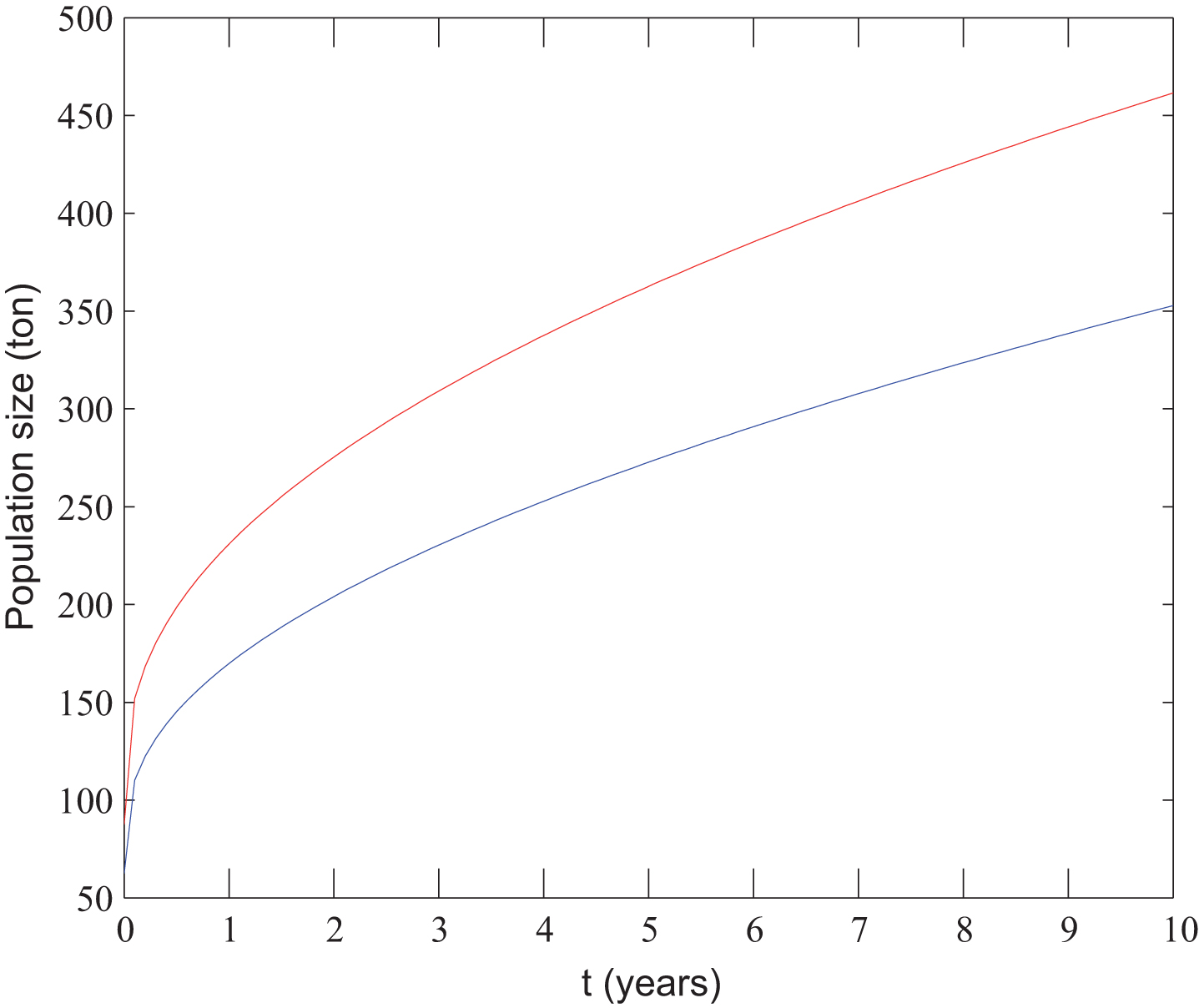
where α ∈ [0, 1) . In our numerical simulations we use the following parameters: β = 1, m = 0.2, r = 0.5, ω = 0.9 ∈ Ω = (0, 1) , α = 0.5, x0 (ω) = (10ω, 20ω, 30ω) , and the harvesting rate H = (5, 10, 15) . The solution of (4.26-F) with the above hypothetical data is shown in Fig. 1.
Suppose that there is no harvesting (so H = 0). If then we obtain d-increasing solution of (4.26-F), as follows:
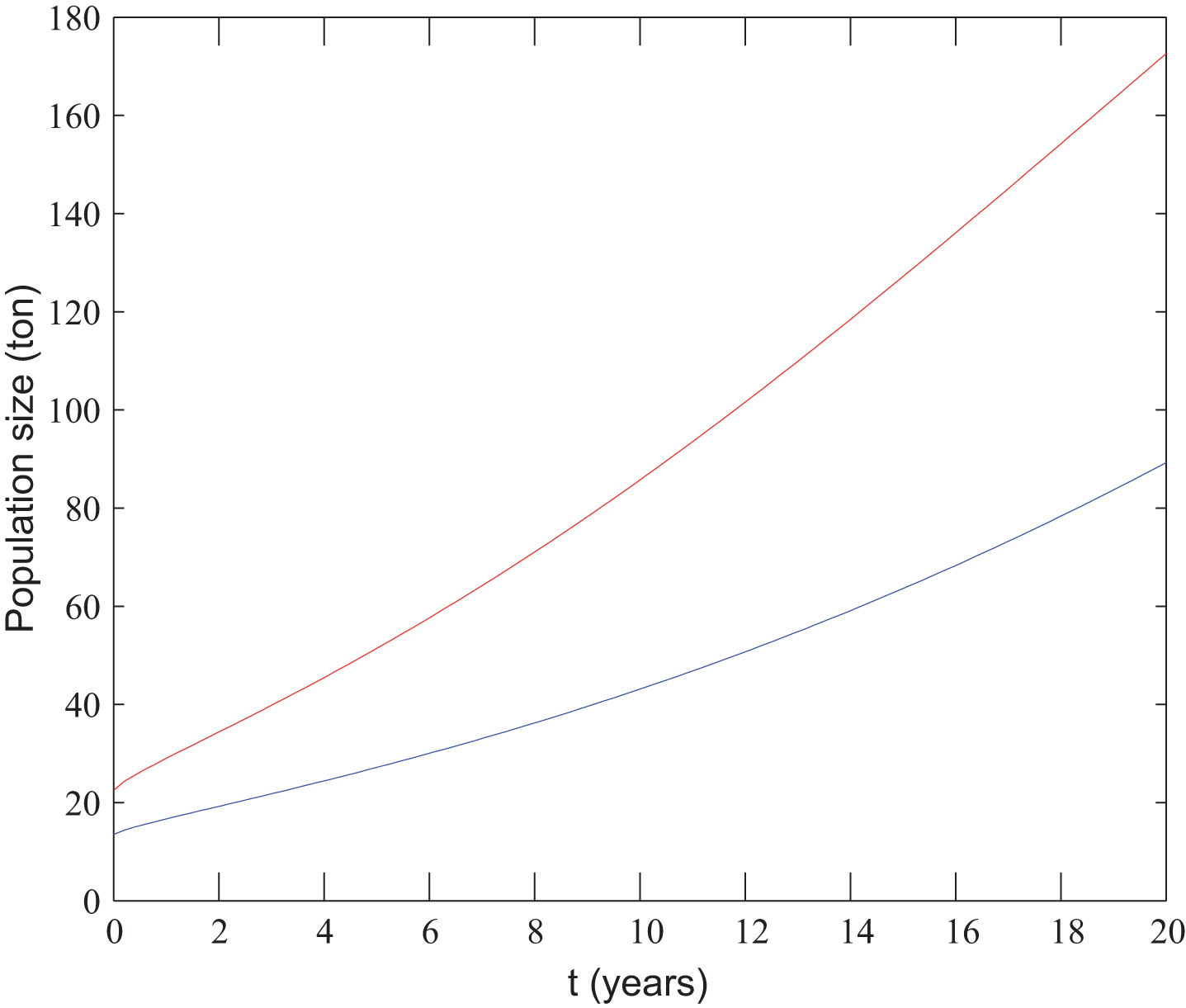
where α ∈ [0, 1) . In our numerical simulations we use the following parameters: β = 1, m = 0.4, r = 0.5, ω = 0.9 ∈ Ω = (0, 1) , α = 0.5, x0 (ω) = (10ω, 20ω, 30ω) , and the overcrowding rate c = 0.001 . The solution of (4.26-F) with the above hypothetical data is shown in Fig. 2.
Suppose that there are overcrowding and harvesting (so c ≠ 0 and ). If and (see λi below)
then we obtain d-increasing solution of (4.26-F), as follows:
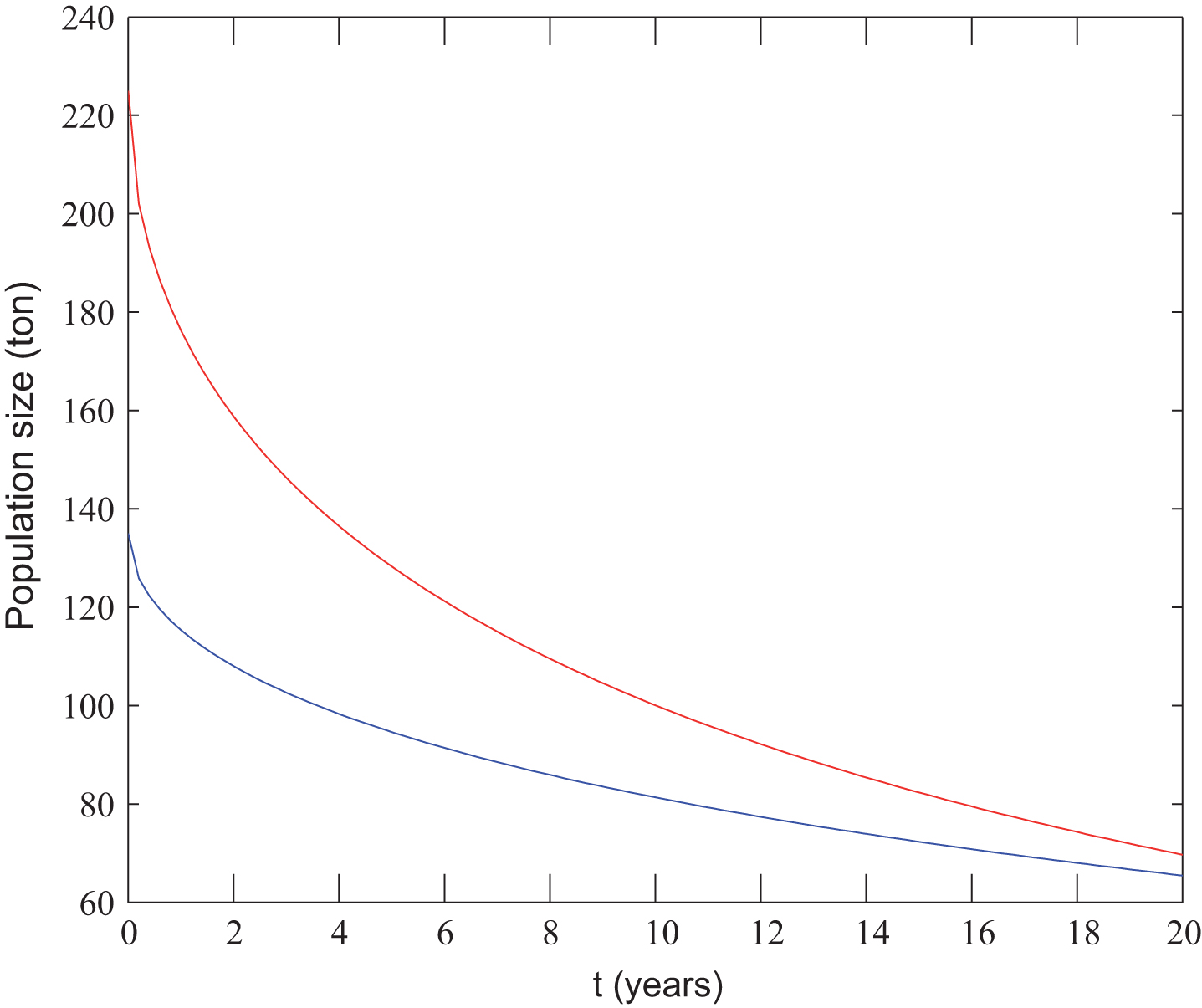
where , , and . In our numerical simulations we use the following parameters: β = 1, m = 0.01, r = 0.5, ω = 0.5 ∈ Ω = (0, 1) , α = 0.25, x0 (ω) = (100ω, 150ω, 200ω) , and the overcrowding rate c = 0.0005 . The solution of (4.26-F) with the above hypothetical data is shown in Fig. 3.
The population size of fish (ton) without overcrowding of (4.26-F) with respect to time (years)
The population size of fish (ton) without harvesting of (4.26-F) with respect to time (years)
The population size of fish (ton) with overcrowding and harvesting of (4.26-F) with respect to time (years)
Example 4.6. From the crisp problem (4.26), in this example we choose a form for the corresponding random fuzzy fractional initial value problem as follows:
where (β - m) is to be assumed negative, H ∈ E is the harvest rate. In the sequel, we solve (4.26-F-2) in the case of x1-α (t, ω) is d-decreasing for a.a. ω on [0, b]. If and (see λi above), then we obtain d-decreasing solution of (4.26-F-2), as follows:
In our numerical simulations we use the following parameters: β = 0.5, m = 1, r = 0.5, ω = 0.9 ∈ Ω = (0, 1) , α = 0.5, x0 (ω) = (15ω, 30ω, 45ω) , and the overcrowding rate c = 0.1 . The solution of (4.26-F-2) with the above hypothetical data is shown in Fig. 4.
The population size of fish (ton) with overcrowding and harvesting of (4.26-F-2) with respect to time (years)
In the above examples we also consider the fuzzy fish population growth model by assuming that fish population size, the birth rate and the death rate are all fuzzy-valued. We can see the following examples.
Example 4.7. Let be the environmental carrying capacity of the resource population and let λ ∈ E be the growth rate of fish. We consider the random fuzzy fish proportional harvesting model given
where is the harvester of population size x and f (u) ∈ E is the harvesting rate for each person of u by individuals of φ. In this example we consider some proportion H ∈ E of u for the proportional harvesting model is harvested by each individual of φ, that is, we can take f (u) = Hu. In the sequel, we solve (4.29) under assuming that is positive i.e., , and in the case of x1-α (t, ω) is d-increasing for a.a. ω on [0, b]. If and for r ∈ [0, 1], then we obtain d-increasing solution of (4.29), as follows:
In our numerical simulations we use the following parameters: r = 0.5, ω = 0.9 ∈ Ω = (0, 1) , α = 0.75, φ = 10, k = 1000, x0 (ω) = (10ω, 20ω, 30ω) , the growth rate in fuzzy environment λ = (0.3, 0.5, 0.8) and the harvesting rate H = (0.001, 0.003, 0.005). The d - increasing solution of (4.29) (or the population size of fish with respect to t) with the above hypothetical data is shown in Fig. 5.
The population size of fish (ton) of problem (4.29) with respect to time (years)
Example 4.8. Similarly, we also consider the fish proportional harvesting model in fuzzy environment given
where is negative i.e., . In this example we solve (4.30) in the case of x1-α (t, ω) is d-decreasing for a.a. ω on [0, b]. If and for r ∈ [0, 1], then we get d-decreasing solution of (4.30), asfollows:
In our numerical simulations we use the following parameters: r = 0.5, ω = 0.9 ∈ Ω = (0, 1) , α = 0.5, φ = 2, k = 1000, x0 (ω) = (100ω, 200ω, 300ω) , the growth rate in fuzzy environment λ = (-0.3, - 0.2, - 0.1) and the harvesting rate H = (0.002, 0.006, 0.010). The d - decreasing solution of (4.29) (or the population size of fish with respect to t) with the above hypothetical data is shown in Fig. 6.
The population size of fish (ton) of problem (4.30) with respect to time (years)
Conclusions
In this paper we investigate the existence and uniqueness results of solution of an initial value problems for random fuzzy differential equations with Riemann-Liouville fractional derivative. In addition, method to find solution of fractional fuzzy differential equations with Riemann-Liouville derivative and initial condition is proposed. The main usefulness of this method is being able to find the explicit solution of an initial value problem for random fuzzy differential equation with fractional order by using the solution of an integer-order fuzzy differential equation. We also use this method to find the exact solutions of the fish proportional harvesting model with two kinds of uncertainties: fuzziness and randomness. In recent years various advanced technique have been proposed to solve integer order fuzzy differential equations numerically, but for fractional fuzzy differential equations are not as strong as them. Therefore, by using the above approach we can establish the numerical methods for fuzzy fractional differential equations through the numerical methods for integer-order fuzzy differential equations. In future we plan to apply this approach to solve fuzzy fractional differential equations numerically.
Footnotes
Acknowledgments
The authors are very grateful to the referees for their valuable suggestions, which helped to improve the paper significantly. This research is funded by Vietnam National Foundation for Science and Technology Development (NAFOSTED) under grant number 101.02-2018.311.
References
1.
AgarwalR.P., LakshmikanthamV., NietoJ.J., On the concept of solution for fractional differential equations with uncertainty, Nonlinear Analysis: (TMA)72 (2010), 2859–2862.
2.
AgarwalR.P., ArshadS., OReganD., LupulescuV., Fuzzy fractional integral equations under compactness type condition,, Frac Cal and App Anal15 (2012), 572–590.
3.
AgrazP.T., On Borel measurability and large deviations for fuzzy random variables,, Fuzzy Sets and Systems157 (2006), 2558–2568.
4.
AlikhaniR., BahramiF., Global solutions for nonlinear fuzzy fractional integral and integro differential equations, Commun Nonlinear Sci Numer Simulat18 (2013), 2007–2017.
5.
AllahviranlooT., GouyandehZ., ArmandA., Fuzzy fractional differential equations under generalized fuzzy Caputo derivative, Journal of Intelligent & Fuzzy Systems26 (2014), 1481–1490.
6.
AllahviranlooT., SalahshourS., AbbasbandyS., Explicit solutions of fractional differential equations with uncertainty, Soft Comput Fus Found Meth Appl16 (2012), 297–302.
7.
AnT.V., VuH., HoaN.V., Applications of contractive-like mapping principles to interval-valued fractional integro-differential equations, Journal of Fixed Point Theory and Applications19 (2017), 2577–2599.
8.
AnA.T.V., VuH., HoaN.V., A new technique to solve the initial value problems for fractional fuzzy delay differential equations, Advances in Difference Equations2017 (2017), 181.
9.
ArshadS., LupulescuV., On the fractional differential equations with uncertainty, Nonlinear Analysis: (TMA)74 (2011), 85–93.
10.
BedeB., StefaniniL., Generalized differentiability of fuzzy-valued functions, Fuzzy Sets and Systems230 (2013), 119–141.
11.
BhaskarT.G., LakshmikanthamV., LeelaS., Fractional differential equations with a Krasnoselskii– Krein type condition, Nonlinear Analysis: Hybrid Systems3 (2009), 734–737.
12.
ColubiA., Domínguez-MencheroJ.S., López-DíazM., RalescuD.A., A DE[0, 1] representation of random upper semicontinuous functions, Proc Amer Math Soc130 (2002), 3237–3242.
13.
HoaN.V., Fuzzy fractional functional differential equations under Caputo gH differentiability, Commun Nonlinear Sci Numer Simulat22 (2015), 1134–1157.
14.
HoaN.V., VuH., DucT.M., Fuzzy fractional differential equations under Caputo- Katugampola fractional derivative approach, Fuzzy Sets and Systems (2018).
15.
HoaN.V., Fuzzy fractional functional integral and differential equations, Fuzzy Sets and Systems280 (2015), 58–90.
16.
HoaN.V., LupulescuV., O’ReganD., Solving interval-valued fractional initial value problems under Caputo gH-fractional differentiability, Fuzzy Sets and Systems309 (2017), 1–34.
17.
HoaN.V., LupulescuV., O’ReganD., A note on initial value problems for fractional fuzzy differential equations, Fuzzy Sets and Systems347 (2018), 54–69.
18.
HoaN.V., Existence results for extremal solutions of interval fractional functional integro-differential equations, Fuzzy Sets and Systems347 (2018), 29–53.
19.
KalevaO., A note on fuzzy differential equations, Nonlinear Anal64 (2006), 895–900.
20.
KilbasA.A., SrivastavaH.M., TrujilloJ.J., Theory and applications of fractional differential equations, Amesterdam: Elsevier Science B.V, 2006.
21.
KlementE.P., PuriM.L., RalescuD.A., Limit theorems for fuzzy random variables, Proc Roy Soc Lond A407 (1986), 171–182.
22.
KruseR., MeyerK.D., Statistics with Vague Data, Kluwer, Dordrecht, 1987.
23.
KwakernaakH., Fuzzy random variables. Part I: Definitions and theorems, Inform Sci15 (1978), 1–29.
24.
LakshmikanthamV., Theory of fractional functional differential equations, Nonlinear Analysis: Theory, Methods & Applications69 (2008), 3337–3343.
25.
LakshmikanthamV., LeelaS., A Krasnoselskii-Krein-type uniqueness result for fractional differential equations, Nonlinear Analysis: TMA71 (2009), 3421–3424.
26.
LakshmikanthamV., MohapatraR.N., Theory of fuzzy differential equations and applications, Taylor & Francis, London, 2003.
27.
LakshmikanthamV., VatsalaA.S., Theory of fractional differential inequalities and applications, Communications in Applied Analysis11 (2007), 395–402.
28.
LongH.V., SonN.T.K., HoaN.V., Fuzzy fractional partial differential equations in partially ordered metric spaces, Iranian Journal of Fuzzy Systems14 (2017), 107–126.
29.
LongH.V., SonN.K., TamH.T., YaoJ.C., Ulam Stability for fractional partial integrodifferential equation with uncertainty, Acta Math Vietnam42 (2017), 675–700.
30.
LongH.V., SonN.K., TamH.T., The solvability of fuzzy fractional partial differential equations under Caputo gH-differentiability, Fuzzy Sets Systems309 (2017), 35–63.
31.
LongH.V., On random fuzzy fractional partial integro-differential equations under Caputo generalized Hukuhara differentiability, Computational and Applied Mathematics37 (2018), 2738–2765.
32.
LongH.V., DongN.P., An extension of Krasnoselskiis fixed point theorem and its application to nonlocal problems for implicit fractional differential systems with uncertainty, Journal of Fixed Point Theory and Applications20 (2018), 37.
33.
LupulescuV., HoaN.V., Existence and uniqueness of solutions for random fuzzy fractional integral and differential equations, Journal of Intelligent & Fuzzy Systems29 (2015), 27–42.
34.
LupulescuV., Fractional calculus for interval-valued functions, Fuzzy Set and Systems265 (2015), 63–85.
35.
MazandaraniM., KamyadA.V., Modied fractional Euler method for solving fuzzy fractional initial value problem, Communications in Nonlinear Science and Numerical Simulation18 (2013), 12–21.
36.
MazandaraniM., NajariyanM., Type-2 fuzzy fractional derivatives, Communications in Nonlinear Science and Numerical Simulation19 (2014), 2354–2372.
37.
MalinowskiM.T., On random fuzzy differential equations, Fuzzy Sets and Systems160 (2009), 3152–3165.
38.
MalinowskiM.T., Random fuzzy differential equations under generalized Lipschitz condition, Nonlinear Analysis: RealWorld Applications13 (2012), 860–881.
39.
MalinowskiM.T., Existence theorems for solutions to random fuzzy differential equations, Nonlinear Analysis: TMA73 (2010), 1515–1532.
40.
MalinowskiM.T., Random fuzzy fractional integral equations - theoretical foundations, Fuzzy sets and Systems265 (2015), 39–62.
41.
MalinowskiM.T., Fuzzy and set-valued stochastic differential equations with local Lipschitz condition, IEEE Transactions on Fuzzy Systems23 (2015), 1891–1898.
42.
MalinowskiM.T., AgarwalR.P., On solutions to set-valued and fuzzy stochastic differential equations, Journal of the Franklin Institute352 (2015), 3014–3043.
43.
MalinowskiM.T., Some properties of strong solutions to stochastic fuzzy differential equations, Information Sciences252 (2013), 62–80.
44.
MalinowskiM.T., Itô type stochastic fuzzy differential equations with delay, Systems & Control Letters61 (2012), 692–701.
45.
MalinowskiM.T., Strong solutions to stochastic fuzzy differential equations of Itô type, Mathematical and Computer Modelling55 (2012), 918–928.
46.
MalinowskiM.T., Random fuzzy fractional integral equations-theoretical foundations, Fuzzy Sets and Systems265 (2015), 39–62.
47.
NguyenH.T., A note on the extension principle for fuzzy sets, J Math Anal Appl64 (1978), 369–380.
48.
ParkJ.Y., JeongJ.U., On random fuzzy functional differential equations, Fuzzy Sets and Systems223 (2013), 89–99.
49.
PodlubnyI., Fractional differential equation, San Diego:Academic Press, 1999.
50.
PuriM.L., RalescuD., Differential for fuzzy function, Journal of Mathematical Analysis and Applications91 (1983), 552–558.
51.
PuriM.L., RalescuD.A., The concept of normality for fuzzy random variables, Ann Probab13 (1985), 1373–1379.
52.
PuriM.L., RalescuD.A., Fuzzy random variables, J Math Anal Appl114 (1986), 409–422.
53.
SalahshourS., AllahviranlooT., AbbasbandyS., BaleanuD., Existence and uniqueness results for fractional differential equations with uncertainty, Advances in Difference Equations2012 (2012), 112.
54.
SalahshourS., AllahviranlooT., AbbasbandyS., Solving fuzzy fractional differential equations by fuzzy Laplace transforms, Communications in Nonlinear Science and Numerical Simulation17 (2012), 1372–1381.
55.
SongS., WuC., Existence and uniqueness of solutions to Cauchy problem of fuzzy differential equations, Fuzzy Sets and Systems110 (2000), 55–67.
56.
VuH., DongL.S. and HoaN.V., Random fuzzy functional integro-differential equations under generalized Hukuhara differentiability, Journal of Intelligent & Fuzzy Systems27 (2014), 1491–1506.
57.
VuH., Ho, LupulescuV. and HoaN.V., Existence of extremal solutions to interval-valued delay fractional differential equations via monotone iterative technique, Journal of Intelligent & Fuzzy Systems34 (2018), 2177–2195.
58.
VuH., HoaN.V., SonN.T.K., O’ReganeD., Results on initial value problems for random fuzzy fractional functional differential equations, Filomat32 (2018), 2601–2624.