



Abstract
Considering that the 3D pulse-coupled neural network (3D-PCNN) model has the deficiency of high parameter complexity and low accuracy in color image segmentation, swarm intelligence optimization algorithm is adopted to optimize the image segmentation process. In this paper, whale optimization algorithm (WOA) is adopted to optimize the 3D-PCNN model parameters E and β. The improved product cross entropy (IPCE) is chosen as the fitness function of optimization algorithm. WOA algorithm is used to find the minimum fitness function, and the corresponding optimal parameters are obtained. Through the study of image segmentation in the image segmentation library of University of Berkeley and the actual plant canopy image, the maximum entropy value and the Tsallis entropy value are compared and analyzed. Experimental results illustrate that the proposed algorithm can obtain more accurate image segmentation effect and higher segmentation rate.
Introduction
In the field of image processing, image segmentation is a basic work, but image segmentation is a very challenging research topic. The main methods of image segmentation include threshold-based segmentation [1], clustering based segmentation [2], regional segmentation [3] and artificial neural network [4]. With the popularization of artificial intelligence, the pulse-coupled neural network does not require learning and training. It has the characteristics of global cooling and synchronous pulse, which makes it widely use in the field of image processing. Pulse-coupled neural network (PCNN), originated from Eckhorn et al. [5] who focus on the study of the synchronous oscillation phenomenon in the visual cortex of cats, has been applied into a variety of applications in image processing [6, 7].
For years, several PCNN models with certain modifications or simplifications [8–12], namely SPCNN, are being gradually developed for ease of use. For example, leaky integrator part in the input field was often removed [13–15], allowing the behavior of neurons for feasible control. A novel fusion framework based on adaptive PCNN in nonsubsampled contourlet transform proposed by Zhiying Song [16] who tried to solve for fusing whole-body PET and CT images. An automatic parameter setting method of SPCNN was proposed by Y Chen [17], this paper proved the validity and efficiency of our proposed automatic parameter setting method of SPCNN. An algorithm of PCNN combined with linear discriminant analysis(LDA) was proposed by GN He [18], this algorithm could deal with the condition of variance Gaussian noise. In their work, linking coefficient was set by manual experience. Xiang T [19] proposed a novel fusion algorithm based on the adaptive dual-channel unit-linking PCNN for infrared and visible images fusion in nonsubsampled contourlet transform domain. However, segmentation accuracy of PCNN model was still very sensitive to values of its network parameters for segmenting a wide range of images.
In fact, linking coefficient and neural threshold are the key parameters for enabling PCNN to obtain the desired image segmentation results [20]. The linking coefficient provides a simple and effective method to change the net input for promoting the internal activity of neurons. In general, a feasible approach of setting this parameter should be built on the appropriate condition of color image segmentation. However, PCNN has a large of parameters needed to be determined in its original model. So many optimization algorithms are used to optimize PCNN optimum parameters. Tan W C presented a method of image segmentation and detection technique in human spermatozoa image using a modified PCNN [21], the network was optimized with particle swarm optimization(PSO) where a new fitness function was introduced as mutual information. Forgac R introduced an approach for linking and activation potential optimization in PCNN to reduce the number of parameters [22], with linking and activation potential optimization were better possibilities for PCNN application because four parameters were eliminated. Jin X proposed a novel image fusion method based on SPCNN, PSO and block image processing method [23], the experiments were proved that the automatically parameters setting method was effective as well. Therefore, the optimization algorithm can solve the problem of multiple parameters of PCNN model, and the segmentation results are changed to be affected by optimization algorithm and optimal fitness function.
Due to diversity in actual engineering problems that various meta-heuristics adapt to solve, the meta-heuristics are mainly divided into two types [24], namely evolutionary algorithm and swarm intelligence optimization algorithm. Evolutionary algorithms are concepts that mimic evolution in nature. The most classic and popular algorithm of this type is genetic algorithm (GA) which imitates the theory of Darwinian evolution [25]. In GA, optimization starts to provide a set of random solutions for specific problems. Through the evaluation of the objective function, the variable of solution is updated based on fitness value [26–28]. There are several other common evolutionary algorithms, such as differential evolution [29], evolutionary strategy [30], and biogeography optimization [31]. Swarm intelligence optimization algorithms derive from the collective behavior of organisms, mimicking how large populations find food. Ant colony optimization (ACO) [32] and PSO [33] are two classic methods in this kind of algorithm. The ACO imitates ants to find the shortest path of social behavior, and PSO algorithm simulates the behaviour of birds on the voyage and the hunt. Other swarm optimization algorithms include artificial bee colony algorithm (ABCA) proposed by Karaboga in 2015 [34], which can adapt to the change of environment by imitating the behavior of bees in picking nectar. Bat algorithm (BA) [35] can search the optimal solution through iteration and produce local new solution by flying near the optimal solution, which strengthens the local search ability. Flower pollination algorithm (FPA) [36] proposed by Yang X S in 2013, was inspired by the pollination process of flowers, and the simulation results show that FPA is more efficient than GA and PSO. The WOA [37] proposed by Mirjalili in 2016 was an algorithm that imitated the hunting of humpback whales. This algorithm has strong ability in global search and local optimization. There’s a difference between evolutionary optimization and group optimization, but it’s the same thing that can find the optimal value in a finite domain. Although all kinds of algorithms have their own advantages, no-free-lunch (NFL) [38] has proved that no algorithm can solve all optimization problems.
The remainder of this paper is organized as follows. Firstly, the simplified PCNN model is extended to the 3D-PCNN model, and the linking matrix is modified, so that the neuron can make better use of the information around it to complete the firing operation. Secondly, the WOA is proposed to optimize the model of 3D-PCNN, and the fitness function is proposed which is more suitable for image segmentation. Finally, Comparisons with other optimization algorithms to optimize the 3D-PCNN model, some existing PCNN-based methods and traditional segmentation methods are also given in Section 4. The experiment results verified that the image segmentation algorithm proposed in this paper has a higher accuracy in image segmentation for engineering application.
3DPCNN Model
Standard 3DPCNN
PCNN simplified model is a feedback neural network model proposed by simulating the signal processing mechanism of cat visual cortex. In the simplified model, the partial simplification of parameters makes the generality of the model well guaranteed. However, there is a great difference in the response of visual system to the different feature regions in the image. In PCNN model, this difference is mainly reflected in the setting of the parameters, and the flexible changes in parameters still affect the final fusion results. Therefore, this paper uses the most commonly mathematical iterative model. The simplified model is shown in Fig. 1.

Model of 3DPCNN neuron.
The mathematical expression of the PCNN simplified model can be expressed by
Weights W are used to connect the neighbouring neurons in the feeding and linking channels, which are responsible for transmitting some information from neighbours. In general, a three-dimensional matrix with six neighborhood is used as the linked matrix. This matrix receives less information feedback and can not reflect the connections between neurons, as shown in Fig. 2. Weight W is usually set to:

Six neighborhood linked matrix.
In order to reflect the information of color images, 26 neighborhood linked matrix is adopted to expand the information in the 3D space acceptable to neurons, which can make better use of the information in color images and improve the precision of segmentation. As shown in Fig. 3, it show the 26 neighborhood linked matrix. The intermediate neurons can transmit information to 26 neurons in 3D through ignition. The figure is divided into three channels, which correspond to the feedback output of three color components of R, G and B in the color image. The linked matrix is convolved with the color image. The fluctuation caused by ignition of each pixel can cause the fluctuation of other pixel points, and the ignition information of the pixel in each color space can be observed. Thus, information utilization in the color image can be realized and image segmentation can be realized.

26 neighborhood linked matrix.
In the segmentation of color images by 3DPCNN, the color images are viewed as the data matrix. The data matrix is convolved by the linked matrix, and binary pulse sequences Y generated through the pulse generation region. The 3D integral segmentation method processes the whole information of color image, breaks the spatial information limitation of the 2D segmentation method and reduces the computational complexity.
Whale optimization algorithm
The WOA is a newly proposed meta-heuristic that is inspired from the bubble-net hunting technique of humpback whales. The algorithm describes the special pursuing behavior of humpback whales, in which the whales attempt to encircle the prey near the surface of water while creating bubbles that are in the shape of a circle. In the bubble-net hunting technique, the humpback whales dive approximately 12 meters down and then begin to make bubbles in a spiral shape around the prey and swim toward the surface. Its prey process is shown in Fig. 5.
Humpback whales firstly observe the locations of the prey and then encircle them. The WOA presumes that the objective prey that is closest to the perfect answer is the best candidate solution. After the best hunting agent is denied, the other whales’ search operators will accordingly attempt to update their positions toward the best hunting gent. During the optimization, to mathematically model the encircling mechanism, the following equations are proposed.
To express a mathematical equation for the bubble-net attacking behavior of the humpback whales, two strategies are modeled, as follows:
a: SHRINKING ENCIRCLING SYSTEM
This technique is achieved by decreasing linearly the value of
b: LOGARITHMIC SPIRAL UPDATING POSITION
Firstly, the humpback whales search the prey and then calculate the distance from themselves to the prey. Then, the humpback whales move with a conical logarithmic spiral motion to prey on the fish herds. Each humpback whale is proposed to update its position according to the spiral fight path. This behavior is mathematically expressed as follows:
It should be noted that humpback whales swim around the prey in a circle, at the same time, move with a conical logarithmic spiral motion to prey on the fish herds. For simplicity, we assume that the positions of the humpback whales will be updated by Equation (8) or Equation (11), each with the possibility of 50%, which can be mathematically expressed as follows:
In resolution of color image segmentation, that parameters in the 3DPCNN model need to rely on the prior knowledge, determination, the exponential decay results in increased operation time and slow partition calculation, and the 3DPCNN model based on WOA is proposed in this paper, as shown in Fig. 4. The exponential decay value function in the model is reduced to the threshold function E and β as compared to the 3DPCNN model. It uses that WOA to find the optimal solution of the threshold value E and the connecting intensity constant.

WOA-3DPCNN Model.

Humpback whale feeding process.
The mathematical expression of the WOA-3DPCNN simplified model can be expressed by
Where,
In order to solve the problem of high parameter complexity, long operation time and low segmentation precision of the 3DPCNN image segmentation algorithm, WOA optimizes the searching process of model parameters. For better solutions, the selection of fitness functions is very important. In this paper, application and product cross entropy as the fitness function of WOA, by calculating the minimum cross entropy to search the parameter optimal solution. The minimum cross entropy is to represent the differences between the different probability distributions using the cross entropy represented by the following convex function, and there is always a threshold to reduce the amount of information on the front and back of the image, and the minimum cross entropy (MCE) can be used to evaluate the image segmentation result by calculating the entropy of this threshold. Cross entropy describes information differences between probability distributions P = {P1, P2, ⋯ , P N } and Q = {Q1, Q2, ⋯ , Q N }. It can be expressed by
In image segmentation, P is the original image and Q is the segmented image. To reduce the complexity of the cross entropy, The improved product cross entropy (IPCE) is used as the fitness function in this paper, it can be expressed by
Where, i is the gray value of the image, h is the square value of gray value, E is the threshold to be optimized, P1 and P0 are the probabilities of 1 and 0 in the image obtained after the optimal parameter E and β1 the input of 3DPCNN model, respectively. Equation (15) is taken as the fitness function of WOA, and the parameters E and β1 of the 3DPCNN model are optimized at the same time. When D is the minimum, the optimal solution obtained is input into the 3DPCNN model, and the segmentation result graph is output. The algorithm flow chart of the WOA-3DPCNN model proposed in this paper is shown in Table 1.
Pseudo code of the WOA-3DPCNN algorithm
In this section, experiments on plant phenotypes and Berkeley images were carried out to assess the effectiveness of the proposed method. Firstly, The results obtained by the proposed method were then compared with the results yielded by three types of segmentation methods, namely, the 3DPCNN-based on optimization algorithm methods, such as BA-3DPCNN, PSO-3DPCNN and FPA-3DPCNN. Secondly, the results obtained by the proposed method were compared with the PCNN model proposed by other scholars. Finally, the results obtained by the proposed method compared with the classic image segmentation methods. The test images are presented in Fig. 6. All the images are 481×321 size. All algorithms are developed using MATLAB Release 2016. To eliminate stochastic discrepancy, each test color image is independently run with each algorithm 30 times for comparisons. The initial population of each optimization algorithm is set to 10 and the maximum number of iterations of each optimization algorithm is set to 50. The parameters for 3DPCNN model are given as follows. In the WOA-3DPCNN model, F ijk = 0.1, α L = 0.7, V L = 1.0, V T = 2000. V T must be large enough to ensure that every neuron of the 3DPCNN is permitted to fire only once.

The convergence curve of the ME.
In order to provide the numerical assessment for segmentation performance, we use the maximum entropy and Tsallis entropy as the evaluation index:
1) The mathematical formula of Maximum entropy (ME) is as follows:
Where, The probability of 1 and 0 in the image are represented by P1 and P0. The condition of maximum information entropy is P1 = P0.
2) The mathematical formula of Tsallis entropy (TE) is as follows:
Where,
The IPCE is selected as the fitness function of the 3DPCNN model. In order to verify its performance, different fitness functions are selected to be optimized by 3DPCNN-ISOA. The fitness functions we choose are respectively 3DOtsu [39], the cross entropy (CE) [40] and Renyi entropy (RE) [41].
The Figs. 6 and 7 show the convergence of the compared fitness function’s ME and TE. It can be seen from the Figs. 6 and 7, the IPCE algorithm has the best value of the ME and TE, and it has the best stability. The results of CE and MCE are poor, and their segmentation results of different images differ greatly. Therefore, this paper uses IPCE as the fitness function of the 3DPCNN model for experiment and analysis.

The convergence curve of the TE.
In this section, numerous experimental results are presented using BA, PSO and FPA algorithm based on the 3DPCNN model for color image segmentation. Additionally, in the experiments, unless specified otherwise, we set the parameters of each optimization algorithm as shown in Table 2. The above parameters are manually set by experiments. The experiment on the Berkeley images, as shown in Fig. 8. Thus, this image is expected to be divided into four classes by the use of those segmentation methods. Figures 9–10 shows the segmentation results of each optimization algorithm.

Berkeley images.

The segmentation image of test1-4.

The segmentation image of test5-8.
Parameter of the heuristic algorithm
From Fig. 9, the segmentation images of test1, test2 and test4 that show PSO and FPA algorithm can see different degrees of segmentation problem, and the redundant information exists for the division of target area. From test3 and test5 images, it’s obvious that WOA can be able to separate the desired target area, and the other three algorithms have different levels of separation and dissection, and the segmentation is worse. As can be seen from the test6, test7 and test8 images of Fig. 10, the target region in the image is relatively complex. WOA can adapt to this complex image well, and can segment the main region in the image for 3 images. Other optimization algorithms have under segmentation phenomenon, resulting in poor segmentation effect. It can be seen from the segmentation results Figure that the WOA-3DPCNN model proposed in this paper has relatively excellent ability in processing the segmentation tasks of different images, which is better than other more classic swarm intelligence optimization algorithms.
The results of the maximum entropy and Tsallis entropy are given in Tables 3, 4. It is clear that the maximum entropy value of the WOA-3DPCNN model is superior to other algorithms, which better reflects the diversity and richness of the image. The PSO algorithm is poor in numerical value, and the ability to deal with the parameter optimization problem of the 3DPCNN model is weak. It can be found that the Tsallis entropy value of WOA-3DPCNN after processing different images is relatively stable, which is better than the Tsallis entropy of other algorithms. From the two indicators of maximum entropy and Tsallis entropy, it can be clearly found that the WOA-3DPCNN proposed in this paper performs well in the segmentation result. At the same time, the ME value of the WOA-3DPCNN is considerably more than BA, PSO and FPA algorithms that shows an improvement by 4.8%, 7.16% and 6.4%, respectively. The TE value of the WOA-3DPCNN is considerably more than BA, PSO and FPA algorithms that shows an improvement by 6.38%, 6.21% and 5.27%, respectively. So, we remark that, the part of WOA optimizes 3DPCNN model enables the model to be faster iteration, and to be getting the better results with the use of our setting way for linking coefficient.
The maximum entropy value of the segmentation result
The Tsallis entropy value of the segmentation result
Frankly speaking, our model extended by optimization algorithm can divide the whole image into two part with similarity. In order to further demonstrate the advantage in terms of parameter setting and the performance of color image segmentation, we perform the experiments on Berkeley images for the test, and the results obtained by our method are then compared with some existing PCNN-based methods, such as an automatic parameter setting method of a simplified pulse coupled neural network (PCNN1) [42], PCNN and SVM are employed for feature extraction and classification (PCNN2) [43] and the PCNN algorithm is firstly employed to achieve mammary-specific and mass edge detection for subsequently extracting contour as the initial zero level set (PCNN3) [44].
The Figs. 11 and 12 show the curves of the maximum and Tsallis entropy values of the experimental results of improved PCNN model. It can be seen from the figure that WOA-3DPCNN proposed in this paper is not only superior in the value of maximum entropy, but also better than other algorithms in the value of Tsallis entropy. It shows that the result graph of algorithm segmentation in this paper is effective in segmentation of the image, and more information of the image is obtained and the segmentation precision is higher. It can be seen from the segmentation results and the curve diagram of evaluation indexes that the WOA-3DPCNN model proposed in this paper is better than the improved PCNN model compared in this paper, and can better complete the image segmentation.

The graph of maximum entropy.

The curve of the Tsallis entropy.
We statistically analyze the experimental results to better observe the differences between algorithms. We use Friedman’s test [45] is a nonparametric statistical test of multiple measures. It can be used to verify the null hypothesis that measures of multiple groups have the same variance and have a certain level of necessary significance. Table 5 shows the mean rankings achieved by Friedman test for compared algorithms. A smaller ranking value means that the corresponding algorithm is better. From the results, the performances of the compared algorithms are ranked as follows: WOA-3DPCNN<PCNN3 < PCNN2 < PCNN1 < PSO<BA<FPA. The highest ranking demonstrates that WOA-3DPCNN is the best algorithm among compared algorithms.
Friedman test for different algorithms
Friedman test for different algorithms
For further analysis of the WOA-3DPCNN Model, the plant phenotypic images are used. The experimental images are displayed in Fig. 13. In this experiment, for further showing the merits of WOA-3DPCNN model, comparison is performed with other classical image segmentation algorithm, such as Random walk [46](RW), Improved FCM [47] (IFCM) and 3DOtsu [48].

Plant phenotypic images.
From these difference images in Figs. 14–17, it can be seen that RW, IFCM and 3DOtsu perform worse than WOA-3DPCNN model. The algorithm proposed in this paper is completely divided plant phenotypes from the plant image. When dealing with the segmentation of plant canopy image, the RW algorithm has the over segmentation problem, and the irrelevant area is also segmented. IFCM algorithm and 3DOtsu algorithm have different degrees of under segmentation problems, which can not completely extract the canopy area of plants.

The segmentation image of plant1.
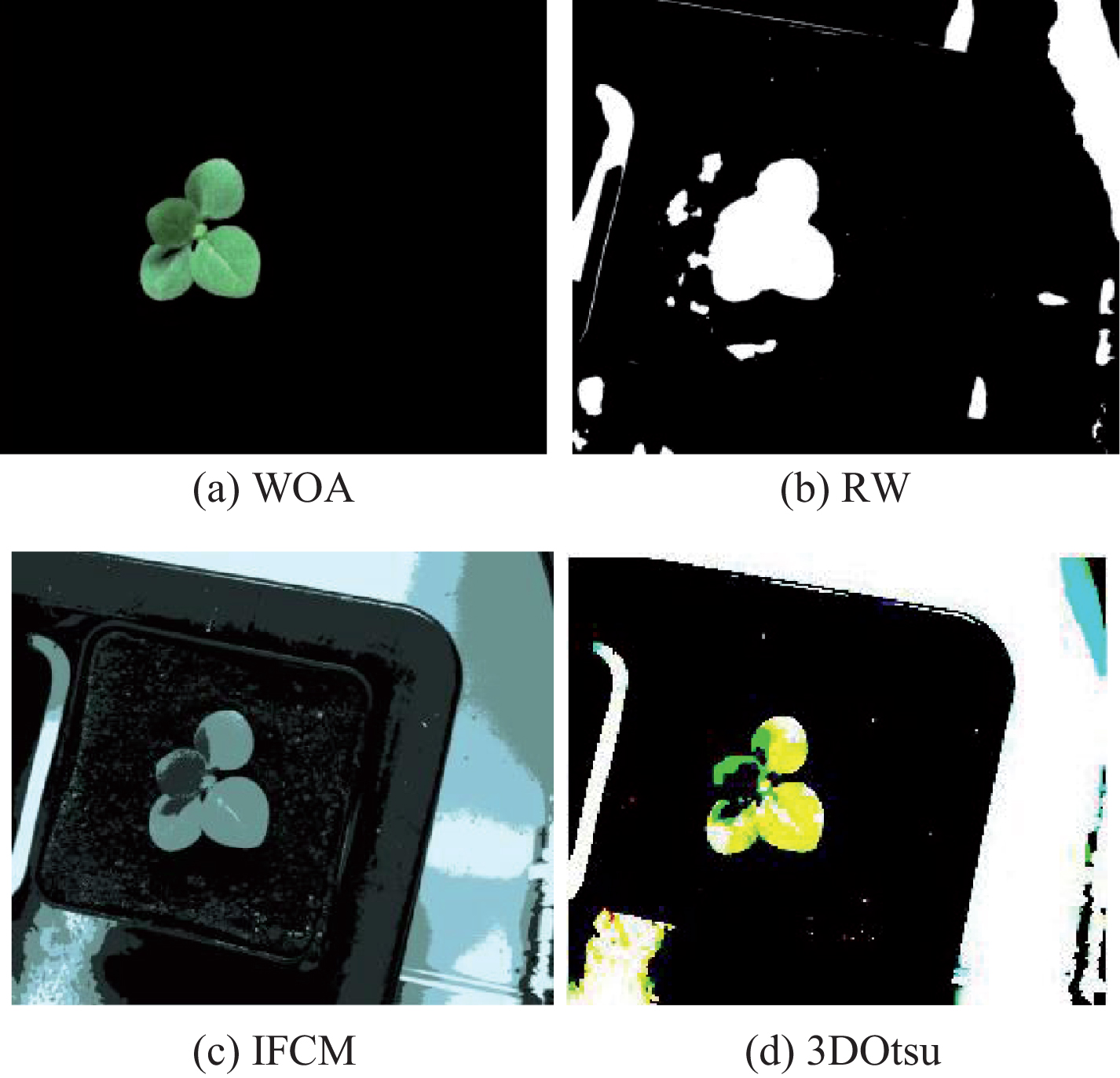
The segmentation image of plant2.

The segmentation image of plant3.

The segmentation image of plant4.
Algorithm in this paper to the plant canopy area of different growth conditions can be effective for image segmentation, so the algorithm processing complex image segmentation performance is stronger. In this paper, the algorithm is applied to image segmentation field, and to ensure that the segmentation accuracy at the same time, split time shorter. In dealing with complex plant canopy image, this algorithm can effectively display the canopy area segmentation for complex plant canopy image segmentation problem, more accurately find the plant canopy.
In this paper, an algorithm based on the WOA to optimize the parameters of 3DPCNN model is proposed, and the product type cross entropy as the fitness function for optimization. It can effectively overcome the shortcomings of 3DPCNN parameters setting by manual, which is inconvenient and time-consuming. WOA can adaptively adjust 3DPCNN parameters in accordance with the entropy of the segmentation image to obtain the optimal image. The selection of parameters E and β1 can effectively reduce 3DPCNN model iterations to segment the color images, and by this way the computational operand of 3DPCNN will be greatly reduced. In addition, through comparison with BA, PSO, FPA and the improved PCNN model, it can be found that the global searching ability and the optimal value searching ability of this algorithm are stronger, which can complete the effective segmentation of complex images and provide an effective method to solve the segmentation of plant canopy images. In the process of solving the segmentation problem of plant canopy image, it is compared with some common color image segmentation methods. From the experimental results it can be clearly found that the WOA-3DPCNN model has strong ability in plant canopy image segmentation field.
Footnotes
Acknowledgments
The article is supported by the fund of natural science foundation of China.(Project Number: 31470714).