



Abstract
This paper investigates intuitionistic fuzzy information aggration problem with the interrelationship among the input values and the “singular point” (i.e. the input value was either too large or too small) which canot be solved by most existing aggregation operators. To accomplish this, this paper combines the geometric Heronian mean (GHM) operator with the power geometric (PG) operator under intuitionistic fuzzy environment. Then, the intuitionistic fuzzy power GHM (IFPGHM) operator and the weighted intuitionistic fuzzy power GHM (WIFPGHM) operator are presented. The new operators capture not only the correlations between the input arguments but also the relative closeness of decision making information such that they can better solve the intuitionistic fuzzy information aggregation problem with diversified connections between arguments. The desirable properties of these new extensions of GHM operator and their special cases are investigated. Finally, based on the WIFPGHM operator, we present an approach to multiple attribute decision making and illustrate that approach with a practical example.
Keywords
Introduction
Multiple attribute decision making (MADM), as one branch of decision making science, has long been a concern of academic researchers for many years. In fact, MADM has a variety of applications in many domains, which range from inventory management, financial risk management, designing online learning systems and evaluating of renewable power sources, to disaster evaluation of the floods [1–5]. Due to the complexity of decision making objects and the fuzzy characteristics of human thinking, it is difficult to evaluate the attribute characteristics of alternatives with precise values in most cases. To overcome this problem, fuzzy theory is introduced as a means to better express decision making information.
The fuzzy set (FS), initially introduced by Zadeh [6], has been widely used to express decision making information in fuzzy or uncertain circumstances. Several scholars argue that accurately representing complex decision making information using FS is impossible, because the sets only have memberships. For example, a survey conducted by the board of directors of a company showed that 51 percent of shareholders are in favor of passing a restructuring plan, while 37 percent are opposed. Expressing the results of this survey using FS is difficult. Because of this, Atanassov further put forward the intuitionistic fuzzy set (IFS) based on FS [7]. The IFS has three components: a membership degree function, a nonmembership degree function and a hesitancy degree function.This makes IFS more flexible and efficient than FS, particularly when expressing uncertainty information in decision making. By using IFS, the results of the survey above can be shown by membership 0.51 and nonmembership 0.37. Therefore, many scholars have focused on the study of intuitionistic fuzzy decision making problems [8–10].
In order to aggregate the intuitionistic fuzzy individual evaluation values into a collective one, a large number of aggregate operators have been introduced during the past few years, such as intuitionistic fuzzy weighted geometric operator [11], intuitionistic fuzzy weighted averaging operator [11], intuitionistic fuzzy hybrid averaging operator [12], and intuitionistic fuzzy ordered weighted distance operator [13]. Su et al. presented the induced generalized intuitionistic fuzzy ordered weighted averaging operator by using induced variables [14]. Liao et al. introduced the generalized intuitionistic fuzzy hybrid weighted geometric operator and applied it to MADM [15]. Zeng et al. developed the intuitionistic fuzzy generalized probabilistic ordered weighted averaging operator [16]. Garg presented some intuitionistic fuzzy Hamacher interaction weighted operators to solve the MADM problems [17].
However, operators as mentioned above assume that input values are independent. This assumption overlooks the interconnectedness between attributes in decision making information infusing. Therefore, the information aggregation methods based on these operators do not have high reliability and veracity in decision making. The Heronian mean (HM) operator has the desirable characteristic of capturing correlations between aggregated arguments. Beliakov et al. theoretically proved that HM operator meets the conditions of an aggregation operator [18]. The HM operator have been widely applied to the fuzzy MADM problem in recent years. Zang et al. designed a method for MADM with interval-valued dual hesitant fuzzy information based on HM operator [20]. Han et al. proposed an unbalanced linguistic generalized Heronian mean aggregation operator to solve MADM problem [19]. Liu et al. proposed the intuitionistic fuzzy Archimedean HM operator based on the Archimedean t-conorm and t-norm [22]. Peng et al. introduced the Frank HM operator to aggregate linguistic intuitionistic decision making information [21].To extend and develop HM operator, Yu defined the geometric Heronian mean (GHM) operator based on the geometric averaging operator [23].
Operating from a different perspective, in order to take the relative closeness of decision making information into consideration, and pay close attention to the optimization of the whole in decision making, Yager originally proposed the power average (PA) operator [24]. Liu et al. combined the PA operator with Schweizer–Sklar operations under intuitionistic fuzzy environment and presented the interval-valued intuitionistic fuzzy Schweizer–Sklar PA operator [25]. Wen et al. proposed intuitionistic fuzzy evidential PA aggregation operator based on the D-S evidence theory [26]. Wen et al. presented intuitionistic fuzzy entropy weighted PA aggregation operator and developed a method to solve multiple attribute group decision making problems [27]. Rani et al. presented some PA operators to solve the complex intuitionistic fuzzy MADM problems [28]. Xu and Yager further put forward the power geometric(PG) operator [29]. In recent years, many researchers have devoted themselves to studying the PG operator in different fuzzy environments [30–34].
A new problem arises when considering these operators only form a single factor, as this may lead to one-sided decision making conclusions. Therefore, it is necessary to design some new information aggregating operators, which can simultaneously take multiple factors into account in the decision making process at the same time, if required. For example, when faced with a risky decision making problem (such as selecting the location of nuclear power plants or selecting aircraft engine suppliers), people often choose robust decision making methods. They hope to mine the correlation between the economic and social attribute variables, while avoiding the impact of “singular point” on the decision making results. Thus, the aim of this paper is to solve MADM problems in which the attribute variables are interrelated and the evaluation values have the singular points. To do this, we first propose the intuitionistic fuzzy power GHM (IFPGHM) operator and the weighted intuitionistic fuzzy power GHM (WIFPGHM) operator. And then, apply them to deal with MADM prpblems in intuitionistic fuzzy enviroment.
The motivation of this paper is reposed on the following facts: The existing intuitionistic fuzzy information aggregation operators are mainly proposed from a one-dimensional perspective. There was less research about multi-objective information aggregation with intuitionistic fuzzy information. The GHM operator can capture the relationship between the input arguments. In addition, the GHM operator has two flexible parameters, and we could select the appropriate parameters to meet the different requirements in information infusing process. Until now, no operator exists that is designed based on the GHM and PG operators. At present, the power Bonferroni mean (PBM) operator is the main way used to solve the above MADM problems, which was introduced initially by He et al. based on the BM and PA operators [35]. However, Liu et al. recently pointed out that the BM operator has the defect of computing complexity and overusing interactive computation to capture correlation in information infusing process, while the GHM operator can effectively avoid these situations [36].
In this paper, we intend to achieve the following contributions: We introduce some new operators to reduce the influence of singular value and deeply mine the relationship among aggregated arguments in the information infusing process, i.e., the IFPGHM and WIFPGHM operators. We develop a multi-objective MADM method on the basis of the proposed operator under the intuitionistic fuzzy environment. Some comparative analyses between the proposed operators and method and other existing operators and methods are conducted based on the derived results. The advantages of the proposed operators and decision making method are highlighted.
The rest of this paper is organized as follows: Section 2 reviews some fundamental concepts, such as the intuitionistic fuzzy number (IFN), the comparison law of IFNs, the GHM and PG operators. In Sections 3, we design some new operators and investigate their properties. A new method that can be used to solve MADM problems with intuitionistic fuzzy information is presented in Section 4. In Section 5, the validity and feasibility of this proposed technique is explained through a numerical example. In Section 6, a comparative analysis with other MADM methods is provided. Finally, conclusions and directions for future research are presented in Section 7.
Preliminaries
Intuitionistic fuzzy values
Atanassov first proposed the concept of IFS as a flexible and efficient tool for expressing the fuzzy and uncertain information [7].
To facilitate information modeling in decision making, Xu called the pair α = (μ α , υ α ) an IFN with the conditions μ α ∈ [0, 1], υ α ∈ [0, 1], μ α + υ α ∈ [0, 1], and defined the following operation laws [11].
α1⊕ α2 = (μ
α
1
+ μ
α
1
- μ
α
1
μ
α
2
, υ
α
1
υ
α
2
) ; α1⊗ α2 = (μ
α
1
μ
α
2
, υ
α
1
+ υ
α
2
- υ
α
1
υ
α
2
) ;
To compare the IFNs, Xu [11] further gave the following method:
If S
α
1
> S
α
2
, then α1 > α2; If S
α
1
< S
α
2
, then α1 < α2; If S
α
1
= S
α
2
, then if h
α
1
= h
α
2
, then α1 = α2 ; if h
α
1
> h
α
2
, then α1> α2 ; if h
α
1
< h
α
2
, then α1 < α2.
There is also other comparison rules of IFNs in the literature. For example, Szmidt et al. proposed a comparison rule between IFNs based on the reliability of information [37]. Zhang et al. introduced a novel approach for ranking IFNs by using the similarity measure and the accuracy degree of IFNs [38]. Jafarian et al. presented a valuation-based method for ranking IFNs by mapping the IFNs to the crisp values [39]. Lakshmana et al. proposed a total ordering rule on IFNs by using the upper lower dense sequence [40]. However, the comparison rule proposed by Xu et al., as shown in Definition 3, is simple and convenient. So it is widely used in decision making.
Geometric Heronian mean and power geometric operator
The HM operator is a common tool used to capture the interrelationships between decision variables. Yu proposed the GHM operator by generalizing the HM and geometric average operators [23].
To reduce the effect of the outliers, Yager originally proposed a PA operator [24]. Xu and Yager further put forward the PG operator [29].
Sup (a
i
, a
j
) ∈ [0, 1]; Sup (a
i
, a
j
) = Sup (a
i
, a
j
); If d (a
i
, a
j
) ≤ d (a
l
, a
k
), then Sup (a
i
, a
j
) ≥ Sup (a
l
, a
k
), where d (a
i
, a
j
) is the distance between a
i
and a
j
.
Intuitionistic fuzzy power GHM
In this section, we combine the HM and PG operators, and propose some new operators who capture not only the correlations between the aggregated arguments but also the relative closeness of the input values.
then IFPGHMp,q is called the intuitionistic fuzzy power GHM (IFPGHM) operator, where
Sup (α
i
, α
j
) is the support for α
i
and α
j
, with the following conditions: Sup (α
i
, α
j
)∈ [0, 1] ; Sup (α
i
, α
j
) = Sup (α
j
, α
i
) ; If d (α
i
, α
j
) ≤ d (α
l
, α
k
), then Sup (α
i
, α
j
) ≥ Sup (α
l
, α
k
).
Similarly, β- ≤ IFPGHMp,q (α1, α2, ⋯ , α n ).
Therefore, we obtain
(i = 1, 2, ⋯ , n), where
First, we utilize the IFPGHM operator (p = 1, q = 1) to aggregate these IFNs, as described in the following:
This shows that
Then
Utilizing the intuitionistic fuzzy geometric (IFG) operator [42], then we can get
Utilizing the intuitionistic fuzzy PG (IFPG) operator [41], then we can get
Utilizing the IFGHM operator [23], then we can get
Comparison with other geometric operators
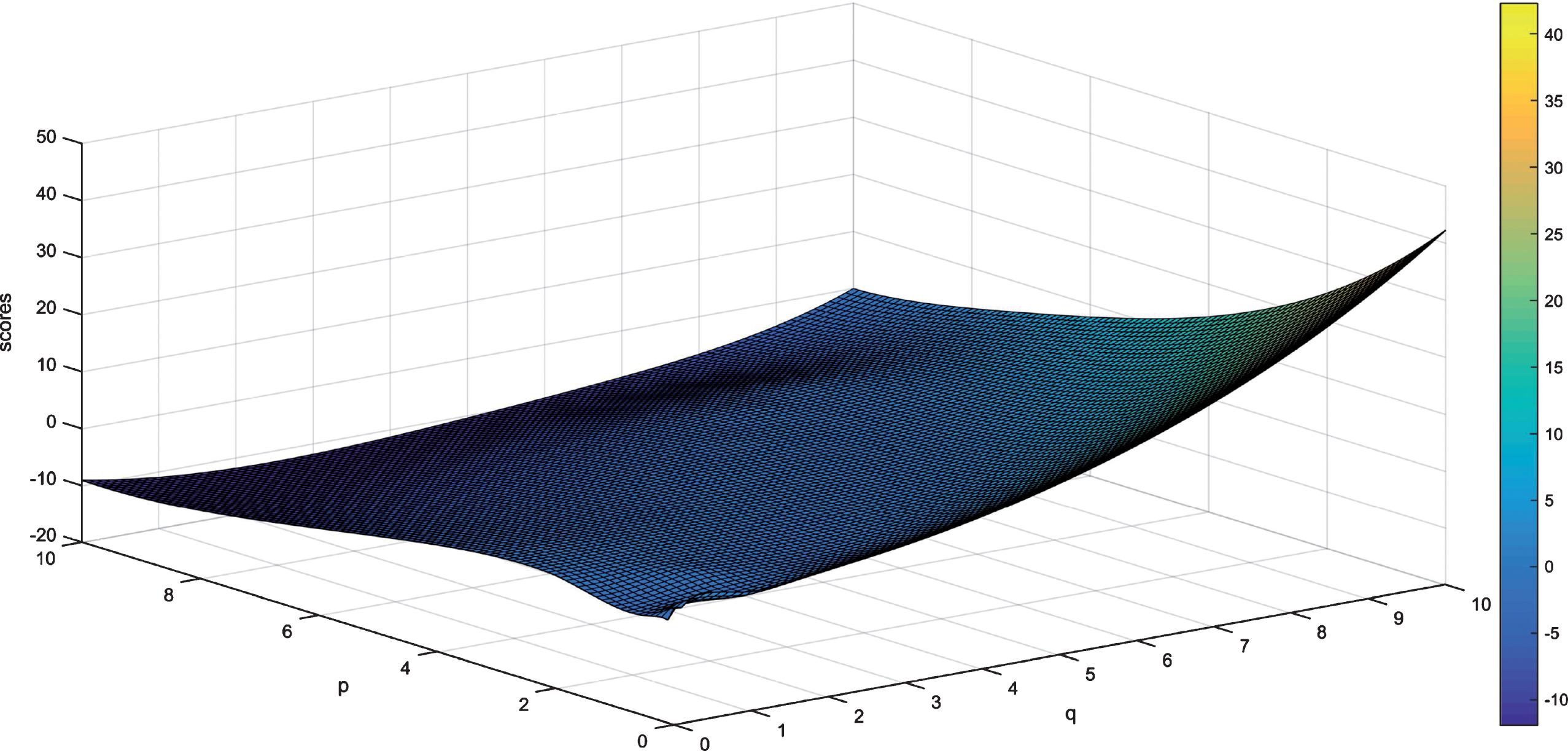
Scores of the IFPGHM.
Utilizing the intuitionistic fuzzy power geometric BM (IFPGBM) operator [35], then we can get
As can be seen in Table 1, only the IFPGHM and IFPGBM operators satisfy all of the conditions. The IFGHM, IFPGBM and IFPGHM operators have two alterable parameters. When taking some unique parameter values, they can degenerate into other aggregation operators, which makes the information infusing process more flexible and better capable of meeting the needs of different users. Furthermore, the IFPGHM operator combines the advantages of the IFPG and IFGHM operators, so it can be regarded as an expansion of them. Compared with the IFPGHM operator, the IFPGBM operator has the defect of providing potentially redundant information, and cannot capture the relationship between the attribute value and itself [36]. In addition, from Table 1,we can see that the aggregation result of the IFPGHM operator is closer to that of the IFG and IFPG operators than the IFPGBM operator. This shows that the IFPGHM operator better retains the mathematical structure of the IFG and IFPG operators.Therefore, the IFPGHM operator is more suitable for MADM problems with fused information.
Figure 1 clearly demonstrates that the IFPGHM operator is not necessarily monotonic. If we let p = q = m, then Fig. 2 reveals that the scores obtained by the IFPGHM operator decrease as the parameters increase. This finding indicates that parameter m can reflect the risk preference of the decision maker. A decision makers in a negative mood could use the IFPGHM operator and choose a larger value for the parameter m, while a decision makers with a positive attitude could use the IFPGHM operator and choose a smaller value for the parameter m.
The hypothetical condition that all the arguments have the equal importance in Definition 6 does not hold in many situations. In many decision making cases, we should consider the attributes’ degrees of importance. If we assume that each attribute has a weight representing its importance, then we propose the intuitionistic fuzzy weighted power GHM operator, as described below.
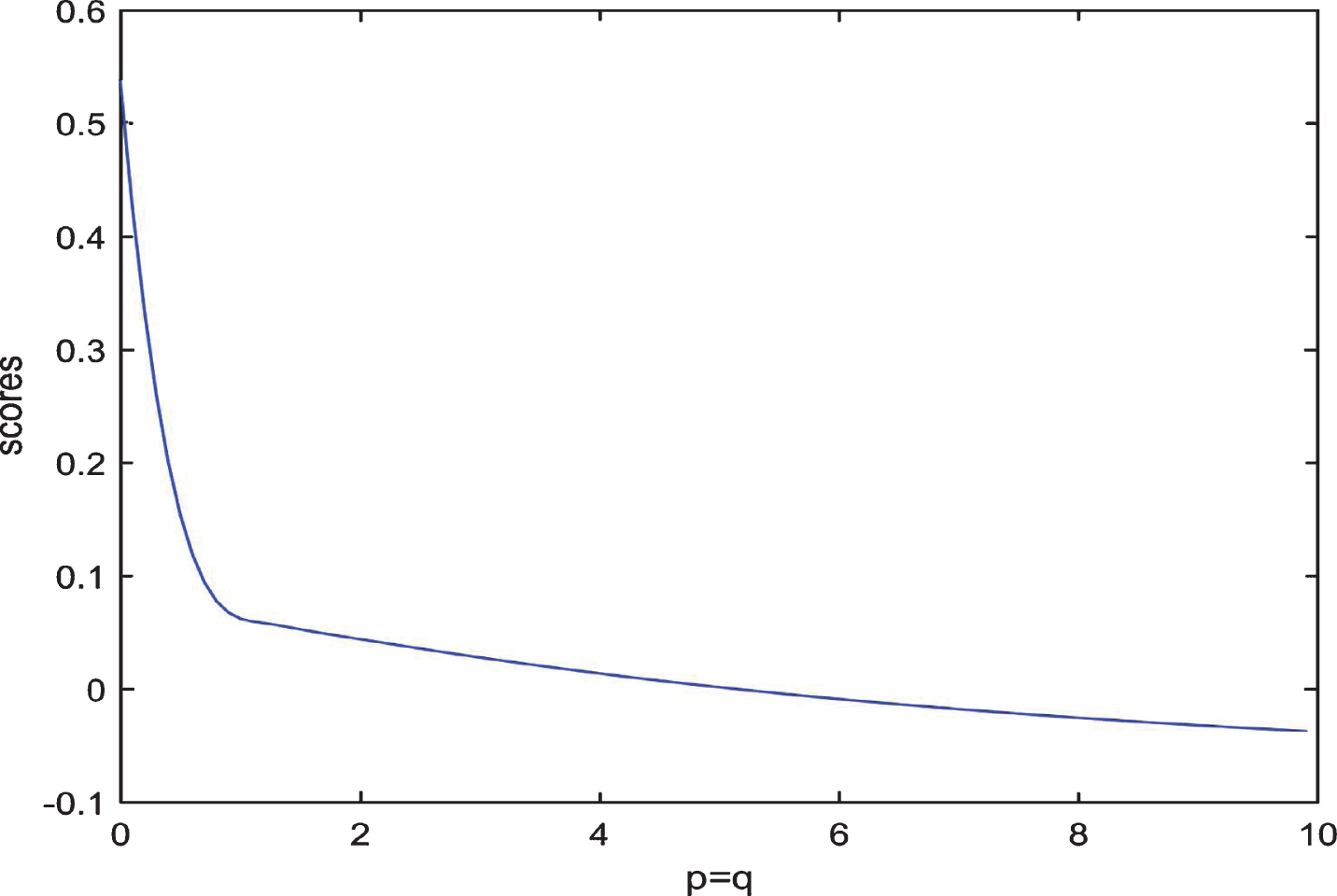
Scores of the IFPGHM with p = q.
The detailed computational formula of the WIFPGHM operator can be expressed as follows.
That is to say the WIFPGHM operator reduces to the IFPGHM operator.
Theorem 2 and Properties 4-6 can be proved along the same lines as the proof of Theorem 1 and Properties 1-3, therefore, we omit the details.
In this section, we consider the MADM problems in which the evaluation of attributes takes the form of intuitionistic fuzzy information.
Let X = {x1, x2, ⋯ , x
n
} be a set of n alternatives, and C = {c1, c2, ⋯ , c
m
} be a set of attributes with the weight vector w = (w1, w2, ⋯ , w
l
)
T
, satisfying,
To rank the alternatives, we apply WIFPGHM operator to develop an approach to MADM under intuitionistic fuzzy environment, which involves the following steps:
In this section, we will use a practical example to demonstrate the application of the proposed method.
x1 is a new energy car company; x2 is a restaurant management company; x3 is a mobile phone software company; x4 is an office supply company; x5 is a household appliances company.
The purchasing company must consider the following four attributes (whose weighting vector is w = (0.2, 0.1, 0.3, 0.4)
T
): c1 is the risk factor; c2 is the growth factor; c3 is the influence power to society; c4 is the environmental impact factor.
All α ij are contained in the intuitionistic fuzzy decision matrix H = (α ij ) 5×4 (see Table 2).
Intuitionistic fuzzy decision matrix
Intuitionistic fuzzy decision matrix
Normalized intuitionistic fuzzy decision matrix
The comprehensive evaluation values obtained using the WIFPGHM
The orderings of the alternatives
As can be seen in Table 5, the ordering of the alternatives varies with the parameters p and q. All the results also show that x2 is the optimal alternative. If one of the parameters is fixed, different alternative values can be obtained as the other parameter changes, as shown in Figs. 3–6.
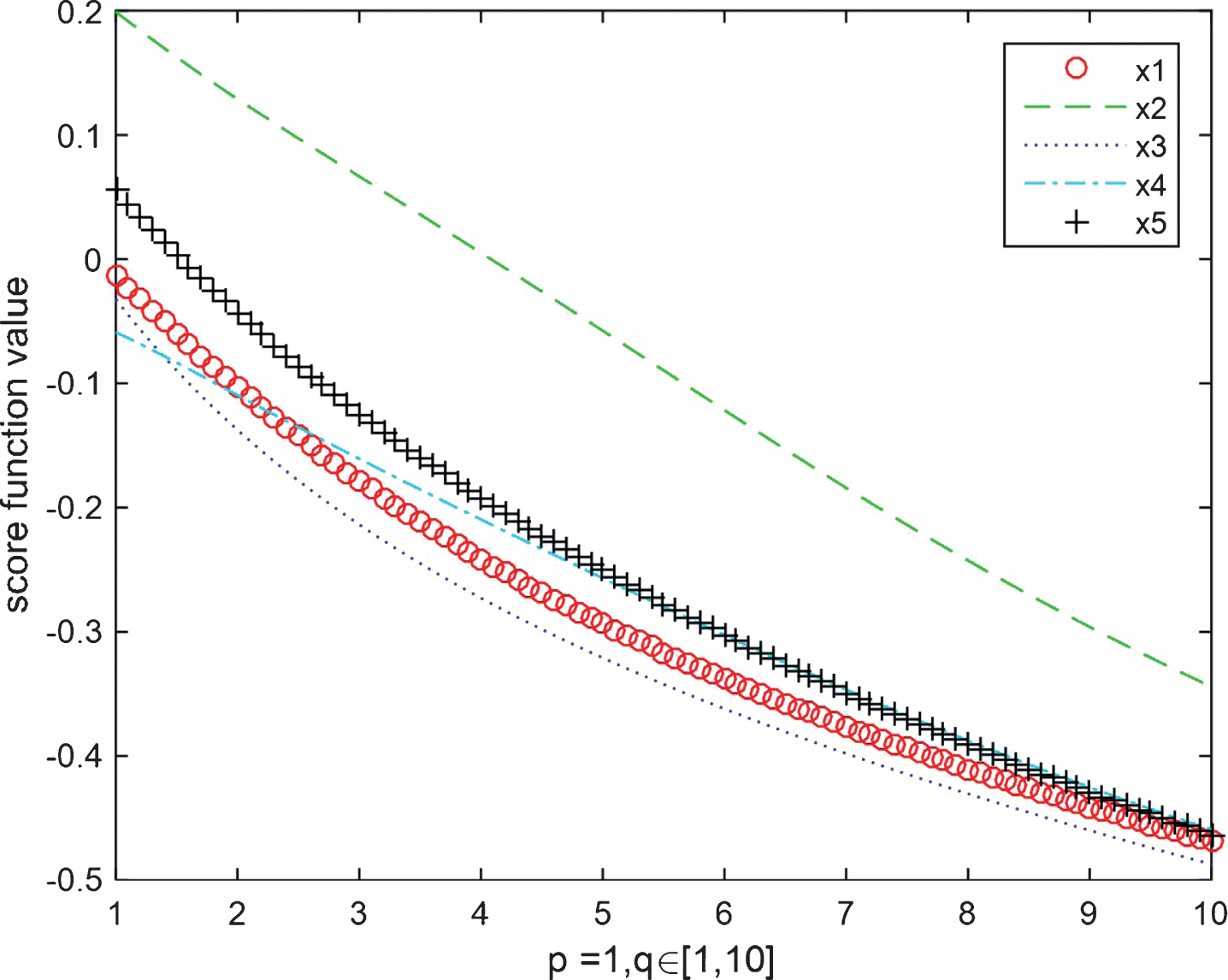
Scores of the WIFPGHM with p = 1, q ∈ [1, 10].
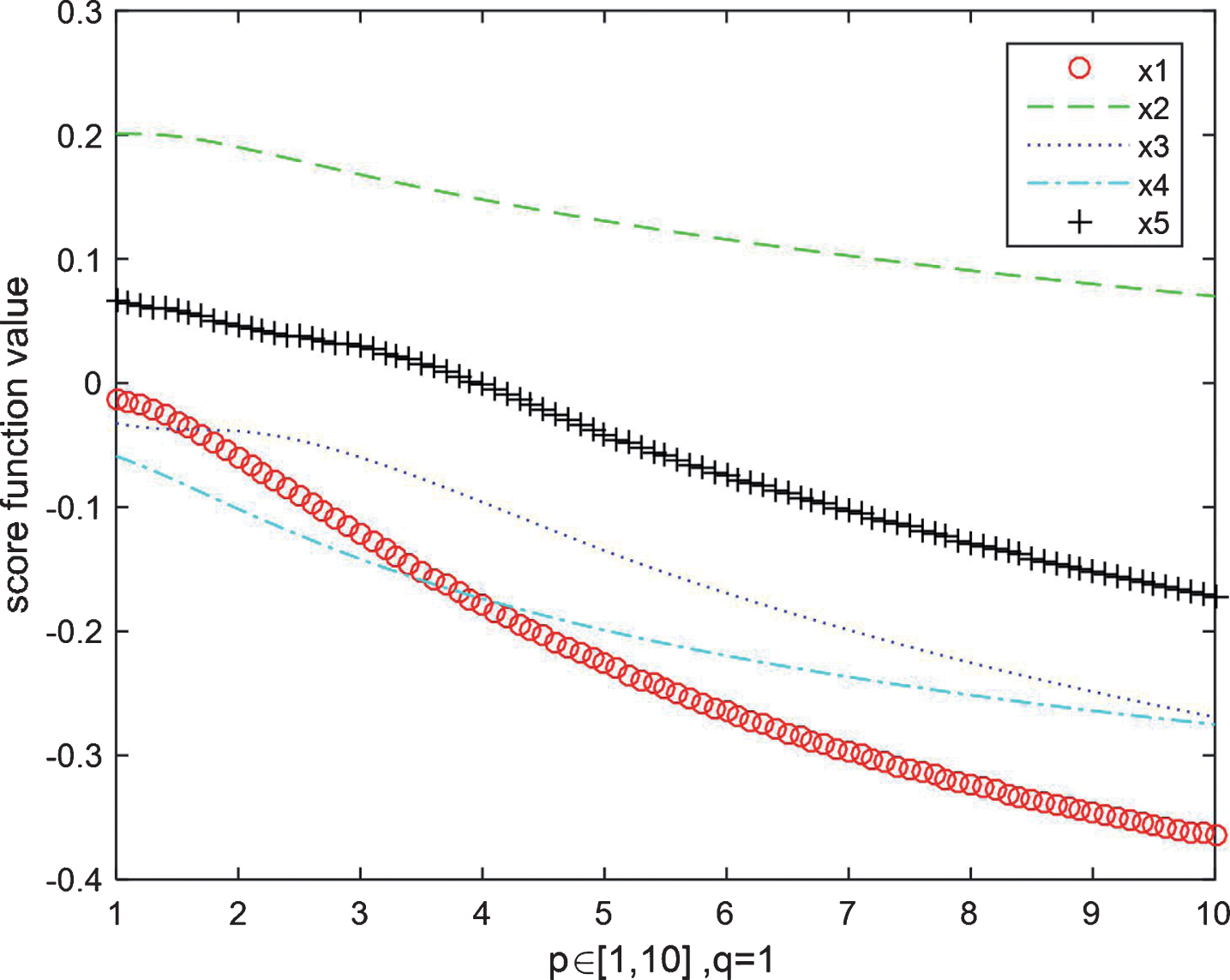
Scores of the WIFPGHM with q = 1, p ∈ [1, 10].
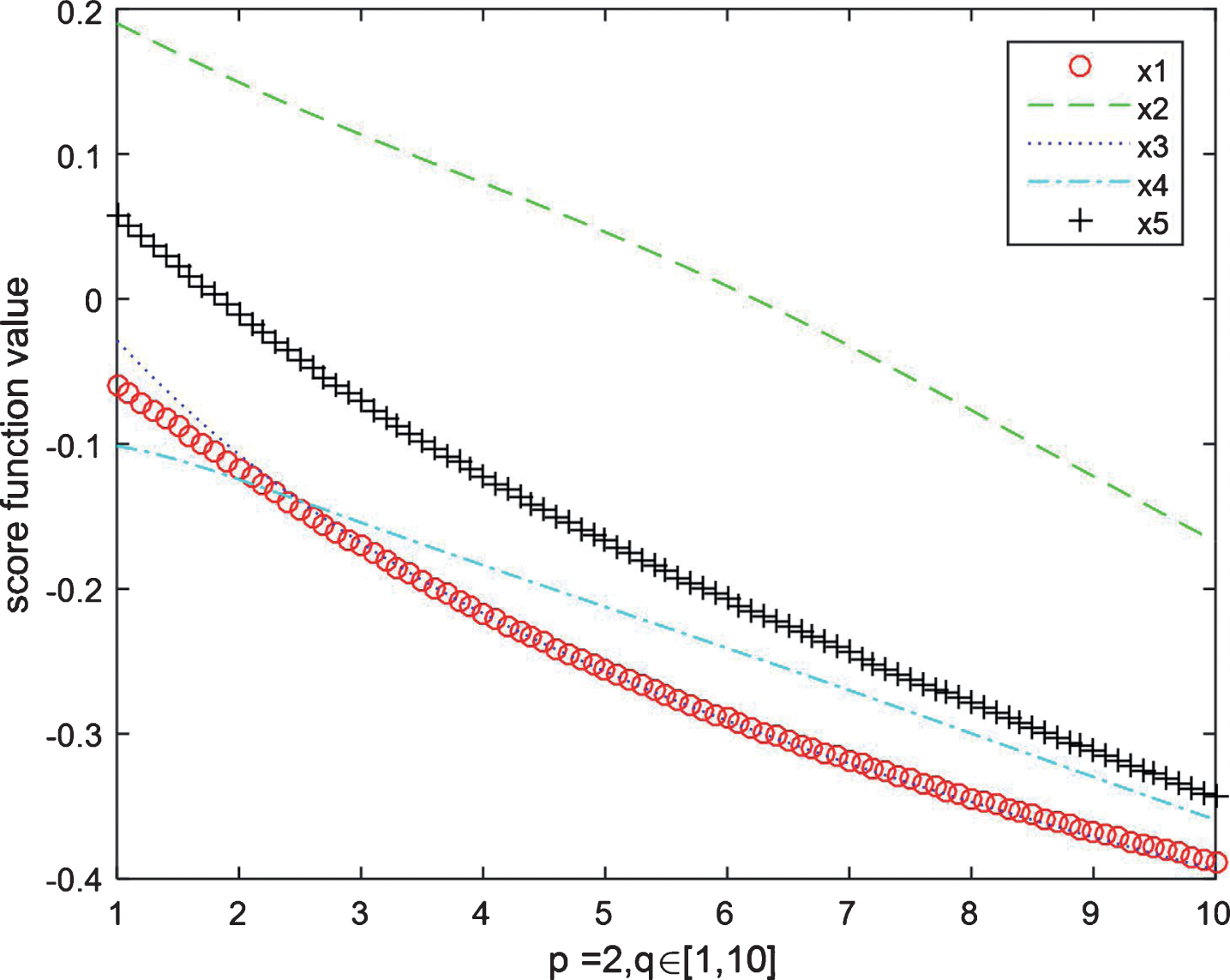
Scores of the WIFPGHM with p = 2, q ∈ [1, 10].
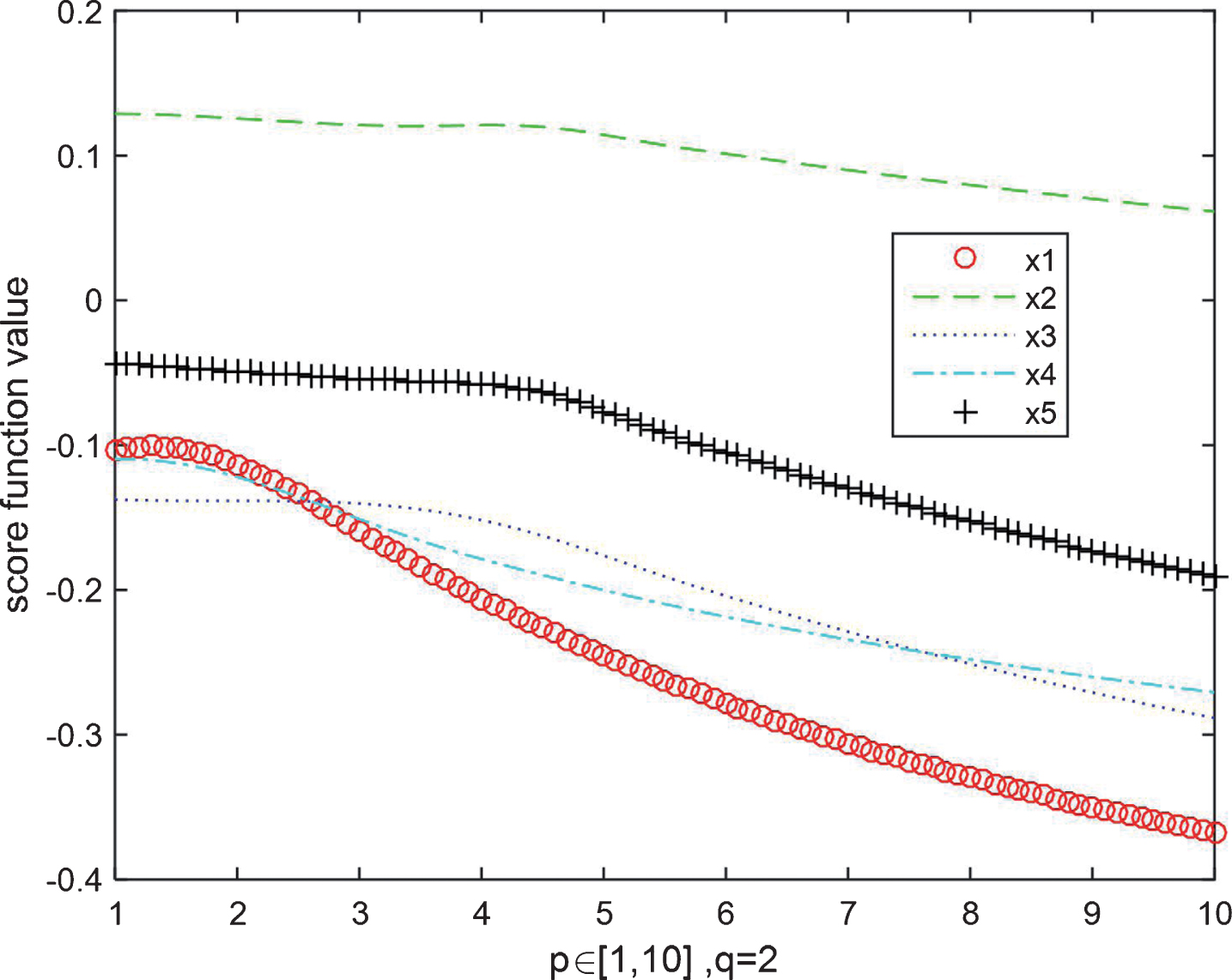
Scores of the WIFPGHM with q = 2, p ∈ [1, 10].
From Figs. 3–6, one can find that the score function values gained by the WIFPGHM operator decrease with the increase of p(or q) for the same input values. Therefore, the parameters should be chosen based on the risk preference types of experts during the decision making process, as discussed in detail in Section 3. In view of the computational complexity and recognition capability of the decision making modeling, we would not recommend using parameters that are too large or too small in the WIFPGHM operator. For example, if p → q, then the WIFPGHM operator degenerates to the generalized intuitionistic fuzzy PG operator. This does not capture the correlation among the aggregated arguments. For this reason, taking p = q=1 is recommended, as this not only makes the aggregation calculations simple but also represents the correlation and the relative closeness of individual arguments.
In this section, the proposed method is compared with other related methods, which were designed based on an aggregation operator to solve intuitionistic fuzzy MADM problems with attribute weights that were completely known. We now consider the MADM method based on the intuitionistic fuzzy geometric weighted HM (IFGWHM) operator developed by Yu [23], the MADM method based on the weighted intuitionistic fuzzy PG averaging (WIFPGA) operator developed by Zhang [41], and the decision making method based on the weighted intuitionistic fuzzy geometric BM (WIFGBM) operator developed by Xia et al. [42]. Comparative analysis results are given in Tables 6 and 7.
Comparison with other method
Comparison with other method
Comprehensive evaluation values (p = q = 1)
As can be seen in Table 6, the major differences between the four methods come from how the diversity in the aggregation operators. Although the operators are all based on the geometric averaging operator, they have different emphases and angles in the decision making process. The IFWGHM and WIFGBM operators can capture the correlations among the aggregated arguments, but they are likely to be affected by a singular point [35]. The WIFPGA operator takes the relative closeness of decision making information into consideration, and plays attention to using global optimization technique in decision making. The WIFPGHM operator takes into consideration not only the correlations between the aggregated arguments but also the relative closeness of the fused values, which is the most advanced development of the IFWGHM and WIFPGA operators. According to Table 7, we can find that the comprehensive evaluation values derived from the WIFPGHM operator is an approximation of the values calculated by the IFWGHM operator. This finding shows that the WIFPGHM operator preserves the characteristics of the IFWGHM operator.
Generally, the method proposed in this paper has the following advantages:1) For the use of IFWGHM operator, the proposed method can solve the problem that attribute information is not robust and has correlation characteristics. 2) The proposed method can set the parameters according to the decision maker’s requirements, which reflects flexibility in the decision making process. 3) The interactive operation between attributes is not repeated, which causes the calculation efficiency of the decision model to be better than the BM operator-based method. Due to the complicated and dynamic nature of decision making circumstances, and the diversified decision making process, the design of a generally applicable method for fuzzy information aggregation is a tough task. In addition, the existing fuzzy information aggregation operators have their own strengths and weaknesses. Furthermore, none of existing operators can always perform better than the others in any decision making environment. Therefore, in order to ensure the decision results are reliable and credible, we should rationally select a operator based on the situation as regards the problem and needs.
This paper analyzes the relative strength of the GHM and PG operators. Then, the power GHM operators under intuitionistic fuzzy conditions are developed, known as the intuitionnistic fuzzy power GHM (IFPGHM) operator and the weighted intuitionistic fuzzy power GHM (WIFPGHM) operator. Their desirable characteristics are analyzed in this paper, and some commonly used special cases concerning parameters p and q are also provided. Based on the WIFPGHM operator,we also developed a detailed calculation procedure to solve the intuitionistic fuzzy MADM problem. The application and efficiency of the new procedure is illustrated with practical examples.
The designed power GHM operators with parameters p and q can provide more choices for the user, because people can select reasonable parameter values, according to the decision making situations. This is an interesting topic and is worthy of being further study in the future. Besides, it is necessary and significant to take the proposed aggregation operators as a means to solve the real MADM problems such as supplier selection, investment strategy selection, data mining, and website quality evaluation.
Footnotes
Acknowledgments
This work was supported by the National Natur-al Science Foundation of China(Grant No.111712), the Natural Science Foundation of Anhui Prov-ince (Grant No. 1908085QG306), the Ministry of Ed-ucation Humanities and Social Sciences Research Youth Fund Project(18YJCZH216) and the Research on Bidding for Henan Government Decision making (2018B461).