The aim of this paper is to develop the spectral theory of prime L-ideals in ordered semigroups. Firstly the concepts of an L-fuzzy ideal and that of an L-fuzzy prime ideal are given and discussed. And then a topological space, called the L-fuzzy prime spectrum of an ordered semigroup, has been gained. This topological space is T1 and sober. Furthermore some homeomorphic spaces of this topological space are investigated. Finally, a contravariant functor from the category of commutative ordered semigroups into the category of sober topological spaces is obtained.
It is well known that Zadeh put forward the concept of fuzzy sets which has opened up keen insights and applications in various range of scientific fields. It offers a new approach and tool to model the imprecision and uncertainty present in phenomena that do not have sharp boundaries. Since then, a lot of work on fuzzy sets has come out expounding the significance of the concept and its applications to various fields such as computer science, artificial intelligence, expert systems, management science, operations research, pattern recognition, and others [3, 31– 34].
Kehayopulu and Tsingelis first studied fuzzy sets in ordered semigroups in [12], then they defined fuzzy analogies for several notations, which have been proved useful in the theory of ordered semigroups. Lately, Xie and Tang [30] introduced the concepts of prime fuzzy ideals, weakly prime fuzzy ideals, completely prime fuzzy ideals and weakly completely prime fuzzy ideals of an ordered semigroup, and established the relations among these four types of prime ideals. And then, Lekkoksung [21] first introduced the notion of semiprime Q-fuzzy ideals of an ordered semigroup and gave a characterization of prime Q-fuzzy ideals of an ordered semigroup in which the structure of truth values is a quantale. Soon afterwards, Han and Zhao [6] studied the concept of a Q-fuzzy subset of an ordered semigroup. They proved that every ordered semigroup S can be embedded into a quantale that consists of all Q-fuzzy subsets of S. Recently, a great amount of work has been done on fuzzy sets, fuzzy ideals of ordered semigroups in general and prime fuzzy ideals of ordered semigroups in particular [8, 21].
In 1937, Stone [28] studied the prime spectra of bounded distributive lattices and established the dual-equivalence of the category of bounded distributive lattices and certain category of topological spaces. Later, Kist [13] discussed the hull-kernel topology on the set of the prime ideals in the context of commutative semigroup with 0. And then Henriksen and Jerison [7] studied Zariski topology on the set of minimal prime ideals of a commutative ring. Soon afterwards, the hull-kernel topology on the set of minimal prime ideal of a distributive lattice L with 0 was studied by Speed [27]. Next Kumar started the research of fuzzy prime spectrum of a ring [17]. Various topological properties of the fuzzy prime spectrum of a ring and certain of its subspaces as well as its functorial nature were discussed [14, 17]. And then the fuzzy prime spectrum of a ring and the spectrum of prime L-fuzzy h-ideals of a hemiring were developed by Kumbhoojkar [18–20]. During the past few years, the spectrum of prime (fuzzy) ideals of an algebraic structure (poset, lattice, ring, semiring, hemiring, etc.) was studied by many researchers [1, 33]. It is discovered that researches of the prime spectrum or Zariski topology (also called hull-kernel topology) on the set of prime ideals, prime (L-)fuzzy ideals plays a very important role in the areas of commutative algebra, order theory, lattice theory, algebraic geometry and topology theory.
Keeping in view all these facts, ideals in ordered semigroups and spectrum theory are very important. Therefore it is natural to attempt to introduce an appropriate topology on the set of prime fuzzy ideals of an ordered semigroup. To fill this gap, we attempt in the paper to study L-fuzzy ideals, prime L-fuzzy ideals and L-fuzzy prime spectrum in an ordered semigroup in detail, where L denotes a complete lattice. We have the following two main aims:
(A1) The first aim is to define and study L-fuzzy ideals, prime L-fuzzy ideals of an ordered semigroup.
(A2) Motivated by the prime spectra in lattices, rings, semirings and hemirings, the second aim is to define a suitable topology on the set of prime L-fuzzy ideals of an ordered semigroup.
In this paper, we not only develop the theory of prime L-ideals but also investigate the topological properties on the L-fuzzy prime spectra of ordered semigroups. At first, the definitions of L-ideals, prime L-ideals in an ordered semigroup are introduced, which are common generalizations of fuzzy ideals, prime fuzzy ideals in [30]. We also give a characterization of prime L-ideals in an ordered semigroup, which essentially extends the result (Theorem 4.8) of [30]. And then, the L-fuzzy prime spectrum of an ordered semigroup S is defined, which will be denoted by L-spec (S). The space L-spec (S) has many interesting properties. It is T1 and sober. Furthermore, we establish a close relation between the classical prime spectrum Spec (S) and L-spec (S) and got some homeomorphic spaces of L-spec (S). Finally, a contravariant functor from the category of commutative ordered semigroups into the category of sober topological spaces is obtained. As an application of the results of this paper, the corresponding results in semigroups (without the order structure) can be obtained.
The work of this paper is organized as follows. In Section 2, we shall first briefly review some notions and facts related to ordered semigroups. In Section 3, we introduce the definitions of L-ideals and prime L-ideals of an ordered semigroup and give a characterization of prime L-ideals of an ordered semigroup. In Section 4, topological properties of the L-fuzzy prime spectrum of an ordered semigroup are obtained. Furthermore we investigate some homeomorphic spaces of this topological space in Section 5. Finally, some conclusions are presented in Section 6.
Preliminaries
This section reviews some terminologies and results related to ordered semigroups and L-fuzzy subsets.
An ordered semigroup is a semigroup (S, ·) with a partial order ≤ on S which is compatible with the multiplication ·, i.e., x ≤ y implies x · z ≤ y · z and z · x ≤ z · y for all x, y, z ∈ S. Sometimes, we denote an ordered semigroup (S, ≤, ·) by S. It is customary to write x · y as xy for all x, y ∈ S. S is called commutative if xy = yx for any x, y ∈ S. For subsets A, B of S, let (A] = {x ∈ S: x ≤ aforsomea ∈ A}, [A) = {x ∈ S: x ≥ aforsomea ∈ A} and AB = {ab: a ∈ A, b ∈ B}. A zero element for an ordered semigroup S is an element 0 such that 0 ≤ x and x0 = 0x = 0 for all x in S. Let S and T be ordered semigroups. A map f: S → T is called an ordered semigroup homomorphism if f is a semigroup homomorphism which preserves order. A nonempty subset I of S is called a left(right) ideal of S if it satisfies: (1) SI ⊆ I(IS ⊆ I); (2) for x ∈ I, y ∈ S, y ≤ x implies y ∈ I. I is called an ideal of S if it is a left and right ideal of S. Let A be a nonempty subset of the ordered semigroup S. We denote I (A) the ideal of S generated by A, i.e., the smallest (under inclusion relation) ideal of S containing A and I (A) = (A ∪ SA ∪ AS ∪ SAS]. For any x ∈ S, I (x) = (x ∪ Sx ∪ xS ∪ SxS]. If S is commutative, then I (A) = (A ∪ SA].
Let S be an ordered semigroup and L be a complete lattice with the maximum element 1 and the minimum element 0. An arbitrary mapping μ: S → L is called an L-fuzzy subset, or shortly, an L-subset, of S and the symbol LS denotes the set of all L-subsets of X. For A ⊆ S, the L-subset χA is defined by, ∀x ∈ S,
χA is said to be the characteristic function of A. For t ∈ L and x ∈ S, the L-subset xt is defined by, ∀y ∈ S,
xt is said to be an L-point with value t and support by an element x. We say that an L-point xtbelongs to an L-subset μ, written as xt ∈ μ, if μ (x) ≥ t. Let μ be any L-subset of S. The set
is called a level subset of μ. In special, we use μ1 to denote the set {x ∈ S: μ (x) =1}.
For any μ, ν ∈ LS, we define a partial order on LS as follows: μ ≤ ν if and only if μ (x) ≤ ν (x) for all x ∈ S. Then (LS, ≤) is also a complete lattice, where (⋁ iμi) (x) = ⋁ i (μi (x)), (⋀ iμi) (x) = ⋀ i (μi (x)). The maximum element 1S and the minimum element 0S of (LS, ≤) are defined by
For any x ∈ S, we define Ax: = {(y, z) ∈ S × S: x ≤ yz}. For any μ, ν ∈ LS, a binary operation ∘: LS × LS → LS, called the product on LS, is defined by, ∀x ∈ S,
Obviously, if we let L = [0, 1], then L-fuzzy sets will become fuzzy sets. In this paper, L always denotes a complete lattice.
Definition 2.1. [30] Let S be an ordered semigroup. A proper ideal I of S is said to be prime (also called weakly prime in [11]) if for any two ideals A, B ⊆ S, AB ⊆ I implies A ⊆ I or B ⊆ I. In this paper, the set of all prime ideals of S is denoted by .
Definition 2.2. [30] A proper ideal I of S is said to be completely prime (also called prime in [11]) if for any two elements x, y ∈ S, xy ∈ I implies x ∈ I or y ∈ I.
Lemma 2.3. [11] Let S be an ordered semigroup. If S is commutative, then the completely prime and prime ideal coincide.
Definition 2.4. [23, 24] Let L be a complete lattice. An element x ≠1 of L is called prime if for any y, z ∈ L, y ∧ z ≤ x implies that y ≤ x or z ≤ x.
Definition 2.5. [2] Let S and S′ be any two sets, and let f be any map from S to S′.
(1) Let μ be any L-subset of f (S). The L-subset f-1 (μ) of S, which will be called the preimage of μ under f, is defined by
(2) Let ν be any L-subset of S. The L-subset f (ν) of S, which will be called the image of ν under f, is defined by, for any x′ ∈ S′,
L-ideals and prime L-ideals
In this section, we introduce the definitions of L-ideals and prime L-ideals of an ordered semigroup, which are actually generalizations of fuzzy ideals and prime fuzzy ideals in ordered semigroups [12, 30]. And then, the characterization of prime L-ideals of an ordered semigroup is obtained.
Definition 3.1. Let S be an ordered semigroup. An L-subset μ of S is called an L-left(L-right) ideal of S if it satisfies
(1) x ≤ y ⇒ μ (x) ≥ μ (y);
(2) μ (xy) ≥ μ (y) (μ (xy) ≥ μ (x)) for all x, y ∈ S.
By an L-ideal, we mean the one which is both an L-left and L-right ideal.
Clearly, Definition 47 is a generalization for the concept of fuzzy ideals on ordered semigroups that was introduced by Kehayopulu and Tsingelis in [12], in which [0, 1] is replaced by a complete lattice L.
Example 3.2. (N, ≤, ·) with the standard multiply operation is an ordered semigroup, where for any m, n ∈ N, m ≤ n if there exists k ∈ N such that m = k · n. Let L be a complete lattice. For any a ∈ N and α, β ∈ L with α < β, define an L-subset of S by
Then μa is an L-ideal of (N, ≤, ·).
Lemma 3.3. Let S be an ordered semigroup and {μi: i ∈ I} be a family of L-ideals of S. Then ⋁iμi and ⋀iμi are both L-ideals of S.
Proof. Obviously.
Proposition 3.4. Let S be an ordered semigroup and μ be any L-subset of S. Then μ is an L-ideal of S if and only if its every non-empty level subset μt (t ∈ L) of S is an ideal of S.
By Proposition 3.4, the following corollaries are obtained.
Corollary 3.5. Let S be an ordered semigroup and ∅ ≠ A ⊆ S. Then the characteristic mapping χA of A is an L-ideal of S if and only if A is an ideal of S.
Corollary 3.6. Let S be an ordered semigroup and xt be an L-point of S. The notation [x] t denotes the L-ideal generated by xt. Then ∀s ∈ S,
where I (x) denotes the ideal generated by x.
Proposition 3.7. Let S be an ordered semigroup and μ an L-subset of S. Then μ is an L-ideal if and only if μ satisfies that
Proposition 3.8. Let S be an ordered semigroup and μ, ν, μi, νi (i = 1, 2) L-ideals of S. Then
(1) if μ1 ≤ μ2 and ν1 ≤ ν2, then μ1 ∘ ν1 ≤ μ2 ∘ ν2;
(2) μ ∘ ν ≤ μ ∧ ν.
Proof. (1) Obviously.
(2) Let x ∈ S. Since μ, ν are L-ideals of S, we have μ (y) ≤ μ (yz) ≤ μ (x), ν (z) ≤ ν (yz) ≤ ν (x) for any (y, z) ∈ Ax. Hence
Therefore μ ∘ ν ≤ μ ∧ ν.
Next, the definition of prime L-ideals is given, which extends the concept of prime fuzzy ideals in [30].
Definition 3.9. Let S be an ordered semigroup. An L-ideal μ of S is called prime if μ is nonconstant and for any L-ideals ν and ω of S, ν ∘ ω ≤ μ implies ν ≤ μ or ω ≤ μ.
The set of all prime L-ideals of S is denoted by .
At first, a characterization of prime L-ideals of an ordered semigroup is given in the following theorem. Then we will give examples of prime L-ideals in Example 3.12. As a consequence of Theorem 3.10, the result in Theorem 4.8 of [30] follows as a corollary.
Theorem 3.10. Let μ be an L-subset of an ordered semigroup S. Then μ is a prime L-ideal of S if and only if μ satisfies the following conditions:
(1) Im (μ) = {1, t}, where t is a prime element of L;
(2) μ1 is a prime ideal of S, where μ1 = {x ∈ S: μ (x) =1}.
Proof. Assume that μ is a prime L-ideal of S. Firstly, we show the condition (1) holds. This proof is divided into four steps:
Step 1: At first we will show that for any a, b ∈ Im (μ), a, b are comparable, that is, a ≤ b or b ≤ a. Let a, b ∈ Im (μ). So there exist x0, y0 ∈ S such that μ (x0) = a, μ (y0) = b. Then ∀x ∈ S,
Because μb is an L-ideal by Proposition 3.4 and y0 ∈ μb, we have I (y0) ⊆ μb. Similarly, I (x0) ⊆ μa. Hence (I (x0) I (y0)] ⊆ μb ∩ μa, that is, for any x ∈ (I (x0) I (y0)], μ (x) ≥ b and μ (x) ≥ a. So for any x ∈ (I (x0) I (y0)], μ (x) ≥ a ∧ b and hence [x0] b ∘ [y0] a ≤ μ. Since μ is prime, we have [x0] b ≤ μ or [y0] a ≤ μ. So μ (x0) = a ≥ b or μ (y0) = b ≥ a. Therefore for any a, b ∈ Im (μ), a, b are comparable.
Step 2: We claim that |Im (μ) |=2. Since μ is nonconstant, we have |Im (μ) |≥2. Suppose |Im (μ) |≥3. Then there exist x0, y0 and z0 ∈ S such that μ (x0), μ (y0) and μ (z0) are different from each other. By step 1, without loss of generality, we can assume that μ (x0) < μ (y0) < μ (z0). Let r = μ (y0) and t = μ (z0). Then r < t and ∀x ∈ S,
Because μr is an ideal by Proposition 3.4 and y0 ∈ μr, we have I (y0) ⊆ μr. Hence (I (x0) I (y0)] ⊆ μr. So [x0] r ∘ [y0] t ≤ μ. By the primeness of μ, [x0] r ≤ μ or [y0] t ≤ μ. Say [x0] r ≤ μ, then μ (x0) ≥ r, which is impossible. Therefore |Im (μ) |=2.
Step 3: We will show that there exists x0 ∈ S such that μ (x0) =1. By step 1 and 2, Im (μ) = {r, t} and r ≠ t. Suppose that r < t < 1. Thus there exist x0 and y0 ∈ S such that μ (x0) = r and μ (y0) = t. So ∀x ∈ S,
Then by the similar way of the proof of the step 2, we have [x0] t ∘ χI(y0) ≤ μ. By the primeness of μ, we have [x0] t ≤ μ or χI(y0) ≤ μ, which is impossible.
Step 4: By the previous steps, we have Im (μ) = {1, t} and t < 1. Finally, we will show that t is prime. Suppose that there exist a, b ∈ L such that a ∧ b ≤ t. Let x0 ∈ S such that μ (x0) = t. Then ∀x ∈ S,
Obviously, [x0] a ∘ [x0] b ≤ μ. So [x0] a ≤ μ or [x0] b ≤ μ. Hence μ (x0) = t ≥ a or μ (x0) = t ≥ b. Therefore t is prime.
Secondly, we show the condition (2) holds. By Proposition 3.4, μ1 is an ideal of S. Let I, J be ideals of S such that IJ ⊆ μ1. Then χI, χJ are L-ideals of S. Further, for any x ∈ S,
Since IJ ⊆ μ1, we have (IJ] ⊆ (μ1] = μ1 and hence χI ∘ χJ ≤ μ. By the primeness of μ, χI ≤ μ or χJ ≤ μ. So I ⊆ μ1 or J ⊆ μ1 and therefore μ1 is a prime ideal of S.
Conversely, suppose that μ is an L-ideal of S by Proposition 3.4. Then we claim that μ is prime. Indeed: Let ν and ω be L-ideals of S with ν ∘ ω ≤ μ. Suppose ν ≰ μ and ω ≰ μ. Then there exist x0, y0 ∈ S such that ν (x0) ≰ μ (x0) and ω (y0) ≰ μ (y0). Since Im (μ) = {1, t}, we have μ (x0) = t and μ (y0) = t, that is x0, y0 ∉ μ1. So ν (x0) ≰ t and ω (y0) ≰ t. Then we will show that (x0Sy0] ⊈μ1. If (x0Sy0] ⊆ μ1, then,
Since μ is a prime ideal of S, we have (Sx0S] ⊆ μ1 or (Sy0S] ⊆ μ1. Say (Sx0S] ⊆ μ1, then I (x0) I (x0) I (x0) ⊆ (Sx0S] ⊆ μ1, it follows that x0 ∈ I (x0) ⊆ μ1, which is impossible. Therefore (x0Sy0] ⊈μ1. So there exists s0 ∈ (x0Sy0] but s0 ∉ μ1, that is μ (s0) = t. Then there exists s1 ∈ S such that s0 ≤ x0s1y0. So (x0, s1y0) ∈ As0. Hence
Since ν ∘ ω ≤ μ, we have ν ∘ ω (s0) ≤ μ (s0) and so ν (x0) ∧ ω (y0) ≤ μ (s0) = t. By the primeness of t, we have ν (x0) ≤ t or ν (y0) ≤ t which is impossible. Therefore μ is prime.
Corollary 3.11. Let S be an ordered semigroup and P an ideal of S. Then χP is a prime L-ideal of S if and only if 0 is a prime element of L and P is a prime ideal of S.
Proof. It follows from Theorem 3.10.
According to Theorem 3.10, we give examples of prime L-ideals of an ordered semigroup defined in Definition 3.9.
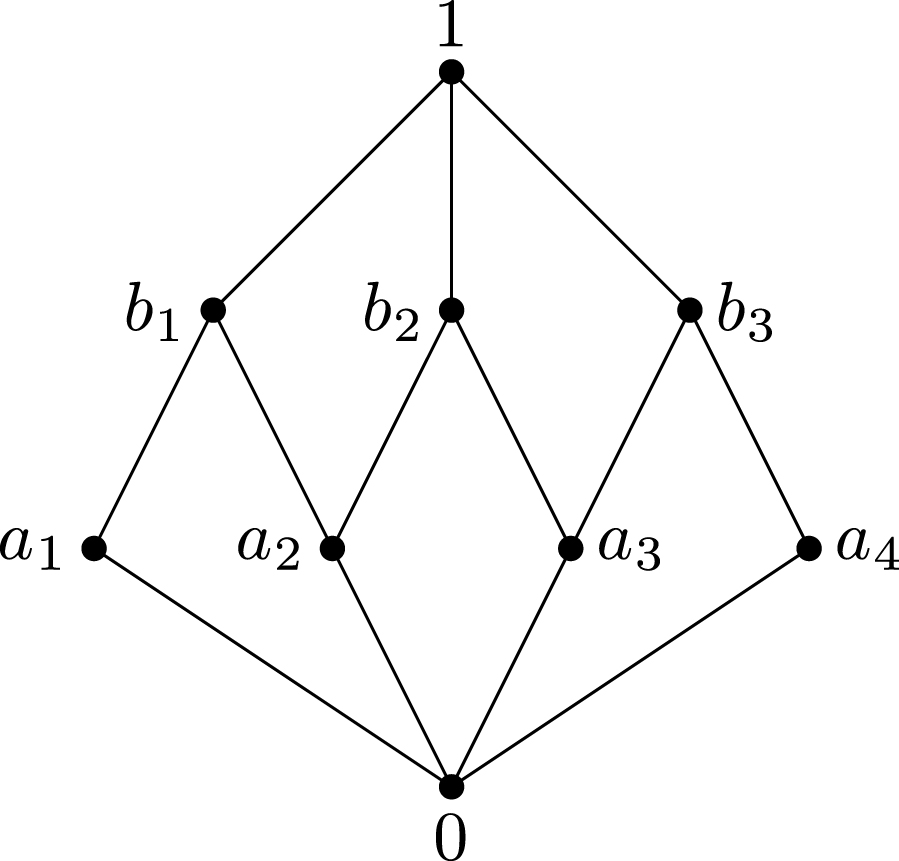
Example 3.12. (1) (N, ≤, ·) with the standard multiply operation is an ordered semigroup, where for any m, n ∈ N, m ≤ n if there exists k ∈ N such that m = k · n. Let L = {0, a, b, 1} be a complete lattice, whose Hasse diagram is shown in Fig. 1.
Let P be a family of prime integers in N. Then μ is a prime L-ideal of N if and only if , where is defined by, ∀x ∈ N, p ∈ P,
Example 3.12(1).
(2) For any n ∈ N, let S = ([0, 1] n, ≤, ·), where for any (x1, x2 ⋯, xn), (y1, y2 ⋯, yn) ∈ [0, 1] n, (x1, x2 ⋯, xn) ≤ (y1, y2 ⋯, yn) if xi ≤ yi for 1 ≤ i ≤ n and (x1, x2 ⋯, xn) · (y1, y2 ⋯, yn) = (min(x1, y1), min(x2, y2), ⋯, min(xn, yn)). Then S is an ordered semigroup. A subset I is an ideal of S if and only if I = ((x1, x2 ⋯, xn)] for some (x1, x2 ⋯, xn) ∈ [0, 1] n. A subset P is a prime ideal of S if and only if P = ((1, ⋯, 1, xi, 1, ⋯, 1)] for some 1 ≤ i ≤ n, xi ∈ [0, 1). Let L be a complete lattice, whose Hasse diagram is shown in Fig. 2. Then μ is a prime L-ideal of S if and only if , where P is a prime ideal of S and is defined by, ∀x ∈ S,
Example 3.12(2).
Topological properties of L-fuzzy prime spectra
In this section, the L-fuzzy prime spectrum of an ordered semigroup is being initiated and topological properties of the spectrum are discussed.
Let S be an ordered semigroup. For any μ ∈ LS, let , and call the hull of μ. For any , let , and call the kernel of X.
By the definitions of L-ideals and prime L-ideals of an ordered semigroup, we have the following propositions.
Proposition 4.1. Let S be an ordered semigroup and x1, x2 ∈ S, μ, μ1, μ2 ∈ LS. Then,
(1) ;
(2) if μ1 ≤ μ2, then ;
(3) x1 ≤ x2 implies ;
(4) x1 ≤ sx2, for some s ∈ S, implies .
Proposition 4.2. Let S be an ordered semigroup and μ, ν, μi be L-ideals of S, i ∈ I. Then,
(1) ;
(2) ;
(3) .
Due to Proposition 4.2, the sets for an L-ideal μ of S can be considered as closed sets in a topological space on .
Definition 4.3. For an ordered semigroup S, the topological space having -ideal of S} as the collection of closed sets is called the hull-kernel topology of S. This topological space of prime L-ideals of S will be called the L-fuzzy prime spectrum of S and will be denoted by L-spec (S).
Before giving examples of this topology, we first give a proposition to show the topology L-spec (S) is nontrivial and illustrate the basis of this topology.
For any L-ideal μ of S, let . Then and , for any x ∈ S, t ∈ L.
Proposition 4.4. Let S be an ordered semigroup. Then,
(1) L-spec (S) is nontrivial;
(2) the collection forms a basis for the open sets of L-spec (S).
Proof. (1) In fact, for any with f1 ≠ f2, without loss of generality, assume that f1 ≰ f2, then . Hence is a closed set and . Therefore L-spec (S) is nontrivial.
(2) Obviously.
According to Proposition 4.4, we give two examples of the topology defined in Definition 4.3.
Example 4.5. (1) Consider the N and L in (1) of Example 43. Let denote all prime L-ideals of N. Then if and only if which is defined by, ∀x ∈ S,
Suppose x ∈ N. Then the elements of the topological basis of L-spec (N) are , , , .
(2) Consider the S and L in (2) of Example 43. Let denote the all prime L-ideals of S. Then if and only if , where P is a prime ideal of S and is defined by, ∀x ∈ S,
Suppose x ∈ S. Then the basic open sets of L-spec (S) are , , , , , , , .
Proposition 4.6. Let S be an ordered semigroup and U an open set of L-spec (S). Then for any μ ∈ U there exists an L-ideal ν such that .
Proof. It is obvious by Proposition 4.4, Lemma 3.3 and Proposition 4.1.
Proposition 4.7. Let S be an ordered semigroup and X any subset of . Then , where denotes the closure of X in the space L-spec (S).
Proof. It is obvious that is a closed set of and . We will show that any closed set Y containing X also contains . Indeed, by Definition 4.3, for some L-ideal ν of S. As , we have ν ≤ μ for any μ ∈ X. Therefore ν ≤ ⋀ {μ: μ ∈ X} and thus . Hence .
Theorem 4.8.The space L-spec (S) is always a T0-space.
Proof. Obviously.
Proposition 4.9. Let S be an ordered semigroup. Then the following conditions are equivalent:
(1) L-spec (S) is a T1-space;
(2) for any ;
(3) is an antichain.
Proof. It is obvious.
Let X be a topological space. A closed subset V of X is said to be reducible if V = V1 ∪ V2, where V1 and V2 are closed sets in X, and V1, V2 are proper subsets of V. Otherwise, V is called irreducible.
The following theorem relates the irreducibility of sets in L-spec (S) with the primeness of L-ideals in S.
Theorem 4.10. Let S be an ordered semigroup and V a nonempty closed set in L-spec (S). Then V is irreducible if and only if μ = ⋀ {ν: ν ∈ V} is a prime L-ideal of S.
Proof. Assume that V is irreducible in L-spec (S). We claim that μ = ⋀ {ν: ν ∈ V} is a prime L-ideal of S. Now, suppose that there exist L-ideals ω1, ω2 with ω1 ∘ ω2 ≤ μ but ω1, ω2 ≰ μ. Since μ = ⋀ {ν: ν ∈ V}, there exists νi, νj ∈ V such that ω1 ≰ νi and ω2 ≰ νj. Consider the closed sets and . So νi ∉ V1 and νj ∉ V2 and hence V1, V2 are proper subsets of V. Suppose there exists ν0 ∈ V but ν0 ∉ V1 ∪ V2. Then ω1 ≰ ν0 and ω2 ≰ ν0. By the primeness of P, we have ω1 ∘ ω2 ≰ ν0, a contradiction. Hence V = V1 ∪ V2, where V1, V2 are nonempty proper subsets of V. This contradicts the irreducibility of V and thus μ is a prime L-ideal of S.
Conversely, assume that μ = ⋀ {ν: ν ∈ V} is a prime L-ideal of S. Suppose on the contrary that V = V1 ∪ V2, where V1 and V2 are proper closed subsets of V. Let ω = ⋀ {ν: ν ∈ V1} and k = ⋀ {ν: ν ∈ V2}. Then μ ≤ ω, μ ≤ k and μ = ω ∧ k. Since V1V, there exists a prime L-ideal ν0 ∈ V but ν0 ∉ V1. So . As is open, by Proposition 4.6, there exists an L-ideals ω1 such that . Therefore ω1 ≰ ν0 and , that is ω1 ≤ ν for all ν ∈ V1. Thus we get ω1 ≤ ω. Observe that ω1 ≰ ν0 ≥ μ, and hence ω1 ≰ μ. Similarly we can obtain that there exists an L-ideal ω2 such that ω2 ≤ k but ω2 ≰ μ. That is there exist L-ideals ω1, ω2 such that ω1 ≤ ω, ω2 ≤ k but ω1, ω2 ≰ μ. By Proposition 3.8, ω1 ∘ ω2 ≤ ω1 ∧ ω2 ≤ ω ∧ k = μ, which is a contradiction to the primeness of μ. Thus V is an irreducible set.
A topological space X is said to be a sober space if every irreducible closed subset of X is the closure of exactly one point of X.
Theorem 4.11. Let S be an ordered semigroup. Then L-spec (S) is a sober space.
Proof. Assume that V is an irreducible closed set of L-spec (S) and . Then by Proposition 4.7. Since by Theorem 4.10, we have by Proposition 4.7. If there exists another point such that , then by Proposition 4.7 and hence . Thus and so . Since , we have , and hence μ′ = μ. Therefore every irreducible closed subset of is the closure of exactly one point of , that is, L-spec (S) is a sober space.
Homeomorphic spaces of L-fuzzy prime spectra
In this section, some homeomorphic spaces of the L-fuzzy prime spectrum of an ordered semigroup are discussed. And then a contravariant functor from the category of commutative ordered semigroups into the category of sober topological spaces is obtained.
Definition 5.1. Let μ be a prime L-ideal of an ordered semigroup S. μ is called L-maximal if the prime ideal μ1 = {x ∈ S: μ (x) =1} is maximal.
Example 5.2. Consider the N and L in (1) of Example 43. Let denote all prime L-ideals of N. Then if and only if which is defined by, ∀x ∈ S, p ∈ P,
By Definition 5.1, for any , μ is L-maximal.
Theorem 5.3. Let S be an ordered semigroup and t a prime element of L, . Then,
(1) the family is a basis for the closed sets of the subspace ;
(2) the subspace is T1 if and only if every element of is an L-maximal ideal of S;
(3) the subspace is a sober space.
Proof. (1) It follows from Proposition 4.4.
(2) Assume that the subspace is T1. Then for any , {μ} is a closed set. By Proposition 4.7, . In order to show that μ is L-maximal, we must show that the prime ideal μ1 = {x ∈ S: μ (x) =1} is maximal. For this, it is only need to show that there is no prime ideal of S properly containing μ1. Suppose μ1P, for some prime ideal P of S. Consider the L-ideal ν of S defined by, ∀x ∈ S,
Then and μ is properly contained in ν. This contradicts the fact that .
Conversely, Assume that is L-maximal. Then the prime ideal μ1 is maximal. We claim that . Clearly . For the other direction, suppose , then μ ≤ ν and μ1 ⊆ ν1. This means μ1 = ν1. Since Im (μ) = Im (ν) = {1, t}, we have μ = ν. Therefore {μ} is a closed set of and is T1.
(3) By Theorem 4.10 and Theorem 4.11, it is similar to show that the subspace is sober.
In the classical case, Wu., Li. and Yu. [29] defined the classical prime spectrum of an ordered semigroup S with a zero element which will be denoted by Spec (S) and obtained many topological properties of this topological space. More precisely, if denotes the set of all prime ideals of S, then a basic open set of Spec (S) is of the form for some element x of S. In the following theorem, we establish a close relation between Spec (S) and L-spec (S) which shows that Spec (S) is homeomorphic to the subspace , where t is a prime element of L.
Let denote all prime elements of L and , for any t ∈ L. By Definition 46, for any t1, t2 ∈ L, P (t1) ∩ P (t2) = P (t1 ∧ t2), and hence the family of {P (t): t ∈ L} forms a basis for the open sets of a topological space on . Hereafter stands for this topological space. We also gain that L-spec (S) is homeomorphic to the product space .
Theorem 5.4. Let S be a commutative ordered semigroup with a zero element and , where t is a prime element of L. Then,
(1) Spec (S) is homeomorphic to the subspace ;
(2) L-spec (S) is homeomorphic to the product space .
Proof. (1) Suppose and t be a prime element of L. Consider the prime L-ideal φ (P): S → L which is defined as follows: ∀x ∈ S,
Clearly this defines a mapping . Moreover, let be a basic open set in , where x ∈ S, β ∈ L. Then if t≱β and , if t ≥ β. Therefore or ∅. Thus φ is continuous.
On the other hand, if , let ψ (μ) = {x ∈ S: μ (x) =1}. This defines a mapping . Consider a basic open set in Spec (S), where x ∈ S. Then for some t≱β, which is an open set in . Hence ψ is also continuous.
It is straightforward to check that φ and ψ are inverses of each other and hence are homeomorphisms.
(2) If , let φ (μ) denote the ordered pair (μ1, t), where μ1 = {x ∈ S: μ (x) =1} and μ (x) = t, for x ∉ μ1. This defines a mapping . Then for any x ∈ S, ,
which is an open set in L-spec (S). Hence φ is continuous.
On the other hand, if , , let ψ (P, t) denote the L-ideal ψ (P, t): S → L which is defined by, ∀x ∈ S,
This also defines a mapping . Moreover, for any x ∈ S, t ∈ L,
which is an open set in . Hence ψ is continuous.
Clearly φ and ψ are inverses of each other and hence are homeomorphisms.
Definition 5.5. Let S and S′ be any two ordered semigroups and f any map from S onto S′. An L-subset μ of S is called f-invariant if for any x, y ∈ S,
Let μ be any f-invariant L-subset of S and let ν be any L-ideal of S′. By the above definition, we can get that:
(1) if f (x) = f (y), then μ (x) = μ (y);
(2) f-1 (f (μ)) = μ, f (f-1 (ν)) = ν, where f (μ), f-1 (ν) are defined as Definition 2.5.
Theorem 5.6. Let S and S′ be commutative ordered semigroups and f an ordered semigroup homomorphism from S onto S′. Let f-invariant }. Define as Definition 2.5. Then,
(1) f-1 is continuous;
(2) f-1 is an open map;
(3) L-spec (S′) is homeomorphic to the subspace X.
Proof. At first we give two maps and show that they are well-defined. Define as Definition 2.5. That is, for any μ ∈ X, x′ ∈ S′, f (μ) (x′) = ⋁ a∈f-1(x′)μ (a). And define as Definition 2.5. That is, for any , x ∈ S′, f-1 (μ) (x) = μ′ (f (x)).
We claim that . Suppose x′ ∈ S′. For any a1, a2 ∈ f-1 (x′), we have μ (a1) = μ (a2) since μ is f-invariant. So for any a ∈ f-1 (x′), f (μ) (x′) = ⋁ a∈f-1(x′)μ (a) = μ (a). Then we will show that f (μ) is an L-ideal of S′. Assume x′, y′ ∈ S′ with x′ ≤ y′. For any a ∈ f-1 (x′), b ∈ f-1 (y′), we have f (a) = x′ ≤ f (b) = y′. Since μ is f-invariant, we have μ (a) ≥ μ (b). So f (μ) (x′) = μ (a) ≥ μ (b) = f (μ) (y′). Suppose x′, y′ ∈ S′. For any a ∈ f-1 (x′y′), b1 ∈ f-1 (x′), b2 ∈ f-1 (y′), we have x′y′ = f (a) = f (b1) f (b2) = f (b1b2) because f is an ordered semigroup homomorphism. Hence b1b2 ∈ f-1 (x′y′). So f (μ) (x′y′) = μ (b1b2). Since μ (b1b2) ≥ μ (b1), μ (b1b2) ≥ μ (b2). Therefore f (μ) (x′y′) ≥ f (μ) (x′), f (μ) (x′y′) ≥ f (μ) (y′). So f (μ) is an L-ideal of S′. Next we will show that f (μ) is prime. Since μ is prime, we only need to show that (f (μ)) 1 is a prime ideal of S′ by Theorem 3.10. Suppose x′, y′ ∈ S′ such that x′y′ ∈ (f (μ)) 1. Since f (μ) (x′y′) =1, we have for any a ∈ f-1 (x′y′), μ (a) =1, that is, a ∈ μ1. Assume b1 ∈ f-1 (x′), b2 ∈ f-1 (y′). We know that b1b2 ∈ f-1 (x′y′) and so μ (b1b2) = f (μ) (x′y′) =1, that is b1b2 ∈ μ1. By Theorem 3.10, μ1 is prime. Then μ1 is completely prime by Lemma 2.3. Hence b1 ∈ μ1 or b2 ∈ μ1. So f (μ) (x′) =1 or f (μ) (y′) =1. Therefore f (μ) is prime and .
Then we will show that f-1 is well-defined. Assume x, y ∈ S with x ≤ y. Since f is an ordered semigroup homomorphism, we have f (x) ≤ f (y). As μ′ is a prime L-ideal of S′, we have μ′ (f (x)) ≥ μ′ (f (y)). Suppose x, y ∈ S. Because μ′ is a prime L-ideal of S′, we have μ′ (f (x) f (y)) ≥ μ′ (f (x)) and μ′ (f (x) f (y)) ≥ μ′ (f (y)). Since f is an ordered semigroup homomorphism, we have μ′ (f (xy)) = μ′ (f (x) f (y)) ≥ μ′ (f (x)) and μ′ (f (xy)) ≥ μ′ (f (y)), similarly. Therefore f-1 (μ′) is an L-ideal of S. Then we claim that f-1 (μ′) is prime. By Theorem 3.10, we should show that (f-1 (μ′)) 1 is a prime ideal of S. By Lemma 2.3, it is only need to show that (f-1 (μ′)) 1 is completely prime. Suppose that there exist a, b ∈ S such that ab ∈ (f-1 (μ′)) 1 but a ∉ (f-1 (μ′)) 1 and b ∉ (f-1 (μ′)) 1. That is f-1 (μ′) (ab) = μ′ (f (ab)) =1 but μ′ (f (a)) ≠1, μ′ (f (b)) ≠1. Hence f (ab) = f (a) f (b) ∈ (μ′) 1 but f (a), f (b) ∉ (μ′) 1. By Theorem 3.10 and Lemma 2.3, μ1 is prime. A contradiction.
Therefore (f-1 (μ′)) 1 is a prime ideal of S and f-1 (μ′) is prime. Since μ′ is a prime L-ideal of S′, we can get that f-1 (μ′) is f-invariant. So f-1 (μ′) ∈ X and f-1 is well-defined.
(1) By the above paragraphs, f-1 is well-defined. For any x ∈ S, t ∈ L,
As is a basis for the closed sets in the subspace X of L-spec (S) and is a basis for the closed sets in L-spec (S′), we have f-1 is continuous.
(2) Firstly we show that (f-1) -1 (μ) = f (μ). Suppose μ ∈ X. Since f-1 (f (μ)) = f-1 (f (μ)) = μ, we have f (μ) ∈ (f-1) -1 (μ). Assume ν ∈ (f-1) -1 (μ). Then f-1 (ν) = f-1 (ν) = μ. Because f (f-1 (ν)) = ν, we have ν = f (μ). So (f-1) -1 (μ) = f (μ). By the above paragraphs, f is well-defined.
Suppose that x′ ∈ S′ and t ∈ L. By Proposition 4.4, is a basic open set of L-spec (S′). Since f is onto, there exists x ∈ S such that f (x) = x′. Then, we claim that . In fact,
Hence, the image of every basic open set in is open in the subspace X of L-spec (S). Therefore, f-1 is open.
(3) By the items (1) and (2), it is sufficient to show that f-1 is one-to-one and onto. Suppose . Then f-1 (μ′) = f-1 (ν′) implies f-1 (μ′) = f-1 (ν′) which means f (f-1 (μ′)) = f (f-1 (ν′)) and thus μ′ = ν′. So f-1 is one-to-one. Finally, suppose μ ∈ X. By the item (2), (f-1) -1 (μ) = f (μ). Hence f-1 is onto.
Let S denote the category of commutative ordered semigroups and surjective homomorphisms of ordered semigroups. We use T to denote the category of sober topological spaces and continuous mappings of topological spaces.
Theorem 5.7. Let S, S′ be commutative ordered semigroups. Then the correspondence which associates S with the topological space L-spec (S) in T and a morphism f: S → S′ in S with the morphism in T, becomes a contravariant functor from S to T.
Proof. Suppose that S, S′, S″ are ordered semigroups and f: S → S′, h: S′ → S″ are morphisms in S. By Theorem 5.6, f-1, h-1 are well-defined and f-1, h-1 are morphisms in T. Clearly, (h ∘ f) -1 = f-1 ∘ h-1 and if f: S → S is the identity on S in S, then f-1 is the identity on L-spec (S). This completes the proof.
Conclusion
Ordered semigroups are very important algebraic structures due to their various applications. The present paper has addressed a connection among three research topics, i.e., ordered semigroups, fuzzy sets and topological spaces, each of them has applications across a wide variety of fields. Based on a complete lattice, we investigated the properties of L-ideals and prime L-ideals of an ordered semigroup. We also exhibited the L-fuzzy prime spectrum of an ordered semigroup and discussed many topological properties about this topological space. Finally, a contravariant functor from the category of commutative ordered semigroups into the category of sober topological spaces is obtained. In future, we can consider how to apply the spectra theory to other ordered structures, such as ordered groups, ordered semirings.
Footnotes
Acknowledgments
We would like to thank the anonymous referees for their careful reading and valuable comments which have improved the quality of this paper.
This work is supported by National Natural Science Foundation of China (No. 11771134).
References
1.
AmeriR. and MahjoobR., Spectrum of prime fuzzy hyperideals, Iranian Journal of Fuzzy Systems6(4) (2009), 61–72.
2.
DixitV.N., KumarR. and AjmalN., Fuzzy ideals and fuzzy prime ideals of a ring, Fuzzy Sets and Systems44(1) (1991), 127–138.
3.
FanX., ChenQ. and KongX., Weak inverses modulo Greenąŕs relation H on E-inversive and group-closed semigroups, Semigroup Forum92(3) (2016), 691–711.
4.
FanX., ChenQ. and KongX., Complete lattice homomorphism of strongly regular congruences on E-inversive semigroups, Journal of the Australian Mathematical Society100(2) (2016), 199–215.
5.
GrätzerG., Springer Science and Business Media, General lattice theory2002.
6.
HanS.W. and ZhaoB., Q-fuzzy subsets on ordered semigroups, Fuzzy Sets and Systems210 (2013), 102–116.
7.
HenriksenM. and JerisonM., The space of minimal prime ideals of a commutative ring, Transactions of the American Mathematical Society115 (1965), 110–130.
8.
HuangX.K. and LiQ.G., On strongly convex L-fuzzy subsets of an ordered semigroup, Journal of Intelligent & Fuzzy Systems32(3) (2017), 1735–1744.
9.
HuangX.K., LiQ.G. and XiaoQ.M., The L-ordered igroups based on L-partial orders semigroup, Fuzzy Sets and Systems339 (2018), 31–50.
10.
JinQ., LiL., LvY., ZhaoF. and ZouJ., Connectedness for lattice-valued subsets in lattice-valued convergence spaces, Quaestiones Mathematicae (2018). doi: 10.2989/16073606.2018.1441920.
11.
KehayopuluN., On prime, weakly prime ideals in ordered semigroup, Semigroup Forum44(1) (1992), 341–346.
12.
KehayopuluN. and TsingelisM., Fuzzy sets in ordered groupoids, Semigroup Forum65(1) (2002), 128–132.
13.
KistJ., Minimal prime ideals in commutative semigroup, Proceedings of the London Mathematical Society3(1) (1963), 31–50.
14.
KohliJ.K. and KumarR., Fuzzy prime spectrum of a ring II, Fuzzy Sets and Systems59(2) (1993), 223–230.
15.
KongX. and WangP., The product of quasi-ideal adequate transversals of an abundant semigroup, Semigroup Forum83(2) (2011), 304–312.
16.
KongX. and MengF., The basic generalization of two results for orthodox semigroups, Semigroup Forum89(2) (2014), 394–402.
17.
KumarR., Fuzzy prime spectrum of a ring, Fuzzy Sets and Systems46(1) (1992), 147–154.
18.
KumbhojkarH.V., Spectrum of prime fuzzy ideals, Fuzzy Sets and Systems62(1) (1994), 101–109.
19.
KumbhojkarH.V., Some comments on spectrums of prime fuzzy ideals of a ring, Fuzzy Sets and Systems85(1) (1997), 109–114.
20.
KumbhojkarH.V., Spectrum of prime L-fuzzy h-ideals of a hemiring, Fuzzy Sets and Systems161(12) (2010), 1740–1749.
21.
LekkoksungS., On iprime and prime Q-fuzzy ideals in ordered semigroups, International Journal of Mathematical Analysis6(5) (2012), 397–404.
22.
MaX., ZhanJ., AliM.I. and MehmoodN., A survey of decision making methods based on two classes of hybrid soft set models, Artificial Intelligence Review49(4) (2018), 511–529.
23.
MahjoobR., On weakly prime L-ideals, Italian Journal of Pure and Applied Mathematics36 (2016), 465–472.
24.
MordesonJ.N. and MalikD.S., World Scientific, Fuzzy commutative algebra1998.
25.
MundlikN., JoshiV. and HalašR., The hull-kernel topology on prime ideals in posets, Soft Computing21 (2016), 1653–1665.
26.
SharmaP.K. and KaurG., Intuitionistic fuzzy prime spectrum of a ring, International Journal of Fuzzy Systems9(8) (2017), 167–175.
27.
SpeedT.P., Spaces of ideals of distributive lattices II. minimal prime ideals, Journal of the Australian Mathematical Society18(1) (1974), 54–72.
28.
StoneM.H., Topological representations of distributive lattices and brouwerian logics, Časopis Pro Pěstování Matematiky a Fysiky67 (1937), 1–25.
29.
WuH., LiQ. and YuB., Preprint, The hull-kernel topology on prime ideals in ordered semigroups2018.
30.
XieX.Y. and TangJ., Fuzzy radicals and prime fuzzy ideals of ordered semigroups, Information Sciences178(22) (2008), 4357–4374.
31.
ZhanJ. and AlcantudJ.C.R., A novel type of soft rough covering and its application to multicriteria group decision making, Artificial Intelligence Review (2018). doi: 10.1007/s10462-018-9617-3.
32.
ZhanJ. and AlcantudJ.C.R., A survey of parameter reduction of soft sets and corresponding algorithms, Artificial Intelligence Review (2018). doi: 10.1007/s10462-017-9592-0.
33.
ZhanJ., AliM.I. and MehmoodN., On a novel uncertain soft set model: Z-soft fuzzy rough set model and corresponding decision making methods, Applied Soft Computing56 (2017), 446–457.
34.
ZhanJ., LiuQ. and HerawanT., A novel soft rough set: Soft rough hemirings and its multicriteria group decision making, Applied Soft Computing54 (2017), 393–402.