



Abstract
Social network analysis for multi agent based models can support deeper and empirically grounded understanding of the activities as well as agent’s roles in the system. An agent may store and share information of its environment with other agents of the system. Implementing a secure communication setup, in accordance with requested information is significant to select appropriate recipient. In such state of affairs cognitive phenomena like trust plays a vital role. Agents when converse based on trust establish emotional ties of varying strength in their social network. This paper presents a trust based fuzzy inference model in multi agent system by incorporating social relationships and contributes to analyze for cognitive agents for their roles as being influential, trustworthy and perilous. The model has also been implemented using Dempster Shafer Theory (DST) and the results are compared.
Introduction
Multi agent based models have always been endorsed suitable in decentralized situations, especially when individual agents interact and lead to emergence of collective patterns as in social networks. Agent based social networks have been under study since mid of 1980s [4]. Employing agent based models, where agents possess trust [19, 5] as subjective traits have prominent roles in supporting decision making to facilitate information sharing among them. These models not only serve to make decisions but may also help in empowering capabilities of cognitive agents in evaluating their effectiveness within the network. Consequently, multi agents’ cognitive systems should be simplified in structure and sophisticated in output.
This simplicity and sophistication can be made more effective by applying network analysis to the emergent results. Effectiveness of the agents is made to be more influential when they exhibit subjective traits like trust. Agents when are cognitively aware of selecting their recipients on the bases of subjectivity may control the information flow as well.
Sociologists and psychologists have been studying these social networks in human societies for a long time and also to see how trust can be used to analyze the agents’ social networks [6, 7]. Studies have shown that it is possible to deduce various properties of an agent’s position in the network on the bases of their social network analysis. Here the multi agent system has been considered as to build their interaction on the bases of direct interactions and building social relationships with each other. Sequences of such interactions may contribute to the experience of agents onto which it develops emotional ties [3]. Strength of the emotional ties leads to the level of trust one agent builds for another and can be used as to study the roles of different agents in the network society. This paper incorporates social networks in trust based social setups between trustworthy agents.
Social network societies among cognitive agents
Social network analysis emerged as a set of methods for the analysis of social structures methods that specially allow investigation of the relational aspects of these structures [17]. The use of these methods, therefore, depends on the availability of relational rather than attribute data [22]. The more the interaction of agents is there, more relational data will be there hence better social network analysis could be conducted. Since in real life relational data can be collected by public opinions, this procedure is obviously not possible in case of cognitive agents. Moreover in real life the analysis is conducted from outside the human society, whereas in the model under consideration, this analysis is conducted as part of the trust model included in each agent.
Social networks in multi agent systems
Various trust mechanisms and models have been introduced which may be the key elements to design multi agent systems. This section presents a brief review about the works related to trust in multi agent systems from this decade.
In [13], Grzegorz Kolaczek presented a novel idea to model trust for multi agent systems and proposed the idea of analyzing autonomous multi agent systems. They used the approach to define two classes of complex networks. Enrico Franchi in [8], describes that multi agent systems can be used for both simulation and evolution of social networks and can provide technical support for the services for networks. They have defined how the use of multi agent system technologies for the support of social networks. Daniele Rosa in [24], in his thesis presented various algorithms for the coordination of multi agent systems through consensus and diffusion of innovation in social networks. They proposed a common reference frame on the bases of gossip between agents. Similarly, [2] propose that social network analysis can assist in modeling multi agent systems. They built a prototype of multi-agent systems for resolution of tasks through the formation of teams of agents that were formed on the basis of the social network established between agents. Granatyr et al. identified four types of MAS employed in the analysis models [11] and discussed how these models employ trust and reputation mechanisms related to the types of interactions. Aldini in [1] proposed a framework for modeling of systems that use trust and reputation for intercommunication of agents and characterizes high level of addictiveness and flexibility. In [18], Lin et al. proposed Neighborhood Cumulative Reward Average Evaluation (NCRAE) method to model interactions between agents in the system and alterations in their mutual relationships. They observed communication patterns between them and analyzed them for closeness.
In present literate review conducted for current paper, it has been observed that few of the systems have been proposed so far to handle the initialization of communication between the agents depending upon their neighboring agents to build initial virtual trust. It is therefore carried out in proceeding sections on the bases of neighbors’ trust levels to estimate trust level among agents to start communications.
Trust estimation in multi-agent social network analysis: organizational inter- departmental communication scenario
A multi-agent system has been suitable means for the modeling and simulation of complex systems. This paper considers a situation consisting of four sets of agents from different departments of a single organization, (i.e. Human Resource, IT, Management and Production) that encapsulate subjective traits as being trustworthy. In particular, the use of such an approach may give important results in studying social interactions and their role by providing the behavior of individuals or groups of individuals and their interactions [19].
The agent-based model consists of individual agents, implemented as software, which have states and rules of behavioral traits. Agents belonging to any particular group are in contact to each other and are exhibiting direct trust (shown by solid lines). Inter departmental communication is being carried out by certain agents and hence developing direct trust (shown by dotted links). A particular agent from a group should have a level of virtual trust when is required to start communication with an agent of other group for that trust estimation has been carried out in accordance to its neighboring agents.
Running of the system simply amounts to instantiating an agent population of behaviors and interacting with other agents. The analysis conducted here is based on an instance of time where trustworthy agents are interacting through information exchange. The dimensions that contribute to the development and growth of trustworthiness are ability, benevolence and integrity [21]. Information sensitivity is the control of access to information that may contribute to loss level of security when disclosed to others. These four factors can be defined as:
Above mentioned departments are building their corresponding social networks through information exchange. Only those agents are considered that have some sort of communication with at least one agent in the network. Agents from one department may also communicate with other departments with the same criteria of being trustworthiness thereby building virtual social networks as shown in Fig. 1. In Fig. 2 we consider a directed graph that shows the direction of trust level (e.g. “a” is trust that A has on B, “b” is trust level that B has on C etc.). Suppose that A from department “Production” now needs to communicate with X of department “Management”, for very first time. To build initial trust levels a, b and c will be used and estimation of virtual network will be done. The solution to this is discussed in the following section.

Social networks of four different departments of an organization.
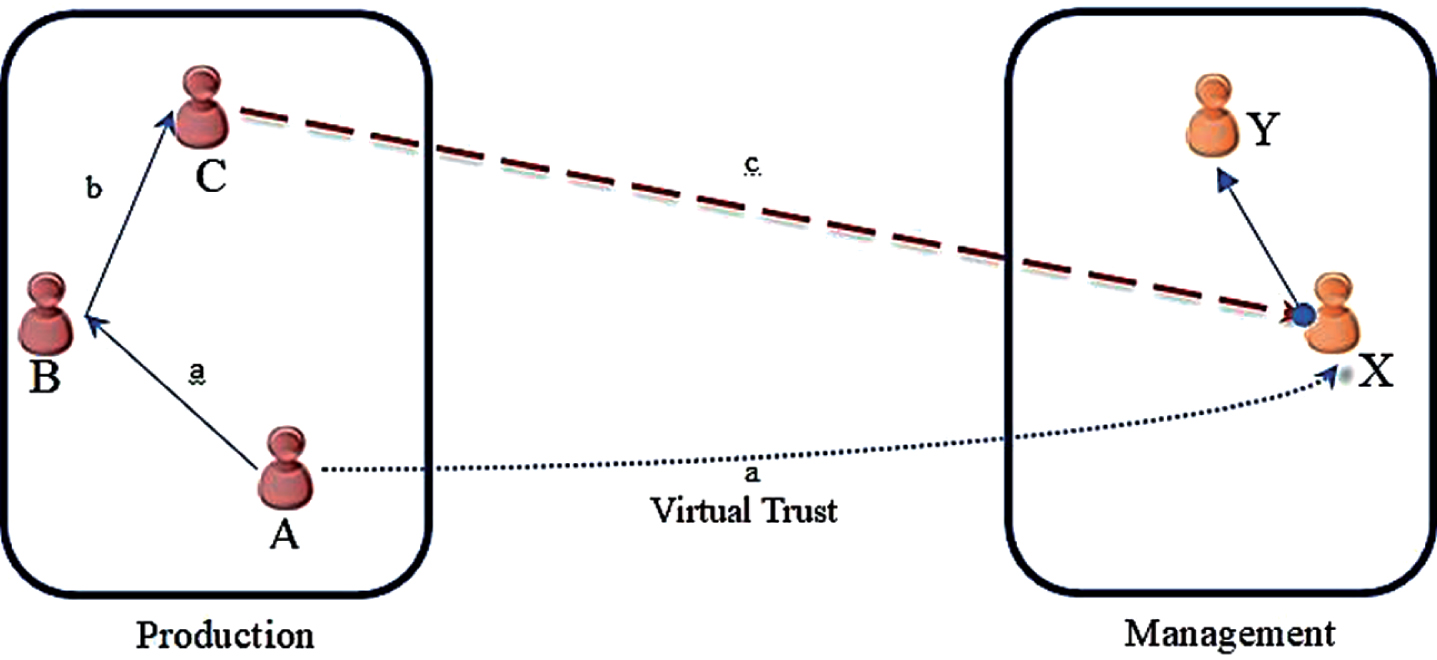
Estimating trust level for virtual network.
The three dimension of trustworthiness are based upon cognition based trust, whereas information sensitivity and privacy that is going to be shared should also be observed. The entire four dimensions are equally important while trusting each other. From these dimensions existing direct trust levels between the agents are calculated using Fuzzy Inference Engine.
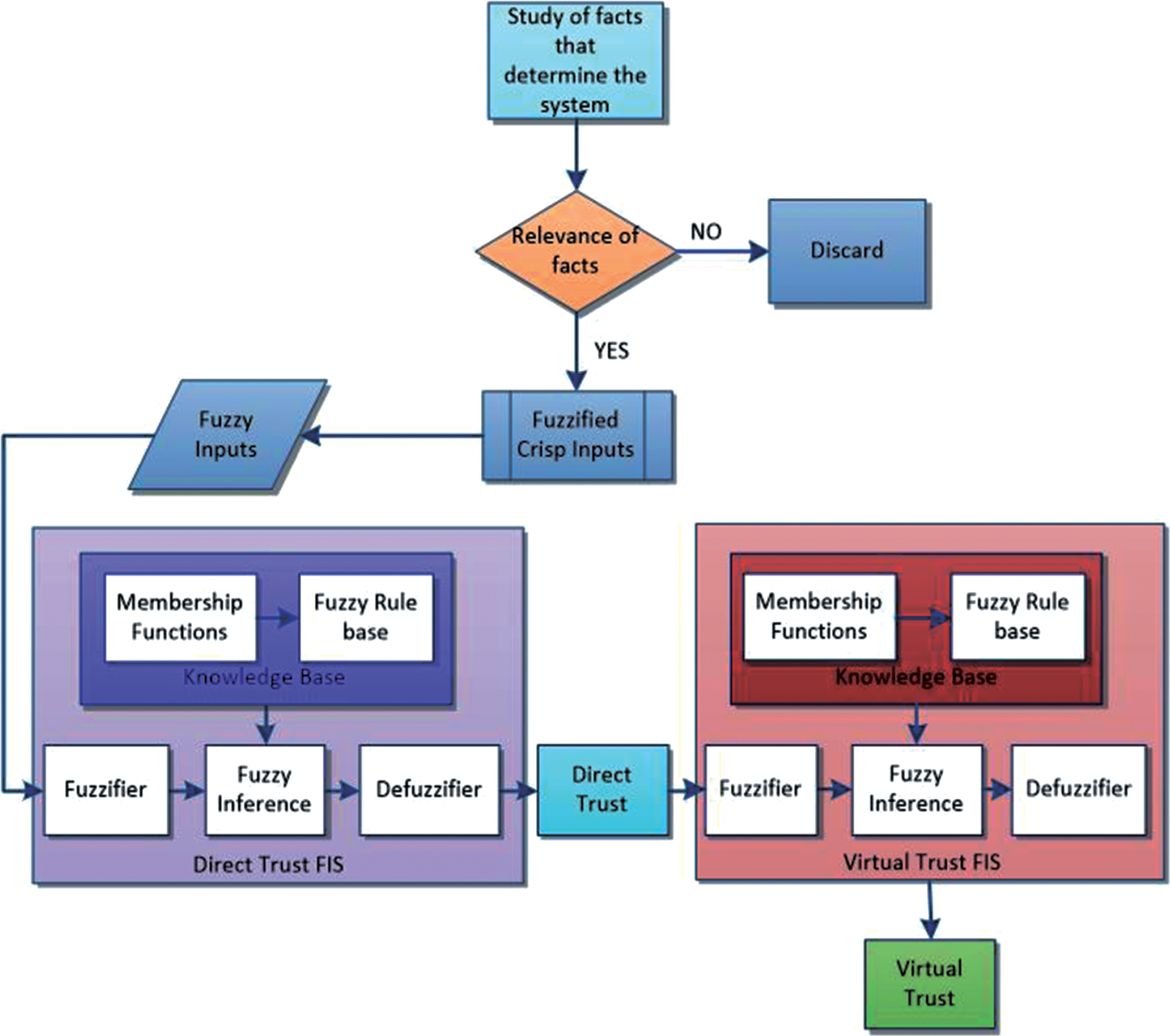
A cascaded fuzzy inference system with two layers in context of above discussion is proposed for the estimation of initial trust level between agents to start communication.
Since the trust levels have been calculated by fuzzy inference system, where the inputs, outputs and there ranges for varying linguistic values are given in Tables 1 and 2.
Ranges for Fuzzy Inference System for calculating weights of virtual trust
Ranges for Fuzzy Inference System for calculating weights of virtual trust
Ranges for Fuzzy Inference System for calculating weights of virtual trust
The above mentioned dimensions of trust given in Tables 1 and 2 are arranged for all possible combinations to construct rules for the two levels of proposed fuzzy inference engine. The possible rules fed to the fuzzy system are covered in Section 3.2.
A membership function (MF) is a curve that defines how each point in the input space (also called universe of discourse) is mapped to a membership value (or degree of membership) between 0 and 1. Membership functions for level 1 and 2 are given as under.
Membership functions for proposed Socio-Fuzzy Inference (Socio-FIS) System are given in Tables 3 and 4.
Mathematical & Graphical MF of Layer-1 Socio-Fuzzy Inference System Input/ Output variables
Mathematical & Graphical MF of Layer-1 Socio-Fuzzy Inference System Input/ Output variables
Mathematical & Graphical MF of Layer-2 Socio-Fuzzy Inference System Input/ Output variables
A compound fuzzy proposition is a composition of atomic fuzzy propositions using the connectives “or,” “and,” and “not” which represent fuzzy union, intersections and complement, respectively. Here, a, i, b, s represents ability, integrity benevolence and sensitivity then the following fuzzy propositions hold:
FP1 = (Ability is Incapable and Integrity is Dishonest and Benevolence is Indifferent and Security is Public)
Here the function t- norm for layer-1 and layer-2 are defined as:
Equation (1) transforms the membership functions of fuzzy sets of Ability, Integrity, Benevolence and Sensitivity for level 1 of proposed fuzzy inference system among membership function of the intersection of Ability, Integrity, Benevolence and Sensitivity that is:
Whereas from Equation (2) membership functions of fuzzy sets of direct trust Td1, Td2 and Td3 among the membership function of the intersection of Td1, Td2 and Td3 for FIS level 2 as:
In Equations (1) and (2), for the function t; getting qualified as an intersection, following axioms must be satisfied and will be called as t-norm:
Equation (3) can be written in terms of t-norm as:
Similarly Equation (4) can be interpreted as
From Equations (3) & (5)
And from Equations (4) & (6)
In order to formulate the conditional statements that embrace fuzzy logic, if-then statements are used. These statements provide the core grounds to construct fuzzy rule vase. In current situation, few rules for layer 1 and layer 2 of fuzzy inference system are provided as under. IF (A is Incapable and I is Dishonest and B is Indifferent and S is Public) THEN Td is Weak IF (A is Incapable and I is Honest and B is Indifferent and S is Public) THEN Td is Weak
IF (A is Capable and I is Highly Honest and B is Highly Compassionate and S is Public) THEN Td is Strong
Similarly rules may be written for level 2 of proposed FIS as follows IF ( IF ( IF (
Mamdani implications
The fuzzy IF-THEN rule in section 3.4 is interpreted as a fuzzy relation Q81 with the membership function for level 1 and Q27 with the membership function for level 2 are written as
Then we may calculate fuzzy product for Ability: Incapable and Integrity: Dishonest γFP1 as under
Furthermore,
In the same way Equations (11–13) can be extended for μFP1(Incapable,Dishonest,Indifferent,Public) as under in Equations (14–16) respectively:
In the same way membership functions for FIS level 2 may be written as
Fuzzy IF-THEN rules are the constituents of fuzzy rule base. Fuzzy rule base is the major component of fuzzy system because all other components are used to implement these rules with realistic and proficient way. Fuzzy rule base comprises the following fuzzy IF-THEN rules, where rules for layer 1 are denoted by Ru
e
, where 1 ⩽ e ⩽ 81: ⋯ IF ( (( ⋯ IF ((
For level 2 rules for layer 2 are denoted by ru
f
where 1 ⩽ f ⩽ 27:
The above rules are in the form of canonical fuzzy IF-THEN rules as they comprise special cases of fuzzy prepositions and fuzzy rules; “Partial Rules” here.
Fuzzy inference engine
In a fuzzy inference engine, fuzzy logic principles are used to combine the fuzzy IF-THEN rules in the fuzzy rule base into a mapping from an input fuzzy set to an output fuzzy set. A fuzzy IF-THEN rule is interpreted as a fuzzy relation in the input-output product space, and we proposed implications in section 3.4 that specify the fuzzy relation. Any practical fuzzy rule base constitutes more than one rules, the key question here is how to infer with a set of rules. There are two ways to infer with a set of rules: composition based inference and individual-rule based inference.
In composition based inference, all rules in the fuzzy rule base are combined into a single fuzzy relation that lies under inner product on input universes of discourse, which is then viewed as a single fuzzy IF-THEN rule. There are two opposite arguments for what a set of rules should mean. The first one views the rules as independent conditional statements. This point of view is applicable in current implementation and therefore, a reasonable operator for combining the rules is union.
Let Ru
e
and ru
f
be a fuzzy relation that represents any fuzzy IF-THEN rule in section 3.4; that is,
Let I, φand Ψ be arbitrary fuzzy sets and be the input and output to the fuzzy inference Engine respectively. Then, by viewing Q81 and Q27 as a single fuzzy IF-THEN rule and using the generalized modus ponens (Hellendoorn, February 1992), we obtain the output of the fuzzy inference engine as
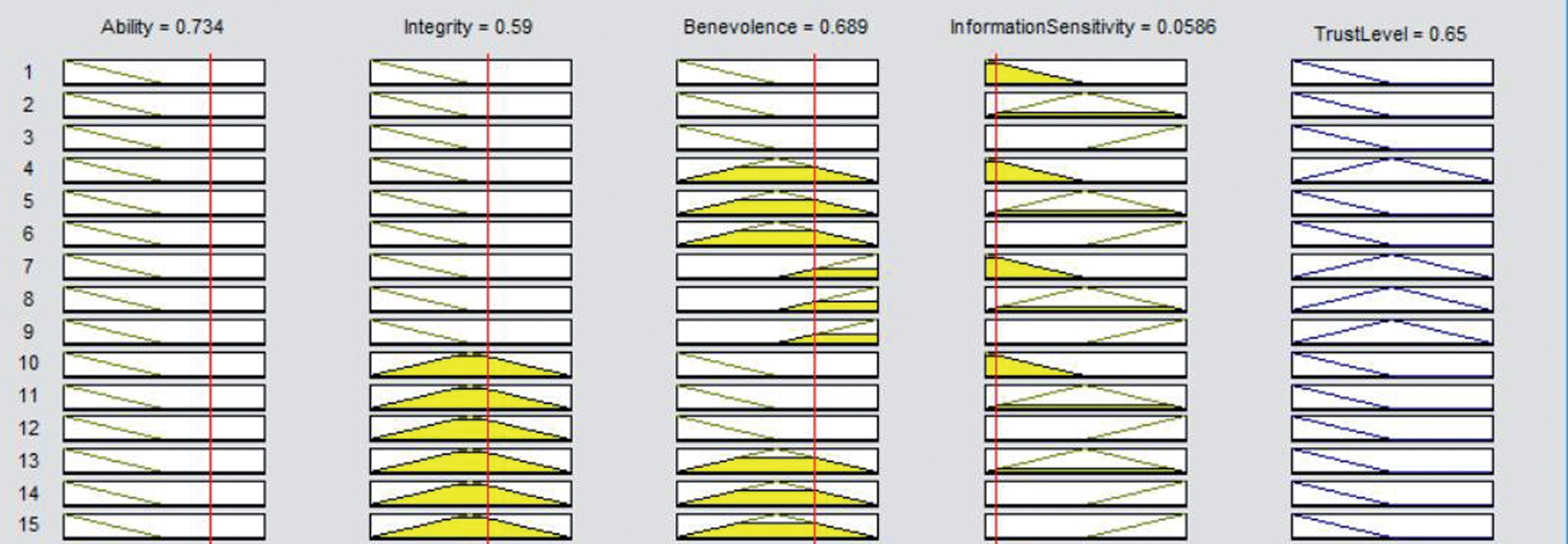
individual rule based inference with union combination Mamdani’s product implication algebraic product for all the t-norm operators Proposed multi layered socio fuzzy inference system for estimating virtual trust level to start communication between agents. Layer 1 rule viewer for proposed socio- FIS.
we obtain the product inference engine as
The defuzzifier is defined as a mapping from fuzzy set φ which is the output of the fuzzy inference engine in Equation (28) to crisp point o* for layer 1 and o** for layer 2. Theoretically, the task of the defuzzifier is to specify a point in output universe of discourse that best represents the fuzzy set φ. This is similar to the mean value of a random variable. Conversely, since φ is constructed in a number of choices in determining this representing point. The following three criteria should be considered in choosing a defuzzification scheme:
Plausibility: The point o* should represent φ from an intuitive point of view and may lie approximately in the middle of the support of φ or has a high degree of membership in φ. Computational simplicity: This criterion is particularly important for fuzzy control because fuzzy controllers operate in real-time Continuity: A small change in φ should not result in a large change in o*
The center of gravity defuzzifier specifies the o* as the center of the area covered by the membership function of, φ that is,
Fuzzy logic has Boolean logic and that works partially true or false values. Fuzzy systems deals with the Boolean values in fuzzy logic or membership values in fuzzy sets that are indicated by a value on the range [0, 1], with 0 representing absolute Falseness and 1 representing absolute Truth (Hellmann, March, 2001). The proposed Socio-Fuzzy inference system has been simulated on MATLAB and the simulated graphs have been presented in (Figs. 6–8) for direct trust and (Figs. 8–10) for virtual trust estimation.

Layer 2 rule viewer for proposed socio- FIS.

Trust level dependency upon integrity and ability.

Trust level dependency upon benevolence and ability.

Trust level dependency upon information sensitivity and ability.

Effects of trust level 1 and 2 on estimated trust.
For an effective communication setup it is important for an agent to possess a particular level of integrity and ability. Graph simulation for these factors effecting direct trust level among agents is depicted in Fig. 6. Although being integral is influential, whereas in the absence of ability communication is not effective and hence trust level will be low. On the other hand with the rise of these dimensions direct trust rises accordingly. These variations can easily be seen in Fig. 7.
Figure 8 shows accumulative effect of benevolence and ability on direct trust. In the absence of details for information security, trust level is moderately influenced by integrity and ability.
Information sensitivity is the control of access to information that might result in loss of security if unveiled to every agent. No matter at which integrity level a cognitive agent is, it will compromise over mutual trust level to maintain security level. This situation is portrayed in simulation graph shown in Fig. 8.
While estimating virtual trust an agent’s correspondence with neighboring agents to build direct trust is very persuasive. As shown in scenario depiction in Fig. 2 agent A is trying to establish a virtual trust on X through its neighboring agents B and C.
Direct trust levels in multi agent systems drastically effect the level of virtual trust. This fact is clearly shown in Figs. 9 and 10. Virtual trust level depends not only on the neighboring trust levels but also upon the relativity of the level. This relativity has also been represented in Table 5.

Effects of trust level 1 and 3 on estimated trust.
Virtual Trust Estimation for some randomly assigned direct trusts
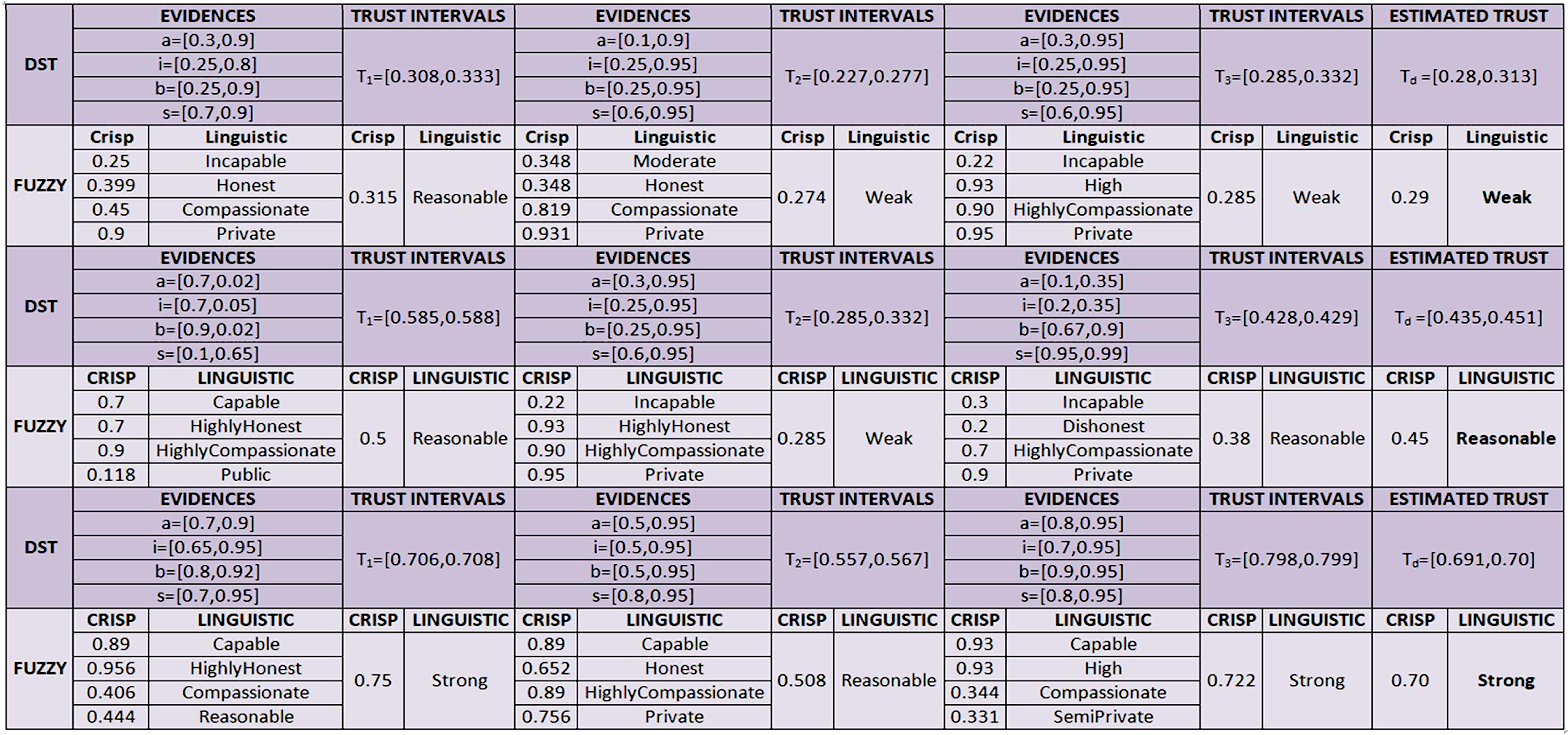
Comparing results of Socio-Fuzzy Inference Model and Dempster Shafer Theory
The Dempster-Shafer (DS) theory of belief functions [23] is a mathematical theory of evidence based on belief functions and plausible reasoning that is used to combine separate pieces of information (evidence) to calculate the probability of an event. DS theory has already been utilized in estimating and computing trust in networks and social setups [9, 25].
In comparison to results estimated in section 3.1, the technique using Dempster Shafer theory in [9] has been pre-owned here for trust estimation in the model shown by Fig. 1. There are four influencing factors namely ability “a”, integrity “i”, benevolence “b” and sensitivity “s” serving as trust dimensions.
In order to apply DS Theory for trust estimation from agent A to X following definitions may help to delineate belief intervals which will be used in this work:
Pl AX ({D})shows the extent to which agent A is not independent of agent X.
In accordance to DS Theory, the interdependence interval is defined as, [Dep
AX
({D}) , Pl
AX
({D})]. The interdependence transfer mechanism and interdependence clustering mechanism needed to combine the different kinds of evidence are presented in the following two sections. If the degree to which agent A depends on agent B is represented by interdependence interval [Dep
AB
({D}) , Pl
AB
({D})]and interdependence interval [Dep
CX
({D}) , Pl
CX
({D})]denotes the degree to which agent C depends on agent X, then according to the principle of attenuation (Kanter, 1989) we can have
Equations (28) and (29) are expressible in terms of interdependence function as:
Whereas Plausibility could be found out as:
Dempster Shafer rule of combination is used to combine two independence sets of basic probability assignments; m A , m I , m B and m S in the following manner:
For the given four evidences between two agents (A and B), to support interdependence, there are four intervals[Dep
ɛ
({D}) , Pl
ɛ
({D})] , 1 ⩽ ɛ ⩽ 4; and their aggregate probability is:
Where Fis the intersection of all the subset of a power set and K-1is called the normalized factor its values can be calculated by using the following formula:
Now, for the virtual society provided in Fig. 1 Virtual trust estimation can be calculated using Equations (1–5) of DS Theory. Assuming the trust dimensions (namely “Ability”, “Integrity”, “Benevolence” and “Sensitivity”) a, b, i, s between the agents as evidences between them and support interdependence at levels 0.7,0.7,0.9 and 0.1, and negate interdependence at levels of 0.02, 0.05, 0.02 and 0.65 producing interdependence intervals [0.7,0.9], [0.65,0.95], [0.8,0.92] and [0.7,0.95]. According to clustering mechanism provided by Equation (3) evidences A and I are combined as:
Thus interdependence interval for “a” and “i” is [Dep ai ({D}) Pl ai ({D})] = [0.88, 0.95]
Similarly the evidences “b” and “s” can also be combined as:
Therefore,, the interdependence interval for “b” and “s” is [Dep bs ({D}) Pl bs ({D})]= [0.933, 0.967]
We have,
In the same way, to find out the combined effects of trust dimensions from agent A to B, the intervals [Dep
ai
({D}) Pl
ai
({D})], [Dep
bs
({D}) Pl
bs
({D})] are used to calculate [Dep
ai
({D}) Pl
ai
({D})] ⊕ [Dep
bs
({D}) Pl
bs
({D})] as follows:
So finally, for agent A and B the interdependence interval for trust dimensions is
Trust interval between agent A and B is therefore calculated as [0.992, 0.994]. Similarly, trust intervals for agents B and C for evidences
Is calculated as [Dep
BC
({D}), Pl
BC
({D})] = [0.557, 0.567] and between C and X with evidences
Let T
d
be the aggregated trust interval between agent A and X which is the sum of three intensity intervals T1, T2 and T3 representing trust levels between specified pairs of agents can be obtained by their weighted aggregate sum is given by:
Table 6 shows three trust estimation results for three random cases (Weak, Reasonable, Strong) through DS Theory and compares the estimated resultant trust intervals with those generated with socio-fuzzy inference model depicted in section 3.1. It has been found out that the two methods support trust estimation to a higher precision with negligible amount of difference.
Estimating initial trustworthiness has been an important factor in our daily life before meeting someone or interacting with. This paper has presented one of the possibilities for Multi Agent Systems to act human like and behave cognitively to estimate virtual trust level. Computational fuzzy inference system simulation model along with fuzzy mathematical model has been proposed to assess virtual trust to start communication and the results have been compared with their corresponding belief and plausibility functions obtained by Dempster Shafer Theory. The relative influence of neighboring trust on virtual trust estimation has also been observed. In future the process may be implemented using artificial neural networks, deep learning technique or some advance techniques of machine learning to make the system more robust.