In this paper, using the structures of (L, L)-fuzzy product supratopological spaces which were introduced by Hu Zhao and Gui-xiu Chen, we give a proof of generalized Tychonoff theorem in L-fuzzy supratopological spaces by means of implication operations.
As the generalization of topological spaces, Mashhour firstly introduced the notion of supratopological spaces [6]. In 1987, El-Monsef and Ramadan [1] introduced the concept of fuzzy supratopological spaces by using the notion of fuzzy supraopen sets. In 2000, Ghanim, Tantawy and Selim [3] introduced the notion of I-fuzzy supratopological spaces. In 2014, Shi and Liang [7] gave the notions of the degrees of compactness in L-fuzzy supratopological spaces by means of implication operations. It is worth mentioning that this concept can not be extended to (L, M)-fuzzy supratopological spaces. Subsequently, Liang and Shi [4] gave the new notions of the degrees of compactness in (L, M)-fuzzy supratopological spaces, they proved the notions of precompactness, semi-compactness and sp-compactness in (L, M)-fuzzy topological spaces can be viewd as special cases of compactness in (L, M)-fuzzy supratopological spaces. However, some results on compactness in (L, M)-fuzzy product supratopological spaces were not given, including some similar results on precompactness, semi-compactness and sp-compactness in (L, M)-fuzzy topological product spaces were not obtained, especially when M is equal to L. Follow this idea, Hu Zhao and Gui-xiu Chen [12] studied the degrees of compactness in (L, M)-fuzzy product supratopological spaces. Significantly, the degrees of compactness in (L, L)-fuzzy supratopological spaces [4] isn’t the degrees of compactness in L-fuzzy supratopological spaces by means of implication operations [7]. Therefore, the purpose of this paper is to study the generalized Tychonoff theorem in L-fuzzy supratopological spaces by means of implication operations.
Throughout this paper, both L and M always denote Hutton algebras. A Hutton algebra (L, ∨ , ∧ , ′), is a completely distributive lattice with order-reversing involution with the smallest element 0 and the largest element 1. An element c ∈ L is called prime if a ∧ b ⩽ c implies a ⩽ c or b ⩽ c . c ∈ L is called coprime if a′ is a prime element. The set of all nonunit prime elements in L is denoted by P (L). The set of all nonzero coprime elements in L is denoted by J (L). We say that a is wedge below b in L, denoted by a ⪡ b, if for every subset C ⊆ L, ⋁C ⩾ b implies c ⩾ a for some c ∈ C (see [5,10-11, 5,10-11]). A complete lattice L is completely distributive lattice iff a = ⋁ {b ∈ L ∣ b ⪡ a}. β (b) is the greatest minimal family of b, β∗ (b) = β (b) ∩ J (L) is a minimal family of b. α (b) is the greatest maximal family of b, α∗ (b) = α (b) ∩ P (L) is a maximal family of b. When L is completely distributive lattice, each element b in L has the greatest minimal family(resp., the greatest maximal family) (see[10-11]).
In a completely distributive lattice L, there exists a binary operation →, and the implication is defined by
It is easy to verify the following properties of →.
(1) (a → b) ⩾ c ⇔ a ∧ c ⩽ b.
(2) a → b = ⊤ ⇔ a ⩽ b.
(3) a → ⋀ ibi = ⋀ i (a → bi).
(4) (⋁ iai) → b = ⋀ i (ai → b).
(5) a ⩽ b ⇒ a → c ⩾ b → c, c → a ⩽ c → b.
(6) (a ∧ b) → c = a → (b → c).
For a subfamily , denotes the set of all finite subfamilies of , and for every index set I, 2(I) denotes the set of all finite subsets of I.
Definition 1.1. [1, 4] Let X be a nonempty set, LX the set of all L-subsets on X, 0X the smallest element of LX and 1X the largest element of LX. An (L, M)-fuzzy supratopology on a set X is a map such that
(1) ;
(2) can be interpreted as the gradation of supraopenness of A, and will be called the gradation of supraclosedness of A. The pair is called an (L, M)-fuzzy supratopological space. Obviously, if (L, M) = (L, L), then is an L-fuzzy supratopological space.
A mapping f : X ⟶ Y from an (L, M)-fuzzy supratopological space to another (L, M)-fuzzy supratopological space is said to be continuous if for each G ∈ LY. The category of all (L, M)-fuzzy supratopological spaces and their continuous mappings is denoted by (L, M)-FsupraTOP.
Next, we give some examples on (L, M)-fuzzy supratopology.
Example 1.2. (1) Let L = {(0, 0) , (1, 1)} ∪ (0, 1) 2 be a subset of the square [0, 1] 2 and M = [0, 1], "⩽" and "′" are defined as follows:
and
Then (L, ⩽ , ′) is a Hutton algebra. Let X = {x, y}, define as follows:
It is easy to verify that
This implies is an (L, M)-fuzzy supratopology on X. However, is not an (L, M)-fuzzy topology on X. In fact, set
and
then
Hence, it follows that is not an (L, M)-fuzzy topology on X.
(2) (i) Let τ be an (L, M)-fuzzy topology on X. For any E, define a mapping as follows:
Then is called the (L, M)-fuzzy semiopen operator induced by τ (see [4,7, 4,7]).
(ii) Let τ be an (L, M)-fuzzy topology on X. For any E, define a mapping as follows:
Then is called the (L, M)-fuzzy preopen operator induced by τ (see [4,7, 4,7]).
(iii) Let τ be an (L, M)-fuzzy topology on X. For any E, define a mapping as follows:
Then is called the (L, M)-fuzzy semi-pre open operator induced by τ (see[2,4,7, 2,4,7]).
It is easy to check that the above three operators and (L, M)-fuzzy topology are special (L, M)-fuzzy supratopology.
Definition 1.3. [12] Let be a family of (L, M)-FsupraTOP-objects, let , and let pi : X ⟶ Xi be the i-th projection. The (L, M)-fuzzy product supratopology on X is denoted , is the weakest (L, M)-fuzzy supratopology on X such that pi is continuous. The pair is called the product supratopological space of .
Theorem 1.4. [12] Let be a family of (L, M)-FsupraTOP-objects, let X be a nonempty set, and let fi : X ⟶ Xi be a mapping for each i ∈ I. Define by
where I is an index set, and for each j ∈ J. Then
(1) is the unique (L, M)-fuzzy supratopological space on X such that each fi is continuous for each i ∈ I.
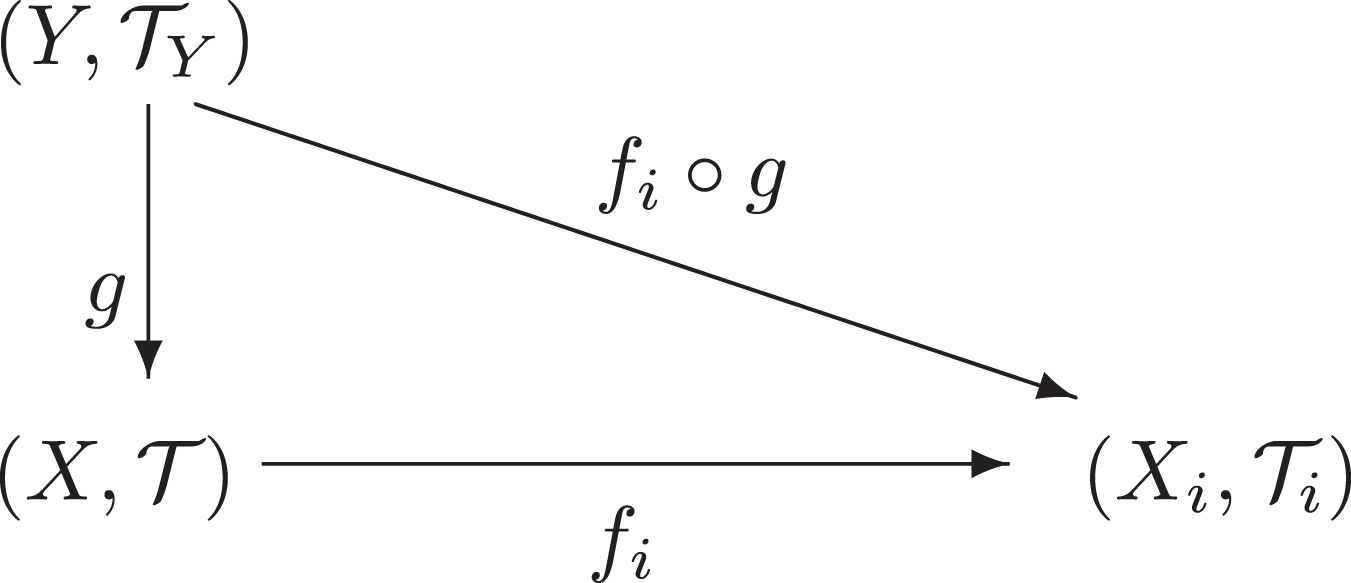
(2) If is an (L, M)-fuzzy supratopological space and a mapping, then g is continuous iff fi ∘ g is continuous for each i ∈ I (see Fig.1).
Commutative diagram.
By Theorem 1.4, we can obtain Corollary 1.5 as follows:
Corollary 1.5. [12] Let be a family of (L, M)-FsupraTOP-objects, let , and let pi : X ⟶ Xi be the i-th projection. Define by
where I is an index set, and for each j ∈ J. Then is the product supratopological space of .
Definition 1.6. ([8, 9]) An L-fuzzy inclusion on X is a mapping defined by the equality .
In the sequel, we will write instead of .
Definition 1.7. ([7]) Let be an L-fuzzy supratopological space. For any A ∈ LX, define as follows:
Then is called the degree of fuzzy compactness of A with respect to .
Lemma 1.8. ([7]) Let be an L-fuzzy supratopological space and A ∈ LX. For any , if
Then
Lemma 1.9. ([7]) Let f : X ⟶ Y be a set mapping. be an L-fuzzy supratopology on X, be an L-fuzzy supratopology on Y, and be continuous. Then ∀A ∈ LX,
The main results are as follows:
Theorem 1.10. (Generalized Tychonoff theorem)
(1) Let be the L-fuzzy product supratopological space of , then
where Ai ∈ LXi for any i ∈ I.
(2) Let be the L-fuzzy product supratopological space of , then
A proof of the main results
In this section, using the structures of (L, L)-fuzzy product supratopological spaces, we will give a proof of Theorem 1.10.
Proof. (1) Suppose that then for any i ∈ I .
Thus ∀i ∈ I, we have that
By Lemma 1.8, we only need to prove
for any
Suppose that then , , and b ∈ β (a).
Notice that, for any
where I is an index set, and for each j ∈ J.
Thus ∀xλ ⪡ C, there exists a finite J0 of I and Cj ∈ LXj such that for each j ∈ J0, and
Furthermore, there exists such that and for each j ∈ J0,
From the above proved, we can obtain the following result:
if for each , then there exists a finite J0 of I and Vj ∈ LXj such that and for each j ∈ J0 .
Let and where ∀j ∈ J0 ⊆ I .
So, ∀j ∈ J0, we can obtain
and .
Meanwhile, ∀x ∈ X, we can obtain
Case 1: If for any x ∈ X, then
In this case, we have that
Case 2: If there exists x = {xi} i∈I ∈ X such that , then for each i ∈ I.
Now, we show that there exists j ∈ J0 such that for any yj ∈ Xj. If not, ∀j ∈ J0, there exists yj ∈ Xj such that
Hence, and . We take z = {zj} j∈I such that zj = yj when j ∈ J0, zj = xj otherwise. Obviously,
and b ∉ β (A′ (z)) .
By for any j ∈ J0, we know that
Hence . This yields a contradiction.
Thus we obtain the proof that there exists j ∈ J0 such that
for any yj ∈ Xj. This shows
Therefore,
In this case, we also have that
By cases 1 and 2, we know that , Hence,
(2) By (1) and Lemma 1.9, we can easily obtained the result, so we omit it.□
References
1.
Abd El-MonsefM.E. and RamadanA.E., On fuzzy supratopological spaces, Indian J Pure Appl Math18 (1987), 322–329.
2.
GhareebA., L-fuzzy semi-preopen operator in L-fuzzy topological spaces, Neural Comput and Applic21 (2012), 87–92.
LiangC., ShiF.-G., A new kind of measures of compactness in (L;M)-fuzzy supratopological spaces, J Intell Fuzzy Syst33 (2017), 2109–2117.
5.
LiuY.M., LuoM.K., Fuzzy topology, World Scientific Publishing, Singapore, 1997.
6.
MashhourA.S., AllamA.A., MahmoudF.S., KhedrF.H., On supratopological spaces, Indian J Pure Applied Math14(4) (1983), 502–510.
7.
ShiF.-G., LiangC., Measures of compactness in L-fuzzy pretopological spaces, J Intell Fuzzy Syst26 (2014), 1557–1561.
8.
ŠostakA.P., , On compactness and connectedness degrees of fuzzy sets in fuzzy topological spaces, in: General Topology and its Relations to Modern Analysis and Algebra, Heldermann Verlag, Berlin, 1988.
9.
ŠostakA.P., Two decades of fuzzy topology: Basic ideas, notions and results, Russian Math Surveys44 (1989), 125–186.
10.
WangG.J., A new fuzzy compactness defined by fuzzy nets, J Math Anal Appl94 (1983), 1–23.
11.
WangG.J., Theory of topological molecular lattices, Fuzzy Sets Syst47 (1992), 351–376.
12.
ZhaoH., ChenG.X., Measures of compactness in (L, M)-fuzzy product supratopological spaces, Asia Mathematika2 (2018), 59–68.