In this study, hesitant fuzzy graph (HFG) structure and some concepts related to HFGs such as homomorphism, isomorphism, weak isomorphism and co-weak isomorphism are introduced. Also, operations of Cartesian product, direct product, lexicographical product and strong product between two HFGs are defined, and examples are given related these operations. Finally, a decision making algorithm and an application of HFGs in decision making are given.
The concept of fuzzy set, which is a useful tool to model vague and indeterminant information in real world, was defined by Zadeh [54] in 1965. A fuzzy set is characterized by its membership function. In a fuzzy set, each element in reference set has a membership degree, and there isn’t any hesitation on this membership degree. This case isn’t convenience to model some problems in the real life. Therefore, in 1986 Atanassov proposed the concept of intuitionistic fuzzy set which permits us to include some hesitations on membership degree. In classical set theory, we know that there are two important properties, one of them is that in a set ordering of elements doesn’t matter and the other is that repeated elements in a set are redundant. But in some cases, we may need a structure containing repeated elements. To express these situations Knuth [24] defined the concept of multi-sets(or bags). In 1986, Yager discussed operations of bags such as union, intersection and addition. He also gave a definition of fuzzy bags as a generalization of bags. In 2010, the concept of hesitant fuzzy set (HFS), which is another generalization of fuzzy bags, was proposed by Torra [51]. Recently, HFS and its applications are progressing rapidly [13, 40],
Rosenfeld [41] introduced the concept of fuzzy graphs (FG) based on fundamental idea proposed by Kauffman [23], and obtained some structures related to FGs. Relations between FGs and fuzzy groups were discussed by Bhattacharya [10], and some remarks were given. Bhutani [11] defined concepts of weak isomorphism, co-weak isomorphism and isomorphism between FGs. Then, Mordeson and Peng [33] defined cartesian product, composition, union and join operations of FGs, and studied on some of their properties. Sunitha and Kumar [49] modified definition of complement of a FG, and studied some properties of self complementary FGs. Also some works on FGs may be found in [4, 47].
The concepts of intuitionistic fuzzy relation (IFR) and intuitionistic fuzzy graph (IFG) were defined by Atanassov [7]. Based on a special case of Atanassov’s definition, Karunambigai and Parvathi [18] introduced IFG, and defined operations between IFGs. Akram and Davvaz [2] investigated some properties of IFGs. Sahoo and Pal [45] defined some product operations on IFGs and discussed some of their properties. Some more works on IFRs, IFGs and mean operators of IFSs may be found in [1, 48].
In 2015, Pathinathan et al. [39] constructed a new graph structure called hesitancy fuzzy graph (HFG), and gave some basic concepts related to this structure. Even though Pathinathan et al. [39] introduce the concept of hesitancy fuzzy graph, they don’t assign hesitant fuzzy elements (HFEs) to vertices and edges of graph. They use IF-values instead of HFEs, and indicate these IF-values with triples including membership degree, hesitancy degree and non-membership degree of vertices and edges. It can be seen that Pathinathan et al.’s definition is a similar structure to neutrosophic graphs [3, 17] with some aspects.
Despite the fact that the concept of HFS is a similar concept to the IFSs, there are some basic differences between them in terms of their interpretations and operations. The HFS is more functional than IFS in a decision making problem to model hesitancy in opinion over objects. In a similar way, the HFG is a generalization of the IFG and FG, but it is a more useful tool than IFGs for modeling some decision making problems which include hesitancy of decision makers related to vertices and edges.
Taking into account these considerations, in this paper, we define some new concepts such as Cartesian product of HFSs, hesitant fuzzy relation, hesitant fuzzy graph (HFG), which is different from definition in [39], hesitant fuzzy subgraph (HF-subgraph), partial HF-subgraph by using definition of HFG structure defined in this paper, and give examples related to these concepts. We also introduce concepts of homomorphism, isomorphism, weak isomorphism and co-weak isomorphism between two HFGs based on definition of HFG. Furthermore we define operations of Cartesian product, direct product, lexicographical product and strong product between two HFGs and give examples related these operations, and obtain some of their properties. Finally, to determine dominant element in a group an application of the HFGs in decision making is given.
Preliminaries
In this section, we recall basic definitions related to graphs and HFSs.
2.1. Graphs
A graph is an ordered pair G (V, E), where V is the set of vertices of G and E is the set of edges, formed by pairs of vertices. A simple graph is an undirected graph that has no loop and no more than one edge between any two different vertices. Throughout the paper, G will be considered as a simple graph. Let G = (V, E) be a graph. If for any x, y ∈ V, {x, y} is an edge of graph G it is said that vertices x and y are adjacent in G. Let G = (V, E) and H = (U, F) be two graphs. If U ⊆ V and F ⊆ E, then it is said to be graph H is a subgraph of graph G.
Let G1 = (V1, E1) and G2 = (V2, E2) be two graphs.
The graph G1 × G2 = (V, E) is called the cartesian product of G1 and G2, where V = (V1 × V2) and E = {(x, x2) (x, y2) |x ∈ V1, x2y2 ∈ E2} ∪ {(x1, z) (y1, z) |z ∈ V2, x1y1 ∈ E1} .
The graph G1 ∗ G2 = (V, E) is called the direct product of G1 and G2, where V = (V1 × V2) and E = {(x1, x2) (y1, y2) |x1y1 ∈ E1, x2y2 ∈ E2} .
The graph G1 • G2 = (V, E) is called the lexicographic product of G1 and G2, where V = (V1 × V2) and E = {(x, x2) (y, y2) |x ∈ V1, x2y2 ∈ E2} ∪ {(x1, x2) (y1, y2) |x1y1 ∈ E1, x2y2 ∈ E2} .
Let G1 = (V1, E1) and G2 = (V2, E2) be two graphs. The graph G1 ⊗ G2 = (V, E) is called the strong product of G1 and G2, where V = (V1 × V2) and E = {(x, x2) (y, y2) | x ∈ V1, x2y2 ∈ E2} ∪ {(x1, z) (y1, z) |z ∈ V2, x1y1 ∈ E1} ∪ {(x1, x2) (y1, y2) |x1y1 ∈ E1, x2y2 ∈E2} .
Hesitant fuzzy sets
Definition 2.1. [51] Let X be a non-empty set. Then, a hesitant fuzzy set (shortly HFS) in X is in terms of a function that when applied to X return a subset of [0, 1] . We express the HFS by a mathematical symbol: A = {(x, ξA (x)) : x ∈ X} , where ξA (x) is a set of some values in [0, 1] , denoting the possible membership degrees of the element x ∈ X to the set A, ξ = ξA (x) is called a hesitant fuzzy element (HFE) and denotes the set of all HFEs on X.
Definition 2.2. [51] Let . Then, lower and upper bound of ξA (x) related to x ∈ A are defined as follows:
respectively.
Definition 2.3. [51] Let . α-lower and α-upper bounds of HFS A are defined as follows:
respectively. Here, and
Definition 2.4. [51] Let . Then, complement of HFS, union and intersection operations between two HFSs are defined as follows:
Definition 2.5. [53] Let , and ξA (x) be a HFE of HFS A. Then, is called the score function of ξA (x).
Here l (ξA (x)) denotes the number of values in ξA (x) .
Deepak and John [14] defined hesitant fuzzy subset (HFS-subset) of a HFS as follows:
Definition 2.6. [14] Let . If, for all x ∈ X, δ (ξA (x)) ≤ δ (ξB (x)), then it is said that HFS A is a HFS-subset of HFS B, and denoted by A ⪯ B.
Example 1. Let X = {x1, x2, x3} be a discourse set, HFSs A and B on X be A = {(x1, {0.3, 0.4, 0.5}) , (x2, {0.4, 0.8, 0.6, 0.7}) , (x3, {0.5, 0.2})} and B = {(x1, {0.5, 0.9}) , (x2, {0.8, 1.0, 0.9}) , (x3, {0.6, 0.7, 0.8})}. It is easy verified that A ⪯ B. Also, by Definition 2.6, δ (ξA (x1)) =0.4 ≤ 0.7 = δ (ξB (x1)), δ (ξA (x2)) ≤ δ (ξB (x2)) , and δ (ξA (x3)) ≤ δ (ξB (x3)). Therefore, we say that A ⪯ B.
Based on score based intersection given in [14], we define score based intersection operation as follows.
Definition 2.7. Let represented by their membership functions ξA and ξB. Then, a score based intersection of HFEs ξA (x) and ξB (x), denoted by is defined as follows:
Definition 2.8. Let . If, for all x ∈ X, , then it is said that HFS A is a strong hesitant fuzzy subset (SHFS-subset) of HFS B, and denoted by A ≺ B.
Proposition 2.9. If HFS A is a SHFS-subset of HFS B, then for all x ∈ X, δ (ξA (x)) ≤ δ (ξA (x)) .
Proof. The proof is easily made by using definition of SHFS-subset and scores of HFS.□
Proposition 2.10. Let A and B be two HFSs over X. Then, .
Proof. The proof is obvious from Definition.□
3. Hesitant fuzzy relation
Definition 3.1. Let A and B be two HFSs over sets X and Y, respectively. Then, the Cartesian product of HFSs A and B, denoted by , is defined as follows:
Definition 3.2. Let X and Y be two non-empty sets and let A and B be two HFSs over sets X and Y, respectively. Then, hesitant fuzzy relation (shortly HFR) from the HFS A into HFS B, denoted by , is a HFS on X × Y such that , for all (x, y) ∈ X × Y.
If A = B, then is called a HFR on HFS A.
Example 2. Let X = {x1, x2, x3} and Y = {y1, y2} and let A and B be two HFSs on X and Y given as follows:
Ax1x2x3
Definition 4.1. Let G = (V, E) be a graph, be a HFS on V and be a HFS on E ⊆ V × V. If for all (x, y) ∈ E, it is called a hesitant fuzzy graph (HFG) over graph G = (V, E) and denoted by .
HFS over V is HF-vertex set of HFG and HFS over E is the HF-edge set of HFG. Note that is a symmetric HFR on .
From now on we use the notation xy for (x, y) ∈ E. In this study, we will not appear elements ξA (x) = {0} in HFG. Throughout this paper, set of all HFGs over vertex set V will be denoted by .
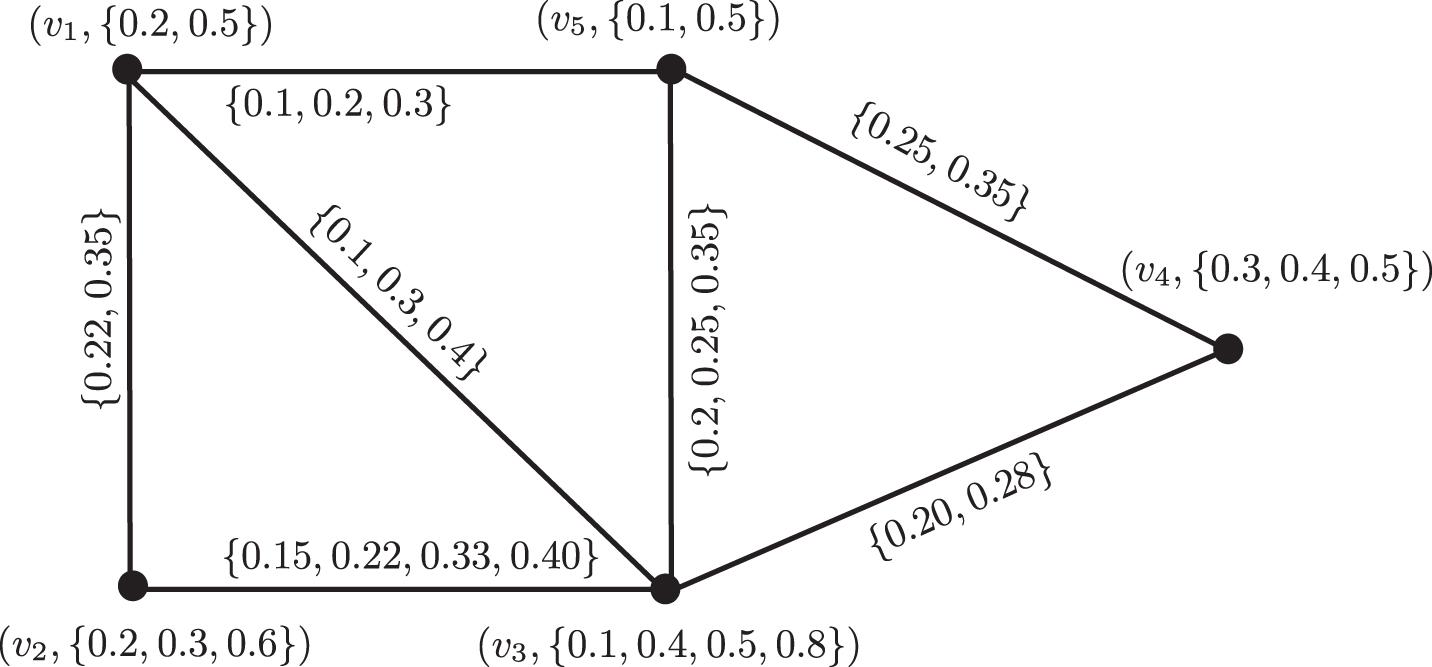
Example 3. Let V = {v1, v2, v3, v4, v5} be an initial universe, be a HFS over V and be a HFS over E = {v1v2, v1v3, v1v5, v2v3, v3v4, v3v5, v4v5} ⊆ V × V given as follows:
Definition 4.2. Let be a HFG on graph . The degree of a vertex x ∈ V in a HFG is defined as
Example 4. Let us consider HFG in Example 1. Then, and
Definition 4.3.Let and be two HFGs over G1 = (V1, E1) and G2 = (V2, E2), respectively. If ξA (x) ⪯ ξB (x) and , then HFG is called a hesitant fuzzy subgraph (HF-subgraph) of and denoted by
Definition 4.4.Let and be two HFGs over G1 = (V1, E1) and G2 = (V2, E2), respectively. If V1 ⊆ V2, ξA (x) ⪯ ξB (x) for all x ∈ V1 and for all x, y ∈ V1, then HFG is called a partial HF-subgraph of and denoted by
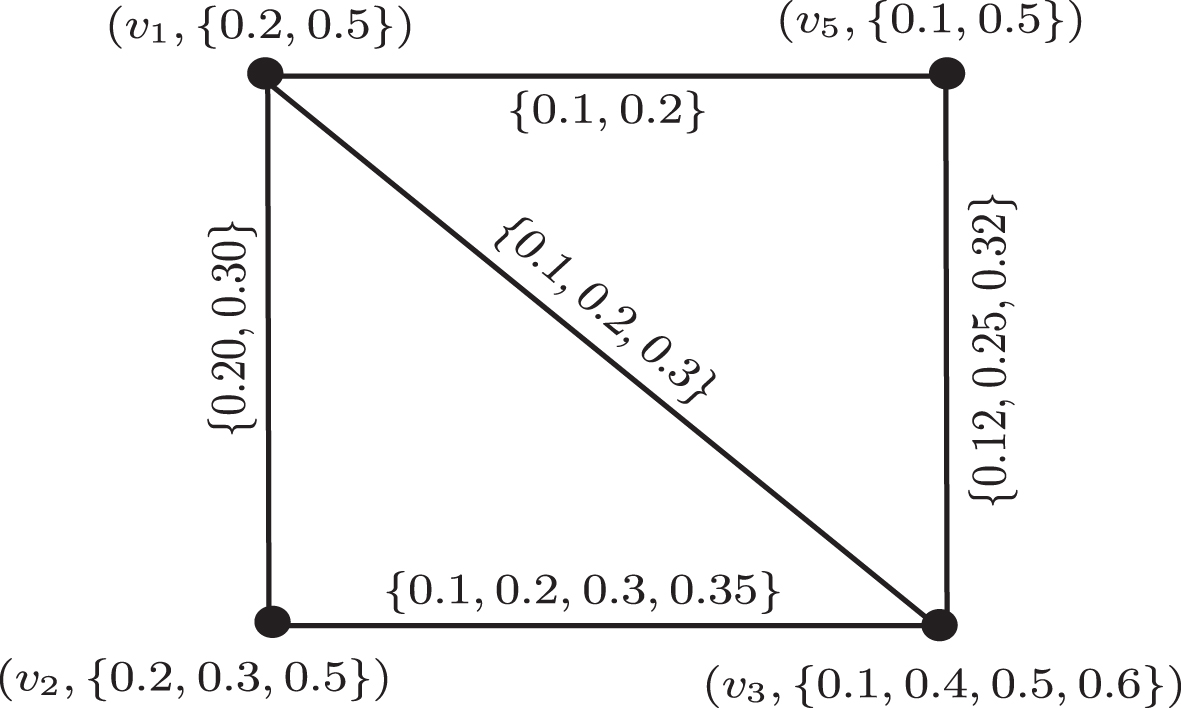
Example 5. Consider HFG given as in Example. Given HFG and as follows:
Then, partial HF-subgraph can be depicted as in Fig. 2.
Definition 4.5. Let and be two HFGs over graphs G1 = (V1, E1) and G2 = (V2, E2), respectively. Then, bijective mapping φ : V1 → V2 satisfying the following conditions is called a homomorphism from to
δ (ξA (x)) ≤ δ (ξB (φ (x))),
for all x ∈ V1, xy ∈ E1 ⊆ V1 × V1 .
Definition 4.6. Let and be two HFGs over graphs G1 = (V1, E1) and G2 = (V2, E2), respectively. Then, bijective mapping φ : V1 → V2 satisfying the following conditions is called an isomorphism from to
δ (ξA (x)) = δ (ξB (φ (x))),
for all x ∈ V1, xy ∈ E1 ⊆ V1 × V1 .
Definition 4.7. Let and be two HFGs over graphs G1 = (V1, E1) and G2 = (V2, E2), respectively. Then, bijective mapping φ : V1 → V2 satisfying the following conditions is called a weak isomorphism from to .
f is homomorphism
δ (ξA (x)) = δ (ξB (φ (x))) ,
for all x ∈ V1, xy ∈ E1 ⊆ V1 × V1 .
Example 6. Let V1 = {v1, v2, v3} V2 = {u1, u2, u3} be two vertex sets and bijective function φ : V1 → V2 is defined as φ (v1) = u1, φ (v2) = u2 and φ (v3) = u3. Let and be two HFGs over graphs G1 = (V1, E1) and G2 = (V2, E2), respectively where ξA (v1) = {0.2, 0.3, 0.5}, ξA (v2) = {0.4, 0.6}, ξA (v3) = {0.3, 0.7, 0.8} and , , ξB (u1) = {0.1, 0.2, 0.7}, ξB (u2) = {0.3, 0.5, 0.7}, ξB (u3) = {0.3, 0.6, 0.7, 0.8} and .
Here since δ (ξA (v1)) = δ (ξB (u1)), δ (ξA (v2)) = δ (ξB (u2)), δ (ξA (v3)) = δ (ξB (u3)) and , , h is a isomorphism of onto .
Remark 1. A weak isomorphism may not be an isomorphism.
In above example, if we get , , since and , then φ is weak isomorphism but φ is not an isomorphism.
Definition 4.8. Let and be two HFGs over graphs G1 = (V1, E1) and G2 = (V2, E2), respectively. Then, bijective mapping φ : V1 → V2 satisfying following conditions is called as a co-weak isomorphism from to .
φ is homomorphism
for all xy ∈ E1 ⊆ V1 × V1 .
Example 7. Let us consider function φ in Example 6. Let and be two HFGs over graphs G1 = (V1, E1) and G2 = (V2, E2), respectively where ξA (v1) = {0.2, 0.5}, ξA (v2) = {0.4, 0.5, 0.7}, ξA (v3) = {0.3, 0.7} and , ,
ξB (u1) = {0.5, 0.7, 0.8}, ξB (u2) = {0.4, 0.8}, ξB (u3) = {0.3, 0.5, 0.9} and . Here, since φ is a homomorphism from to and , , f is a co-weak isomorphism from to .
Note that f is not an isomorphism from to , since ξA (v1) ≠ξB (u1), δ (ξA (v2)) ≠δ (ξB (u2)) and δ (ξA (v3)) ≠δ (ξB (u3)) .
Definition 4.9. Let and be two HFGs over graphs G1 = (V1, E1) and G2 = (V2, E2), respectively. Then, Cartesian product of two HFGs and is denoted by and defined as follows:
for all (x, y) ∈ V1 × V2,
for all x ∈ V1, yz ∈ E2.
for all z ∈ V2, xy ∈ E1.
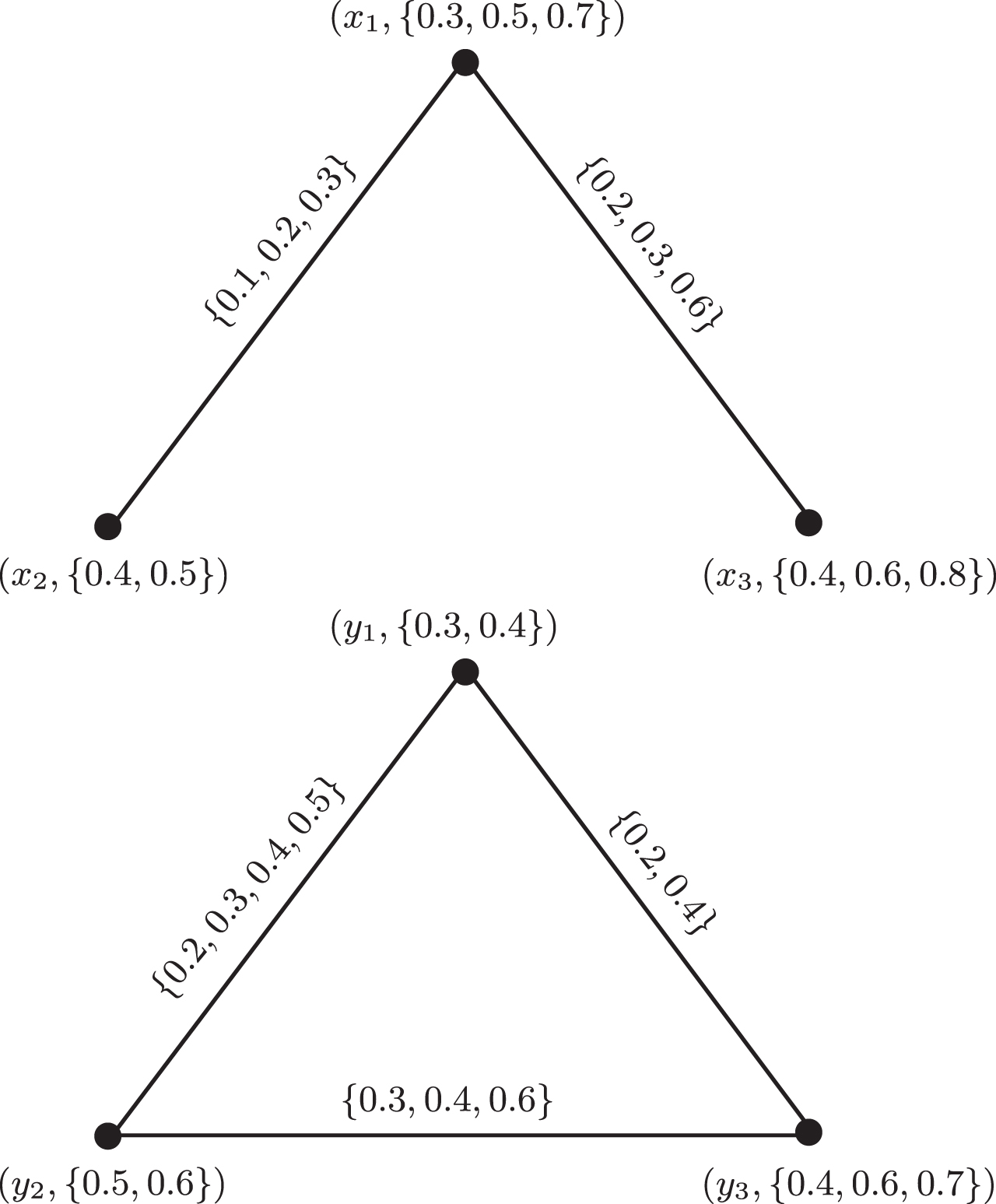
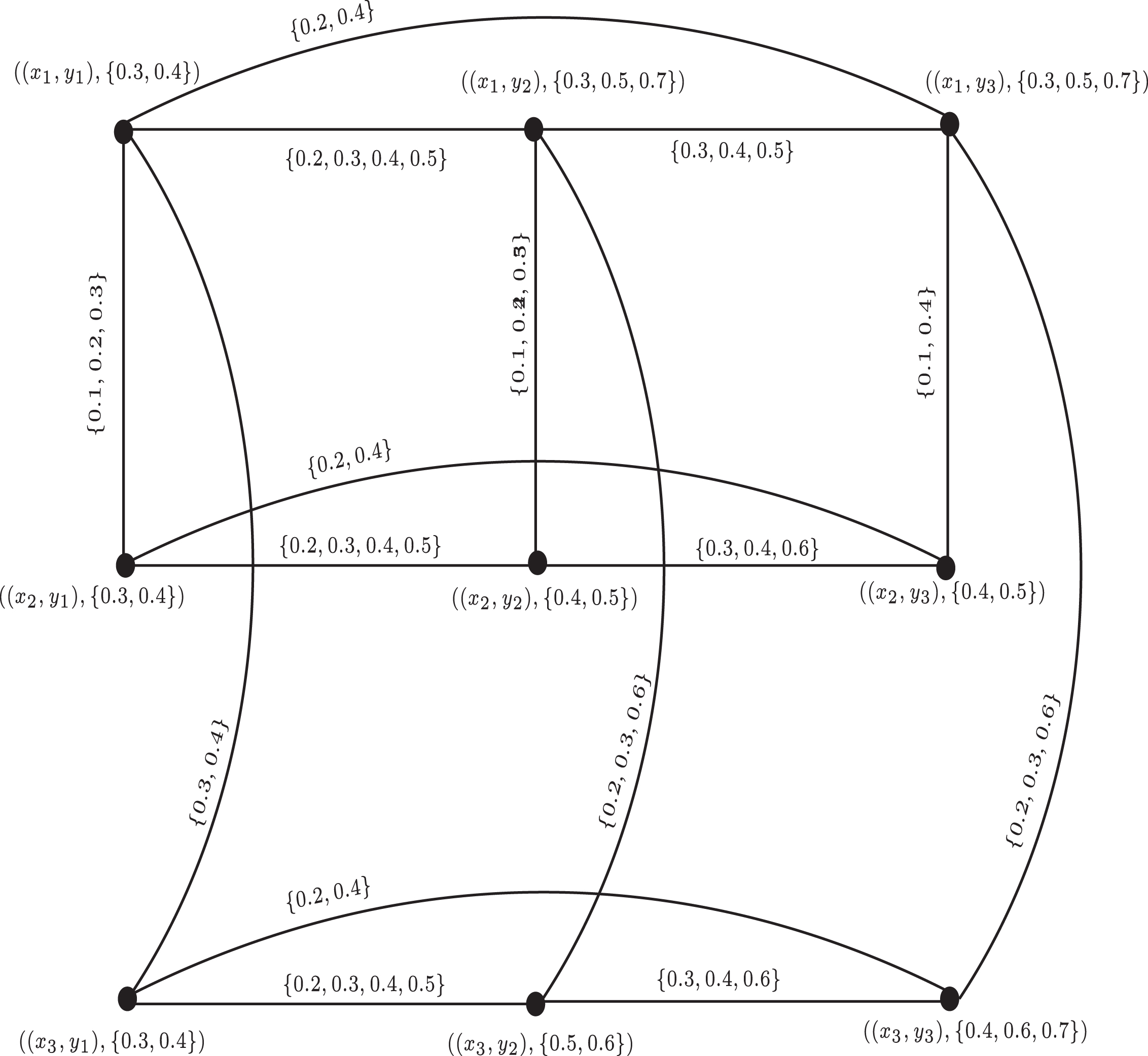
Example 8.Consider two HFGs and given as in Fig. 4. Then, Cartesian product of HFGs and is as in Fig. 5.
and HFGs, respectively.
HFG .
Proposition 4.10. Let and be two HFGs over graphs G1 = (V1, E1) and G2 = (V2, E2), respectively. Then, is an HFG.
Proof. In Definition 4.9 Case 1 is clear form definition of Cartesian product of two HFSs. Let x ∈ V1, yz ∈ E2. Since
Let z ∈ V2, xy ∈ E1. Then,
Therefore, is an HFG.□
Definition 4.11. Let and be two HFGs over graphs G1 = (V1, E1) and G2 = (V2, E2), respectively. Then, direct product of two HFGs and is denoted by and defined as follows:
, for all (x1, x2) ∈ V1 × V2,
for all xz ∈ E1 and yt ∈ E2.
Example 9. Consider two HFGs and given in Example 8. Then, direct product of HFGs and is as in Fig. 6.
HFG .
Proposition 4.12. Let and be two HFGs over graphs G1 = (V1, E1) and G2 = (V2, E2), respectively. Then, is a HFG.
Proof. The proof can be made in similar way to proof of Proposition 4.10.
Definition 4.13. Let and be two HFGs over graphs G1 = (V1, E1) and G2 = (V2, E2), respectively. Then, lexicographical product of two HFGs and is denoted by and defined as follows:
(ξA • ξB) (x, y) = (ξA (x) ∧ ξB (y)) , for all (x, y) ∈ V1 × V2),
, for all yz ∈ E2),
, for all xz ∈ E1 and yt ∈ E2.
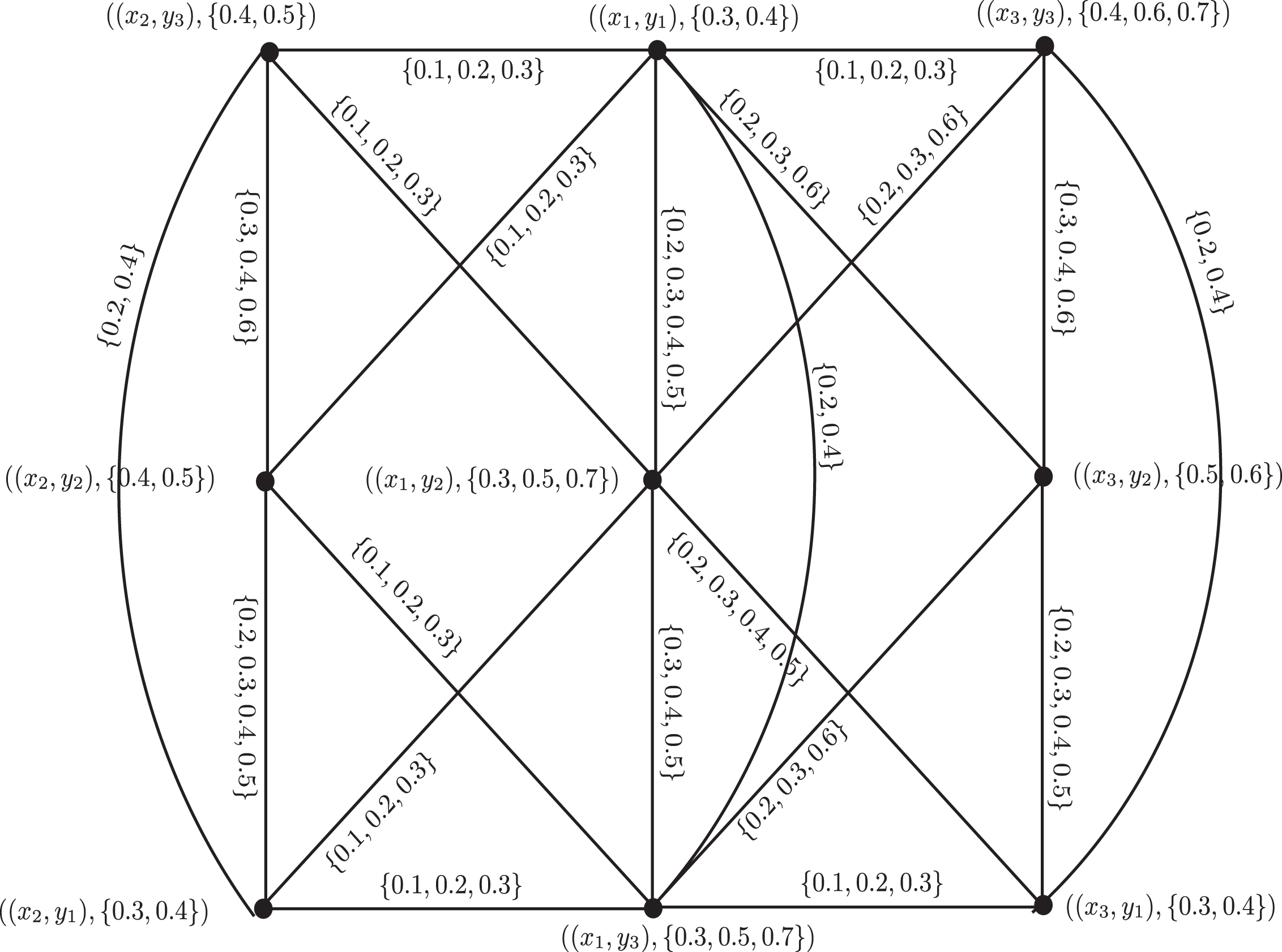
Example 10. Consider two HFGs and given in Example 8. Then, lexicographic product of HFGs and is as in Fig. 7.
HFG .
Proposition 4.14. Let and be two HFGs. Then, is a HFG
Proof. The proof is can be made by similar way to proofs of Proposition 4.10.□
Definition 4.15. Let and be two HFGs over graphs G1 = (V1, E1) and G2 = (V2, E2), respectively. Then, strong product of two HFGs and is denoted by and defined as follows:
for all (x, y) ∈ V1 × V2,
, for all yz ∈ E2,
, for all xy ∈ E1 and z ∈ V2.
, for all xz ∈ E1 and yt ∈ E2.
Example 11. Consider two HFGs and given in Example 8. Then, strong product of HFGs and is as in Fig. 8.
HFG .
Proposition 4.16. Let and be two HFGs. Then, is a HFG.
Proof. It is similar to Proposition 4.10 and 4.12.□
Corollary 4.17. Let and be two HFGs. Then,
,
,
,
Proof. The proofs are clear from Definitions 4.3 and 4.4.□
Application of HFGs in Decision Making
In this section, some definitions to be used in suggested method are presented. Decision making method is developed and given its algorithm in order to choose element which has dominate degree in group, and to show process of proposed decision making method we give an illustrative example.
Definition 5.1. [52] Let ξi (i = 1, 2,. . . , n) be a collection of HFEs. Then, hesitant fuzzy weighted averaging operators (HFWA) is a mapping HFWA : HFEn → HFE such that
where w = (w1, w2,. . . , wn) T is the weight vector of ξi (i = 1, 2,. . . , n), with wi ≥ 0 (i = 1, 2,. . . , n) and (see [52]). Here if it is taken all of wi (i = 1, 2,. . . , n) as equal, then Eq. (1) can be written as follows:
Eq. (2) can be written as more explicit, respectively, as follows:
Based on Definition 5.1 and 2.5, we define following concepts:
Definition 5.2. Let be a directed HFGs over graphs G = (V, E) and vr, r = 1, 2,. . . , n be adjacent HF-vertices of vk ∈ V. Out-degree of vk, denoted by , is defined as follows:
Similarly, in-degree of vk, denoted by is defined as follows:
Scores of out-degree and in-degree of a vertex vk, dednoted by and respectively, is calculated by using Definitions 2.5.
Let and be scores of out-degree and in-degree of a vertex vk, respectively. Then is called domination degree of vertex vk and denoted by .
Input: The directed hesitant fuzzy graph
Output: Dominate element
algorithmic
1. Input the set of vertices V = {v1, v2,. . . , vn} and a HFS A which is defined on set V
2. Input the set of edges E = {e1, e2,. . . , en} .
3. Compute the membership degrees of edge using relation .
4. Compute out-degree and in-degree for each of vertices by using Eqs. (3) and (4).
5. Find score values of out-degree and in-degree for each of vertices.
6. Find domination degree for each of vertices.
7. Rank vertices according to real domination degrees of them.
8. Choose vertex which has maximum domination degrees.
Illustrative Example
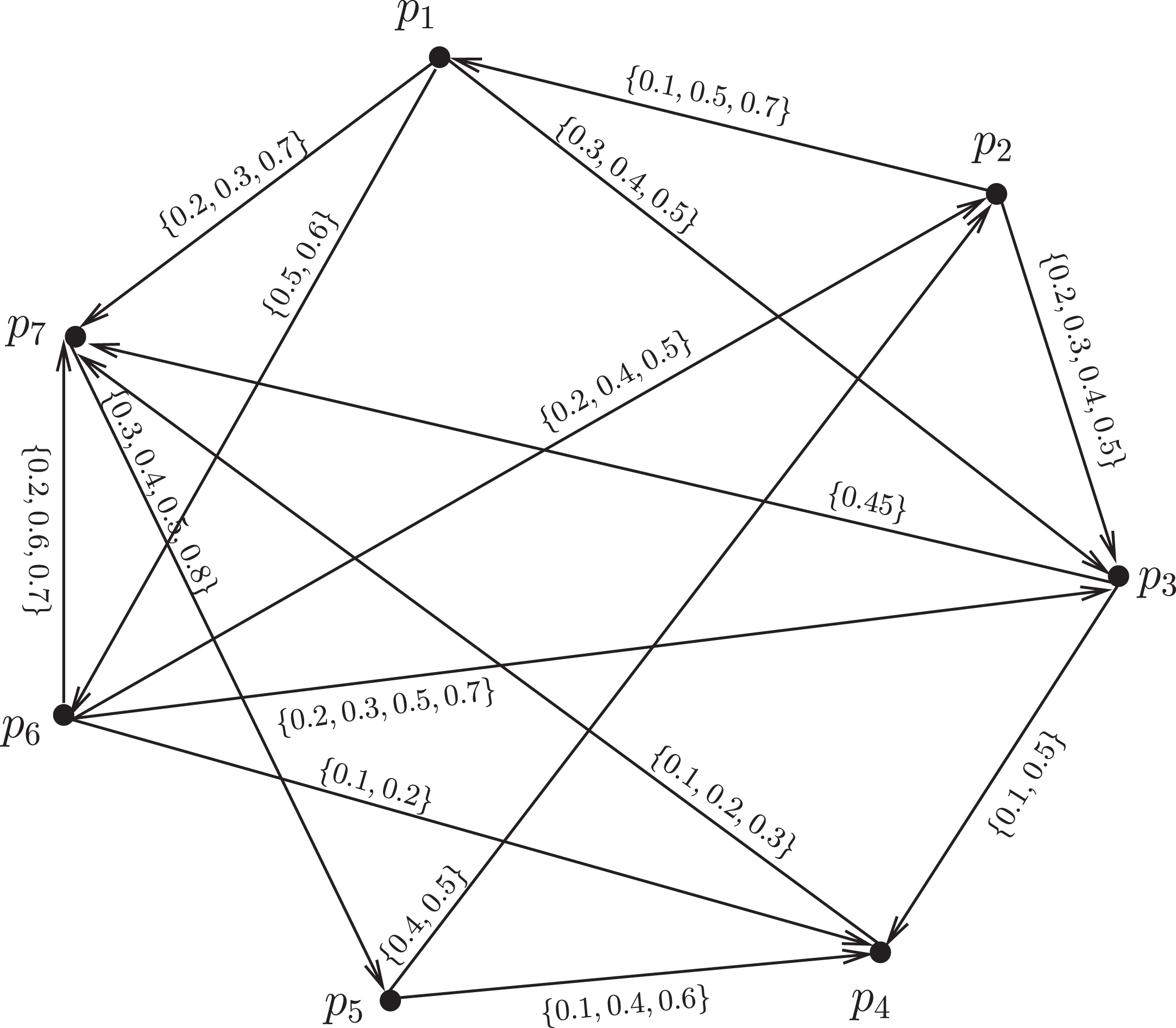
Let us consider the application in [3, 17]. There are seven persons which are influence each other on a social group on ICQ. Let P = {p1, p2, p3, p4, p5, p6, p7} be set of seven person in a social group on ICQ.
Step 1: (p3, {0.1, 0.5, 0.6, 0.7}) , (p4, {0.35, 0.40}) , (p5, {0.45, 0.8, 0.75}) , (p6, {0.6, 0.9}) , (p7, {0.2, 0.55, 0.8}) is the HFS on the set V, where these HFEs related to persons represent his good influence on others.
p1
p2
p3
p4
p5
p6
p7
Scores
0.600
0.450
0.475
0.375
0.667
0.750
0.517
Step 2:J = {(p6, p3) , (p6, p4) , (p6, p7) , (p6, p2) , (p1, p3) , (p2, p3) , (p7, p1) , (p5, p4) , (p5, p2) , (p2, p7)} is the set of edges.
Step 3: Let be HFS on the set E as shown in following table.
Step 4: By using Eqs. (3) and (4), out-degrees and in-degrees of each person are obtained as follows:
Step 5: By using Eq. (2.5), scores of out-degrees and in-degrees of each person are obtained as follows:
Step 6: Real domination degrees of each person are obtained as follows:
Step 7: Domination degrees of persons in this group can be rank in form p7 ≥ p2 ≥ p4 ≥ p1 ≥ p6 ≥ p5 ≥ p3 .
Step 8:p7 is a person who has real dominant effect in the group.
Conclusion
In this paper, definition of HFG, some concepts and operations related to HFGs such as HF-subgraph, partial HF-subgraph, homomorphism, isomorphism, weak-isomorphism and co-weak isomorphism between HFGs are first given. Also, some product operations are defined, and some properties of them are obtained. Furthermore, to find dominant element in a directed HFG, a method is proposed and is given its an application in decision making. In the future, other operations and definitions existing in fuzzy graphs and classical graphs may be extended to HFGs, and also researchers can study on applications of HFGs in decision making and clustering analysis based on defined new concepts and operations.
Conflict of interests
The author declares that there is no conflict of interests regarding the publication of this paper.
Footnotes
Acknowledgement
The author is very grateful to anonymous reviewers for their valuable comments and constructive suggestions, which greatly improved the quality of this paper.
References
1.
M.Akram and R.Parvathi, Properties of intuitionistic fuzzy line graphs, 16th International Conference on IFSs, Sofia, 2012, Notes on Intuitionistic Fuzzy Sets18(3) (2012), 52–60.
2.
M.Akram and B.Davvaz, Strong intuitionistic fuzzy graphs, Filomat26(1) (2012), 177–196.
3.
M.Akram and G.Shahzadi, Operation on single-valued neutrosophic graphs, Journal of Uncertainty Systems11(3) (2017), 176–196.
4.
M.Akram and H.R.Younas, Certain types of irregular m-polar fuzzy graphs, Journal of Applied Mathematics and Computing53 (2017), 365–382.
5.
M.Akram and S.Shahzadi, Novel intuitionistic fuzzy soft multipleattribute decision-making methods, Neural Computing and Applications29(7) (2018), 435–447.
6.
K.T.Atanassov, Intuitionistic fuzzy sets, Fuzzy Set and Systems20 (1986), 87–96.
7.
K.T.Atanassov, Intuitionistic fuzzy sets: Theory and Applications, Physica-Verlag, New York, 1999.
8.
K. T.Atanassov, G.Pasi, R.Yager and V.Atanassova, Intuitionistic fuzzy graph interpretations of multi-person multi-criteria decision making, Proceedings of EUSFLAT Conference,2003, pp. 177–182.
9.
R.A.Borzooei, H.Rashmanlou, S.Samanta and M.Pal, A study on fuzzy labeling graphs, Journal of Intelligent and Fuzzy Systems30(6) (2016), 3349–3355.
10.
P.Bhattacharya, Some remarks on fuzzy graphs, Pattern Recognition Letters6(5) (1987), 297–302.
11.
K.R.Bhutani, On automorphisms of fuzzy graphs, Pattern Recognition Letters9 (1989), 159–162.
12.
S.Broumi, M.Talea, A.Bakali and F.Smarandache, Single valued neutrosophic graphs, Journal of New Theory10 (2016), 86–101.
13.
R.G.delCampo, L.Garmendia, J. Recasens and J.Montero, Hesitant Fuzzy Sets and Relations using Lists, 2017 IEEE International Conference on Fuzzy Systems,Naples, Italy2017. Doi: 10.1109/FUZZ-IEEE.2017.8015516
14.
D.Deepak and S.J.Jhon, Homomorphisms of hesitant fuzzy subgroups, International Journal of Scientific and Engineering Research5(9) (2014), 9–14.
15.
D.Deepak and S.J.John, Hesitant fuzzy rough sets through hesitant fuzzy relations, Annals of Fuzzy Mathematics and Informatics8(1) (2014), 33–46.
16.
S.Faizi, W.Salabun, T.Rashid, J.Waatrobski and S.Zafar, Group decision-making for hesitant fuzzy sets based on characteristic objects method, Symmetry9,136, (2017), 1–17.
17.
F.Karaaslan and B.Davvaz, Properties of single-valued neutrosophic graphs, Journal of Intelligent and Fuzzy Systems34 (2018), 57–79.
18.
M.G.Karunambigai and R.Parvathi, Intuitionistic Fuzzy Graphs, Proceeding of 9th Fuzzy Days International Conference on Computational Intelligence, Advances in soft computing: Computational Intelligence, Theory and Applications,Springer-Verlag, 20, 2006, pp. 139–150.
19.
M.G.Karunambigai, R.Parvathi and O.K.Kalaivani, A Study on Atanassov's Intuitionistic Fuzzy Graphs, Proceedings of the International Conference on Fuzzy Systems, FUZZ-IEEE, Taipei, Taiwan, 2011, pp. 157–167.
20.
M.G.Karunambigai and O.K.Kalaivani, Self centered intuitionistic fuzzy graph, World Applied Sciences Journal14(12) (2011), 1928–1936.
21.
M.G.Karunambigai, R.Parvathi and R.Buvaneswari, Constant intuitionistic fuzzy graphs, Notes on Intuitionistic Fuzzy Sets17(1) (2011), 37–47.
22.
M.G.Karunambigai, M.Akram, S.Sivasankar and K.Palanivel, Clustering algorithm for intuitionistic fuzzy graphs, International Journal of Uncertainty, Fuzziness and Knowledge-Based Systems25(3) (2017), 367–383.
23.
A.Kauffman, Introduction a la Theorie des Sous-emsembles Flous, Masson et Cie, Vol.1, 1973.
24.
D.Knuth, The Arl of Computer Programming, Vol. 2: Seminumerical Algorithms, Addison-Wesley, Reading, MA,1981.
25.
V.Kobza, V.Janis and S.Montes, Divergence measures on hesitant fuzzy sets, Journal of Intelligent and Fuzzy Systems33 (2017), 1589–1601.
26.
X.Li and H.Yi, Structural properties of fuzzy graphes, Iranian Journal of Fuzzy Systems14(1) (2017), 131–144.
27.
P.Liu, Multiple attribute group decision making method based on interval-valued intuitionistic fuzzy power Hero- nian aggregation operators, Computers and Industrial Engineering108 (2017), 199–212.
28.
P.Liu and S.-M.Chen, Group decision making based on Heronian aggregation operators of intuitionistic fuzzy numbers, IEEE Transactions on Cybernetics47(9) (2017), 2514–2530.
29.
P.Liu, S.-M.Chen and J.Liu, Multiple attribute group decision making based on intuitionistic fuzzy interaction partitioned Bonferroni mean operators, Information Sciences411 (2017), 98–121.
30.
D.S.Malik, S.Mathew and J.N.Mordeson, Fuzzy incidence graphs: Applications to human trafficking, Information Sciences447 (2018), 244–255.
31.
H.M.Malik and M.Akram, A new approach based on intuitionistic fuzzy rough graphs for decision-making, Journal of Intelligent and Fuzzy Systems34(4) (2018), 2325–2342.
32.
S.Mathew, J.N.Mordeson and D.S.Malik, More on Blocks in Fuzzy Graphs, In: Fuzzy Graph Theory. Studies in Fuzziness and Soft Computing, Springer, Cham, 2018, p. 363.
33.
J.N.Mordeson and C.-S.Peng, Operations on fuzzy graphs, Information Sciences79 (1994), 159–170.
34.
K.K.Myithili, R.Parvathi and M.Akram, Certain types of intuitionistic fuzzy directed hypergraphs, International Journal of Machine Learning and Cybernetics7(2) (2016), 287–295.
35.
A.NagoorGani, M.Akram and P.Vijayalakshmi, Certain types of fuzzy sets in a fuzzy graph, International Journal of Machine Learning and Cybernetics7(4) (2016), 573–579.
36.
M.Nasir, S.Siddique and M.Akram, Novel properties of intuitionistic fuzzy competition graphs, Journal of Uncertain Systems11(1) (2017), 49–67.
37.
R.Parvathi, M.G.Karunambigai and K.Atanassov, Operations on Intuitionistic Fuzzy Graphs, Proceeding of IEEE International Conference on Fuzzy Systems (FUZZY-IEEE),2009, pp. 1396–1401.
38.
Z.Pei and L.Yi, A note on operations of hesitant fuzzy sets, International Journal of Computational Intelligence Systems8(2) (2015), 226–239.
39.
T.Pathinathan, J.J.Arockiaraj and J.J.Rosline, Hesitancy fuzzy graphs, Indian Journal of Science and Technology8(35) (2015), 1–5.
40.
G.Qian, H.Wang and X.Feng, Generalized hesitant fuzzy sets and their application in decision support system, Knowledge-Based Systems37 (2013), 357–365.
41.
A.Rosenfeld, Fuzzy graphs, fuzzy Sets and their Applications to Cognitive and Decision Processes(Proceeding of U.S.- Japan Sem., University of California, Berkeley, Calif, 1974), (L.A.ZadehK.S.Fu and M.Shimura, eds.), Academic Press, New York, 1975, pp. 77–95.
42.
R.Schütze, An Intuitionistic Fuzzy Approach for Service Level Management, In: Improving Service Level Engineering Fuzzy Management Methods,Springer, Cham, 2018.
43.
A.Shannon and K.T.Atanassov, A first step to a theory of the intuitionistic fuzzy graphs, Proceeding of FUBEST
(D.Lakov, Ed.), Sofia, 1994, pp. 59–61.
44.
A.Shannon and K.T.Atanassov, Intuitionistic fuzzy graphs from a-,ß-, and(a; ß)-levels, Notes on Intuitionistic Fuzzy Sets1(1) (1995), 32–35.
45.
S.Sahoo and M.Pal, Different types of products on intuitionistic fuzzy graphs, Passific Science Review A: Natural Science and Engineering17(3) (2015), 87–96.
46.
S.Sahoo and M.Pal, Intuitionistic fuzzy competition graphs, Journal of Applied Mathematics and Computing52(1-2) (2016), 37–57.
47.
S.Sahoo and M.Pal, Product of intuitionistic fuzzy graphs and degree, Journal of Intelligent and Fuzzy Systems32(1) (2017), 1059–1067.
48.
S.Sankar, M.Pal, H.Rashmanlou and R.A.Borzooei, Covering and paired domination in intuitionistic fuzzy graphs, Journal of Intelligent and Fuzzy Systems33(6) (2017), 4007–4015.
49.
M.S.Sunitha and A.V.Kumar, Complement of a fuzzy graph, Indian Journal of Pure and Applied Mathematics33(9) (2002), 1451–1464.
50.
G.S.Thakur, R.Thakur and R.Singh, New hesitant fuzzy operators, Fuzzy Information and Engineering6 (2014), 379–392.
51.
V.Torra, Hesitant fuzzy sets, International Journal of Intelligent Systems25(6) (2010), 529–539.
52.
M.M.Xia and Z.S.Xu, Studies on aggregation of intuitionistic fuzzy and hesitant fuzzy information, Technical Report (2011).
53.
M.Xia and Z.Xu, Hesitant fuzzy information aggregation in decision making, International Journal of Approximate Reasoning52(3) (2011), 395–407.
54.
L.A.Zadeh, Fuzzy sets, Information and Control8 (1965), 338–353.
55.
B.ZhuandZ.Zhu, Extended hesitant fuzzy sets, Technological and Economic Development of Economy22(1) (2016), 100–121.