



Abstract
To cut several types of hard materials in manufacturing, Computer Numeric Control (CNC) router machines are commonly used. The tasks to be done by different machines can be performed by a single CNC router machine. Production of parts with better quality is possible at lower costs by production with CNC router machines, and these machines improve the productivity of manufacturing system. For these reasons, determination of the appropriate CNC router machine for manufacturing systems is a crucial decision. Different factors related to properties of machines are effective on the decision. Therefore, decision makers must include different effective aspects into decision process. Under this consideration, an analytic selection procedure for CNC router machines by taking uncertain expressions of experts on the selection criteria and variable values occur over time is proposed in this study. In order to handle the modelling difficulty of uncertainty of the statements and the value changes by time, dynamic intuitionistic multi attribute decision making is used to select the best CNC router. Applicability of the proposed selection procedure is demonstrated on an application, and a comparative analysis with dynamic neutrosophic multi attribute decision making is presented.
Keywords
Introduction
Machines can be considered as the most important determinants of the performance and productivity of manufacturers with the materials used in the system [1]. Therefore, machine and material selection decisions are crucial for manufacturing management departments and need careful analyses. [2]. Company success in the market over their rivals is directly affected by these decisions, and these decisions should be taken by considering different factors. However, the number of alternative machines which have different technical specifications and costs makes the choice of the best machine decision a very complex issue.
Several aspects of production problems can be modelled as dynamic decision problems. There is not a commonly accepted single-criterion to determine the optimal decision for such systems since the decisions must be determined concerning the technical parameters, time constants, and gain factors, etc., in order to attain an acceptable system behavior [3]. Utilization of multi-criteria analysis methods on decision problems with a number of conflicting criteria helps decision makers to handle the problem in a systematic and quantitative manner [4].
The final decision is made after some exploratory processes in which both alternatives and criteria vary in most real-world problems. This kind of decision problems are called as dynamic decision problems [5]. However, capturing dynamicity with the classic multiple criteria decision making (MCDM) is not possible because the classic MCDM assumes that the criteria set and the alternative sets are determined prior to decision making process.
In real cases, some of the complex decisions need consideration of current and past performance of alternatives. This kind of decision problems are defined as multi-period decision making problems [6]. Some examples of the multi-period decision problems in which information related to decision are collected at different moments in time have been shown on medical diagnosis, personnel examination efficiency evaluation of military system so far [7–12].
Through the technological progresses in manufacturing, many companies are able to use CNC machines [13]. Several processes which are performed to transform the material into the desired shape on different machines can be done by a single CNC machine. By this way, the improved product quality is achieved in a shorter manufacturing time.
CNC machines were built around numerical control machines which were produced in the 1940s. Thanks to the progress on the efforts to integrate programming with machine tool design, the first CNC machines were introduced in the 1980s [14]. Because of the advances in computer and production technologies, utilization of CNC machines in manufacturing is ordinary today. Due to their productive, flexible and cost efficient nature, CNC machines are used in almost all type of manufacturing. An example of CNC router machine can be seen in Fig. 1.
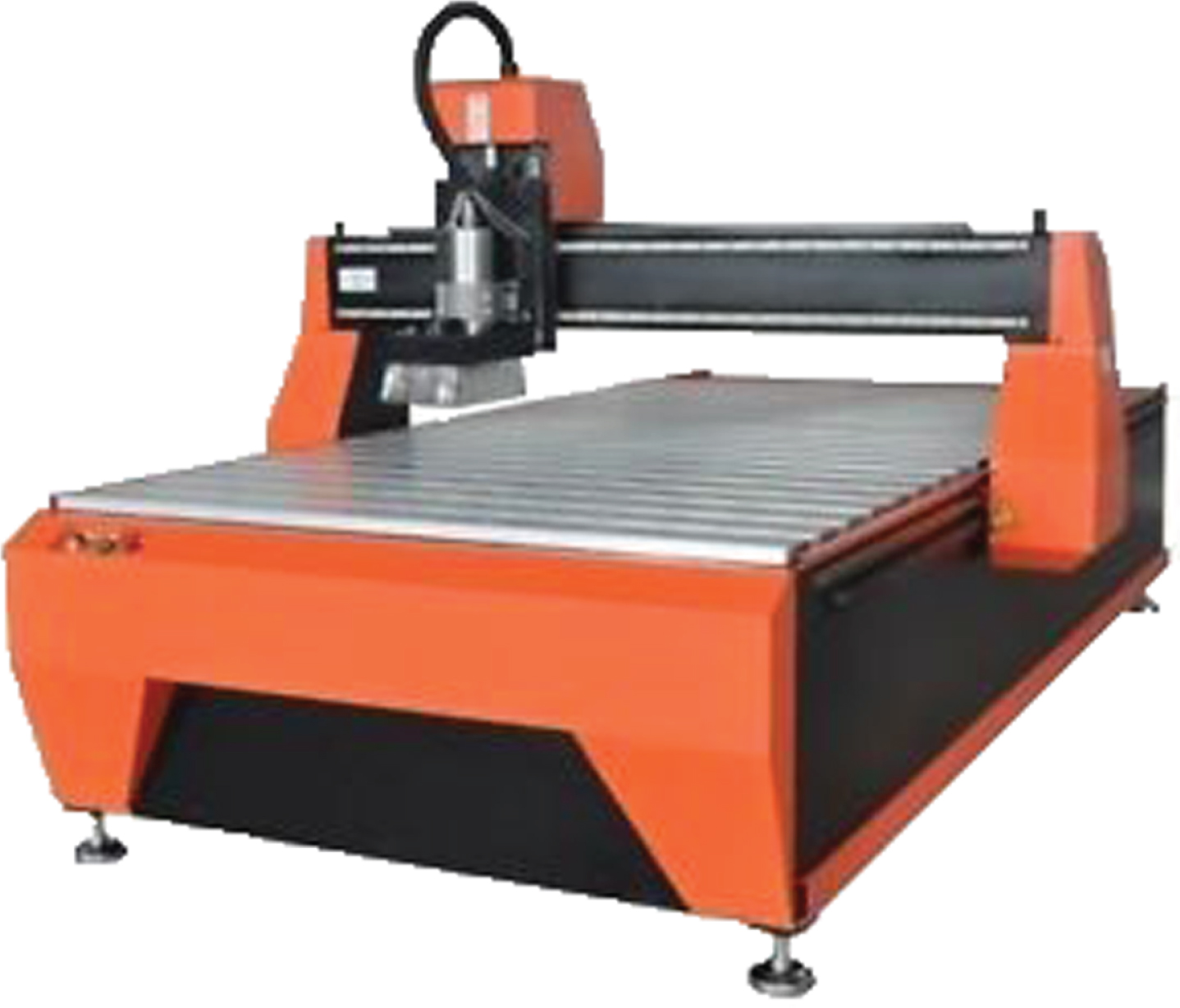
CNC router machine.
CNC router machines provide great advantages on cutting hard materials because these machines are able to do jobs performed by panel saw, spindle molder and boring machine, in a single machine. Therefore, the allocated area for machines in plant and production costs are reduced, quality of the products is increased.
Selection of the appropriate CNC router is considered to be a dynamic multi-attribute decision making problem in this study. Existence of the uncertain and variable values of alternative scores over time is handled by utilization of the dynamic intuitionistic fuzzy multi-attribute decision making (D-IF-MADM) methodology [8]. Moreover, results of this methodology is compared with the results obtained from the dynamic neutrosophic fuzzy multi attribute decision making technique.
After introducing the framework of this study, Section 2 presents a literature review on the studies related to machine selection problems. Section 3 introduces the main descriptions regarding dynamic intuitionistic fuzzy elements and D-IF-MADM approach. Next, in Section 4 a case study for a furniture manufacturer who is about to a decision of CNC router procurement in Ankara is presented. Results of D-IF-MADM and dynamic neutrosophic fuzzy MADM approaches are compared in Section 5. Section 6 presents the conclusion, managerial implications and further research suggestions.
Machine selection is a popular topic for researchers. In this part, a summary of machine selection applications by using MCDM approaches in the literature is given.
The appropriate CNC milling machine for a flexible manufacturing cell was determined by a preference based fuzzy MCDM approach [15]. A fuzzy AHP and Benefit / Cost Analysis based approach was used for the evaluation of alternative CNC vertical turning center machine tools [16]. Rank of the machine alternatives for a textile company was determined by using fuzzy extension of TOPSIS [17]. Alternative milling machines were ranked by using an AHP – PROMETHEE based hybrid MCDM approach for a manufacturing company [18]. Onut et al. [19] used fuzzy AHP – TOPSIS hybrid approach for determination of the most appropriate CNC machine for an automotive spare parts manufacturer. Evaluation of the alternative pressing machine tools under fuzzy environment for a construction company was made by Delphi – AHP – PROMETHEE hybrid approach [20]. Delphi method was used to determine the evaluation criteria, and the criteria weights were calculated by using AHP. Five alternative pressing machine alternatives were ranked by PROMETHEE method. A 0-1 Goal Programming model with a constraint which was formed by using normalized results of PROMETHEE technique was used for Welding machine selection [21]. Yazdani-Chamzini and Yakhchali [22] used Fuzzy AHP-TOPSIS method to determine the best tunnel boring machine alternative for a tunnel construction project in Central Iran. CNC machine selection decision of an Iranian company was supported by SWARA – COPRAS-G hybrid approach [23]. Intuitionistic fuzzy (IF) sets based TOPSIS technique was used for determination of the best Vertical Form, Fill, and Seal (VFFS) machine which was needed by a food company [24]. The best machine tool for an Iranian manufacturing company was determined by using a fuzzy goal programming model [25]. Ozceylan et al. [26] analyzed the correlation between the results of FANP – PROMETHEE and TOPSIS methods for CNC router machine recommendations to a manufacturing company by using Spearman Correlation Coefficient. Fuzzy VIKOR based Group MCDM model was used for supporting CNC machine tool selection decisions of Pakistan Machine Tool Factory. An interval target-based VIKOR method was proposed for the machine selection problems [28]. The proposed approach was tested on two case studies on punching machine selection and continuous fluid bed tea dryer machine selection problems. Choice of the best CNC router for a manufacturing firm in Ankara was made by using ANP – GRA hybrid approach [1]. CNC router selection decision of a woodwork manufacturer SME was supported by hesitant fuzzy AHP model [14]. Evaluation of the alternative dryer machines in tea industry was made by fuzzy weighted axiomatic design and fuzzy SMART methods [2]. Fuzzy AHP method was used to determine the most suitable tunnel boring machine for a tunnel construction in Iran [29]. Vertical CNC machining tool selection of a manufacturer in Egypt was supported by neutrosophic fuzzy MOORA approach [30].
Based on the aforementioned studies, no dynamic MCDM approach has been considered in the literature for the machine selection so far. However, performance of the CNC router machines can be variable in different periods because of the existence of several products and production plans. To fill the gap in the literature, utilization of the D-IF-MADM approach on machine selection problem will be the main contribution of this study.
Dynamic intuitionistic fuzzy multi-attribute decision making
In this section, we focus on the D-IF-MADM problems where all the attribute values are expressed in intuitionistic fuzzy numbers (IFNs), collected at different periods of time. Xu and Yager [8] proposed D-IF-MADM method as follows:
For convenience, we denote an IFNs by
For an intuitionistic fuzzy variable
Let the MADM problem be designed by n alternatives A = {A1, A2,…,A
n
}. The alternatives are evaluated with respect to m attributes C = {C1, C2,…,C
m
}, whose weight vector is w = (w1, w2, …, w
m
)
T
, where w
j
≥ 0, j = 1, 2, …, m,
Step 1. Utilize DIFWA (Dynamic Intuitionistic Fuzzy Weighted Averaging) operator.
Aggregate all the intuitionistic fuzzy decision matrices
Step 2. Define
Step 3. Calculate the distance between the alternative A
i
and the intuitionistic fuzzy ideal solution, and the distance between the A
i
and intuitionistic fuzzy negative ideal solution as follows:
Step 4. Calculate the closeness coefficient of each alternative:
Step 5. Rank the alternatives according to decreasing values of closeness coefficient.
Application of the proposed D-IF-MADM methodology is presented in this part with a case study on CNC router selection of a furniture manufacturer in Ankara. The firm wants to procure a new machine to their manufacturing plant after the analysis of a simulation study of the system. Finding the most appropriate machine is desired by the company owner, and the planning team determined four possible machines (A1, A2, A3 and A4) as a result of a pre-evaluation. However, the team couldn’t find a dominant alternative among these four machines, because the machines have variable and uncertain scores in terms of Cost (C1), Reliability (C2), Flexibility (C3), Safety (C4), Manufacturing rate (C5), Utilization (C6) criteria.
Moreover, the products manufactured in the plant change in different periods, and alternative machines have variable performances based on the production plan. Also, alternative machines are evaluated by area experts in the form of possibility and impossibility scores. Therefore, D-IF-MADM methodology becomes suitable for the case. Factors that affect CNC router selection decision is presented in Fig. 2.

Factors that affect the decision.
The steps of the algorithm are given as follows:
Step 1: Intuitionistic decision matrices (
Decision matrix
Decision matrix
Decision matrix
Complex Decision matrix
Step 2: Define
Step 3: Calculate the distance between the alternative A
i
and the uncertain intuitionistic fuzzy ideal solution, and the distance between A
i
and intuitionistic fuzzy negative ideal solution as follows;
Step 4: Calculate the closeness coefficient of each alternative.
Step 5: Rank the alternatives according to decreasing values of closeness coefficient.
According to the results obtained by using the method, the first alternative is favored over the other alternatives with the highest score of closeness coefficient.
In this section, we compare the results with neutrosophic MADM method. The neutrosophic method is slightly similar to neutrosophic TOPSIS [31], and we adapted the neutrosophic aggregation operator to use different periods.
There is no restriction on the sum of T
A
(x), I
A
(x) and F
A
(x), so
For each point x in X, we have we have T A (x) , I A (x) , F A (x) ∈ [0, 1], and 0 ≤ T A (x), I A (x), F A (x) ≤3.
A SNS
For a neutrosophic variable
Let the MADM problem be designed by n alternatives A = {A1, A2,…, A
n
}. The alternatives are evaluated with respect to m attributes C = {C1, C2,…,C
n
}, whose weight vector is w = (w1, w2, …, w
m
)
T
, where w
j
≥ 0,
Step 1. Utilize DNWA (Dynamic Neutrosophic Weighted Averaging) operator.
Aggregate all the intuitionistic fuzzy decision matrices
Step 2. In this step, the weights of attribute and aggregated neutrosophic decision matrix by DNWA operator are combined by using Equation (14) as follows;
Here,
Step 3. Let
Where,
Where,
Step 4. The normalized Euclidean distance measure of each alternative
Then, the normalized Euclidean distance measure of each alternative
Step 5. Calculate the closeness coefficient of each alternative:
Where,
Step 6: Rank the alternatives according to decreasing values of the closeness coefficient.
In the comparison analysis, alternative performances are collected in different periods by utilizing neutrosophic evaluations. Neutrosophic evaluations are seen in Tables (5–7), and the steps of the algorithm as follows;
Decision matrix
for the first period
Decision matrix
Decision matrix
Decision matrix
Step 1. DNWA is utilized to aggregate decision matrices into the Complex Decision Matrix (Table 8).
Complex decision matrix
Step 2. Weighted complex neutrosophic decision matrix is presented with Table 9.
Weighted complex decision matrix
Step 3:
Step 4: The distance between alternative A
i
and the neutrosophic positive ideal solution, and the distance between A
i
and the neutrosophic negative ideal solution are calculated as follows;
Step 5: Closeness coefficient of each alternative is determined.
Step 6: Rank the alternatives according to the decreasing values of closeness coefficient is obtained.
Manufacturing companies are required to provide products with higher quality for their customers. Usage of good materials and computer aided machines for manufacturing is a good way for obtaining high quality products. Machines should be chosen carefully for manufacturing systems because of the existence of a number of alternatives. Also, due to the uncertain evaluations of decision makers and parameters with variable values over time, choice of the appropriate machine is a complex decision. To handle the complex nature of the machine selection problem, D-IF-MADM method was used in this study.
Utilization of this method helps reducing the complexity of the problem caused by uncertain expert statements and variable values of machines over time. The method starts with the aggregation of different periods’ data by using IF aggregation operator. Next, the best and the worst solutions (ideal solutions) are defined. Then, the distance of each alternative to the ideal solutions are calculated, and the alternatives are ranked according to the closeness coefficient.
A case study to support CNC router procurement decision of a furniture company in Ankara was presented in this study. Rank of four alternatives was determined by considering their uncertain performances on six criteria over three periods time.
A comparative analysis of D-IF-MADM and dynamic neutrosophic multi-attribute decision making methodology was also presented to see the effect of uncertainty type on problem results. Both approaches gave the same rank of alternatives. The results can be considered to be consistent for these two methods.
This study can be extended in the future because the existence of different machine selection criteria affects the decision. Weighting of the evaluation criteria can be inserted into the methodology, and effect of the criteria weights can be analyzed. With this aim, the weighting approaches like AHP, ANP or Entropy theory can be used. Consideration of the different distance measures and comparison of the results obtained with each measure can also be analyzed.