



Abstract
Since proposed by Zadeh in 1965, ordinary fuzzy sets help us to model uncertainty and developed many types such as type 2 fuzzy, intuitionistic fuzzy, hesitant fuzzy etc. Intuitionistic fuzzy sets include both membership and non-membership functions for their each element. Ranking of a number is to identify a relationship of scalar quantity between these numbers. Ranking of fuzzy numbers play an important role in modeling problems such as fuzzy decision making, fuzzy linear programming problems. In this study, a new ranking method for triangular intuitionistic fuzzy numbers is proposed. The method based on the incircle of the membership function and non-membership function of TIFN uses lexicographical order to rank intuitionistic fuzzy numbers. Two examples are provided to illustrate the applicability of the method. Also, a comparative study is performed to demonstrate the validity of the proposed method. The results indicate that proposed method is consistent with other methods in the literature. Also, the method overcomes the problems such as numbers being very small or close to each other.
Keywords
Introduction
Fuzzy sets proposed by Zadeh [20] are part of our daily lives. We use fuzzy sets to define uncertainty without realizing it. For instance, while driving a car, when we see the traffic jam ahead, we intuitively define a fuzzy set called “distance” without knowing exact distance between us and traffic jam and we apply brakes. This cycle is repeated many times in daily life to define and to measure uncertainty that occurs from lack of knowledge, misinformation, measurement error etc.
Type 2 fuzzy sets, hesitant fuzzy sets, neutrosophic fuzzy sets, pythagorean fuzzy sets, spherical fuzzy sets and intuitionistic fuzzy sets are the extensions of ordinary fuzzy sets. Intuitionistic fuzzy sets considering both membership function and non-membership function are more successful than ordinary fuzzy sets to model uncertainty.
Ranking of a fuzzy number is to find out which number is greater or equal. It is needed to rank the fuzzy numbers for some decision making applications, hypothesis testing and risk analysis and etc. Misranking of fuzzy numbers can affect the decisions made. Therefore, it is an important and difficult task to rank fuzzy numbers correctly. Many researchers have proposed many different ranking methods to overcome this challenge. Although there are many ranking methods for fuzzy numbers, the ranking methods for intuitionistic fuzzy numbers are less.
A ranking method based on a metric for intuitionistic fuzzy numbers is proposed by Grzegorzewski [25]. Mithcell [12] introduced a ranking method for triangular intuitionistic fuzzy numbers by using statistical approach. Nayagam et al. [32] proposed a ranking method for triangular intuitionistic fuzzy number (TIFN) by using Chen and Hwang’s [26] method. Whang and Zhang [17] introduced the expected value, score function and accuracy function for trapezoidal intuitionistic fuzzy numbers and proposed a ranking method based on score and accuracy function. Li [6] defined the values and ambiguities of the membership and non-membership functions and introduced a ranking method. Li et al. [7] introduced a ranking method for triangular intuitionistic fuzzy numbers based on some indexes. Nehi [16] proposed a ranking method for trapezoidal intuitionistic fuzzy numbers by the help of the characteristic value of an intuitionistic fuzzy number. Wei and Tang [4] defined a ranking method based on a possibility degree method for intuitionistic fuzzy numbers and used this method to rank alternatives in decision making problems. Dubey and Mehra [5] defined an approach for triangular intuitionistic fuzzy number by using Li’s [6] method and used the proposed method to solve linear programming problems. Nayagam et al. [33] proposed a ranking method for intuitionistic fuzzy numbers by the help of the score function and applied it to clustering problems. Salahshour et al. [27] proposed a ranking method by converting each triangular intuitionistic fuzzy number to related two triangular fuzzy numbers. Seikh et al. [22] defined a ranking method for generalized triangular intuitionistic fuzzy number based on a ranking index. Nagoorgani and Ponnalagu [2] introduced a ranking method based on the score and accuracy functions and used the proposed method to solve intuitionistic fuzzy linear programming problem. Das and Guha [28] defined a new ranking method by the help of the centroid point of an intuitionistic fuzzy number and compared the proposed method with existing methods. Kumar and Kaur [1] proposed a new ranking method by modifying Nehi’s [16] method and showed the drawbacks of the existing ranking methods. Rezvani [29] introduced a ranking method for trapezoidal intuitionistic fuzzy numbers by using the value and ambiguity indexes. Roseline and Amirtharaj [30] gave definitions of the magnitude value for trapezoidal intuitionistic fuzzy numbers and introduced a ranking method based on the this value. Peng and Chen [35] defined the center index and radius index for canonical intuitionistic fuzzy numbers and proposed a new ranking method by using a ranking index. Also, they gave some examples to show the validity of the proposed method. Zhang and Nan [24] developed a ranking method for triangular intuitionistic fuzzy number and applied it to multi-attribute decision making (MADM) problems. Seikh et al. [23] proposed a ranking method by the help of an average ranking index. Prakash et al. [19] suggested a ranking method for both triangular intuitionistic fuzzy numbers and trapezoidal intuitionistic fuzzy numbers based on a centroid concept and gave some examples to demonstrate the validity of the proposed method. Bharati [31] introduced a new ranking method by using fuzzy origin and signed distance for triangular intuitionistic fuzzy numbers and showed the validity of its axioms. Garg [14] developed a new improved score function for intuitionistic multiplicative set and used it to rank the alternatives in MDM problems. Nayagam et al. [21] gave definitions of eight different scores for the class of trapezoidal intuitionistic fuzzy numbers and used them to rank trapezoidal fuzzy numbers. They discussed the significance of the proposed method. Tao et al. [36] introduced a new ranking method for interval-valued fuzzy numbers by using the intuitionistic fuzzy possibility degree. Uthra et al. [10] defined the generalized intuitionistic pentagonal fuzzy number and suggested a new ranking method. Garg and Kumar [15] defined a ranking method for intuitionistic fuzzy numbers by the help of an improved possibility degree method and used this method to solve MADM problems. Hao and Chen [34] gave definitions of the maximum, minimum and ranking function for interval-valued intuitionistic fuzzy numbers and suggested a new ranking method. They used the proposed method to solve MADM problems with interval-valued intuitionistic fuzzy numbers. Uthra et al. [11] gave definitions of generalized intuitionistic hexagonal, octagonal and pentagonal fuzzy numbers and introduced a new ranking method. Xing et al. [37] proposed a ranking method for intuitionistic fuzzy numbers by the help of Euclidean distance and generalized the proposed method by using Minkowski distance. Atalik and Senturk [9] suggested a new ranking method for triangular intuitionistic fuzzy numbers based on Gergonne point and compared the proposed method with existing methods.
Although there are lots of studies about intuitionistic fuzzy ranking methods, the existing papers have classical approach that assign a classical number to intuitionistic fuzzy number to rank them. Also, the existing papers can be grouped into three categories such as distance measure based ranking methods, ratio based ranking methods and possibility degree based ranking methods. The novelty of this paper is to introduce a ranking method based on the incircles of the membership and non-membership functions of the triangular intutionistic fuzzy number. The suggested ranking method assigns a triplet to triangular intuitionistic fuzzy number and ranks the number using a lexicographical order.
The rest of the paper is organized as follows: Section 2 gives brief information about intuitionistic fuzzy sets, intuitionistic fuzzy numbers and operations of triangular intuitionistic fuzzy numbers. Section 3 gives the theory of the suggested ranking method. Section 4 demonstrates an example and a comparative study. The last section contains conclusion remarks.
Intuitionistic fuzzy sets
In this section, definitions of intuitionistic fuzzy sets, intuitionistic fuzzy number and some basic arithmetic operations of triangular intuitionistic fuzzy numbers will be given.
Atanassov [18] introduced the intuitionistic fuzzy sets as an extension of Zadeh’s ordinary fuzzy sets. In contrast to ordinary fuzzy sets, membership degree, non - membership degree and hesitancy degree are taken into account in the intuitionistic fuzzy sets. The basic definitions of intuitionistic fuzzy sets (IFS) are given in the following.
Let X≠ ∅ be a given set. An intuitionistic fuzzy set
A special form of fuzzy sets is called fuzzy number. An intuitionistic fuzzy set is called “intuitionistic fuzzy number” iff;
The functions f
A
, g
A
, h
A
, k
A
: R → [0, 1] called sides of a fuzzy number
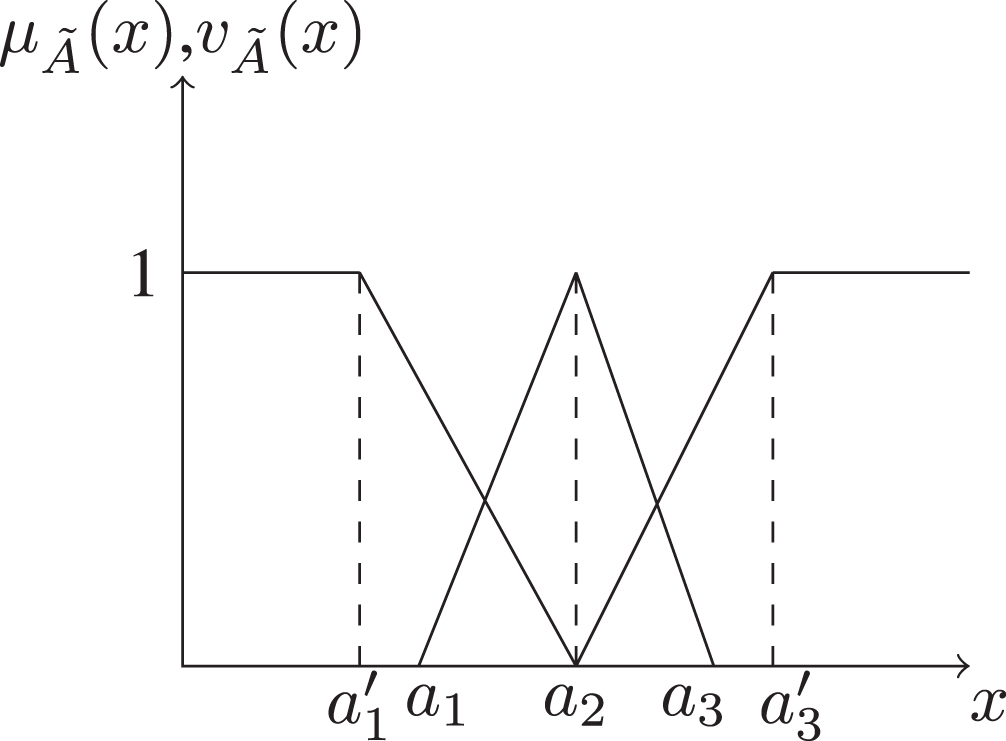
Triangular intuitionistic fuzzy number (TIFN).
In the following, the arithmetic operations for TIFNs are given.
Let
Addition:
Subtraction:
Multiplication: Then
Division: Then
In Kahraman et al.’s study [3], the demonstration of TIFN was done in a different way. They showed the TIFN with membership function and complement of non - membership function. This demonstration can help researchers to treat to TIFN as a type 2 fuzzy number. The new demonstration of TIFN is given by Fig. 2.

New demonstration of TIFN [3].
In this section, a new ranking method for TIFN which uses the incircle of the membership and non-membership functions of TIFN is suggested. In a triangle, a circle touches all sides of the triangle is called incircle. Incenter of a triangle is represented in Fig. 3.

The incircle of a triangle [8].
Akyar et al. [8] presented a ranking method for ordinary fuzzy number. As it mentioned in Section 2, Kahraman et al. [3] showed TIFN in a different way. Here, the theory of the proposed ranking method will be given by the help of Kahraman et al.’s demonstration and Akyar et al.’s paper.
Thus, there are two triangles one for membership function

Incircles and incenters of TIFN.
By the help of Theorem 1 and Lemma, the formulation of inradius is gathered as shown in Equation (12)
Here, the formulation of the proposed method is presented by using the theorems and lemmas given before. Let
The ranking methods contains incenters and inradiuses of TIFN. But, there are two incircles and two incenters. To rank the intuitionistic fuzzy number, there should be only one point to represent
The rank of triangular intuitionistic fuzzy number, by using the Eq.(20) is shown as below:
Let
Here, <
L
shows the lexographical order. The lexographical order is defined in Eq.(22)
In this section, first an example is provided to illustrate the suitability of the proposed ranking method. Then, another example provided from Bharati [31] is given to show the consistency of the proposed method. Later, the validity of the proposed method is determined by comparing the proposed method with existing method in the literature.
Then, for the membership function of
Similarly, for the non - membership function of
For the TIFN
For TIFN
Now, a comparison study between proposed method and existing method in the literature will be given. Some of the numbers are taken from Atalik and Senturk’s [9] paper. The results are shown in Tables 1 and 2.
The comparison of the proposed method with existing method
The comparison of the proposed method with existing method
The comparison of the proposed method with existing method (continued)
When tables are considered, for the first,third and last TIFN all the methods resulted same. All methods ranked the second number same except Nayagam et al.’s method. Altough, Bharati’s method, Prakash et al.’s method and Atalik and Senturk’s method ranked fourth number differently, Nayagam et al.’s method, Roseline and Amirtharaj’s method, Rezvani’s method and proposed method gave the same result. Also, Li’s and Dubey and Mehra’s method resulted that fourth numbers are equal. Except Prakash et al.’s method, all the methods showed the same result for the fifth number. For the sixth number, except Bharati’s method, Nayagam et al.’s method and Dubey and Mehra’s method, all methods gave same result. Altough Nayagam et al.’s method and Prakash et al.’s method ranked the seventh number differently, the other methods showed the same result.
According to tables, we can say that the proposed method gives consistent results with the other methods in the literature. Also, the proposed method can rank the numbers that are very close to each other. In other words, the proposed method is not affected by the small differences between numbers. Also, the proposed method can rank numbers without being affected by the sign.
Fuzzy sets, essential part of our lives, help us to model uncertainty. Fuzzy sets have extended many types. Intuitionistic fuzzy sets are one of them. Intuitionistic fuzzy sets model uncertainty better than the ordinary one.
Ranking of intuitionistic fuzzy number is to indicate which of these numbers are greater or less than the others. There are many ranking methods in the literature. In this study, a new ranking method was proposed for triangular intuitionistic fuzzy number. The proposed method is based on the incircles of the membership and non-membership functions of TIFN’s. The proposed method uses the lexicographical order to rank fuzzy numbers. Two examples were introduced to demonstrate the applicability of the proposed method. Also, a comparative study between proposed method and other methods in the literature was performed to indicate the validity of the method. The results show that the proposed method is consistent and is not affected by being positive or negative. Also, the method can rank numbers that are very close to each other.
For further research, the proposed method can be applied to linear programming problems. The proposed method can be also developed for other intuitionistic fuzzy numbers such as trapezoidal intuitionistic fuzzy numbers.