



Abstract
Failure mode and effects analysis (FMEA) is a structured approach for discovering possible failures that may occur in the design of a product or process. Since classical FMEA is not sufficient to represent the vagueness and impreciseness in human decisions and evaluations, many extensions of ordinary fuzzy sets such as hesitant fuzzy sets, intuitionistic fuzzy sets, Pythagorean fuzzy sets, spherical fuzzy sets, and picture fuzzy sets. Classical FMEA has been handled to capture the uncertainty through these extensions. Neutrosophic sets is a different extension from the others handling the uncertainty parameters independently. A novel interval-valued neutrosophic FMEA method is developed in this study. The proposed method is presented in several steps with its application to an automotive company in order to prioritize the potential causes of failures during the design process by considering multi-experts’ evaluations.
Introduction
Risk analysis is the process of determining potential factors that can affect an organization’s effectiveness in a negative way. Analyzing those risks are crucial for companies to avoid or mitigate them if possible. The most widely used risk analysis tools in the literature are Failure Modes and Effects Analysis (FMEA), fault tree analysis, and hazard and operability analysis.
FMEA is a frequently used systematic analysis tool to determine and assess the potential failure modes and risks in products, processes, or systems. FMEA method has been applied in various fields to analyze the causes and effects of the risks, improve the reliability and safety of the systems, and be able to take appropriate proactive actions. FMEA was first applied to the aerospace industry in the United States in 1960 s and has been used in various industries as automotive, healthcare, marine, nuclear, and electronic [24].
FMEA focuses on organization, system, process and equipment development with the following objectives: Preventing the potential risks that may occur in the system or process by predetermining them After identifying the potential risks, taking corrective precautions to eliminate them or perpetually reduce their potential for occurrence Ensuring the identification of risks arising from equipment and machinery during the assembly or manufacturing process Providing analysis of possible risks in the system based on past experiences of engineers or technical staff Systematically examining the types of risks to ensure that even the slightest damage caused by those risks in the systems and processes is prevented Identifying any risks that may affect processes in systems or subsystems and the effects of such risks Determining which of these identified risks have more critical impact on processes, systems or operations; therefore, identifying the greatest damage that can occur and which type of risk can produce this damage Providing the necessary data for testing the reliability of a system
To prioritize the risk for FMEA, risk priority number (RPN) is calculated by considering the occurrence (O), severity (S), and detectability (D) factors. In the traditional FMEA those values are represented by 1–10 crisp numbers which causes the biggest criticism in the literature regarding to the method’s weaknesses to represent reliable real applications. In order to overcome this shortage, several studies have been conducted considering the risk factors as fuzzy values and applying fuzzy techniques to prioritize the failure modes.
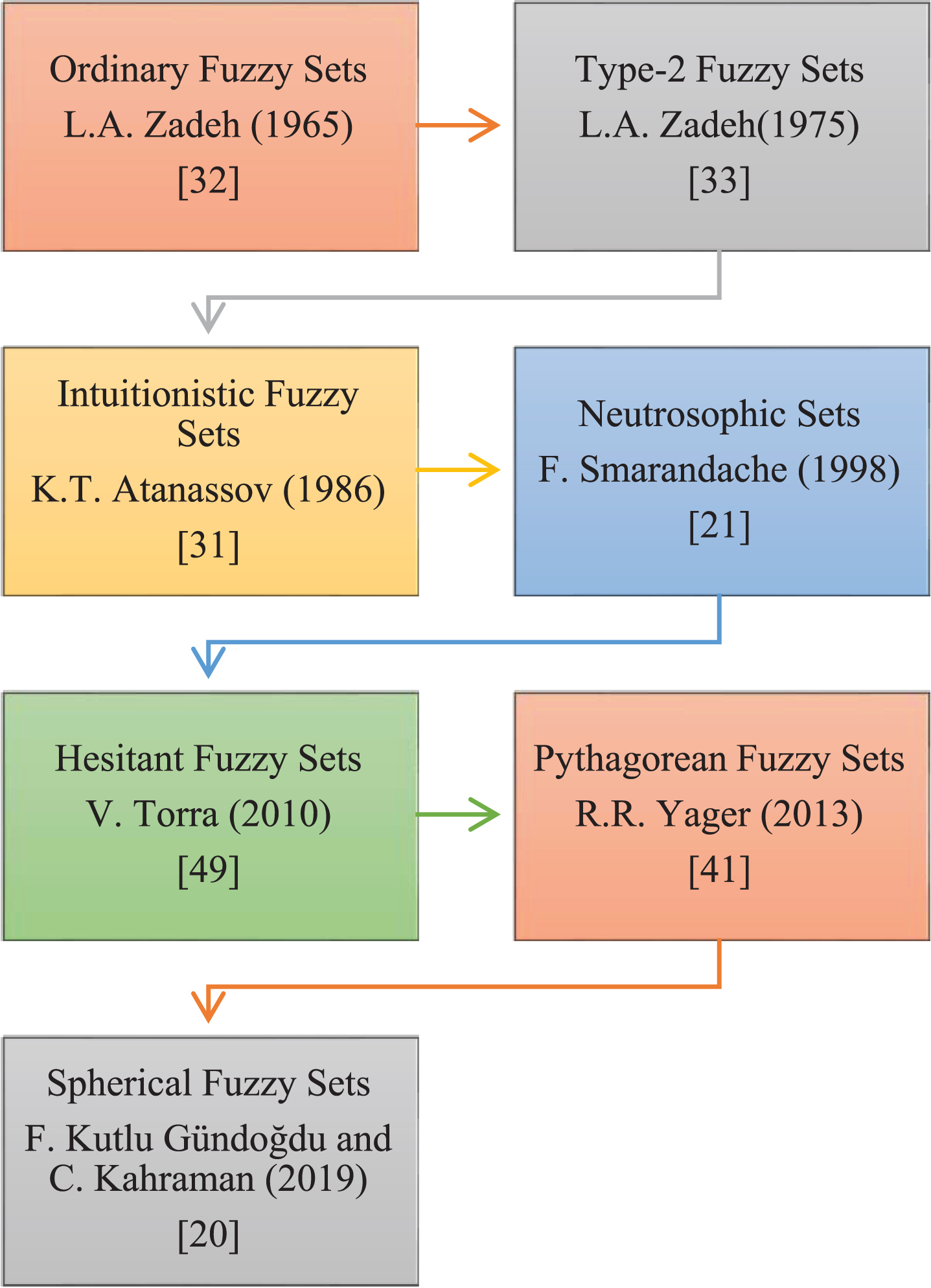
The most frequently used fuzzy sets are shown in Fig. 1 in a chronological order with their developers.
Most frequently used fuzzy sets.
Fuzzy set theory was introduced to the literature by Zadeh [32]. The first type of fuzzy sets is ordinary fuzzy sets, which are represented by only a membership degree for an x value as given in Equation (1).
Zadeh [33] developed type-2 fuzzy sets since ordinary fuzzy sets were criticized by some researchers. A type-2 fuzzy set
Intuitionistic fuzzy sets are developed as a generalization of Zadeh’s ordinary fuzzy sets by Atanassov [31]. These sets involve the degrees of membership and non-membership together with experts’ hesitancies.
Let U be a universe of discourse. An intuitionistic fuzzy set
Neutrosophic sets are introduced by Smarandache [21] to the literature. Let U be a universe of discourse. Neutrosophic set
Hesitant fuzzy sets are developed by Torra [49] and defined as follows:
Pythagorean fuzzy sets are developed by Yager [41]. Let U be a universe of discourse. A Pythagorean fuzzy set
Kutlu Gündoğdu and Kahraman [20] developed the spherical fuzzy sets. Spherical fuzzy sets
Neutrosophic sets is a powerful tool to deal with incomplete, indeterminate and inconsistent information which exist in the real world. Among all the extensions of ordinary fuzzy sets, neutrosophic sets has a significant importance in many application areas since indeterminacy is quantified explicitly and the truth membership function, indeterminacy membership function and falsity membership functions are independent.
Although Ayber and Erginel [42] developed single valued neutrosophic fuzzy FMEA and applied it to improve the overhaul process of a fighter jet engine turbine, there is no IVN FMEA study in the literature. Originality of our study is to apply FMEA approach with the aid of IVNSs that enables the decision makers to make better decisions in indeterminate and inconsistent information environments.
The rest of this study is organized as follows. Section 2 presents a literature review on FMEA. Section 3 gives the preliminaries for interval-valued neutrosophic sets (IVNSs). Section 4 develops an IVN-FMEA model. Section 5 illustrates the application of the proposed model. Section 6 concludes the paper with future directions.
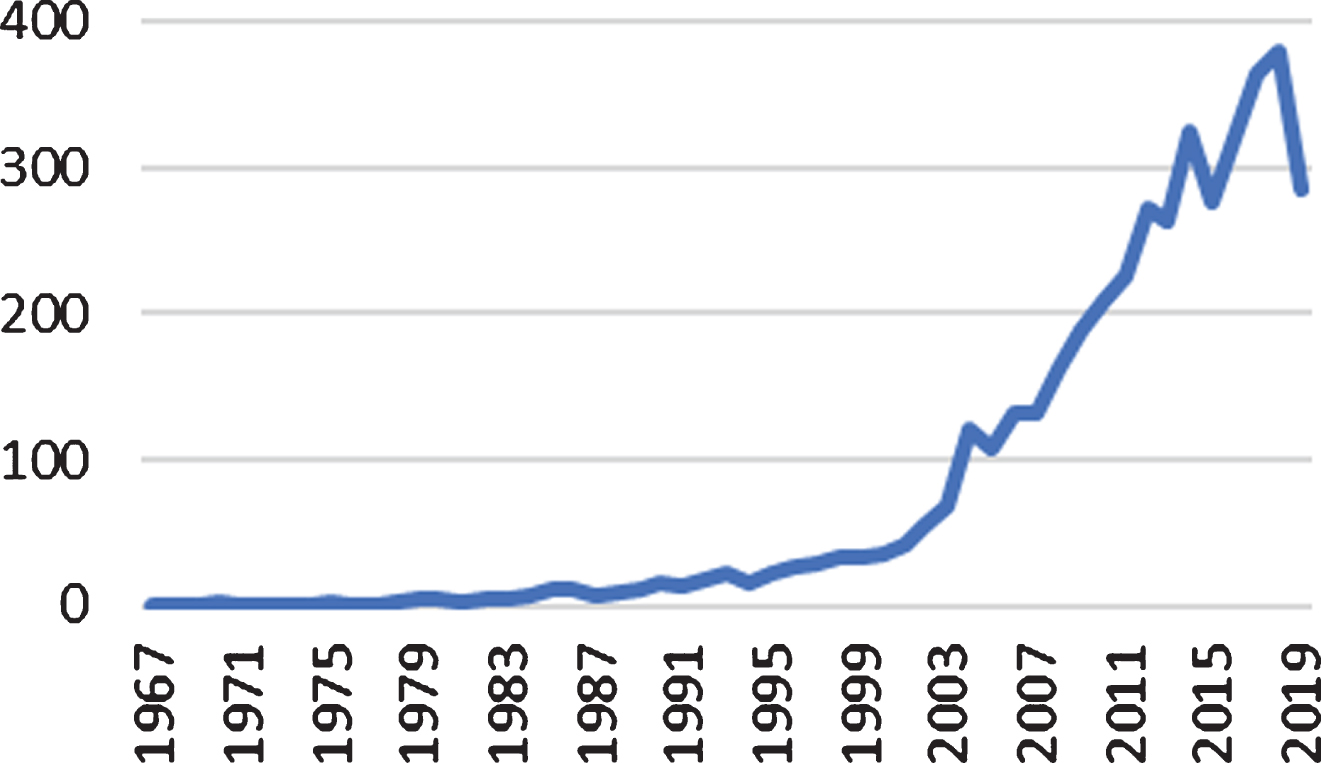
A literature review on FMEA based on Scopus database gave a list of 4,297 publications when the FMEA keyword search is limited into article titles, abstracts, and keywords between the years 1967 and 2019. Figure 2 shows the distribution of the FMEA publications with respect to years.
Distribution of the FMEA publications with respect to years.
Although it is one of the long-standing risk assessment methods in the literature, its usage has significantly increased in the last two decades. The year with the most publications on FMEA is 2018 with 380 studies in total.
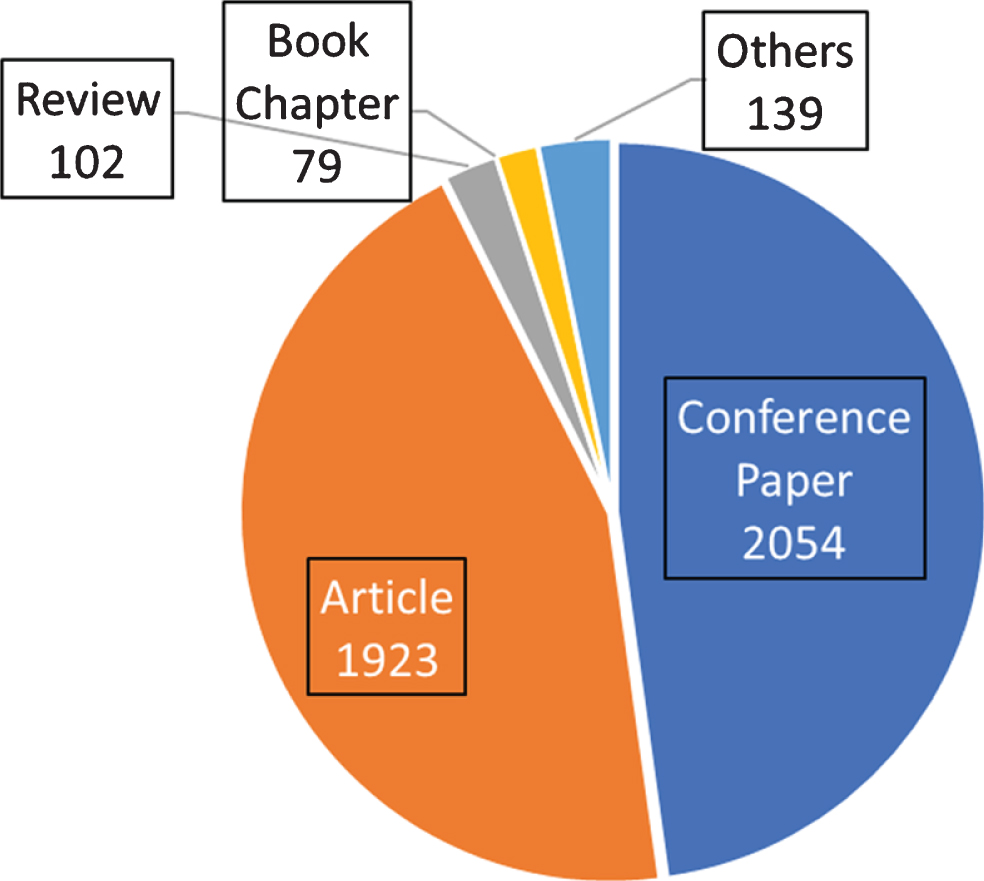
As it is given in Fig. 3, most of the FMEA studies are in conference paper type which is followed by articles, review papers, book chapters and other types of publications.
Document types distributions of FMEA publications.
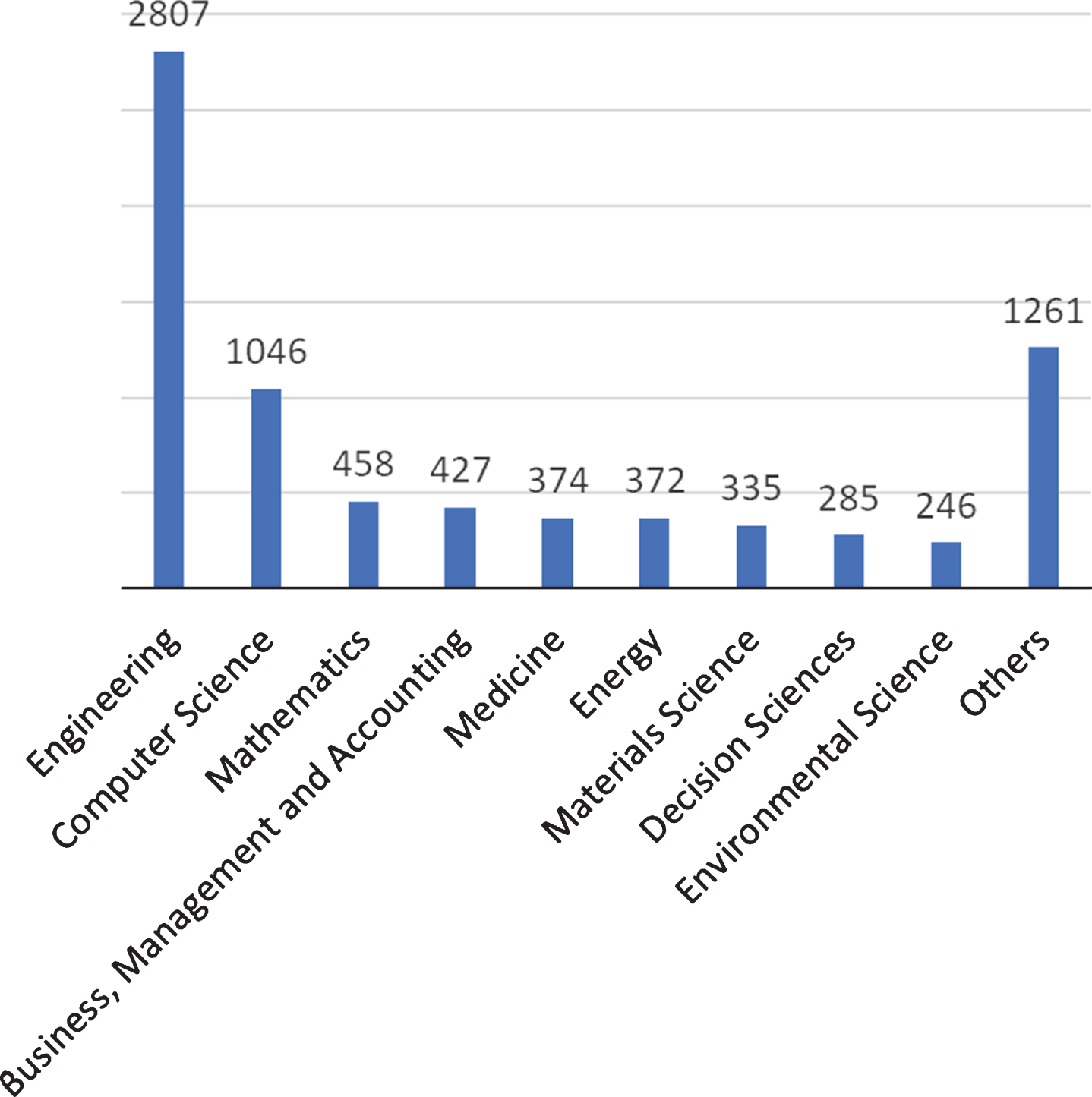
FMEA method has been applied to many subject areas and Fig. 4 shows their frequencies. Engineering, computer science and mathematics are the most frequently applied subjects respectively.
Document types distributions of FMEA publications.
Some representative FMEA studies are given below considering the method’s development over the years. Tashjian [7] defined FMEA as a technique for checking designs and assuring quality and used a simplified example of the reactor protective system to illustrate the method. Legg [28] discussed a computerized technique for preparing a matrix-form of FMEA which has previously been completed using manual methods. Reifer [10] discussed the possible use of FMEA to produce more reliable software. Dobrotin [5] addressed the importance of establishing detail processing requirements through a FMEA and related to various spacecraft computer capabilities. Underwood and Laib [50] developed a prototype knowledge-based system that supports FMEA. Dale and Shaw [6] reported the main findings of a questionnaire survey on the use of FMEA in the United Kingdom motor industry. Watts [23] discussed how computer-aided engineering can be extended beyond the use of design verification into the area of dynamic FMEA for both digital and analogue electronic circuits as well as complete systems encompassing any engineering discipline. Price [9] described the application of model-based technology in the area of FMEA. Krause et al. [19] introduced approaches for the integration of the QFD and FMEA methods as well as feedback with system components for computer aided product development. Hunt [27] reviewed the FMEA process and considered the requirements of an automated FMEA system. McNally et al. [30] used FMEA to identify deficiencies in the ward stock system that led to medication errors in an Australian hospital. Pinna et al. [48] summarized the FMEA performed for the heat transfer systems. Goddard [39] provided a summary of two types of software FMEA which have been used in the assessment of embedded control systems: system software FMEA and detailed software FMEA. Borgmann [2] explained the basics of FMEA and its implementation with a cross-functional team approach involving various disciplines like manufacturing, engineering and quality assurance. Rhee and Ishii [45] addressed a new life cost based FMEA methodology to measure risks in terms of cost. Pantazopoulos and Tsinopoulos [22] used the FMEA technique in the design stage of a system or product as well as in the manufacturing process. Teng et al. [43] offered guidelines for manufacturing industry in correcting the problems in FMEA applications, so companies can adopt their FMEA process into a collaborative supply chain environment. Jegadheesan et al. [8] reported the examination of FMEA implementation in service industry. Segismundo and Augusto Cauchick Miguel [4] reported and discussed the FMEA within a broad context of risk analysis. Chang [29] proposed a general RPN methodology, which combines the ordered weighted geometric averaging operator and DEMATEL approach for prioritization of failures in a product FMEA. Chuang [38] proposed an approach to enhance perceived service quality by incorporating disservice analysis with FMEA. Jee et al. [47] presented a fuzzy FMEA methodology incorporating an analogical reasoning technique. Gan et al. [34] proposed a computer integrated FMEA approach that enhanced FMEA in supply chain management through automated processing using a fuzzy approach and a computer-integrated and internet-based interface to support the system implementation. Razi et al. [18] proposed a model using grey technique to rank various alternatives and FMEA technique to find important faults. Ilangkumaran et al. [35] developed an evaluation model based on FMEA and fuzzy analytic hierarchy process to help the maintenance person for assessing the risk priority of the critical components in the paper industry to provide timely maintenance. Rafie and Samimi Namin [36] aimed to predict the subsidence risk by FMEA and fuzzy inference system. Ardeshir et al. [1] applied a combination of fuzzy logic, FMEA, fault tree analysis, and analytical hierarchy process-data envelopment analysis to improve the process of managing safety risks. Geramian et al. [3] applied fuzzy FMEA for quality improvement in the automobile industry. Li et al. [52] presented a FMEA method to analyze five dimensions of the information security of smart city and assess the risks based on the fuzzy set theory and the grey relational theory. Foroozesh et al. [37] resented a new soft computing approach based on FMEA’s concept for sustainable supplier selection problem in the light of multi-attributes decision analysis.
Compared to the traditional FMEA, fuzzy FMEA has certain advantages. FMEA under fuzziness has been often handled in the literature with ordinary fuzzy sets by the researchers. However, some FMEA studies have been conducted with the extensions of fuzzy sets such as Type-2 fuzzy FMEA, intuitionistic fuzzy FMEA, and Pythagorean fuzzy FMEA. Akyuz and Celik [11] prompted a quantitative risk-based approach combining interval type-2 fuzzy sets with FMEA to perform a comprehensive risk analysis. Mirghafoori et al. [44] analyzed the barriers affecting the quality of electronic services of libraries by VIKOR, FMEA and entropy combined approach in an intuitionistic fuzzy environment. Wang et al. [40] developed an improved FMEA method for risk evaluation based on intuitionistic fuzzy MULTIMOORA. Sayyadi Tooranloo et al. [25] proposed a method Evaluate knowledge management failure factors using intuitionistic fuzzy FMEA approach. Geng and Zhang [51] developed an improved FMEA approach for risk evaluation based on hesitant fuzzy set. Liu et al. [53] proposed a novel FMEA approach which permits values given by decision-makers to with hesitant fuzzy information. Mete [46] proposed a FMEA based AHP-MOORA integrated approach under Pythagorean fuzzy sets for assessing occupational risks in a natural gas pipeline construction project. Ilbahar et al. [17] proposed a novel approach to risk assessment for occupational health and safety using Pythagorean fuzzy AHP and fuzzy inference system. They compared the results with Pythagorean fuzzy FMEA.
Since defining truth, falsity, and indeterminacy degrees of a certain statement exactly in the real situations is not always possible, they might be better to be denoted by several possible interval values. IVNSs are proposed by Wang et al. [26] and they gave the set-theoretic operators of IVNSs. Some of the operations of IVNSs are given below.
A classical FMEA approach consists of 3 parameters:
Severity (S): the effect degree of the potential failure when it occurs
Occurrence (O): the likelihood of a failure to occur
Detectability (D): difficulty degree to detect the failure
The Risk Priority Number (RPN) is obtained from the product of these three parameters as given in Equation (17). Higher RPN means higher risk for product to fail.
Since classical FMEA fail to represent the vague and uncertain judgments of human being and the subjective cognition of the decision makers (DMs), we proposed a new IVN FMEA method in 4 steps as shown below.
Step 1. Determine and list all the potential causes of failure and collect the DMs’ evaluations for each of the three parameters (
Step 2. Aggregate all the DMs’ evaluations for
Let
Step 3. Calculate the
Step 4. Deneutrosophicate the IVNS part of the
Then rank the potential causes of failures to find the one with the highest value which needs to be taken into consideration promptly.
Another possible calculation for final prioritizing score can be found as in Equation (26) which can be called as exponential calculation approach (FEPS).
Suppose that an automotive company in Turkey wants to prioritize the potential causes of failures in the design process depending on 3 DMs’ evaluations. The proposed method is presented below by steps.
Step 1. The potential causes of failures are determined as low level of upper edge of protective wax application used in inner door panels, insufficient wax thickness, inappropriate wax formulation, prevention of wax from entering corner/edge access by entrapped air, plugged door drain holes because of wax application, and insufficient room between panels for spray head access. Their corresponding
Potential causes of failure and the
, and
values
Potential causes of failure and the
Step 2. 3 DMs’ evaluations for potential failure causes and their corresponding
Aggregated potential causes of failure score and the their corresponding
Step 3.
Potential causes of failures and corresponding
Step 4. IVNS part of the
Potential causes of failures and corresponding rankings
Depending on the calculations “Plugged door drain holes because of wax application” process has the highest potential cause of failure score which needs to be taken into consideration promptly. The next highest potential cause of failure is “insufficient wax thickness”.
FMEA is a qualitative and systematic tool to show practitioners what might go wrong with a product or process. FMEA also finds the possible causes of failures and the likelihood of failures being detected before their occurrence. The evaluations generally involve vagueness and ambiguity due to human’s subjective judgments. To capture this uncertainty, we applied the fuzzy set theory to the classical FMEA method. This study is an extension of the conference paper on IVN FMEA [15]. Each parameter is represented by a failure score and its corresponding IVN number. The proposed 4-step method is presented with an application to an automotive company to prioritize the potential causes of failures during the design process depending on multi-experts’ evaluations. Neutrosophic aggregation operators have been used to aggregated these evaluations. RPNs have been deneutrosophicated to determine the priority ranks of the possible causes of failures. The proposed FPS and FEPS approaches produced the same ranking outcome which indicates that the highest potential cause of failure is “Plugged door drain holes because of wax application”. The least important potential cause of failure is “inappropriate wax formulation”.
For further research, we suggest a comparative analysis through other extensions of ordinary fuzzy sets such as intuitionistic fuzzy sets [12] or Pythagorean fuzzy sets [13, 16]. Z-fuzzy numbers are another alternative to develop a new FMEA approach under fuzziness [14]. Another possible further research area is to provide a comparison by using interval neutrosophic power generalized aggregation (INPGA) operator, interval neutrosophic power generalized weighted aggregation (INPGWA) operator or interval neutrosophic power generalized ordered weighted aggregation (INPGOWA).