



Abstract
With the continuous spread of COVID-19 epidemic, the strict control of personnel makes it a problem to optimize the design of vehicle parameters after field measurement. The energy absorption characteristics and deformation mode of the front structure of the vehicle determine the acceleration or force response of the vehicle body during the impact, which plays an important role in occupant protection. The traditional multi-objective optimization method is to transform multi-objective problems into single objective optimization problems through weighted combination, objective planning, efficiency coefficient and other methods. This method requires a strong prior knowledge. The purpose of this paper is to combine the experimental design with the Multi-objective Particle Swarm Optimization (MPSO) method to achieve the optimization of the crash worthiness of automobile structure. This method can effectively overcome the defect of low precision caused by the conventional response surface method in the whole design space. In this paper, the multi-objective particle swarm optimization method is applied to the research of Crash worthiness optimization of automobile structure, which expands the application field of the multi-objective particle swarm optimization method, and also has a very big role in the optimization of other complex systems. It can be seen from the experiment that the speed of multi-objective particle swarm optimization is much faster than that of other methods. Only 100 iterations can get the relative better results. The case study on the front structure of a car shows that the method has a good result. It is of great significance to apply the method to the optimization design of the crash worthiness of the car structure to improve the crash safety of the car under the influence of COVID-19 epidemic.
Keywords
Introduction
The reliability robust design of vehicle structure is a multi-objective optimization design method which requires that the reliability is not sensitive to the change of controlling parameters. In the design of vehicle structure, the correct application of reliability robust design method can make the product keep its reliability stable under the interference of various factors [1–6].
With the development of digital simulation technology, optimization theory and the rapid development of computer software and hardware technology, improving the crash worthiness of automobile structure with finite element analysis tools and optimization algorithm has become a front topic of many scholars in the world. Its objective function and constraint function can’t be expressed. Most of the derivatives of constraint function and objective function are seriously discontinuous. The finite element model is becoming more and more complex and large-scale. For example, the whole vehicle model has developed from tens of thousands of units to millions of units now. On the other hand, in the process of vehicle structure crash worthiness, the change of design variables often leads to the problem of element calculation or contact calculation, which leads to the failure of single simulation and the whole optimization process are unable to proceed.
The traditional multi-objective optimization method is to transform the problem by means of weighted combination, objective planning, efficiency coefficient, multiplication and division [7], which requires a strong prior knowledge. Evolutionary computing is a kind of computing technology based on population operation. In some cases, it is more efficient than genetic algorithm [8, 9]. In this paper, a robust design model for vehicle structure reliability is established, and the fuzzy MPSO (MOPSO) is used to solve the model. The results with practical application reference value are obtained through calculation and simulation.
Reliability robust optimal design of vehicle structure
Random perturbation method of reliability design
One goal of reliability design is to calculate reliability:
Where: f X (X) –The joint probability density of basic random parameter X - (x1, x2,..., xn). These random parameters represent random variables such as load, component characteristics, etc.;
g(X) –The state function which can represent two states of parts: g(X) <0 is failure state, g(X)>0 is safety state.
The limit state equation g(X) = 0 is a three-dimensional and four-dimensional surface respectively.
The random parameter vector X and the state function g(X) are noted as:
Where: ɛ is a small parameter. Obviously, the random part is much smaller than the definite part. Then we have:
Where: Var (X) –variance vector of basic random parameters.
The state function g(X) is taken to find the partial derivative of the basic random variable vector X, respectively:
By substituting equation (6) into equation (5), we can get the expression of variance of state function.
Reliability index is defined as:
It can be obtained:
Where: Φ (•) –Standard normal distribution function.
As the reliability robust design of vehicle structure requires that the reliability is not sensitive to the change of controlling parameters. The reliability of the structure can be expressed as follows:
Where: f1 (x) –Objective function;
X –Design variables;;
R –First order estimator of reliability;
β T –Target reliability.
A multi-objective optimization can have such a solution: it is impossible to further optimize one or several objective functions, and it is not inferior to other objective functions. The second is interactive method, which does not first find many non inferior solutions, but gradually finds the final solution through dialogue between the analyst and the decision-maker. The third is to ask the decision-maker in advance to provide the relative importance between the goals. This method can also be considered as a sub method of the first method. The difficulty of this kind of method lies in how to get the real weight information of decision maker. Combined with the actual situation of robust design, the first method will be used to solve the problem with multi-objective PSO algorithm.
In the process of optimization design, the selection of test points is very important. Arbitrary selection of test points will lead to inaccurate structural design or even structural design. The theory of test design can help to determine reasonable design points. Uniform Latin square test design distributes the test design points uniformly in the design space and represents as much information as possible with as few test design points as possible. The number of levels for each factor can be set as desired.
In this paper, the uniform Latin square experimental design method is used to optimize the design model. Figure 1 shows the distribution of 2 factors (x, y), 9 levels and 9 experimental design points generated by the uniform Latin square program in the design space. It can be seen from Fig. 1 that the generated test design points are very evenly distributed in the design space, providing excellent test sample points for constructing high-precision optimization design model.

Experimental design of two factor nine point uniform Latin square.
Generally speaking, the smaller the sub region, the higher the approximate accuracy of the model. Therefore, a series of continuous regions of interest is used in this paper to determine the approximate optimization. The new region of interest is the previous optimization design point of the region of interest as the center of the region of interest. The region of interest is updated in the whole design space by moving, zooming and other ways which is shown in Fig. 2.

The mode to update the domain of interest –(a) move; (b) zoom; (c) move and zoom.
In the process of foraging flight, the birds often change direction, disperse and gather suddenly. Their behavior is unpredictable but the whole is always consistent. Each individual keeps a proper distance from each other. The optimization process is done with the following equation, namely:
Where: w –Weight;
c1, c2 –Learning factor;
rand () –Random function is between (0, 1). The constraint factor of D-speed is relatively large at the initial stage of search, which can speed up the convergence speed of the algorithm and be smaller at the later stage, so as to ensure that the optimal solution can be found;
Pid –Local optimal value;
Pgd –Global optimal value.
Particle swarm optimization (PSO) can not be directly applied to the process of solving multi-objective problems. In general, the difference between multi-objective optimization and single objective optimization is that multi-objective optimization is generally a set of one or several groups of continuous solutions, while single objective optimization is a set of single solution or a set of continuous solutions. Referring to the reference [10–12] in which the non inferior optimal solution is considered in the multi-objective optimization solution and the selection principle of the optimal solution evaluation proposed in reference [13–17], the particle swarm optimization algorithm suitable for multi-objective solution is given.
As shown in Fig. 3, two objective function spaces of goal 1 and goal 2 are minimized. The target vector B will change in the direction of V1 or V2. Because of the need for objective function objective 1 and objective 2 to guide the change of B through the particles in the decision variable space, the change of B does not change along the direction of V1 or V2, but from the direction of a certain objective 1 and objective 2 between V1 and V2 not increasing at the same time, and finally reaches the non inferior optimal objective domain.

Objective function space.
The literature that uses the PSO algorithm to solve the proposed problems rarely introduces the solution when there are constraints. Combining the characteristics of robust optimization design, fuzzy theory is used to propose a fuzzy multi-objective PSO algorithm for robust optimization design.
First apply certain principles to blur the fitness values of goal 1 and goal 2, and the obtained values are recorded as f-objective1 and f-objective2, respectively. At the same time, find the function value of each solution in the solution space (each particle in the particle swarm) relative to the constraint function. It is obfuscated according to the strengths and weaknesses that satisfy the constraints, and the value obtained is recorded as f-restrict. After completing the above work, introduce a generalized fuzzy operator, namely:
Where: (a + b) = a + b - ab and the value of v is 2.
Through formula (12), the fuzzy value f-objective1 of target 1 and the fuzzy value f-restrict of constraint condition are calculated, and the fuzzy value is fuzzy-objective1. The fuzzy value f-objective2 of objective 2 and the fuzzy value f-restric of constraint condition are also calculated, and the fuzzy value is fuzzy-objective2. The values of fuzzy-objective1 and fuzzy-objective2 are used to replace the original fitness values of object1 and object2, and the operation of particle swarm optimization algorithm is performed.
The result of response surface optimization of MPSO for Crashworthiness of automobile structure is a non inferior solution set [18–20]. In order to make the sequence approximate optimization continue to iterate, it is necessary to select the most satisfactory solution from the set of non inferior solutions and take the solution as the center of the interest domain in the next iteration. The traditional method is that the designer sets the corresponding weights for each objective function according to personal preferences, and then the weighted sum is transformed into a single objective problem which can directly compare the size. The selection of weights is subjective, so it is difficult to find the most satisfactory solution. Therefore, in this paper, the minimum distance selection method is used to quickly and effectively select the most satisfactory solution from the non inferior solution set of each iteration step. The minimum distance solution is shown as following:
Where, n is the number of components in the target vector, fki is the i-th component in the k-th non inferior solution in the non inferior solution set, p = 2,4,6,8,....
The flow chart of solving the whole optimization process of automobile structure crash worthiness by MPSO method is shown in Fig. 4.

The flow chart of solving the whole optimization process.
In order to further improve the collision safety of a mini-car so as to pass the safety regulations smoothly, it is necessary to reduce the development cost, shorten the development cycle and reduce the number of changed parts, so as to share the production line of the original car to the greatest extent. The front longitudinal beam of the original vehicle is very short, and the energy absorption capacity of the front longitudinal beam is limited during the collision, which directly leads to the large peak deceleration of the vehicle body and the high energy transmitted to the passengers. The most direct and economical way to improve the safety of the original vehicle is to add a front structure at the head of the original vehicle to extend the original longitudinal beam. Figure 5 is the effect picture of the sample vehicle after adding the front structure, and Fig. 6 is the finite element model of the new front structure, which consists of five parts: the upper crossbeam, the middle connecting structure, the lower crossbeam, the upper plate of the lower longitudinal beam and the lower plate of the lower longitudinal beam.

Objective function space.

Objective function space.
A large number of studies have shown that for every 10% weight loss of a car, its fuel consumption will be reduced by 10%, and its emissions will be reduced by 3% to 7%. Therefore, under the premise of meeting safety regulations, reducing the quality of automobiles is equally important. To sum up, the newly added front structure should maximize its energy absorption and lightest structural weight as long as the acceleration peak does not exceed a certain limit. Through analysis, the upper crossbeam plate thickness δ1, the lower longitudinal beam upper plate thickness δ2 and the lower longitudinal beam bottom plate thickness δ3 are the most important factors affecting energy absorption, lightweighting of structures and peak acceleration, so they are used as design variable. The final deformation mode of the optimized design is shown in Fig. 7.

Optimized design of the final deformation mode.
The mathematical model of multi-objective optimization for this problem is shown as:
Where Eobj represents the absorbed energy, mobj represents the mass of the structure, and am represents the peak acceleration.
In the initial design, the maximum collision acceleration is 53.14 g, which does not meet the constraints, so an optimization calculation must be performed. After two iterations, the partial factor of the design variable is λ3 = 1, and the results converge. The first iteration was performed in the global design space, and the optimization results of the design variables were 2.45, 1.00, and 1.70, respectively. The second iteration of optimization is centered on the results of the first optimization. The partial factors of the design variables are calculated according to equations (7) and (8) and λ2 = 0.75. The range of design variables is according to equations (9) and (10). The calculations are: δ1 = [1.7,3], δ2 = [1,1.75], δ3 = [1,2.45], and the optimized results are 2.44, 1.00, and 1.71, respectively.
The following table lists the initial design, iterative step optimization process design variable values, goals and constraints, approximate values and finite element calculations. From the table below, it can be seen that the approximation of the final optimization design variables corresponding to the goals and constraints and the finite element calculated value error are small. Although the final finite element calculation value of the constraint function is 50.29 g, which exceeds the design requirement of 50 g, similar small errors in the actual project are completely acceptable. Compared with the final optimization results, the initial design shows that the energy absorption is increased by 5.99%, while the weight is reduced by 11.14%, and the constraints basically meet the design requirements.
The entire optimization process calls a total of 40 positive questions, which greatly reduces the number of calls to the positive questions and improves efficiency significantly compared with directly using the finite element model for optimization. Figures 8 and 9 list the final deformation results of the optimized design, the energy absorption comparison curve before and after optimization, and the acceleration comparison curve before and after optimization, respectively.

Energy absorption comparison before and after optimization.

Acceleration comparison before and after optimization.
In order to verify the rationality of the structural design shown in Fig. 5, a real car crash test was conducted. The two lower energy absorption cylinders in the model shown in Fig. 5 are the most important components that affect the acceleration curve and energy absorption of the vehicle body. Reasonable simplification of the upper beam of the structure shown in Fig. 5 can avoid the shortcomings of having to design it in the conceptual design stage, greatly shorten the test preparation period and save test costs, and win the time for the modified car to be listed in advance. It will not cause a great influence on the energy absorption characteristics and deformation modes of the two lower energy absorption cylinders. The energy absorbing tube has a simple process and is easy to manufacture. Therefore, the upper beam in the model of Fig. 5 is simplified into two equivalent energy absorbing tubes for alternative tests. The energy absorption capacity and deformation mode of the simplified model (Fig. 11) are comparable to those shown in Fig. 5. Figures 10 and 11 are photos of the test results before and after deformation. The test results show that the modified car meets the requirements of CMVDR294, proving that the structural design shown in Fig. 5 is reasonable and feasible.
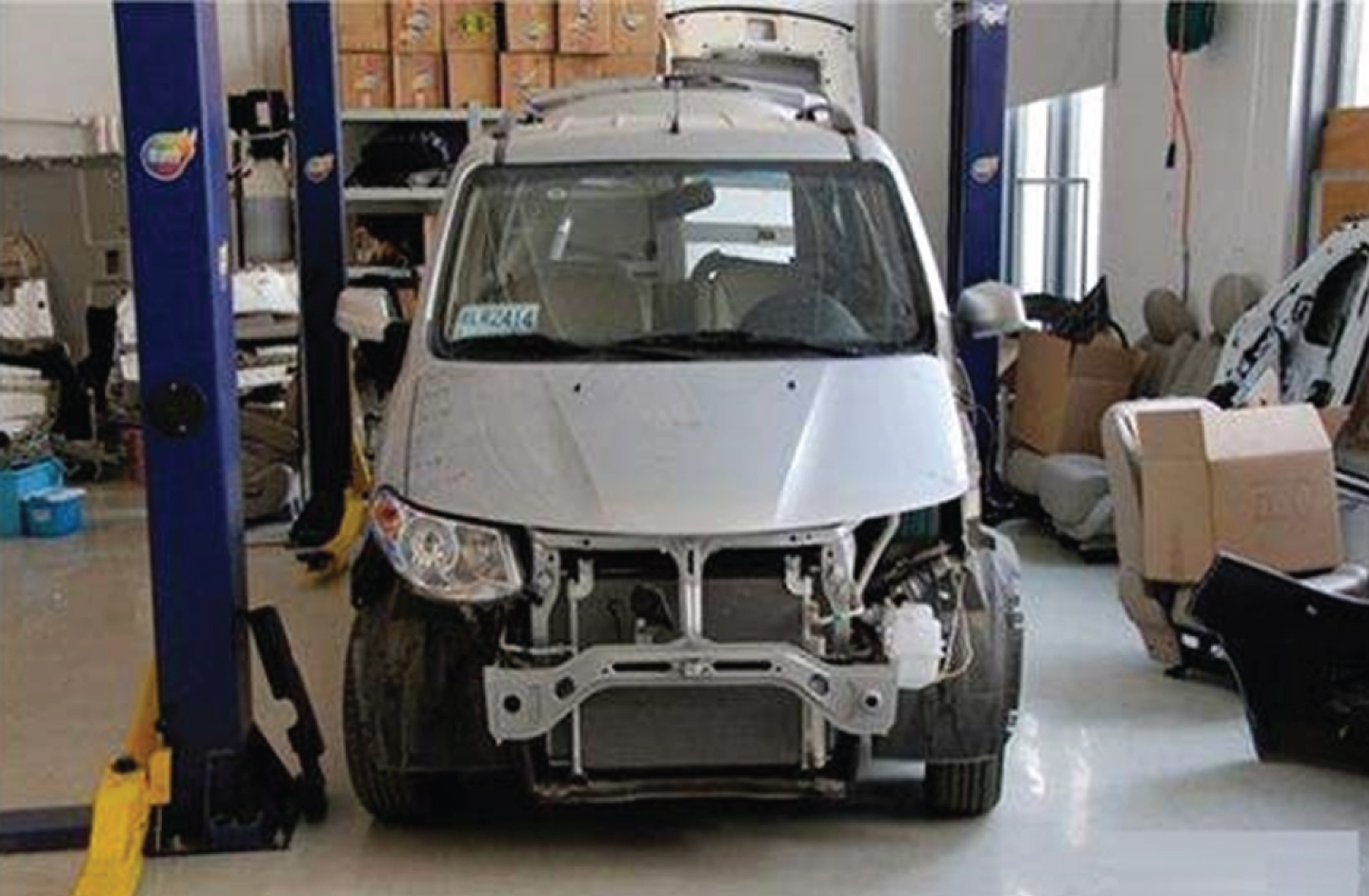
Test results before deformation.
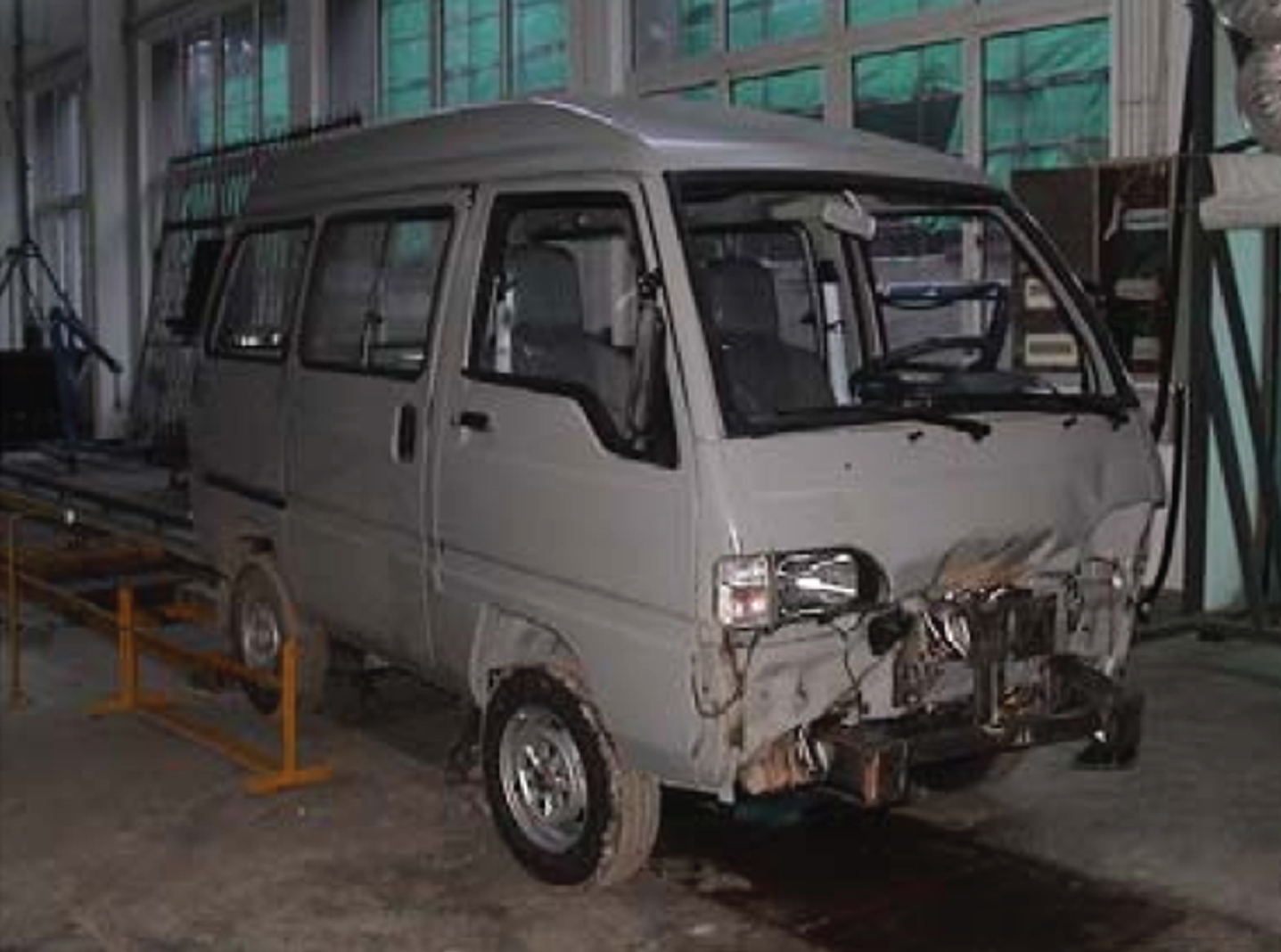
Test results after deformation.
The strict control of personnel in COVID-19 epidemic makes it a problem to optimize the design of vehicle parameters after field measurement. In this paper, the test design and MPSO method are combined to achieve the optimization of Crash worthiness of automobile structure. This method can effectively overcome the defect of low precision caused by the conventional response surface method in the whole design space. In the optimization process, the response surface approximation model instead of the finite element model is invoked, which greatly reduces the number of calls to the finite element model and improves the efficiency. It overcomes the problem of bottle strength in the numerical simulation of vehicle structural crash worthiness due to problems arising from unit calculation or contact calculation.
As the result of multi-objective optimization is a non-inferior solution set, the minimum distance selection method proposed in this paper can help engineering designers to select the most satisfactory solution quickly and effectively, and overcome the shortcomings of subjective preference setting of engineering personnel in the past.
In this paper, the MPSO method is applied to the research of Crash worthiness optimization of automobile structure, which expands the application field of the MPSO method, and also has a very big role in the optimization of other complex systems. The case study on the front structure of a car shows that the method has a good result. It is of great significance to apply the method to the optimization design of Crash worthiness of the car structure to improve the crash safety of the car.