



Abstract
In order to explore the impact of the system-driven supply chain, collaborative operations, and organizational characteristics on supply chain operational performance, this paper based on the system dynamics method to simulate the established information collaborative supply chain model, analyze market demand data, inventory before and after the supply chain sharing The changes of inventory fluctuations in the supply chain and related calculations are compared with the simulation results under the current model to prove the importance of implementing information collaboration in the supply chain of a large retailer-led supply chain. The research in this paper shows that with the supply chain information collaboration model, the average value of the manufacturer’s order quantity has dropped by 30.4%. Affected by this, the dispersion coefficient has also dropped from 0.76 to 0.6, and the average number of orders in the distribution center has also dropped by 12.2%; With the supply chain information synergy model, the average value of the raw material inventory of manufacturers has dropped significantly, from 3400 in the current model to 2500 in the information synergy model, a decrease of 27%, the standard deviation has also decreased by 57%, and the dispersion coefficient has dropped from 0.98 to 0.50; The standard deviation rate of the inventory of the distribution center is 30%; from the perspective of the overall retail supply chain, the inventory has fallen by 14%, the standard deviation has fallen by 34%, and the dispersion coefficient has dropped from 0.76 in the current model to the information collaboration model. 0.6, it can be seen that the mode of supply chain information coordination has a great effect on reducing supply chain costs and improving supply chain efficiency.
Keywords
Introduction
With the rapid changes in the economic environment, the product life cycle is getting shorter and shorter, and market uncertainty is constantly increasing [1]. Individual companies can no longer survive in a fiercely competitive environment, and they must systematically plan and manage their supply chain. Supply chain collaboration has a very important meaning and effect on the performance of an enterprise’s supply chain operations. However, most of the current research on supply chain operation performance, especially the research on its pre-factors, focuses on the supply chain influencing factors [2]. There are few empirical studies on supply chain coordination and supply chain operational performance.
Supply chain performance is currently a hotspot in academic and business circles. It is an important part of supply chain management. It is of great significance for measuring the achievement of supply chain goals and providing operational decision support. If the enterprise does not pay enough attention to the interruption of the supply chain, does not take certain preventive measures in advance, and does nothing, then once the interruption occurs, the cost is huge, not only affecting the performance of a single enterprise but also affecting the entire supply chain [3].
In order to evaluate the effectiveness of contextual operation involving internal supply chain personnel (involving logistics and supply management) in enterprise product innovation activities [4], Turkulainen et al., Based on the classic contingency theory argument, participated in the innovation activities of internal supply chain personnel (SCPII). A detailed contextualized study of performance effects was conducted [5]. Gabriel Crainic et al proposed a new freight integration operator planning model, linking strategy, resource acquisition, and allocation decisions with tactics and service network design-related decisions [6]. Mohamed M et al studied the two-stage stochastic programming model of biomass co-firing supply chain network design and management under the uncertainty of raw material supply [7].
In order to explore the impact of system-driven supply chain collaborative operations and organizational characteristics on supply chain operational performance [8], this paper based on the system dynamics method to simulate the established information collaborative supply chain model, analyze market demand data, inventory before and after the supply chain sharing. The changes in inventory fluctuations in the supply chain and related calculations are compared with the simulation results under the current model to prove the importance of implementing information collaboration in the supply chain of a large retailer-led supply chain.
Supply chain management theory
Supply chain collaboration management
(1) Supply chain management
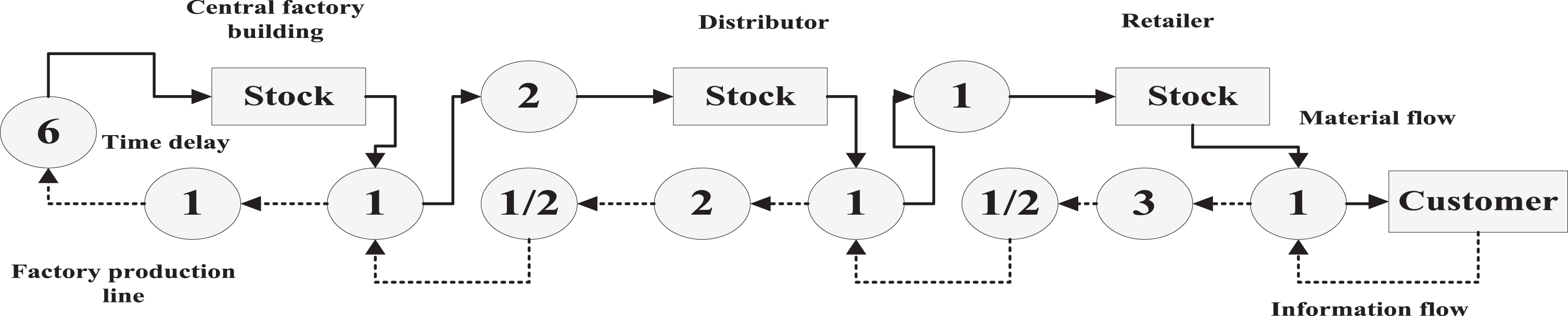
This situation makes people focus on specific production and manufacturing technologies and management methods [9]. The proposal of supply chain management first appeared in the 1960 s. Professor Forrester of MIT put forward the idea of a supply chain including production, supply, storage, and other links in industrial dynamics, and established the corresponding model, which is considered as the earliest model of the supply chain, as shown in Fig. 1:
Supply chain model first proposed by Forrester.
The concept of supply chain management has not formed a unified definition since it was put forward. Generally speaking, supply chain management is based on feedforward information flow and feedback information flow, which combines suppliers, manufacturers, distributors, retailers, and customers into an integrated model. The basic idea of supply chain management is “horizontal integration", which is to send out the products produced by enterprises, scientifically and reasonably use the beneficial resources owned by the outside, and form with these enterprises Equal cooperation in law [10]. Supply chain management is quite different from the general internal management of the organization. The internal management of the organization is that the superior orders the subordinate, and the subordinate obeys the relationship of the superior. Supply chain management is a cooperative chain of enterprises with independent legal person status, and each enterprise is in an equal position [11].
(2) Research level of supply chain management
The aspects of supply chain management research are very wide and wide. The research methods used are also in many forms. The specific methods used are mainly based on various aspects such as research content, research objects, and product types. At present, the research direction of supply chain management mainly focuses on supply chain inventory management, information flow management, and cooperative relationship management. The concept of supply chain proposed by the researchers mainly includes: agile supply chain, integrated supply chain, virtual supply chain, Product-based supply chain, and other types. However, in terms of the main aspects of supply chain research, it mainly includes the following three aspects:
1) Enterprise supply chain management
The formulation and implementation of the plan has an adverse impact, and it will also have an adverse impact on the operation mechanism of the entire supply chain. On the basis of enterprise supply chain management, we must not only pay attention to communication and cooperation with other supply chain members, but also pay attention to Optimized allocation of resources for various products in technical aspects such as raw material procurement, production, distribution, and transportation [12, 13].
2) Product supply chain management
A product supply chain is a supply chain-related to a specific product or project. Product supply chain management is the systematic management of the entire process of the entire product supply chain operating under the influence of customers’ demand for specific products [14]; scientific use of information technology is to improve product supply chain operation performance, accelerate product development efficiency and enhance product quality. In the product supply chain, related advertising effects and market development will have a certain impact on product demand, but improving the supply chain in logistics, transportation, distribution, and other fields cannot solve the main problems [15].
3) Supply chain coordination
Supply chain coordination is a strategic cooperative partnership consisting of some members of the supply chain. At present, in this research, there are both quantitative research methods and qualitative research results. The supply chain partnership is mainly used to manage cooperation between members [16].
(3) Supply chain collaborative management
The important idea of the synergy theory is that the small systems existing in the large system influence and interact with each other [17]. When they reach a balanced structure or change from an old structure to a new structure, they all follow certain rules; the greater the sum effect, the smaller the adverse effects of the system, and the more reliable the results obtained [18].
Supply chain collaboration refers to a network alliance formed by two or more enterprises through enterprise agreements or joint organizations to achieve certain strategic objectives; at present, the main research problem of supply chain management is how to effectively coordinate supply chain enterprises. Each node enterprise can form a network structure through a company agreement or a joint organization. In this structure, suppliers, manufacturing retailers, distributors, and customers can share information, cooperate closely, and move towards common goals [19, 20].
(1) Methods based on operations research
The model can cover supply chain management, mainly used in strategic decision-making, the solution methods mainly include the branch and bound method, Lagrange relaxation method, bending decomposition method, and line decomposition method. Operational research methods generally require reliable assumptions and mathematical abstractions, because there are many complex and uncertain factors in the actual supply chain system. It is difficult for existing mathematical tools to provide an optimal solution. The method, which makes the operations research method, cannot fully solve this kind of problem, so it has strong limitations [21–23].
(2) Based on cybernetic methods
These modeling ideas are mainly based on the theory of control discipline and the input-output relationship of the supply chain system to describe a series of differential equations. When the scale of the model is relatively large and complex, it is difficult to describe the problem using cybernetic methods. Even if the problem can be described well, it is still difficult to achieve accurate results [24].
(3) Analysis method based on system simulation
Simulation modeling and analysis methods mainly include spreadsheet software simulation, discrete event simulation, system dynamics simulation, multi-agent-based simulation, etc [25]. Spreadsheet software simulation methods are limited in their analysis and simulation capabilities. It requires a high degree of data sufficiency and is often used in finance, accounting, and bookkeeping; business games mainly simulate the real world, and their ability to analyze and model human behavior is limited. Used for teaching and training [26].
Supply chain management based on system dynamics
(1) Complex characteristics of supply chain system
1) The complexity of the entity
The entities in the supply chain can be divided into subordinate entities, semi-autonomous entities, and autonomous entities according to different management methods and decisions [27–28]. Establishing a good cooperative relationship between entities and clarifying their respective responsibilities and obligations is an effective way to reduce the complexity of supply chain management; the supply chain is composed of multiple enterprises (subsystems), and these enterprises themselves, including the public, must strengthen coordinated operation and management of resources [29].
2) Structural complexity
From the point of view of the relationship between entities, the structure of the supply chain can be divided into two forms: one is the compact type, and there is a close connection between the entities of this supply chain, which is led by a group headquarters with a dominant power Coordinate the operation of the supply chain; the other is the dynamic alliance (federal system), the general enterprise supply chain will have a clear system boundary, the system boundary is small, and the boundary of the dynamic alliance supply chain system is not very accurate, the system boundary is relatively Large, there is no clear control and control relationship between many system members, but a loose cooperative relationship. Enterprises join the supply chain in the form of franchising, and each seeks to maximize its own interests from their own interests [30]. Generally speaking, the supply chain presents a complex network structure, namely chain, tree, bidirectional tree, and star structure [31].
3) Openness
All enterprises (subsystems) in the supply chain interact and interact with each other, and the subsystems also have a certain relationship with the external environment. Especially under the influence of market changes, upstream suppliers will supply at the beginning of the supply chain. Retailers have a certain impact, so retailers will also interact with customers at any time. In addition, as the market environment continues to change, the entire supply chain will be improved to a certain extent, which reflects an evolutionary trend [32].
4) Emergence
The emergence of the system means that the system has properties that other parts do not have [33]. This is the most special nature of this system. The supply chain is a process of continuous evolution when the enterprise adapts to the changing market environment. The supply chain model is where the enterprises compete with each other. A model emerged in the process of cooperation and development, but its constituent entities do not possess the overall nature of the supply chain [34].
(2) Research category of supply chain system dynamics
1) Research on the inventory control strategy
The application of inventory management is a very common research field. System dynamics has a great influence on the research and application of inventory management. For this aspect, many studies have used established system dynamics models to study the two-level supply chain. Under the environment, based on the quantity of VMI integrated replenishment strategy, and then analyze the impact of different replenishment thresholds on the supply chain bullwhip effect and the inventory level fluctuations of each node [35].
2) Research on the bullwhip effect
The study of the bullwhip effect is the earliest application of system dynamics in the supply chain [36]. In the Forrester supply chain, it clearly reflects the flow of materials in the entire supply chain, and to a certain extent reveals the time lag and bullwhip in the supply chain Dynamic characteristics such as effects; subsequent research on the bullwhip effect is considered to be an important research area [37].
3) Multi-party business modeling (PBM method)
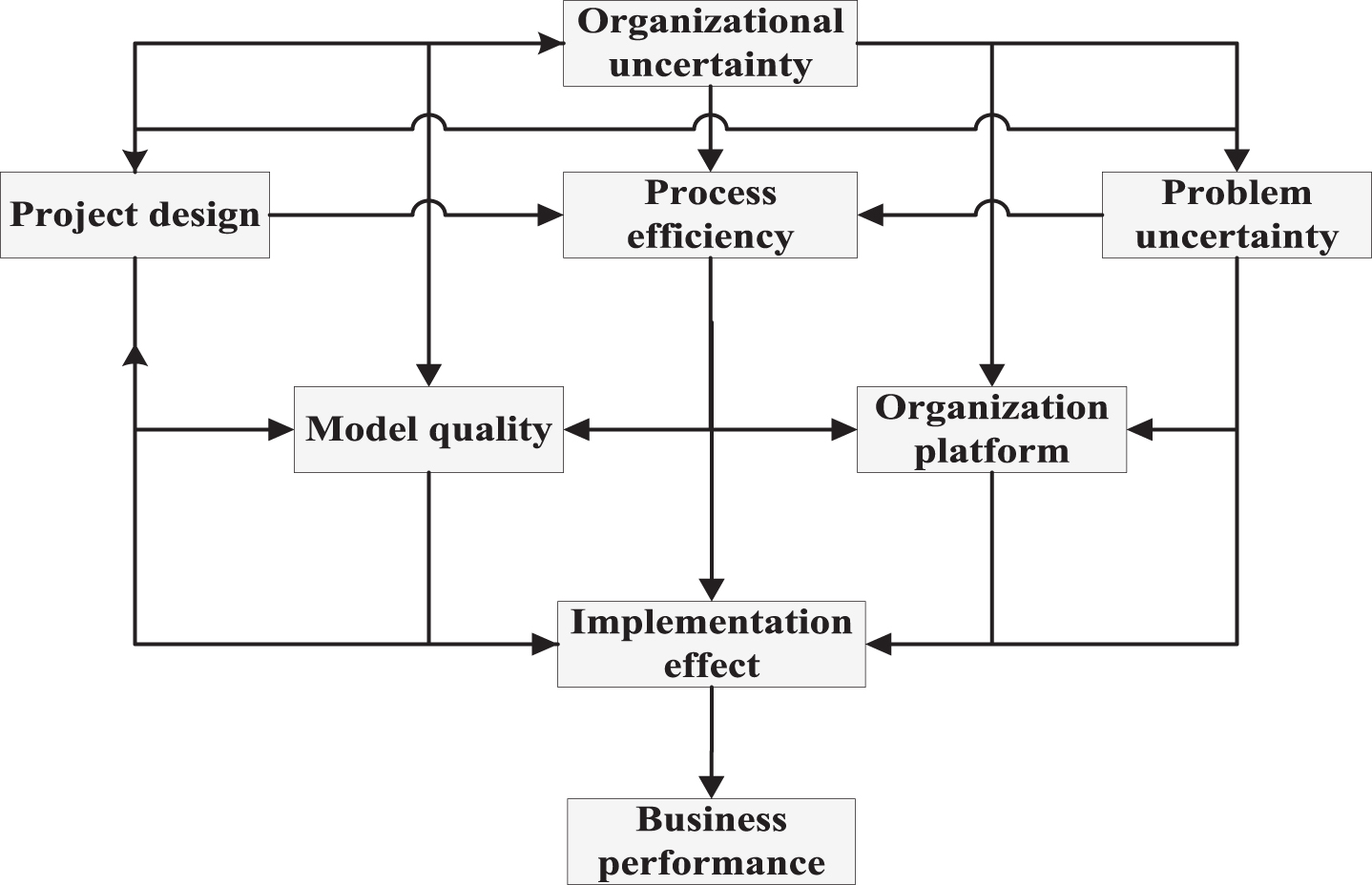
The conceptual model of multi-party business modeling is shown in Fig. 2.
Conceptual model of multi-party business modeling.
There are four steps in the PBM method: first, the problem definition stage: start with the complexity, and then integrate the relevant concepts of project management to analyze the strategic issues; second, the problem conceptualization and structuring stage: main Use the brainstorming method, causal loop diagram, state variables and flow diagram to complete the process structure and its associated feedback loop diagram; third, the model quantification stage: use the system dynamics method or discrete event simulation method to achieve the model structure and Express the mathematical relationship of variables, and experiment and test the model to discover the dynamic behavior model of the system under different strategies; Fourth, the knowledge discovery and diffusion stage: conduct scenario analysis and flexibility testing of the model to complete the relevant sensitive variables and models in the model Reliability test, and further modify and improve the model to maximize system performance [38, 39].
Research content
Based on the VensimPLE simulation platform, the system dynamics method is used to simulate the established information collaborative supply chain model, analyze the changes in market demand data, inventory before and after inventory, and supply chain inventory fluctuations during supply chain sharing, and make relevant calculations. The comparative analysis of the simulation results under the model proves the importance of implementing information collaboration in the supply chain of large retailers.
Research methods
Adopt the literature review method, induction, and deduction methods to elaborate on the application and related theories in the information collaborative supply chain. Using the system dynamics method, based on the VensimPLE simulation platform, the retailer-led supply chain collaboration is simulated and simulated. Use Excel software to calculate and calculate the background data simulated by VensimPLE software, and analyze the changes in inventory.
Model assumptions
This article mainly studies the demand and sales of a representative product (a model) sold by retail enterprises and the procurement and production of raw materials. Among them, the products sold by retail enterprises are produced by the production of raw materials provided by manufacturers and suppliers, assuming that the products are composed of one kind of raw material. The transportation capacity of raw material suppliers, manufacturers, and distribution centers is not restricted. In the model, the production capacity, personnel, equipment, technology, and other factors that affect the operation of the enterprise are not restricted, so they do not consider the production suspension or business suspension due to special reasons. For the convenience of calculation, the ratio of the product produced by the manufacturer and the raw material is 1:1, that is, one unit of raw material can produce one unit of product. The raw materials provided by the raw material suppliers and the products produced by the manufacturers are qualified, that is, the return of the distribution system is not considered. The raw material supplier can supply any number of raw materials to the manufacturer, that is, the supply of raw materials is not limited.
Introduction to the initial situation of the calculation example
This article takes the relevant business data of a chain supermarket as an example, and performs simulation in two parts: Simulation of supply chain management under the current model: under the current model, information is not shared among members of the supply chain, forming information islands, retail enterprise distribution centers, and stores, distribution centers, and manufacturers according to their next node Enterprise orders to predict market demand. Simulation of the supply chain after information collaboration: After information collaboration, real-time sales data and inventory information are shared among members of the supply chain, and all member companies participate in the same demand forecast and make synchronous decisions.
Discussion and analysis of experimental results
System simulation and analysis in current mode
(1) Analysis of order quantity and inventory of supply chain node enterprises under the current model
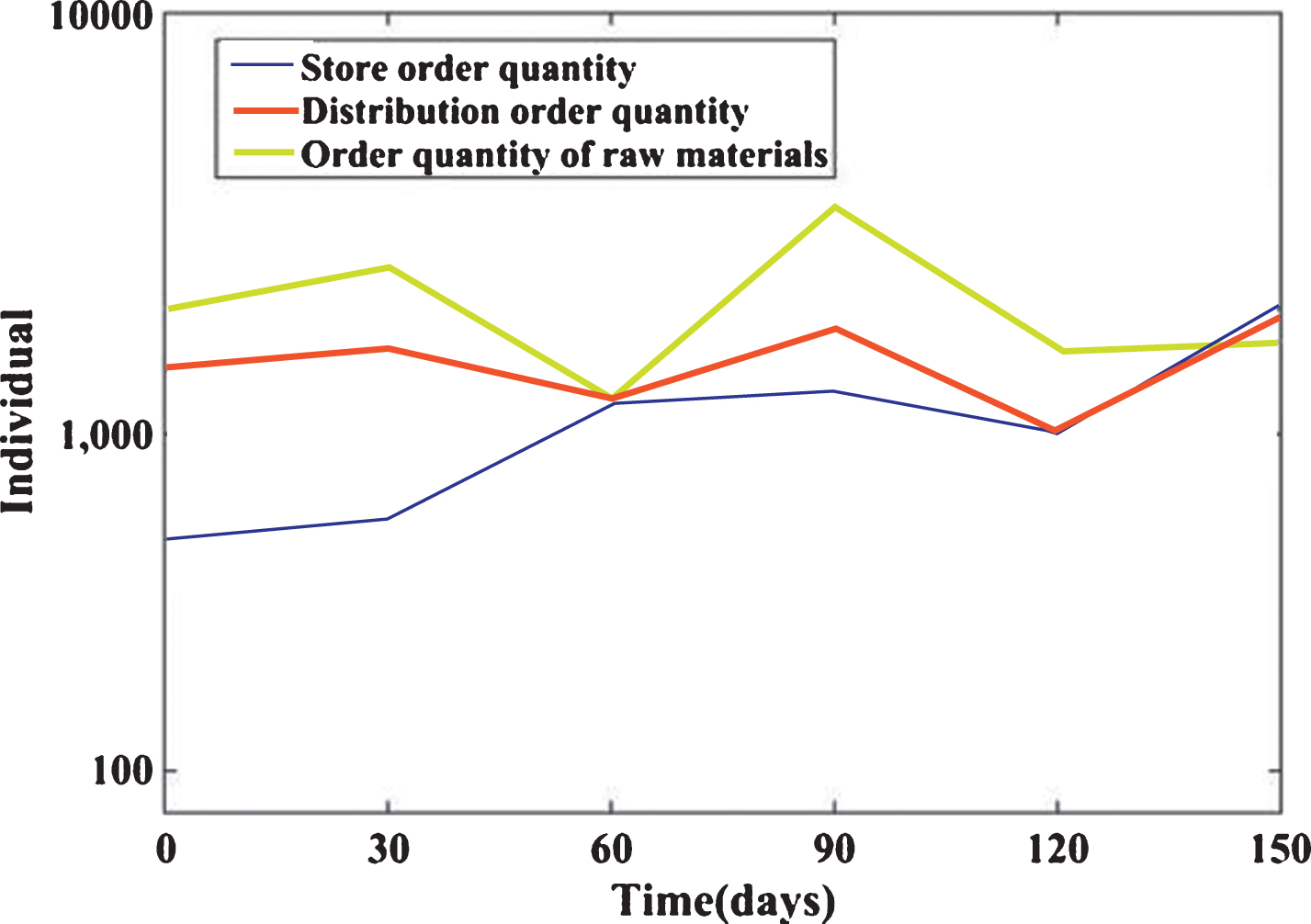
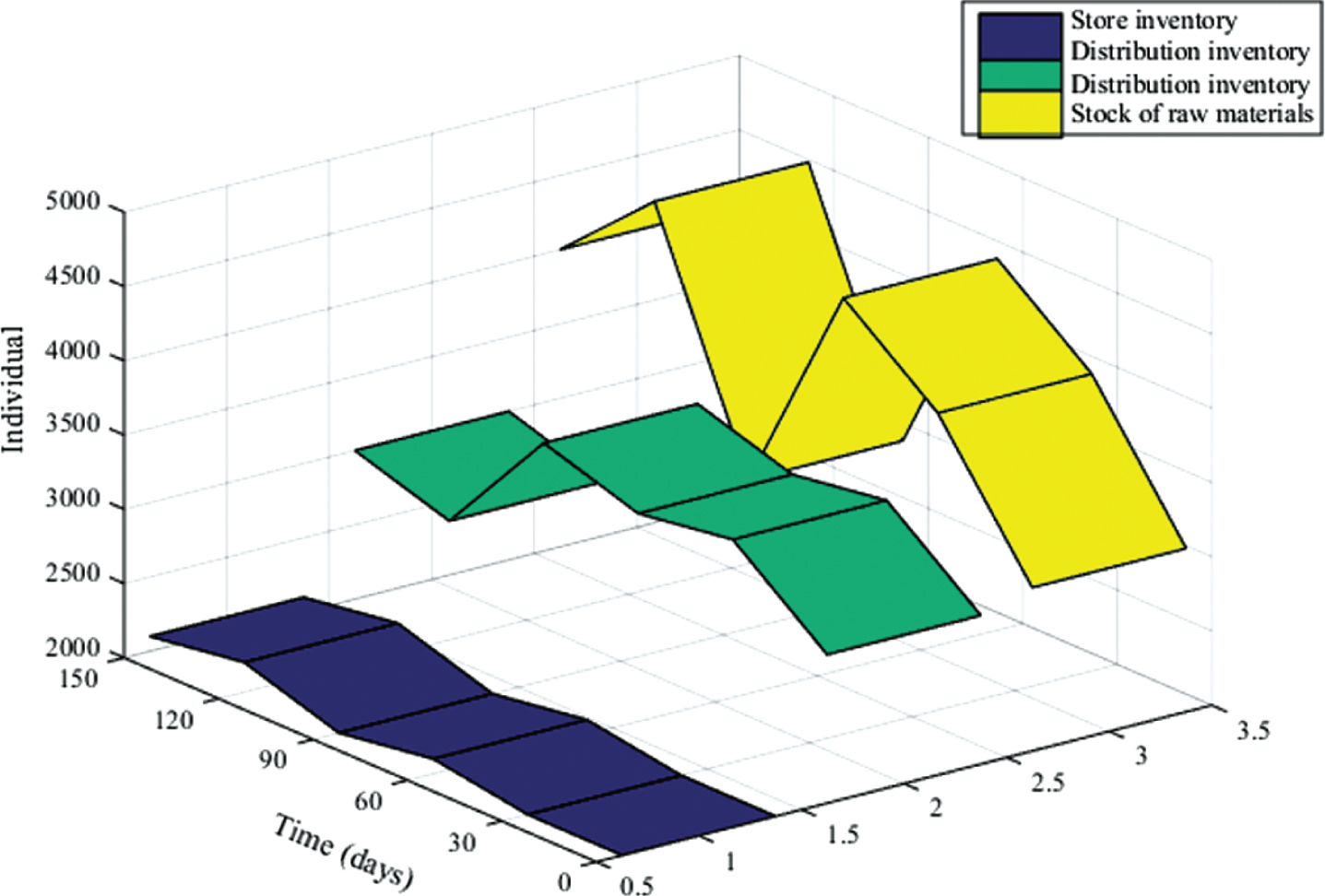
When the market demand fluctuates randomly, the changes in the order quantity and inventory quantity of retail enterprises, distribution centers, and manufacturers are shown in Figs. 3 and 4.
Order quantity of supply chain node enterprises under the current mode.
Node enterprise inventory under the current mode.
It can be seen from Fig. 3 and 4 that the store order quantity, the distribution center order quantity, and the manufacturer’s raw material order quantity on the 30th day are: 600, 1700, 3500; on 60 days, they are: 1000, 1200, 1300; The time of day is: 1200, 1500, 3000 respectively, the fluctuation range becomes larger with the passage of time, so the fluctuation range of store inventory, distribution center inventory and producer’s raw material inventory also increase sequentially. This is due to the uncertainty of market demand, which leads to the dynamic change of expected inventory as demand changes. Therefore, the amount of orders submitted by stores/distribution centers/producers to their upstream distribution centers/producers / raw material suppliers naturally changes dynamically. In addition, the inventory in transit is delayed in time, so the actual inventory of each node enterprise in the supply chain has been randomly fluctuating around the change in demand and is in a state of constant adjustment.
(2) Analysis of simulation results of order quantity and inventory of supply chain node enterprises under the current model
Table 1 shows the analysis results of the simulation results of the order quantity and inventory of supply chain node enterprises under the current model.
Simulation results of order quantity and inventory quantity of supply chain node enterprises under the current mode
It can be seen from Table 1 that the discrete coefficient of market demand is 0.45, which is smoothly predicted when the retail enterprise stores formulate the order quantity so that the discrete coefficient of the store order quantity becomes 0.33, but due to the bullwhip effect, the greater the upstream discrete coefficient The order quantity of each node is obviously enlarged step by step from bottom to top. Affected by this, the fluctuation of the inventory of each node company is also increasing from bottom to top. The order quantity received by the enterprises in each link will be greater than their actual demand, and the higher-level enterprises arrange their own procurement or production activities based on the orders submitted by the lower-level enterprises, and these activities will take a certain amount of time. In addition, There is the transportation time, so the response to market demand will lag behind in turn; the supply chain from bottom to top, the fluctuation of inventory and order quantity is increasing, resulting in a long whip effect, and the products in the enterprise’s inventory that exceed the actual demand will definitely Increasing the company’s expenditure, increasing operating costs, reducing the company’s profitability, when the market demand suddenly decreases, it will cause a backlog and bring losses to the company.
The above analysis results show that the inventory of supply chain node enterprises is basically high, and there is room for compression, indicating that the current model is not optimal, that is, the asymmetry and untimely information transmission results in low overall supply chain efficiency. Therefore, it is of positive significance for retail enterprises to lead each node enterprise in the supply chain to implement information collaboration for the stable development of each subject in the retail enterprise supply chain.
(1) Comparative analysis of order quantity and inventory of supply chain node enterprises
The order quantity of supply chain node enterprises under the information collaboration mode is shown in Fig. 5.
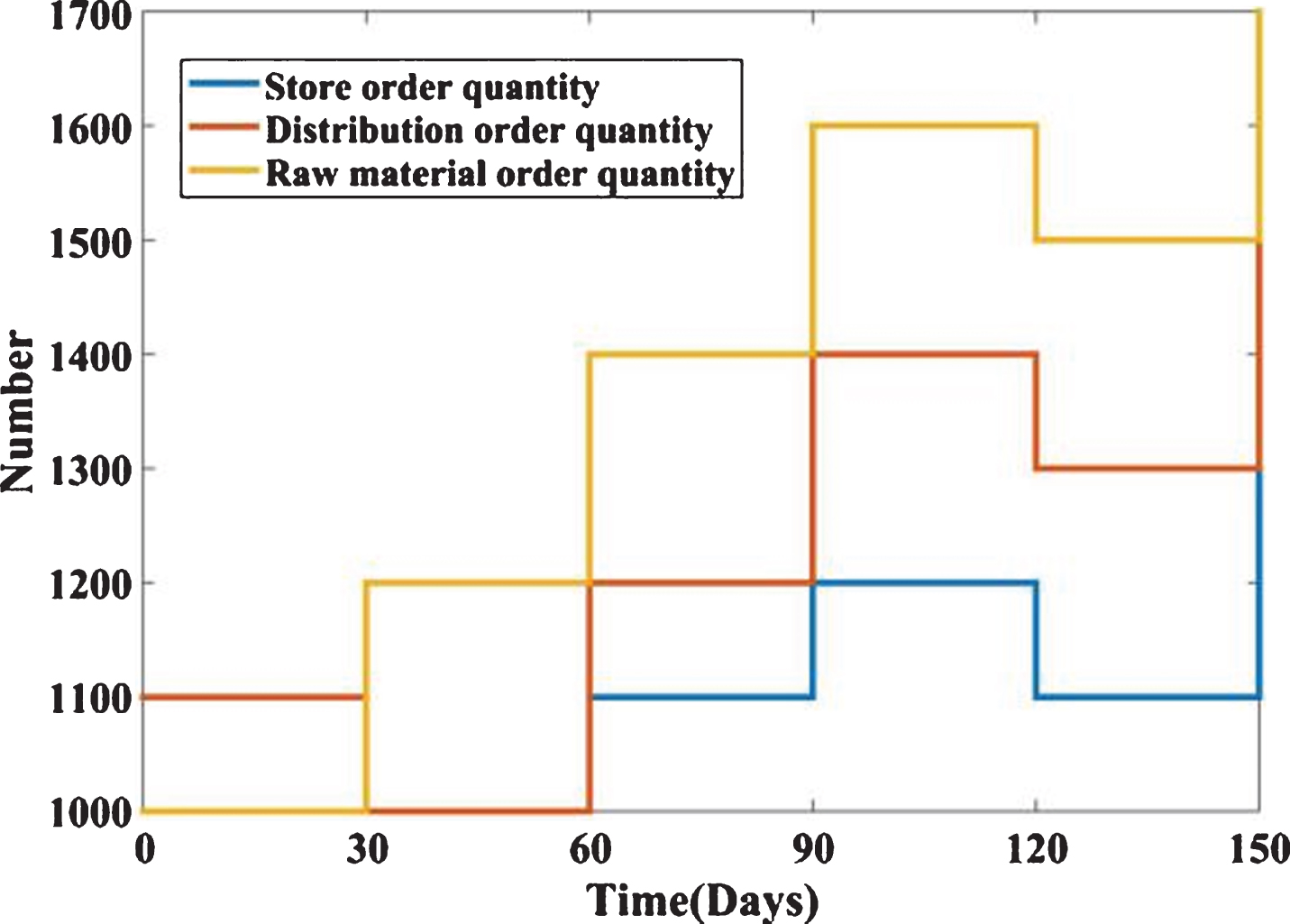
Order quantity of supply chain node enterprises in information collaboration mode.
It can be seen from Fig. 5 that the three curves of store order quantity, distribution center order quantity, and manufacturer raw material order quantity have a high degree of agreement, and the order quantity is enlarged upstream rarely. Under the information coordination model, the fluctuation of the raw material order quantity of the supplier and the order quantity of the distribution center has moderated.
The inventory situation of supply chain node enterprises under the information coordination mode is shown in Fig. 6.
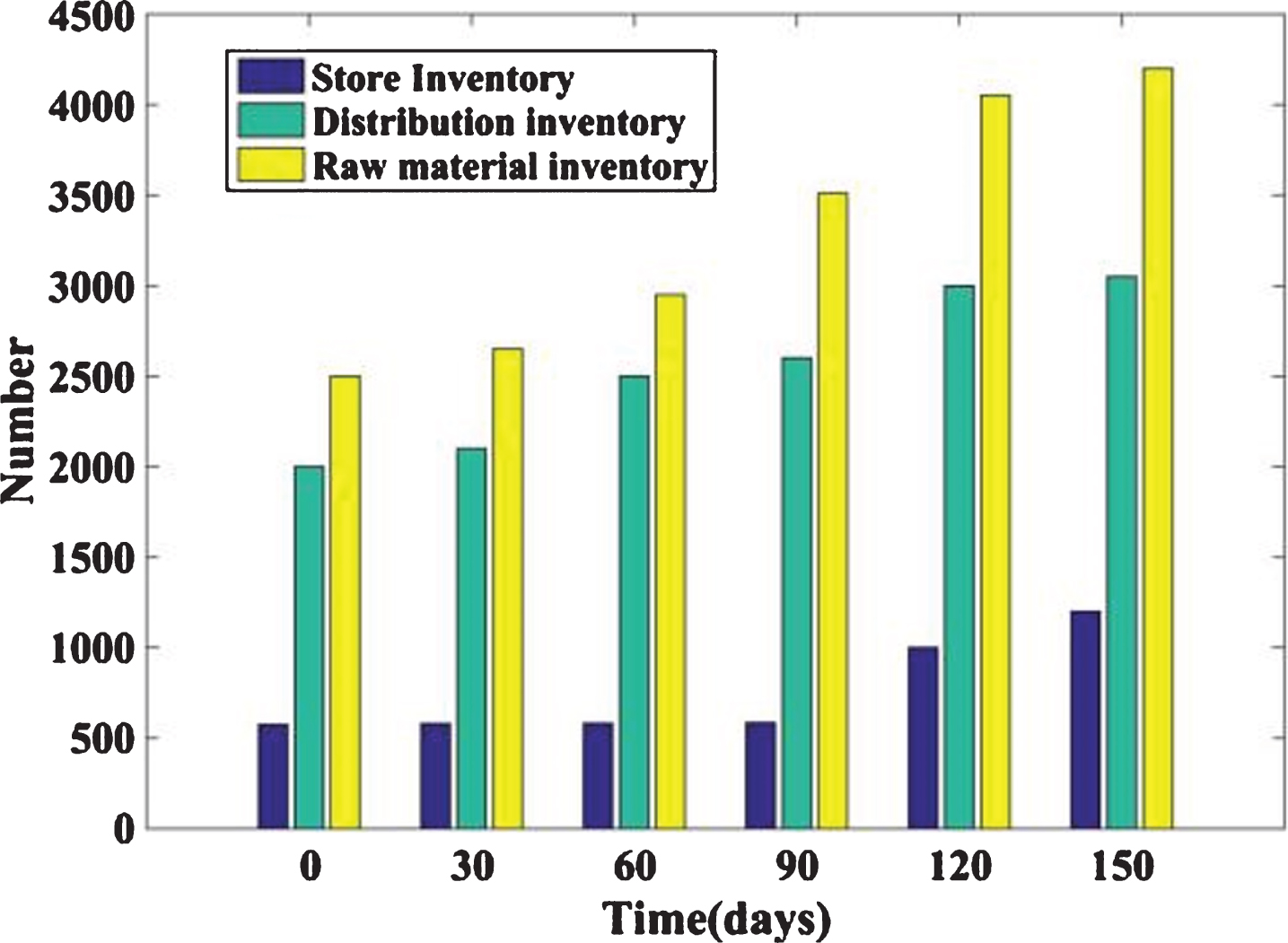
Enterprise inventory at supply chain nodes in information collaboration mode.
It can be seen from Fig. 6 that the fluctuation trend of the three curves of retail enterprise store inventory, distribution center inventory, and producer raw material inventory is basically the same, but due to the impact of time delays such as transportation and production, the curve fluctuation from the downstream retailer to the upstream producer remains Lag in turn. This shows that compared with the current model mentioned above, the inventory of supply chain nodes, such as store inventory, distribution center inventory, and producer raw material inventory, fluctuates significantly under the information coordination model.
(2) Analysis of simulation results of order quantity of supply chain node enterprises fewer than two modes
By calculating the background data of the model operation and comparing it with the current model, the conclusions are shown in Table 2.
Simulation results of the order quantity of supply chain node enterprises under two modes
It can be seen from Table 2 that under the same market demand if the supply chain information collaboration model is adopted, although the average value of the manufacturer’s order quantity is not much different, the fluctuation range is much smoother, from the current model of 948 to the information The 825 in the collaborative model dropped by 30.4%. Due to this, the dispersion coefficient also decreased from 0.76 to 0.6; the average number of orders in the distribution center also remained basically unchanged, and the standard deviation decreased, from 573 in the current model to the information collaborative model Of 450, a decrease of 12.2%; since the store order quantity is currently only affected by market demand, the market demand remains unchanged, so the store order quantity also remains unchanged. By comparing and analyzing the discrete coefficients of the order quantity of the stores, distribution centers, and manufacturers of the two schemes, it can be seen that under the information collaboration scheme, the fluctuation of the order quantity from the bottom up is slowed down, and the “bullwhip effect” is significantly suppressed.
(3) Analysis of simulation results of supply chain node enterprise inventory under two modes
The background data of the model operation is calculated and compared with the current model, the results are shown in Table 3.
Simulation results of supply chain node enterprise inventory under two modes
It can be seen from Table 3 that under the same market demand, if the supply chain information synergy model is adopted, the average value of the raw material inventory of the manufacturer has dropped significantly, from 3400 in the current model to 2500 in the information synergy model, a decrease of 27%, and Its standard deviation decreased from 3000 in the current model to 2000 in the information collaboration model, a 57% decrease, which significantly reduced its volatility. Affected by this, the dispersion coefficient decreased from 0.98 to 0.50; the standard deviation of the inventory of the distribution center decreased from the current model. 1650 dropped to 1242 of the information collaboration model, the rate of decline was 30%, and the fluctuation range was also relatively smooth. Because the store order quantity is currently only affected by market demand, the market demand remains unchanged, so the average, standard deviation and store inventory The dispersion coefficient remains unchanged; from the perspective of the overall retail supply chain, the inventory level has dropped from 6000 in the current model to 5190 in the information collaboration model, a 14% drop, and the standard deviation has dropped from 4000 in the current model to 2997 in the information collaboration model., A drop of 34%. Affected by this, the dispersion coefficient dropped from 0.76 in the current model to 0.6 in the information collaboration model. Great synergistic mode of the supply chain to reduce costs and improve efficiency in the supply chain effect. From the above analysis, we can see that under the information synergy mode of the retailer-led supply chain, the inventory fluctuation of each node of the supply chain company has slowed down significantly, and the number of inventories has also decreased significantly. It can be seen that the implementation of information synergy in the supply chain helps alleviate the “bullwhip effect".
Information sharing and coordination among members of the supply chain is an effective way to improve the performance of the supply chain, especially for suppliers whose main production and supply methods are pulling. The performance improvement is more obvious. At the same time, the information sharing of the supply chain also It can directly reduce the total cost by reducing inventory; supply chain information sharing must be based on mutual trust. From the application effect of information sharing to actual enterprises, the effect is relatively significant. Based on the characteristics of the supply chain system of retail enterprises and the current status of enterprise supply chain management, this paper proposes the implementation of information collaboration in the supply chain led by retail enterprises, combined with system dynamics theory and supply chain management theory. The impact of retail enterprise supply chain management under the information collaboration model was compared and analyzed, and the importance and necessity of implementing information collaboration on the retail enterprise supply chain were obtained.
The research in this paper shows that under the same market demand if the supply chain information collaboration model is adopted, the average value of the manufacturer’s order quantity is not much different, but the fluctuation range is much smoother, from the current model of 948 to the information collaboration. Model 825, a drop of 30.4%. Affected by this, the dispersion coefficient has also dropped from 0.76 to 0.6; the average number of orders in the distribution center has remained basically unchanged, and the standard deviation has declined, from the current model of 573 to the information collaboration model. 450, a decrease of 12.2%; with the supply chain information synergy model, the average value of the producer’s raw material inventory has dropped significantly, from 3400 in the current model to 2500 in the information synergy model, a decrease of 27%, and the standard deviation from the current model of 3000 Decreased to 2000 in the information collaboration mode, a decrease of 57%, significantly reducing its volatility. Affected by this, the dispersion coefficient decreased from 0.98 to 0.50; the standard deviation of the distribution center’s inventory decreased from 1650 in the current model to 1242 in the information collaboration model, The rate of decline is 30%, and the fluctuation range is also relatively smooth; from the perspective of the overall retail supply chain, the inventory level is from the current model The 6000 decreased to 5190 in the information collaboration model, a 14% drop, and the standard deviation decreased from 4000 in the current model to 2997 in the information collaboration model, a 34% drop. Affected by this, the dispersion coefficient dropped from 0.76 in the current model to the information collaboration model. 0.6, it can be seen that the implementation of information coordination mode in the supply chain has a great effect on reducing the cost of the supply chain and improving the efficiency of the supply chain. By comparing and analyzing the discrete coefficients of the order quantity and inventory quantity of the stores, distribution centers, and manufacturers of the two schemes, it can be seen that under the information collaboration scheme, the fluctuation of the order quantity and inventory quantity from the bottom to the top is slowed down. “Effect” was significantly suppressed.
The implementation of information synergy and optimization of related variables in the retail enterprise supply chain can significantly reduce the “bullwhip effect” and optimize business processes. Companies in all links can also grasp market trends based on real-time data, and then collaborate with each other to formulate practical strategies to improve the efficiency of the supply chain while promoting the in-depth development of enterprises. However, the retail enterprise supply chain management system is a huge and complex system with many internal and external variables and intricate relationships. Some issues need to be further studied. National Social Science Foundation Youth Project, Research on the influence of capital market opening on the investment efficiency of listed companies,19CJY008. National planning office for philosophy and social sciences (China) National Social Science Foundation (China) 17BGL084. Liaoning social science federation(China) Research topics on economic and social development in Liaoning Province (China) 20201slktyb-014.