



Abstract
Now-a-days due to advancements in technologies most of the applications in signal processing were using the models based on the sparse signal. Sub optimal strategies were used in these models to estimate the sparsest coefficients. In this work various algorithms were analyzed to address its optimal solutions. The sparsest solution can be found for the linear equations which are under determined. In this work, a complete study is carried out based on Compressive Sensing Matching Pursuit Back Tracking Iterative Hard Threshold (CMPBIHT) algorithm in the real-world scenario. As the BIHT algorithm may often fail to converge and its performance seems to be degraded if the conditions fail. To address these challenges, we have modified the BIHT algorithm to guarantee the convergence using the proposed method, even in this regime. Further the proposed CMPBIHT algorithm is evaluated and compared with the state of art techniques and it is observed that the proposed algorithm retains the similarities of the original algorithm. In this proposed model we have adopted the Compressive Sensing (CS) schemes along with Orthogonal Matching Pursuit (OMP). With this proposal we are able to solve the least squares problem for the new residual. We also investigated the reliability in sparse solutions along with compressive sensing techniques while decoding and over complete representations. An extensive research is carried out at the reconstruction side with the fundamental theme of CS, IHT and OMP techniques. The simulation results perform better efficiency at the reconstruction of the Gaussians signals by guaranteeing the productions in the residual error and noise. Further the proposed algorithm performs better at the reconstruction with nominal complexity in each of the iteration computationally.
Introduction
The sparse approximations and its challenges were investigated by the researchers for nearly a century ago. This analysis may appear in many of the applications say for instance in analyzing the signals for video, audio, image, de-noising and Machine Learning (ML). In each of these signals and its applications we approximate by a linear combination technique which draws a fixed and linear system dependent on collecting the signals stated as a dictionary. The sparse approximation it is critical to seek the approximation using some of elementary signals. The success of this algorithm is based on the geometry of the dictionary under consideration.
The signal acquisition is usually carried out based on the generally known Nyquist sampling theorem which is commonly used based on the technique that the signals has to be sampled twice the bandwidth of the signal. This scenario is valid for most of the band limited signals [1], this may not be considered in to account for another say additional signal structures. Due to emerge of the Compressive Sensing (CS) and its innovations, the signals are approximated or assumed to be sparse and some of the domains. This sparsity reduces the size of the signal significantly when compared with the signal in space dimensions. The CS uses its operators based on linear sampling and highly non-linear while reconstruction of the signal.
The Compressive Sensing or Compressive Sampling (CS) is mainly used for the Sparse signal reconstructions and offers the higher acquiring dimensional signals from the incomplete or inaccurate Samples. For an instance of is an unknown parameter for a vector for a signal or a digital image, in this the linear general functions for to be reconstructed. The reconstruction process is non-linear manner. The reconstruction can be made accurate by using the non-adaptive measurements [2] the techniques proposed [3] discusses on the reconstruction of the sparse methods for extension of the pursuit algorithm based on dual linear program this allows the basis vectors for each stages in the Orthogonal Matching Pursuit (OMP) stage wise [3, 4]. The researchers [4] proposed the comparative analysis for the OMP and the Basic Pursuit (BP) for the recovery of the signal and it is observed that OMP performs better than the BP for the random measurements [5]. The research carried out [7] supports the Compressive sensing approach is have reliability over the error corrective codes and decoding during the recovery and representation process over OMP technique [6]. The authors in [8] presented the analysis related to the theory and based on the hard thresholding for the CS signal recovery to get the near optimal error guarantee to obtain the robust observations in noise in a minimal number of observations.
The authors [9] Discusses on the IHT technique and guarantees the performance for the theoretical performances and holds, its empirical studies show that performance degrades when the conditions fails [10]. In [11] the authors proposed the cumulative method of proof for the natural coherence system and evidence the coherence system in a geometric manner for the approximation of the sparse redundant dictionaries. Many real-world signals and its applications use the sparsity for say interferometry, medical imaging and digital data analytics. The CS algorithms restore the relaxation for the underlying optimization for sparse signals [12]. From the researchers the comprehensive analysis is performed for the sparsity minimization methods for a fixed-point function and its approximations [13]. When applied for the real world challenges the sparsity level is chosen for the IHT and introduces the step size to enable the borders for the practical challenges [14]. The comprehensive performance analysis for the sparsity is analyzed for the fixed-point regularized functions for approximations [15]. Most recently the CS based approaches have attracted the popularity among the researchers for the non-convex approaches for sparse signal recovery [16].
The thresholding for the Gaussian metrics is used for certain random metrics in an asymptotic framework. The adaptive thresholding techniques are used for both soft and hard thresholding techniques [17]. A novel methodology [18] for the signal recovery is used for recovering the signal for multiple signals, the performance is compared in the distributed manner for the CS based recovery for the sparse signals and the researcher have not focused on the joint sparce signals [19]. The safety of the human is a concern in the spectral era so the effective usage of spectral resources is vital [20–22] for the upcoming wireless applications. Further, in the research work carried from the literature the error in estimation and the noise is also neglected for the compressive sensing based matching pursuit algorithm.
In this work, a complete study is carried out based on CMPBIHT algorithm in the real-world scenario. As the BIHT algorithm may often fail to converge and its performance seems to be degraded if the conditions fail. To address these challenges, we have modified the BIHT algorithm to guarantee the convergence using the proposed method, even in this regime.
Organization paper is as follows: Section 2 presents the mathematical modelling of CS. Section 3 deals with the reconstruction schemes. Section 4 presents the proposed reconstruction schemes. Section 5 deals with the simulation analysis. Section 5 surmises of the paper.
Compressive sensing
Compressive sensing is also known as also compressive sampling or compressed sensing. In this approach the signal measurement is carried out where x is a signal which can be reconstructed or it can also be estimated with a smaller number of measurements. In other ways x is also termed as sparse representation which can be represented as in Equation (1)
Where s is expressed as [s1, … . . , s
N
] with a smaller number of K = s0 number of entities which are non-zero and further K ⪡ N this condition is termed as K - sparse. The number of measurements that are taken for x are M < N and results in giving y as in Equation (2)
Where in,
Here the value of A is expressed as A = Φψ. The original signal can be reconstructed by using Equation (4)
The measurement of Φ and ψ are represented as incoherent and the measurements are taken on the basis of M < N. In this process the probability in recovering the original signal x is high.
In signal processing the sparsity and its possibility are exploited and this is attracting the attention of the researchers. There were several applications found where the signals and its representations are offering benefits. For an instance if we consider the Gaussian entries for a given n - vectory and say y = Φx, here x0 is the sparse vector unknown. From this scenario we need to recover x0; from the condition stating n < N, so this scenario states the problem encounters in linear algebra. Where the sparsity of x0 is allowing to find unique number of solutions for various applications in relevant areas in a unique manner.
In signal processing the sparse models are popular from many years due to its wide range of applicability for signal processing techniques especially, pattern recognition, de-noising, sampling, coding. To understand this scenario let us formulate a problem as y ∈ R M is a vector. Here the matrix Φ ∈ RM×N with a greater number of columns when compared with rows say N > M, now the vector x is having greater number of elements with zeros and ΦX is approximated to Y, then Y - ΦX2 is a smaller value.
As we know that in CS the sparse sample modelling is special in this say f is an expansion of an orthogonal signal expressed as in Equation (5)
In which most of the values present in x
n
are negligible or close to zero. In this instead of using a traditional method for sampling f with an N number of samples we use a CS based sampling with M < N and the measurements carried out are y
m
= (Ø
m
, f). Thus from this the sampling model is represented as in Equation (6)
Where in the noise is observed to be as e and X is a vector with elements x n . With the matrix Φ having the entries as (Φ m , ψ n )). In this if the signal f has to be recovered with the vector X, the values of X is assumed to be sparse.
For an instance to analyze this scenario, the X is approximated with K - sparse, where the approximation of X is carried out based on the non-zero elements say K, this problem is optimized based on Equation (7)
In this, the vector tries to minimize the approximation error in this manner the optimization is achieved with minimizing the error. The findings from these scenarios guarantee that, this approach performs well with the CS based matching pursuit and IHT techniques. The advantage of these techniques is faster than the convex methods use for optimization and we are able to achieve the signal reconstruction even for more complex structures. So, these algorithms are fond to be robust and used in many applications and verified to be computationally strong and effective in nature.
More specifically to understand the scenario the Sparse signal in the representation of the orthogonal basis will allows the reconstruction with l2 error and is possible to design the non-adaptive measurements which will allow the reconstruction to design the possible way using n = O (N log(m)) with N as the most important possible coefficients. To optimize the performance of the system a min max error is chosen to associate the information.to achieve the best performance the recovery errors are kept optimal and very small. As in compressive sensing techniques the information is communicated in the form of the coded blocks. For a given signal = Φx0, here the x0 parameter is termed as an error which needs to be corrected, where Φ is the checksum operator. It is assumed that numbers of errors are smaller than the threshold value as it is sparse in nature. Further if we extend this for x0 + e, where e is the probable observed noise encountered at sensors or the errors in the quantization. In the research work carried out the estimation of x with the known vales of y andΦ is carried out effectively using CS techniques with the aid of Matching Purist and the BIHT is proposed and discussed clearly along with the robustness to noise and errors in minimal number of iterations/measurements with best sampling operator for the memory required application in an effective manner were discussed with performance comparison with the algorithms in the practical scenario.
From the extensive study carried out the from the literature the compressive sensing is best suited for the effective communication in an effective manner with the aid of the orthogonal matching Pursuit concepts for the Back tracking mechanism in this aspect the comparative study in performance evaluation is carried out for the proposed technique with Orthogonal Matching Pursuit (OMP) Iterative Hard Thresholding (IHT) and Back tracking Iterative Hard Thresholding the detailed discussion of these algorithms are discussed in detail in subsequent sections.
Iterative Hard Thresholding (IHT)
The main objective of the IHT algorithm is to recover the K-sparse vector which is un-known s0 ∈ C
N
and this can be measures as y = As0 + e, in this e is termed as the noise factor and the sensing is carried out form the matrix as A ∈ C
MXN
; and this can be understood as in Equation (8)
Where the function μ is a step function with the values (0, 1/A2), and the η (v ; K) for a v ∈ C
n
for the function in the hard thresholding and the K - sparse vector is expressed as u ∈ C
n
and it is computed as
Where T K (.) refers to the K - th largest component of the vector. The independent entities were drawn for A has N (0, 1/M) and x t in Equation (8) is convergence to x*. The s0 is closer to x* with its linear convergence rate and higher probability.
Based on the basic understanding we had on the IHT algorithm. Let us analyze the basic definition of this algorithm with the following analysis.
Let x[0] = 0, then the iteration x[n+1] = H
s
(x[n] + Φ
T
(y - Φx[n])) where H
s
(a) is the non-linear operator which sets all except the larger magnitude s elements of a to zero. If no unique set found then a set has to be found randomly or through pre-defined ordering. The convergence of this algorithm is checked based on Φ2 < 1. In this scenario the algorithm converges to its minimization locally for the problem based on optimization as
To solve the problems based on optimization we have Equation (10)
Further the iterative algorithm is derived as in Equation (11)
Where H
λ
0.5 is the heart threshold operator element wise as expressed in Equation (12)
This term to be as an iterativehard - thresholdingalgorithm. And this shows the algorithm guarantees the converges to a local minimization. Iterative Hard Thresholding (IHT) Algorithm is as proposed in Algorithm (1)

The BIHT algorithm is used to reconstruct the signal in an effective manner as this can reduce the time consumption in iteration process with a novel backtracking thought which unites the concepts involved in the IHT and majorly improves the support in its selection for each of its iterations.
This improves the performance in an effective manner in less number of iterations. Along with the improved performance the BIHT also has an additional features as reduced complexity in the computationally with reduction in the iterative numbers. The BIHT algorithm is best understood based on the Algorithm (2) as discussed. In this algorithm the mechanism is carried out based on the best possible way to achieve the minimal time for reconstructing the signal in an effective manner for the given inputs and the
Algorithm 2: Back Tracking Iterative Hard Thresholding (BIHT)
Orthogonal Matching Pursuit (OMP)
From the problems encountered in the basic pursuit algorithms, can be solved with the methods using linear programming techniques which are faster and approximate and termed as matching pursuits. The orthogonal based matching pursuit algorithm is discussed as follows in simple two-step process.
The algorithm comprises of input functions, output functions and its procedure which is discussed as follows in the Algorithm (3).
Orthogonal Matching Pursuit for signal recovery
In order to recover the signal at the reconstruction we need the input as an N × d matrix measurements along with a data vector v with an N - dimentional for the ideal signal with a sparsity level m. To generate the output with an estimation of
Algorithm 3: Orthogonal Matching Pursuit (OMP)
Computational complexity
The ITH is a simple algorithm use and the operators Φ and Φ T are used as application operators for each vector. The H s operator which operates in operating the elements a[n] = x[n] + Φ T (y - Φx[n] as a magnitude, in this aspect the storage requirements are very small. With length N the storage of vector a and y the storage of x[n] with s number of non-zero elements and 2s numbers need to be stored. The storage and the computation are monitored for both Φ and Φ T . In Fast Fourier Transforms the proposed algorithm has the computational complexity is O (MN), in case of sustainably less memory then it is O (N log M) or O (N) operations. If ℓ is the complex complexity involved then that is calculated as O (k * ℓ) for a given k*number of iterations.
Compressive sensing matching pursuit backtracking iterative hard thresholding
A Power full method is proposed in the research work for the sparse signal reconstruction and this is compared with the performance of the existing systems. This work is a comprehensive work carried out with the compressive sensing frame work and the reconstruction of the signal is based on the sparse signals. The strategies adopted in the research work. The M × N randomly generated for a matrix Φ is normalized standard is used for Gaussian noise. A support set is selected for a uniformly random manner Γ for a size of |Γ| = K to generate a vector xfor sparse signal for a given length of N in any of the following methods. Firstly, the standard Gaussian distribution for a vector x to a formΓ, then compute the measurements for y = Φx, apply the reconstruction algorithm to obtain the
Finally, for each value of K repeat the process. This experimental process is carried out for the Gaussian signal for a length of N = 256 and the sparsity signal were chosen from a range of K = 20toK = 70.
The compressive sensing based matching purist algorithm (CMP) is proposed in the research work and compared the performance with the Orthogonal Matching Pursuit (OMP) algorithm and the hard thresholding pursuit algorithm. The proposed algorithm outperforms the state of art greedy algorithm along with iterative algorithm based on hard thresholding.
The Sparse vector unknown is to be estimated for the vector x0 ∈ R N and this is assumed to be sparse for a given k number of non-zeros for a smaller number N for a given linear measurement y = Φx0 where Φ is represented as the know parameter for n for a given N Matrix in order to recover the x0.
For an instance where n = N the recovery of x is done easily but the challenging part is that if n < N then the signal is non-recoverable and seeks the sparse solutions as discussed in the schematic discussed in Fig. 1. The proposed algorithm has the similarities between the Orthogonal Matching Pursuit (OMP) and the Back Tracking Iterative Hard Thresholding (BIHT) as discussed in the earlier sections. While discussing in technical aspects the algorithm relies on the hard thresholding, which are a class of greedy algorithms. The proposed algorithm is discussed as follows:

Proposed Schematic of the CMPBIHT Algorithm.
The proposed model initially identifies the 2k number of columns for A and this is correlated with r n = Ax n - y for a given iteration of n. Then the algorithm executes the least – square problems to the sub-matrix which is defined for the x n and 2K columns indicates the previous step
With this the proposed algorithm achieves the k - Sparsesolutions and also estimates the xn+1 is estimated finally as per the Hard Thresholding Least mean square Updated Vn+1.
The support set allows the proposed algorithm for the index size of the column for at most effectively for 3K and adaptively corrects the previous choices.
In the real world the signals are rarelyK - sparse in nature and are prone to errors and noise. Further the influence of two primary factors affects the performance. This is experimented based on the observation y = Φx + e, where for x was the Sparse and e was represented as Gaussian Noise. In the proposed work we have normalized with Φx for the specific Signal to Noise Ratio (SNR). The performance of the various SNR in dB is implemented and we used the pseudo-inverse based implementation for the proposed Compressive Sensing Matching Pursuit Backtracking Iterative Hard Thresholding.
Simulation parameters for the proposed research work are as follows the row number for the matrix A is expressed as m = 256, the column number for the given matrix is n = 512, the sparsity function for the signal xis expressed as k = 30to60, the support set size estimation is k j is between 30to60,the stopping thresholds for all the algorithms are expressed as η = 1 ×10⁻⁴, the step size is expressed as μ = 0.3. for the IHT BIHT and CMPBIHT algorithms are chosen for the experimenting settings for the parameters.
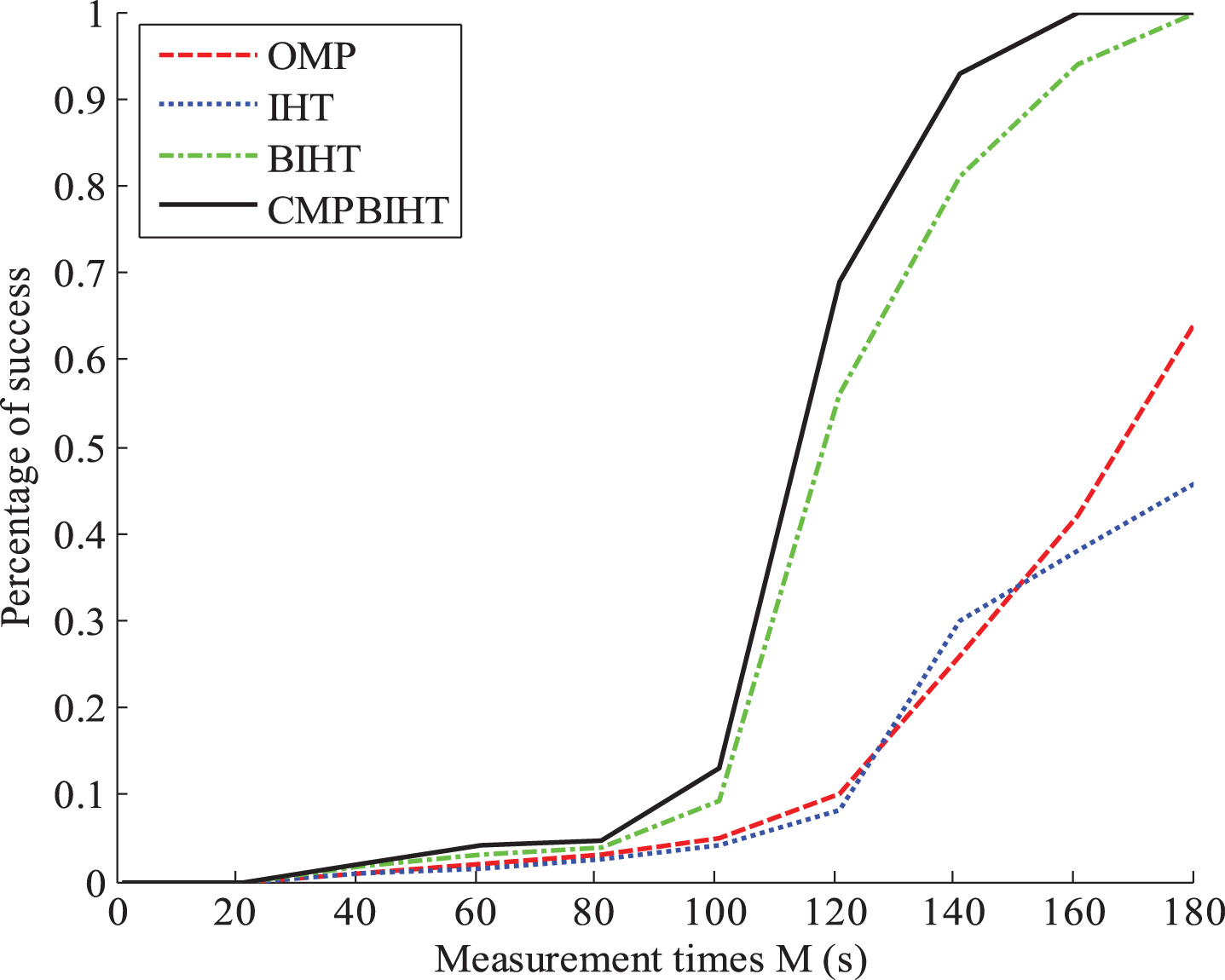
The Fig. 2 represents the percentage of success for a given M number of measurement time shows the percentage of successful percentage of signals recovered each curve in this graph represents the sparsity levels for various algorithms. The signal non zero components increases the measurements taken were increased and the signal recovery is guaranteed and the proposed algorithm is compared with the state of art algorithms and the better performance is observed.
Reconstruction probability comparison.
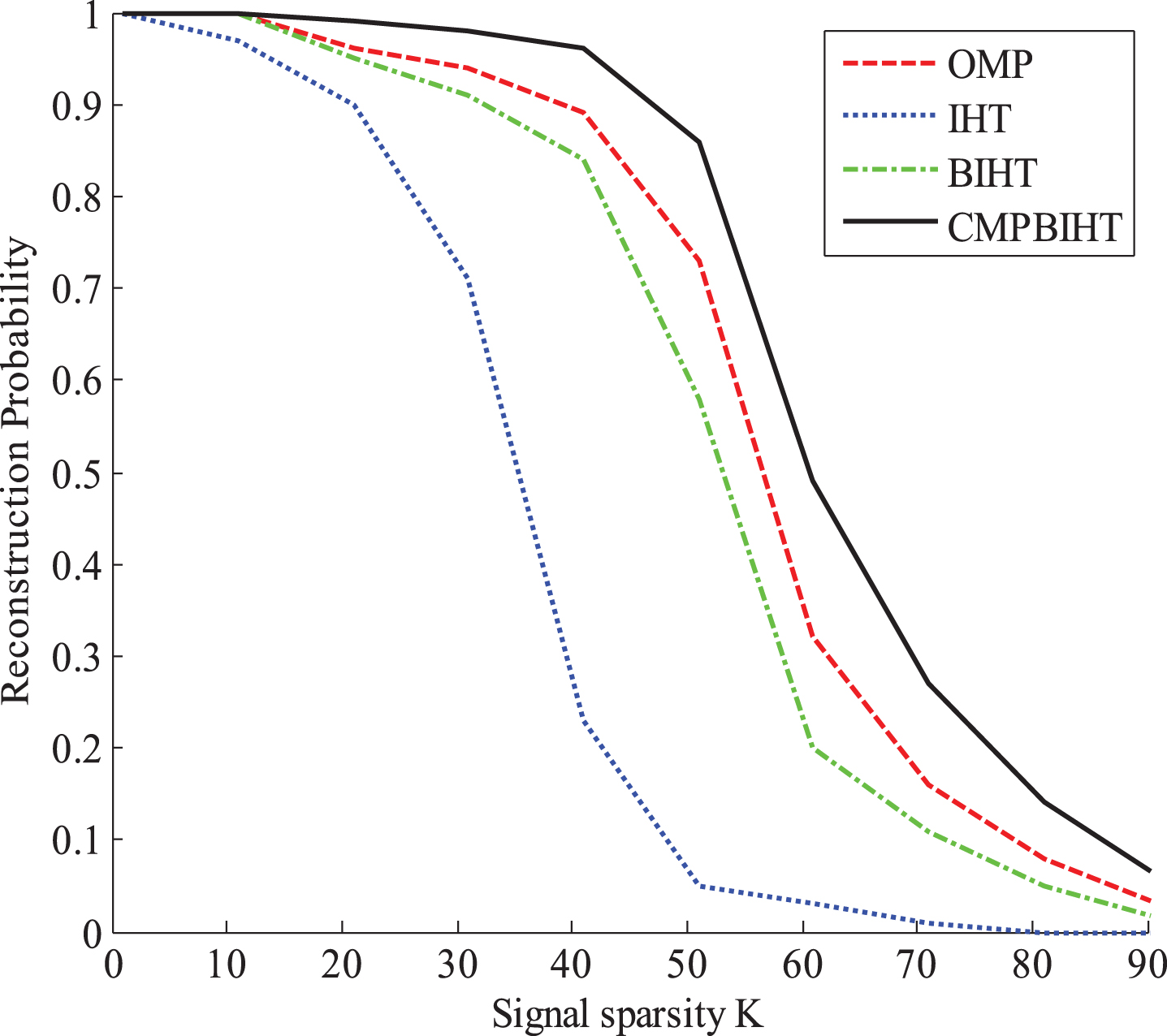
The performance of proposed algorithm is compared with the state of art algorithms for the Gaussian Sparse signal and the performance of the proposed systems is better than the other techniques as in Fig. 3 for the Gaussian Sparse signal for a given value of K ≥ 29, in spite the proposed algorithm is achieving the reconstruction to 100% until the K ≥ 42. Whereas the proposed algorithm achieves a better performance from 50 ≤ K ≤ 80, the ability of reconstruction for the proposed algorithm is better than the other algorithms.
Successful Gaussian spares signal reconstruction rate by various reconstruction algorithms.
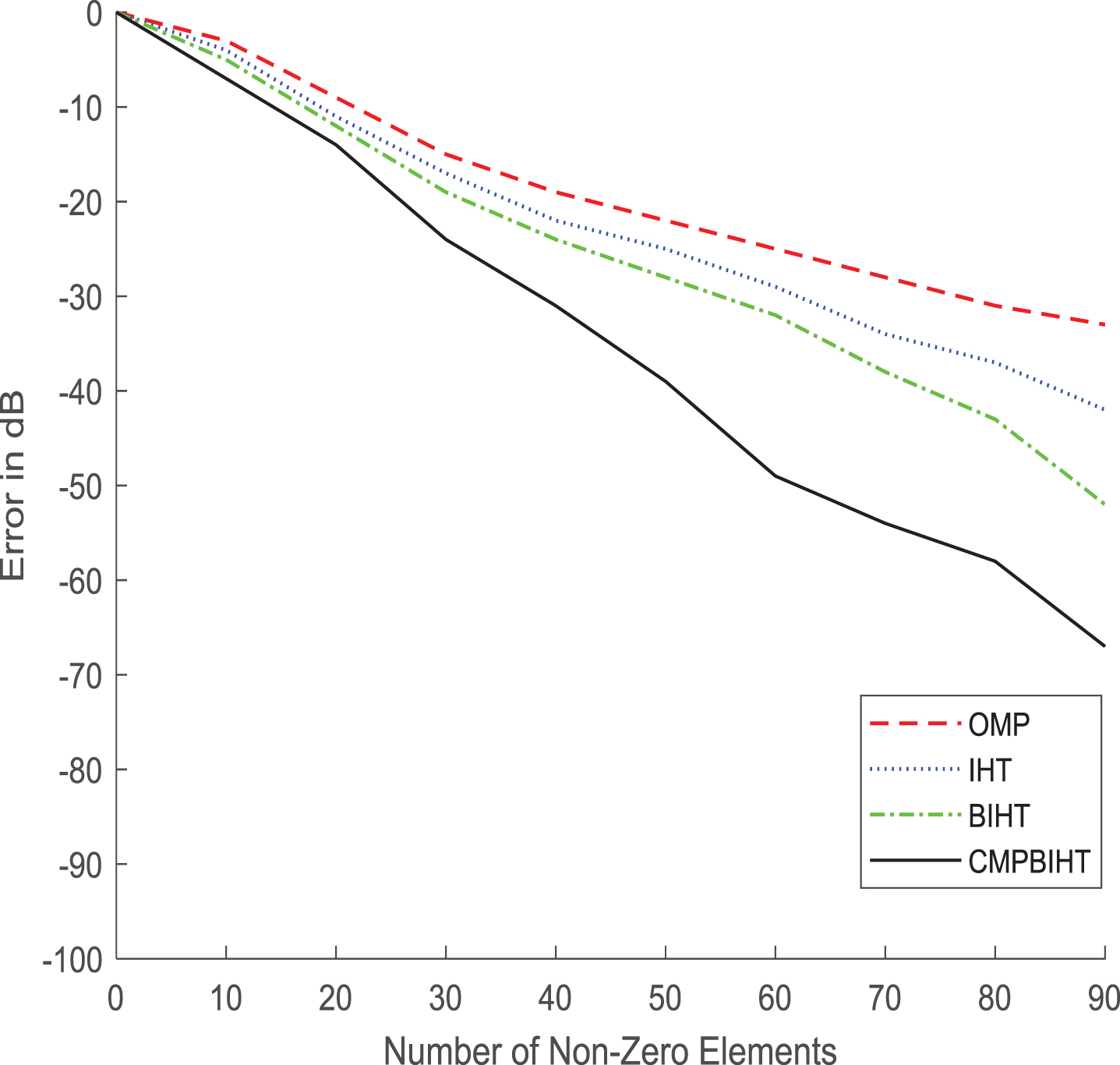
The SNR for various non-zero elements is analyzed for the prosed algorithm and the performance is compared with the OMP, IHT and BIHT, as the number of non-zero elements increases the error in dB is dropped to its subsequent values. Lesser the signal is sparse its error free to recover the signal successfully and from the experiment carried out the proposed algorithm is less prone to error and the measurements were projected in the Fig. 4 for the number of non-Zero elements.
Performance of various reconstruction algorithms in terms of error in dB.
The results obtained in Fig. 5 represent the moderated values of the SNR, the proposed protocol performs close to the optimal performance. The Sparsity of the signal is estimated through the K/Mration and is ranging between 0.45 and 5. The performance of the proposed algorithm shows the best results for the sparsity till 52 as the algorithm stops when the approximation error increases thus does not perform well from 52 to 90 and thus prevents the instability and thus performed better than the stare of art algorithms.

Influence of observation noise for various reconstruction algorithms
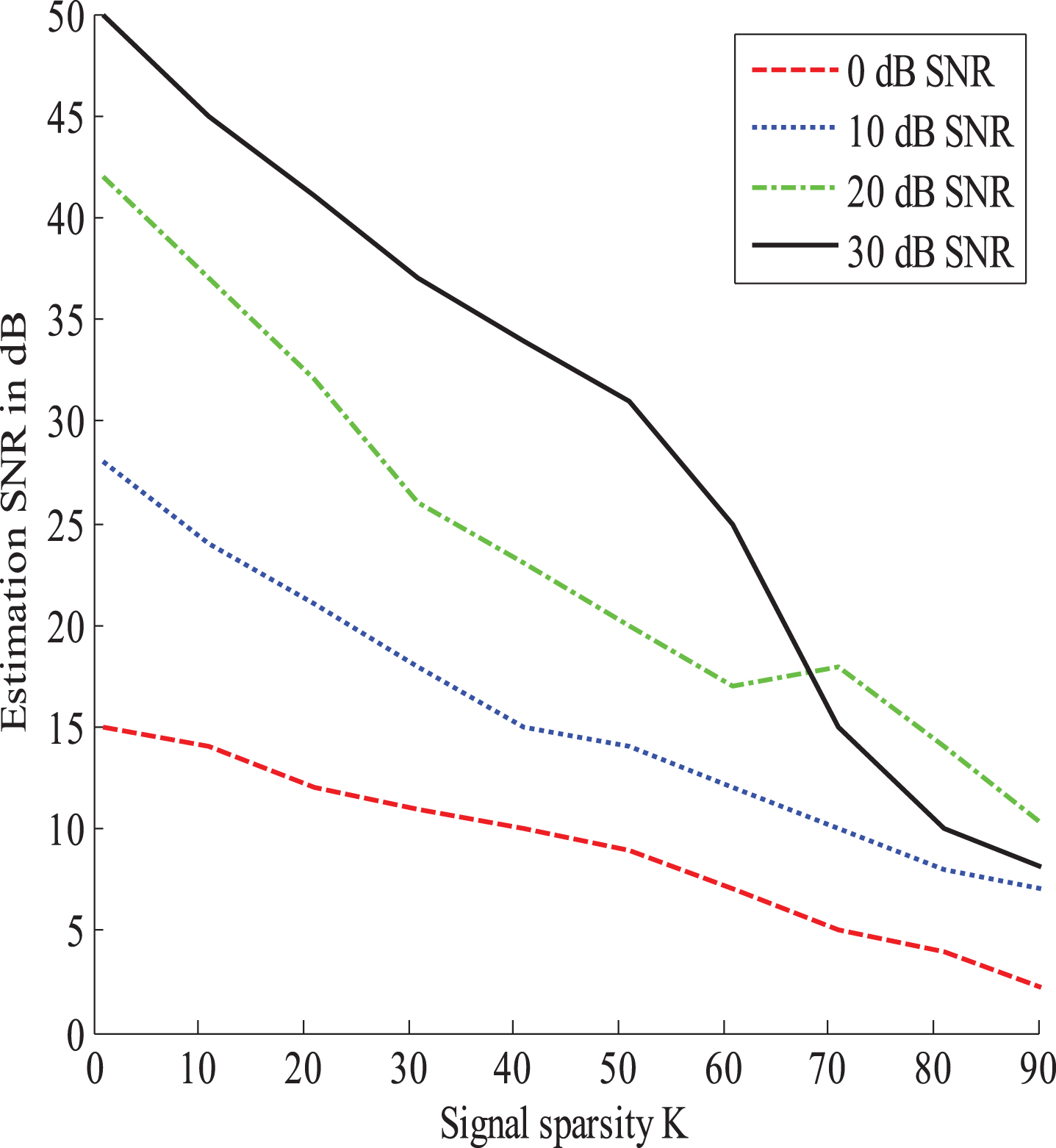
The noise factor as in y = Φx + e is under stood for based on e for a given sparsity level for the values ranging from 0 to 90 and the respective SNR values the performance is analysed for the proposed CMBIHT algorithm for the 0 dB SNR the estimation is minimum comparatively and this decreases further based on sparsity and this exhibits similar pattern for the various dB for 0,10,20,30 respectively and is presented in Fig. 6.
Influence of observation noise for CMPBIHT for various SNR.
The performance is estimated for the Klargest coefficients and x lease mean square errors for a Gaussian noise for the coefficients to set the remaining coefficients to zero. The SNR is estimated for the various noise factors in the proposed work and we were able to reconstruct the signal irrespective of the influence of the noise evidences that guarantee the stability in the algorithm and show the optimal performance in achieving the successful reconstruction of the sparse signal using Compressive Sensing approach.
In compressive sensing, the reconstruction is key challenge and has taken the attention of researchers globally. In this research work, a novel approach using the compressive sensing along with the matching pursuit is proposed for the backtracking Iterative Thresholding algorithm. The performance of the proposed algorithm is compared with the effective stare of art algorithms and observed that the simulation results shows the effective ness in reconstruction of the Gaussian signals along with the analysis of the complexity involved in the computation. The proposed work is compared with the OMP, IHT and BIHT and the experimental results shows that the CMPBIHT algorithm performs better. With the aid of the matching purist and the compressive sensing the BIHT is improved to accelerate the convergence in the IHT and improved the reconstruction of the signal accurately and the performance is discussed in the proposed work. Further the sparse randomization is used in greedy algorithms to improvise the signal performance in reconstruction of the signal for the compressive sensing. The novel techniques proposed in the sparse signals for the linear measurements techniques performs accurately and updates the working solutions. Finally, the observation and technique perform well in Gaussian sparse signals.