



Abstract
The potato itself has high nutritional value, strong adaptability, long industrial chain and extremely stable yield. At the same time, due to the rich variety of processed products, the further improvement of China’s social and economic level is greatly strengthened. In February 2016, the Ministry of Agriculture issued guiding opinions on promoting the development of the potato industry, which took potato as the main food product for industrial development. The central government attaches great importance to the rapid development of the potato industry, but at the same time, it also exposes many problems, which affect the production and development of the potato industry to a large extent. In order to change this problem, the relevant staff needs to strengthen the application of intelligent technology, so as to improve the level of potato production and processing and improve the competitive advantage of China’s potato industry. There are many types of research on the potato industry in China, but most of them focus on Cultivation and maintenance skills, and there is almost no research on market competition of agricultural products economic management based on the intelligent system. Based on the current situation of potato production in China, combined with the advantages of an intelligent system, this paper analyzes its competitive advantages and disadvantages from the perspective of economic management, and constructs the industrial competitiveness analysis model with the intelligent system as the core technology, and analyzes and discusses the adverse factors affecting the competitiveness. And from the perspective of international trade, the export competitiveness of China’s potato industry was analyzed. Finally, we collected Ximeng as the sample of this study and verified the core points of improving competitiveness from the research. In this paper, based on the intelligent system management of the potato planting industry on agricultural product economic management of market competition optimization research, to a certain extent, filled the domestic blank, has high research and promotion value.
Keywords
Introduction
Potato is a crop with food, vegetable, feed and industrial raw materials. It is the third-largest starch raw material crop except wheat and corn in the world. Among the main food crops in the world, it ranks fourth after wheat, corn and rice. Because of its special physical and chemical properties, potato is widely used in food, feed, medicine, chemical industry, textile, petroleum and other important industrial fields. Potatoes not only provide us with food and industrial raw materials but also play an important role in solving people’s food and clothing and disaster resistance in poverty-stricken areas due to its high harvest index, large potential per unit yield and wide adaptability. In the past 20 years, China’s potato planting area and total output have increased rapidly, becoming the world’s largest potato production country. By 2002, the potato planting area reached 70.8 million mu, accounting for about 1/4 of the world’s total potato area, accounting for 70% of Asia’s: total output is 64.54 billion kg, accounting for about 1/5 of the world’s total production. It is estimated that by 2010, the national planting area will reach about 90 million mu. At the same time, the per-unit yield of fresh potato has also been greatly improved. At present, it has reached 934 kg / mu. Through the measures of breeding new varieties, research on supporting technology and promotion of virus-free seed potato, the per-unit yield of fresh potato is expected to reach 2000 kg / mu by 2010. According to the planting area of 90 million mu, the total potato output in China will reach 1.8 billion tons.
China has become the world’s largest potato production country, and the development of the potato industry has many advantages. Most regions have the advantages of natural conditions suitable for planting potatoes, the huge market advantage of 1.3 billion people, the geographical advantage of neighboring Southeast Asian market, and the production cost advantage of only half of European and American countries. The full play of any advantage is enough to make China’s potato industry achieve better development. However, China is a big potato import country; especially processing potatoes almost relies on imports. According to the data, domestic brands account for less than 10% of 19 kinds of potato food in 12 supermarkets in Beijing, and the rest are imported products. McDonald’s and KFC, which use potato chips and mashed potatoes as basic raw materials, occupy half of the fast-food market in China, but most of their raw materials are imported from abroad, while other fried chips and puffed food imported from various channels are also rolling in. In this regard, the insiders are mixed. They are glad that China’s food structure has begun to change, and the Chinese and Western food culture has begun to infiltrate and integrate with each other. They are worried that the potato production country with both production advantages and huge market plays the role of an importing country at the same time. How to realize the survival and development of potato in the global market is a problem worthy of discussion. Under the background of economic globalization and agricultural trade liberalization, as a labor-intensive potato product, it is facing unprecedented opportunities and challenges. Only by improving the competitiveness of potato products, can we cope with the new domestic and foreign environment.
The research on potato production technology has been attached great importance in China. As early as 1961, the China crop society was established, and China potato professional committee is one of the 12 professional committees of China crop society, which is mainly committed to promoting the research and development of potato planting and management technology in China. In recent years, with the rapid development of intelligent technology, it has become a mainstream trend to adopt an intelligent system for intelligent management in the planting industry. Under the auxiliary management of the intelligent system, it can effectively improve the production efficiency of the potato industry, and play an important role in cost reduction and scientific decision-making, which plays a key role in improving the market core competitiveness of the potato industry [1, 2].
At present, to improve the competitiveness of the potato industry is mainly concentrated in cultivation and maintenance technology, and this paper puts forward an innovative intelligent management strategy combined with an intelligent system. The implementation of the program has realized the intelligent planting, production and processing of the potato industry effectively improved the competitiveness of the potato planting industry in the agricultural product market, and laid a solid foundation for it to occupy a place in the international market of agricultural products. First of all, based on the current situation of potato production in China, this paper analyzes its competitive advantages and disadvantages, and at the same time, studies out the optimization scheme of industrial competitiveness. The core technology of the scheme is to build a potato planting management system with an intelligent system as the core. Then, in order to further test the changes in the potato industry market competitiveness based on intelligent system management, this paper constructs an analysis model of potato industry competitiveness. By establishing a unified evaluation index system and a series of operations, the model effectively improves the calculation accuracy of the model. Finally, in order to verify the actual effect of the model, this paper carried out a number of comparative analyses including potato planting capacity analysis, the rapid growth of planting output, and the proportion of potato sales in the total output. Through the analysis of experimental data, it can be seen that the potato planting industry with this intelligent system management scheme has greatly improved its market competitiveness, and the intelligent management system and competitiveness analysis model developed in this paper has reached a higher level in the industry and can be widely used.
A review of potato industry-related theories
Potato industry development status
In the past 10 years, the potato planting area in China has been on the rise. By 2000, it has reached 4.723 million Hm2. It is the largest potato planting area in the world, accounting for more than 20% of the global planting area and about 60% of the Asian planting area. However, the average yield is only 933 kg / 667 m2, which is 138 kg / 667 m2 less than the world average of 107 kg / 667 m2, 12.9% lower. Inner Mongolia has the largest planting area, with the planting area of 646400 hm2 in 2000 and 11 provinces with the planting area of more than 200000 Hm2, among which Shandong has the highest yield of potatoes over 400000 hm2 in Inner Mongolia, Guizhou and Gansu, In 2000, the average yield of the whole province reached 2200 kg / 667 m2, which is close to the average level of the central and North American countries with high potato production level. This fact not only shows that the potatoes in the second Central Plains region (such as Shandong Province), which is not a concentrated potato producing area, can rely on science and technology to improve the production level, It also shows that the potato production potential in China is huge: firstly, the natural conditions of planting potato in many provinces are much better than that in Jiaodong Peninsula; secondly, the natural conditions of growing potato in some provinces in the west of China are very good. Although the technical level of planting potato is not high and the planting area is small, the production level is far higher than that in other regions of the country, For example, the per-unit yield of Xinjiang and Tibet has reached more than 1667 kg / 667 m2; finally, there is great potential in some provinces with large planting area and low per-unit yield. In 2000, for example, the per-unit yield of Hubei Province was only 429 kg / 667 m2, and that of Heilongjiang Province was 692 kg / 667 m2, 54.2% and 25.8% lower than the national average, respectively, with great potential [3].
Definition of competitiveness and industrial competitiveness
The concept of international competitiveness is the GDP growth capacity obtained by comparing countries in the context of world economic integration. The concept of competitiveness comes from this. Generally speaking, the comprehensive ability of both parties through competition or comparison becomes competitive. Competitiveness is a relative index; the main feature is that both sides must compete to get performance. Jinbei (1997) defined competitiveness as the ability of an enterprise to produce products and services to meet the needs of consumers at a price determined by market supply and demand from the perspective of the company level in the industrial and trade sectors. The definition of competitiveness by OECD at the national level is similar to the definition of golden darkness, which requires the ability to produce goods and services to meet the needs of the international market under free and fair market conditions. In addition, competitiveness also shows the ability to improve people’s income levels in the long term. It can be seen that the definition of competitiveness includes many angles. With the change of analysis purpose and the development of economic practice, the concept of competitiveness also keeps pace with the times.
It is meaningless to talk about industrial competitiveness alone. Industrial competitiveness is essentially a concept of comparison between countries or regions. The research object of industrial competitiveness includes industrial agglomeration, industrial transfer, location advantage and other factors that affect economic development. In this paper, industrial competitiveness is defined as the competitiveness of a particular industry in a country (region) in terms of the production efficiency of products, the ability of products or services to meet market demand, and the sustainable profitability relative to the same industry in other countries (regions) [4, 5].
Analysis of the restricting factors of potato competitiveness
At present, the potato has initially realized the pattern of industrial production and management in the main production areas of the north, with a large increase in planting area every year, and has become a pillar industry of agriculture in many main production areas. In the main rice-producing areas of South China, potatoes are generally planted as winter fallow crops, mostly sporadically. Although the large-scale and industrialization of winter potato production has attracted the attention of relevant departments in China, and many potato industrialization projects have been carried out, there are many problems in the supply of high-quality Virus-free Potatoes, cultivation and planting level, processing and sales, large-scale planting, scientific research and technology, which restrict the improvement of the competitiveness of winter potato, It hinders the development of industrialization.
1. The supply of seed potatoes cannot be guaranteed because there are few special varieties of potatoes
There are still a few varieties of potatoes. Potato varieties generally require good commercial quality, and medium maturity or early maturity is better. At present, the main varieties in China are Kexin 2, Kexin 3, Zihua 851, Dongnong 303, Favorita, Atlantic Ocean, etc. In general, there are many varieties suitable for commercial vegetable potato production, but the varieties of medium and early maturity are still relatively scarce. With the improvement of people’s living standards, the requirements for fresh potato varieties, such as potato shape, taste, skin color and meat color, are getting higher and higher. At present, it is more urgent to select potato processing varieties suitable for cultivation in China.
2. Low output and production technology level
In recent years, the planting area of potato in China has been expanding, but the development of cultivation, facilities, management and other production technology level is unbalanced, and some of them are relatively backward. Many farmers are lack of understanding of biological characteristics and cultivation techniques and do not have a good grasp of seed potato cutting technology, water and fertilizer management, identification and control of late blight. There is a lack of high-quality virus-free seed potatoes, and the germination technology is often not up to standard. The most frequent problem in production is the late emergence or serious lack of seedlings, which often leads to disputes on seed potato quality.
3. Deep processing lags behind; product value-added and processing leading role is not obvious
Many aspects of the potato industry in Europe and America, such as planting, processing, scientific research and so on, are very perfect, and there are more than 2000 kinds of related products. However, the potato industry in most production areas of our province basically stays in the raw material type, food type, vegetable type, feed type. The processing degree of the potato industry is still very low, and the industrial processing is mostly limited to processing potato chips, coarse starch, making fans, vermicelli and so on, Not only the quantity is small, but also the processing depth is not enough, the economic benefit is not high, and the digestion capacity is limited. The preferential policies for supporting leading potato enterprises involve many functional departments and are difficult to implement. There is no close community of interests between enterprises, scientific research, bases and farmers.
4. The limitation of small scale production
The current system of small-scale agricultural production and management with farmers as the unit is difficult to bear the pressure of natural and market risks caused by the adjustment of agricultural structure. Under the condition of imperfect market development and intermediary organization, the narrow production scale is difficult to connect with the large market, which makes farmers vulnerable to loss of interest and compensation. In this case, farmers have to be cautious about structural adjustment. From the perspective of the whole country, due to the different land quality of single-family, the plots of private plots, grain ration fields and contracted land are scattered, resulting in the overall scale unable to adapt to the large-scale technology promotion, and the production of potato commercial potatoes requires higher water conservancy technology conditions, while the farmers have a small scale of operation and limited family financial resources, although there are requirements for improvement, but the cost is too high, unable to meet the demand. Without the guidance and intervention of the government or cooperative organizations, it is difficult for a single farmer to change the production model without prediction and information block [6, 7].
How to improve the competitiveness of the potato industry
Construction of potato industry competitiveness analysis model
As mentioned above, the analysis model of potato industry competitiveness should include a series of factors that interact with each other. The general meaning of potato industry competitiveness is: according to the needs of consumers or purchasers, first of all, the enterprises in the industry are able to provide as many potatoes and their finished products as possible to the market to meet the market demand, and second, the enterprises in the industry should be able to continuously obtain profits from the market. According to the above review, this paper analyzes the competitiveness of the potato industry from four aspects: production factor competitiveness, environmental competitiveness, product competitiveness and display competitiveness. In terms of production factors of the potato industry, the theoretical basis mainly comes from the resource sharing described in the diamond model. This paper intends to study the competitiveness of the potato industry from the aspects of resources, science and technology, human capital and infrastructure. These factors are indirect indicators that affect the competitiveness of the potato industry, because these factors are not directly related to the potato industry, but reflect the potato industry’s ability to maintain the current competitiveness and the potential to enhance competitiveness in the future. The competitiveness of the potato industry includes marketing, price, quality, variety and brand. The direct index of potato industry competitiveness is the displayed competitiveness of the potato industry. The competitiveness of the potato industry is mainly the external sales and sales revenue of potato and its finished products. These factors and indicators are the direct indicators that affect the competitiveness of the potato industry and in the form of the competitive strength of the potato industry. In this paper, combined with the current relevant industrial competitiveness theory and the particularity of the potato industry, the potato industry competitiveness analysis model is constructed [8]. The main influencing factors and their relationships included in the model are shown in Fig. 1.
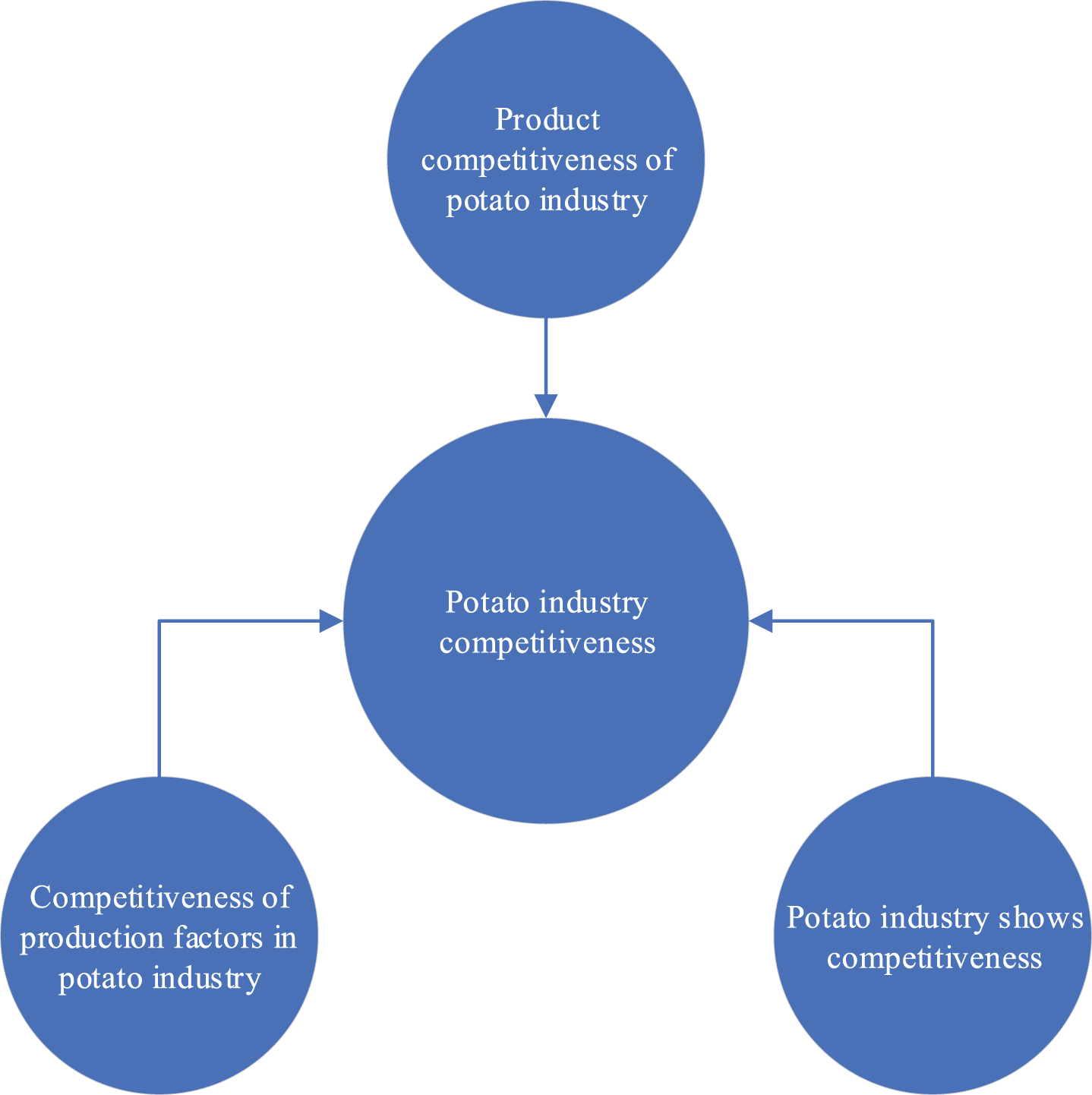
Potato industry competitiveness analysis model.
At present, the research on the theory, method and experience analysis of potato industry competitiveness is still in the primary stage, and the relevant literature is very few. Potato industry competitiveness involves a wide range, and it is difficult to evaluate quantitatively, so it is more difficult to build an index system to evaluate its competitiveness. Therefore, this paper attempts to focus on the current situation of the development of potato industry competitiveness, to sort out the many factors that affect the competitiveness of the potato industry, and select the indicators that have a greater impact to establish the potato industry competitiveness index system, in order to more scientifically reflect the status of potato industry competitiveness. The construction of an index system of potato industry competitiveness should follow the following principles: The principle of comprehensiveness. Comprehensiveness is to strive for the designed indicators, which can comprehensively reflect the competitiveness level of the potato industry from different aspects and reveal the essential characteristics of its competitiveness. Principle of importance. There are many factors that affect the competitiveness of the potato industry. Although setting all factors as indicators will more comprehensively reflect the level of competitiveness of the potato industry, it will also make the setting of competitiveness indicators of potato industry appear to be primary and secondary, on the one hand, there is no focus, on the other hand, the evaluation will be difficult. Therefore, this paper selects the factors that have an important impact on the competitiveness of the potato industry as the evaluation index. Principle of operability. The purpose of setting up the evaluation index of potato industry competitiveness is to reflect the potato industry competitiveness directly. Therefore, when setting the competitiveness index, we should fully consider all kinds of situations of the potato industry. The index should be easy to evaluate and operate, and the most important thing is that the data should be easy to obtain. Principle of comparability. Vertical or horizontal comparison is very important in the study of competitiveness. Therefore, in the design of the potato industry competitiveness index, each index should not only adapt to the comparison of the potato industry in different years but also require the space and time range, calculation caliber and method included in the index system to be consistent. Guiding principle. The evaluation of potato industry competitiveness is to better guide its competitiveness, so the design of indicators should be conducive to the formulation of policies to enhance the competitiveness of the potato industry and play a guiding role in the long-term development of the potato industry. The principle of hierarchy. The index system of potato industry competitiveness should be divided into three levels, such as first, second and third level indexes.
Selection basis of potato industry competitiveness index
1. Production factor competitiveness of the potato industry
The competitiveness of production factors refers to the input capacity of various competitive resources in the potato industry. The competitiveness of production factors in this paper includes resources, science and technology, human capital and infrastructure. Resource competitiveness. As potatoes belong to vegetables, natural resources such as land and water are very important to potato production. To analyze the competitiveness of the potato industry, resource factors are essential. In this paper, climate conditions and other indicators are used to illustrate the natural resource competitiveness of the potato industry. Technology competitiveness. The competitiveness of science and technology is to put the existing technology resources of theory into practice through research and development, so as to make it become a real production capacity. The index system reflecting technological competitiveness mainly includes processing technology level, industrialization management level, facility and variety level, etc. Human capital and infrastructure competitiveness. Human capital refers to the accumulation of knowledge and skills acquired by workers through investment in education, training, practical experience, migration, health care, etc., also known as “nonmaterial capital”. According to the connotation of human capital, this paper mainly analyzes the quantity and quality. Infrastructure is an important condition for the smooth development of the potato industry. The competitiveness of infrastructure can be examined from the aspects of annual per capita power consumption and total power of agricultural machinery.
2. Potato industry shows the competitiveness
The potato industry shows that competitiveness is the direct expression of potato industry competitiveness. This paper intends to measure the apparent competitiveness of the potato industry from the perspective of potato export revenue.
3. Product competitiveness of the potato industry
The competitiveness of the potato industry should be realized through the competition of potato products. The direct factors that determine the competitiveness of potato products mainly include the price brand and varieties of potatoes. Price is one of the key factors to determine the competitiveness of the potato industry. Generally speaking, the sales volume of soil is inversely proportional to the price, and the lower the price, the stronger the market competitiveness. Brand competitiveness is mainly used by consumers to judge and test the quality of products, which will have a “lock-in effect” on customers. When customers repeatedly purchase, they will refer to the reputation and reputation of products. The competitiveness of varieties is mainly investigated from the aspects of product culture, business integrity and service level of the potato industry [9, 10].
Evaluation index system of potato industry competitiveness
Evaluation index system of potato industry competitiveness
Considering the availability of all indicators and official data mentioned above, in the overall evaluation of the potato industry competitiveness of the national municipal potato production areas, the total output, Mu output, fixed asset investment and education expenditure are selected as the quantifiable indicators of the potato industry production factor competitiveness; The regional GDP, processing capacity, total population, utilization rate of virus-free seed potatoes and potato planting proportion are selected as the quantifiable indexes of environmental competitiveness of potato industry; the potato export income is selected as the quantifiable indexes of potato industry; the rural residents’ net income and potato price are selected as the quantifiable indexes of potato product competitiveness. See Table 1 for specific index selection results.
1. Strengthen the investment of production equipment and facilities
In the current period, in the process of potato industry production in China, the production and quality of potato production and processing can be improved to a large extent through modern advanced production technology and equipment, and the development needs of relevant markets can be met to a large extent. Therefore, managers of related enterprises need to strengthen the application of modern advanced technology and equipment in the process of potato production and processing, so as to strengthen the level of potato production and processing, and solve the problems in the process of production and processing on the other hand, so as to promote the healthy development of potato industry in China.
2. Strengthen the introduction and cultivation of high-quality varieties
In general, in the process of potato production and processing in China, it will also be greatly affected by the varieties of processed products; therefore, relevant staff need to strengthen the introduction and cultivation of high-quality new varieties in the daily work process, so as to enrich the technology and mode of potato production and processing, And then promote the progress and development of potato production and processing in China.
3. Strengthen the optimization and innovation of production technology
As we all know, in the process of any work, the relevant production technology level has a great impact on the efficiency and quality of the work. In the production process of the potato industry in China, in order to improve the quality and efficiency of production and processing, the relevant staff needs to strengthen the in-depth research and innovation of relevant production technology to improve the level of production technology, In order to solve the problems in potato production and processing to the greatest extent.
4. Strengthen the optimization of production and operation mode
At present, in the process of production and processing of potato industry in China, in order to promote the further development of the potato industry, relevant staff also need to strengthen the application of modern advanced technology and equipment in the daily work process, so as to optimize the model of innovative production and operation, and realize the scale and industrialization of potato production and processing, At the same time, we should strengthen the combination of potato industry production and processing enterprises with sales departments, scientific research institutions and relevant government departments, so as to realize the prediction of relevant markets, strengthen the establishment of potato industry database, and strengthen the safety and perfection of potato technology information network, so as to promote the progress and development of potato industry in China.
Analysis on the promotion effect of potato industry competitiveness
Research object selection
Inner Mongolia Autonomous Region is one of the major potato producing areas in China. This time, we will take the Xilingol League, the most representative of the Inner Mongolia Autonomous Region, as our research object. Ximeng is located in the middle of the Inner Mongolia Autonomous Region, with the terrain of shallow hills and hills, with an altitude of 1000-1800 meters. It is mainly loam and sandy loam, with the high potassium content. According to the growth characteristics of potato crops, it likes to be cold and cool, and its mouth is suitable for about 12 hours. It is not resistant to high temperature, and its soil nutrients are suitable for the growth of potato tubers. The natural resources and climate of Ximeng are very suitable for the growth characteristics of potato, It is a dominant crop with great development potential in the alpine region.
Analysis of potato production capacity
Potato planting in Ximeng is mainly distributed in Taipusi Banner, Duolun County, Zhenglan Banner, Zhengxiangbai banner towns and Baiyin Xile and Baiyin Kulun farm in Xilinhot City. The potato planting area is increasing year by year. On the basis of strengthening the development of the animal husbandry industry, Ximeng also vigorously develops the potato planting industry. Through the integration of project funds, the integration of technology promotion, the establishment of service mechanism, and the implementation of high-yield projects for potato industry organizations, the experiment, demonstration and popularization of virus-free potato seed potato propagation technology in the production test base and the technical training for potato growers have achieved remarkable results. Ximeng regards the high-yield and income generation of the potato industry as an important measure to promote the development and efficiency of the agricultural industry, increase farmers’ income. From Fig. 2, it can be seen that Taipusi Banner and Duolun County in the Southern Qi county of Ximeng potato planting distribution are the main planting areas, and the total output is also increasing year by year.

Total potato production in 2015 and 2018.
According to the data in Fig. 3 since 2015, the potato planting scale of Ximeng has grown rapidly. The main business entities are leading enterprises, professional cooperatives and large planting households. The production and operation mode has changed from the traditional self-sufficient, self-produced and self-selling family business model to the integrated large-scale operation of the agricultural industry. After 20 years of the rapid growth of potato planting area and production experience in Ximeng, potato planting enterprises and farmers realized mechanization in the whole process of planting technology, irrigation (water-saving irrigation) and harvest under the guidance of agricultural policy support, capital investment and Biotechnology of Ximeng government. The single yield and product quality of potato in Ximeng were improved. Up to 2018, the potato planting area of Ximeng is about 680000 mu, accounting for 52.1% of the total grain planting area, with a total output of 31.71, accounting for 60.2% of the total grain output, and there is still more room for development.

Potato production.
According to the data in Fig. 4, before 2015, the area of potato storage cellars in Ximeng was very small, and the vast majority of potatoes were stored in simple storage cellars and cellars built by farmers. After the adjustment of China’s market economy and the change of grain structure, potato growing enterprises, professional cooperatives and large growers in Ximeng have built large and medium-sized storage cellars year by year with the support of government policies and economy through self-financing, investment attraction and part of national investment. At present, the large storage capacity of potatoes in Ximeng has reached about 450000 tons, among them, the storage capacity of private potatoes reached about 150000 tons.

The proportion of potato storage to total yield.
In 2015, the output value of potatoes was still about 300 million yuan due to farmers’ blind planting of most unsalable potatoes; in 2012, the output value of potatoes was 500000 mu, 1.1399 million tons, and 330 million yuan; in 2016, the output value of potatoes was 1.4 million tons, and 575 million yuan; in 2018, the planting area of Xiling potatoes in Ximeng was about 680000 mu, and the output value was 680 million yuan, with the benefit increasing year by year. It can be seen from Fig. 5 that the sales volume of commodity potatoes alone accounts for more than 50% of the total output in each county of Ximeng, bringing considerable economic benefits to each county.
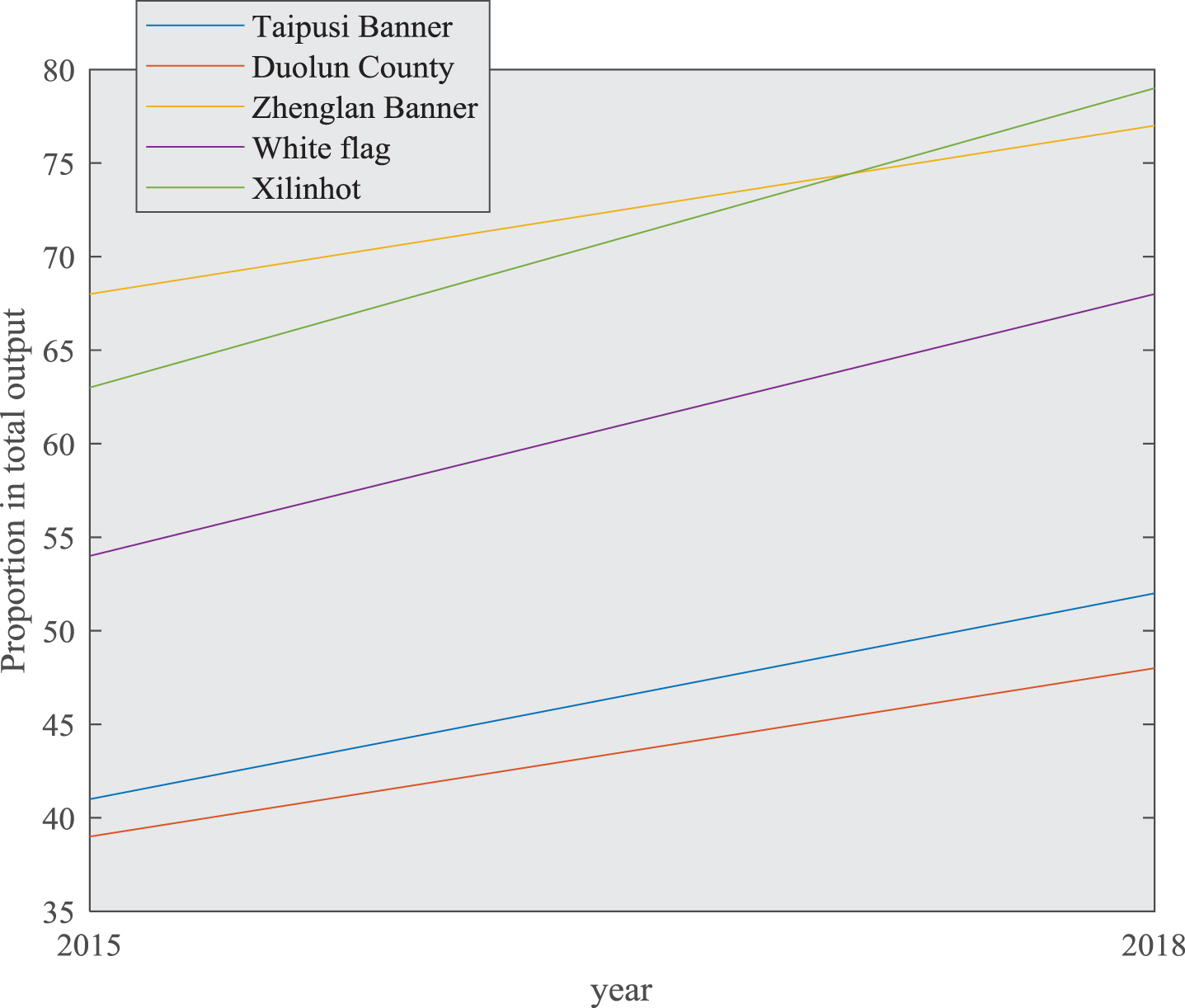
Statistics of potato industry sales.
Potato is one of the important food crops in China, which has a long history of cultivation. Since the reform and opening up, with the improvement of people’s food structure and the improvement of people’s living standards, China has made great efforts to improve the yield and quality, vigorously promote agricultural industrialization, and constantly improve the technical level of potato production, so as to further improve the economic value of this crop, which can be used as food, vegetable and industrial raw materials. With China’s entry into WTO, the international competitiveness of potato production and potato product market in the world has a greater impact on China’s potato industry. We also see the shortcomings of the potato industry in China. Although we are the largest potato production country, we are also a big import country. The market supply and demand are not matched, the industrial structure is unreasonable and the related policy problems are everywhere. In recent years, there are more and more researches in the potato industry. From the perspective of innovation, this paper analyzes the influencing factors in the development of the potato industry from the perspective of agricultural product economic management combined with intelligent system management and constructs the competitiveness analysis model of the potato industry. The purpose is to put forward countermeasures and suggestions for the healthy development of the potato industry in China; it is of great significance to promote China’s agricultural economic development and structural reform.
Footnotes
Acknowledgments
This work was supported by “Rebalance study on Sino-US manufacturing trade interests under the reconstruction of global value chain” project supported by Minjiang University (project number: MYS18020); “Research on the path of China’s agriculture climbing the global value chain” supported by The Coordinated development of industrial chain innovation team (Minjiang University).