



Abstract
Based on the introduction of the principle of the optical wireless system, the WDM-ROF based on hybrid modulation of MZM and OFM is designed WDM-ROF-PON system architecture, using simulation software to build the system to verify the rationality of the MZM and OFM hybrid modulation system structure; and put forward an MZM and OFM hybrid modulation scheme, using IRZ code in the downlink data stream, with better extinction ratio and dispersion tolerance, reducing the cost of the user receiving equipment, improving the system transmission quality. The simulation results show that the scheme of MZM and OFM hybrid modulation WDM-of-pon network architecture is reasonable and practical.
Introduction
ROF (Wireless over Fiber) technology is a low-cost broadband wireless access technology. The WDM-ROF-PON (Wavelength Division Multiplexing-Passive Optical Network Integrating Optical Carrier Wireless Technology) system integrates ROF technology under the WDM-PON structure, and uses the wavelength routing function in the WDM system to distribute multi-channel ROF signals to users The group realizes the networking of the ROF system. The system combines the advantages of ROF system with low high-frequency transmission cost and large wireless access bandwidth, and at the same time has good compatibility with traditional digital optical communication networks. The ROF system of multi-service transmission uses the free frequency band in the ROF system spectrum to carry additional data signals, which enables the system to transmit 2 to 3 different services at the same time, which improves the bandwidth utilization of the ROF system. The ROF system under the WDM structure usually uses integrated optical filter components to realize the loading of different data services in multiple channels. The WDM-ROF-PON system for multi-service transmission is one of the research hotspots in recent years. The multi-service system designed in this paper adopts quadruple double-sideband modulation. The modulated signal is composed of the second harmonic component and the center carrier component. Compared with the ordinary DSB (double-sideband modulation) optical millimeter wave, the cost is lower. The system uses IL (comb filter) to separate different carrier sidebands, and realizes the simultaneous transmission of 60 GHz millimeter wave signals and 5 GHz DPSK (differential phase shift keying) signals. The 60 GHz millimeter wave frequency band is an indoor broadband wireless access frequency band, and the 5 GHz frequency band is a frequency band of the WiMax (Global Interoperability for Microwave Access) system. Through simulation experiments, this article briefly analyzes the performance of two different frequency band services in the WDM-ROF-PON system when they are simultaneously transmitted and the crosstalk effects between services.
Modulation recognition is widely used in military and civil communications, such as signal monitoring, signal confirmation, interference identification, electronic countermeasures, electronic rescue and military threat analysis, etc. it is the basis of software radio, cognitive radio, spectrum sensing, and other fields. With the rapid development of radio communication technology, the signal environment is becoming more and more complex, new modulation methods are emerging, and more and more factors affect the recognition efficiency. How to innovate and improve the existing automatic identification technology is still a challenging research topic. Because of the analog communication systems still in use in many fields in China, such as Civil am, FM broadcasting system; aircraft navigation system; monitoring and intercom systems used by taxi companies, bus companies, fishing boats, maritime search and rescue, community property management, unit security, and public security, etc., all these analog communication systems can not be replaced immediately Using technical transformation and upgrading, such as digital modulation of digital information, and then analog modulation of the carrier of the original analog system with the modulated signal, the communication system after twice modulation will become an analog-digital hybrid communication system. For example, the subcarrier communication system, subcarrier broadcasting system, vehicle automatic positioning system, and so on have been widely used in foreign military and civil communication.
As these mixed modulation signals can be seen as multi-carrier signals, they are transmitted through the analog system. They have certain concealment and are not easy to be separated from other signals. At the same time, the signals in this frequency band are dense, the electromagnetic background is complex, and the mutual interference is serious, which brings great challenges to the electromagnetic spectrum monitoring and recognition. At present, the research on modulation recognition of this kind of multi-carrier mixed modulation signal is relatively less. In reference [5], a new mixed modulation scheme is proposed, which uses some improved hybrid modulation methods to obtain higher bandwidth efficiency, power spectrum characteristics, and lower bit error rate, further improving the frequency band utilization [6–8] the spectrum characteristics of TT & C signals of satellite link containing mixed modulation are preliminarily analyzed and simulated. The conventional method is used to identify the outer layer modulation, and then the inner layer modulation signal is processed after signal demodulation and shunting to realize the classification and recognition of mixed modulation signal, but the recognition effect needs to be improved. In this paper, based on the analysis of the instantaneous amplitude, instantaneous frequency, the number of subcarriers and eigenvectors, the normalized envelope variance of mean value, the statistical value of instantaneous amplitude distribution area of subcarrier signal, and the number of the peak of signal modulation order histogram, the modulation recognition of mixed modulation signal is realized by using tree classifier algorithm And the recognition effect is good.
Optical wireless technology is a kind of wireless communication technology that modulates the RF subcarrier to the optical carrier to realize the distribution based on the optical network. A typical optical wireless system consists of four parts: central station, base station, optical fiber link, and the user terminal. In the optical wireless system, all the expensive and complex devices are set in the central station. The base station is very simple. It only needs to complete the optical/electrical conversion, signal transmission, and amplification.
Because the next generation access network wants to provide multiple broadband services for a large number of end-users at the same time in an efficient way, this means that the communication network will develop in the direction of increasing capacity, reducing system cost, and providing wired and wireless services for multiple users at the same time. The optical fiber WDM passive optical network is seamlessly integrated with the optical wireless system. The hybrid modulation mode of MZM and OFM is adopted to overcome the influence of dispersion. It can not only provide high-frequency wireless access to multiple optical nodes but also provide fiber-optic cable access, which improves the security of communication. At the same time, centralized signal processing is placed in the central station, which reduces the cost of the base station [1]. WDM-ROF-PON system not only absorbs the advantages of low-frequency transmission cost and ultra-high wireless access bandwidth of the optical wireless system but also organically combines optical wireless system with the traditional digital optical communication network. To realize the hybrid access of optical cable and wireless in the WDM channel, it becomes the future development trend. Therefore, the study of the WDM-ROF-PON system has important practical significance.
Principle of optical transmission system based on optical wireless
FSO (Free Space Optical Communication) is a digital communication system transmitted by laser or optical plus in the atmosphere. It is also called“Wireless Optical Communication” or“Wireless Optical Network”. FSO both has microwave and laser communication’s advantages. Furthermore, it is structured with some inimitable characters such as unlimited bandwidth, no frequency admission, low cost, strong anti-jamming, good transmission secrecy, ease and speed of deployment, and so on. Compared with the former broadband connection, these advantages can easily solve the“last mile” question of the broadband network when FSO begins to be researched. More and more research organizations and network merchandise focus on FSO. Now FSO has been used in commercial networks successfully with 2.5Gbps speed rate and its speed rate can reach 1 60Gbps in the laboratory. Its maximal communication distance is 4-5 km. Developed with the high sensitivity receptor and advance communication electronic device, as well as network increasing recently; the research on FSO achieves a new climax. This paper based on the 155Mbits/s FSO system designed by our laboratory and it introduces the system principle, modular function, and signal flow. It analyses the atmosphere channel influence, optical T/R devices, and environmental effect than research on the factors, which affect the FSO system. Afterward, the dissertation estimates the system parameter such as transmitting power, BER, receiving sensitivity, and analyses their relationship. In the end, the author brought forward some suggestions to improve system performance for designing better FSO in the future.
In the optical wireless system, the RF subcarrier is used to modulate the digital baseband signal, which is loaded on the optical signal by the external modulator, then transmitted to the receiving end by the optical fiber transmission link, and finally demodulated by the antenna after receiving the RF signal. The central station is responsible for routing, switching, radio resource allocation, and processing of some baseband/radio frequency signals of the whole system. The electric/optical module of the central station modulates the downlink radio frequency signal on the optical carrier and transmits it to the base station through the optical fiber. The base station performs optical/electric conversion of the received optical signal, the electrical RF signal is separated from the optical signal, and finally sent to the user through the microwave antenna. The optical fiber transmission link in the optical wireless system only plays the role of transmission. Switching, control, and signal regeneration are centralized in the central station, and the base station only realizes photoelectric conversion [2]. In this way, complex and expensive devices can be centralized to the central site, and multiple remote base stations can share these devices, and reduce the power consumption and cost of the base station. Therefore, the topological structure of the optical wireless system can be combined with the point-to-point structure of WDM-PON, which can not only transmit the mobile signal service on WDM-ROF-PON, but also avoid the influence of electromagnetic interference on the radio frequency signal, and can reduce the cost of the overall transmission of fixed and mobile services [9–13].
The optical wireless system can generally adopt the method of external modulation, and its structure is shown in Fig. 1. The baseband signal is loaded on the microwave source F0, loaded on the optical signal by the external modulator, and then transmitted to the receiving end by the optical fiber link. The original information signal is obtained by coherent demodulation. The external modulator uses a two-electrode Mach Zehnder modulator. Different modulation modes can be obtained by changing the settings of the bias difference between the upper and lower electrodes of the modulator, the phase shift of the RF driving signal, and the modulation depth [3].
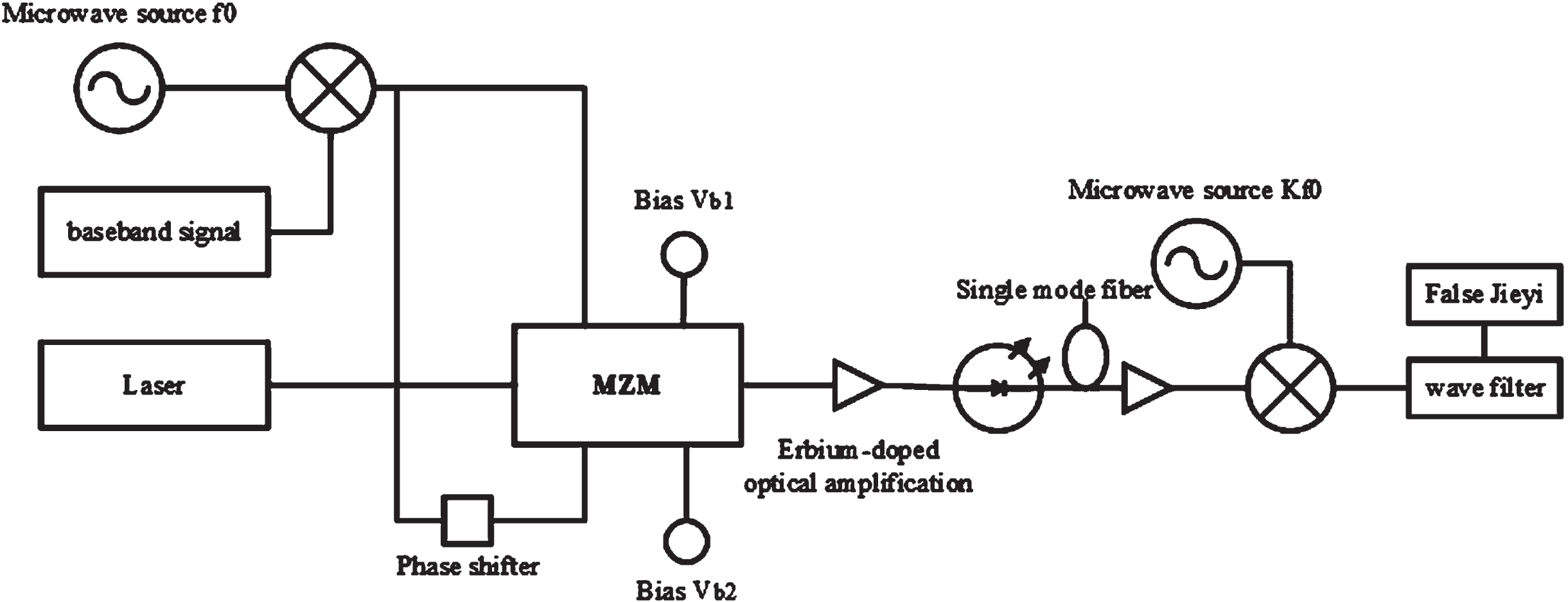
Structure of optical wireless system based on external modulator.
The basic scheme of the optical wireless system is to connect the central station and the base station with optical fiber, to realize two-way interactive communication. In the uplink, when the base station receives the terminal signal, the signals of different base stations can be combined after laser modulation, Transmit to the central station for processing: in the downlink, the central station modulates the signal to the optical carrier signal to obtain the optical signal, transmits it to the base station through the optical fiber, and the base station carries out the optical detection, and then transmits the obtained millimeter-wave signal to the terminal. In the design of an optical wireless system, not only the basic functions of RF systems such as transmission and mobile but also the functions of data modulation, signal processing, and frequency conversion should be considered [14–19]. At the optical line terminal at the central station, RF and baseband signals are modulated at different wavelengths. After the single-mode fiber link transmission, the mixed signal is demultiplexed at the optical node of the base station, demodulated, and sent to the corresponding terminal. The input electric signal of the optical wireless system depends on the function needed by the system. It can be a baseband signal, modulated RF signal, or distributed signal.
The combination of the optical wireless system and the WDM-PON system can realize the hybrid access of optical wireless in the WDM channel. The basis of the fusion system is that both WDM-ROF and WDM-PON systems are point-to-multipoint access, that is, the optical line terminal in the PON system corresponds to the central station in the optical wireless system. The base stations in the optical wireless system correspond to the optical nodes in the PON system. Figure 2 is a schematic diagram of a passive optical network system incorporating optical wireless technology. In Fig. 2, the upper left part is the traditional optical network access point, which provides a n-way optical signal loaded with baseband information; the lower-left part is the optical millimeter-wave generation device, which generates n-way pure optical millimeter-wave carrier; the two optical signals pass through the all-optical switching device. The device is composed of a semiconductor optical amplifier or electric absorption modulator to realize all-optical upconversion [20–25]. After amplified by EDFA, the signal is transmitted to the remote access node via optical fiber, and then demultiplexed into N channels. Each optical signal is distributed to each access unit (RAU) through the optical fiber. It is directly converted into the RF signal in the access unit and sent to the user [3].

WDM-ROF-PON structure schematic diagram.
The system structure is shown in Fig. 3. In this paper, the simulation software optisystem 7.0 is used to build the system to verify the rationality of the structure of MZM and OFM hybrid modulation WDM-rof-pon. The key technology is to obtain multi-wavelength light source with good performance, and according to the needs of different frequency wireless signals. Provide a wavelength-tunable function. For the analysis of the existing multi-wavelength light source technology, only the laser array based on the multi-quantum well waveguide or the supercontinuum spectrum technology can meet the above situation [4]. In the downlink data stream modulation, MZM and OFM mixed modulation mode is adopted, and the downlink data stream includes two kinds of wired data baseband signal and radio frequency signal, which are transmitted in the same downlink optical carrier by combining phase modulation and intensity modulation respectively [5, 26–34]. The DPSK mode of phase modulation is adopted at the optical line terminal / central station, and the downlink baseband signal is carried by precoding mode [6].

WDM-ROF-PON Simulation System Structure.
At the downlink end of each independent WDM channel, three optical signals, i.e. intensity-modulated wireless signal, DPSK modulated wired signal, and no-load optical signal, are coupled to the same link as a whole downlink signal of a channel. At the same time, the signals of other N channels are multiplexed into one optical fiber by WDM and transmitted to the optical distribution node. Here, WDM is the core device of the optical distribution node to distribute the signals of different optical nodes, that is, to divide the received n-channel signals. At the same time, each path is transmitted to the optical node of the corresponding wavelength. In the uplink, the data from the wireless client and the wired client can be fused as the uplink data, and its intensity is adjusted to a certain wavelength and sent to the optical distribution node. The wavelength division multiplexer for uplink in the optical distribution node multiplexes and transmits uplink signals from N optical nodes/base stations to the uplink receiver of the optical line terminal / central station. After intensity demodulation of each signal, n-channel uplink information is obtained.
To verify the feasibility of the above system scheme, after the system is built by the simulation software Optisystem 7.0, the wavelength-tunable laser array is used as the multi-wavelength light source to generate three independent optical carriers, the wavelengths are 193.1thz, 193.16thz, and 193.135thz respectively. Among them, the optical carrier with the wavelength of 193.1thz is input into the MZM intensity modulator, and the information of 2.5gb/s generated by the sequence controlled code generator is loaded: the carrier with the wavelength of 193.135thz is phase modulated by DPSK to obtain the ODPSK signal; the optical signal with the wavelength of 193.16thz is phase modulated by 10Gb / s electric signal intensity as the uplink optical carrier, After demodulating, the simulation results of the uplink OOK link are obtained. The downlink of the system is divided into two parts, one is DPSK modulation signal with the advantages of reducing optical SNR tolerance, overcoming nonlinear effect, and increasing dispersion limited distance and the other is ROF signal with baseband modulation. The uplink adopts OOK modulation, which simplifies the system structure.
Because of the mixed modulation of MZM and OFM of uplink OOK and downlink DPSK, when the downlink adopts phase modulation, the NRZ code of the downlink 10Gb / s pseudo-random sequence (PRBS) is differential precoded to drive the phase modulation (PM) to carry out the downlink data stream transmission, and after the transmission of 20 km SMF system, it is received at the optical node end. The uplink data stream driver is the NRZ code type, and the downlink data stream code type adopts the IRZ code. The relationship between the extinction ratio of downlink and uplink data stream signals and the Q factor is shown in Fig. 4.

Relationship between the extinction ratio of IRZ code and Q factor.
It can be seen from Fig. 4 that the Q value of the downstream IRZ data stream is the least sensitive to the change of extinction ratio. The Q value of the upstream IRZ data stream after re modulation increases with the increase of extinction ratio. When the extinction ratio is 10 dB, the Q value of the upstream and downstream data streams are the same. Because of the mixed modulation scheme of MZM and OFM, the extinction ratio of the intensity modulator directly affects the transmission quality of the downlink baseband signal and RF signal. When the extinction ratio is less than 10 dB, the performance of the baseband signal received by intensity modulation decreases rapidly, while the RF signal received by phase modulation has better performance. Therefore, choosing a proper extinction ratio of 10 dB can meet the receiving performance of downlink baseband and RF signal at the same time.
In the same way, it is necessary to analyze the anti-dispersion performance of the uplink data stream signal after the mixed modulation of MZM and OFM. Therefore, it is necessary to simulate the anti-dispersion performance of different code types in a single channel. In the simulation experiment, NRZ, 33% RZ, 67% RZ, and IRZ are used to test, and the simulation results are shown in Fig. 5.
From Fig. 5, it can be seen that when NRZ code is used in the downlink, the power cost of dispersion of uplink data stream signal changes the most, while that of IRZ code changes the least. In single-channel data stream transmission, the anti-dispersion performance of code type is closely related to the spectrum width of the optical signal. If the RZ code with 33% or 67% duty cycle is used, the transmission delay of the signal with different frequency components will be caused, and the error rate of the signal will be increased. Compared with 67% RZ and NRZ in a bit period, the RZ code with 33% duty cycle has the smallest amplitude change and the smallest influence on the uplink phase re modulation, so it has better anti dispersion performance. For the uplink data stream signal using IRZ code, in a bit cycle, both the signal level and the signal level carry optical energy. Generally speaking, the amplitude change of code pattern after downlink modulation is the smallest, so its anti-dispersion performance is the best among all code patterns.
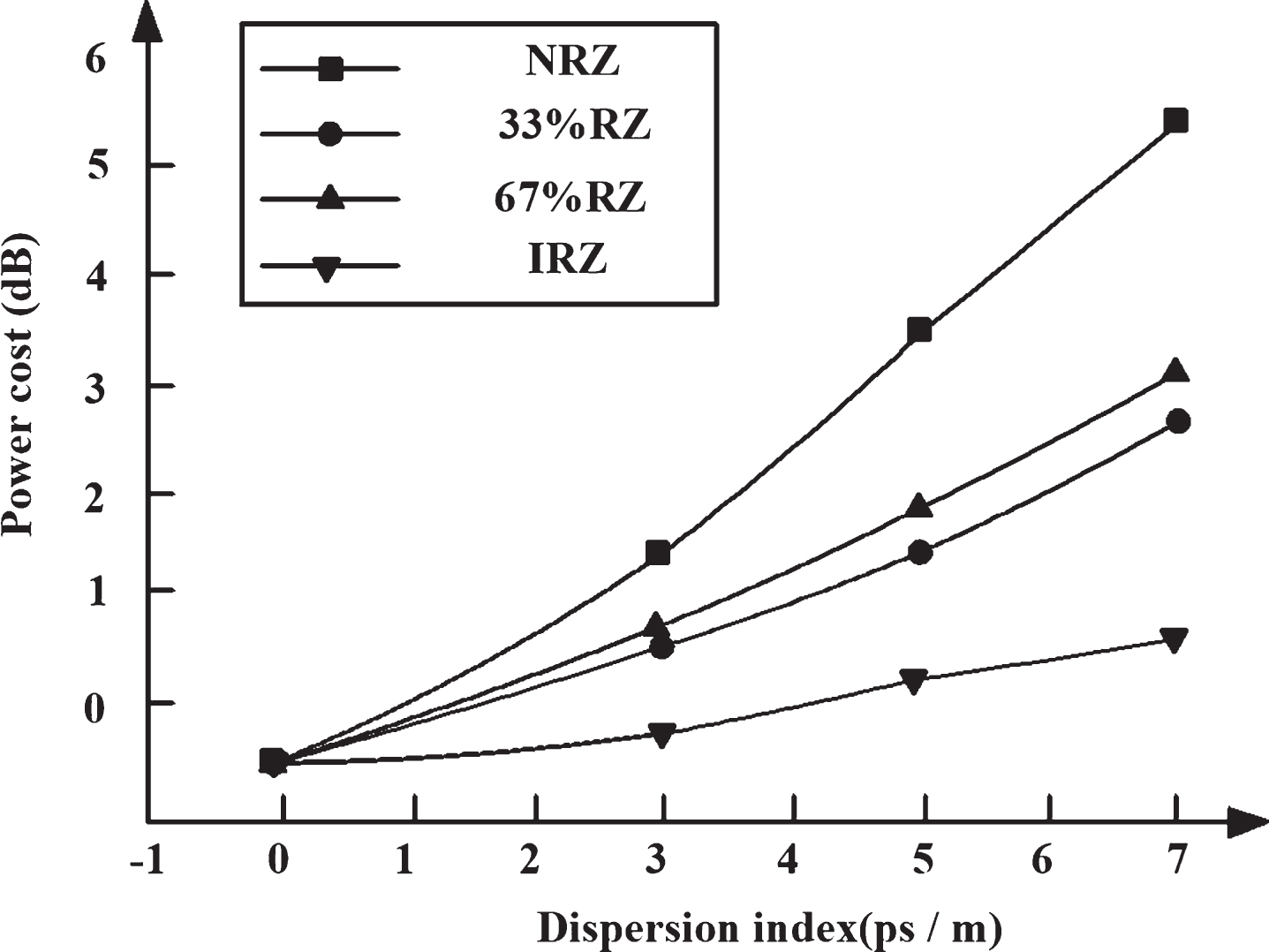
Comparison of anti-dispersion performance of uplink re modulation codes.
Generally speaking, the mixed modulation of MZM and OFM with uplink OOK modulation and downlink DPSK requires that the amplitude of downlink data stream signal changes little. It can reduce the impact on the transmission and reception of uplink data stream signals. Therefore, IRZ code with an extinction ratio of 10 dB is recommended as the preferred code type in the WDM-ROF-PON system. Based on the above simulation results, the scheme of the WDM-ROF-PON optical wireless hybrid access system based on MZM and OFM hybrid modulation is feasible. Spectrum of each point in the systems and Receiving eye chart are as shown in Figs. 6 and 7.
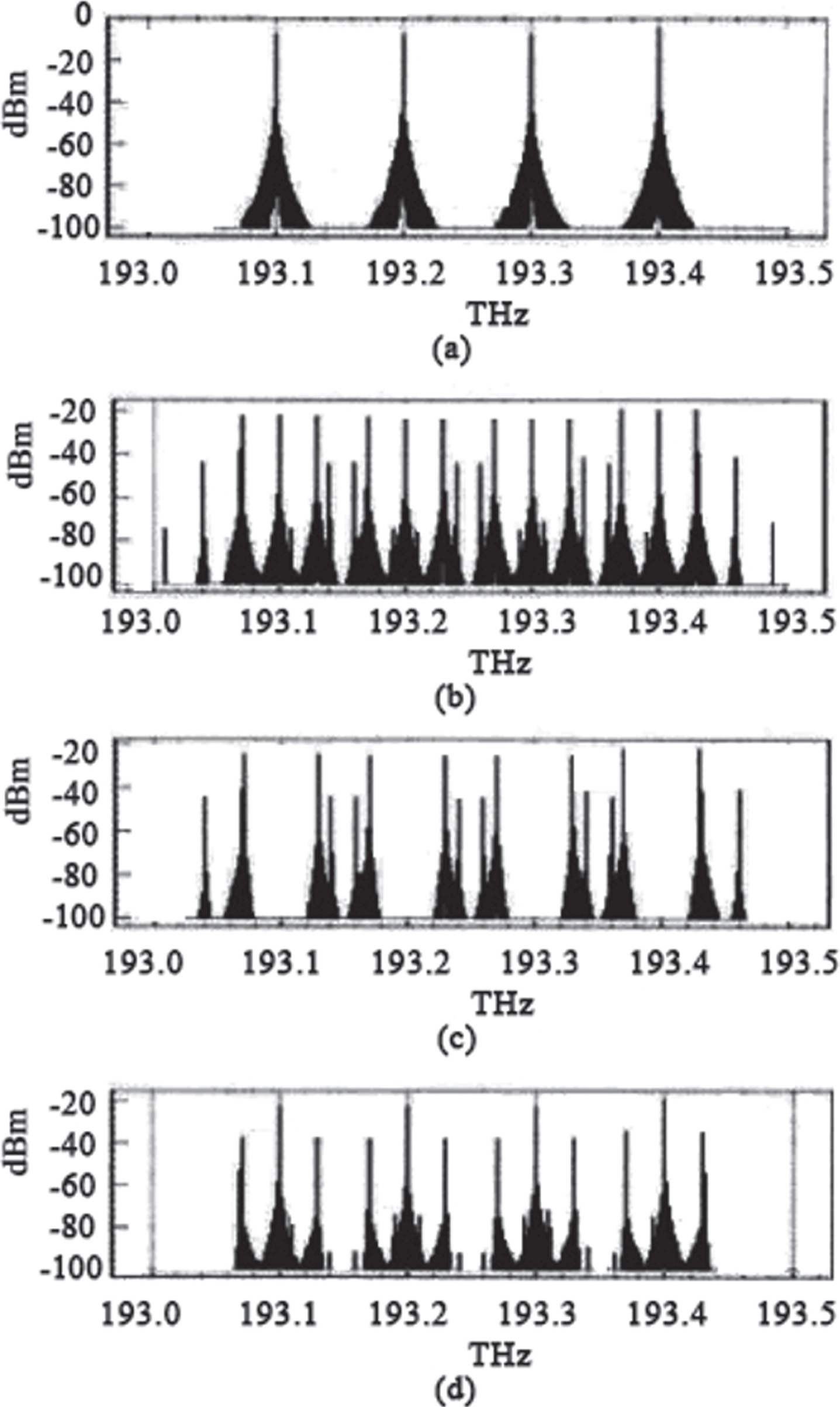
Spectrum of each point in the systems.
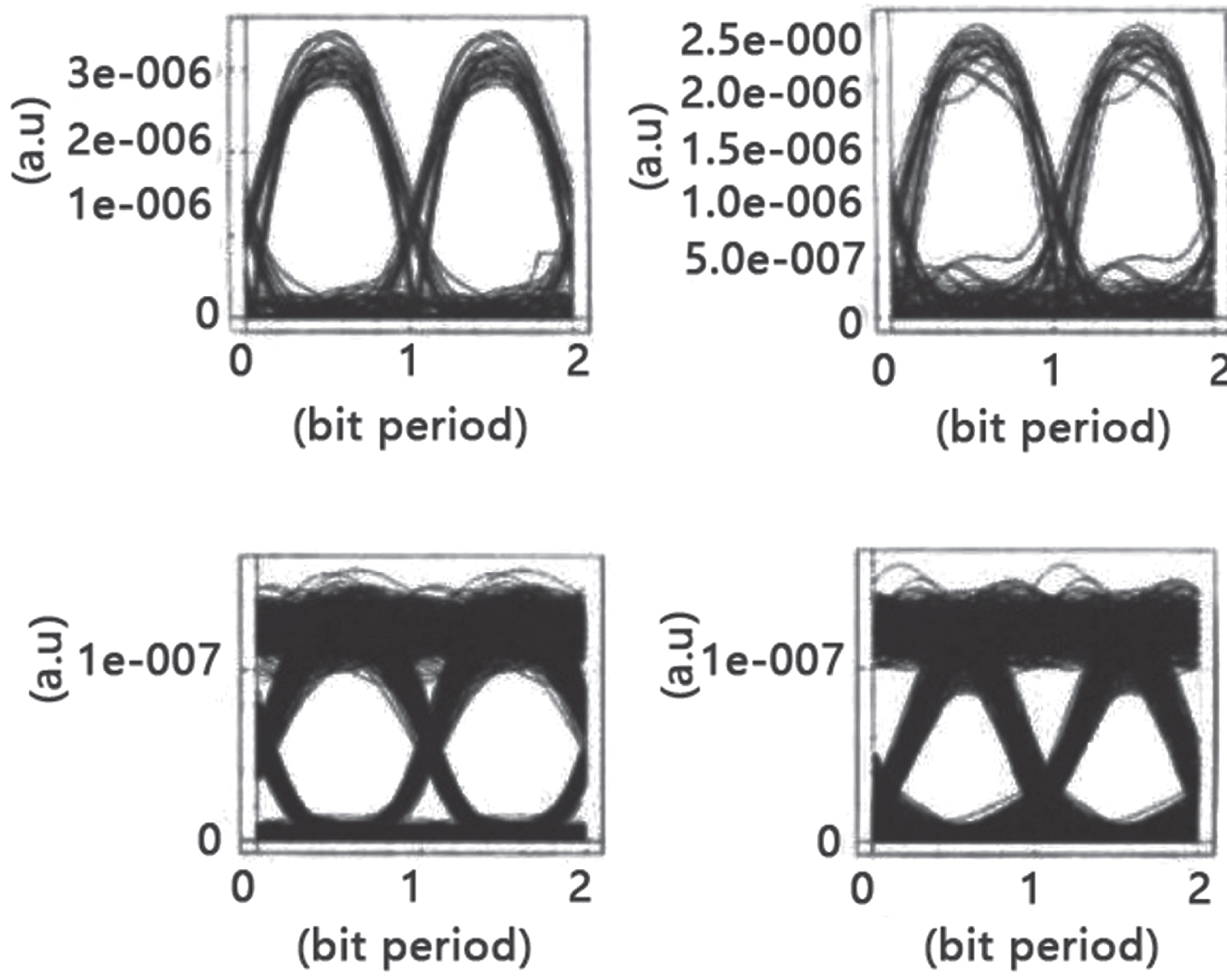
Receiving eye chart.
This paper studies and designs a WDM-ROF-PON system network architecture based on the mixed modulation of MZM and OFM. The IRZ code with better extinction ratio is adopted in the downlink data stream, which not only ensures the better dispersion tolerance of the uplink data stream, but also reduces the cost of the user’s receiving equipment, and improves the transmission quality and practical performance of the whole system. The simulation experiment verifies the rationality of the scheme. The system has a long signal transmission distance, little influence of dispersion and crosstalk, and good transmission performance, which shows that the WDM passive optical network structure of the optical wireless system is feasible in practical application.
In order to further analyze the impact of low-step services in the multi-service system on millimeter wave services, this article has improved the system, leaving the point of the system principle empty, and the system only transmits millimeter wave signals. Compared with the original business system model, the single-service system has exactly the same millimeter wave signal generation and data loading methods. By comparing with the millimeter wave service signal in the multi-service system, the influence of low frequency service on millimeter wave service transmission is analyzed. The experimental results also reveal this principle.
The research of WDM-ROF-PON system is still in the early stage, and there is no unified standard for the system structure. The multi-service transmission WDM-ROF-PON system designed in this paper has greater development advantages, and also puts forward higher requirements on the bandwidth and isolation of integrated optical filter components.
Footnotes
Acknowledgment
This paper is supported by the science and technology project of China Southern Power Grid Co., Ltd. research and application of atomic probe in power data network “(Project No.: 066700kk52150001)”