



Abstract
Concrete is influenced by affecting conditions during its production and construction processes. The literature reveals that there is limited understanding about the effect of unstructured factors (i.e., construction site factors) on concrete product. Crew experience, compaction method, mixing time, curing humidity, and curing temperature were selected to quantify their impact on concrete compressive strength, fabrication cost, and production rates. Each response was measured and utilized for fuzzy modeling. A Sugeno-type fuzzy inference system (FIS) was obtained for quantifying each response. Model validation was accomplished by plotting predicted versus experimental data while sensitivity analysis used Monte Carlo simulation and Spearman’s correlation coefficients. Curing temperature was identified as the most influential factor for concrete compressive strength while mixing time was identified to have the largest impact on concrete cost and production rates. All FISs can be used as supporting tools to discern desired concrete operating conditions.
Introduction
There are several affecting conditions that could impact concrete compressive strength, costs, and production rates when fabricating concrete at the jobsite. The impact is manifested by reducing strength, by reducing productivity, and by increasing costs. These potential impacts are usually unknown or ignored by construction laborers, foremen and project managers. Knowing such impacts in advance could prevent managers from wasting resources as well as help save time and money. The novel approach presented in this study assists in reducing uncertainty in order to manage concrete quality during the construction phase of a project through the use of novel fuzzy set theory.
Fuzzy set theory overview
Several theories or approaches are available to deal with uncertainties including probability, belief and plausibility, possibility, and fuzzy set theory [13, 25]. Fuzzy set theory, introduced by Zadeh in [40], is a very efficient tool to understand complex systems where there are unknown mathematical functions. Usually, the more complex the system is, the less knowledge about the system is available and vice versa. Fuzzy rule-based systems are known as fuzzy inference systems (FISs), and they are suitable mechanisms to manage problems where uncertainties are caused by lack of knowledge and vagueness [41], recalling that a FIS can provide researchers with information, increasing their understanding about how a system works. Also, a FIS could be thought of as an approximation of a mathematical function, being very useful when modeling complex systems that are described by humans through the use oflinguistic variables [25]. On the contrary, it would not be necessary to use fuzzy set theory if the function governing the system were known or defined.
Fuzzy inference systems (FISs)
Two main components can be distinguished for a FIS: (1) a fuzzy knowledge base and (2) an inference mechanism. The knowledge base component consists of input– output (I/O) data coming from the observed system and if– then rules. This information is used by the inference mechanism to predict or map outputs for any input. The knowledge base describes I/O relationships, while the inference mechanism uses such knowledge for estimating outputs. The most common inference mechanism methods are Mamdani [18, 19], Sugeno, also known as Takagi, Sugeno and Kang (TSK) [29], and Tsukamoto models [34], all based on if– then rules. Mamdani’s inference mechanism differs from the others in that the output is a fuzzy set while the other procedures produce crisp outputs for each rule by using mathematical functions.
The use of fuzzy inference systems is an appropriate approach for understanding and quantifying the impact of construction site factors (i.e., unstructured factors) affecting concrete compressive strength, costs, and production rates through experimental I/O data. Influencing factors affect such concrete characteristics nonlinearly, and fuzzy systems perform well when dealing with such models. FISs perform well when having I/O data, and the rules derived from that data provide knowledge of the system [25]. An experimenter or analyst uses experimental data obtained through testing in order to model or predict results when dealing with complex systems, and thus FISs may be applied in these cases [25]. Furthermore, several investigations have attempted to develop prediction models for concrete strength from experimental I/O data. In [31], Tesfamariam and Najjaran utilized adaptive neuro-fuzzy inference systems (ANFIS) for predicting concrete compressive strength by testing different mix proportions. They concluded that this technique has significant advantages in estimating concrete strength from experimental data; i.e., in-situ quality controls. Also, the authors emphasized that the use of past experience (experimental data) should be utilized to gain knowledge of a system. In [17], Madandoust et al. attempted to predict concrete compressive strength by developing ANFIS based on concrete core testing data. In [30], Tayfur et al. fabricated concrete samples with varying binder contents and tested them at different ages, concluding that fuzzy logic is a very useful technique to predict concrete compressive strength. In a recent study [11], Khademi et al. evaluated concrete compressive strength made with different mix designs by means of sample fabrication and testing in the laboratory. The authors concluded that artificial neural networks (ANN) and ANFIS models are preferred due to the nonlinear relationship between variables. Fuzzy set theory is thus an effective technique for mapping I/O data in concrete-related studies because of its ability to deal with nonlinearity and to provide information for understanding system behaviors.
Membership Functions (MFs) and If– Then Rules
A membership function (MF) of a fuzzy set maps each element of the universe of elements to a membership value or degree of membership between 0 and 1 [10], being 1 for full degree of membership. A MF can have many shapes, such as triangular, trapezoidal, and Gaussian, and the precision of the shape that comprises a membership function is not important as long as the functions represent each input. Overlap MFs is an important characteristic to be considered when partitioning the universe of discourse, allowing each element to have different degrees of membership in different MFs.
Several methods such as intuition, inference, inductive reasoning, and automated methods may be utilized to develop MFs, depending on data availability and the degree of knowledge of the system [25]. Automated methods are alternatives to creating not only MFs but also if– then rules. In [23], Passino & Yurkovich mentioned several automated techniques that are available for fuzzy identification and estimation including a clustering method (CM), which creates rules based on grouping or partitioning data into similar groups. In [9], Jang proposed a method called Adapted-Network-based Fuzzy Inference System (ANFIS) for constructing a FIS by developing if– then rules and MFs based on I/O data tuples through a hybrid learning algorithm that combines the gradient method and least squares estimates.
Research significance
Even though concrete strength depends mostly on mixture constituents, proportions, and fabrication, it also depends on other factors affecting testing results, including boundary conditions [12]. In [39], Yuan et al. pointed out that the factors that affect concrete compressive strength may be classified into structured and unstructured factors. The first category is related to the factors affecting concrete during its production process while the second category refers to construction site factors that influence concrete during the construction phase. The literature indicates there is limited understanding of the effect of such factors on concrete. The present research addresses this limitation by developing fuzzy models for quantifying their effect, assisting concrete laborers and technicians when performing concrete operations.
The goal of this study is to provide construction workers and technicians with decision-support prediction models for quantifying the impact of construction site factors on concrete compressive strength, costs, and production rates by using experimental data and fuzzy set theory. The research objectives are to (1) develop a fuzzy inference system for quantifying concrete strength, cost, and production rate effects, (2) identify affecting conditions that dominate the output of each fuzzy model, and (3) create a decision tool for identifying desired operating conditions that will meet required concrete compressive strength as well as costs and production rates.
Experimental investigation
Adapted-Network-based Fuzzy Inference System (ANFIS) utilizes data tuples for constructing a Sugeno-type FIS by developing if– then rules and MFs based on data clustering when having experimental I/O data. ANFIS is a neuro-fuzzy model that utilizes the advantages of artificial neural networks (ANNs) by allowing fuzzy systems to learn through a hybrid learning algorithm [10]. An ANFIS model was used to investigate the effects of construction site factors on concrete compressive strength, on costs and on production rates in this study.
Experimental data (I/O data)
For this study, five construction site factors—crew experience, compaction method, mixing time, curing humidity, and curing temperature—were selected from the literature [6, 36]. These factors refer to construction site conditions (i.e., unstructured factors) that are present during manual concrete fabrication, placement, and curing until the concrete is 28 days old at the jobsite. For developing a Sugeno FIS for quantifyingcompressive strength effect, four factors —compaction method, mixing time, curing humidity, and curing temperature —were utilized, since they were found to be significant after performing an analysis of variance (ANOVA) at 0.05 level of significance with a 95% confidence level.
Six cylindrical concrete samples of 150mm by 300 mm (6 by 12 inches) were fabricated and cured for each factor combination, simulating affecting conditions, and were tested for a compression axial load, as per [3] at the laboratory for Testing and Construction Materials of the School of Civil Engineering of the Central University of Ecuador. A total of 192 samples were fabricated, keeping constant concrete mix proportions and slump, as per [2]. Additionally, six standard concrete samples, as per [4] were fabricated to ensure a compression strength of 28 MPa (4000 psi) and used as a baseline for computing concrete strength effects by comparing affected samples and standard samples subtracted from unity and expressed as a percentage.
Input data comprised all four construction site factors while the output was the compressive strength effect. Half of the data (i.e., 96 strength responses) were used as training data and the other half as checking data for the ANFIS model. Training and checking datasets for ANFIS models were selected randomly, resulting in 32 data tuples made of the average of three compressive strengths of samples corresponding to the same experiment for each dataset. Training data were the data tuples used to generate the ANFIS model while checking data were used for verifying the performance of the model.
Table 1 summarizes affecting conditions and strength effects for training and checking data. Negative values of strength effect indicate a reduction in strength, suggesting that affecting conditions had an adverse impact on concrete strength. Positive values indicate that affecting conditions increased concrete strength.
Training and checking data for concrete strength effect
Training and checking data for concrete strength effect
Regarding concrete costs, three unstructured factors; namely, crew experience, compaction method, and mixing time, were considered for developing a Sugeno FIS. The costs of curing humidity and curing temperature were not considered in this study since they correspond to environmental conditions existing at the jobsite. Concrete cost effects were computed by taking into consideration the costs of labor and equipment utilized for fabricating a batch of concrete for six samples under each factor combination, and were then compared to the costs of the standard sample fabrication. Affecting conditions (inputs) and the corresponding effect on concrete cost (output) are shown in Table 2. The data for training and checking ANFIS consisted of 16 data tuples respectively since 32 experiments were conducted. Positive values indicate that concrete costs increased while negative values indicate a reduction in concrete costs due to the presence of construction site factors.
Training and checking data for concrete strength effect
Regarding production rate effect, the same three unstructured factors—crew experience, compaction, and mixing time—were selected for developing the Sugeno FIS, just as for concrete costs. Concrete production rate effects were computed by considering production rates for fabricating a batch of concrete for six samples made under affecting conditions and compared to a standard sample fabrication rate. Training and checking data for the ANFIS model are illustrated in Table 3 and consisted of 16 data tuples for each dataset. Construction site factors were the inputs and the corresponding effect on concrete production rates was the output. Positive numbers imply that production rates increased due to affecting conditions and vice versa for negative output.
Training and checking data for production rate effect
Yager and Filev [37] pointed out that there are two approaches for developing fuzzy models; namely, a direct approach and system identification. The first one consists of creating a fuzzy inference system based on expert knowledge. An expert oversees partitioning the data, creating if– then rules, choosing an appropriate inference mechanism, and evaluating the model. On the other hand, system identification is a method for developing a FIS based exclusively on I/O data (e.g., experimental data). This approach was used in this research to develop a Sugeno-type FIS.
System identification
System identification can be divided into (1) structure identification and (2) parameter identification [28]. The main goal of structure identification is to determine the partitions of the I/O data points, if– then rules, and the number of rules, while parameter identification involves adjusting the parameters of the model to minimize output errors. All cluster centers identified by a clustering method determine the number of if– then rules and antecedent membership functions (i.e., the MFs for the inputs) that are utilized by ANFIS during the parameter identification process. The subtractive clustering method [7] and ANFIS are used for structure and parameter identification respectively.
Structure identification
There are several methods for clustering data (i.e., classifying data). Fuzzy c-means is a very popular method described in [5] and is based on iterative optimization. The objective function is intended to minimize Euclidean distances between a data point and its cluster center, and to maximize the Euclidean distance between cluster centers [25]. The mountain method, a simple and effective clustering algorithm, is another procedure used for grouping data and was proposed by Yager and Filev [38]. This method is based on gridding the data space of each input and output variable. A grid point with many surrounding points has a high potential value and is chosen as a cluster center. The main drawback is that it is very computationally intensive when the number of inputs increases. Subtractive clustering, introduced by Chiu [7] is a variation of the mountain method. In this method, any data point is considered as a potential cluster center instead of a grid point. The number of grid points is equal to the number of data points, reducing computational load significantly, even for a large number of input variables. This method is fast, since it does not involve iterative nonlinear optimization. Also, it is recommended for use when the possible number of clusters is unknown [20]. Thus, the subtractive clustering method was used in this research for the structure identification process to determine the number of if– then rules and membership functions.
Subtractive clustering
As mentioned before, each data point is considered a potential cluster center and the potential value (P
i
) of a data point x
i
is defined by Equation (1). The value α is defined by Equation (2), where r
a
, a positive constant, is the radius of influence of a cluster center. This parameter is specified by the user and a large value of r
a
produces fewer clusters and vice versa. The radius r
a
is adjusted based on the results of the model accordingly, meaning that it can be modified according to the number of cluster centers identified.
It is inferred from Equation (1) that a data point with many neighbors has a high potential value. After computing the potential of each point (P
i
), the point with the highest potential value is assigned to be the first cluster center (P1). Then the potential values of all remaining data points are updated with respect to the first cluster according to Equation (3). The value β is defined by Equation (4) and it is inversely proportional to r
b
which is a positive constant defined as the radius of the neighborhood having measurable reductions in potential. Measurable reductions refer to the values for updating all remaining potentials.
Once all potential values of the remaining data points are calculated using Equation (3), the data point with the highest potential value becomes the second cluster center. Then the potential of the remaining data points is reduced with respect to the second cluster center and so forth as indicated in Equation (6), where
The procedure described using Equation (6) is repeated until meeting the criteria according to [7] as follows, using an if – then – else rule:
else if Let dmin =shortest of the distances between
Reject end if end if
In this procedure,
After clusters have been identified, they are used to create the MFs that are going to be utilized by the ANFIS model. First, the number of clusters identified determines both the number of MFs for each input and the total number of if – then rules for the FIS. The parameters needed for creating a Gaussian MF become each cluster center (c
i
) with its corresponding sigma (σ
i
). Sigma is computed by using Equation (7) for each cluster by subtracting the maximum and the minimum values of the X data matrix (i.e., each input data point).
When using the subtractive clustering method for parameter identification with adaptive ANFIS and under a MATLAB platform, the resulting FIS structure has the following characteristics: first or zero order Sugeno-type FIS; single output using weighted average defuzzification method; Gaussian MFs only, all of the same type; equal number of MFs and if – then rules; and unity weight for each rule. A characteristic of this model is that it gives crisp outputs or functions for each rule.
Adaptive neuro fuzzy inference systems (ANFIS)
ANFIS, described in [9], is a neuro-fuzzy model that makes use of the advantages of artificial neural networks by allowing fuzzy systems to learn through a hybrid learning algorithm. ANFIS uses experimental I/O data available from a system to tune MFs and create if– then rules for a Sugeno-type FIS. Fig. 1 shows an example of a Sugeno system with four rules, two inputs (e.g., construction site factors F1 and F2), and one output (i.e., concrete compressive strength effect). In addition, Fig. 1 illustrates ANFIS architecture with its 5 layers. It can be inferred from both figures that a characteristic of this model is that it gives crisp outputs or functions for each rule and an aggregated total output of the system. The number and shapes of MFs for ANFIS are set first through the structure identification process.
Each layer (see Fig. 1) of ANFIS has a specific purpose, in order to process input data until a final output is obtained. Calculations performed in each layer are described as follows:
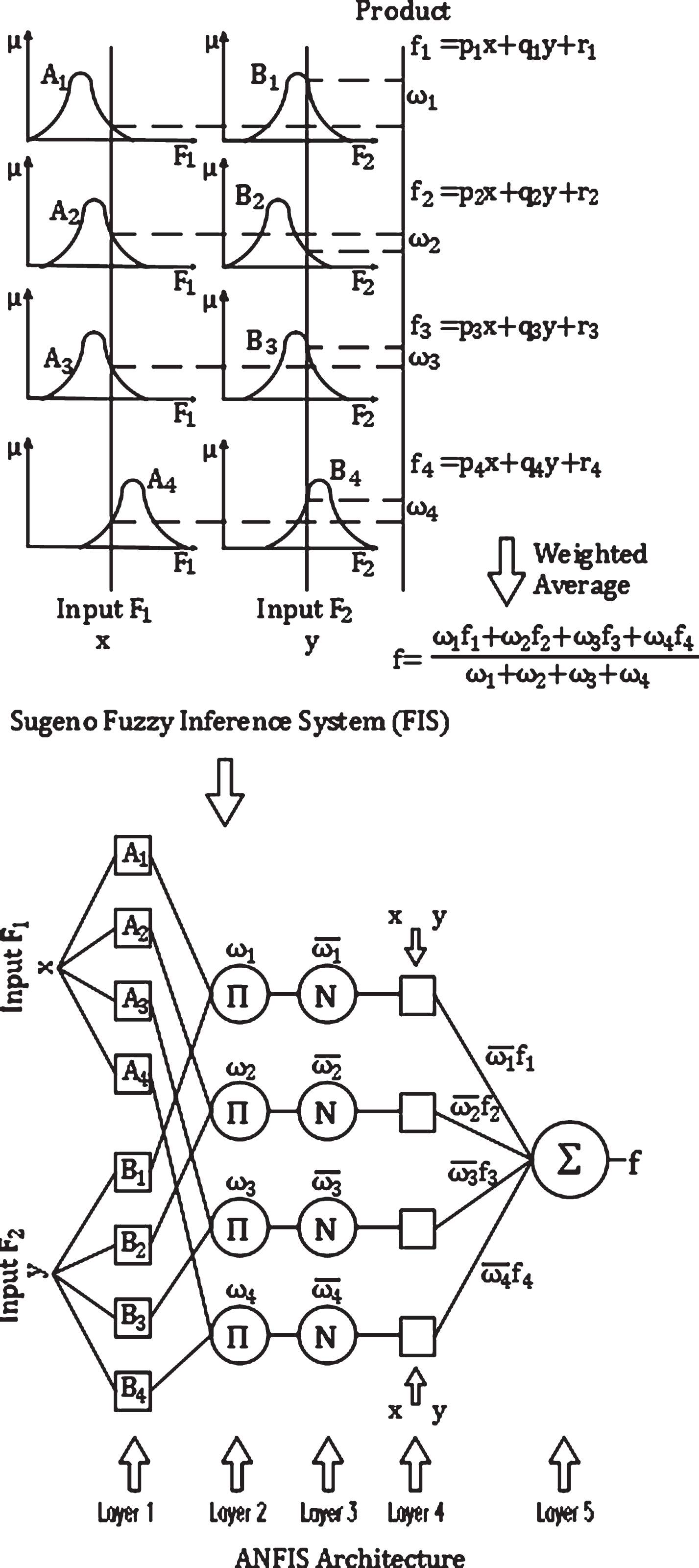
ANFIS Mechanism (Adapted from [10]).
Layer 1: This layer is an input layer and it is where the degree of membership of each construction site factor is calculated from its corresponding Gaussian MF (i.e., μA1(x), ... , μA4(x), μB1(y), ... , μB4(y)) by applying Equation (8), where x
i
corresponds to each input (i.e., a construction site factor), and c
i
and σ
i
are the subtractive clustering parameters resulting from the structure identification process.
Layer 2: This is a product layer represented by ∏ where firing strengths (ω i ) are computed by multiplying (i.e., fuzzy operation t-norm) all membership values that arrive to each node (e.g., ω i = μA1(x) . μB1(y))
Layer 3: This is a normalization layer where each firing strength (ω
i
) is normalized by dividing it by the summation of all firing strengths (e.g.,
Layer 4: This is a layer where the output of each rule is calculated. The consequent parameters, p, q, and r, are estimated for each function (f) by using linear least squares estimation (e.g., f1 = p1x + q1y + r2).
Layer 5: The total output of the fuzzy inference system (f) is computed in this layer by using the weighted average defuzzification method (e.g.,
Lastly, ANFIS model validation is recommended and it should be carried out to test the performance of the resulting Sugeno FIS by comparing predicted and experimental data. In this study, statistics including the correlation coefficient, R-squared value, and standard errors were used for interpreting model performance. One aspect to be taken into consideration is that training data should not be used for model validation; instead, checking or testing data should be applied [31].
FIS for compressive strength effect
The Sugeno fuzzy inference system (FIS) for predicting the concrete compressive strength effect has four inputs—compaction method, mixing time, curing humidity, and curing temperature. The subtractive clustering parameters used to partition the input data were accept ratio (
In addition, two if– then rules determined by clustering were utilized: If (compaction is μcompaction1) and (mixing time is μmixing time1) and (curing humidity is μcuring humidity1) and (curing temperature is μcuring temperature1) then (strength effect is f1) If (compaction is μcompaction2) and (mixing time is μmixing time2) and (curing humidity is μcuring humidity2) and (curing temperature is μcuring temperature2) then (strength effect is f2)
FIS for cost effect
The Sugeno FIS for predicting the cost effect has the three inputs: crew experience, compaction method, and mixing time. The same previous subtractive clustering constants were used for developing the FIS for cost effect, producing the Gaussian parameters for each construction site factor: (1) crew experience: μcrew experience, (2) compaction method: μ compaction , and (3) mixing time: μmixing time.
The Sugeno FIS also has two if– then rules, since only two clusters were identified: If (crew experience is μcrew experience1) and (compaction is μcompaction1) and (mixing time is μmixing time1) then (cost effect is f1) If (crew experience is μcrew experience2) and (compaction is μcompaction2) and (mixing time is μmixing time2) then (cost effect is f2)
FIS for production rate effect
The Sugeno FIS for predicting the production rate effects has the same characteristics (i.e., inputs) as for the previous FIS for predicting cost effect. Gaussian parameters were determined for each: (1) crew experience: μcrew experience, (2) compaction method: μ
compaction
, and (3) mixing time: μmixing time, using the same clustering constants as for strength and cost effects. This Sugeno FIS also has two if– then rules determined by the clustering process: If (crew experience is μcrew experience1) and (compaction is μcompaction1) and (mixing time is μmixing time1) then (production rate effect is f1) If (crew experience is μcrew experience2) and (compaction is μcompaction2) and (mixing time is μmixing time2) then (production rate effect is f2)
All three fuzzy inference systems are valid as long as the input variables vary between the ranges shown in Table 4, since those were the limit values corresponding to the experimental data on which the ANFIS models were based. The crisp output of each FIS was computed by the weighted average defuzzification method as previously mentioned in layer 5 (Fig. 1).
Input data ranges for FISs
Input data ranges for FISs
1 -1 for unexperienced crews and 1 for experienced crews. 2 -1 for manual and 1 for vibrator.
Statistical parameters such as the correlation coefficient, R-squared (R2), root mean squared errors (RMSE), and standard errors (S) allow testing of model performance [15, 33]. Predicted versus experimental data plots were developed for each model by using checking data [31] in order to see how well each final Sugeno FIS would perform. Statistical results indicate that all models had R2 values greater than 93%, which suggests that all FISs were able to fit data for new observations very well. Also, similar low error values for S and RMSE were obtained for each FIS.
Sensitivity analysis
A sensitivity analysis of each model was performed to estimate the effect of construction site factors on concrete compressive strength, cost, and production rates. Monte Carlo simulation and Spearman’s rank correlation were the procedures utilized to identify which factors impacted the outputs the most [32]. Discrete probability distributions were used for categorical variables (i.e., crew experience and compaction method) and uniform probability distributions for numerical variables (i.e., mixing time, curing humidity, and temperature). Table 5 summarizes the results of the sensitivity analyses. Positive Spearman’s correlation coefficients indicate that the output increased as the input also increased, and negative coefficients point out that the output decreased as the inputs increased. The numbers in parentheses represent the rank of each construction site factor, where 1 is the rank for the factor that affected a specific output the most. The results of tornado diagrams are also depicted in Table 5, where the contribution to variance indicates the percentage contribution of each construction site factor on compressive strength, cost, and production rate effects caused by switching a specific input parameter from low level tohigh level.
Sensitivity analysis
Sensitivity analysis
Desired operating conditions refer to those construction site factors existing during concrete fabrication, placement, and curing that tend to preserve concrete compressive strength while avoiding cost increments and reduction in production rates. Such conditions can be identified from each FIS by, for example, plotting response surfaces. Some affecting conditions, including crew experience, mixing time, and compaction method, can actually be controlled when performing concrete operations while others are difficult to manage on the jobsite, since they rely on surrounding conditions such as ambient temperature and relative humidity. Experienced crews are always preferred for concrete fabrication [26], mixing time should ensure uniform and homogeneous mixtures [1], and compaction methods should avoid voids in concrete after placing [8]. Several response surfaces could be explored by keeping constant the previous construction site conditions. For instance, Fig. 2(a) shows the influence of curing temperature and humidity on compressive strength, suggesting that the compressive strength effect is augmented as curing temperature and humidity increase; however, being aware of the consequences of existing conditions would be the real advantage of this supporting tool. A strength effect equaling zero indicates that concrete compressive strength was not affected by construction site factors, and it can be reached by changing controllable construction site conditions accordingly. Fig. 2(b) illustrates the impact of mixing time and compaction method on concrete cost. Compaction method has a slight impact on cost; however, mixing time greatly affects cost. Regarding concrete production, Fig. 2(c) points out that the compaction method does not have an important impact on concrete production; rather, mixing time is the factor that dominates production rates. As can be inferred, many other potential scenarios may be investigated to find desired operating conditions.
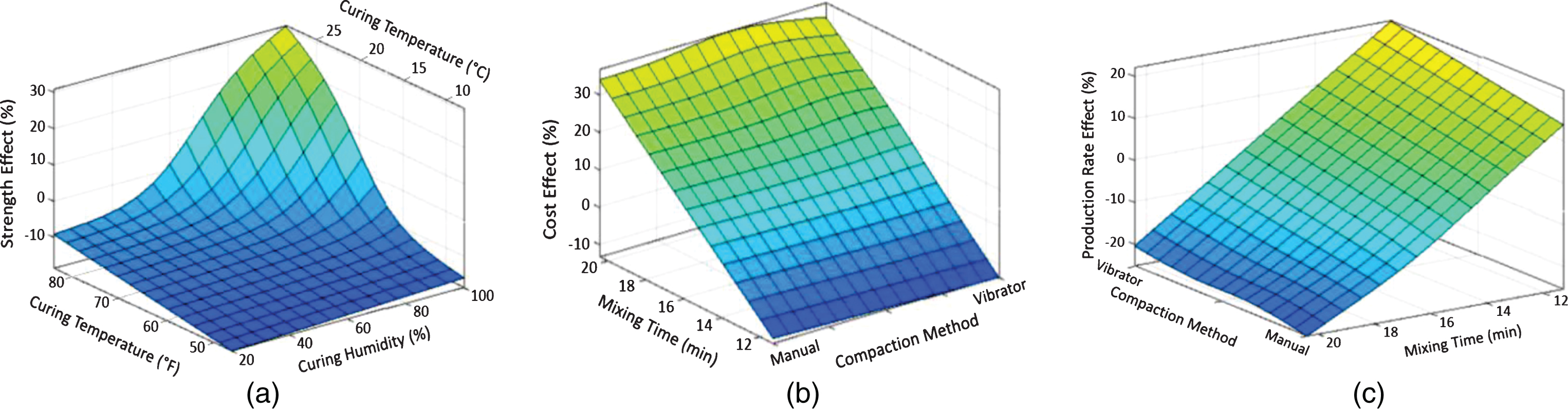
Response surface for: (a) strength effect (vibrator and 15 min of mixing time), (b) cost effect (experienced crews), and (c) production rate effect (experienced crews).
Finding optimal operating conditions for preserving concrete compressive strength without increasing fabrication costs and while maximizing productivity should be considered for future studies through the examination of multi-objective optimization techniques. The main premise could consist of preserving concrete compressive strength; however, minimizing production costs and maximizing production rates should also be taken into consideration for problem formulation. Also, conducting different experiments by using center points and additional variable boundaries should be explored.
Conclusions
Sugeno-type fuzzy inference systems perform well when quantifying the effect of construction site factors on concrete compressive strength, cost, and production rates. Three FISs were created to accomplish this research goal based on experimental I/O data. A structure identification process was performed by using a subtractive clustering method, and a parameter identification process was completed through ANFIS, resulting in a Sugeno-type FIS. When using recommended values for subtractive clustering, 16, 8 and 8 membership functions (MFs) were identified for each FIS respectively at first; however, only two MFs for each FIS were found to be necessary to map input data, since MFs mapping low values and MFs mapping high values were similar to each other. In other words, there was no improvement in the errors when considering more than two MFs. For this reason, only two MFs were used in each FIS by using a radius of influence (r a ) of 0.95 and a squash factor (η) of 4. The lower the number of if-then rules, the lower the computational cost. Furthermore, all Sugeno-type FISs have correlation coefficients (R2) greater than 93%, indicating that models can predict new observations very well. Errors (S and RMSE) range from approximately 4.3 to 5.3 for all fuzzy models, which are relatively low when using checking data.
To evaluate the effect of construction site factors (i.e., unstructured factors) on concrete compressive strength, cost, and production rates, sensitivity analyses were conducted by using a random sampling method (Monte Carlo simulation) combined with a rank correlation method (Spearman’s rank coefficients). The sensitivity analyses indicated that curing temperature dominates concrete compressive strength effect while curing humidity is the second most influential factor. Strength effect increased by 44.2%, 28.2%, and 2.6% as curing temperature, curing humidity, and mixing time increased respectively from low level to high ranges (Table 4). In terms of concrete cost, mixing time is the most influential condition. Cost effect increased (83.4%) as mixing time increased from low level to high level, suggesting that the more mixing time, the more expensive concrete becomes. In contrast, concrete cost was reduced by 3.3% when switching from manual compaction to vibrator compaction and by 10.3% when switching from not experienced crews to experienced crews. Regarding concrete production rates, production rate effect decreased (71.8%) as mixing time increased from low to high values, which was expected, since production rates are reduced when production time increases. Concrete productivity improved by 13.6% when switching from not experienced crews to experienced crews and by 13.2% when selecting vibrators as a compaction method instead of manual tamping rods.
The FISs developed as part of this study are supporting tools that provide concrete laborers and technicians with information to make them aware of potential impacts on concrete compressive strength, cost, and production rates caused by the construction site factors studied: crew experience, compaction method, mixing time, curing humidity, and curing temperature. Developed FISs allow construction workers not only to identify desired operating conditions but also to explore other possible on site conditions in advance, facilitating decision makers to take preventive actions in time. Several response surfaces (see Fig. 2) could be created, depending on each case and when required for each prediction model, by considering two input variables and keeping the others set at constant levels. Maximum and minimum zones can be inferred from response surfaces, helping find conditions that will stimulate compressive strength or increase concrete productivity at low cost. Fig. 2, for instance, allows us to recognize operating conditions where concrete strength, cost, and production are not being affected by construction site factors (i.e., effects equal to zero). Therefore, being aware of potential adverse conditions for concrete fabrication gives a tremendous advantage that can help a project be completed on time and under budget.