



Abstract
Virtual reality emerged as an interactive, dynamic and dynamic technology in the early 1980 s. recently, with the introduction of advanced digital (DT) concept and its application in space, it has great advantages in information integration. virtual integration, real-time dynamic optimization decision-making and so on are helpful to solve these problems. means making full use of physical models and data (product design data, historical run data, service recovery data, etc.) to accomplish tasks. Replicating physical space in virtual space and applying virtual reality and digital mirror image to the production of digital media can help news integrate all content, display the whole process, avoid problems, close circuits, optimize repeated operations, Make dynamic decisions in real time. The goal is to realize the interaction and integration between the real world environment and the virtual space of the digital environment in order to realize the harmony between the virtual real space in the whole life cycle.
Introduction
Virtual reality emerged in the early 1880 s as an interactive, dynamic and selective technology. Its application to news communication has made the traditional information industry leap forward in quality and promoted the modernization of traditional media. it has reformed–virtual reality through new means and methods of communication, production, communication, marketing, etc. This technology not only creates virtual scenes, but also creates virtual singers, such as virtual hosts and so on. Virtual reality creates a virtual space through sound, image, touch and so on, which can be built from a specific reality. Virtual reality can provide new opportunities for the development of information industry. Users may be in virtual space and have close or even identical feelings of reality at the same time, in this simulation space, users can experience the experience, they can not first-hand experience in the real world without time constraints, space and other conditions. Information technology provides a technical tool for the information industry to replicate information and can provide new insights into the reform of traditional means of communication. The application of virtual reality in news has the advantages of improving visibility, improving public experience, expanding information dissemination and improving information quality news. Because of its own technical characteristics, virtual reality can better display the authenticity and visibility of news, visually transmit news scenes that could not be displayed to the public before, and provide this dynamic and interactive news.
Recently, with the introduction of advanced digital twinning (DT) concept and its great advantages in information integration, virtual integration, real-time dynamic optimization decision making and so on, they have helped solve these problems. Digital twinning means making full use of physical models and data (product design data, historical running data, service recovery data, etc.) to complete the replication of physical space in virtual space in order to track the whole life cycle. Applying virtual reality and digital mirror image to digital media production can help news integrate all content, make the whole process visual, avoid problems, turn off circuit, optimize iterative function, make real-time dynamic decision and so on. The goal is to realize the interaction and integration between the real world environment and the virtual space of the digital environment in order to realize the harmony between the virtual real space in the whole life cycle.
Related work
Literature [1] proposed virtual reality technology is helpful to improve the description of reality in Literatureary, and through the overlap of detailed information in practical aspects, the audience can understand the background of Literatureary more directly. Literature [2] introduces the use of virtual reality in news shows that with the development of new media, the application of virtual reality, such as the application of virtual technology, virtual research and so on, will become more and more extensive. Literature [3] Compared with news games and interactive online games, and based on the concept of “underground journalism” adopted, it is pointed out that virtual reality reduces the number of news, which enables users to enter the real virtual world. And make the public feel the authenticity of news more directly. Literature [4] studies the new media “Hungry Los Angeles “, the new means of communication, is a typical example, it combines virtual reality and news, so that the audience can enter the virtual three-dimensional environment through three-dimensional instruments, thus creating a” immersion “. Literature [5] suggests that virtual reality has become one of the most effective ways for modern media to spread information. He points out that the development of virtual reality will change the way modern media disseminate information. Literature [6] proposes that the process of copying information is to create situations through language and influence. copying is a process of expression through language, language, and images, and adds three theories about copying information: the meaning of the idea of copying lies in the expression of the outside world, the meaning of the recurring ideas in the author’s intention, and the meaning of the recurring ideas in human construction.
Literature [7] suggests that the concept of digital twinning is to create virtual digital models that express physical entities abstractly, and then he points out that digital twinning has the opportunity to design, test, manufacture, and use systems in a virtual environment before it is actually produced, thereby reducing problems or other failures. The deployment and use of complex digital twinning of unexpected emergencies in physical systems has attracted wide attention as an important means to solve the problem of interactive integration in the information physics world.[8] literature suggests that the use of digital twinning to combine actual physical data with analog models can provide good prediction and enable production systems and production units to respond automatically to interference, thereby increasing modulation. Connectivity and autonomy of manufacturing systems.[9] literature, it is proposed that the digital twin reference model should be flexible, extensible, interoperable and authentic, and the reference model can be transformed in the life cycle of the product by merging, decomposing and evaluating four main operations. literature [10] a combination of two methods, the virtual test platform and two digital twinning, resulting in a novel experimental digital twinning, which greatly reduces the workload associated with the use of imitation technology throughout the life cycle of complex technology systems.
Literature [11] suggests that in the 2015 presidential election of the United States of America, CNN used virtual realism technology to broadcast the debate on the presidential campaign live, and the public must build its own virtual realism in addition to the existence of CNN to provide a 180-degree live perspective. The literature [12] suggests that virtual reality is part of news coverage, mainly in a variety of forms of news coverage, in which virtual reality is an aspect of different levels of news coverage to raise public awareness, for example, in the 2014 edition entitled “The Harvest of Change “, and in the New York Times Displacement, virtual reality is news, in part to draw public attention to news an analysis of the re-emergence of images in television shows shows shows that this is a form of news broadcasting that helps to increase the visibility and attractiveness of programmes, but is fact-based, The creator must remain faithful to the facts [13].
“The application of virtual reality in the field of information has also attracted the attention of our academic community, and based on extensive research on cases of the application of virtual reality technology abroad, our information department has begun to learn from these cases and apply virtual reality technology to information and communication technology. The use of media in foreign communications has also prompted our scholars to study the combination of virtual reality and public information, the most popular myths in the Republic, the study of virtual reality by foreign researchers, and the impact of virtual reality dissemination by relying on real news or Literatureary programs, mainly because foreign virtual reality producers are mostly large technology companies or media companies. Experts regularly produce virtual news about the actual situation of the production process, which shows the contribution of this combination of business and academia.
Construction of simulation scene model based on virtual reality technology and digital twinning technology
Digital twinning, as the name implies, refers to an object in the physical world, using digital technology to build a virtual model exactly the same as the physical world, in order to achieve the understanding, analysis and optimization of physical objects. At first, Grieves professor at the University of Michigan defined digital twinning as an “information reflection model” and later became the specific term for digital twinning. Digital twinning technology is developed using very low frequency model technology. In these enterprises, a large number of digital models have been accumulated for the development of industrial products, and digital twinning technology has also been developed. In 2012, NASA gave a more in-depth and professional conceptual description of digital twinning technology. this includes maximizing the use of a range of data such as physical models, sensor signals, device running history, etc. to simulate multi-angle, interdisciplinary simulations that are used as virtual models of images of objects in the physical world and reflect physical objects. complete digital twinning is a technical tool consisting of models, data, and intelligence, oriented to the entire cycle of the product, serving as a bridge between the physical world and virtual space, providing real-time, efficient, and controlled services. Digital twinning is technology, process and method, is object, model and data.
According to the latest theory, the study of digital twinning should focus on models and data, which can be divided into five levels of structural models, including physical objects, virtual models, connections, data systems and services, see Fig. 1 for details.
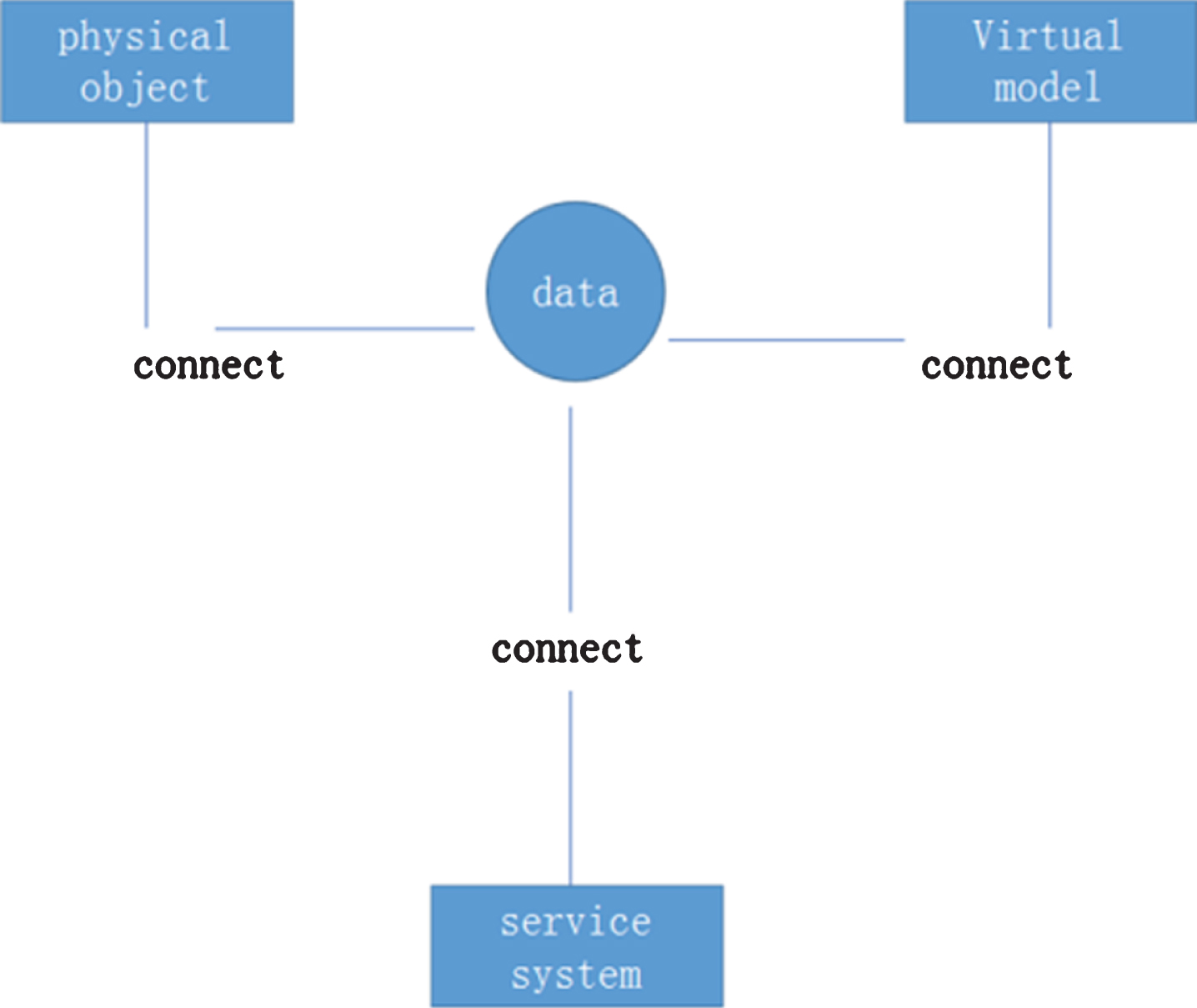
Digital Twin Five-dimensional Structure Model.
According to the digital five-dimensional structure model, the practical application of digital two-dimensional technology is to analyze a series of characteristics of physical objects, to establish virtual models according to these characteristics, and to interact with data in two virtual spaces. by connection and data analysis.
With regard to the modeling of twin digital spaces, there is no uniform method for establishing such spaces, and there is not enough detailed implementation measures and standardized implementation mode support. a space-oriented bilingual qualitative digital model is established as a model for the implementation of 3d imaging space applications on the basis of digital twinning. this paper discusses the specific simulation processes and methods of each of the three components.
In order to establish a digital twin space and physical space, the core is to realize the interconnection of spatial physical devices and the real-time transmission of data. The key to interoperability of equipment is to develop standardized information models based on standard protocols, formats and languages that describe all spatial information so that: information can be freely circulated and shared on the Internet. The basis of spatial information model is the modeling of spatial “artificial environment” resource information, which is the abstract expression of spatial resources. All spatial entities and their relationships are manufactured and described by unified conception or description language.
OPCUTA users can access the information provided by the server by managing the space, which consists of one or more nodes, as shown in Fig. 2, which are obtained by encapsulating the actual physical object by using the space object model. Connection between Opcuta. La nodes depends on the reference management space is a network of nodes composed of interconnected nodes through which all data exchange information is expressed, see Fig. 2 for details.

OPCUA Address space.
Nodes include attributes that illustrate the attributes of node data. customers can obtain attributes by reading, writing, querying, and subscribing services and are referenced to contact other nodes, such as source nodes, target nodes, reference types, specified unique reference addresses, which can be understood as pointing to another indicator. OPCUTA includes eight types of nodes, Fig. 3 lists the eight node types and the common characteristics of these nodes. the required features include node identification, type, navigation name, name description, and the other three are optional, where the node tag is used to display the unique identity of the node, see Fig. 3 for details. Nodes on the server and nodes on other servers can be queried by server name and node identity.
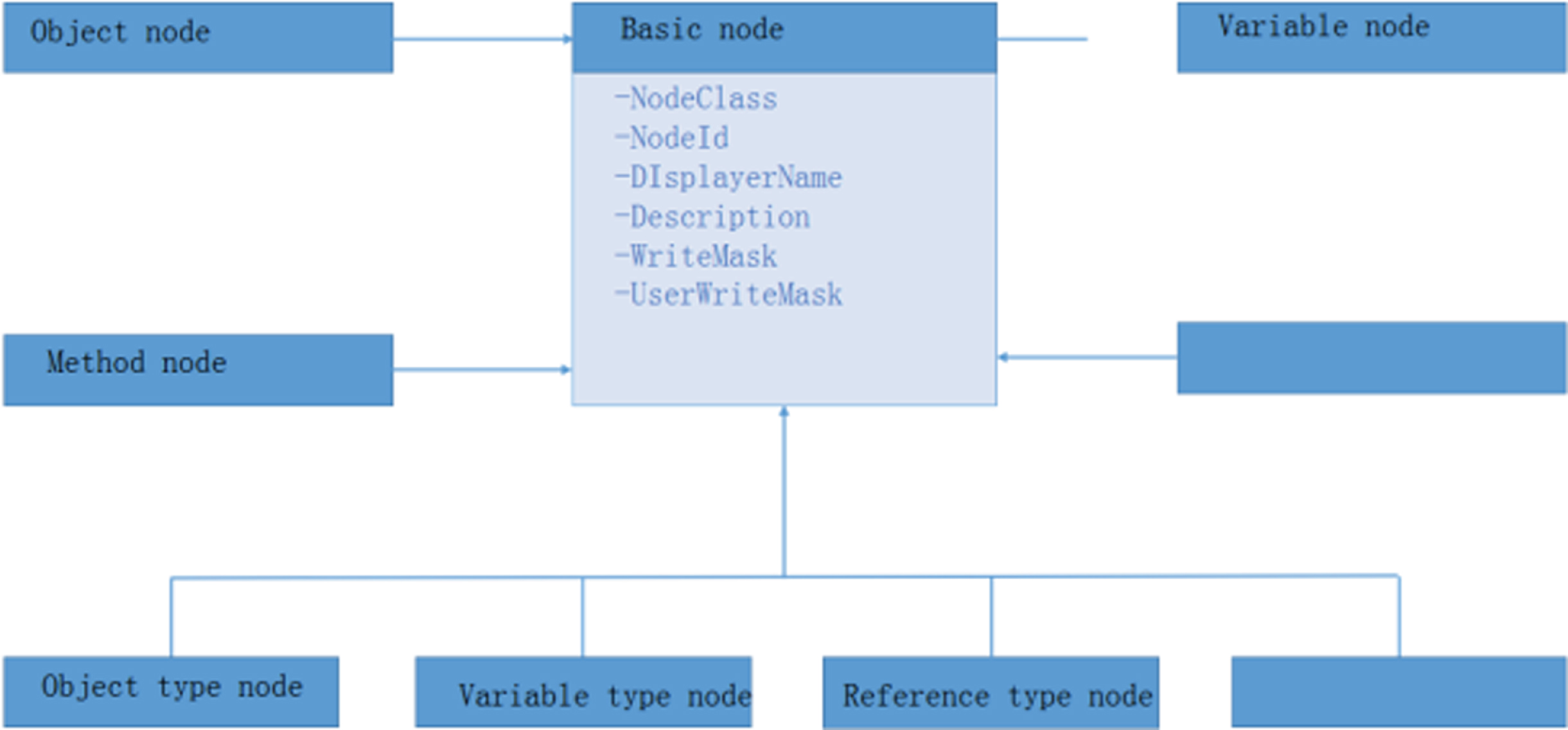
Node types and generic attributes.
The objective of land-use change and forestry (LUCF) is to present data and activities of the underlying system in a land-use, land-use change and forestry-based approach. objectives: instances are from objects, variables, methods, object type nodes, variable type nodes, and method type nodes, respectively. they can manage object information by OPCUTA services, for example by reading variable values.
The method node is the result node, which can be called return. A method is part of an object and must therefore belong to a particular object or object type and be used to refer to Hascomponent type.
In digital cufflinks, the data engine realizes real-time dynamic consistency between physical objects and virtual models by OPCUTA data acquisition (data), data transmission (data used to start the corresponding model in virtual space), which makes the model in the same real-time state as reality. In virtual space, or using historical data to reset the working state at a certain time in the news scene, that is, the principle of data transmission, see Fig. 4 for details.

Data-driven principle.
3D visual modeling flow based on virtual reality
As shown in Fig. 5, these include the following steps:
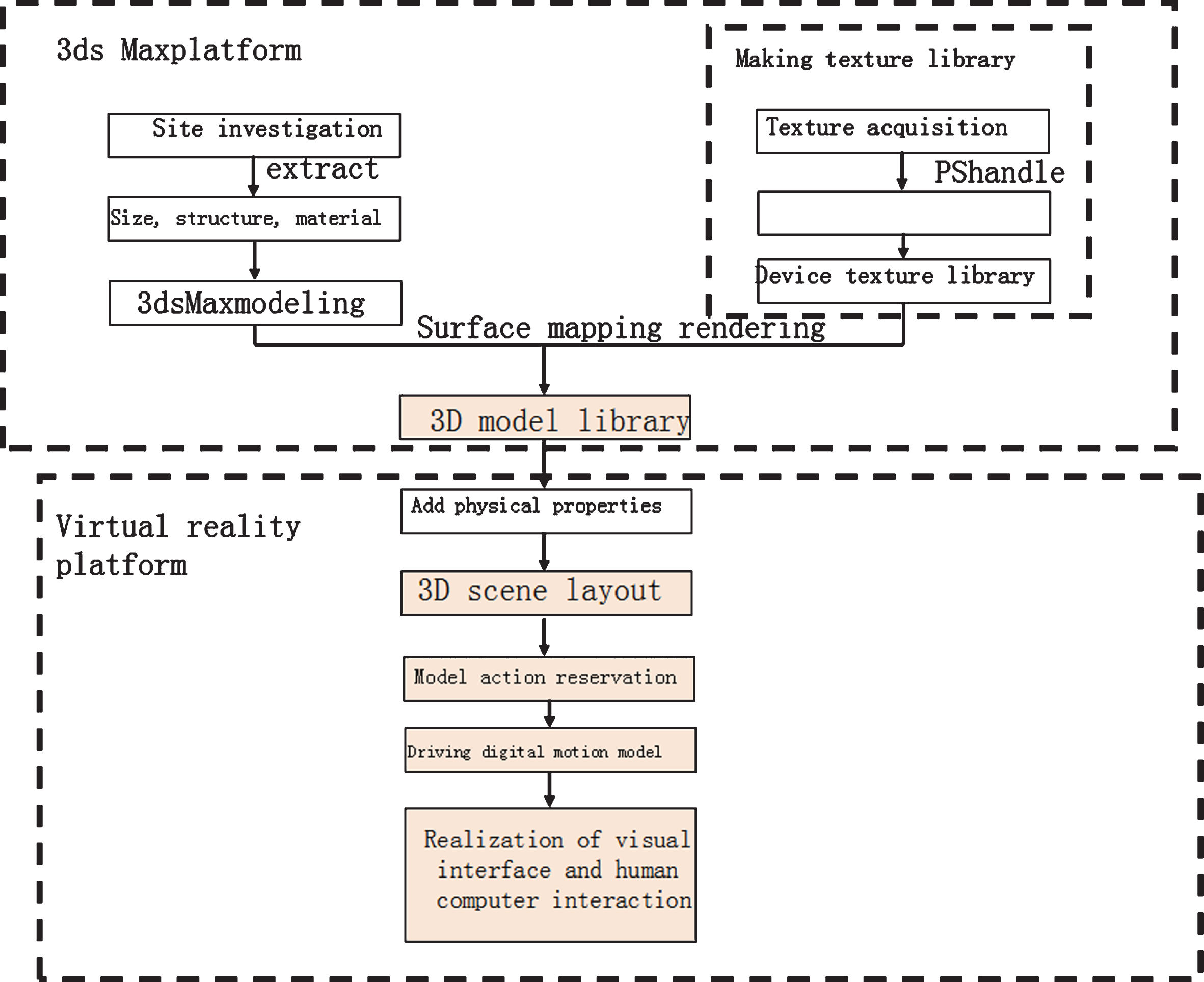
Spatial 3D Visualization Modeling Flowchart.
As can be seen from Fig. 5 above. Establishment of field spatial topography, extraction of material size, structure and characteristics, 3 modeling DSMAX three dimensions of the platform, plus texture imaging of the equipment, optimization of image processing by means of: cutting using PS (Photoshop), mapping maps, etc., drawing surface maps of the model, in order to arrive at a 3D model, all of which require modelling equipment in order to establish a 3D spatial model basis. Three-dimensional space imaging space. the 3d spatial model is introduced into the virtual reality platform, which increases the physical properties such as impactor, friction, endurance, gravity and so on, so that it is more realistic to configure the device in the physical entity simulation under a unified coordinate system to obtain a 3d scene map. Physical space objects include static objects (e.g. bookshelves, solid storage) and moving objects (e.g. conveyor belts, robots, accumulators), which are static objects corresponding to virtual static models. moving objects related to dynamic virtual models, spatial manufacturing process analysis, acquisition of spatial moving objects, and virtual dynamic models (such as conveyor belts, robots) that need to move the behavior characteristics of objects, robots capture, place, store, etc. and use tools to predict their behavior, whose effects are the same as those of physical space. The script code of the operational virtual reality platform for digital movement patterns and its connection to models that require control in order to control the movement of the model, acquire manageable digital movement models and prepare for subsequent real-time data-driven movement of the spatial virtual model. Displaying the UAV visual interface with the user interface includes, in addition to the spatial visualizations established through previous phases, visual displays of other spatial information (e.g. orders, environmental data, production speed, etc). At the same time, through the virtual reality platform, the interaction between UAVs, for example, the first person perspective, the third person perspective, the control command button changes the perspective and so on.
3d graphics transformation is the basis of computer drawing for the movement of the model, that is, through the transformation and rotation of the 3d model, to obtain a new position or a new 3d model. it is mainly developed by the script code driven by the 3d model 3d graphics conversion. it is required to include the 3d graphics conversion method.
Comprehensive coordinates represent the original N + 1 dimension vector.
A four-dimensional matrix M consists of four-part matrices, in which:
Represents the perspectiv he perspective projection of three-dimensional graphics.
Represents the translat e translation of three-dimensional graphics.
Represe matrix, representing the overall scaling of three-dimensional graphics. Therefore, by means of a four-dimensional transformation matrix M, the model coordinates can be A from the initial point positioniGo to A new locationj3D transformation, the most used in 3D transformation is translation, scaling, rotation these three, A.3j In three cases, the new matrices are as follows:
Translation:
Proportional transformation:
Rotation transformation: the three-dimensional model rotates around th the z coordinates remain unchanged. And the x,y coordinates can be obtained by the formula of two-dimensional coordinates rotating around the origin:
By rotating the X axis
n these th l foundati lated ording to the specific situation, and then realized by the script control model of the virtual reality platform.
Finite state machine is a discrete mathematical model used to study finite states. these transfer and movement behaviors are a common technique in the field of decision making. this paper uses it to change the performance state of a dynamic model. first, to keep the finite state of the dynamic model, the 3d model is transferred from one morphology to another when the relevant information arrives.
In this paper, the term finite state automatically used to make behavioral decisions creates a dynamic three-dimensional model that:
For each dynami ately on the virtual reality platform according to the graph conversion theory, and the limited state, connection state and entry condition are realized on the platform. And prepare for the engine from the back of the real-time data.
Linear LSTSVM
A linear TWSVM is replaced by a least square and an inequality constraint is replaced by an equality constraint:
ω in formula 14(1)b; and(1)At the same ti tion is equal to zero, and can be obtained:
For better ω solutions(1)b; and(1)In the form of a matrix:
rmed into the inve oblem of two matrices
With regard to the nonlinear separability problem of LSTWSVM, the kernel function is introduced K, which transforms the linear separability problem of low dimensional space into the linear separability problem of high dimensional space. The corresponding classification hyperplane is:
If the inequality constraint is replaced by the equality constra he objective function, the convex quadratic programming problem can be:
As with linear LSTWSVM, the nonlinear classification pros.
Establishment of communication effectiveness evaluation criteria
The effectiveness of information dissemination is the goal of public information activities, so it is necessary to check whether the objectives of communication activities have been achieved. Because various modern communication methods and means are intertwined, the effectiveness of information is comprehensively analyzed and evaluated. Evaluate its impact on the dissemination of information, determine whether it meets the goals desired by the communicator, evaluate its impact, and assess three aspects of professionalism, communication and news impact: The main focus of professional evaluation is the accuracy and subjectivity of evaluation. Authenticity refers to the objective authenticity of facts, the existence of subjective, fabricated situations and so on. In fact, the view includes the image of news, sound, experience, etc., whether the real evaluation of the image, sound effect and image combination, whether the expression of special influence can improve the public’s sense of experience and achieve the “live” effect? Broadcasting capacity: communication capacity is an important indicator for assessing the impact of information dissemination, including the scope and effectiveness of communication, i.e. the number of broadcasts (visits) and the number of news reports that can not be statistically measured due to the limitations and technical level of the communication platform. The effectiveness of communication is primarily determined by assessing the recipient’s acceptance by assessing the main direction, including the user’s acceptance of form and value. Impact includes the impact and dissemination of information, including the public’s rational views and feelings about events, in particular the audience’s ability to react after experience, to understand the entire information process, to understand the dangers of the information environment and the harsh conditions of the information environment. Work guidance includes the ability of the public to continuously pay attention to information related to post-event events, to maintain the popularity of news, and to keep the public informed of news hotspots at any time.
Establishment of assessment indicators
The influence of information dissemination can be divided into three levels according to the logical order in which it is produced: the level of cognition and intuition, the level of perception and experience, the level of action and the quality of information dissemination. Table 1 lists three levels of evaluation index systems. effectiveness of mock news footage produced according to the scoring criteria of the heart information quality test assessment method and the three specific guidelines of professionalism, communication and impact assessment, as well as consultations and suggestions of relevant experts. See Table 1 for details:
Evaluation indicator system
Evaluation indicator system
In the evaluation index system, the effect of news simulation scene communication is evaluated from the perspective of cognition, cognition and behavior, as follows:
Cognitive effect is mainly measured by the public’s understanding of news information in simulated scene communication. Mainly by evaluating the authenticity of information and subjective news. The basic competitiveness of news lies in the professionalism, authority and authenticity of its content, that is, to examine its professionalism from the public point of view and to measure its professionalism from the public point of view, not only from the point of view of public understanding and satisfaction with information, but also from the perspective of visual quality of information, that is, from the perspective of the public sector. The display of each part of the media scene is measured from the perspective of the reproduction of the scene.
The influence of these concepts is mainly to measure the public’s feeling and value of news information by evaluating the public’s acceptance and active access to information in the context of simulated scene communication. It is the dissemination of social values, giving priority to social welfare and fulfilling the task of disseminating information. Therefore, the assessment of the impact of ideas focuses on new ways for recipients to receive information, active access to relevant information, understanding and the author’s intention and recognition of the values advocated by information.
The impact of behavior is measured mainly by real-time virtual news reports on the impact of communication news on the public, its impact and orientation on the public, its perception and conceptual impact, its information orientation, the impact of information measured by public feedback and continuous attention, public comments and participation programmes, and the direction of major concerns: whether the public will maintain the heat of information and disseminate it again.
According to the design of the evaluation index system, the computer and virtual reality simulation scenarios are tested, and the effectiveness of the information is evaluated from the public point of view, and the evaluation is divided into each index. The effectiveness of simulation information dissemination is calculated according to the relevant evaluation values and scales.
According to the ThomasL. Saaty analytic hierarchy process, the judgment matrix is constructed, and each index in the evaluation index is compared. score using levels 1-9 : 1 indicates that two elements are of the same importance, 3 indicates that one element is slightly more important than the other, 5 indicates that one element is significantly more important than the other, 7 indicates that one element is strongly important than the other, 9 indicates that one element is extremely important than the other, and 2,4,6,8 is in the middle of the above judgment. Synthesizing the opinions of each expert on the weight proportion, the weight of the evaluation of the propagation effect of the simulation scene is determined, and the judgment matrix is shown in Table 2.
Evaluation indicator judgement matrix
Evaluation indicator judgement matrix
The judgment matrix is reduced to:
The matrix weight calculation of the judgment matrix is shown in Table 3.
Weight calculation table of the judgment matr
Through the above methods, the weights of the first grade index, the second grade index and the third grade index are calculated respectively, and the weight table of the evaluation index system is summarized and sorted out, as shown in Table 4.
Evaluation indicator system weights
According to the weights of the above indicators and the communication impact indicators, the impact of communication is evaluated in the simulation case on the basis of a phased evaluation, first of all, three levels of indicators. Next is the third level index and the related secondary index weighted corresponding secondary index, plus the second level index the first level index weighting and final score.
The corresponding formula is:
The n, is:
Evaluation value of two-level index = ∑×three-level index value three-level index weight;
First class index evaluation value = ∑×second class index value second class index weight;
Comprehensive evaluation value = ∑×first class index value first class index weight.
Ten evaluators, including five television reporters and the public in other departments, were randomly invited to evaluate the effectiveness of the media on a stage. The five TV reporters included a deputy editor (chief of the interview department). three journalists and a senior producer in the production department, and the remaining five interviewees. Choosing this type of evaluator can objectively evaluate the design and efficiency of news professional knowledge, on the one hand, and the quality of news professional knowledge on the other hand. From the point of view of news production, the advantages and disadvantages of this design in the process of news production are analyzed from a professional point of view, in which the characteristics of information and the use of technology are quite large. The effect of this design is very obvious.
Based on the evaluation data of ten evaluators, the final evaluation results of each evaluator are shown in Table 5.
A final assessment of the effect of a simulated scene
A final assessment of the effect of a simulated scene
By calculating the average of the final evaluation results of ten evaluators, it can be concluded that the evaluation result of the propagation effect of the simulation scene is 8.25, and the propagation effect is excellent.
Interviews and ratings by evaluators show that websites using virtual realism and data replication techniques have considerable advantages over traditional newspaper reports.
First, using virtual reality to play news scenes, rather than traditional news reports, makes the news images that can not be provided because of objective conditions can be displayed to the public, thus breaking the uniqueness of these latest news models.
Second, in the process of news production, virtual realism technology is used to copy the news scene of the Department of Public Information. this traditional news production program is to collect information on selected topics ——interviews, drafting press releases, fact sheets, video material (this is the television news process), making news videos using non-linear editing software (this is the television news process), publishing (broadcasting) and making news scenes using virtual realism technology to obtain materials on topic selection ——design and programming ——collecting interview materials and related materials ——making simulation scenes ——uploading to the platform and operation related. The necessity of simulating scenarios has done a lot of work in previous interviews and the collection of relevant information materials. Although the workload has increased, the submission of all information materials has been more comprehensive and objective, and the accuracy of information has been further improved.
Finally, through the application of virtual reality, the design not only improves the visual aspects of news reports, but also increases the number of news reports and the participation of users through interactive design: through the knowledge link module, the content of news reports is increased. The background of this information activity and other relevant materials are presented to enable users to selectively obtain information as needed; the first personal module is added to enable users to understand freely and enhance autonomy. Adding special effects of different sounds to enable the dissemination of reality and environmental pressures in the field; and adding trigger units for event exploration to enable users to participate in new activities. Through this interactive design, it creates a powerful environment for the public to “I am on the scene” and greatly improves the experience of users.
Conclusions
With the development of virtual reality technology, various applications are also increasing. In the field of digital media information, using virtual realism technology, news can be reported through animation, hiking and new interactions, not only to introduce all kinds of events in a comprehensive way, but also to improve the experience of the public, and to improve the efficiency of communication through data links, interactions and collisions with special effects on images. According to the discussion in this paper, they design and carry out news simulation based on virtual reality technology and data technology, evaluate the effectiveness of communication, and draw the following conclusions:
Using virtual reality technology to report events, the design of this technology accords with the traditional media news production design principles, such as content selection and audience location principle, as well as the actual reduction of news content, and pays full attention to the characteristics of virtual reality. It is based on three design principles: free choice of press releases and press scenes. The original principle of relative integrity, live reporting of news, it strengthens the interactivity and depth of virtual reality.
The production process of virtual reality is very different from that of traditional news. It is based on three production principles, that is, expanding the scope of data collection, providing news materials for exploratory exhibitions, and providing news reports for controlling key points. Make news reports more realistic. Simulates the scene, increases the replication effect, enhances the user’s experience, increases the news dissemination influence.
Virtual reality technology replicates the news, enabling it not only to be fully re-available to the public, but also to improve the efficiency of communication through improved public experience and data connectivity. The interaction and special influence of sound images: with the continuous development and renewal of technology, virtual reality has become an important dependent factor in the development of media knowledge and numbers. The application of virtual reality technology in the media industry will become more mature, wider and deeper.
Footnotes
Acknowledgments
Project of the Review Committee on Social Science Achievements Project in 2019 of Hunan Province, China, Project approval No. XSP19YBC004.