



Abstract
Public art communication in colleges and universities needs to be launched with the support of artificial intelligence systems. According to the current situation of public art communication in colleges and universities, this paper builds a smart cloud platform for public art communication in colleges and universities with the support of artificial intelligence algorithms. Moreover, this paper introduces the bandwidth offset coefficient to judge the change of network throughput, introduces the slice download rate difference to first judge the consistency change trend of bandwidth, and then further proposes the calculation method of bandwidth prediction value by situation. In addition, this paper proposes a flexible transmission mechanism based on smart collaborative networks. Through in-depth perception of network status and component behavior, this mechanism implements the selection of the optimal path in the network according to the current network status and user service requirements to complete the transmission of service resources. If the current transmission path fails, the mechanism should ensure the continuity and reliability of the service. The research results show that the system constructed in this paper has good performance and can be applied to practice.
Introduction
In colleges and universities, as the fresh blood in this society, the future of college students affects the future of the whole society to a certain extent. At this time, art education needs to make these fresh bloods have the ability to feel beauty, experience beauty, appreciate beauty, and create beauty, so that they understand that art is not inscrutable, it has inextricably linked with our survival and the entire human society. This plays an important role in improving college students’ cultural heritage, knowledge-seeking ability, way of looking at the world, gaining perception and pursuit of truth, kindness, and beauty [1].
Contemporary public art design has gradually become an important way of constructing a diverse public culture and disseminating public information in contemporary cities, and it is also a carrier of urban information. At the same time, it is also a communication platform that conveys the cultural ideas and value orientations of different communities. In addition, the political, economic, historical, and cultural information presented by public art design works has certain educational functions and educational significance for the public. Therefore, the interdisciplinary research in the field of cultural communication and public art design has theoretical significance and practical guidance significance for the development of the city and should arouse everyone’s attention and discussion. At present, we live in an information age, and any objects around us can bring us different kinds of information. The public art design works that exist in the public spaces of the city convey the relevant information of the city to people from all over the world and all ethnic groups all the time. Our initial understanding of a city is to label a city through its appearance, that is, through construction, geographical environment, cultural environment, and construction of public places. The existence of public art design is the carrier of people’s initial understanding of a city’s culture and spirit. Because of its own characteristics of publicity and publicity, public art has an indisputable function of disseminating information [2].The main research content of communication is the information meaning of various symbols of language and words; people’s communication behavior and its mode; the process and channel of communication; the effect and role of communication; the interaction between the transmitter and the receiver. Public art design exists in the public space of the city in the form of works of art. Its cultural communication function has a profound and lasting impact on society and the public, so it is also suitable for research from the perspective of art communication. Therefore, understanding the communication function of public art design, grasping the cultural communication content of public art design, and exploring the educational role of public art design cultural communication can prompt the solution of the problems existing in public art design in urban space today, promote the development of public art undertakings, and enhance the role and influence of historical value, aesthetic value, and cultural value. Moreover, it is also useful for studying the relationship between art communication and political economy and social culture [3].
Related work
The literature [4] put forward the idea of smart cloud platform, but it only put forward the concept of wisdom, and established a company to promote the application of smart cloud platform concept. The smart cloud platform code is an ideal solution for the application of a large amount of data to ensure the reliability while broadcasting. However, the design plan was not actually given. In the early days after the concept of the smart cloud platform was proposed, no suitable coding scheme with practical value was found, but this idea has aroused the interest of researchers from various countries, including the attention of some institutions and units. The literature [5] bring the LT code into everyone’s field of vision. As the original fountain code, the LT code provides a basis for the subsequent development of the fountain code. The code rate of the LT code is not fixed and belongs to a rateless code. The code rate of the LT code is not fixed and belongs to a rateless code. The LT code generates a coding package by selecting a suitable degree distribution to add the original information bits by modulo two, which takes a solid step from the theoretical development of the smart cloud platform code to practical application [6].Aiming at the problem that traditional LT codes cannot realize linear time coding and decoding, literature [7] found that precoding before LT coding can reduce the decoding time. Moreover, it improved the LT code and proposed another smart cloud platform code with better performance, namely the Raptor code. In 2010, Qualcomm promoted a fountain code RaptorQ with better performance, and in 2011 this RaptorQ technology was incorporated into the standard RFC6330 [8].The literature [9] put forward the requirements for degree selection. The idea of LT codes with limited randomness is mentioned in the literature [10], which restricts the selection of the original information in the coding package and simplifies the entire coding and decoding process. In the coding method, the literature [11] proposed a special fountain code mapped by chaotic sequence. At the encoding end, it used the characteristics of the chaotic sequence to construct a special degree distribution to improve the performance of the fountain code and has achieved good results. The literature [12] analyzed the selection of degrees and the recursive formula for the probability of successful decoding and made the coding process more concise. The literature [13] proposed to improve the performance of fountain codes by deleting the short-loop case in the generator matrix. The degree distribution is improved in [14].
The literature [15] proposed a maximum likelihood decoding algorithm. Although this decoding algorithm improves the decoding performance and reduces the probability of decoding failure, it increases the decoding complexity. The literature [16] proposed an important decoding method, that is, decoding the matrix by Gaussian elimination method, which can shorten the decoding time and ensure the success rate of the fountain code decoding. The literature [17] used the correlation column extraction method to eliminate the short quaternary ring in the matrix. After testing, it was found that the decoding performance of the fountain code can be improved, and the probability of successful decoding can be increased. By studying the ripple set, the literature [18] found that by reducing the number of ripple sets, unnecessary overhead can be reduced and the decoding performance can be improved during fountain code decoding. Literature [19] proposes to optimize the decoding complexity by feeding back the degree distribution from the expected ripple set size in one code segment. The article [24] implementated IoT-based Smart City is achieved by exploiting IoT and BigData Analytics using Hadoop ecosystem in real time environments. The article [25] reflects on IoT and its main role in the development of human behaviors and actions. The paper also deals with the compilation of various data from different databases connected to the Internet. The literature [26] addresses the numerous issues in the field of vehicle communication with the suggestion for a mutual unified and dispersed spectrum sensing model. The introduction of a mutual cognitive paradigm minimizes conflict and multiple unknown problems. The literature [27] discusses the issue, such as large amount of bigdata, and introduces the SmartBuddy framework for creating smart and adaptive ecosystems using human behaviors and human dynamics. The article [28] talks around the development of coordinated non-cyclic chart for video coding calculations for movement estimation in parallel reconfigurable computing frameworks. The partitioning algorithm moreover plays a key part in optimizing the encoding of images [29, 30].
MPEG-DASH bit rate adaptive algorithm
The bandwidth-based bit rate adaptive algorithm uses the most commonly used indicator in the stock or foreign exchange market prediction and analysis process, that is, the moving average of similarities and differences, to estimate the available bandwidth in the wireless network environment, and then perform bit rate matching. The moving average of similarities and differences is developed from the double exponential moving average. It is mainly obtained by subtracting the exponential moving average of the short period EMA short from the exponential moving average of the long period EMA long to obtain Difference (DIF), and then predict the future trend of random sequences through the difference value. Therefore, the slice download rate can be regarded as a set of random sequences, and the MACD line can be used to determine the trend of network throughput [20].
If the transmission bandwidth of the current fragment i is represented by T
i
, the data size of fragment i is D
i
, and the time taken by the client to complete the download of fragment i is t
i
. Then T
i
can be calculated by formula (1) [21]:
Normally, using the actual download rate T
i
of the i-th slice as the bit rate of the i + 1-th segment will result in high-frequency oscillation of the bit rate and unstable video quality. Therefore, the estimated bandwidth needs to be smoothed to adapt to the randomly changing network transmission environment. DIF is used as a MACD indicator to evaluate the trend of bandwidth changes, as shown in formula (2). The current network bandwidth development and change trend are characterized by the discrete and aggregation of the moving average of the network throughput index in the long and short periods [22].
In the above formula, the calculation method of the moving average of the network throughput index in the long and short periods is shown in formula (3):
Among them, T i (i = 1, 2, ⋯ , N) represents the actual download rate of the slice sequence, N represents the moving average period, and α is the smoothing index. When the MACD value fluctuates slightly near the zero line, it is determined that the network is in a stable state. At the same time, if the MACD deviates from the zero line to a large extent, the network state is determined to be in a sensitive state. MACD also shows changes in estimated bandwidth. If it is below the zero line, it may be due to network congestion, and the network throughput gradually decreases; otherwise, if it is above the zero line, the network throughput gradually increases. The two thresholds Th N and Th p are set, and the two are placed on the zero line. If MACD ∈ (Th N , Th p ), the network state is stable. In this state, the harmonic averaging method is used to smooth the slight fluctuation of the estimated network bandwidth; if MACD ⩽ Th N or MACD ⩾ Th p indicates that the network state is in a sensitive state, and then the exponentially weighted moving average method is used to calculate the estimated bandwidth [23].
The algorithm uses a MACD-based bandwidth estimation scheme to make full use of the network transmission rate data in the most recent period to predict the bandwidth trend and estimate the available bandwidth during the next slice download according to the situation. This can reduce the adverse impact of the slight fluctuation of bandwidth on the stability of video quality to a certain extent, but when the network throughput fluctuates sharply, it is easy to cause buffer underflow and video playback interruption.
Cache-based bit rate adaptive algorithm indirectly senses network throughput changes by detecting cache changes and maintains the cache occupancy level within the target interval, which can better reduce the adverse effects of sudden bandwidth changes on smooth video playback. When the network throughput changes significantly, the video can still be played smoothly.
By classifying the cache and setting different multiplication factors, the estimated bit rate of the i + 1-th slice is jointly determined according to the cache occupancy rate and the download rate of the latest slice, as shown in formula (5):
In the above formula,
A Fuzzy-based DASH (FDASH) algorithm based on fuzzy logic is proposed, as shown in Fig. 1. The fuzzy logic control model is used to blur the input information: the client’s current cache duration q (t i ) and the cache change difference Δq (t i ).Then fuzzy decision rules are used to perform fuzzy reasoning and analysis on the data after the fuzzy processing. Finally, through the de-fuzzifying process, the estimated code rate multiplication factor f is output. The control purpose of the fuzzy logic controller has two main purposes: one is to stabilize the playback cache near the target cache value Q, and the other is to maintain the cache change amount Δq (t i ) at a low level.

Fuzzy logic control model.
First of all, the fuzzy process is adopted, and the ratio of the cache occupation time q i to the target cache Q is used as the fuzzy variable of the first membership function. The three variables of Short, Close, and Long are used to describe the gap between the current cache duration and the set target cache value Q. Δq (t i ) is used as the fuzzy variable of the second membership function. Falling, Steady, and Rising are used to describe the current trend of cache volume changes. When the playback cache belongs to two fuzzy language ranges, the fuzzy language with greater membership is selected, Reduce (R), SmallReduce (SR), NoChange (NC), and SmallIncrease (SI) and Increase (I) are output.
Then fuzzy inference is performed, two fuzzy variables are input into the fuzzy decision device, and the fuzzy decision rule matrix is used to obtain the fuzzy decision result.
Then the fuzzy inference result is de-fuzzified, that is, the fuzzy set is converted into a clear value. The output r1 ∼ r9 corresponding to each logic rule is taken as the smaller value of the membership function of the two input variables q
i
and Δq (t
i
), and then the fuzzy linguistic variables obtained by inference are refined. The calculation formula is as follows:
Finally, the five variables obtained by the precision processing are deblurred by the centroid method, and the final output result of the deblurring is set to f. The calculation formula is shown in (11):
Among them, a1, a2, b, c1 and c2 are the weight coefficients of each variable. The output rate of the fuzzy logic controller is used to estimate the bit rate, and the quantization value is used to obtain the bit rate of the slice to be downloaded finally.
This algorithm can maintain the client’s playback buffer in a stable interval and can quickly adjust the code rate to an ideal level when the bandwidth changes suddenly. However, this algorithm adopts a more conservative bit rate switching operation at the early stage of video playback because the cache did not reach the target value, resulting in a low video bit rate in the early stage. At the same time, when the network continues to fluctuate, the response is relatively slow, which easily leads to problems such as low bandwidth utilization.
The code rate adaptive algorithm based on the combination of bandwidth and cache combines the current network conditions and buffer conditions to select the code rate of the slice, which can more accurately and comprehensively judge the current situation and has the advantages of two algorithms based on bandwidth and cache. Although the research idea of combining bandwidth and caching makes the algorithm execution steps more complicated, it can improve the shortcomings of bandwidth-based or cache-based algorithms to a certain extent, and establish a more flexible and efficient bit rate adaptation mechanism to deal with the complex changes of wireless networks. In addition, the current good processing capabilities of wireless terminals are also sufficient to provide reliable guarantees for the efficient and rapid execution of more complex algorithms. Therefore, the application algorithm based on the joint control of bandwidth and cache has important research significance and good application prospects.
By integrating the average and variance of the download rate of the slice over a period of time in the decision-making process to capture network changes, the cache and network conditions are considered to balance playback stalls and frequent switching of bit rates. The “probe” mechanism is adopted to estimate the current available bandwidth, and construct a smoothing factor model associated with the cache state occupancy rate and cache change rate, and use the scheduling strategy that pushes the cache to approach the equilibrium level change to select the slice code rate.
An adaptive algorithm for adjusting the rate driven by throughput is proposed. The algorithm consists of a throughput estimation module and a buffer estimation module. Among them, the TE module is responsible for smoothing the estimated bandwidth, and the BE module selects the bit rate of the slice to be downloaded according to the target cache through a loop iteration method. The TE module uses the smoothing factor ρ to reflect network changes, and the calculation method of ρ is shown in formula (12):
Among them, a
n
and b
n
are the absolute value and smooth value of the network throughput deviation value e
i
when downloading the i-th slice, which are given by the following formulas:
In the above formula, γ is a constant, and 0 ⩽ γ ⩽ 1. The network throughput deviation value e
i
is obtained by subtracting the actual download rate T
i
from the estimated bandwidth
The BE module of the algorithm sets two thresholds B
l
and B
h
(0 < B
l
< B
h
) for the cache interval. Meanwhile, the target cache value is B
tar
= (B
l
+ B
h
)/2, the current cache duration is B
cur
, and the cache duration is B
pre
when the previous slice download is completed. First the cache offset rate δ1 is defined, secondly the cache growth rate δ2 is defined, and finally the cache growth rate is defined:
As can be seen from the above formula, δ1 represents the “gap” between the current cache value and the target cache value, and δ2 represents the size of the current buffer rate. Based on the influence of the two on the rate selection process, an estimated code rate smoothing factor
Finally, the algorithm uses the estimated bandwidth, the smoothed estimated bit rate and the current buffer duration as input variables to the iterative selection algorithm to find the bit rate to be selected. The algorithm uses the deviation between the current cache and the target cache level and the cache change rate to establish a joint control mechanism for bandwidth and cache, which can well avoid the client cache overflow and underflow in the case of continuous network fluctuations. However, in the process of the network state changing from large fluctuations to stable, the algorithm will suffer from the rate hysteresis jitter, so it is still necessary to further improve the stability of the algorithm and reduce the number of unnecessary rate switching.
In the algorithm’s bandwidth detection mechanism, we must first distinguish between transient jitter and continuous changes in network throughput. In this paper, a bandwidth offset coefficient c
v
is introduced to determine the change in network throughput, and c
v
is expressed as a standard deviation that reflects a set of data fluctuations. The calculation method of c
v
is to take the download rate of the nearest W slices in the sliding window to construct the ratio of the standard deviation of the data set {d
w
|di-W+1, di-W+2, ⋯ , d
i
} to the average value. The specific calculation method is shown in Equation (20).
The download rate of the i-th slice involved in the above formula is obtained by dividing the data amount of the i-th slice, that is, the product of its code rate S (l
i
) and its duration τ, by the time it takes to download the slice. The time it takes to download a slice can be approximated as the difference between the time t
i
for downloading the slice and the time ti-1 for downloading the previous slice. The calculation method of the download rate of the i-th slice is as follows:
The size of the bandwidth offset coefficient c v characterizes the degree of dispersion of the download rate values of the last W slices. A smaller value of c v indicates that the bandwidth fluctuates less during the download of W slices. There may also be a temporary “burr”, but the overall change trend is relatively smooth. Conversely, when the value of c v is large, it indicates that the download rate is very unstable, and the bandwidth fluctuation is relatively sharp. Therefore, this paper defines the stability threshold θ of the bandwidth offset coefficient to measure the fluctuation of the bandwidth. If the offset coefficient c v is within (0, θ), it indicates that the current link bandwidth is in a stable state. Otherwise, it means that the bandwidth is in an unstable state, there may be periodic jitter with a relatively large amplitude, and there may also be a continuous upward or downward trend with a relatively large amplitude.
After judging the bandwidth fluctuations, the bandwidth detection mechanism needs to further calculate the bandwidth prediction value, which is recorded as For c
v
⩽ θ, a situation where the bandwidth is at a steady state, there may be short-term “glitches” in the bandwidth to be considered. The average value For c
v
> θ, that is, the situation where the bandwidth is unstable, the case where the download rate of the i + 1-th slice may be significantly different from the average value of historical data is considered. If you continue to use the average value of historical data as the bandwidth prediction value, the selected bit rate will be seriously low or high. Therefore, this paper introduces the slice download rate difference to first judge the consistency change trend of the bandwidth, and then further gives the calculation method of the bandwidth prediction value.
This paper defines the download rate difference Δd i as the difference between the download rate of the i-th slice and the download rate of the i - 1-th slice, that is, Δd i = d i - di-1. By analyzing the value of Δd i , you can determine whether the trend of bandwidth change in the short term is rising or falling. L is defined as the dynamic period of the bandwidth consistency change. If the download rate difference of L slices meets Δdi-L+1 and Δd j ⩾ 0, j ∈ [i - L + 2, i] within a period of time, that is, starting from the i - L + 1-th slice, the download rate of the slices gradually increases, then the bandwidth change trend is judged as rising; if the download rate difference of L slices meets Δdi-L+1 < 0 and Δd j ⩽ 0, j ∈ [i - L + 2, i] within a period of time, the bandwidth consistency change trend is judged as decreasing.
When there is a consistent change trend in bandwidth, firstly the exponentially weighted average formula is used to predict the download rate difference
Among them, α is the smoothing index, and α = 2/(L + 1). Secondly, the bandwidth change trend in this case is considered to be consistent for a long time, so the download rate of the recently requested slice can be used as the main reference object for calculating the bandwidth prediction value. Therefore, the calculation method of the bandwidth prediction value is shown in formula (23):
In addition, when the value of L is small, it is impossible to determine whether the bandwidth has a long-term consistency change trend. Therefore, the consistency change period threshold T L is set for the period L. When L < T L , the overall change trend of the bandwidth is not obvious at this time. The ascending and descending conditions appear alternately without the characteristic of consistent change, and the average value of the download rate of M slices is still used as the bandwidth prediction value.
In view of the shortcomings of the existing network and routing mechanism transmission, this paper proposes a flexible transmission mechanism based on intelligent collaborative network. This mechanism provides in-depth perception of the network state and component behavior and implements the selection of the optimal path in the network according to the current network state and user service requirements to complete the transmission of service resources. If the current transmission path fails, the mechanism should ensure the continuity and reliability of the service. The specific working principle of the flexible transmission mechanism can be described by Fig. 2.

Schematic diagram of flexible transmission topology.
Therefore, the flexible transmission mechanism can be divided into three modules: network state awareness module, network state measurement module and flexible transmission module. The overall design architecture of the flexible transmission mechanism is shown in Fig. 3.

The overall architecture of the flexible transmission mechanism.
The network state awareness module is used to sense real-time changes in network resources, including changes in network topology connection status, access or deletion of routing components, access host information (including port address and MAC address) and changes in port connection status, etc. The specific network resource awareness module design can be represented in Fig. 4.

Network resource awareness module design.
To trigger an update, we need to set the trigger condition first. When the trigger condition is reached, the network component dynamically sends update information to the resource manager. For the network component status information, the network component status is changing in real time under the network operation status. It changes with increasing network traffic and component resource utilization. When a certain threshold is reached, all routing components in the network may fail. At this time, a message will be actively sent to the resource manager to tell the current state. Relative to routing components, triggering updates is an active update method. As shown in Fig. 5, when the following events occur, it will cause a triggered update of the resource manager.
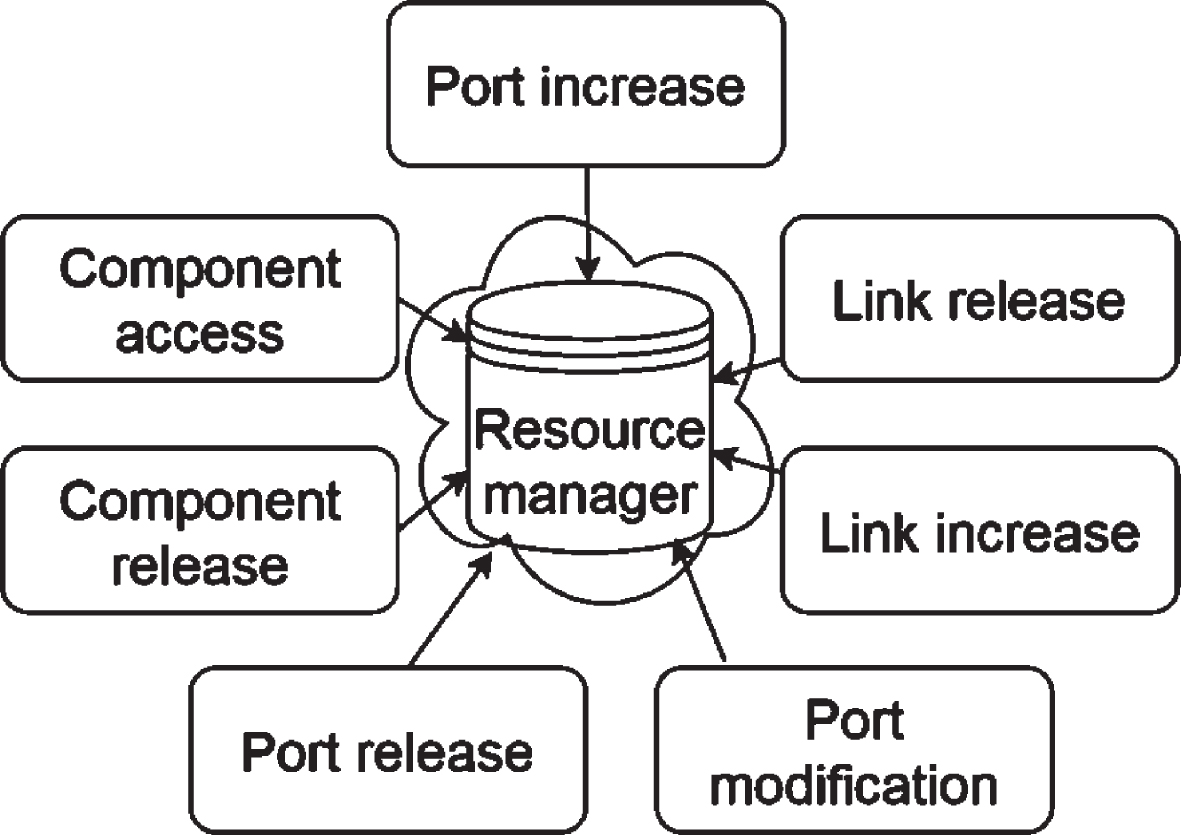
Types of events that trigger updates.
In a smart collaborative network, the resource manager can deliver LLDP data packets containing timestamps to the routing component through a secure channel. Then the timestamp in the received reply packet is subtracted from it to obtain the transmission time of the entire path of the data packet from sending to receiving. For ease of explanation, we use Fig. 6 to illustrate the principle of delay testing.
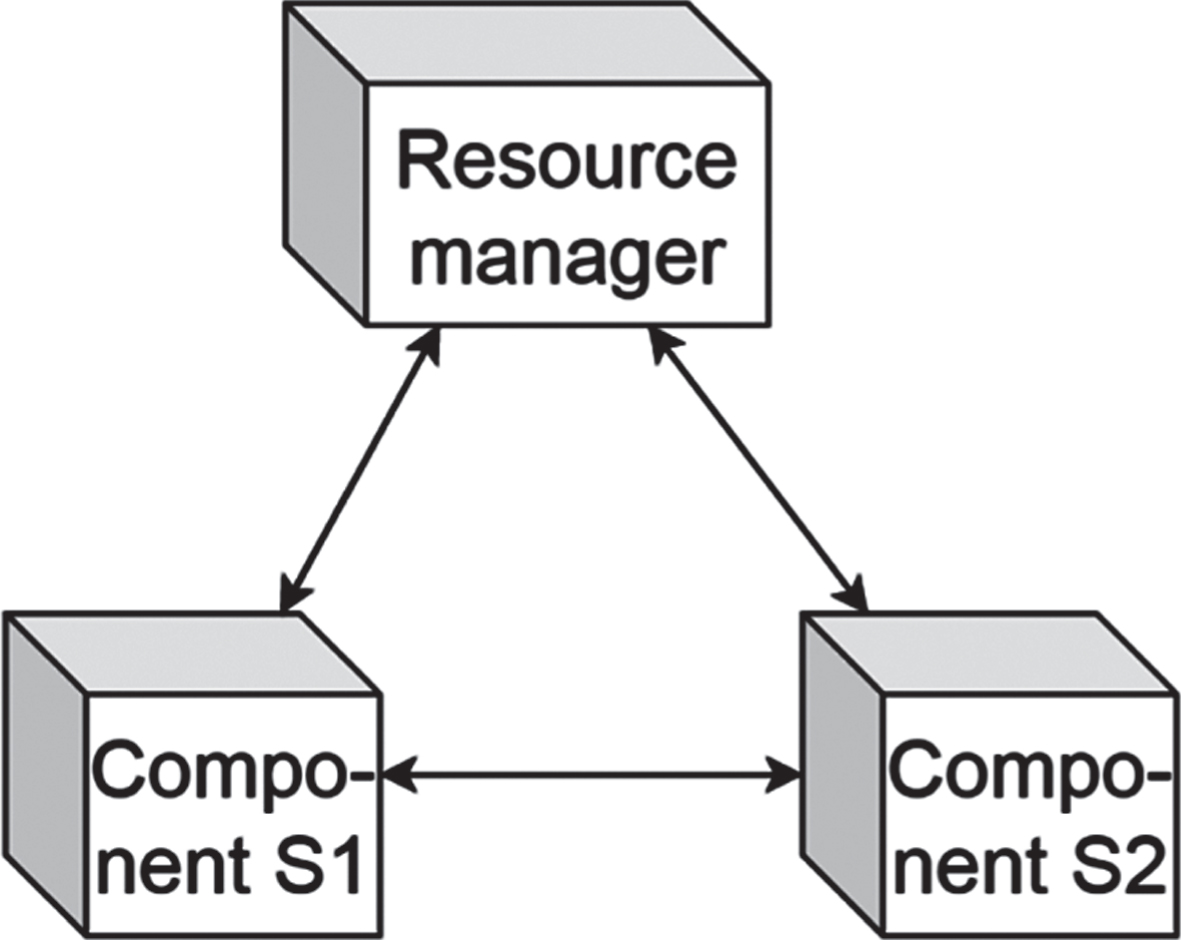
The principle of delay test.
Based on the above construction of system models and functional modules, the system performance is studied. The main function of the system constructed in this article is to spread public art. The spreading process includes teaching spreading and resource spreading. First of all, this study investigates the teaching communication of the system, and conducts quantitative analysis through actual teaching and student scoring. A total of 60 students are surveyed. The results obtained are shown in Table 1 and Fig. 7.
Survey table of educational communication effect of smart system
Survey table of educational communication effect of smart system
As shown in Fig. 7, the three points basically fall within the 55-95 zone, which shows that the system has a good response among the student population. After that, this research studies the spreading effect of the system constructed in this article on public art in society. This system is built on the smart cloud platform, so it can be associated with the external network. The one-year social impact of public art in colleges and universities is counted mainly by the number of hits, and the system constructed in this article is compared with the traditional system. The two systems are put into the network at the same time, and the results obtained are shown in Table 2 and Fig. 8.
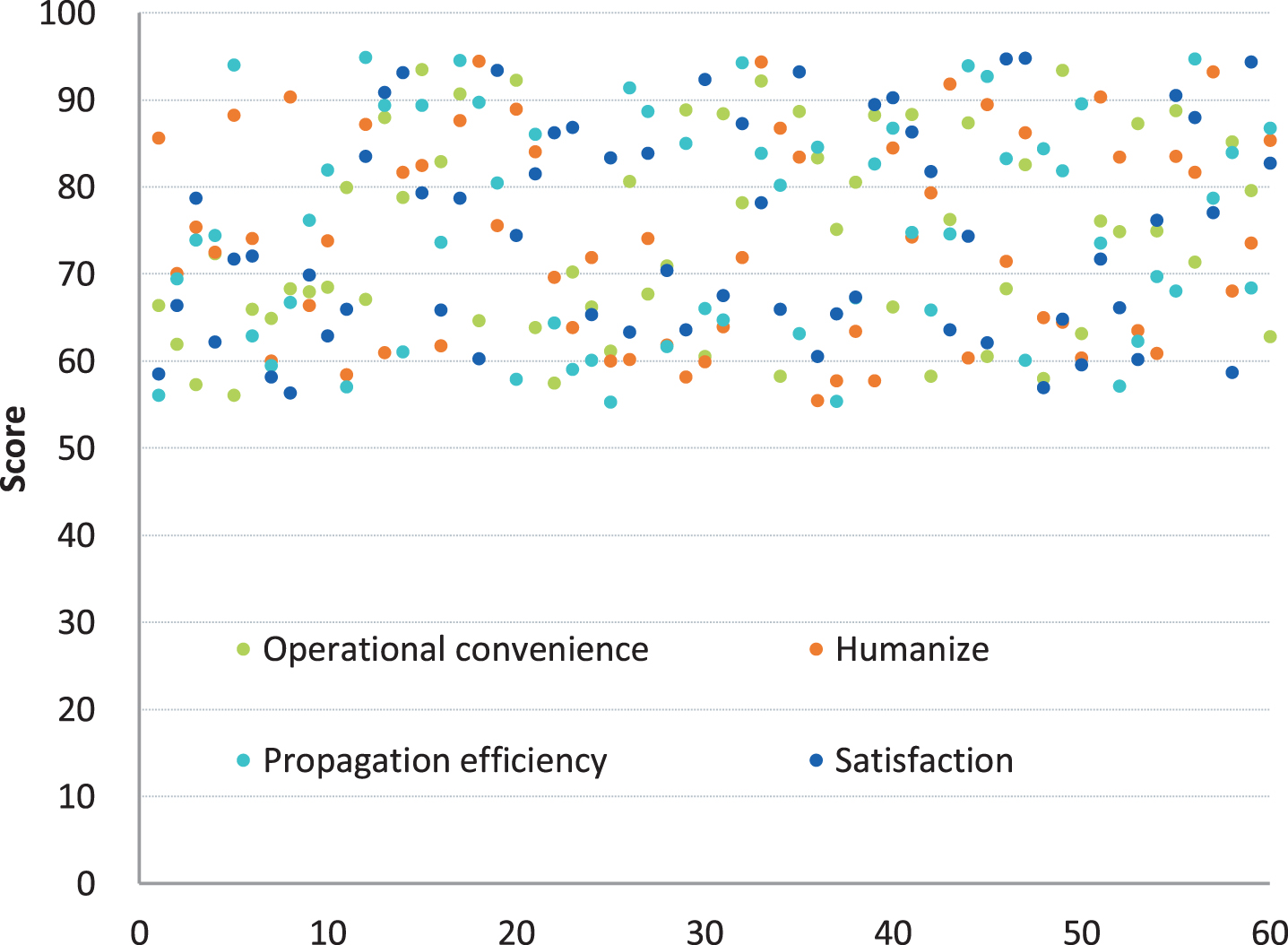
Survey diagram of educational communication effect of smart system.
Comparison table of public art communication effects on different platforms
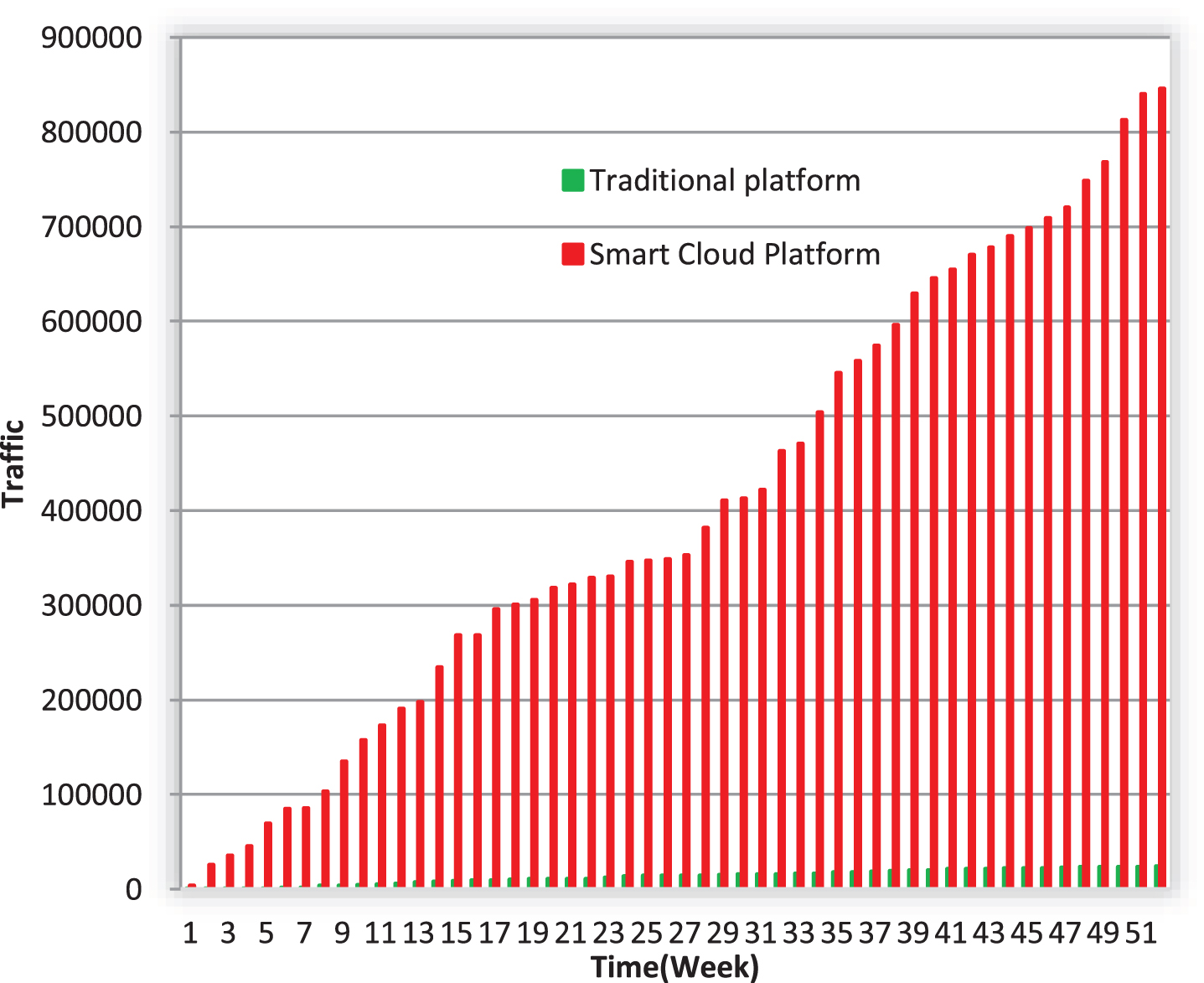
Comparison diagram of public art communication effects on different platforms.
As shown in Fig. 8, the smart cloud platform can help public art effectively spread to society, while the traditional platform’s communication effect is minimal. This shows that the smart cloud platform system constructed in this paper is effective.
In response to the existing problems of public art communication in colleges and universities, we should introduce strategies and roads that are more suitable for the development of public art design. This article combines artificial intelligence technology to build a university public art communication system based on the intelligent cloud platform and artificial intelligence algorithms. Moreover, this paper introduces the bandwidth offset coefficient to judge the change of the network throughput, introduces the slice download rate difference to first judge the consistency change trend of the bandwidth, and then further gives the calculation method of the bandwidth prediction value by situation. In addition, this paper proposes a flexible transmission mechanism based on smart collaborative networks. The mechanism performs depth perception through network status and component behavior and implements the selection of the optimal path in the network according to the current network status and user service requirements to complete the transmission of service resources. If the current transmission path fails, the mechanism should ensure the continuity and reliability of the service. The system function constructed in this paper is mainly for the communication of public art. The communication process includes two kinds of teaching and social communication. The research results show that the platform constructed in this paper has a good communication effect.