



Abstract
These years, the laboratory safety situation in Colleges and universities has improved, but the safety problem still needs to be improved. Based on the research basis of previous literature, this paper extracts the causes of laboratory accidents in Colleges and universities in the past six years, uses the grey system theory to carry out correlation analysis, sorts the correlation degree of influencing factors of laboratory safety behavior, and through empirical analysis, the organization system, safety education, laboratory environment management, foundation safety ,professional safety show a decreasing relationship in the influencing factors of laboratory safety. On the basis of this conclusion, the safety management path of related laboratories is proposed: Improve the laboratory organization and management system; carry out safety education regularly; strict professional operation process; orderly laboratory environment; effective basic safety management. These path studies have positive practical significance for laboratory safety management.
Introduction
Laboratory is an important base for university to organize teaching and research activities. More and more cutting-edge topics need to be completed in the laboratory. However, the research and development and application of new materials and technologies in new fields need to be explored in the laboratory. The application of these new technologies makes the university laboratory face great challenges in safety management, which requires the laboratory safety management in the University. More professional, systematic and sustainable [1]. In recent years, the safety management of laboratories in university is still facing various challenges, and accidents occur from time to time. For example: in 2015, a postdoctoral researcher who was doing experiments died on the spot due to hydrogen explosion in a university laboratory in Beijing; in 2017, an explosion occurred in a laboratory in Shanghai, and a student who was doing experiments was injured by the explosion; in 2018, in Bangalore, India, Manoj Kumar, a 28 year old researcher, was killed in the explosion of a high-pressure hydrogen cylinder in the Institute of science. Laboratory safety accidents not only disturb the normal order of teaching and scientific research, but also threaten the life safety of teachers and students and damage the property interests of the state and the collective, so it is very urgent to study the safety management of university laboratory.
In this paper, on the basis of consulting the relevant literature and synthesizing the research of other scholars, we extract the relevant laboratory safety influencing factors, use the gray correlation analysis method, use this method to study the laboratory safety influencing factors, rank the influencing factors, and on this basis, the university laboratory safety management path is provided.
Principle
The early Grey relational analysis is generally based on the similarity of proximity measure, and generally does not need to consider whether there is linear correlation between data columns. The most typical one is the Grey relational analysis model proposed by Professor Deng Julong. The Grey relation analysis is to compare and analyze each factor in a unified system. Through quantitative analysis, the statistical set relation of each comparison sequence is obtained, and the relation degree of each factor is analyzed. Within the system, if the trend of change between the two factors tends to be consistent, the degree of correlation between the two factors is higher; otherwise, it is lower. This analysis method overcomes the shortage of traditional statistical sample demand and calculation, and is currently a more commonly used system analysis and evaluation method [2, 3]. The specific operation steps are as follows: Determine reference sequence: Set
Determine comparison sequence: Set
Dimensionality of variables: in order to eliminate the influence of the original data dimension, dimensionality of variables should be carried out, and the standardized formula should be used to convert the values into comparable data series:
The corresponding absolute difference is calculated according to the comparison sequence and reference sequence after quantification: Set
Calculate the correlation coefficient between the reference sequence and the comparison sequence: the correlation coefficient between X0 (k) and X
i
(k) is recorded as ξ
i
(k), then
Calculate relevance:
Where r i represents the degree of association between sequence X i and participating sequence X m . the larger r i is the closer the relationship between them will be, so as to find out the key influencing factors or the optimal system.
The theory of grey relational analysis can effectively deal with the practical problems of difficult data collection and less data collection in the laboratory safety problem, It is a useful tool to analyze the influencing factors of laboratory safety and their correlation. In this paper, based on the Grey correlation analysis, the model of influencing factors of laboratory safety will be constructed, and the influencing factors of laboratory safety will be studied and discussed in depth.
Selection of influencing factors
Due to the different professional nature, the induced factors and risk degree of laboratory safety accidents in university have great uncertainty and randomness. These accident factors have a lot of “uncertain information”. It is very difficult to analyze and determine all the influencing factors, even if the same accident circumstances and consequences, the causes of accidents can not be the same [4]. Based on 66 typical accident cases in 2013–2018, through accident investigation, analysis and synthesis, this paper analyzes the causes of safety accidents, draws on the research opinions and research results of scholars at home and abroad, and selects the indicators of laboratory safety influencing factors by referring to ZH Li 2014; JY Dong et al.2016; L He et al. 2017; F Qing et al.2017; Y Du et al. 2018; KS Huang et al. 2018; J Guo 2019; J Fu et al. 2019 and other scholars [4–11]. In particular, Y Du and JY Feng visited 75 institutions directly under the Ministry of education in the past three years. They have typical and comprehensive inspection and summary of laboratory safety. On the basis of these theories and practices, the paper constructed an index system of laboratory safety influencing factors, including 5 first level indicators, organizational system, safety education, laboratory environment and management, foudation safety, professional safety etc, and 13 secondary indicators, including rules and regulations, safety inspection system, funding guarantee, safety education, safety access examination, pipeline safety, other safety of the site, electricity and water safety, personal protection, instrument use safety, chemical safety, biological safety, waste management, etc. For the analysis of laboratory safety influencing factors, as shown in Fig. 1.
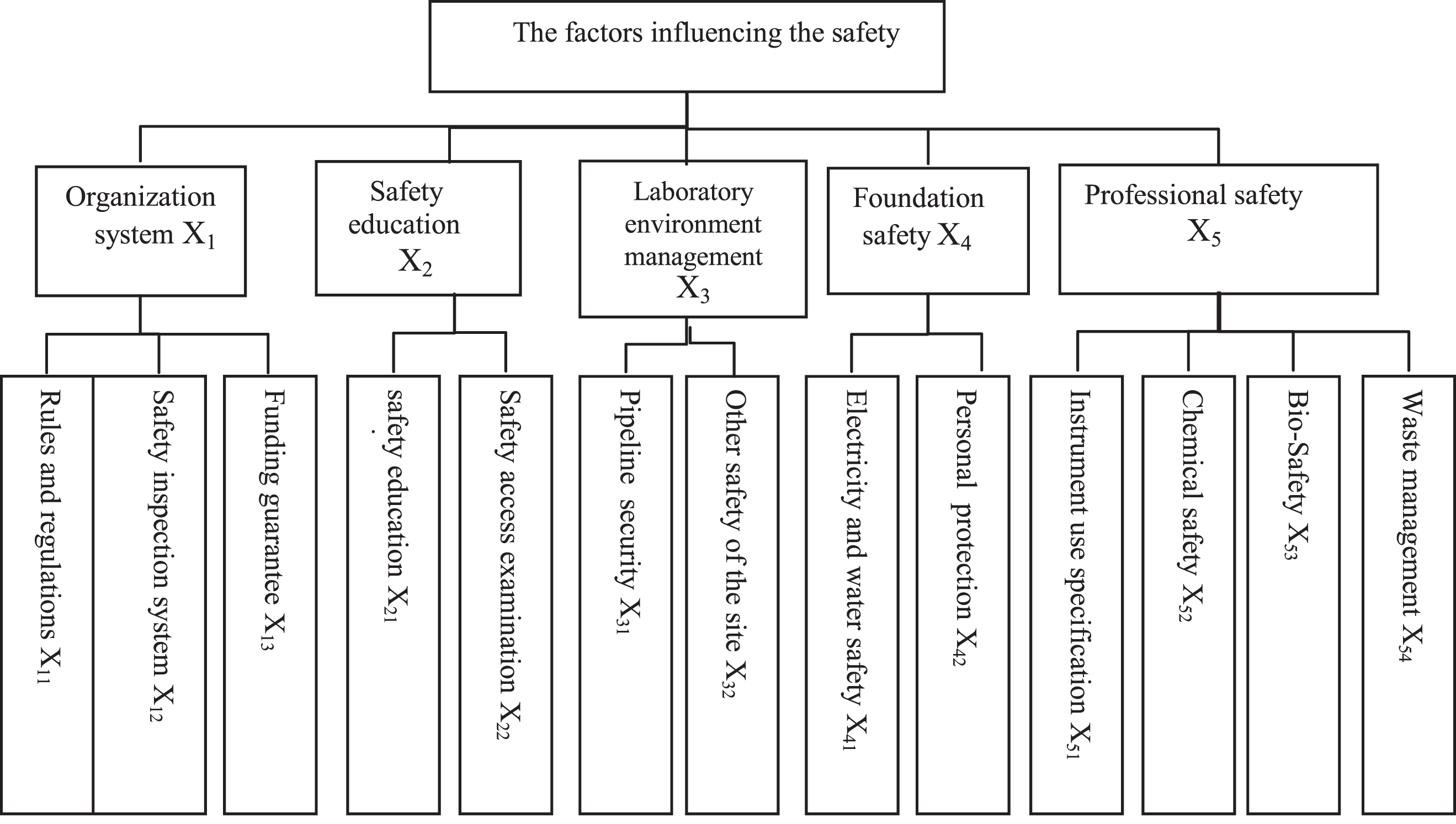
Laboratory Safety Factors.
At present, there is no special data statistics on laboratory safety accidents in Colleges and universities across the country. The data is mainly sorted out through the website of the former State Administration of safety, the Higher Education Department of the Ministry of education, baidu search, Google search, accident case investigation and other channels. According to the currently available data, 66 typical laboratory accidents in Colleges and universities at home and abroad during 2013–2018 are obtained for statistical analysis basic, because the samples of laboratory safety accidents selected in this paper tend to be events with high media exposure, typicality and serious consequences, rather than random events, the final statistical results slightly deviate from the actual overall data. In the selected cases, a total of 10 people died, more than 38 people were injured or poisoned. According to the post accident investigation report and for cause analysis, refer to the analytic hierarchy process model of influencing factors of laboratory safety factors, get the result of event cause analysis, and summarize it (see Table 1).
Analysis Results of Influencing Factors of Laboratory Safety in Universities
Analysis Results of Influencing Factors of Laboratory Safety in Universities
Taking the total number of laboratory safety impacts in university X0 as the reference sequence, the organizational system X1, safety education X2, laboratory environment and management X3, basic safety X4 and professional safety X5 as the comparison sequence, in order to make the comparison between sequences possible, dimensionless treatment must be carried out to eliminate the dimensionality. The results obtained by using formula ➁ are shown in Table 2:
Dimensionless Results
Dimensionless Results
Then the absolute difference between the reference sequence and the comparison sequence is calculated by using formula ➂, and the results are shown in Table 3:
Absolute Difference Between Reference Sequence and Comparison Sequence
Therefore,
According to formula ➃, the correlation of organization system, safety education, laboratory environment management, foundation safety and professional safety with the total number of laboratory safety impacts in university is as follows:
The order of association is:
Through the above correlation analysis, it can be concluded that the correlation degree of the factors affecting the laboratory safety in university is the organization system > safety education > professional safety > laboratory environment management > foundation safety. The construction and guarantee of the organization system is a major factor affecting the safety of the laboratory. It is also the guarantee of the top-down system of the school to prevent and put an end to the occurrence of unsafe behaviors, so as to ensure the systematic safety of the laboratory. The lack of necessary safety education for laboratory personnel is the second factor, so the safety education training and safety test assessment are indispensable elements of the safety management of the laboratory. Element, can have the effect of prevention and prevention in advance practically.
Taking the organizational system as X1 reference sequence, the rules and regulations X11, the safety inspection system X12, and the funds guarantee X13 of each sub factor under the organizational system as the comparison sequence, the correlation degree sequence of each sub factor to the organizational system calculated is: r12 > r11 > r13, therefore, the safety inspection system plays a major role in the organizational system factors affecting the laboratory safety factors. A well executed safety inspection system can strangle all safety risks of the laboratory in the cradle, so as to prevent them in advance. Taking safety education as X2 reference sequence and safety education training X21 and safety admittance examination X22 as comparison sequence, the correlation degree of each sub factor to safety education calculated is as follows: r21 > r22, it can be seen that safety education and training are the main factors influencing laboratory safety factors, and then safety admittance examination. Therefore, university should take safety education and training as the normalization of laboratory management, and only take “safety first, prevention first” as the basic principle of safety work, and truly realize the safety awareness in the concept and life of each teacher and student, so as to achieve group prevention and governance, and spread out from point to area. Taking the laboratory environment management X3 as the reference sequence, taking the pipeline security X31 of each sub factor management under the laboratory environment management and the other safety X32 of the site as the comparison sequence, the correlation degree order of each sub factor to the laboratory environment and management calculated is: r31 > r32, therefore among the laboratory environment and management factors that affect the laboratory safety, pipeline security is the main influencing factors, normal and orderly daily management mechanism, are the necessary guarantee of laboratory safety. Based on the foundation safety X4 as the reference sequence and the comparison sequence of each sub factor electricity and water safety X41 and personal protection X42 under the foundation safety, the correlation degree sequence of each sub factor to the basic safety is as follow: r41 > r42, it can be seen that the electricity and water safety has an important impact on the basic safety, remember to turn off the power supply in time when leaving the laboratory, and regularly check the circuit damage to avoid it Fire caused by aging circuit. Taking the professional safety X5 as the reference sequence and the sub factor instrument usage specification safety X51, chemical safety X52, biosafety X53 and waste management X54 under the professional safety X5 as the comparison sequence, the correlation degree sequence of each sub factor to the professional safety is: r51 > r52 > r54 > r53, therefore, the instrument usage specification safety occupies an important position in the professional safety. Before the relevant experiments, It is necessary to train the staff in the standard operation of experiments to avoid tragedy.
The path of laboratory safety management
In this paper, based on the research results of various scholars, five major safety influencing factors of the laboratory are selected as the first index, and the ranking is obtained through the above grey correlation empirical analysis: organization system > safety education > professional safety > laboratory environment management > foundation safety. Based on this sorting result, the following suggestions for laboratory safety management path are provided to managers: (1) The sound organization management system of laboratory, especially the rigorous laboratory safety inspection system. For example, whether the rules and regulations of the laboratory, the preparation before the experiment, the operation process, the safety responsibility system are perfect and strictly implemented; (2) The regular safety education system. For example, the safety of water and electricity use in the laboratory, the safety of the use and operation of various instruments, the nature and use safety of various drugs and reagents should be regularly educated and studied, and the safety education and training system should be normalized; (3) Strict professional operation process. Enter the chemical, biological and other professional laboratory, it is necessary to pass strict training before the experiment, each container must be sub packed and do a good warning mark, etc.; (4) Orderly laboratory environment. For example, whether the laboratory fire fighting access and escape facilities are standardized and complete, whether the laboratory hazard sources and safety information are informed, and whether the circuit facilities are aged and overloaded. (5) Effective basic safety management. For example, when conducting professional experiments, it is necessary to do a good job in personal protection, and turn off the water and electricity at the end of the experiment.
Therefore, the first three factors should be paid more attention to in the laboratory safety management of colleges and universities, Measures should be taken to improve the organization and management system, strengthen safety education and training, and strictly abide by the instrument standard operation process.
Improve the laboratory safety management system and implement the laboratory safety inspection mechanism
Laboratory safety is the top priority of laboratory management and an important part of campus safety. Therefore, the top-level design should be carried out from the perspective of overall campus safety. According to the principle of “who uses, who is responsible, who is in charge, who is responsible", a three-level linkage laboratory safety management responsibility system of school, secondary college and experimental center should be established. In this safety responsibility system, it is necessary to establish and improve relevant safety management systems, such as “laboratory safety management system", “laboratory valuable equipment management method", “laboratory hazardous waste disposal management method", “laboratory instrument sharing management method", “laboratory opening management system", “laboratory post safety responsibility system", “safety and health". Regulations on management of student supervision work, laboratory access and pre job training system, laboratory emergency response plan and laboratory safety management investigation method, etc. In the above safety systems, we should pay special attention to the implementation of the post responsibility system. The school’s safety management leading group and the management personnel of the secondary colleges, the secondary colleges and the experimental centers, the experimental centers and the laboratories sign safety responsibility letters at all levels, so as to practically put the safety responsibility in place and put it into practice. On the basis of further improving the system of laboratory safety management at school and institute level, each experimental center should formulate corresponding implementation rules such as safety regulations and safety operation procedures according to their own work characteristics. Laboratory safety inspection is a necessary measure to eliminate potential safety hazards in the laboratory, which is listed as one of the most important contents of laboratory safety work. The laboratory shall follow the principle of “safety first, prevention first", adhere to the principle of combining self inspection with spot check, and combining regular inspection with random inspection, so as to find and eliminate potential hazards from the source.
Strengthen laboratory safety education and implement laboratory safety access assessment
Safety education is the most basic work, and it is the prevention of laboratory safety accidents. The school needs to establish a long-term mechanism of laboratory safety education, starting from the source. For example, when new students enter the school, they should set up comprehensive courses related to safety education, enter the laboratory, carry out safety access learning before the experiment, and carry out emergency mechanism training after the experiment, so as to build a long-term mechanism of close connection between laboratory safety education, experimental teaching and research [12]. Safety education and training should focus on two aspects: first, the diversification of education and training content, which can be related laws and regulations, rules and regulations, various professional knowledge, common sense of emergency self rescue and emergency response measures; second, education and training should be spread out in an all-round and multi-faceted way, not limited to a laboratory, nor limited to the education of experimental students, but to the school leaders. All kinds of laboratory safety education should be carried out by leaders, experimental teachers and managers. The experimental education and training should be carried out under the institutionalized and normalized mechanism. Laboratory safety access assessment is a safety barrier for entering laboratory operation, and the establishment of all kinds of professional safety question bank is the premise of access assessment, including general safety, professional safety, radiation safety, network safety and fire safety of all kinds of laboratories. The access assessment for experimental teachers and students is the effect guarantee of access system, and schools can actively Build information platform, effectively promote the implementation of laboratory safety access system [13].
Standardize the use and operation of instruments and strictly follow the professional experiment process
From the above correlation analysis, it can be seen that most of the laboratory professional safety accidents are caused by the standardized operation of instruments. The operation requirements of profesional experimental projects have their specific process steps and professional specifications. If they are not operated in strict accordance with the rules, it is easy to cause accidents. Therefore, standardizing the operation of instruments is an urgent training and access requirement. Secondly, the storage of reagents should be strictly in accordance with the requirements. Some chemical reagents are highly toxic, corrosive and flammable, and will become a dangerous source of explosion if they are not careful. The laboratory of biological type is the place to study human body, animals, bacteria and viruses. If the laboratory personnel operate improperly, they may be infected with the virus. Therefore, in terms of the safety of biological operation, the personal protection of laboratory personnel and Prevention has become the main goal, especially to strengthen their own professional knowledge and operational skills. As early as January 1, 2005, the State Environmental Protection Administration (SEPA) issued a notice on “strengthening the supervision of laboratory pollution environment", and all kinds of experimental sites should be monitored in strict accordance with the pollution management. However, the disposal and management of waste products is the most easily neglected link in the laboratory safety management of university. Waste management needs more strict and professional operations, such as the need to set up a designated storage point for hazardous waste, which must have ventilation and heat insulation performance, and should be posted with warning signs in a conspicuous position, and equipped with containers, do a good job in classification signs, sub packaging storage, and try to use the original bottles to recover waste liquid. It is prohibited to discharge or discard any toxic or harmful hazardous waste materials at will, mix with domestic waste, dump hazardous materials into the sewer, and stack experimental waste materials outside the laboratory [14].
Conclusion and significance
In this paper, the grey system theory is applied to analyze the influencing factors of laboratory safety, and the sequence is made. The conclusion is that organization system > safety education > professional safety > laboratory environment management > foundation safety. On this basis, five management paths are provided for laboratory safety managers. In a comprehensive view, organization system, safety education and professional safety are the laboratory safety influences Main factors.
Based on the accident data of previous years, this paper analyzes the relevant accident occurrence factors. The reappearance of the accident can play a role in alerting the laboratory managers of colleges and universities to keep the alarm bell ringing and avoid similar accidents from happening again. In view of the above problems, this paper provides the management path, which can give some management suggestions to the relevant managers and promote them to establish the laboratory safety management. It can promote the safety management of university laboratory from passive response to active protection. Of course, there are still some shortcomings in the gray correlation method, which mainly relies on the past accident data to establish the model of the past accident characteristics, so as to achieve the purpose of prevention, without considering the complexity of future accidents. In the follow-up study, we should continue to improve the gray method, so that the relevant management suggestions are more comprehensive and in place.
Footnotes
Acknowledgments
The study was supported by “Optimization and practice of online experimental teaching mode under epidemic situation” (Grant No. J2020B024), “Optimization of face recognition access control system in post epidemic Era” (Grant No. JAT200358) and “Research on Optimization of practical teaching system of logistics management major based on online and offline hybrid teaching method” (Grant No. FBJG20200098).