



Abstract
As the stability of surrounding rock of coal roadway is affected by many factors, which makes the classification result hard to be consistent with the field practice. To solve the above problems, this paper proposes a method for the classification of stability of rock which is present in roadway of coal using the artificial intelligence algorithm. In this paper, the influencing factors of stability of rock which is present in roadway are analyzed, and seven influential factors are selected as classification indexes. To solve the problem of slow convergence speed and easy to fall into the local minimum of the back propagation artificial neural network (BP-ANN), an improved BP-ANN algorithm based on additional momentum and Levenberg-Marquardt optimization is proposed based on the analysis of the existing improved methods, which improves the convergence speed and avoids the local minimum effectively. Based on the learning model available, classification system based on fuzzy rule have been implemented and yielded better behavior in the situation of uncertain data sets. Finally, the stability classification model of surrounding rocks of coal roadway using BP-ANN was established in MATLAB environment, and the model was applied to 13 data samples of coal roadway for testing, with the identification rate of 92.3%. The experimental results verify that the method proposed based on fuzzy rule classification system in this paper has a high accuracy of type identification and is applicable to the stability classification of surrounding rock in the coal roadway.
Introduction
The classification of stability of rock formed in coal runway is the basis of reasonable roadway support design and the important premise of predicting the stability in rock covering the roadway of coal in the exploitation and removal process [1]. Therefore, the scientific and accurate classification of surrounding stability of rock which is present in roadway will directly affect the support form and method, thus affecting the support effect of the coal roadway [2]. So the classification of stability of rock which is present in roadway must be solved first. The accurate, scientific, and convenient classification of surrounding rock stability is always an important problem for mining experts and scholars [3, 4].
In recent years, because of the complex geological conditions of surrounding rock and the numerous factors affecting its stability, researchers have widely used mathematical statistics, fuzzy mathematics and other modern mathematical methods in the classification of stability [5–9]. The classification of surrounding rock stability changes from qualitative to quantitative and various classification methods are put forward to evaluate surrounding rock stability comprehensively and objectively. However, as the surrounding rock is a complex medium, there is a complex nonlinear relationship between its stability and influencing factors, so the general method cannot truly reflect the nonlinear relationship. Although the present research has made some achievements, it has not been widely applied and still needs further improvement [10, 11].
Due to the complexity of geological conditions and limited geological prospecting methods, it is not possible to obtain all the data to determine the grade of surrounding rocks accurately. Therefore, the traditional classification of surrounding rocks can only be determined by experience and qualitative methods. With the application of various new methods and technologies in the field of mining, a variety of methods have emerged for the stability classification of coal roadway surrounding rocks, including fuzzy theory, grey theory, expert system, abrupt progression method, artificial neural network, and other intelligent prediction methods [12–14]. These methods effectively improve the accuracy of classification, but they all have some shortcomings. In fuzzy theory, membership degree and weight are difficult to determine. The accuracy and simplicity of the grey theory are not enough. The expert knowledge used in expert systems is often trivial, imprecise, and uncertain; the method of abrupt progression is more complicated in the classification of surrounding rock stability. The randomness of surrounding rock instability cannot be considered by the artificial neural network. Because of the influence of random factors, probabilistic neural network and immune evolutionary algorithm are combined in [15] to achieve accurate classification of the stability of slope surrounding rock. In [16, 17], the probabilistic neural network method was used to detect the damage of the bridge panel of the suspension bridge, and the test results showed that the probabilistic neural network method was feasible and effective.
The artificial neural network, especially BP-ANN, has a good modeling ability, which can truly reflect the nonlinear relationship between the problem and its influencing factors without the need for the specific functional form. Moreover, the neural network has the advantages of parallel information processing, distributed storage, self-organization, strong nonlinear approximation, and so on. Therefore, BP-ANN has a great advantage in dealing with the nonlinear classification of stability found in rocks of the coal roadway. However, the traditional BP-ANN has some disadvantages, such as local minimum, the slow convergence speed of learning algorithm, and difficulty in determining network structure. Therefore, it is necessary to optimize and improve the traditional BP-ANN [18, 19].
Because of the above problems, this paper proposes a classification technique of nearby rock stability of coal roadway on improved BP-ANN. The contents of this paper include the following aspects: firstly, this paper analyzes the influencing factors of surrounding rock stability of coal roadway, and selects seven factors that have a great influence on surrounding rock stability as the classification indicators; then, the principle of BP-ANN is studied. Aiming at the shortcomings of BP-ANN, like lower speed convergence and easy to handle a minimum local, an improved BP-ANN method based on additional momentum and optimization is proposed, which improves the convergence speed of the network and avoids local minimum effectively. Finally, the stability classification model of surrounding rocks of coal roadway using BP-ANN was established in MATLAB environment [20], and the model was applied to 13 data samples of coal roadway for testing, with the identification rate of 92.3%. The experimental results verify that the method proposed in this paper has a high accuracy of type identification and is applicable for classification of nearby stability of rock which is found in roadway. Fuzzy Rule-Based Classification System (FRBCSs) are helpful and well established application in machine learning plat form. They offer significant trade off amongst the empirical exactness of techniques belonging to traditional systems and the achieved interpretability utilizing the labels of linguistic which contains sematic closer to natural language, earlier works has provided the FRBCSs having better behavioral knowledge with uncertain data sets by using constant preprocessing techniques.
The hybridization amongst genetic algorithm and fuzzy logic modelling to Genetic Fuzzy Models (GFMs), which is vitally utilized methods when various computational intelligence methodologies are associated. A GFM is normally a fuzzy method formed by learning methodologies on the basis on evolutionary models. In various evolutionary algorithms, the improvement of Genetic Programming (GP) of modernized genetic algorithms that involve tree shaped formulation utilizing chromosome which has the variable length. GP handles the utilization of FRBCSs to form rule based learning algorithm based on fuzzy. Moreover, the certain lack of FRBCSs is the concepts inflexibility of using linguistic components because it implements tough restrictions on structure of fuzzy rule, which lacks in terms of accuracy when handling complex issues, like huge dimensional issues, the attendance of noise or classes which is overlapped. Various possibilities to improvise the model of linguistic fuzzy have been incorporated.
Related work
Liu and Chen [21] mentioned a unique model for classification of rock mass on finding the stability of rock slope on the basis of analyzing through hierarchy process, linear discriminant and fuzzy logic model. Liu et al. [22] developed the fuzzy probabilistic process for estimating the depth stability while slope cutting in rock mass. They utilized fuzzy models to assist traditional approaches for stability achievements. Wu et al. [23] mentioned fuzzy set model analysis to improvise indeterminate issues in estimating the discrepancy coefficient for finding stability of slopes cutting in rocks. Fang and Shen [24] have implemented decision making group using multi attribute on basis of fuzzy. Mikaeil et al. [25] utilized fuzzy and multi criteria decision forming methods for calculating of saw ability in rocks in mining fields.
Jato-Espino et al. [26] mentioned a survey article based on decision making using multi criteria application in civil works. Su et al. [27] demonstrated the fuzzy theory of optimal recognition for stability in slope estimation in hydropower plants. Rafiee et al. [28] developed the fuzzy model for rock modelling improvement, which allows the deliberation of doubt on basis on classical expert methodology which were utilized to estimate cavability in sediment of rocks. Khakestar et al. [29] moderated by applying decision making models on geotechnical components. Mirhossein et al. [30] estimated the fuzzy possibility decision making to praise the key set model in rock analysis for slope stability in rocks.
Influencing factors of surrounding rock stability of coal roadway
Table 1 shows the list of influencing components of nearby stability of rock in roadway of coal. These factors have different effects on the stability of surrounding rock, which can be divided into the engineering geological factors and mining technology factors. Engineering geological factors include the strength and structural characteristics of surrounding rocks, the buried depth of roadway, the characteristics of coal seams, the greatness and way of in-situ stress, groundwater and ore pressure, etc. The mining technical factors include roadway width, height, and width of the chain pillar.
The factors influencing the stability of coal road surrounding rock
The factors influencing the stability of coal road surrounding rock
Based on the principle of classification index and the comprehensive estimation of components on stability of rock present in roadways, this article selects the following seven indicators as indicators of stability classification of surrounding rock of roadway, including roof strength, coal seam strength, floor strength, buried depth of roadway, the ratio of the mining height, roadway pillar width, direct top first caving step.
Principle of BP-ANN
The BP-ANN is included with an input seam, one or more hidden layers, and output seam. Each layer is composed of many simple neurons with parallel operations. The neurons between the network layer and layers adopt full interconnection mode, and there does not includes mutual association amongst the similar layer neurons. Although the structure of a single neuron is simple and its functions are limited, the network system composed of a large number of neurons can achieve extremely powerful functions. Although the structure of a single neuron is simple and its functions are limited, the network system composed of a large number of neurons can achieve extremely powerful functions. The structure of BP-ANN is shown in Fig. 1.
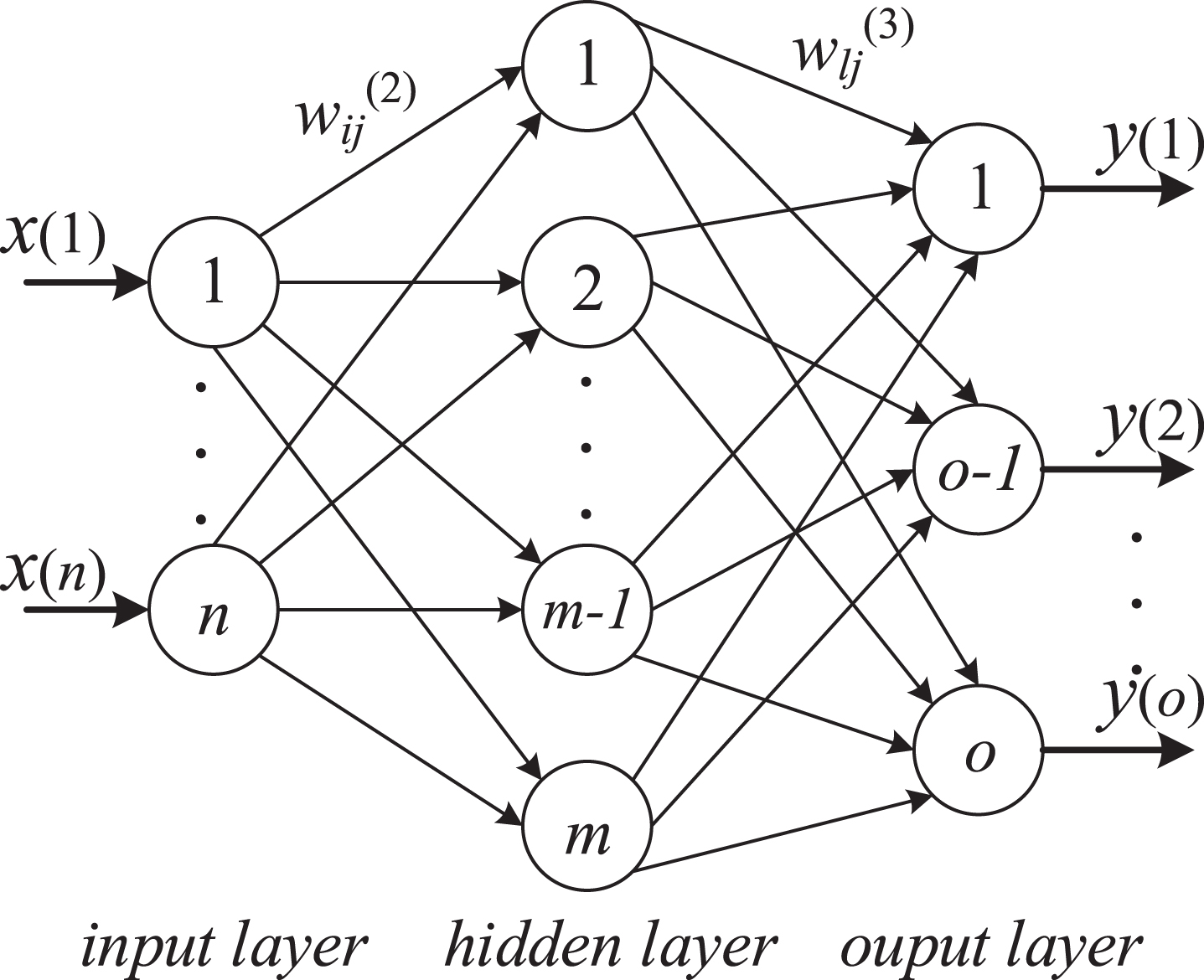
Structure of BP-ANN.
The learning and training of BP-ANN algorithm is divided into three stages: forward propagation stage, error backpropagation stage, and weight update stage. The specific process of the three stages is as follows.
(1) Onward spread stage
The output of the input layer is:
It can be seen from the Equation (1) that the input value of ANN is the output value of the input layer of the ANN.
The initial and final seam are described as follows:
Here,
The input and output of the output layer are as follows:
Here,
(2) Error backpropagation stage
After the forward propagation phase, the calculated mean square value of the error function is:
The calculated error mean square value is corrected by the negative gradient to the weight coefficient of the hidden layer and the output layer so that the increment of the weight coefficient of each layer is:
Here, η for the rate of the learning, α is the coefficient of inertia.
(3) Weight update stage
After the error backpropagation, the weight coefficients of the hidden layer and the output layer will be adjusted according to the negative gradient of the objective function.
Definition:
Therefore, the weight coefficient correction of the output layer is:
Here, η is the rate of the learning,
The modified increment formula for the weight coefficient of the output layer is:
Similarly, according to the gradient method, it can be known that the adjustment parameter coefficient of weights of the hidden seam of BP-ANN is:
Definition:
The modulation parameters of the hidden layer weight coefficient are:
The modified increment of the weight coefficient of the output layer is:
For finding the issues of lower speed convergence and informal to the local lower of BP-ANN, an improved BP-ANN algorithm based on additional momentum and Levenberg-Marquardt optimization is proposed.
(1) Method of additional momentum
The addition of momentum process is to involve the influence of final weight modification using the factor of momentum, that is, to add momentum term when adjusting the weight.
Here, α is the momentum coefficient, 0 < α < 1, Δw ij (k + 1) is the value of the weight correction at this time, Δw ij (k) is the weight of the last time, E is the mean sum of errors.
It can be seen from Equation (16) that the change of weight is related to the direction of updating. If the updating direction of the weight is the same as the previous step, then the weighted sum value increases to make Δw ij (k + 1) increase, thus speeding up the adjustment speed during the stable adjustment. If the updating direction of the weight is different from the previous step, then the weighted sum value decreases to make Δw ij (k + 1) decreases, which plays a stabilizing role. This method not only considers the effect of the error on the gradient but also reduces the sensitivity of the network in local error regulation, so as to prevent the network from falling into local minima and reduce the oscillation in the learning process.
(2) Optimization algorithm of Levenberg-Marquardt
The Levenberg-Marquardt algorithm is a combination of the Gauss-Newton method and gradient descent method, which has both the locality and rapidity of the former and the global and convergence of the latter, greatly improving the generalization ability and convergence speed of the network. The weight updating formula is:
Here, e k is the error vectors for computing and back-propagation network training; J k refers to the Jacobian-Matrix of the differential of network learning error concerning weights in the kth iteration, which contains weights and thresholds and is the first derivative of network training error; w(k) is the network weight in the k th iteration; μ is a scalar; I is the given sample matrix.
When μ goes down to 0, it becomes Newton’s method of approximating the Hessian matrix; When μ increases to 1, it becomes the steepest descent method with a smaller learning rate. In the iterative process, μ is adaptive. If the training is successful, the value of μ will be reduced. If it fails, it increases the value of μ and eventually reduces the training function to a certain value. Generally, the mean-variance of the function is less than 0.001.
FRBCSs are helpful and well-established application in machine learning plat from since they provide an interpretable method for end users’. This model of classification has two vital parts, the knowledge base is association of a rule base, associated by a group of fuzzy based rule and the data base that gathers the membership functions of the fuzzy sections determined to the input variables. If knowledge obtained by experts of the issue is not found, it is necessary for using certain process involving machine learning to get the knowledge base.
Any issues of classification including of M training patterns a l = (ai1 … a lx ), l = 1, 2 ... x from N classes where a lj is the jth value (j = 1,2, ... , x) of the lth pattern of training.
In this model, we utilize fuzzy rules of the below given form for modelling classifier:
Rule F
I
: If a1 is
Here F
i
is ith class label, dimensional pattern is given as a = (a1, …… , a
x
),
For estimation of weight of rule, various heuristic have been implemented. In this model, we include Fhe rule weight as confidence of fuzzy or Certainty factor (CF) as shown in Eqn (19).
The selection of classification index
On basis of initializing the factor influencing the rock stability, the lower input and output details is formed as index for classification of nearby rocks.
(1) Input information
A: roof strength; B: coal seam strength; C: floor strength; D: buried depth of roadway; E: the ratio of the mining height; F: roadway pillar width; G: direct top first caving step.
(2) Output information
The quality grade of surrounding rock: the output layer results (00001), (00010), (00100), (01000), and (10000) respectively represent the quality grade of V, IV, III, II, I. Table 2 shows the stability type and the output information.
Stability type and the output information
Stability type and the output information
An improved BP-ANN was used to establish a model for nearby rock classification stability. The model is implemented by three seams, mentioning the input seam, the hidden layer, and the output seam. The input layer is the classification index of the stability found in the nearby rock. The hidden layer extracts and stores the nonlinear mapping relation in the sample data, and the hidden layer nodes are selected as 8. The output layer is the constancy type of nearby rock of coal.
Design of the sample
The input details of the component is composed of 7 input parameters, which associates to 7 classification indexes, and is expressed as the standardized value of each classification index. The specific values of stability of nearby rocks for the classification index of the coal roadway are arranged into the original data table. Then the original data table is standardized to obtain the standard sample.
Through the investigation of coal mines in many places, the data of 40 coal lanes were gathered and utilized to design training examples and test samples. The training samples include data of 35 coal lanes, which are used for training the model so that it can improve the classification accuracy by continuously learning and mastering the internal law of samples. The test samples include the data from 10 coal roadway to test the model and verify the applicability and accuracy of the classification procedure of nearby rock of coal roadway. Due to limited space, only the training samples containing 15 coal lanes are listed, as shown in Table 3.
Training samples
Training samples
The surrounding rock stability classification model using BP-ANN proposed in this paper is designed based on MATLAB, and the learning samples are used for learning and training. Through repeated training and learning, according to the actual output information of the model and the expected output information in the sample, the weights and thresholds of each layer of network are constantly revised and optimized. After 6543 cyclic calculation, the mean square error of the classification model is less than 0.01.
To test the applicability and accuracy of the classification stability of nearby rocks situated coal roadway using the BP-ANN proposed in this paper, and the stability of rock present in multiple coal roadway is classified and identified. The 13 input samples were used as input information, and the surrounding rock stability identification model of the coal roadway was used for type identification. The results were compared with the actual type of surrounding stability of rock of the coal runway, as shown in Table 4.
Result of testing
As can be seen from Table 4, the identification accuracy of this model is 92.3%. This indicates that the nonlinear fitting effect of the classification model is good, and the complex mapping law between the stability for index in classification and stability type of nearby rock of coal roadway is mastered, which has good applicability and accuracy.
The difference in variation of R2 for the proposed BP-ANN associated with the population utilized in BP-ANN is illustrated in Fig. 2, whereas the difference in variation of RMSE value for the proposed model with the used population size is depicted in Fig. 3. Figures 4 and 5 illustrates the real time and settlement values of the proposed BP-ANN values respectively.
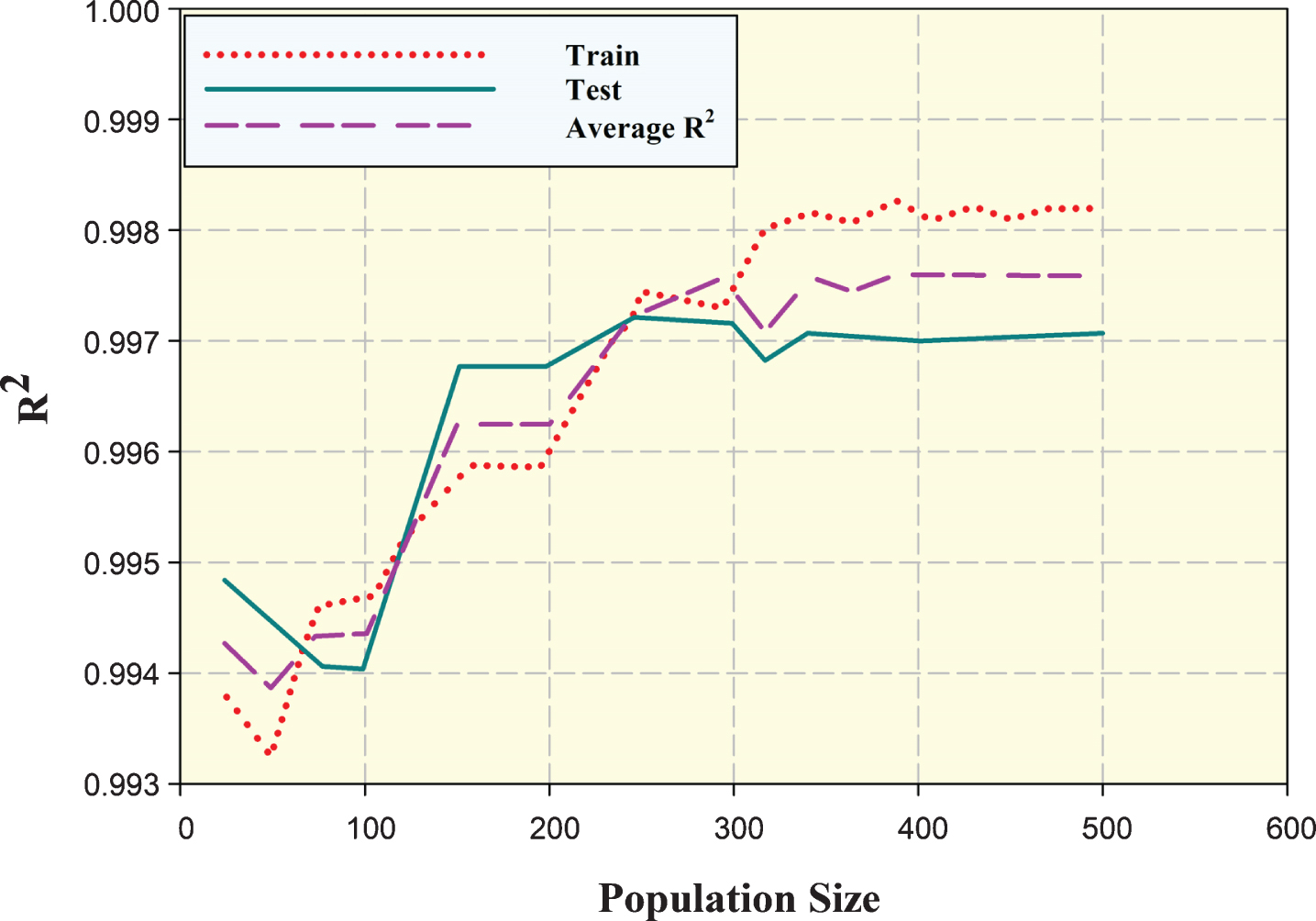
Variation of R2 associated with size of population in BP-ANN.

Variation of RMSE associated with size of population in BP-ANN.

R2 Value for proposed BP-ANN Model.
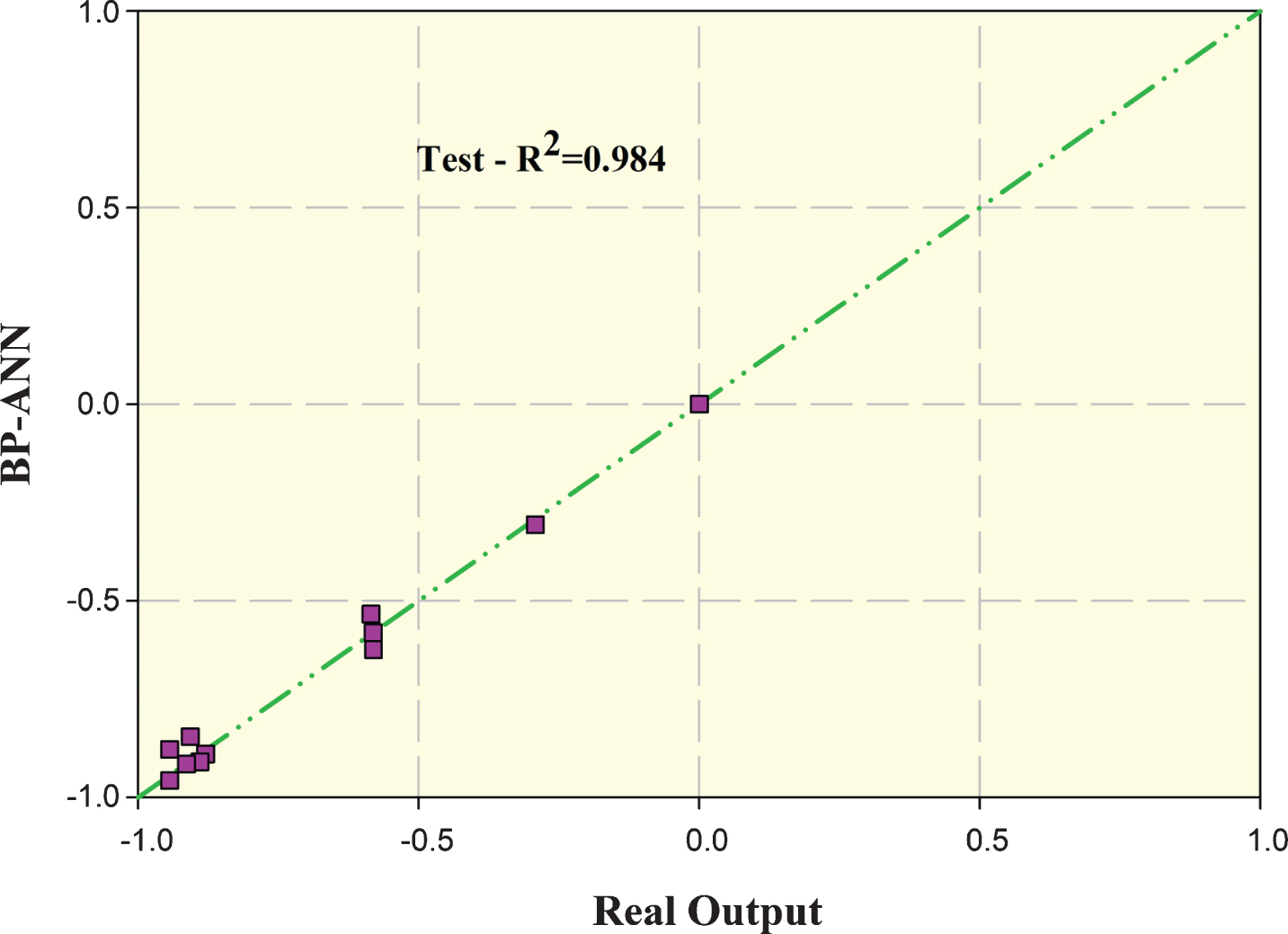
R2 Settlement Value for proposed BP-ANN Model.
Aiming at the classification of roadway surrounding rock stability, a classification method for finding the rocks nearby stability on basis of improved BP-ANN is proposed in this paper. To resolve the problem of lower speed convergence and easily to deploy into minimum of BP-ANN, an improved BP-ANN algorithm based on additional momentum and Levenberg-Marquardt optimization is proposed based on the analysis of the existing improved methods, which improves the convergence speed and avoids the local minimum effectively. Finally, the stability classification model of surrounding rocks of coal roadway using BP-ANN was established in MATLAB environment, and the model was applied to 13 data samples of coal roadway for testing, with the identification rate of 92.3%. The experimental results verify that the method proposed in this paper has a high accuracy of type identification and is applicable for finding the classification stability of rock found in nearby roadways.