



Abstract
Considering the ubiquity of consumer balking behavior (CBB) in real-life economics and the importance of product quality control (QC) to supply chain (SC) competitiveness, this paper explores the SC coordination under both the QC and the CBB. Specifically, the consumer’s loss aversion behavior was illustrated at a fixed balking probability, and the SC models were created for centralized and decentralized decision-making modes. After that, the optimal strategies for the retailer and the manufacturer were identified, and the comparative static analysis was adopted to explore the effects of the CBB and QC on the optimal decision-making of the SC. The research results show that the QC-based SC under the CBB cannot be coordinated by wholesale price contract alone, but can be coordinated perfectly by this contract when the retailer shares the quality effort and the manufacturer shares the oversupply cost and analyzed through the fuzzy environment with the formulation. This finding sheds new light on the theory and application of wholesale price contract in SC coordination. Finally, the parameter sensitivity analysis was performed on balking probability and product qualification rate (PQR) through numerical experiments, which further discloses the impacts of the CBB and product QC on the optimal decision-making and profit of the SC.
Keywords
Introduction
Economic globalization has intensified market competition and improved the consumer’s sensitivity to product quality. Thus, product quality control (QC) is now an important factor for enterprises to achieve core competitive advantage [16, 26]. In this era of economic integration, product quality should be improved through the coordination of the entire supply chain (SC), due to the relatively weak competitiveness of individual enterprises. Through rational contract design, the SC management can be less affected by negative factors like information asymmetry and double marginalization, resulting in better overall profit and coordination of the SC system [12, 31]. While the QC in traditional enterprises mainly focuses on quality management of internal products, the product quality in the SC environment depends on the behavioral factors of SC members, in addition to their QC technology and management level [14]. Therefore, the common behaviors of SC members must be considered to coordinate the SC contract for QC. Facing the ubiquity of consumer balking behavior (CBB) in real-world economics [1], it is of great theoretical and practical significance to explore the SC coordination contract for QC under the CBB.
In recent years, many enterprises in some specific markets are shifting from traditional price competition to quality competition, owing to the growing awareness of product quality among consumers [19]. For instance, McDonald and KFC are competing to provide foods of different varieties or tastes; China Telecom and China Mobile are fighting for potential customers by providing different value-added functions and better service quality. Therefore, the product QC-related SC problem has attracted much attention from scholars. Under unilateral and bilateral moral hazards, Balachandran and Radhakrishnan [17] designed penalties for supplier product quality defects after inspecting incoming quality and external damages, which affect the SC quality decision. Hsieh and Liu [2] examined the quality investment and inspection strategies of suppliers and manufacturers in four non-cooperative games, and disclosed the impacts of quality inspection and defect punishment on the equilibrium strategies and profit of both parties. Through questionnaire surveys, Jraisat and Sawalha [18] demonstrated the importance of product QC to the management of the SC of fresh fruits and vegetables. Hlioui et al. [24] discussed the supplier selection strategy for time-varying product quality, and combined mathematical formula, simulation and optimization techniques to prove the cost-saving effect of dynamic supplier selection strategy.
The above studies mainly tackle the quality inspection decision and QC cost of products. In addition, some scholars have probed into the coordination of SC member behaviors in the field of SC QC, using contract or quality contract to achieve SC coordination. Based on the design of product quality contract, Xiao and Pan [11] studied the advantages and limitations of revenue sharing contract in coordinating QC-related secondary SC, compared the game equilibriums of SC members under revenue sharing contract, supplier-retailer cooperation and wholesale price contract, and concluded that the coordination effect of revenue sharing contract is positively correlated with the sensitivity of sales volume variation to product quality improvement.
Yu and Tzeng [33] proposed a decision making problem using the ANP/AHP for the fuzzy environment with the feedback and defense effects [7, 8, 26, 30]. Sanayei et al. [25] processed the supplier selection for fuzzy environment with the help of VIKOR using group decision making process.
Ma et al. [22] achieved the coordination of a two-phase SC through rational design of quality contract and the integration of manufacturer’s quality improvement efforts and retailer’s promotional efforts, and explored how the SC performance is affected by the changes to quality effort cost and promotional effort cost. Lee et al. [6] found that the SC with uncertain quality cannot be coordinated by repurchase contract and revenue sharing contract, but can be coordinated perfectly by quality compensation contract. Wang et al. [10] studied the SC QC and coordination when all SC members are loss-averse, and set up a SC coordination contract model under wholesale price-quality cost sharing.
The CBB is defined as follows: in real-life economics, the consumer tends not to buy commodities whose inventory is at or below a certain threshold [13]. For example, the consumer generally prefers stores with more clothes on sale in the shopping mall, rather than those with fewer clothes. For fresh and perishable goods like flowers, milk and fruits, the consumer has less desire to purchase them if only a few are on the shelf, because he/she may think that these commodities are not fresh enough or close to the shelf life. Later, Lee and Jung [27] disclosed the impact of the CBB on the performance appraisal of the newsboy model, when the CBB parameters are uncertain. Cheong and Kwon [28] discussed the robustness of CBB-based newsboy model under constrained service level.feng et al. [32] manifested the impacts regarding CBB on the optimally ordered quantity of retailers, and coordinated the CBB-based secondary SC respectively by revenue-sharing contract and repurchase-contract. Recently, Zhang et al. [2] studied the transaction credit problem of the CBB under market information asymmetry, deduced the Stackelberg equilibrium solutions under information sharing and information asymmetry, and designed an information-based credit restriction contract that forces retailers to share information. In addition, Lan [4, 5] deals with the coordination of vender managed inventory (VMI) SC under the CBB.
In recent decades, several regulatory checks have implemented by the companies and programs were conducted to ensure that the services and providing materials are having both high quality and processed based on environmental standards [9]. Hsu and Hu [33] have suggested a framework based on analytic network process (ANP) for constructing an assessment framework for the suppliers Taiwanese Electronics Company. Some criteria such as incoming quality control, R&D management, and management system are analyzed.
Basic models
Problem definition and parameter hypotheses
Our research deals with a secondary SC consisting of a risk-natural manufacturer and a QC-aware retailer. The commodities are manufactured at the unit cost of c, and ordered in a quantity of q. In the SC, the manufacturer supplies the commodities at the wholesale price w to the retailer, which then sells them to the consumer at the retail price p. It is assumed that the secondary SC has complete information symmetry, and that the CBB is common to all consumers. In other words, the consumer, aware of the exact inventory of the commodities on sale throughout the sales period, will purchase a commodity at the probability θ (0 < θ≤1) or cancel the purchase at the probability (1 - θ) and will not return in the sales period, once he/she discovered that the inventory of the commodity reaches or falls below a critical value (threshold) t (0≤t≤q). If short supply occurs in the sales period, the manufacturer and retailer will respectively face a short supply penalty g s and g r (g = g s + g r ). At the end of the sales-period, the unsold products will be disposed of by the retailer, and the net residual value per unit product is v. Without loss of generality, it can be assumed that p > w > c > v > 0, g s > 0 and g r > 0.
To boost sales, the manufacturer needs to take measures to improve the unit product quality e, which requires a certain quality effort cost h(e). It is assumed that h(0) = 0, h’(e) > 0 and h”(e) > 0 [9]. The random market demand for commodities can be denoted as D, with E(D) =μ, and the conditional probability distributed function and density function as F(x|e) and f(x|e), respectively. Since the market demand can be increased by the manufacturer’s efforts to improve product quality, it is assumed that ∂F(x|e)/∂e < 0. Whereas the consumption growth rate will slow down due to the limited number of consumers, it is also assumed that ∂2F (x|e)/∂2e > 0. Meanwhile, the retailer will test the products supplied by the manufacturer to control the product quality. Let δ (0 < δ≤1) be the PQR and m be the unit test cost. Then, the manufacturer needs to compensate the retailer for the loss caused by unqualified products at the unit amount of n. Then, the expected sales volume S (q, e) of the retailers can be followed as:
On the right side of the above equation, the first term refers to the sales volume when the market demand falls between 0 and qδ - t. In this case, the market demand is too small to cause the CBB. The second term refers to the expected sales volume when the market demand falls between qδ - t and
Then, the expected inventory I (q, e) of the commodities can be expressed as:
The expected shortage L (q, e) of the commodities can be expressed as:
Under the model of centralized decision-making, the manufacturer and the retailer form a unified economic entity pursuing the optimal strategy to maximize the overall expected profit. In this case, the expected profit of the SC system can be expressed as:
For ∀e ∈ [0, + ∞), the first- and second-order derivatives of Equation (5) relative to q can be obtained as:
This means π (q, e) is a strict concave-function with respect to the q. Thus, the first-order condition
Since
Proposition 1 shows that, under centralized decision-making, the retailer’s order quantity under the CBB is positively correlated with the manufacturer’s product quality. Better product quality increases the order quantity, and vice versa.
According to Lagrange’s mean value theorem, there exists at least one point
Proposition 2 shows that, under the given balking threshold, the positivity or negativity of the correlation between the retailer’s optimally ordered quantity q0 and the balking probability θ mainly depends on the conditional probability density f (x|e) of random market demand.
Under centralized decision-making, the retailer’s optimal order quantity q0 and manufacturer’s optimal product quality e0 considering the CBB are the solutions to the equation set of Equations (8) and (9):
The interaction of the all fuzzy sets is represented by this fuzzy-solution for fuzzy-constraints or fuzzy objectives [29]. The fuzzy solution of the membership function is expressed as Equation 14.
From the above equation, μ f (x), μ s (x), and μ z (x) is representing the membership functions of solutions, objectives, and constraints.
The supplier selection model based on the fuzzy solution for the J multiple objectives and T constraints are expressed as Equation 15.
In a decentralized SC, the manufacturer and the retailer exist as independent entities and make their own optimal decisions for maximizing the expected profit. The retailer needs to determine the optimal order quantity q*, while the manufacturer needs to determine the optimal product quality e*. Under decentralized decision-making, the expected profit functions of the retailers and the manufacturers can be defined and expressed to be:
According to Equations (16) and (17), the optimal response function q* (e) of retailer’s order quantity and the optimal response function e* (q) of manufacturer’s product quality, considering the CBB, should respectively satisfy:
Proposition 3 can be proved similarly as Proposition 1.
Since
Proposition 4 shows the significant positive correlation between the manufacturer’s optimal product quality e* and the PQR δ under any order quantity from the retailer. Thus, the manufacturer needs to improving the products quality before increasing the PQR. This conclusion is obviously in line with our intuition. Under decentralized decision-making, the retailer’s optimal order quantity q* and manufacturer’s optimal product quality e* considering the CBB are the solutions to the equation set of Equations (18) and (19):
The above equation requires p-v + g r = 0.
Since p-v > 0 and g r > 0, p-v + g r is always greater than zero, which contradicts the requirement. Hence, Proposition 5 is valid. □
The above analysis proves that the QC-based secondary SC under the CBB cannot be coordinated by wholesale-price contract. The major reason indulges in the fact that, in the decentralized SC, the cost should beard by the manufacturer of quality improvement efforts but only receives part of the SC profits, while the inventory cost beard by the needs of retailer cost for the entire SC technology by oversupply. As a result, the manufacturer is reluctant to improve product quality, and the retailers have the conservativeness about the quantity in order, aiming for reducing the risk.
Product quality is improved by reduction of oversupply-risk and achieving SC-coordination, this paper modifies the traditional wholesale price contract into a cost-sharing wholesale price contract {k, λ}, in which the retailer bears (1 - λ) (0 < λ< 1) of the cost of quality improvement efforts made by the manufacturer and the manufacturer compensates the retailer for unsold products at the unit amount k (0 < k < w-v). Under this contract, the expected profits of the retailer and the manufacturer can be respectively expressed as:
From the Equations (23) and (24), the retailer’s optimal order quantity q
λ
and the manufacturer’s optimal product quality e
λ
are the solutions to the following equation set:
Solving equation set (27), we have Equation (26). □
Proposition 6 sets out the requirements on the cost-sharing coefficient and the unit product subsidy for the coordination of the QC-based secondary SC under the CBB using the cost-sharing wholesale price contract: the cost sharing coefficient λ has nothing to do with the unit wholesale price, production cost, product QC or the CBB; the unit product subsidy k is not correlated with the CBB, and only related to the model parameters and product QC. These requirements provide new insights into management: (1) Under the CBB, the cost-sharing wholesale price contract can coordinate the QC-based secondary SC and improve the overall profit of the SC; it is possible to realize the Pareto optimization of the profit of each SC member through rational parameter settings. (2) During the design of the wholesale price-quality cost sharing contract, the manufacturer needs not consider the impact of the CBB on the contract parameters {k, λ}. Only the impacts of model parameters and product QC should be taken into account.
In this section, the above model was adopted for the Matlab simulation of several examples, aiming to verify the efficiency of SC coordination by cost-sharing wholesale price contract. Besides, the author numerically analyzed the effect of the CCB and product QC on the optimal decision-making and profit of the SC. Inspired by Wang et al. [6], it is assumed that D = 20e0.5 + ɛ, where ɛ ∼ U [0, 100] and h (e) = 25e2. The settings of the other parameters are listed in Table 1 below.
Parameter settings
Parameter settings
According to the above model, the contract parameter values, optimal-decision variable, and the expected profit of the retail owner, the manufacturer and other details could be anlaysed.
Three conditions are used for calculating the SC as centralized method of decision-making, decentralized decision-making and cost sharing wholesale-price contract. The calculated results are given in the Table 2 below.
Comparison of decision-variables and expected profits under different conditions
Comparison of decision-variables and expected profits under different conditions
As shown in Table 2, the SC was coordinated after the introduction of cost sharing wholesale price contract. Under decentralized decision-making, the retailer’s order quantity was reduced by 37.4% under the double marginalization effect. After the cost sharing wholesale price contract was introduced, the retailer borne 71% of the manufacturer’s quality improvement cost, while the manufacturer subsidized the retailer RMB 6.45 Yuan per unsold product. Thanks to the cooperation between the two parties, the expected profit of the entire SC reached that under centralized decision-making, the product quality was improved from 0.44 under decentralized decision-making to 3.59 under centralized decision-making, and the expected-profits of the manufacturing, the retailer and the entire SC grew by 22.6%, 71.0% and 56.9%, respectively. The above results show that the cost sharing wholesale price contract can improve the entire profit which is expected by SC, and ensure the Pareto-Optimizations of the profits of both the manufacturer and the retailer, making them willingly enter into the cost sharing wholesale price contract.
This sub-section analyzes the sensitivity of the CCB, that is, the effects of the CCB probability on the optimal decision-making and profit of the SC under centralized and decentralized decision-making modes. The relevant numerical experiments were carried out with the balking probability θ as the variable.
Figures 1 and 2 shows the analysis results about how the variation of θ from 0.1 to 1 affects the optimal product quality and the optimal order quantity under centralized and decentralized decision-making modes. It can be seen that the optimal product quality and the optimal order quantity remained constant, despite the increase of balking probability, whether under the centralized or decentralized decision-making. This is because θ is not included in Equation (13) or Equation (19), when the random demand obeys uniform distribution. It is conceivable that, the optimal product quality and optimal order-quantity may vary with the values of θ, when the random market demand follows other distributions like exponential distribution and normal distribution.

Relationship between balking probability and optimal product quality.

Relationship between balking probability and optimal order quantity.
Figure 3 presents the analysis results about how the variation of θ from 0.1 to 1 affects the SC profit under the centralized and decentralized modes of decision-making. It can be seen that the SC profit under centralized decision-making, as well as the retailer profit and manufacturer profit under decentralized decision-making, increased with the growth in balking probability, and the increase was not highly sensitive to the CCB growth. The slight increase of profit can be explained as follows: The growth in balking probability means the consumer is more likely to purchase commodities at the occurrence of the CCB, which enhance the SC profit; under uniform distribution, however, there was no change to manufacturer’s optimal product quality and the retailer’s optimal order quantity.
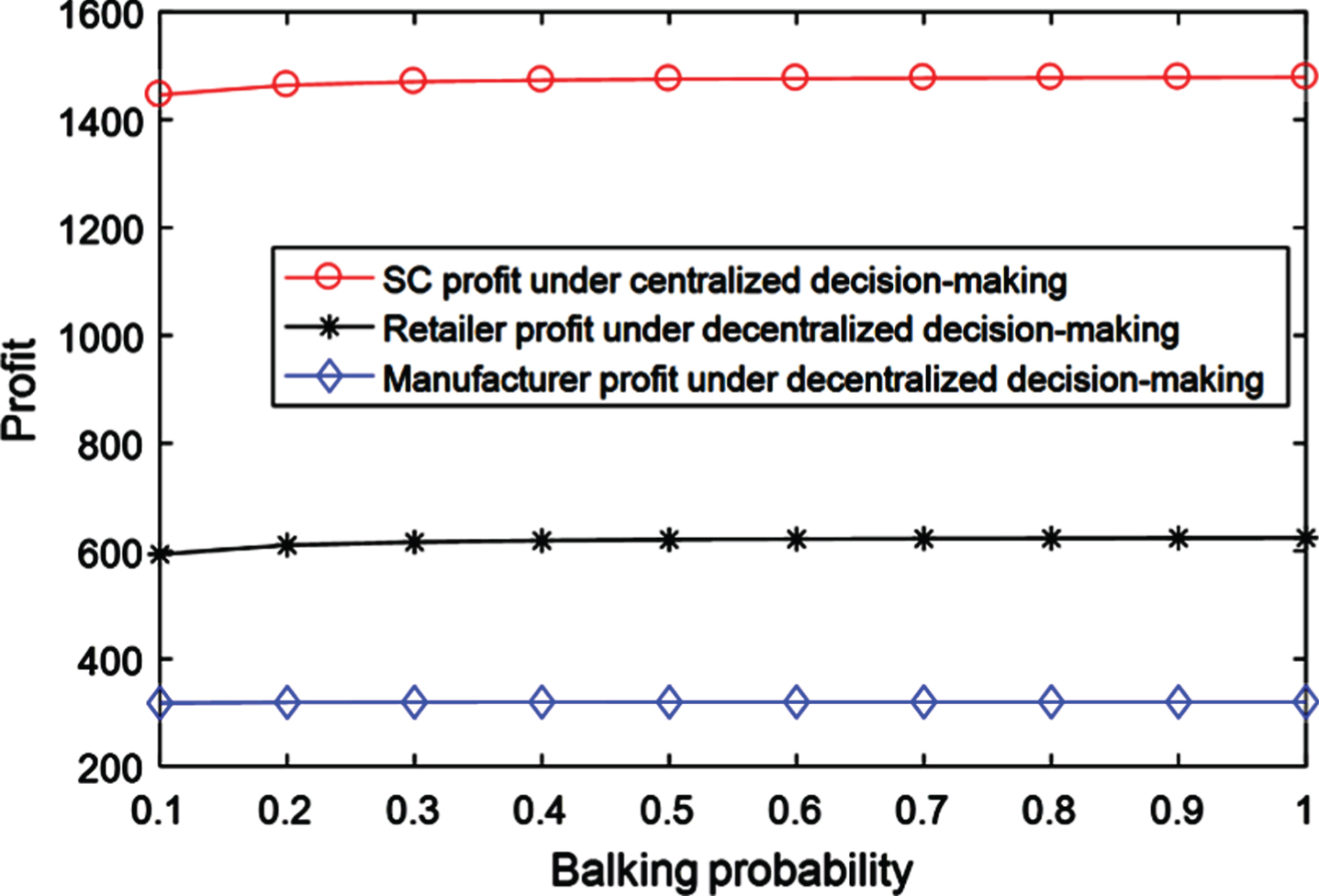
Effects of balking probability on SC profit.
This sub-section analyzes the sensitivity of the product QC, that is, the effects of the PQR on the optimal decision-making and profits of the SC under centralized and decentralized decision-making modes. The relevant-numerical experiments were carried-out with the balking probability δ as the variable.
Figures 4 and 5 show the analysis results about how the variation of δ from 0.5 to 1 affects the optimal product qualities and the optimally order quantity under centralized and decentralized decision-making modes. As shown in Fig. 4, the PQR is positively-correlated with the manufacturer’s optimal under both centralized and decentralized decision-making. Judging by the curve trend, PQR is more sensitive to the optimal product quality under centralized decision-making than decentralized decision-making. It can be seen from Fig. 5 that the retailer’s optimal order quantity increased first and then decreased with the growth in the PQR, rather than increase continuously. Under the same PQR, the optimal order quantity under centralized decision-making was greater than that of decentralized decision-making. After reaching a certain value, further increase of the PQR caused a decline in retailer’s optimal order quantity. A possible reason is that, under a high PQR, there are only a few unqualified products among those ordered by the retailer, i.e. a limited number of products to be returned. Thus, the optimal order quantity will be reduced. What is more, the manufacturer provides less subsidy to unqualified products when the PQR is high, pushing up the QC cost of the retailers per unit of product. The effect of the retailer’s QC strategy will be weakened accordingly.

Relationship between PQR and optimal product quality.

Relationship between PQR and optimal order quantity.
Figure 6 displays the analysis results about how the variation of δ from 0.5 to 1 affects the SC profit under centralized and decentralized decision-making modes. It can be seen that the manufacturer profit, retailer profit and overall SC profit were all on the rise with the increase in the PQR, whether under centralized or decentralized decision-making. Besides, the curve trend shows the PQR is more sensitive to the overall SC profit under centralized decision-making than that under decentralized decision-making. This conclusion is clearly common sense.

Effect of PQR on SC Profit.
Targeting the coordination of QC-based SC under the CCB, this paper constructs the SC decision-making models under centralized and decentralized modes, introduces the cost sharing wholesale price contract to SC coordination, and performs sensitivity analysis on balking probability and the PQR. In this way, the author disclosed the correlations of the CCB and QC with the optimal product qualities and the optimal order quantity. The main conclusions of this research are as follows: (1) The manufacturer’s optimal product quality and the retailer’s optimal order quantity are mutually beneficial; the cost-sharing wholesale price contract can improve the manufacturer’s optimal product quality, the retailer’s optimal order quantity and the SC profit under decentralized decision-making, improve the maximum expected profit of the SC under decentralized decision-making to the level of centralized decision-making, thus achieving the purpose of SC coordination. (2) The distribution of random market demand determines the positivity or negativity of the correlation of the balking probability with the manufacturer’s optimal product quality and the retailer’s optimal order quantity, while the profits of the manufacturer and the retailer both increased with the balking probability. (3) The retailer controls the product quality by inspecting the manufacturer’s products; with the growth in the PQR, the retailer’s optimal order quantity first increased and then declined, while the manufacturer’s optimal product quality and the SC profit both increased continuously.
The above conclusions were drawn under the precondition that the random market demand is continuously changing. The future research will extend the research problem to the scenario of freely distributed random demand. To make our model more realistic, the balking penalty cost will be added, and the SC coordination will be considered when the retailer resorts to mark-down sale under the CCB.
Footnotes
Acknowledgments
The author gratefully acknowledges financial support from the National NaturalScience Foundation of China (71771055) and the Key Project of Natural Science Research in Colleges and Universities in Anhui Province (KJ2020A0523) and the Project of Philosophy and Social Science Planning of Anhui Province (AHSKY2020D24).