



Abstract
With the increase of the number of loaded goods, the number of optional loading schemes will increase exponentially. It is a long time and low efficiency to determine the loading scheme with experience. Genetic algorithm is a search heuristic algorithm used to solve optimization in the field of computer science artificial intelligence. Genetic algorithm can effectively select the optimal loading scheme but unable to utilize weight and volume capacity of cargo and truck. In this paper, we propose hybrid Genetic and fuzzy logic based cargo-loading decision making model that focus on achieving maximum profit with maximum utilization of weight and volume capacity of cargo and truck. In this paper, first of all, the components of the problem of goods stowage in the distribution center are analyzed systematically, which lays the foundation for the reasonable classification of the problem of goods stowage and the establishment of the mathematical model of the problem of goods stowage. Secondly, the paper abstracts and defines the problem of goods loading in distribution center, establishes the mathematical model for the optimization of single car three-dimensional goods loading, and designs the genetic algorithm for solving the model. Finally, Matlab is used to solve the optimization model of cargo loading, and the good performance of the algorithm is verified by an example. From the performance evaluation analysis, proposed the hybrid system achieve better outcomes than the standard SA model, GA method, and TS strategy.
Introduction
With increase in population, their demand increase and in order to fulfill demand production increase which in turn increase product transportation and thereby increase the demand of cargo transportation as well as optimization of cargo loading. In the distribution center, there are many kinds of goods, there are few cases where the goods to be loaded are all heavy goods with high density or are afraid of pressure and fragile goods. In most cases, the goods can be loaded in multiple layers, so the problem of three-dimensional goods loading needs to be considered [1].
In recent years, there has been considerable growth in cargo transporter which certainly leads to amplified antagonism within the business. Due of transportation capacity constraints in distribution center, the logistics distribution industry experience a various troubles including truck overloading, cargo overstock and delay order payment [2]. This trouble not only leads to minimize efficiency and maximize cost of logistics centers, but also passes on ill effects on the growth of societal financial system. Cargo loading containers are restricted by their capacity, however the price is fixed, in order to increase the profit in cargo transportation one can utilize cargo space with efficient cargo loading method thereby optimize the cost [3].
Traditionally, cargo are overloaded in the truck in order to utilize maximum space with limited transportation constraints but overlook some significant aspects including priority concern of the order of product and cargos date of expiry in the stockroom, and this negligence leads to instant impact on orders whose delivery demand is urgent demand but not delivered timely. Additionally, large numbers of cargos are log jam in stockroom and exceeding their shelf life. This tacit understanding has not formerly been incarcerated analytically and exercising at organization level for maximum sustention [4]. Their labor-intensive ad hoc manual methods also create complications for scholar to congregate and store data as well as analyze it to evaluate performance.
In this research we work on hybrid strategy based on genetic algorithm (GA) and fuzzy logic (FL) integration that make effective decision for cargo loading and contribute maximum profit. The major contribution of this research work is as follows: First, we formulate optimization problem for proposed model; Second, integrates concept of GA and FL and proposed hybrid model that make effective decision based on information captures from knowledgeable practitioners; Finally, illustrate the comparative analysis based performance assessment of proposed model.
The paper is structured as follows. In section 2, concise writing review based on proposed work is mention. Section 3 demonstrates problem formulation of proposed model. In section 4, detailed description with framework architecture of proposed hybrid GA and FL based cargo loading model is presented. Section 5 represents simulation result for representing the efficiency of proposed model. The whole work is summarize and concluded in section 6 with future enhancement off this work.
Related work
In recent years, cargo-loading optimization problem in logistic is gaining attention of various scholars.
Li et al. proposed matching model of vehicle and cargo in order to make supply demand equilibrium and solve the issue of repositioning vacant container using multi-agent based reinforcement learning approach in the real-world scenario of logistic industry [12].
In [21], Xiaofeng Xu et al. present balancing of resources in logistic industry using a fuzzy logic for multi-task resource allocation. Furthermore, the problem of shipping order in ride-allocation policy is basically analyzed as a job-allocation resource handing over hitch, aditionally a lot of scholars carried out their research on it. In [23] Lingyu Zhang et al. proposed prediction based heuristic approach to resolve the dispatch order problem. In [22], Zhe Xu et al. present a model that consider this dispatching order problem as MDP and resolve it learning method. In [20], Zhaodong W. et al. employ a deep neural network learning based reinforcement strategy to surmount the restrictions of extensive needs and advance the effectiveness of order dispatching. In [8], Kang et al. focuses on optimizing the complexity off packaging plan and proposed hybrid genetic algorithm (GA) to resolve 3D packaging problem by minimizing cuboid spaces.
Cargo loading necessitates shipment transporter to arrange and recapitulate cargo distinctiveness, pick the getaway to be drive on and then physically produce the plan for cargo loading. This labor-intensive method exploits human intellect, knowledge and certain heuristics approach; conversely, there is no efficient method to examine its effectiveness. Cargo transporters are logically anxious with the most financial use of room to produce highest revenue – this, still, is not make possible by these common handbook methods. A pallet entirely crammed with cargo does not essentially outcome in the maximum profit, this is because clientele are charged by means of a computation based on the authentic volume or weight either expenses more.
The proposed modeling approach presented in this paper is change from the approach projected by Kang et al. [8]. It is also an enhancement on Lau’s et al. [11], in which they proposed cargo planning method for resolving cargo loading in air transport. The mathematical model presented in [11] does not exploit concept of fuzzy logic and has boundaries in managing large number of cargo with specific packaging supplies causing complex procedures. Although existing research has recommended methods and strategy to optimize cargo-planning with loading optimization, study associated with profit optimization for strengthen large consignment inside intricate restriction is what is required. This paper commences hybrid GA and FL integration cargo-loading optimization model that associated with profit optimization too.
Problem formulation optimization
In this paper, we develop hybrid GA and FL integration decision making model for cargo loading that provide maximum profit to logistic distribution service provider as shown in Fig. 1. With this model at any given instance, we achieve high loading capacity into trucks for maximum number of cargo-loading. First we define the weight constraint and volume constraint for the truck. The overall volume – weight constraint of load in cargo should be below or equivalent to the loading capacity limit of truck t in respect of weight and volume and constraint for weight and volume of cargo and truck is defined using following equation:

Framework Architecture for proposed cargo-loading decision making model using hybrid GA and FL approach.
Where, Wt
T
and Vl
T
represent maximum weight loading power capacity and volume loading power capacity of truck,
In the genetic algorithm, the individual genetic processes comprise of selection process, crossover process and mutation process. In the selection process, Nsel individuals were copied by random erotic sampling, that is, Nsel individuals were selected according to the fitness of individuals in the current population for the reproduction probability [12].
During crossover procedure, a particular position crossing is used, which is a random crossing position is set within the particular coding sequence, and then each pair of individuals in the current population exchange part of the chromosomes of two individuals at their crossing point according to a certain crossing probability, so as to generate two fresh individuals to come to the new genus after companioning. The companion pairs are ordered, that is, the odd row is harmonizing with its subsequently even row. If the current population has odd rows, the last row will not participate in mating, so the inhabitants will be structured into incessant match up in accordance with companion necessities [13].
Simultaneously, to facilitate keep the diversity of inhabitants, evade early meeting and even unable to find the inclusive most favorable result in the process of genetic operation, we need to take mutation operation on individuals [14,15, 14,15]. In the process of mutation, the distinct transformation operator is used, that is, every element is transform with a specific possibility [16].
Code preprocessing
Before coding an individual, the following coding preprocessing is required: Cargo Number: Number the goods to be loaded according to the natural integer series, i = –l, –2,...,–n. Position Route number: if the i of the goods is placed in the same direction, ||Length L, ||Width W, ||Height H, is numbered 1; Where goods are i placed in ||L, direction ||W, ||H, 2; Where goods are i placed in ||L, direction ||W, ||H, 3; If the cargo i is placed in a direction, ||L, ||W, ||H, is numbered 4; Where goods are i placed in ||L, direction ||W, ||H, is numbered 5; Where goods are i placed in ||L, direction ||W, ||H, is numbered 6. Loading – Layer Number: The number of loading layers of the goods to be loaded is numbered according to the natural integer series, and the same number is used for the goods of the same layer. to enhance the search effectiveness and efficiency of the algorithm, the number of loading layers of the shipment should be estimated before loading, that is, the number of loading layers B = H /average {(i = 1,2,..., n)}.
Individual coding and decoding
As it is sent to the same customer and all goods arrive at the same time, only the direction constraint of goods placement is considered in coding [17]. Each loading scheme corresponds to a symbol string with a encoding length of 2n
Individual decoding methods: The correlation among gene s
i
and sn+i is one-to-one correspondence. The cargo placement direction indicated by gene s
i
is decoded according to the coding preprocessing in the previous article Gene sn+i indicates the number of layers loaded for genes, the variable heterotopic gene value is replaced by a number randomly generated within the value range of the corresponding cargo placement direction number; for genes, the variable heterotopic gene value is replaced by an integer randomly generated between. s1 = s
n
sn+1 = s2n [0, B].
Individual fitness calculation
In the single vehicle three-dimensional cargo loading problem, for the individual who violates the vehicle loading weight constraint, space constraint and volume weight ratio balance constraint, When calculating the fitness, corresponding punishment shall be given to ensure that the conditions are met. The superior individuals have a larger probability of endurance [18, 19]. The following penalty functions are constructed for this purpose.
pen gen (q) Formula (3) is the penalty function of cargo loading space; formula (4) is the penalty function of cargo loading weight; formula (5) is the penalty function of cargo loading volume; formula (6) is the penalty function of cargo loading bulk density ratio, where C-c |≤a,a is the maximum value of the difference between the two bulk density ratios [20]; and is the penalty factor. c gen .
For the reproduction of number of cargo on the truck N t and rate of mutation (M r ) we integrate fuzzy control system (FCS) within the reproduction phase of GA. FCS performs reproduction process in three steps: Fuzzification, Rule-base fuzzy interference engine, and finally deffuzzification.
Fuzzification
In this step in which input crisp data is converted into fuzzy set in the form of linguistic variable and is describe by membership function ranges {0, 1}. In this paper, we use average individual fitness function value f
gen
(q - 2) and f
gen
(q - 1) from the generations population at (q – 2) and (q – 1), respectively and average weight (AvgW
A
) compliance and average volume (AvgV
A
) agreement. In this work, FCS take degree of fitness variation (ΔF
Gen
) and the degree of weight – volume agreement constraints (WV
A
) as input. (ΔF
Gen
) and (WV
A
) is calculated using following equation:
The fuzzy linguistic value of degree of fitness variation (ΔF Gen ) and the degree of weight – volume agreement constraints (WV A ) are defined as: μ ΔF Gen ={ NVL, MN, NL, ZR, PH, MP, PVH } where, NVL = Negative Very Low, NL = Negative Low, MN = Medium Negative, ZR = Zero, PH = Positive High, MP = Medium Positive, PVH = Positive Very High and μ WV A ={ VHNA, HNA, NA, A, AC, AHC, AVHC } where, VHNA = Very High No-Agreement, HNA = High No-Agreement, NA = No-Agreement, A = Agreement, AC = Agreement with Capacity, AHC = Agreement with High Capacity, AVHC = Agreement with Very High Capacity.
In this step, the input linguistic variables are executed using Mamdani operator based IF-THEN rules mention in Tables (1) and (2) and generate the fuzzy linguistic outputs through interface using following equation:
Where, μ ΔF Gen (Δf Gen i ) and μ WV A (wv A i ) represent membership function of all input linguistic variable and ∧ represent intersection operator, μ ΔM r (ΔF Gen , WV A ) represent fuzzy output for mutation rate.
Fuzzy If-Then rule of mutate rate
Fuzzy If-Then rule of total number of cargo-loading capacity on truck
Where, μ ΔN t (ΔF Gen , WV A ) represent fuzzy output for total number of cargo to be loaded in the truck [19]. The linguistic form of output variable is defined as: μ ΔM r (ΔF Gen , WV A ) = {VLN, LN, MN, SN, ZR, SP, MP, LP, VLP} and μ ΔN t (ΔF Gen , WV A ) = = {VLN, LN, MN, SN, ZR, SP, MP, LP, VLP} where, VLN = Very Large Negative, LN = Large Negative, MN = Medium Negative, SN = Small Negative, ZR = Zero, SP = Small Positive, MP = Medium Positive, LP = Large Positive and VLP = Very Large Positive. Membership function for input and output linguistic variable is shown in Fig. 2.
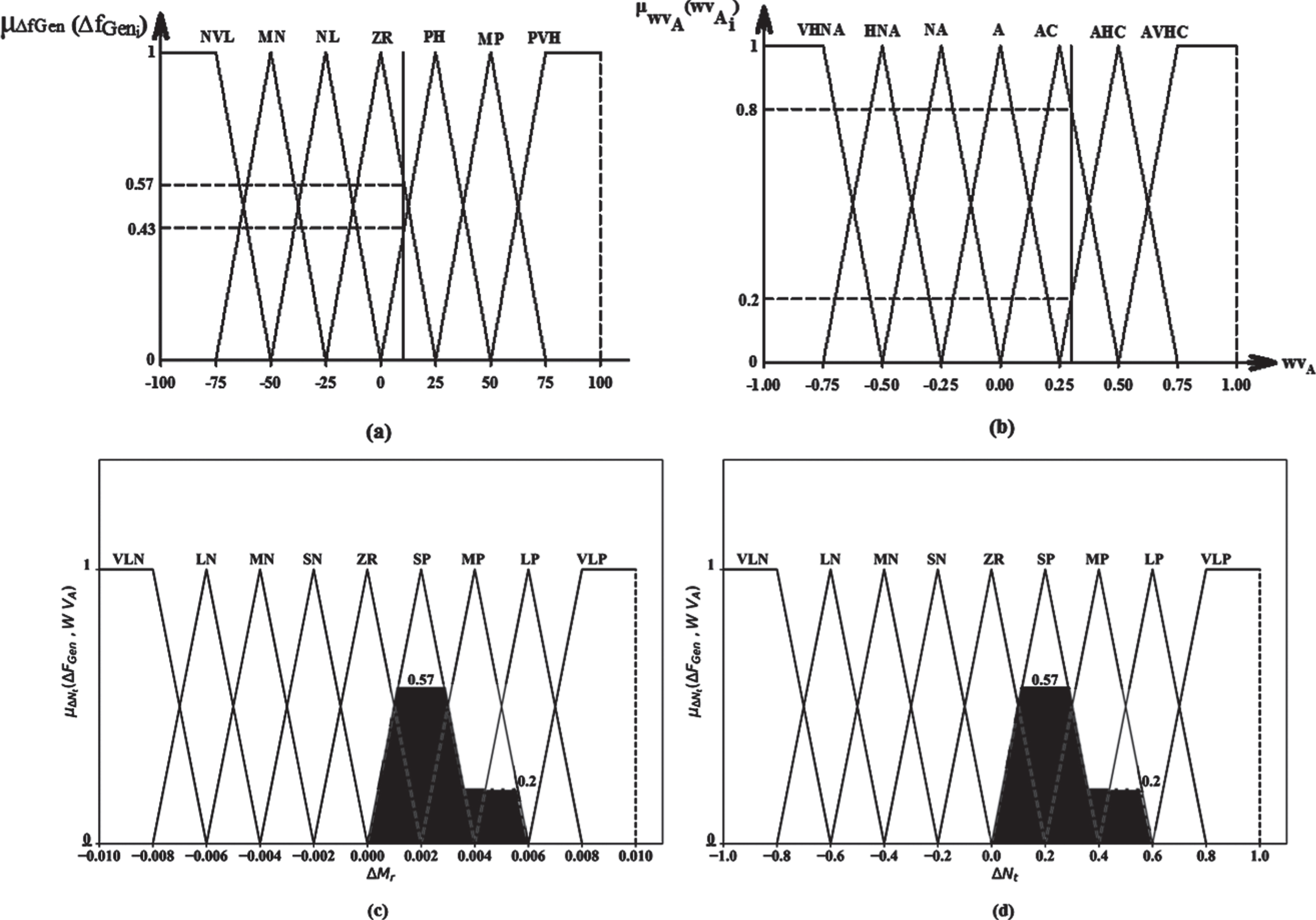
Membership Function Values of Fuzzy input and output linguistic variable: (a) Membership Function Values of Fuzzy input (a) degree of fitness variation (ΔF Gen ) and (b) degree of weight – volume agreement constraints (WV A ); Membership Function Values of Fuzzy output (c) Mutation Rate (ΔM r ) and (d) Total number of cargo to be loaded in the truck (ΔN t ).
In this step, Fuzzy output converted into real value using center of area method (COA) which is defined using following equation:
Where, wgt represent weight value, CT represent gravity center, and AR represent individual region area.
For q
th
generation, number of cargo on the truck N
t
and rate of mutation (M
r
) is updated using following equation:
There are 15 kinds of goods waiting to be loaded in the distribution center, and the loading sequence, length, width, height and weight of each kind of goods are shown in Table 3, the internal length, width, height and maximum loading weight of the carriage to be loaded are shown in Table 4. It is required that these goods be properly loaded into the carriage of the vehicle and that the vehicle’s load and volume be fully utilized [21].
Distribution cargo data sheet
Distribution cargo data sheet
Main technical parameters of cargo compartment
First, the number of loading layers B = 3 is estimated. Then, according to the genetic algorithm of single car three-dimensional cargo loading problem, the matlab genetic algorithm toolbox is used to program and solve the above example [22].
Operation process:
Maximum fitness 0.91364 shown in Table 5. As shown in Table 6, the optimal solution is coded as (6,1,5,3,2,4,5,3,4,5,4,5,2,3,1,2,3,2,3,1,2,0,2).
Numerical selectiom of fitness

Code of loading scheme
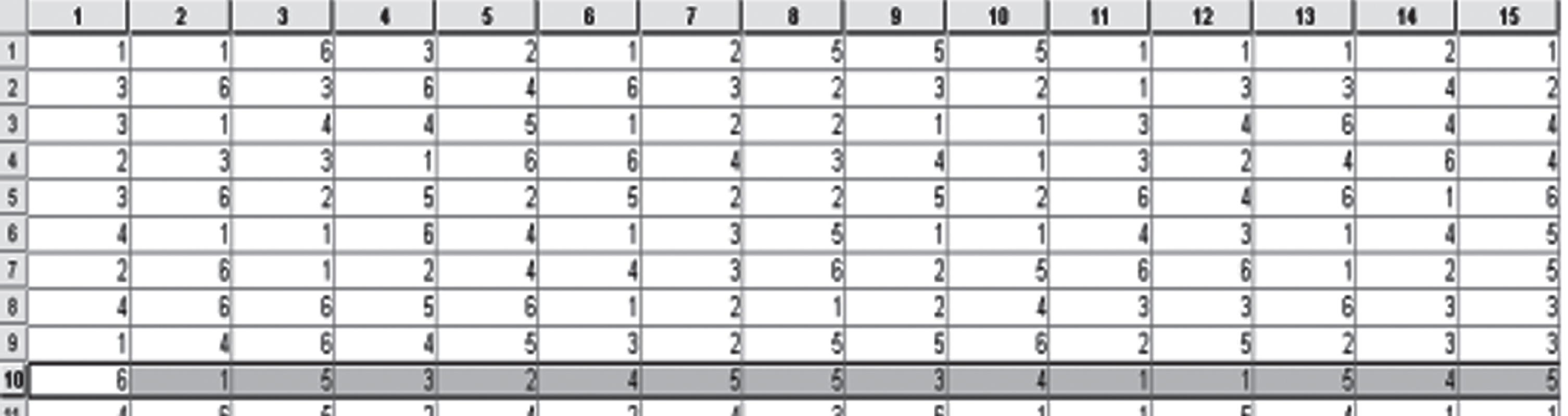
According to the decoding method, the loading mode is (||L,||W,||H;||L,||L,||W;||L,||W,||H;||L,||W,||H;|| L,||W,||H;||L,||W,||H;||L,||W,||H;||L,||W,||H;||L,||W,||H;|| L,||W,||H;||L,||W,||H;||L,||W,||H;||L,||W,||H) if the cargo number is (1,2,3,4,5,6,7,8,9,11,12,13,15)h i l i w i w i h i l i h i l i w i w i h i l i h i w i l i l i w i h i l i h i w i w i h i l i l i h i w i w i l i h i h i l i w i w i h i l i l i w i h i .
We perform simulation For performance evaluation of proposed hybrid GA and FL based cargo-loading decision making model, we use comparative result of proposed model with existing stochastic approaches including Simulated annealing (SA), traditional Genetic algorithm (GA), Tabu Search (TS). We run ten simulation code for each approach and conduct comparative analysis for fitness rate, utilization rate for weight and volume. After simulation execution result is shown in Fig. 3. Form Fig. 3 it is evident that fitness, weight and volume utilization rate of proposed hybrid FL and GA approach are 94.2 %, 84.4% and 97.18 % which is higher than that of GA method (82.1%, 77.3%, 75.5%), SA method (73.4%, 68.1%, 66.9%), and TS method (76.3%, 71.9%, 69.1).
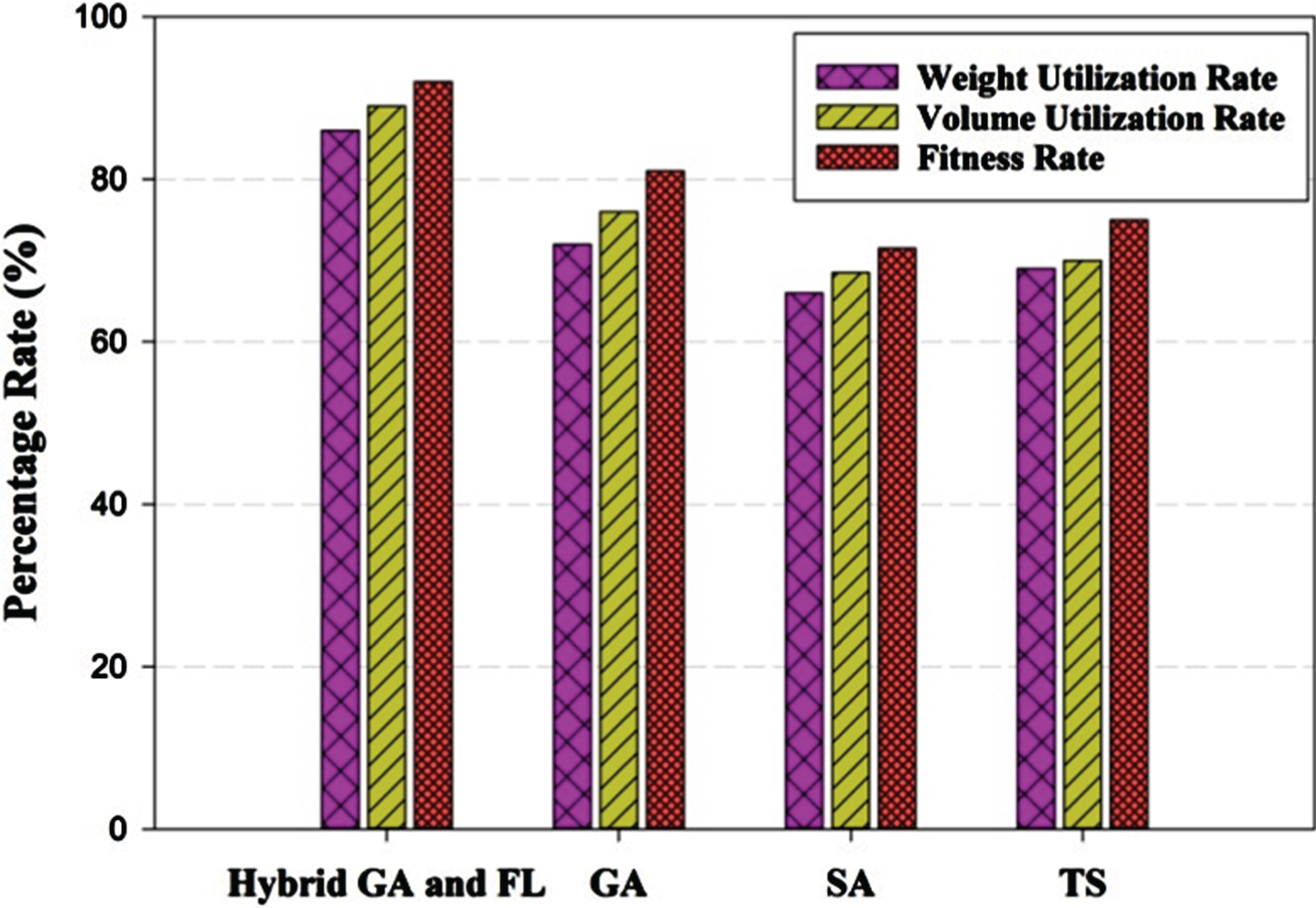
Comparative analysis of proposed model with existing Approach.
In this paper, we propose hybrid genetic and fuzzy based cargo-loading decision making model to achieve maximum profit, with maximum weight and volume utilization of both cargo and truck. The standard model application of GA makes potential substitute of the ad hoc technique used by the business industry and can analytically produce optimized result with maximum profit over repetitive iterations but overlooked weight and volume consumption utilization. In order utilize maximum weight and volume consumption, with profit we integrate fuzzy logic inside GA that incarcerate presented industry proficiency of the experts in the form of implicit information. This information is now implanted in the fuzzy control system in the term of fuzzy rules inside fuzzy interference interface. From the performance evaluation analysis, proposed the hybrid system achieve better outcomes than the standard SA model, GA method, and TS strategy. From result it was proved that fuzzy integrated GA model become more constructive to cargo transporter in its capability to offer maximum profit per cargo-loading. There are some boundaries of this proposed approach that can explore further. In the proposed approach, we perform the simulation over standard size and shape based cargo while in reality shape, size aand capacity of cargo varies according to volume and weight. So, there is scope for further research to extend this work with different real time industrial scenario and situation.