



Abstract
Artificial Intelligence based Fuzzy Importance Performance Analysis Model (AFIPA)With the transformation of economic system, migrant workers transfer employment from underdeveloped areas to economically developed areas, and children’s reading has become one of the important things for migrant workers and families. With the increase of children in the immigration area year by year, the pressure on education in the immigration area has gradually increased, which has become one of the social problems to be solved by the government in the immigration area. The speed of school construction cannot keep up with the growth of children, and because it takes up a lot of resources, funds and manpower, the government is not very enthusiasticin the immigration area. The stakeholders involved are always playing a game. How to achieve the best state is a difficult problem. After the central government’s policywereissuedabout solving the enrollment problem of migrant workers’children in school, local acceptance criteria for admitting migrant children to school were formulated. However, when lowering the admission threshold, all localities always look to other areas for fear of falling too low to become a basin of confluence, which cause an unbearable burden. In this paper fuzzy based analytic theory has been analysed Through the game analysis of various stakeholders, and taking Shengze Town, Jiangsu Province as an example, this paper puts forward some fuzzy policy suggestions, hoping to provide some new experience in promoting migrant children’s education in the future.
Introduction
Under the current background of balanced development of education in China, the value orientation of performance and equity has always been in a dynamic development game situation in the process of formulating and perfecting education policies by our government departments. The school attendance of migrant workers’children has always been one of the important issues in the development of education in China [1]. In order to promote the coordinated development of education and fairness for the children of migrant workers, it is of great theoretical and practical significance to analyze and arrange the educational system by using game theory, and finally formulate a policy and suggestion to promote the development of migrant students’schooling in China.
Current situation of the performance and equity of migrant students in school
Through sorting out and analyzing some basic data, this paper finds that migrant students in China are facing some problems, includingthe low educational performance and inequity. After summarizing and analyzing, it can be summarized as follows:
Problems of education equity
Firstly, the problems of tuition feesrestriction. With the transformation of economic system, migrant workers are transferring employment from underdeveloped areas to economically developed areas. Children’s study has also set up one of the important things of migrant families. At first, a family worker is working outside, a labor force is working at the home, there are many children left behind in the home, and they study in the local area, but after parents go out to work, the children follow their parents. There are two advantages, on the one hand, children can be taken care of by their parents, and on the other hand, the quality of education is good in developed areas. According to the survey, nearly 80% of parents want their children to receive education in the city, but most people say that high borrowing fees are the main obstacle to children’s enrollment in many cities [2]. Although our country has strengthened the management of students’illegal collection of school selection fees and other issues, but these problems cannot be stopped. For some families of migrant workers, this part of school-choosing fee will bring enormous economic pressure to the families of migrant workers, which indirectly deprives the right to education of their children.
Secondly, the admission procedures are complex. At present, many schools need multiple certificates from parents if they want to receive the same education as urban children, these certificates include residence permit of parents or guardians, employment certificate, certificate issued by the local government of the town where the household registration is located, certificate of social insurance for a certain period of time, household registration certificate, etc. Many migrant workers maintains that they will encounter many problems in the process of processing these documents, which invisibly raises the threshold for their children to enter the city and reduces the chances for a large number of their children to enter the city public schools.
Thirdly, theeducationinstitutional constricts the migrant workers’children education opportunities. Due to the obstruction of the household registration system and the restriction of its own economic conditions, educational opportunities are limited [3]. In the past two sessions, in various media, voices have been issued to improve the school enrolment of migrant workers’children. The central government has also issued three orders and five requests to local governments to solve the school enrolment problem of migrant workers’ children in cities, requiring that the government should be mainly public and the local government should be the main body. But the central government’s policies are difficult to implement, and many institutional bottlenecks exist. Local finances are unable or unwilling to bear the cost of education inflows to children. The examination system and household registration system are also involved in attending high school and university. After the central government’s policy was issued on solving the enrolment problem of migrant workers’children in school, local acceptance standards for migrant workers’ children were formulated. However, due to the need to occupy a large quantity of resources, the enthusiasm of the local government is not high, so when lowering the admission threshold, all localities always look at other areas for fear of falling too low to become a basin of confluence, thus causing an unbearable burden.
Problems of educational performance
First, educational resources are unevenly distributed. In the process of allocating educational resources in our country, it often shows that we attach great importance to cities and rural areas, attach importance to higher education and neglect basic education, which eventually leads to the imbalance of educational value and structure in our country [4]. This directly leads to the regional disparity and the urban-rural disparity in the process of receiving education between the migrant children and the urban children in our country. Some educational departments in China will adopt different standards in terms of school-running conditions, school-running funds and the allocation of teachers in urban and rural areas. Limited education funds will be used in key public schools in cities. For some students in remote rural areas, it is impossible to enjoy compulsory education resources equal to those of urban school-age children.
Secondly, there are problems in educational concept. At present, migrant students in China mainly come from rural areas. In rural areas of China, the concept of economy and education is very backward, which leads to the weak learning foundation of many students. After entering urban schools, there are some differences in the curriculum standards between urban and rural areas, teachers’teaching concepts (TTC), teaching methods (TM) and school evaluation methods(SEM). Even if the children who move with them enter the city public schools, some schools, in order not to affect their own enrolment rate, will separate these children into a class, without considering the test results of the children who move with them in the examination. Under the influence of this practice, many children who move with them have inferiority and timidity in the process of learning. Finally, they cannot learn well, so there is no such thing. Teaching performance is remarkable.
Analysis of game theory framework of migrant students’schooling based on performance and fairness
Introduction of game theory (GT)
Game theory is a theory that maximizes the interests of the participants by comparing and analyzing the strategies they choose under the assumption of complete rationality. Game theory regards the fully rational person as the hypothesis premise, and the participants take the pursuit of their own interests as the goal. In the game, it is very important for the participants to win by taking certain measures, and the most important content of the game theory is that the fully rational person uses the optimal strategy and can bring the greatest benefit to himself.
Theoretical assumptions
When using game theory to analyze the fairness and performance between migrantchildren and urban children, we firstly need to assume that migrant children and urban children are the two sides of the game. In other words, both of them belong to rational economic peoplein the game model, andthey need to make certain decisions in order to maximize their own interestsin the process of game. Many stakeholders are involved in the game analysis of migrant students’schooling based on performance and equity. These stakeholders mainly include parents, students, schools, teachers and the government [5]. These stakeholders have different choices of performance and fairness. In this game model, it is assumed that the stakeholders’choice of performance and fairness is to maximize their interests, the choice of performance or fairness depends on which aspect can achieve the greatest benefits.
Game model analysis
Migrant students pursue the fairness of education, while urban children pursue the reduction of foreign competition. At the same time, we assume that if migrant students go to school in the city, then urban children’s access to school will be reduced, and their personal interests will be reduced [6]. If migrant students are not enrolled in the city, they have to return to their place of residence for education, and their own interests will decline. Therefore, in order to achieve a win-win situation with urban children and not harm the interests of the other side, migrant students need to play a game of interests, so as to formulate a fair policy, so that the interests of both sides can be guaranteed. In this way, the mixed strategic game matrix of both sides is shown in Table 2 below.
As can be seen from Table 1, if migrant children receive compulsory education, their education will be the same as that of urban children. While they compete fairly, the interests of both sides will decline, and their benefits will be 5. If migrant children are not educated in cities, their benefits are all zero. However, whether or not urban children are allowed to receive urban education, they do not need to compete passively, so the benefits are 10.
Profit matrix of game Theory
Profit matrix of game Theory
Benefit Matrix of Migrant children and Urban Children
From the above game model, we can see that in order to maximize their own interests, urban children are unwilling to send their children to the city for education, so they cannot receive education in the city, and their benefits are 0. If migrant children are educated in cities, then they will compete with urban children, and the benefits of both sides will be 5 [7], which will achieve a balanced state. Therefore, the resettlement policy of the local government to the migrant children studying in the city is the equilibrium point of the game between the two sides. Therefore, accelerating the implementation of the policy of the local government to resettle migrant children to receive education in the city is the inevitable choice for both sides of the game to achieve the effect of non-zero-sum game.
Regardless of the stakeholders, without considering some external factors, this paper suggests that the Prisoner’s Dilemma Model in Game Theory can be used to design the game matrix of performance and fairness, as shown in Fig. 1 below.
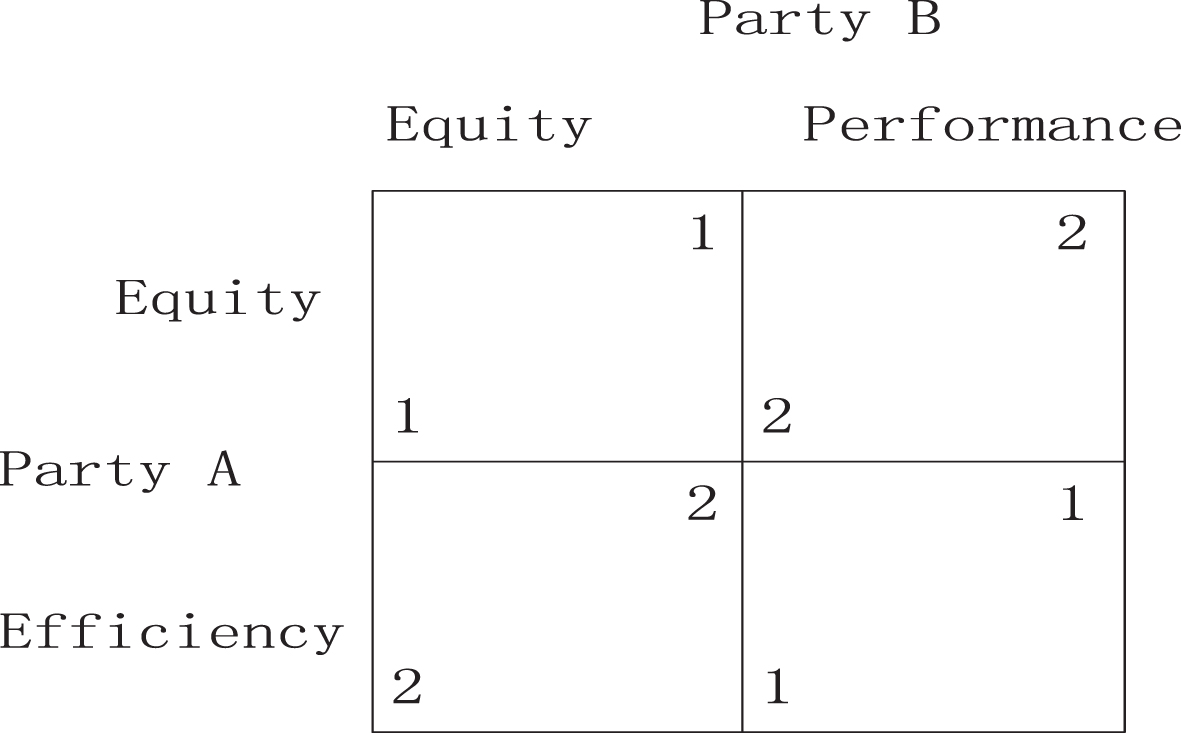
Game Matrix Diagram.
In Fig. 1, it is assumed that A and B refer to the stakeholders involved in the development of education, namely students, parents, schools and the government [8]. The numbers in the game matrix in Fig. 1 show that A and B are paid for choosing fairness or performance. The larger the payment, the more advantageous it is for the development of the players in the game. There are four strategic combinations in Fig. 1 above, but the payment required for both parties to choose fairness or performance in the game matrix is the same. There are two strategic combinations in the whole game matrix, namely (1, 1) and (2, 2). The main reason for this is that these don’t take external factors into account. In this case, there is no way to judge whether the stakeholders choose fairness or the size of the payment for performance, which is equal to the participants. Game participants are equal. Participants’different choices will be higher than the choice of fairness or performance, because they are completely rational participants in the process of balanced development of education. The ultimate goal of participants’ choices is to maximize their own interests. Therefore, different strategies will be chosen for the final emergence of A and B, then the final strategy combination is (2, 2). In order to promote the development of education in China, it is necessary to make a consideration to fairness and efficiency in the process of migrant students’study.
Figure 1 is a game matrix formed without considering external factors. It belongs to an ideal game state. But in real life, every participant is affected by the external environment when choosing fairness or performance. Participants’preference for fairness and efficiency mainly has three situations: the first is fairness priority, making a consideration to performance; the second is performance priority, making consideration to fairness; and the third is the coordinated development of fairness and performance.
Firstly, the two situations of fair priority and performance priority are discussed separately. In Fig. 2, when participants choose fair priority, there will be two combinations. That is (fairness, high performance) and (fairness, low performance). Then we assign benefits to these two portfolios: (fairness, high performance) for (6, 5); (fairness, low performance) for (4, 1). In the case of fair priority, there will be some problems when migrant students enjoy equal rights and interests in education. When choosing fairness as the main factor, it may make the use of educational resources inefficient. At present, although the total amount of educational resources in China has increased greatly, there is a lack of high-quality educational resources [9, 10]. The lower utilization rate of educational resources will make the limited educational resources not be fully utilized, which will hinder the balanced development of education in China.
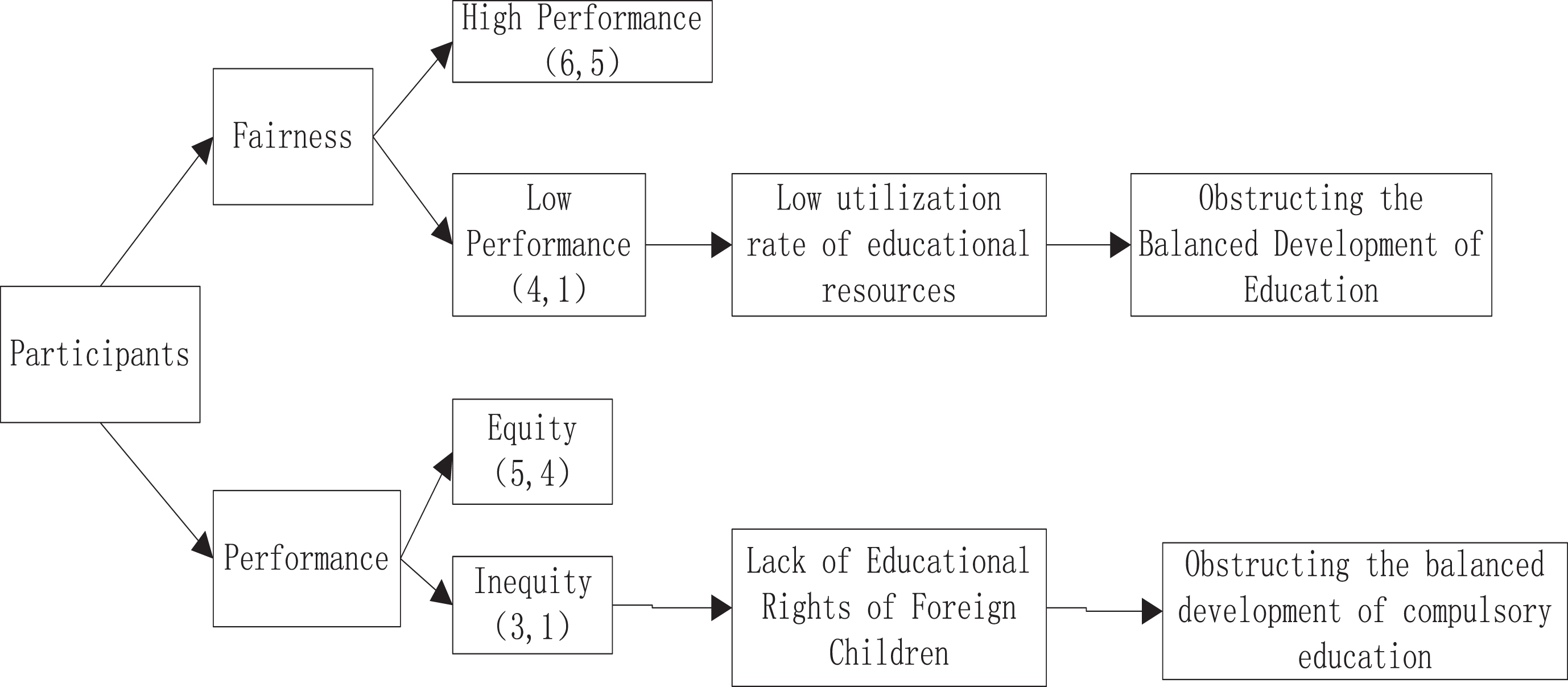
Fair Priority Game Diagram.
Then we analyze the situation of performance priority. When participants choose performance priority, there are also two strategic combination strategies, namely (performance, fairness) and (performance, inequity). In order to distinguish it from fair priority, it is necessary to assign the strategic portfolio of performance priority. We assign (performance, fairness) to (5, 4) and (performance, unfairness) to (3, 1). Then we can see from Fig. 2 that when participants choose performance, if there is a fair situation, then the game model will choose the relatively optimal strategic combination (5, 4). At this time, the participants will maximize their own interests to a certain extent. Performance priority can play a greater role in the current situation of insufficient educational resources and low utilization rate in China. To a certain extent, it can alleviate the problem of insufficient educational resources in China, and optimize the distribution structure of educational resources in China.
Finally, we analyze the game model of fairness and performance, as shown in Fig. 3 below.

Game model with equal emphasis on fairness and performance.
From Fig. 3, we can see that the game model with equal emphasis on fairness and performance may appear (fairness, inefficiency), (fairness, high performance) and (unfairness, low performance). These three combinations are not conducive to the balanced development of education. These combinations may lead to the low utilization rate of educational resources in China, and cannot give full play to the limited educational resources in China and the right to education of migrant children. The lack of benefits leads to the inequity of education and finally hinders the balanced development of migrant children’s education in China.
In summary, the game model that pays equal attention to fairness and performance cannot maximize the interests of participants. Therefore, we can change the “payment function” in the game model, change the unfair situation and improve the performance through some policy incentives to achieve the optimal strategy results of balanced development of education in China [11, 12]. Through some policy incentives, the game portfolio achieves the optimal state. In the new round of games, we need to change the “payment function” and adjust the game structure again, which will further promote the balanced development of education of migrant children in China.
Artificial intelligence-based F-IPA is the method used for quality measuring services of firms, and opportunities are improved and strategic scheduling can be supported. The person introducing the IPA method, Martilla and James determines the company’s product and services which carries on customer satisfaction. For customer satisfaction, the importance and attribute of performance are linear and symmetrical, they are associated with IPA. It also focuses on the benefit in importance and evaluation of the performance of the particular feature of the service consumed between customers. The objective of this paper is to determine that characteristics have a more effective effect on customer satisfaction and lead to recurrent purchasing behaviour. Two sections are classified on the basis of the predetermined attribute as shown in the Fig. 4.
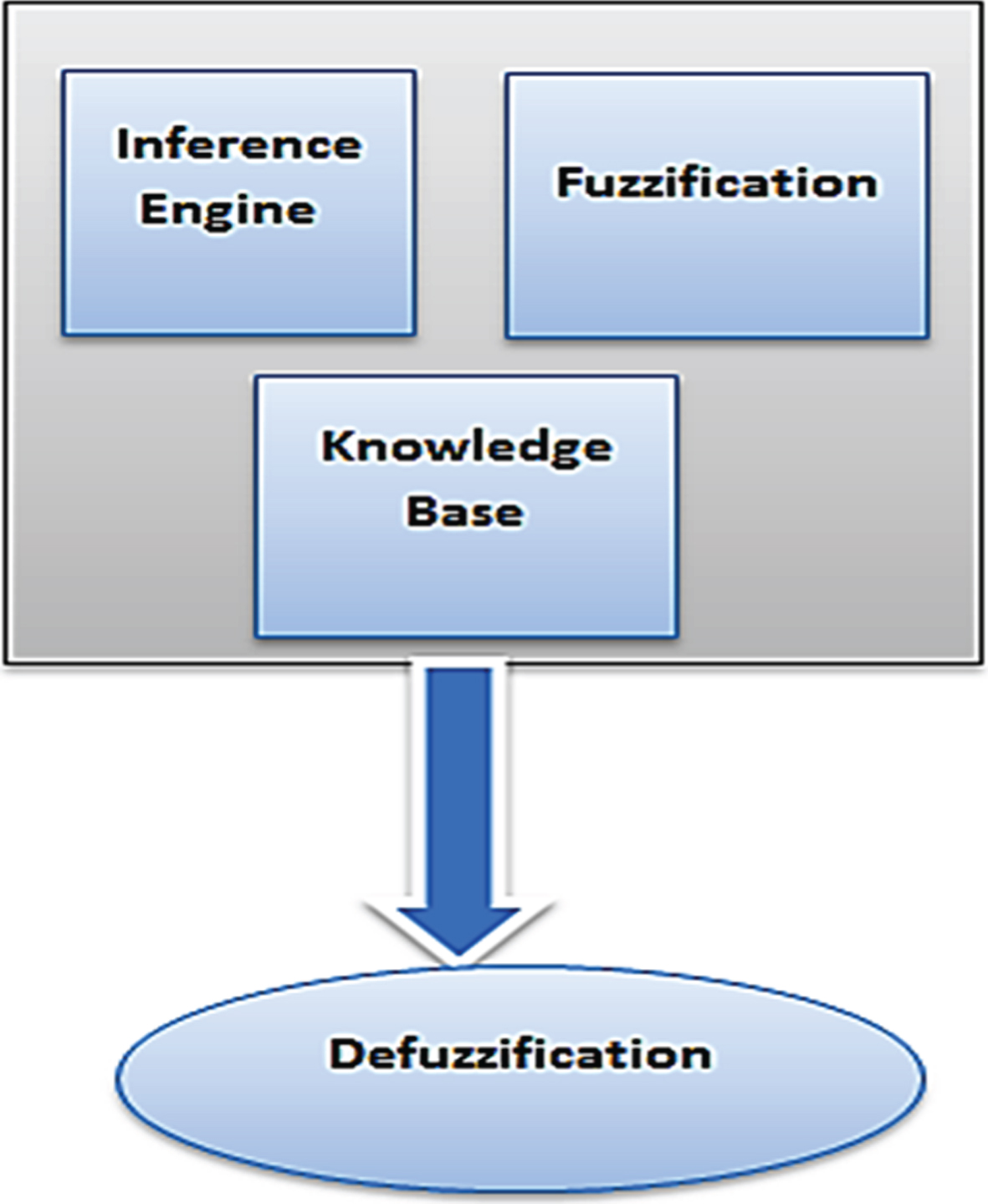
Fuzzy Rule Based Expert System.
the significance of each function its performance judgments.
Thus, when using fuzzy number sets, certain linguistic variables are represented.
As shown in Equation (1) μ D (y) is called membership function y in D. the membership function may varies between 0 and 1, which shows the mapping of input space.
Fuzzy expert system constitutes the membership function and the basic rules using As shown in the Fig. 2.2 The expert system contains of fuzzification, fuzzy inference system, knowledge base, defuzzification procedures resulting in the improvement of basic fuzzy rule. The merit of the comprehensive of fuzzy with fuzzy expert system is that it improves the making decision efficienctly of the expert system.
Statement 1: Fuzzy Set
Let Y is the universe of discourse,
Statement 2: Fuzzy Number
The fuzzy number
Statement 3: Triangular Fuzzy Numbers
TFN
The basic mathematical operations of the triangular fuzzy set numbers are shown in the following Equations (2), (3) for Fuzzy Game Analysis of Migrant students
Fuzzy number Addition operation,
Fuzzy number Multiplication operation,
Statement 4: A linguistic variable is distinguished by quinary (y, T(y), S, H,
Statement 5: Yager’s ranking method: Let Y ={ y1, y2, … . . y k }i = 1,2 ... k is set of substitutes, The yager’s ranking method goal is to obtain the fuzzy set Hj.
The acquirement of goal by option is derived by membership function mij. The point of intersection is Q fuzzy set decision can be expressed as μQ (yi) = min {μij (yi)} Yager ranking method allows for various importance of the aim and derived this by exponentially ranking the membership function of the goals. Analytic Hierarchy Process (AHP) model is used to find the importance weights Equation (4) shows the intersection of the fuzzy sets,
Where w is the importance weight.
We proposed new method of evaluating weapon system using AHP with fuzzy sets based on yager’s ranking method.
The diagnosis improved model contains of following 6 rules: Diagnosis = (Subject, Test, Topics, Cognitive Features, Behaviour, Decipherer) Subject: it is the field of knowledge that one wishes to evaluate and which the students learning Profile will be determined. Test: test is the process of evaluating studentsknowledge based on the differents test results i.e) computer test. Set of tests Topics: set of topics. Topics included that one wishes to evaluate T =s
i
/S
i
∈ subjects, s
i
= objective
i
, name
i
Cognitive Features: Level of knowledge is identified. Afterwards motivation will be added. The Behavior is saves the students test results characterized considering for every topic s
i
and test n tests t
ij
and the evaluated result r
ij
and the date of the evaluation e
ij
.
The Decipherer is the evidence of the students behavior in Cognitive profile. This function is depending on the hybridized fuzzy inference basic system. In Fig. (5) fundamental Fuzzy system.
As shown in the Fig. 1 fundamental fuzzy system basic procedures for fuzzification is where the input of application area is given into the fuzzy set. Therefore defuzzification procedures defines the translation of fuzzy set to outputs. Hybridized fuzzy inference system has been used for the defuzzification conditions for for Fuzzy Game Analysis of Migrant students.
The input of the application field to be taken has fuzzification into fuzzy set. The Fuzzy set L on an object universe Y is refers through its connecting function, it defined by the period [0,1] the function is μ L , Y → [0, 1] . μ L (Y) is denotes the connecting function of each parts Y to tha fuzzy sets.
The fuzzy set rules contains IF-THEN rules. For example If (very acceptable measure of approval) and (final grade in reference to the course’s average above average) and (growing marks succession) Then (high level of knowledge) The fuzzy set rule has four variable: (i) measure of approval, (ii) final grade in reference to the course’s average above average, (iii) level of knowledge, (iv) mark succession. Furthermore, linguistic values are Very Acceptable, Growing, High, above average these are the four fuzzy sets. The hybridized fuzzy inference system denotes the output defuzzified respectively linguistic values. Then the fuzzy inference system engine process the basic fuzzy set rules to identified the linguistic values for the output. The defuzzifier produces the estimated output for forFuzzy Game Analysis of Migrant students. The Decipherer function, the input data is the perceptible evidence of the student’s behaviour and it will be used to value certain students cognitive profile.
As shown in the Fig. 6 defined the Diagnosis improved model and decipherer function for the student evaluation

Fundamental fuzzy system.
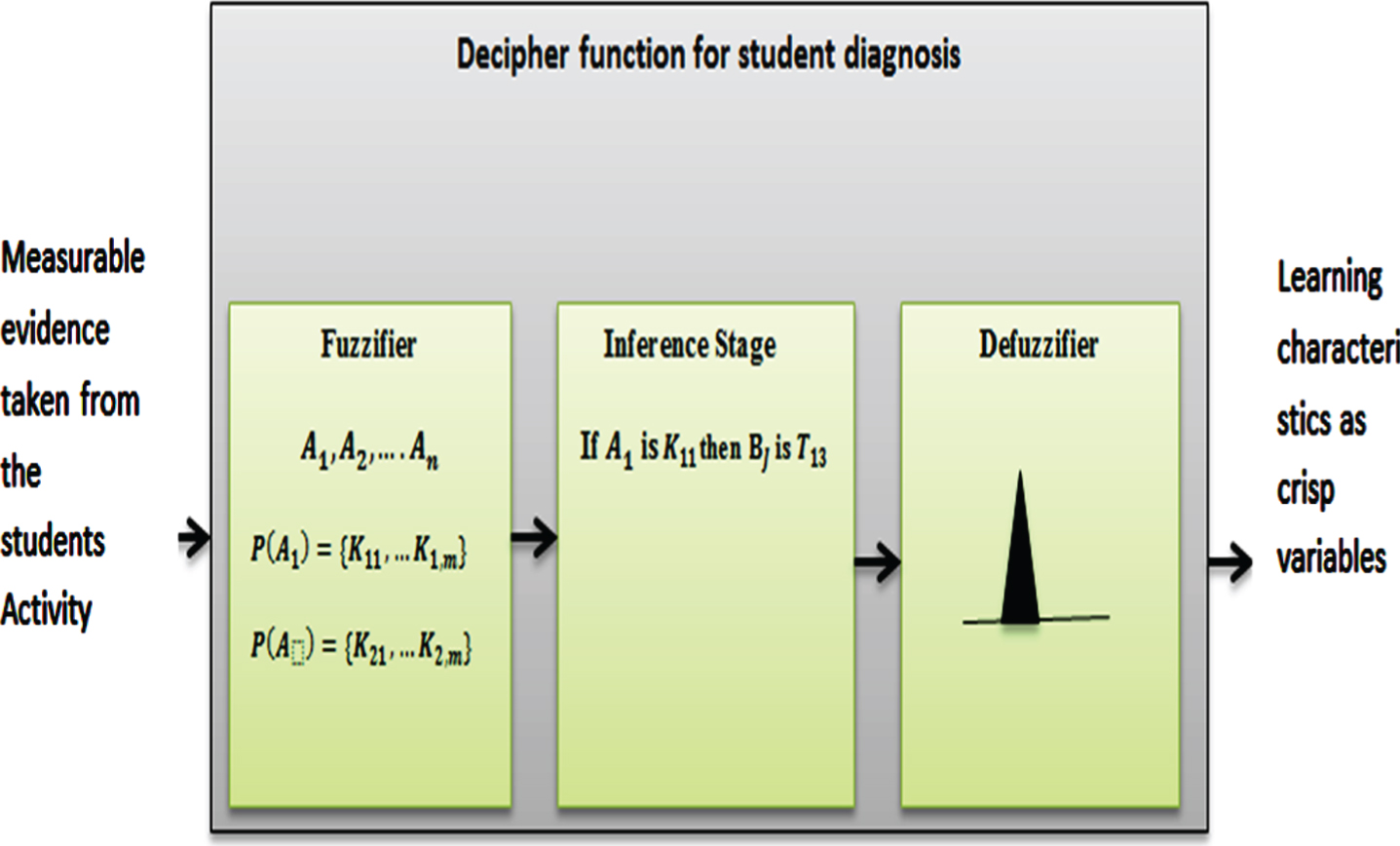
Diagnosis improved Model.
Where A1, A2, … . An is measurable evidence of the subject and test and the linguistic variable value is T (Ai) ={ Ki1, … K1,n } in terms of fuzzy set.
The Hybridized fuzzy inference system constitutes the teachers to find approximate classify the students based on the cognitive profile. The approximate description of the student categories denotes with linguistic value X k . Every student can take on different linguistic values T (X k )=T1s, T2s, … . T ns .
The Defuzzification outputs describes the teacher’s final conclusion when it classifies the students in one of the values T1s, T2s, … . T ns .
This research article has the main objective of reducing the complicaton of the fuzzy expert system for Fuzzy Game Analysis of Migrant students. In data mining, the very vital research problem is the Minuing association rule. The hidden association rules would have been found by using the Mining association rule At the same time, which can be affect the involvement of students and on the basis of this fuzzy system can be employed which helps to analyse and guidance of the students’ experimental performance.
The widely used method in customer satisfaction, business analysis, medical field and other real time applications are Mining Association Rule. The mining rule is used to find the hidden fuzzy set that takes place continuously it correlated with large datasets. The mining association rule has different algorithm like Apriori, Apriori TID and Apriori Hybrid algorithms. In this research paper the hidden association that appears continuously in dataset is determined by using apriori algorithm. if they satisfy the minimal, threshold of support and threshold of confidence, the very weighted association rules are introduced since it is complicated. The mining association rule is stated asa instant of M occurs then N having confidence level also appears.
M → N, where M∩ N ≠ ∅
•
Support: it states that the transactions percentage (p %) in X includes the M and N union item set.
Confidence: it defines the transactions percentage (g %) in X includes the M occurs and also N contains item set.
The Aprior algorithm involves two views, Determine all small support item sets occurs frequently. Create the strong association rules on the basis of that frequent item sets.
There are two procedures for data mining, Self-Join: by joining the frequent item sets in step by step, the candidate sets are created. Prune: Here resulting set from join is filtered with minimum support threshold. Frequent item sets ae determined by scaning the datbase. Joining process is done for candidate generation which induces to get the frequent item set at various other levels. Pruning process is done if frequent item sets at every level is not identified and likewise not accept the small threshold of support. If there are no frequent item sets left, then End the process of algorithm.
At the end, the result basis often item sets, the weighted association mining rules are created mining rules that satisfies the conditions of minimal confidence and support threshold value.
IF-THEN statement: To Validate the conditional statements using if-then rule statements that constitutes fuzzy logic. Linguistic variable: are the variables that values may either sentences or words in a It is also either in natural and synthetic language.
A fuzzy set D in Y is defined by the formula μ D (Y) J = medium only If L value is low and the K value is High where L, J and k are inputs and output respectively. The values low, high and medium is the fuzzy sets defined on L, K and J correspondingly. The set of rules defined in the fuzzy expert system is stored in working memory that is knowledge base. Furthermore, the fuzzy expert system rules are user interface easy to get knowledge and share the results. It is used to find the uncertain data that express in 0 and 1. In this paper fuzzy based analytic theory has been analysed Through the game analysis of various stakeholders, and taking Shengze Town, Jiangsu Province as an example, this paper puts forward some fuzzy policy suggestions, hoping to provide some new experience in promoting migrant children’s education in the future. The experimental analysis has been listed as follows.
Through the Numerical analysis of the relationship between fairness and performance of migrant children in school based on the above game models, we can conclude that there are some problems whether fairness priority, performance priority, or equal emphasis on fairness and performance [13, 14]. Therefore, in the process of promoting the balanced development of migrant children’s schooling, we should increase the control of “payment function” and adjust the game structure model to gradually improve the game structure model. In the continuous game, we should find the optimal strategic combination of fairness and performance.
With the requirement of the state to treat migrant children equally to attend school, and the policy of renting and selling houses with the same rights put forward in the future, the pressure of running schools in the places of immigration has gradually increased. Moreover, the better the quality of education is, the more children will flow in. In order to solve this problem, the central and local governments need to work together [15, 16], the financial and social funds should work together, the innovation of school-running mode and the improvement of education quality should work together, and the whole society should pay attention to the promotion. Based on the situation of Shengze, Jiangsu Province, some practical countermeasures and suggestions are put forward.
Strengthen the regulation and control of educational resources
Policy support should be given to the construction of schools in the immigrated areas, such as special land for education and land indicators according to the size of the number of immigrants, and subsidies for education funds according to the number of people, in order to enhance the enthusiasm of local governments in running schools. Educational land and indicators should be allocated separately to avoid the local government using the limited indicators given by superiors to develop the economy in order to develop the economy, thus making the indicators of educational land decreased.
The focus of examination and approval and supervision should be adjusted appropriately, with emphasis on examination and approval but less on management, replacing it with the leading role of relaxing the examination and approval standards appropriately according to the actual situation, and subsequently strengthening supervision to improve the quality of education [17, 18]. At present, the examination and approval of service enterprises and pension institutions can be relaxed to the nature of industrial land. It is suggested that the land nature of education examination and approval can be liberalized to solve the problem of the nature of education land and the biggest bottleneck of examination and approval. We should encourage social capital to set up private schools to make up for the shortcomings of public schools, and at the same time set reasonable charging standards to achieve win-win results. The proposed method meets the requirement that migrant children enjoy the equal right to education shows prominent results than TTC, TM, SEM and GT as shown in the Fig. 7.
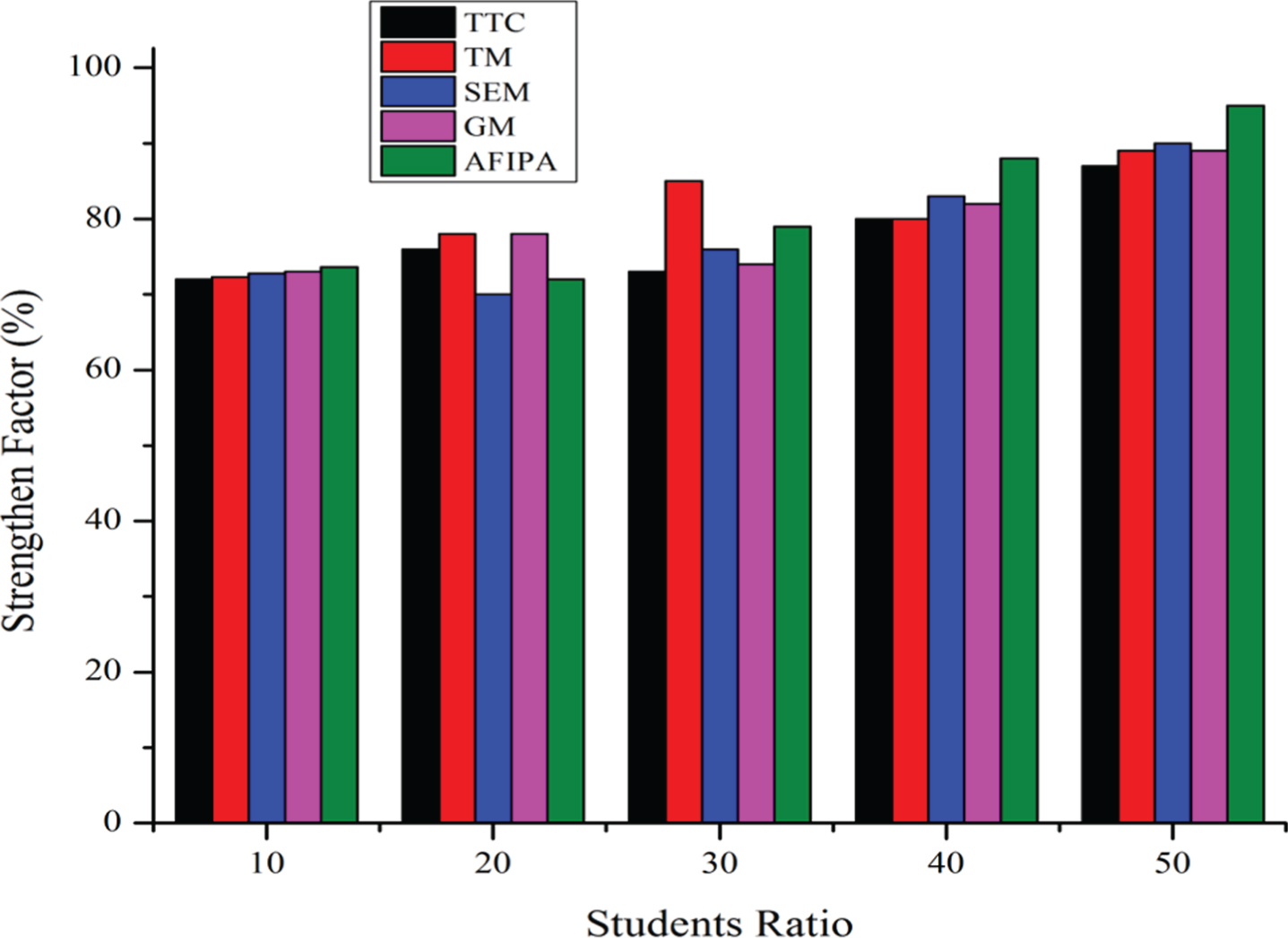
Strengthen factor analysis educational resources.
Explore new models for educational development and enhance the overall capacity for educational development. This paper tries to guarantee the right to receive education in basic education and improve new methods of high-level education. We should adopt the mode of public-run and private-run schools. For example, Shengze Town has 45,000 students, 12,000 local schools and 33,000 migrant students. Among them, 12,000 migrant students study in public schools, which have good hardware and software conditions. The other 21,000 migrant students study in private schools [19, 20]. The conditions are relatively poor. If these private schools are to be upgraded, they need at least 400 mu of land to build schools, of which 250 mu is to rebuild the original schools and 150 mu is to build new schools. However, the current land indicators are tense, and the land price is expensive, which cannot be achieved by ordinary private school investors, so it is feasible to adopt the model of public-owned private schools [12].
From the Fig. 8 the performance of the AFIPA has a premise that it should make a consideration on students’ Enrolment Requirements in public schools, establish state-owned educational investment companies, purchaseidle land and factories, rebuild schools according to the requirements of running schools, and introducebrand education partners in the form of public-owned private enterprises with good Equity factor shows prominent results than TTC, TM, SEM and GT as shown in the Fig. 9.
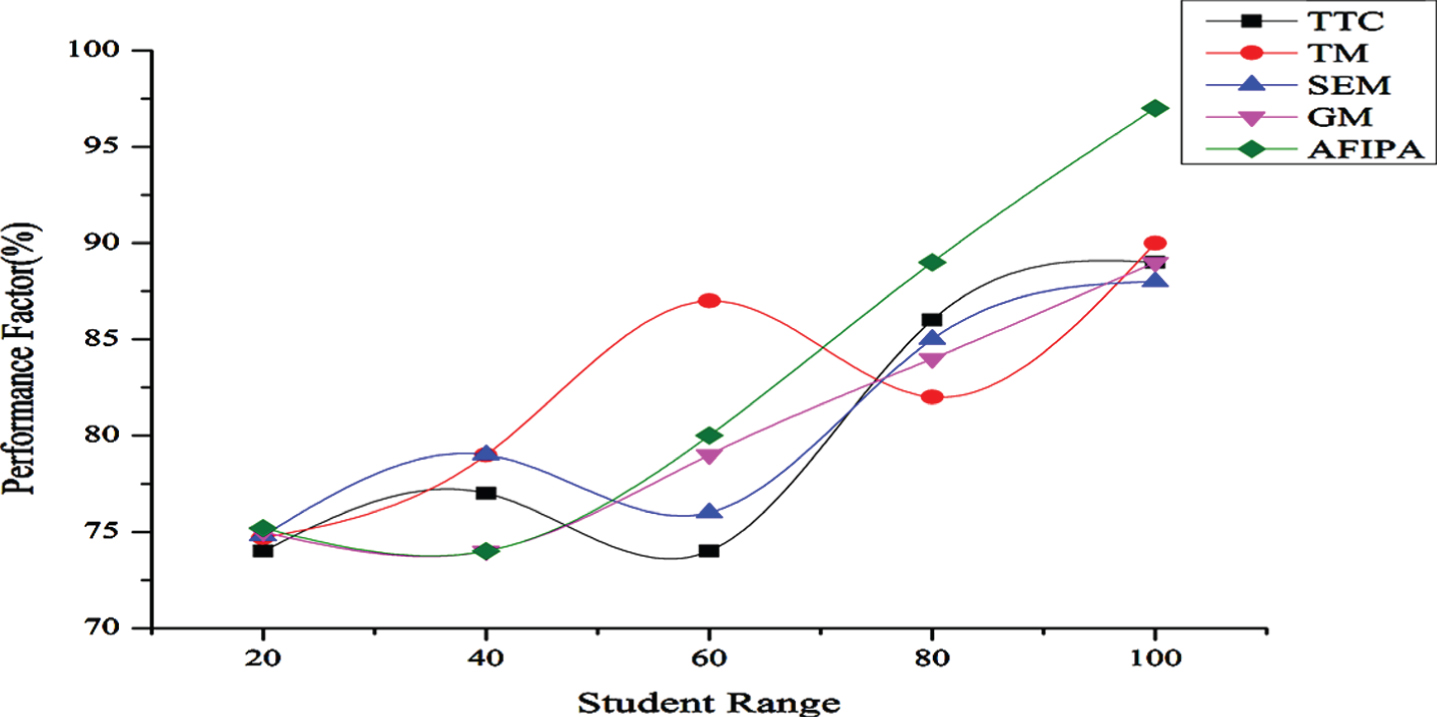
Performance factor analysis educational resources.
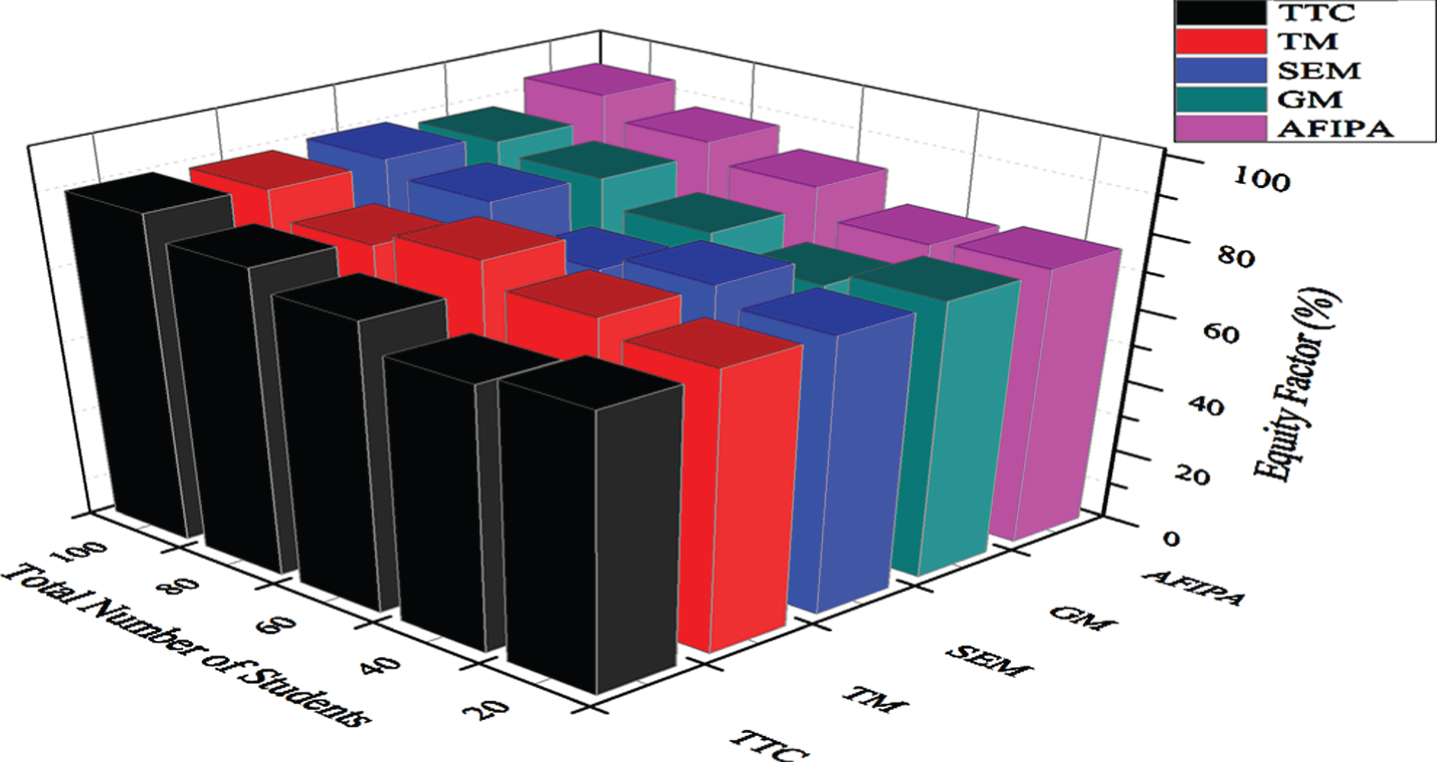
Equity factor analysis educational resources.
Establish a sustainable development model that combines performance and equity. For the two groups whose children do not meet the requirements of enrolment and who need higher education level, we should focus on education development and achieve sustainable development [21]. Firstly, children should have books to read, and then they should read well. We should make a comprehensive and rational distribution of the whole town’s network outlets, including the following aspects: firstly, educational resources in the rural areas are scarce, the urban-rural fringe and the places where foreign personnel are concentrated with basic education; secondly, lay out the high-level teaching spots in the new urban development areas with brand education. There are more than 2600 private enterprises, more than 8000 businesses and more than 10,000 individual households in Shengze, which have a great demand for high-level education. In the past, some entrepreneurs sent their children to high-level schools abroad, Shanghai and Suzhou for training. For those who need high-level education, we should introduce university resources and social capital to build private brand schools alone or jointly; for those who do not meet the local enrolment requirements, we should build private schools by public or introduce private mechanisms to build or cooperate in the development. After the establishment of new private schools, scattered and informal school-running points will be integrated and upgraded. Through this measure, on the one hand, we can solve the problem that migrant children can’t read books and guarantee students’right to receive education fairly; on the other hand, we can also solve the performance problem of investment in education funds through cooperation in running schools. On the other hand, irregular schools can be renovated through market behaviour. Through competition, illegal and poor private schools can either be eliminated, or constantly upgraded to meet standards, or cooperate to run regular schools together.
Encourage the development of educational groups and gradually expand high-quality educational resources. Educational Group is mainly responsible for its development planning, development scale, management team training, teacher training and selection, performance appraisal, budget and management. Create educational brand and export mode, so that high-quality educational resources gradually expand, from public schools to private schools, thereby greatly improving the quality of education as shown in the Table 3.
Overall quality assessment
Overall quality assessment
Stablity of the algorithm in terms of strength assessment
Strengthen the construction of teaching research and teacher training base to enhance the soft power of education. Teaching research and teacher training is a major focus of education. Teaching research is of great significance. Developing new teaching models and teaching contents according to local conditions is an important basis for deepening quality education. The cultivation of managerial talents and excellent teachers in schools needs to establish a system and mechanism, the guidance of campus culture and the establishment of a talent cultivation brand. Shengze Town has a certain foundation, so the governmentcan take the existing block teaching and research room as the research carrier, further expand to all disciplines research function, and with the teacher training function, expand into teaching research and teacher training base mainly in Shengze, covering the entire teaching chain (preschool-kindergarten-primary school-junior high school-secondary technical secondary school-university cooperation-society). Integrating the research resources in various schools, developing new teaching concepts and curricula, and cultivating excellent managerial talents and teachers, it can be used as one of the bases for the performance appraisal of teachers, the evaluation of excellent courses, the evaluation of professional titles and the evaluation of excellence. Teaching research and teacher training base construction can be an important measure to enhance Shengze’s soft power of education, and it is also a source of impetus for the development and promotion of education.
The achievements of teaching research are patented and applied in Shengze and the whole region. The outstanding talents trained are allocated to schools to play an exemplary leading role. Shengze has 1561 teachers in public schools, 1165 teachers in private schools and over 300 teachers in social training institutions. The total number of teachers is more than 3,000. Quality improvement is very important. It directly affects the education level of 45,000 students in Shengze. Therefore, it is very necessary and important to establish a teacher training base. The training covers all teachers in all public, private and social training institutions, so as to enhance the overall strength of the teachers.
Education is the foundation of a century-long plan, and the country is strong. Education is an important way. But the reality is that there are still a large number of migrant children and left-behind children whose educational needs and quality need to be solved. Especially, the problem of children who move into employment with their parents is a big problem. If these children are not well educated, whether they stay in the place of immigration or return in the future. Moving out of the country will be a hidden danger of social stability. This paper uses Artificial Intelligence based Fuzzy Importance Performance Analysis Model (AFIPA) which replaces manual labor, the number of foreign workers will gradually decrease and transfer. On the one hand, there are obstacles to future transfer because of lack of good education. On the other hand, if the number of foreign workers is transferred, the new schools will be surplus, which will also be a problem in the future.