



Abstract
In this work, modified constant modulus algorithm based on bat algorithm is proposed for wireless sensor communications systems. The bat algorithm is a swarm intelligence optimization algorithm, which mainly used to solve optimization problems. The proposed algorithm focused on modified constant modulus algorithm, which is also applicable to the constant modulus algorithm. The error function of blind equalization algorithm is used as the evaluation function of the bat algorithm, and then the initial value of the weight vector is calculated adaptively by the bat algorithm. Theoretical analysis is provided to illustrate that the proposed algorithm has a faster convergence speed than the original one and is suitable for almost all blind channel equalization algorithms. The simulation results support the newly proposed improved algorithm. The proposed algorithm could be applied to some more complex wireless channel environments to improve the reception performance of sensor communication systems.
Keywords
Introduction
It is well known that inter-symbol interference (ISI) is one of the main obstacles to achieving higher capacity and improving data rates in wireless sensor communication systems. The solution to this problem is to eliminate or reduce ISI caused by multipath delay in wireless communication by channel equalization technology [1]. In the past few years, various channel estimation algorithms and equalization methods [2–10] have been developed to overcome the effects of ISI and compensate for channel distortion. Blind equalization is now the most widely used method for recovering transmitted symbols of superimposed noise without providing the desired response externally [3].
The blind equalization algorithm has more practical significance to resist ISI. These disadvantages of common blind equalization are at the cost of slow convergence speed, high computational complexity and poor equalization performance. Quadrature amplitude modulation (QAM) signal is widely used in communication field because of its high spectrum utilization. Therefore, it is urgent to study the fast convergence, low computational complexity and high accuracy blind equalization algorithm of QAM communication system. The constant modulus algorithm (CMA) [5] is the most classical blind equalization algorithm because of its simplicity, stability and efficiency. However, this method takes a long time to converge and can only reach a moderate level of mean square error (MSE) after convergence, and CMA can’t deal with high-order QAM signal well. Therefore, it may not achieve good system performance.
The researchers propose several valuable solutions [6–10] to this problem. In [6], a variable step size (VSS) technique was proposed and applied to the CMA of 16-QAM signals, which improved the performance of the equalizer to a certain extent. However, higher-order QAM signals don’t be considered. On this basis, the modified constant modulus algorithm (MCMA) [7] is proposed, which improves the performance of CMA by obtaining a lower steady state MSE. Several other possible methods are swarm intelligence optimization algorithms [11–19] to the problem of channel equalization.
The swarm intelligence optimization algorithm, which is mainly used to solve optimization problems, simulates the swarm behavior of insects, herds, birds and fish swarms. These swarm search for food in a cooperative manner and each member of the swarm learns its own experience to change the direction of search. Common swarm intelligence optimization algorithms include the firefly algorithm (FA) [13], particle swarm algorithm (PSO) [14], genetic algorithm (GA) [15], harmony algorithm (HA) [16] and bat algorithm (BA) [17]. These algorithms have excellent optimization performance and can be used to solve the equalization problem. In [18], authors applied artificial neural network (ANN) trained by PSO to solve non-linear channel equalization problem. The authors’ method optimized not only the weight vector but also the transfer function. Moreover, the algorithm has a better equalization performance than the other ANN based equalizers. In [19], the PSO strategy was used to find the optimum variable step size parameters for CMA-VSS blind equalization scheme. The simulation results presented the enhanced performance brought about the CMA-VSS algorithm incorporating the PSO.
Bat algorithm (BA) is an algorithm based on swarm emission, the time difference between the ears, and changes in echo loudness to create a three-dimensional scene of the surrounding environment.
They can detect distance, direction, type, and even speed of the prey. This algorithm is an iterative optimization technique, initializes a set of random solutions, and then iteratively searches for the optimal solution, and generates a local new solution by random flight around the optimal solution, which strengthens the local search. The algorithm has the characteristics of simple implementation and few parameters, and has become a research focus of heuristic algorithms in recent years. BA combines the best features of PSO, GA and HA, so it is far superior to other algorithms in terms of accuracy and effectiveness. After that, many improved bat algorithms [20–27] have been proposed, but all of them increase the complexity to some extent.
As is known to all, the step size and the initial value of the weight vector play an important role in determining the convergence time and the steady-state MSE [28–30]. At present, most equalization algorithms improve equalization performance by optimizing step size. In this paper, we focus on MCMA and propose an adaptive blind equalization algorithm based on bat Algorithm for the wireless communication systems employing QAM signal. the initial value of the weight vector is optimized using bat algorithm. Specifically, the error function of MCMA (or CMA) is used as the evaluation function of the bat algorithm, and then the initial value of the weight vector is calculated adaptively by the bat algorithm. The weight vector obtained by this method make the signals passing through the wireless channel closer to the original signals. The method is applicable to almost all blind channel equalization algorithms. MCMA based on Bat Algorithm has significant improvements in equalization performance over the original MCMA through simulation analysis. It could furtherly improve the convergence speed and don’t affect the performance of the original algorithm.
This paper first introduces the basic concept and algorithm overview of the blind equalization algorithm and the bat algorithm, and then proposes the blind equalization algorithm based on the bat algorithm, and verifies the algorithm performance through experiments and simulation, finally summarizes the research work of the paper.
Blind equalization
System model
For an adaptive blind channel equalization system, the received signal for the nth symbol interval x (n) can be expressed as
The transmitted sequence s (n) takes the value from the QAM signal set. v (n) is additive white gaussian noise (AWGN). The actual equalizer output can be written as
The cost function of CMA is given as
And the updating formula is
The MCMA [7] changes the cost function of CMA from real field to complex field, and its cost function has the form
The MCMA equalizer output y (n) can be expressed as
The equalizer weights vector
The error signal e
MCMA
(n) = eMCMA,R (n) + jeMCMA,I (n) is given by
It is not difficult to see that the MCMA comprehensively considers the amplitude and phase equalization, which can correct the phase deflection during transmission to a certain extent and achieve a better equalization effect.
The bat algorithm
The BA uses bats to use ultrasound to detect or locate obstacles, and relates it to optimizing target functions. The bionics principle of the BA maps a certain number of bat individuals to all feasible solutions in a D-dimensional problem space. The optimization and search process is simulated as the bat individual movement process and hunting prey in the population. The fitness function value of the problem is used to measure the bat position. The better feasible solution replaces the poor feasible solution in the iterative process. In the bat search algorithm, in order to simulate bats to detect prey and avoid obstacles, it is necessary to assume the following three approximate or idealized rules: All bats use echolocation to sense distance, and they use a clever way to distinguish between prey and background obstacles. The bat randomly flies at the speed v
i
at the position x
i
, and searches for prey with a fixed frequency fmin, a variable wavelength λ, and a volume A. The bat automatically adjusts the emitted pulse wavelength or frequency and the pulse emission rate r. Although there are many ways to change the volume, in the bat algorithm, it is assumed that the volume A is changed from a maximum value A0 (integer) to a fixed minimum value Amin.
Yang set up a series of rules to update the speed, position and loudness of bats when they look for prey. The mathematical formulas of bat algorithm are as follows,
For the local search part, once a solution x
old
is selected from the current optimal solution, a new solution x
new
is generated for each bat using random walk.
The pseudo code of the bat algorithm is shown in the following Algorithm 1.
In [31], The authors compared the performance of BA, PSO and HA. The results clearly show bat algorithm improves its optimization performance under different conditions compared with other swarm intelligence algorithms. For all the test data sets, the performance of BA outperforms other algorithms.
For MCMA and CMA, the equalization process is also an optimization process. The cost function is used to evaluate the performance of the algorithm. Therefore, MCMA and CMA can be optimized by BA. The weight vector and cost function are bat population and evaluation function of BA algorithm, respectively. Through random flight and continuous iteration, the optimal weight vector is obtained, which is taken as the initial value of the weight vector of MCMA and CMA. The convergence rate of original MCMA and CMA can be greatly accelerated by this method.
In this paper, we take MCMA as examples to verify the performance of the proposed algorithm. The baseband model MCMA based on BA is shown in Fig. 1.
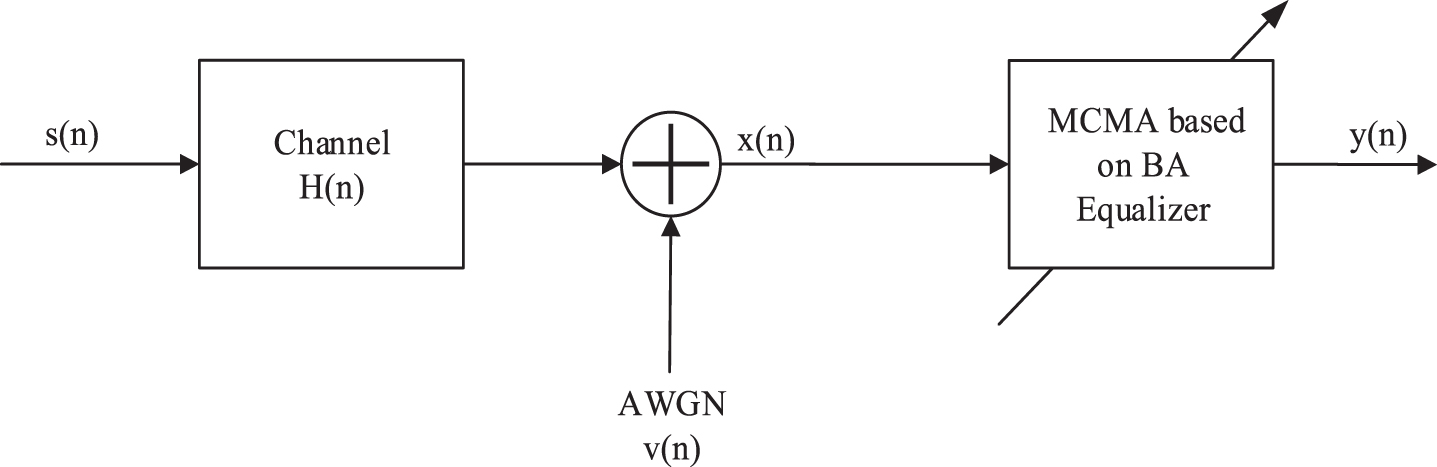
Baseband model of MCMA based on BA blind channel equalization system.
We consider using MCMA’s error function e MCMA as the evaluation function for BA, using equalizer weights vector w MCMA as the bat population.
The entire blind equalization process of MCMA can be summarized in the form of Algorithm 2.
From what has been discussed above, it is obvious that the initial value of w MCMA is optimized using the BA before the equalization process begins. So w MCMA using BA is closer to the steady-state error and MCMA based on BA has a faster convergence speed compared with pure MCMA. After the MCMA equalization iteration process begins, it is no longer affected by the BA. Therefore, the method can be applied to almost all adaptive blind equalization algorithms.
The performance of blind equalization algorithm is mainly measured from the following aspects: convergence rate, mean square steady-state error, residual ISI, whether to obtain the optimal solution, computational complexity, difficulty of algorithm implementation, etc., among which convergence rate, MSE, ISI are the most important three indicators. The convergence rate is important because it is related to whether the algorithm can be used in real-time system. MSE and ISI are related to the correct judgment ability of equalizer after convergence, which directly affects the service quality of the system. Generally, the improvement of one performance is at the expense of the other, so the equalizer should shorten the convergence time and improve the convergence speed as much as possible without sacrificing the mean square error.
The MSE was defined as
The residual ISI is defined by
In order to fully verify the performance of the proposed algorithm, 64-QAM and 256-QAM signals are used in the simulation respectively. The performance simulations of CMA, MCMA and MCMA based on BA are carried out in a 30-dB SNR environment. The channel impulse response is set to be
For 64-QAM signal, the equalizer input signal constellation diagram and the output signal constellation diagram of the three equalization algorithms could be obtained through simulation, as shown in Fig. 2.
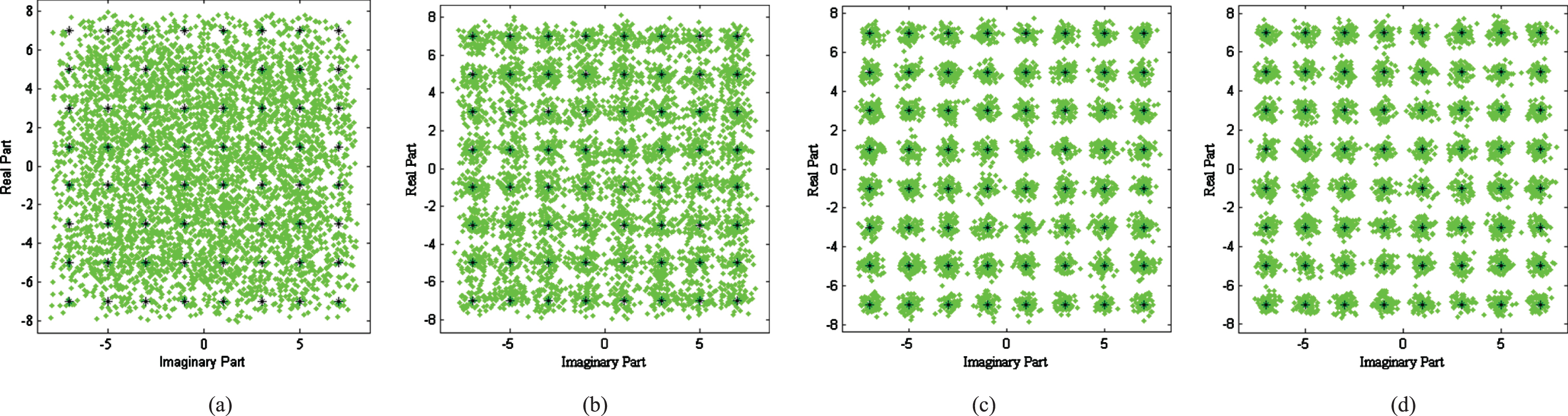
(a) The equalizer input signal constellation diagram and the output constellation diagrams of (b) CMA, (c) MCMA and (d) MCMA based on BA with 64-QAM.
Figure 2 (a) shows the original signal constellation without channel equalization, and Fig. 2 (b), (c) and (d) show the output constellation diagrams of the three algorithms respectively. It could be intuitively seen that the proposed MCMA based on BA and MCMA have better equalization performance compared with CMA. MCMA and the proposed MCMA based on BA have nearly the same equalization effect because BA doesn’t affect the specific equalization process. The correctness of the above theoretical analysis is further verified.
The learning curves for the three equalizers are shown in Figs. 3 and 4 based on the estimated MSE and ISI measurements. The results indicate that the convergence speed of MCMA based on BA is far better than others algorithms. The convergence rate of the proposed algorithm is nearly1000 steps faster compared with pure MCMA. Both original MCMA and MCMA based on BA achieve a very low steady-state MSE, which is about 5 dB better than CMA’s steady-state MSE.
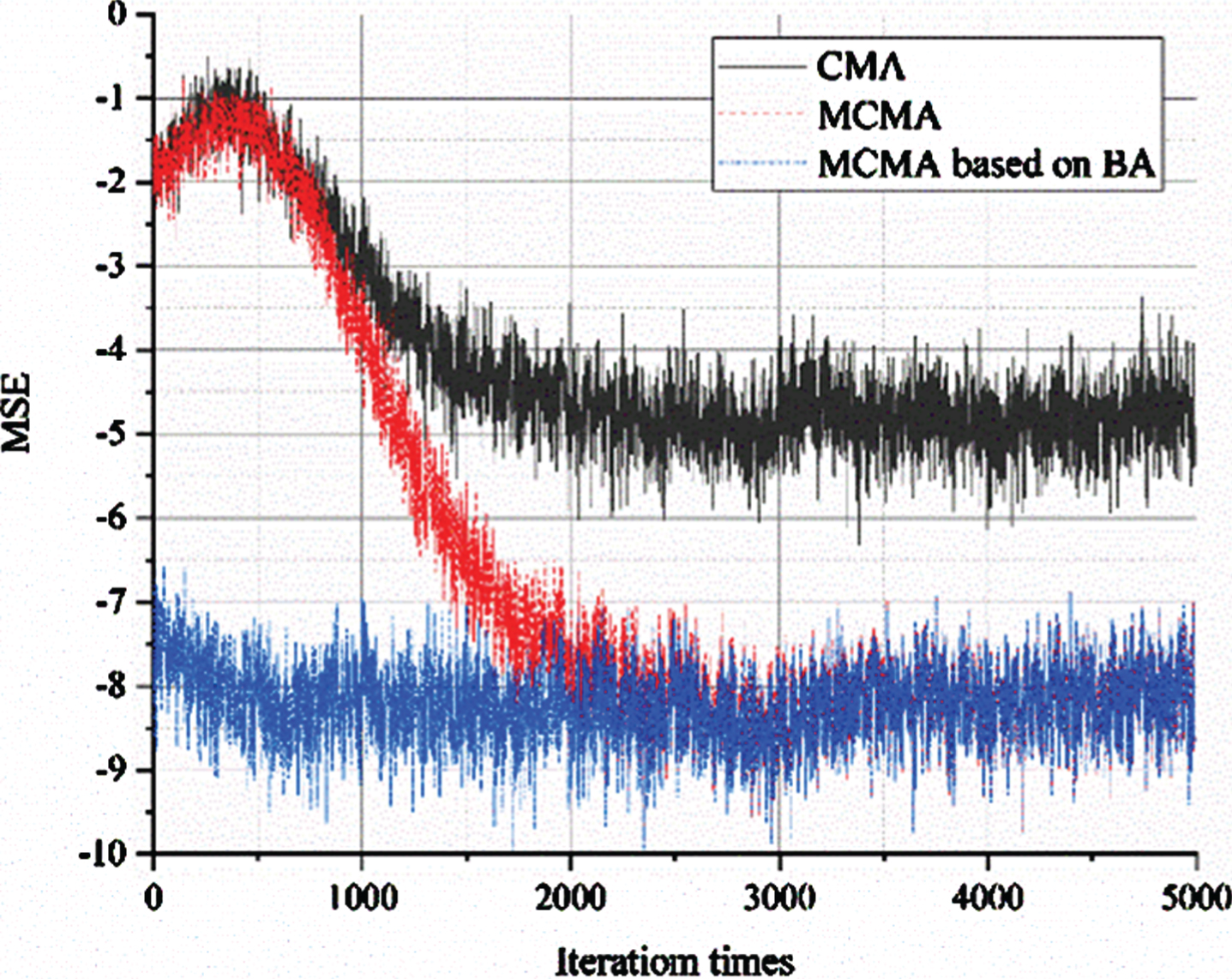
The MSE performance of the three equalizers with 64-QAM.
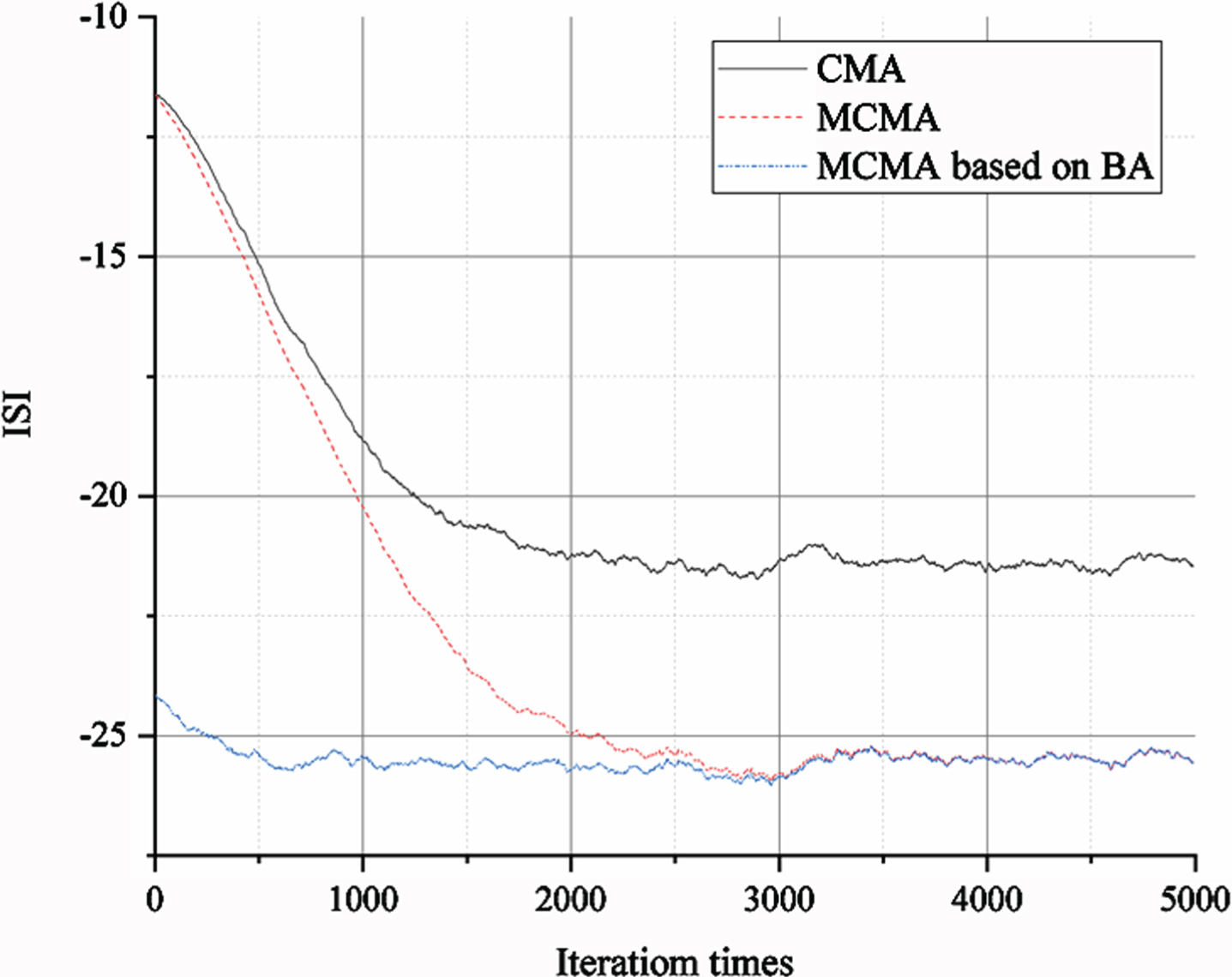
The ISI performance of the three equalizers with 64-QAM.
In order to further verify the correctness and performance of the algorithm, we use 256-QAM signals to analyse MCMA based on BA and MCMA. Because the CMA has poor equalization performance for 256-QAM signals, we only analyse the MCMA and MCMA based on BA. The ISI performance curve can be obtained as shown in Fig. 5.
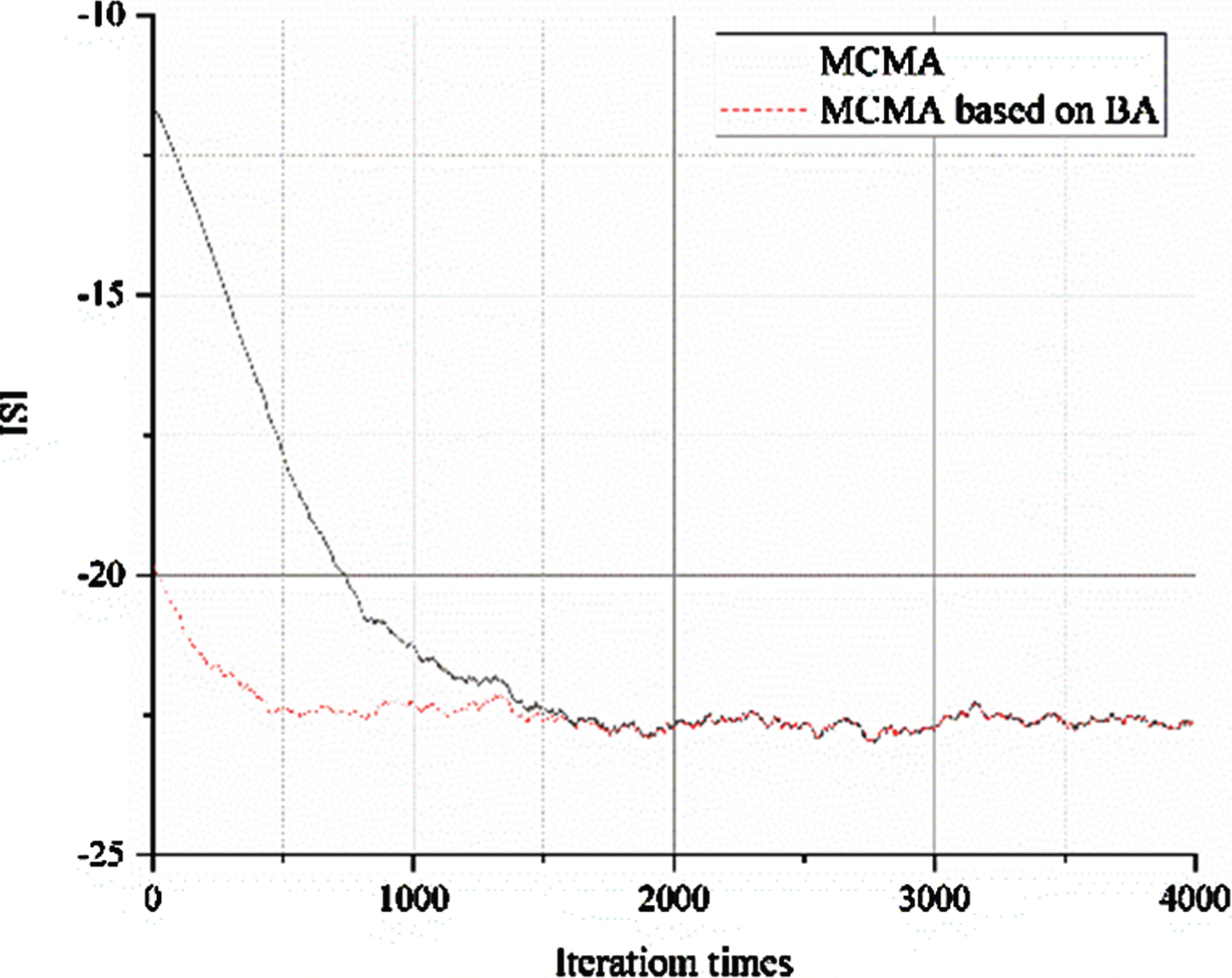
The ISI performance of the two equalizers with 256-QAM.
It can be seen from Fig. 5 that the BA still has excellent performance for MCMA with 256-QAM.
For the proposed MCMA-BA, in order to simplify the analysis of the algorithm complexity, the computational complexity of addition and subtraction is relatively low and can be ignored. Because MCMA is least mean square methods, the computational load of each step can evaluate the computational complexity. For MCMA, calculation of y (n) takes a computational complexity L, and calculation of the error e (n) takes much less computational operations than calculating y (n). Once y (n) and e (n) are obtained, updating Equation (7) approximately costs a computational complexity L. Therefore, if the computation cost lower than L is omitted, the computational complexity of MCMA is about 2 L. The proposed algorithm needs to execute BA on the basis of the original MCMA algorithm, BA approximately takes also a computational complexity 2 L. After the initial value of w MCMA is obtained by BA, MCMA approaches to convergence and the computational complexity can be ignored. Therefore, the computational complexity is about 2 L.
Compared with pure MCMA, MCMA based on BA increases the complexity to a certain extent, but it can be seen from the MSE curve and ISI curve that BA greatly improves the convergence speed after applying the BA, and the BA is also suitable for high-order QAM signals Blind equalization process. Similarly, BA can be applied to variable step size CMA algorithm and multimodulus blind equalization algorithm, which has better performance than the original algorithm. Compared with other swarm intelligence algorithms, BA has better performance. Therefore, MCMA-BA has better equalization performance than MCMA based on other swarm intelligence algorithms.
In this paper, adaptive blind equalization algorithm based on BA has been proposed. The initial value, which is closer to the steady-state error, of weight vector using CMA and MCMA could be got by BA. In this way, convergence could be achieved faster. Compared with pure CMA and MCMA, the proposed algorithm has faster convergence speed. Experimental simulation validates theoretical analysis. The algorithm can be applied to various complex wireless sensor channel environments, which is helpful to improve the performance of channel equalization.
There are still some problems to be further studied in this paper: In this paper, BA is applied to the blind equalization algorithm. Although it can accelerate the convergence speed, the calculation of the algorithm is large and the complexity is high. Further research is needed to reduce the complexity and improve the performance of the algorithm. In this paper, BA is used to optimize the initial weight vector of the blind equalization algorithm, while the initial population of the BA is randomly generated, so the initial weight vector has a certain degree of randomness, and the algorithm has a certain degree of instability. The optimization blind equalization algorithm proposed in this paper is to study the effectiveness of the algorithm through software simulation. Based on software simulation, the development and establishment of a more practical hardware system is still a subject worthy of in-depth study.
Competing interests
The authors have declared that no competing interests exist.
Funding
The work of the authors was supported by the natural science basic research plan in Shaanxi Province of China (Program No. 2019JQ-383).
Authors’ contributions
Tongtong Xu is the main writer of this paper. He proposed the main idea, analysed the feasibility of the algorithm, completed the simulation. Zheng Xiang gave some important suggestions for algorithm idea. All authors read and approved the final manuscript.