



Abstract
In order to better achieve active defense in the escalator risk management, this study based on the vulnerability theory, task driven theory, management error theory, proposed a Gray Relational Analysis (GRA) based fuzzy assessment of escalator accident risk approach. The risk assessment index system of subway station escalator accident was constructed based on the commonness and essence of management defects; the weight of risk index was calculated scientifically and reasonably by using Analytic Hierarchy Process (AHP); escalator accident risk was evaluated by the combination of GRA and Fuzzy approach. The results show that escalator equipment, environment, safety knowledge of riders are all in good condition in the station. However, ‘Maintenance’ of escalator in the Beijing subway station is in an extremely high risk level. The contributions of this studies are: (1) general risk elements analysis model for escalator accidents which enable to compose any risk factor possible to induce escalator accident in subway station; (2) GRA based risk assessment approach can avoid the problem when expend the range to left and right. It can also judge whether the continuous improvement effect of the object is significant by the difference degree of each risk level before and after.
Keywords
Introduction
Escalators were widely deployed as an alternative to stairs or elevators [1] to reduce passenger traveling time and improve the quality of passenger experiences [2]. Although most escalator usage seems safe, many injuries can occur. In China, escalator-related injuries have consistently been top ranked in special equipment accidents, while the number of serious accidents and deaths arising from those accidents had increased greatly over the past years [3]. The usual result of an accident is that the passenger falls from the step without major injury. However, escalators are sources of potentially serious injuries and in some cases, death [4], because, unlike some stationary staircases, escalator steps have hard surfaces and sharp metal edges [5], and these cannot be guarded with carpet or rubber edges [1]. Furthermore, escalators often have longer straight run that staircases [1]. The Chinese metro systems serve an average of 12.411 million passengers daily but with significantly higher crowds during dairy peak time [6]. Of particular concern is the serious knock-on effects of metro escalator accidents, as a passenger fall, may lead to a crush, such as at the Beijing Zoo station in 2014, (one death, more than 28 injuries), making their management and prevention very important. Crucially, most escalator accidents can be predicted and prevented by the proper utilization of existing knowledge [8]. It is accepted that quantitative risk assessment metro station safety cannot be assessed effectively without adequate information of previous incidents [9]. Traditional methods of accident investigation have lacked detailed data on the incidents and this makes it impossible drawn meaningful conclusions and for suitable countermeasures to be implemented [3, 10]. There were no professional subway station escalator accident risk assessment instruments in existence in any metro operation company in China [11]. In U.S., the Consumer Product Safety Commission (USCPSC) have a National Electronic Injury Surveillance System (NEISS 2017) to record such incidents [12].
In response to the issues highlighted above, how to effectively control the occurrence of subway station escalator accidents is an urgent problem for government departments and enterprises to solve. However, the current escalator risk management is mainly based on technology. In the escalator risk management work, there is no perfect and systematic theory that can be used for reference. The risk of escalator accident is not analyzed from the perspective of essence and generality, and the hidden dangers are not identified in advance through reasonable and scientific implementation. In order to better achieve active defense in the escalator risk management, this study based on the vulnerability theory, task driven theory, management error theory, proposed a GRA based fuzzy assessment of escalator accident risk approach. The risk assessment index system of subway station escalator accident was constructed based on the commonness and essence of management defects which enable to compose any risk factor possible to induce escalator accident in subway station. Additionally, escalator accident risk was evaluated by the combination of GRA and Fuzzy approach which can avoid the problem when expend the range to left and right. It can also judge whether the continuous improvement effect of the object is significant by the difference degree of each gray class before and after.
The paper is organized as follows. Following the literature review in Section 2, Section 3 describes the escalator risk assessment approaches. Its use is then demonstrated by analyzing Beijing metro station incident data from different viewpoint in Section 4. Section 5 offer some conclusion and suggestions on countermeasure.
Literature review
Risk factors for escalator accidents
Metro escalator incidents are very different from those in other public environments such as shopping centers for example. Firstly, the environment can be frequently, intensely crowded. Secondly, metro passengers are often in a hurry. Thirdly, metro passengers in China rarely acknowledge escalator safety information compared with other developed countries [13, 14]. Therefore, it is essential to understand the characteristics of metro escalator incidents before incident investigations. There is evidence that many incidents are related to passenger behavior [1, 14]. Major causes highlight tasks such as loss of balance and not holding the handrail. [15] focused on younger passenger related accident happening on escalator in U.S. from 1990–2020 and analyzed the main causes by utilizing data from the U.S. Consumer Product Safety Commission (CPSC). The trends in escalator entrapment accident was explored by utilizing CPSC data from 1998–2017 [16]. The modelling studies are always based on empirical mechanism studies. [17, 18] carried out simulation study on group and individual trampling risks when escalator transfers. A series of trampling scenario were set to simulate pedestrians moving rules when they were transferred by escalators in large buildings. Xing et al. describes escalator-related injuries in Guangzhou metro stations and analyzes the frequency distribution of different contributing factors and their significant association with each other [19]. Major causes highlight tasks such as loss of balance and not holding the handrail. however detailed analysis was not possible due to lack of information like the activity of the victim just before the accident. Chi et al. used the Drury and Brill model [20] which classified out 8 categories (playing on escalator, stepping on the edges of escalator steps, rushing for trains, heading the wrong way, touching stationary sides or comb boards, loss of balance, not holding the handrail, and carrying out other tasks including carrying packages and looking after people in the party) [10]. They found that carrying out other tasks were the major causes of incidents within their data. This advanced the point that human behavior should also be considered alongside equipment and management elements in investigations. From this point all incidents must be considered and analyzed as a chain of events. Four Aberrant behaviors related with escalators was mentioned in [9]: carry bulk items, focus on mobile phones, stand on a wrong side, run along the escalator. Shiwakoti et al. explored the likely behaviors of train passengers in an emergency evacuation in metro stations [6]. In their results, problems with using escalators, following and helping other passengers, were all very likely occur. However, these behaviors are considered as ‘risky’ in the metro escalator safety management context. In a small shopping mall study, over 25% of the users did not hold either handrail while ascending and descending [1]. As long ago as 2006, a passenger escalator accident model which comprised escalator design, maintenance, inspection and operation, and passenger behavior aspects was proposed by [10]. Each accident was able to be related back to any one of the three factors, a combination of two of them or all three. What this model emphasizes is the fact that preventing passenger accidents involves addressing all three areas and not just one. Although that passenger actions themselves are the main source of event and injuries, there is a limit to control the behavior can achieve on its own, and there is a need to address all three areas in order to successfully reduce or even eliminate accidents. Escalator traffic density was studied by [21] in public areas.
Escalator accident risk assessment
Drury and Brill proposed an accident investigation method focused on human factors in consumer products [20]. The key assertion being that any behavior is driven by a task. They used a four-step task analysis model to establish the structure of the questionnaires of limited number of accident patterns. As an application, this task-driven method was applied to both metro escalator incident and electrical fatalities in the construction industry [22]. Although this method applied to passenger behavior [10] is not able to aid the safety operatives in metro incident investigations, it is very useful when investigating random passenger behavior incidents.
Structure modeling for multiple factor interaction. It can be seen from the description of escalator accident that several hazards could simultaneously appear in one accident [23]. Therefore, [24] used the interpretive structural modeling (ISM) and decision-making trial and evaluation laboratory methods (DEMATEL) analyzing multiple influencing factors in escalator-related accidents. Influencing factors were designed by case study and literature review and the relationships between two related factors were quantified by subjective evaluation method.
Regarding operator error behavior accidents, Wang and Fang (2014) looked at the traffic dispatchers error behaviors in subway operations. They proposed a very detailed method for assisting safety personnel in investigations and classifying behaviors and comprised visual, auditory, cognitive, and psychomotor error based on tasks. [9] considered the process of cascading escalator accidents into event chains. Then, based on complex network theory, the event chains were connected into a cascading escalator accident network by the connections between two hazards. Daramola (2014) used the Human Factors Analysis and Classification System (HFACS) as the analytical framework for air traffic accident reports considering organizational influences, unsafe supervision, preconditions for unsafe acts, along with unsafe acts of operators. HFACS appears to be very applicable in aviation accident analysis (Foster et al., 2020). The HFACS tool was developed by Reason (Chi et al. 2009) organizationally based model of human error and provides an organizational framework for accident analysis. Although the Logistic regression method is shown by many studies to be an effective predictive method for categorical variable data [25, 26], it may lead to overfitting when the number of variables is greater than the number of observations [27]. Subset selection can reduce the number of variables, but may delete important variables [28]. Fuzzy comprehensive evaluation method is capable in the uncertainty risk assessment considering all variables [21]. The risk category is evaluated by subjective assignment of all risk factors [29]. Although the fuzzy comprehensive evaluation method can reduce the deviation caused by the deletion of variables to a certain extent, the calculation method of membership degree ignores the difference within the category. From a mathematical point of view, all values between the upper and lower thresholds of a certain class are assumed to belong to this category, which is not in line with the actual situation of escalator accident risk management.
The grey relational analysis (GRA) method can set the threshold which is most likely to belong to a certain grey class according to the characteristic of the object and the rough estimation of its grey class, so as to determine the subordinate degree of the observation index belonging to a certain grey class. This method can overcome the shortcomings of fuzzy comprehensive evaluation method in the determination of membership category. Accordingly, this study develops a general risk elements analysis model for escalator accidents which enable to compose any risk factor possible to induce escalator accident in subway station; (2) GRA based risk assessment approach can avoid the problem when expend the range to left and right. It can also judge whether the continuous improvement effect of the object is significant by the difference degree of each gray class before and after.
Methods
Analysis of escalator accident risk assessment index
The escalator system in MTRS is a human-electromechanical interaction system with high passenger participation. Passengers travel from one floor to another by escalator in certain environment. As defined by [13], whether passengers can successfully transfer from one floor to another depends not only on the operation and safety status of the transport carrier—escalator, but also on the status of passengers themselves. The operation and safety status of escalators depend on the engineering design of escalators and maintenance of escalators. For example, emergency stops, unexpected reverse, shake, speed of escalator suddenly change, handrail poor electrical isolation, handrails are not synchronized with the escalator, and insufficient height above are all engineering design defects of escalator which can be found in the historical data gathered in [9]. Meanwhile, maintenance problems are manifested in the aspects of escalator surface cleaning, neatness, and other damage repair. For example, in the accidents gathered in [9], passengers always were tripped by the water absorbing blanket bulge on escalator pedal or slipped by the liquid on escalator stairs.
Additionally, in some cases where there is no design and maintenance defects, passenger behavior is the key factor for a successful transfer from one floor to another. Risk passenger behavior such as playing on the escalator, pick up the dropped items, concentrated on mobile phones, carrying wheelchair or trolly, waring improper outfit, not holding the handrail et, al. was discussed in related literatures. Health condition of passenger condition should also be considered. For example, although those passengers who are in the proper behavior, and there is no design and maintenance defects, they would be fell because of poor eye sight, pregnancy, lack of lower body mobility and so on.
Besides, escalator riding environment is also an important factor for escalator accident in MRTS [9]. In all the accidents happened between 2016 to 2018 in Beijing MRTS, 10.7% was related with environment. Escalator riding environment means the weather-related environment and the environment formed by other passengers. As examples, crushed over by other passengers, knocked over by the luggage of other passengers, and too crowed to stand still are the normally forms of the environment formed by other passengers. Wet ground of stair is a common weather-related environmental problem.
From the perspective of system, the elements of escalator operation system in subway station include passengers, escalator, environment and management of escalator operation. During the operation of escalator, passengers move between the escalator and the elevator environment, and the escalator accidents can be prevented by behavior norms, management means and design constraints. The relationship between the above four elements is shown in Fig. 1.
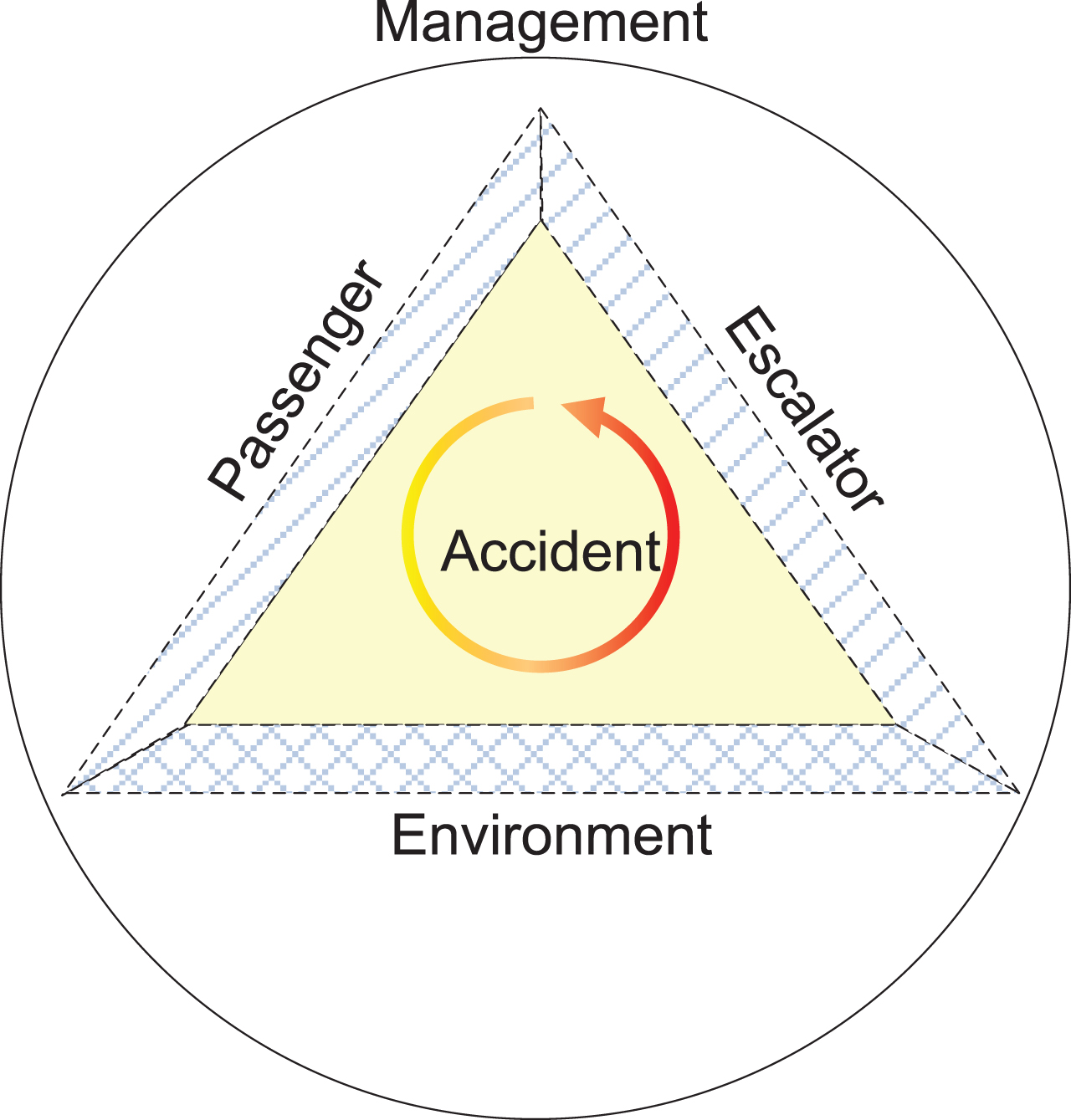
The risk factors of escalator operation system in subway station.
Especially, according to task driven theory, passenger behavior can be divided into three categories according to whether or not they were carrying out another task before the incident. The first category is task-driven behavior, such as for example, carrying bulk items, attending to babies in prams et al. The second category is the behavior which is not task-driven but which is poor riding practice, for example not holding the handrail, wearing clothing that could become tangled with the escalator operation (see Table 1).
The framework of the escalator accident risk indicators in subway station
Definite weighted functions (DWF) setting
Firstly, the center point triangle DWF is improved, that is, the triangle DWF corresponding to grey class 1 and grey class s in the original center point triangle DWF is taken as the lower limit measure DWF and the upper limit measurement DWF, so as to avoid the problem of extending the value range of each clustering index to the left and right.
The modeling steps of grey clustering evaluation model based on improved center point triangle DWF are as follows:

Mixed endpoint DWF of escalator accident risk (very high, very high, high, low, very low).
Let x be an observed value of risk index j, when
For gray class k (
The value x of index j obtained by evaluation is substituted into formula (1), (2) and (3) to calculate the membership degree
The escalator accident risk level in station i is determined by the
According to the characteristics of subway escalator accident, five risk levels are set, which are extremely high, very high, high, low and very low. When the evaluation score is lower than 40, it belongs to grey class 1, which means the risk is very high, and the turning point
Taking the escalator accident risk assessment of Beijing metro station as an example, 10 relevant experts were selected to carry out risk level assessment on a certain station of Beijing Metro twice within two months. The Analytic Hierarchy Process (AHP) is used to calculate the weights of primary indicators and secondary indicators. The results of weights are shown in the Table 2 as well as the value of secondary indicators.
The results of weights and value of risk factors in Beijing subway station
The results of weights and value of risk factors in Beijing subway station
According to the evaluation results in table 4.1, the scores are distributed in five threshold ranges. Therefore, according to the whitening weight function established by formula (1), formula (2) and formula (3), the grey membership degree of each risk factor relative to “very high risk”, “high risk”, “high risk”, “low risk” and “very low risk” is calculated. The calculation results of escalator equipment risk (R1) are shown as an example in Table 3. From the Table 3, it can be known which secondary risk factor is in a high-risk level. Additionally, the difference from value 1 to value 2 can be used to evaluate the quality of safety management and the effectiveness of improvement measures.
MD calculation results of four primary factors
According to the grey membership degree value of each secondary risk factors, combined with formula (4), the clustering coefficient δ of the primary risk factors on gray class k (
The clustering coefficient δ of the primary risk factors on gray class k
It can be seen from Table 4 that the largest membership degree of risk factors ‘Escalator equipment’ and ‘Safety knowledge of passenger’ are
The escalator accident risk in the station is calculated by weighted clustering. The overall risk level of escalator accident is shown in Table 5. In the two times assessments, the maximum membership degree of the risk level of the escalator accident is at a very low risk. In the second assessment, the risk level of escalator accident in classes extremely high, very high, and high have decreased in the second-round evaluation when comparing with the first-round evaluation. It indicates that the overall level of escalator safety management has been improved.
The overall risk level of escalator accident in the station
The escalator operation in subway station system is very complex because it is a human-electromechanical interaction system with high customer participation in a significantly high crowd environment, especially during daily peak times. Therefore, it is very important to find risk factors for escalator daily operation. This study proposed general risk factors identification model for escalator accidents and GRA based risk assessment approach for escalator accident risk evaluation in subway station.
Firstly, the general risk factors identification model which is based on system theory, task driven theory, and vulnerable theory was developed and demonstrated for collecting risk factors in escalator accidents. The need for close study in escalator accidents investigation had been elaborated in the Introduction, but an analysis of published risk identification methodologies for escalator accident in subway stations shows that available techniques do not meet the need. Simply using of this task-driven method in passenger behavior (Chi et al., 2006) makes it impossible to aid safety management in daily operation. In order to draw the full risk factors picture, a systematic oriented based method was proposed from four aspects of the escalator design, maintenance, environment, and passenger’s safety knowledge. The new instrument was seen as a tool that would augment, not replace, their current expertise. Significant associations between risk evaluation methods could help to identify the risk factors and provide prevention method.
Secondly, GRA based risk assessment approach for escalator accident risk evaluation in subway station is an assessment method based on expert knowledge, which can overcome the problem that subway escalator accidents lack of data and cannot effectively carry out objective quantitative risk management. As mentioned in Introduction section, there were no professional subway station escalator incidents investigation instruments in existence in any metro operation company in China. In U.S., the Consumer Product Safety Commission (USCPSC) have a National Electronic Injury Surveillance System (NEISS 2017) to record such incidents. In this database, the escalator related incidents were also recorded in a simple, factual manner i.e. “30 YR OLD MALE INTOXICATED FELL 20 FT OVER SIDE OF ESCALATOR AT SUBWAY” and “46YOF W/LAC, ABRAS TO GREAT TOE. WAS AT *** STATION WHEN TOE GOT CAUGHT”(USCPSC, 2017).
Thirdly, from the result of case study it can be seen that the grey clustering method of mixed endpoint whitening weight function of lower limit measure, moderate measure and upper limit measure can solve the problem of left and right interval expansion in the calculation of membership degree of risk level in security risk assessment. Although the fuzzy comprehensive evaluation method can overcome the problem of insufficient historical data and use expert knowledge to quantitatively evaluate the total risk factors affecting the occurrence of accidents, the calculation method of membership degree of fuzzy decision ignores the differences within the same risk level. In other words, all the values between the upper and lower limits of a certain level of risk level are assumed to belong to this risk level, which does not conform to the actual situation of escalator accident risk management.
Lastly, from the result of case study it can be seen that the risk evaluation approach proposed in this study can be used in subway station to evaluate the risk level of factors. According to the result, safety manager can make decision on how to allocate resources on those factors. The continuous improvement effect of the object can be judged by the difference between the two grey classes whether it is significant as well. Additionally, the research method can be used to compare the risk levels of escalator accidents in different stations, so as to evaluate the safety management level of different station management subjects.
Although the case study demonstrates the applicability of the methodologies and that meaningful improvement strategies can be obtained from the results, it does not include all the categories in each risk variable. Additional research is therefore needed to extend the study to the entire categories of all risk factors in future.
Author contributions
Conceptualization, Z.W.; methodology, Z.W.; formal analysis, Z.W. and L.Y.; investigation, Z.W. and R.H.; data curation, M.W.; writing —original draft preparation, Z.W.; writing —review and editing, R.S. and L.Y.; funding acquisition, Z.W. and L.Y. All authors have read and agreed to the published version of the manuscript.
Footnotes
Acknowledgments
This research was funded by the Natural Science Foundation of Beijing, grant number L181009 and 9194028; Humanities and Social Science Fund of Ministry of Education of China, grant number 18YJC630193; the National Natural Science Foundation of China, grant number 71771113; and Fundamental Research Funds for the Central Universities, grant number FRF-BR-20-03A.
Conflict of interest
The authors declare no conflict of interest.