



Abstract
In 2020, under the major impact of the global COVID-19 epidemic, people are paying more and more attention to safety issues including health and personal safety, and relevant supervision and testing methods are also constantly updated across different countries. In industrial enterprises, both spread of diseases and occurrence of accidents are largely caused by unsafe state of things and unsafe behaviors of people, among which, human factor is the most important factor. In recent years, many scholars have conducted theoretical and practical research on individual behavior from the perspective of individual psychological characteristics. Where, individual initiative as an important individual psychological trait is increasingly incorporated in the research category of safety behavior. A close correlation exists between individual initiative and evolution of safety production behavior. According to constraint conditions and replicator dynamics equation, this paper uses evolutionary game method and computer fuzzy system Matlab simulation software to conduct numerical experiment analysis on the ideal state of the game between organizations and individuals, thereby studying the behavior evolution trend. The basic idea of fuzzy control is to use computer to realize human’s qualitative control experience. Research is found that whether an individual adopts safety obedience behavior will be directly affected by whether the organization adopts regulatory safety production management model. And if the organization adopts regulatory safety production management model and the individual does not implement safety obedience behavior, it is impossible to achieve a stable state. The evolution process of the two to the ideal state is affected by multiple factors.
Introduction
Safety production in industrial enterprises is a currently very important subject. There are many safety accidents due to the particularity of certain production environments, the variability and unpredictability of natural conditions [1]. In recent years, enterprises have gradually realized the importance of safety production management and have innovatively reformed safety production management models. However, scientifically applicable safety production management models are rare. The traditional punitive safety production management model only relies on regulations and severe penalties [2–5]. “Emphasizing production and ignoring safety”, it cannot mobilize individual enthusiasm for safety production, leading to frequent accidents. The successful transformation of safety production management in some international enterprises from punitive safety production management model to incentive safety production management model provides reference for us [6–8]. Where, China’s enterprises such as Shenhua Group, Xuzhou Coal Mining Group, Lu’an Energy Company, Kailuan Group have realized the transformation to incentive safety production management model by referring to advanced safety production management models. The safety production management model with guidance as the main approach, that is, management method with employees with higher initiative are the main management objects, and management method of instructing employees to increase safety behavior level and mobilizing the initiative of safety behavior by rewards, focuses on mobilizing the initiative of individual safety production[9,10, 9,10]. Studying and analyzing the decision-making behaviors of coal mining enterprises as relevant stakeholders of safety management is conducive to corporate transformation from the traditional punitive safety production management model to the incentive safety production management model.
The penetration of people-oriented management ideas has made scholars realize that people are one subject of safety management activities. Safety production management model should be developed in a human-centered direction, and passive management model for people should be transformed into a regulatory management model for people [11]. Human behavior is the direct factor that determines safety production performance. The first stage of the evolution of individual safety production behavior involves individual passive safety behavior and safety obedience behavior [12]. Safety obedience behavior refers to an individual’s behavior to achieve organizational safety goals in strict accordance with established safety rules and regulations in the organization’s daily safety production activities, while guaranteeing smooth progress of safety production; passive safety behavior refers to an individual’s behavior to passively achieve the minimum goal of safety production under responsibility and pressure in the organization’s daily safety production activities. Compared with passive safety behavior, safety obedience behavior displays more compliance with safety production activities, systems and regulations, and is less likely to cause safety accidents. That is, more individual safety obedience behavior means higher probability of avoiding safety accidents. Safety obedience behavior displays more initiative than passive safety behavior, which is an important factor to guarantee organizational safety performance.
Evolutionary game theory no longer models humans as super-rational game players, but believes that humans usually achieve game equilibrium through trial and error. Computer simulation is a dynamic and realistic imitation of the structure, function and behavior of the system as well as the thinking process and behavior of the people involved in system control. The model of the process or system is established to describe the process or the system. A series of purposeful and conditional computer simulation experiments are used to describe the characteristics of the system, so as to obtain quantitative indicators and provide the decision makers with quantitative analysis results of the process or the system as the theoretical basis for decision making. Similar to the principles of biological evolution, the selected equilibrium is an equilibrium process function to achieve equilibrium [11,13, 11,13]. Thus, history, institutional factors, and certain details of the equilibrium process will impact the selection of multiple equilibriums in the game. Fuzzy system theory is a system theory that indicates the ambiguities contained in the system in the form of fuzzy sets and deals with these ambiguities. Fuzzy system theory has been applied to a large number of engineering systems. Where, fuzzy control is the most effective and widest application field of fuzzy system theory. Fuzzy control in various fields unexpectedly solves the problems that cannot be solved or are difficult to solve by traditional control theory, and has achieved some convincing results [14,15, 14,15].
Hypotheses and models
Safety production management mode is the safety production management standard constructed by the organization include safety management concept, safety management method and safety management system that control casualties or property damage within acceptable limits [6].
Individuals and organizations are incorporated into a game system. Both stakeholders feature bounded rationality and have ability to learn and imitate. In the process of transforming passive safety behaviors into safety obedience behaviors, organizations choose a punitive safety management model or a regulatory safety management model strategy in consideration of factors such as transformation costs and safety benefits. Individuals choose passive safety behavior or safety obedience behavior strategy in consideration of their own interests [16]. The gains and losses of stakeholders of different strategies are analyzed as follows:
The individual-related gains and losses are analyzed as follows: the organization’s punitive safety production management model will bring a negative impact R on the individual. When the amount of labor in individual safety obedience behavior is L, there are two cases: 1) In the corporate regulatory safety production management model, the input-output ratio of safety obedience behavior is 1/a1, and the ratio of safety benefits generated by individual safety obedience behavior is B1.The individual safety benefit is a1B1L. Regulatory safety production management model can better reflect the emphasis on individual initiative than punitive safety management model. For instance, job training, popularization of safety production knowledge, advocacy of “people-orientedness” and other behaviors that respect individuals produce positive psychological effect A1in individual, and individual safety obedience behavior will have a positive impact F on other individuals; 2) Under the organizational punitive safety production management model, the input-output ratio of the safety obedience behavior is 1/a2, the individual safety benefit ratio generated by the safety obedience behavior is B2, and individual safety benefit is a2B2L. Since punitive safety production management model lacks attention to and regulation of the individual safety obedience behavior, it produces a negative psychological effect A2 on the individual.
The organization-related gains and losses are analysed as follows: if the organization adopts regulatory safety production management model, it needs to pay additional transformation cost C such as organizational safety culture construction, safety training, safety rewards, etc. Due to adoption of regulatory safety production management model, the organization will receive potential benefit Ssuch as improved corporate social image, etc. as well as safety benefit a1 (1 - B1) Lgenerated by individual’s safety obedience behavior. Individual’s safety obedience behavior will produce a positive psychological impact F on other individuals in the organization. If the organization adopts punitive safety production management model, its benefits will be zero or one of a2 (1 - B2) L + F under impact of individual strategies. The settings and meanings of related parameters are shown in Table 1.
Subject parameters and meanings
Subject parameters and meanings
According to the content, the income matrix of the 4 kinds of strategy combinations can be obtained. The strategy combination types refer to the type of safety production management mode adopted by the organization, and whether the individual implements safety obedience behavior, with specific contents shown in Table 2.
The income combination of evolutionary game
In the above relationship, based on actual investigations, additional constraint conditions can be added as follows: Compared with corporate punitive safety production management model, organizational regulatory safety production management model has relatively high output of individual safety benefits, and high safety benefit ratio generated by individual safety obedience behavior, that is, a1 > a2, B1 > B2. Under the same amount of labor in safety production activities, corporate regulatory safety production management model gains greater safety benefits than punitive safety production management model, namely a1 (1 - B1) L > a2 (1 - B2) L.
1) Equilibrium analysis on the evolutionary game between individuals and organizations: Assuming that in the initial stage of the game, the proportion of organizations adopting regulatory safety production management model is y, and the proportion of organizations adopting a punitive safety production management model is 1 - y; the proportion of individuals adopting safety obedience behaviors is z; the proportion of individuals refusing to adopt safety obedience behavior (that is, adopting passive safety behavior) is 1 - z.
The expected benefits V1Y, V2Y and average benefit
The expected benefits V1Z, V2z and average benefit
2) Replicator dynamics analysis of decision-making of organizational regulatory safety production management model: The replicator dynamics equation for decision-making of organizational regulatory safety production management model is:
If
If
Since a1 (1 - B1) L > a2 (1 - B2) L, there are two cases:
When
When
Replicator dynamics analysis on individual safety obedience behavior:
The replicator dynamics equation of individual safety obedience behavior decision is:
When
When
Since a1B1L - a2B2L + A1 + A2 > 0, there are two cases:
When
When
Evolutionary stability analysis on individual and organizational strategies:
Organizational safety production management model decisions are related to individual safety obedience behavior decisions, and employee safety obedience behavior decisions are related to organizational safety production management model decisions. Based on this, evolutionary stability of strategy of the two stakeholders: organization and individual, is analyzed step by step, that is, evolutionary stability of organization and individual is separately analyzed.
From the formulas (1) and (2), we can see that the dynamic game between organizations and individuals contains 5 equilibrium points (0,0), (0,1), (1,0), (1,1), (
Jacobi matrix:
Matrix
Matrix
According to the above 5 equilibrium points, local stability analysis is performed, with the results shown in Table 3.
Stability analysis of the evolution game between the organization and the individual
It can be seen from Table 3 that if certain conditions are met during the dynamic evolution of organizations and employees, a stable point can be formed:
When the mathematical expectation of paying fines in the organizational punitive safety production management model is less than the actual cost for transformation into the organizational safety production management model, and the negative psychological effect of individual safety obedience behavior is greater than its safety benefits, the result of the game between the organization and the individual is in stable state y = 0, z = 0. That is, when the organization adopts a punitive safety production management model, individuals will not implement safety obedience behavior.
When the mathematical expectation of paying fines in the organizational punitive safety production management model is less than the difference between the actual input in transformation of safety production management model and the incremental safety effect after the model transformation, at the same time, the negative psychological effect of individual safety obedience behavior is smaller than its safety benefits, the result of the game between the organization and the individual is in a stable state. That is, when the organization adopts a punitive safety production management model, individuals implement safety obedience behavior.
When the mathematical expectation of paying fines in the organizational punitive safety production management model is greater than the difference between the actual input in transformation of organizational safety production management model and the incremental safety effect after the model transformation, at the same time, the negative psychological effect of individual safety obedience behavior is smaller than its safety benefits, the result of the game between the organization and the individual is in a stable state y = 1, z = 1. That is, when the organization adopts a regulatory safety production management model, individuals implement safety obedience behavior.
Starting from the idea of human-oriented management, we need promote the ultimate evolution of the game between the organization and the individual to the ideal decision-making state of organizational regulatory safety production management model and individual safety obedience behavior (y = 1, z = 1). Through the step-by-step analysis of the evolutionary stability of organizations and individuals, it can be seen that evolutionary equilibrium between organizations and individuals is affected by the proportion z of individuals adopting safety obedience behavior. From evolutionary stability analysis of individuals and organizations, it can be seen that, at the point y = 1, z = 1 when the stable condition is 0 > C - S - [(1 - B1) a1L - (1 - B2) a2L], there is A2 < a2LB2. Based on the above content and the additional constraint conditions added in light of the actual situation, it can be inferred that when 0 > C - S - [(1 - B1) a1L - (1 - B2) a2L], A2 < a2LB2, a1 > a2, B1 > B2, (1 - B1) a1L > (1 - B2) a2L are met at the same time, the organizational regulatory safety production management model and individual safety obedience behavior can achieve the ideal decision-making state (y = 1, z = 1). According to constraint conditions and replicator dynamics equations, Matlab simulation software is used for experimental analysis of the ideal state of the game between organizations and individuals. The parameter values are set according to the constraint conditions, respectively.
Regarding the influence of the change in initial ratio of the two parties choosing a certain strategy on the evolution result, as shown in Figure 1, the numerical experiment adopts the above parameters. It can be seen that convergence curves of path dependence of the interaction between organization and individual strategies under different initial conditions will not overlap before reaching the ideal state. Convergence speed will be affected by both the proportion of enterprises initially selecting regulatory safety production management model and that of individuals initially selecting safety obedience behavior. When the proportion of organization and individual tends to be balanced in strategy selection, the evolutionary system will have faster convergence.

Map of the evolution path of different initial proportional strategies.
Regarding the influence of labor changes in individual safety obedience behavior on the evolutionary process, as shown in Figure 2, when the amount of labor in individual safety obedience behavior is small, the system will evolve toward “passive safety behavior, punitive safety management model”. As the amount of labor in individual safety obedience behavior increases, the evolution direction changes and the evolution convergence accelerates with less time used, and the system will evolve towards “safety obedience behavior, regulatory safety management model”.
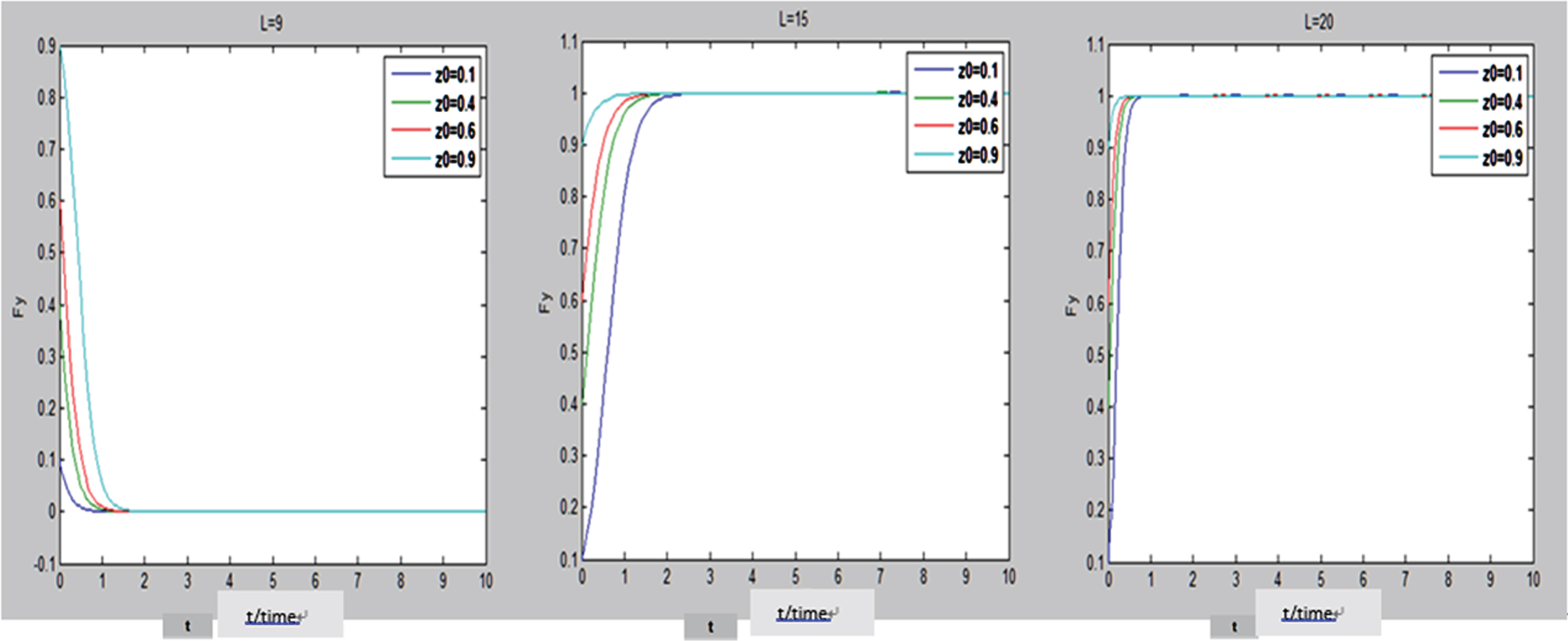
The influence of the change of labor quantity of safety compliance behavior.
Regarding the influence of input cost for organizational transformation into regulatory safety production management model on the evolutionary process, as shown in Figure 3, when the input cost is low, as the input cost for organizational transformation into regulatory safety production management model increases, the evolutionary convergence speed of the two parties decreases, and the time required to converge to the ideal state increases. When the input cost is high, the evolution of the two parties changes in direction and deviates from the ideal state. It can be seen that the increased input cost for organizational transformation into regulatory safety production management model will slow down the evolution of the two towards the ideal state, and when the transformation input cost exceeds a certain range, the two parties cannot eventually evolve into the ideal state.
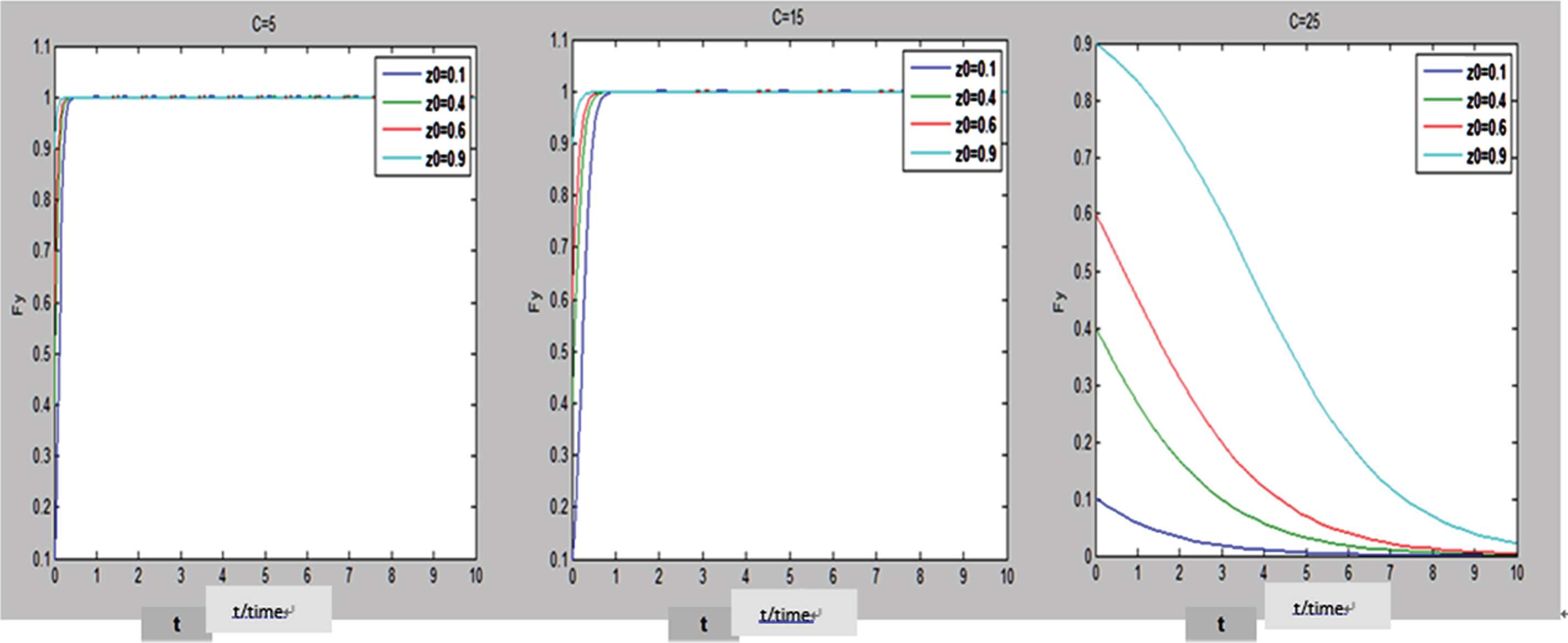
The influence of the organization on the evolution process of the transformation input cost to the regulatory safety production management mode.
Regarding the influence of the opportunity benefit from the organizational transformation into regulatory safety production management model on the evolutionary process, as shown in Figure 4, when the opportunity benefit is small, the system will evolve towards “passive safety behavior, punitive safety production management model”. As the opportunity benefit increases, the evolution direction will change, and the system will evolve towards “safety obedience behavior, regulatory safety production management model”. However, the evolutionary convergence speed of the two parties decreases, and the time required to converge to the ideal state increases. It can be seen that with greater opportunity benefit, organization is more likely to evolve to an ideal state, but organization will also develop slackness, which slows down the evolution to the ideal state.

The influence of the opportunity benefit on the evolution process of the organization to the regulatory safety production management model.
Regarding the influence of the positive psychological effect of individual safety obedience behavior on the evolutionary process, as shown in Figure 5, when the positive psychological effect is small, the system evolves toward “safety obedience behavior, regulatory safety production management model”. As the positive psychological effect of individual safety obedience behavior increases, the evolution direction changes, the evolution speed becomes faster, and the evolution time becomes shorter. It can be seen that when the positive psychological effect is within a moderate range, its increase will promote the evolution of the two towards the ideal state. However, after the positive psychological effect increases to a certain extent, the organization gives too much respect to the individual, causing the individual to develop pride and complacency. In this way, individual safety obedience behavior is correspondingly reduced, making the two parties increasingly deviated from the ideal state.

The influence of the positive psychological effect on the evolution process of individual safety compliance behavior.
Regarding the influence of the negative psychological effect of individual safety obedience behavior on the evolution process, as shown in Figure 6, when the negative psychological effect is small, as the negative psychological effect of individual safety obedience behavior increases, the evolutionary convergence speed of the two parties decreases, and the time required to converge to the ideal state increases. It can be seen that when the negative psychological effect is within a certain range, as the individual’s obedience behavior is not emphasized nor encouraged, individual has increased negative psychological effect, which inhibits the speed of the two parties’ evolution toward the ideal state; when the negative psychological effect of individual safety obedience behavior is too high, individual safety obedience behavior is reduced, and the two parties cannot reach the ideal state.

The influence of passive psychological effect on the evolution process of individual safety compliance behavior.
Through decision-making replicator dynamic analysis, evolutionary stability analysis, numerical simulation and experimental verification of organization and individual stakeholders, the following main conclusions are drawn:
It can be seen from the decision-making replicator dynamics equation that the proportion of individuals taking safety obedience behavior decision is related to the proportion of organizations adopting regulatory safety production management models. Whether an individual adopts safety obedience behavior will be directly affected by whether the organization adopts regulatory safety production management model.
From the evolutionary stability analysis, it can be seen that if the organization adopts regulatory safety production management model and the individual does not implement safety obedience behavior, it is impossible to achieve a stable state. Organizations should be aware that regulatory safety production management model is an effective factor driving individuals to adopt safety obedience behavior. In addition, the two parties need to meet two conditions at the same time to achieve the ideal state: the mathematical expectation of paying fines in the organizational punitive safety production management model is greater than the difference between the actual input in transformation of safety production management model and the incremental safety effect after the model transformation; the negative psychological effect of individual safety obedience behavior is smaller than its safety benefits. Organizations and individual stakeholders can achieve the ideal state when organizational regulatory safety production management model and individual safety obedience behavior reach the ideal safety production state.
From the numerical simulation results, it can be seen that the evolution process of the two to the ideal state is affected by multiple factors. The manifestation is as follows: When the proportion of organization and individual tends to be balanced in strategy selection, the evolutionary system will have faster convergence; the increase in the cost of organizational model transformation will slow down the evolution of the two towards the ideal state, and if the transformation input cost is too high, the two parties cannot eventually evolve into the ideal state. The increase in opportunity benefit due to organizational model transformation will speed up the evolution of the two towards the ideal state, but too high opportunity benefit will slow down the evolution to the ideal state. When the positive psychological effect of individual safety obedience behavior is within a certain range, increased positive psychological effect of the individual promotes the evolution of the two towards the ideal state, but when the positive psychological effect is too big, the two parties cannot reach the ideal state. When the negative psychological effect of individual safety obedience behavior is within a certain range, increased negative psychological effect of the individual will slow down the evolution of the two towards the ideal state, and when the negative psychological effect is too big, the two parties cannot reach the ideal state.
Footnotes
Acknowledgments
This study was supported by the Social Science Foundation of Heilongjiang Province (19GLC161).