



Abstract
The rapid advancements in the technology, increase in comfort levels, movement of population to urban areas, depletion of fossil fuels and increasing greenhouse gas emissions have invigorated the use of renewable energy resources for power generation in the last few years. The major renewable energy resources which have potential to fulfill the requirements includes solar energy, wind energy, small hydro and biomass etc. Among these major resources, solar energy-based technology is considered as one of the fastest growing technology because of its various advantages and ubiquitous availability of the resources. However, there are certain challenges in the utilization of solar energy for power generation because of various uncertainties in the atmosphere. As a result, the power generated from solar based power plants is fluctuating in nature which is not desirable. Therefore, the utilities are adopting the smart grid approach which has ability to integrate the solar power plants efficiently and the solar energy forecasting is one of the essential tools for this new model. In this paper, AI based techniques are utilized to forecast solar energy using high quality measured solar irradiance data. The forecasting accuracy of the developed models is evaluated based on statistical indices such as absolute relative error and mean absolute percentage error. The results obtained from the developed models are compared to observe the forecasting ability and performance with the high-quality measured data and found accurate.
Keywords
Introduction
The requirement of electrical energy is increasing continuously worldwide due to increasing comfort level, urbanization, construction boom and growing population. The power generated through conventional power plants are causing the environmental pollution and negatively impacts the human health through the emission of harmful gases such as SOX (Sulphur oxides), NOX (Nitrogen oxides) and CO2 and CO (Carbon oxides) etc. Therefore, it is utmost important to provide electrical energy using renewable energy resources like solar energy, wind energy, small hydro etc. The solar energy-based technology is most suitable for power generation in many countries because of abundance availability of the resources. However, the power generated from solar based power plants is fluctuating in nature and adversely affected by the various meteorological and atmospheric parameters. Further, the large-scale integration of solar based power plants into the distribution network may impacts the stability and reliability of the system. This problem arises due to sudden changes in solar energy which could be the cause of rapid disconnection or reduction in a power generation capacity of the solar system. To overcome these issues, the utilities are developing the smart grid approach across the world and the solar energy forecasting is playing an important role in this new scenario. To see the importance of the proposed work, the projected and achieved potential of various renewable energy resources has been obtained from various government agencies like ministry of new and renewable energy. The share of various resources in India for power generation is given in Fig. 1.
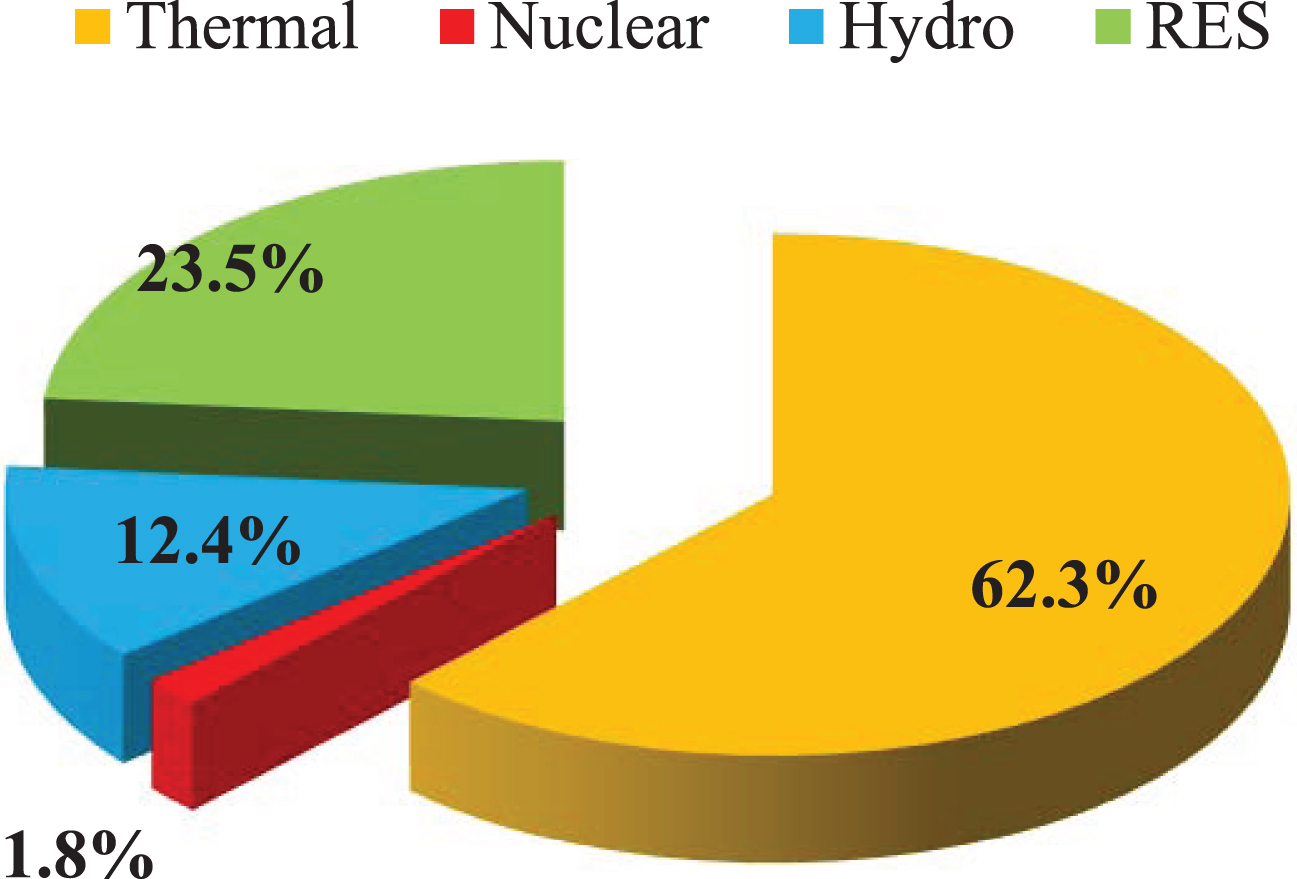
Installed capacity and share of renewable energy.
Moreover, the utilization of solar energy resource for the generation of electricity especially with the solar photovoltaic technology is gaining attention and plays a major role in the global solar energy production. Since year 2000, industry based on solar PV technology has grown by around 45% per year on an average. So, after every 2-3 years, the installed global solar capacity has been doubling and presented in Fig. 2.
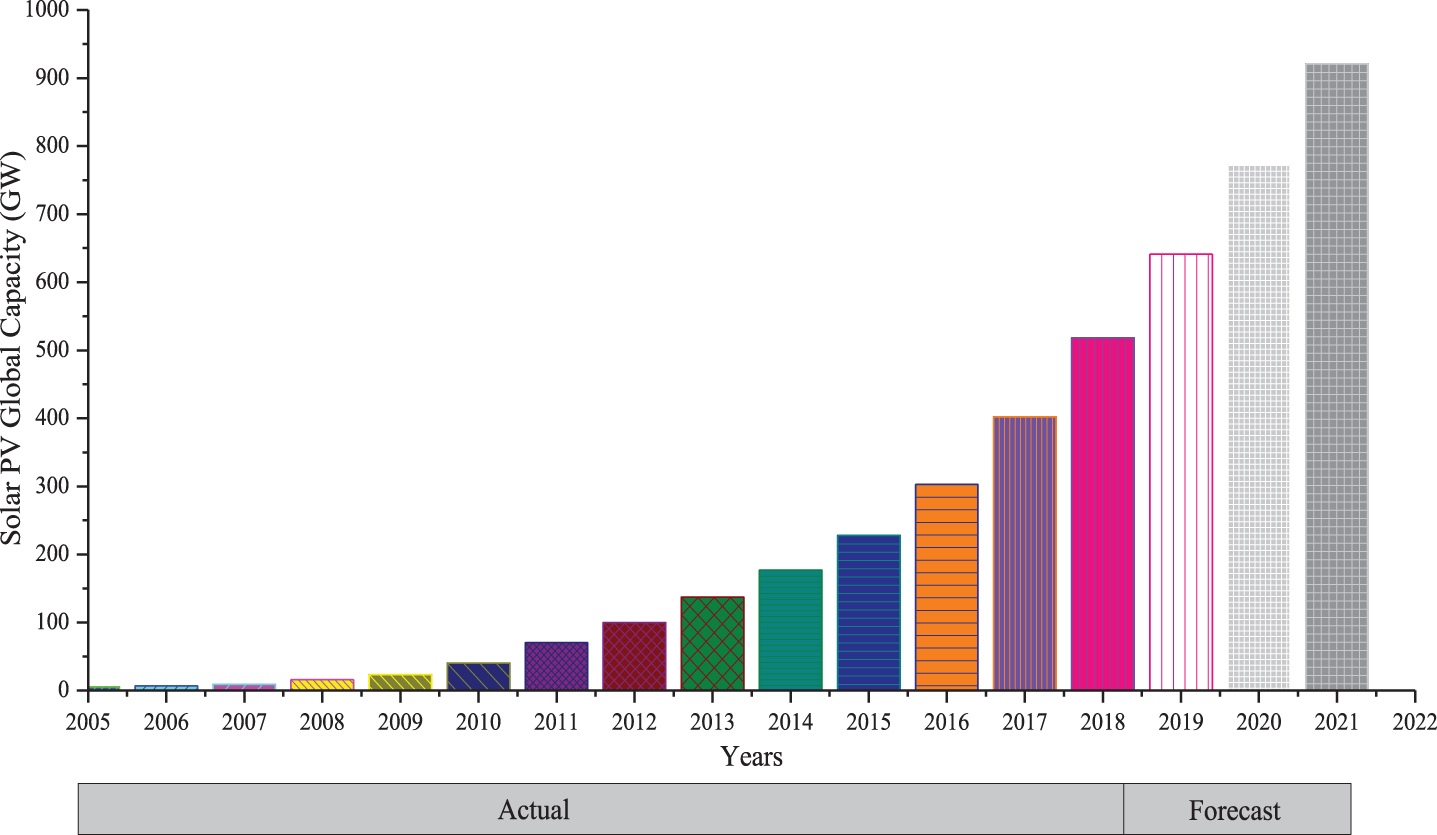
Solar PV global capacity (GW).
It is observed from Figs. 1 and 2 that the generation from solar energy-based technologies have enhanced significantly in the last few years in India and globally. Further, it will be increased drastically in the near future as the demand is not constant and increased at a rapid rate. Therefore, it is very clear that the penetration of solar energy-based technologies would increase and hence this study is becoming important in this sense. In view of the above, the solar energy availability for electrical power generation from solar energy-based power plants must be known to the power engineers, planners and utilities etc. Thus, the researchers are working in the area of solar energy forecasting so that appropriate planning may be done. It is well known fact that there are various techniques available in the literature for solar energy forecasting. The solar energy forecasting may be done for various time horizon, but it is important to know that which time horizon is more important for various applications related to smart energy management systems, inverter control, electricity marketing etc. Most of the models available in the literature are either short term or medium term but very short i.e. 15 minutes ahead and 1 hour ahead are rarely available. The solar energy methods include mathematical/regression modelling, intelligent modeling/machine learning based techniques etc. The mathematical models available in the literature for solar energy forecasting are found inaccurate, primarily due to great simplicity of parameterization; therefore, empirical relations based multiple regression models were established to estimate the global solar energy. Angstrom [1] had made first attempt to develop empirical relation between sunshine hours and global solar radiation under clear sky conditions. Kirmani et al. [2] proposed a model to estimate solar energy which is based on Angstrom’s model. In this work, empirical models were developed based on multiple regression analysis using meteorological parameters. From this research it is observed that the correlations based on five meteorological parameters gave the best results. Cenk et al. [3] proposed 105 literature models based on regression modelling to estimate solar energy over Turkey region and the performance have been evaluated based on statistical validation tests. It has been concluded from this research that the cubic models are suitable from January-June period whereas quadratic models are suitable from July-December period. It is noticed that the mostly models are dedicated to Middle East countries; however, very few models are available for climatic conditions which are like Indian climatic conditions. Khalil and Aly [4] have developed empirical models to estimate solar energy using meteorological parameters such as sunshine duration, relative humidity, and temperature for Saudi Arabia region with aid of statistical error-tests. It has been concluded from this research that during summer, maximum value of solar energy can be obtained while this value curtailed during autumn and winter. Awan et al. [5] proposed an analysis of solar energy data and solar photovoltaic systems output across the Kingdom of Saudi Arabia. In this work, the pattern of solar resource and the solar photovoltaic system has been compared with the country load profile. It has been observed in this research that during summer, Tabuk station performs best for the solar PV power plant as the stress can be reduced by companies during the season of the high load by cutting off the peak load in afternoon during summer season. Teke and Yildirim [6] proposed different models for estimating solar energy for Eastern Mediterranean Region (EMR) with aid of meteorological data in the Turkish state metrological services. Further, comparison of different models was also done using statistical error-tests. It has been observed in this research, that the use of cubic general model has been recommended for EMR. Liu et al. [7] investigated the performance of various site-dependent models in the Tibetan Plateau and nearby regions. A large variation in the coefficients has been observed due to the great spatial difference in elevation and the climate characteristics. Ihaddadene et al. [8] proposed six empirical models to estimate solar energy from ambient temperature for the city of Djelfa (Algeria). Bahel et al. [9] proposed model based on Angstrom correlation to estimate the global solar energy. The correlations were defined between global solar energy and sunshine hours to provide the favorable estimates. Further, the proposed model has been compared with Rietveld’s model and results obtained give better estimates than other correlations.
Abdalla [10] proposed a model to measure solar energy using different atmospheric parameters. It has been observed that the developed model provides an excellent agreement between the measured and estimated data and recommended to be used for the city of Bahrain. Akinoglu and Ecevit [11] presented a quadratic model for estimating global solar irradiance. Here, the developed correlations have been compared with the other recent models and the results obtained from the proposed research is more accurate. From the results it is revealed that the quadratic model performs better as compared to the others. Form the above literature review it is concluded that the performance of these models is accurate for the clear sky conditions. However, they have not performed well for cloudy and rainy conditions. The variation of meteorological parameters and the availability of various atmospheric parameters like moisture, dust, clouds and aerosols may causing the uncertainty in the atmosphere. This variation may be up to 100% in case of cloudy/foggy sky conditions and up to 30% in case of clear sky conditions. Further, all the 365 days are not clear sky and it is noticed that around 250–300 days are having clear sky as for as Indian climatic conditions are concerned. Thus, it becomes utmost important to develop such models which may incorporate the uncertainties as well. In order to incorporate the aforesaid variations and atmospheric parameters artificial intelligence (AI) based techniques could provide the solution. These AI based techniques includes fuzzy logic, ANN and ANFIS, PSO, GWO etc. Sen [12] proposed a fuzzy logic-based model using duration of sunshine hours for estimation of global solar energy. The proposed algorithm showed the ability to explain knowledge like human. A set of rules were established. Suganthi et al. [13] utilizes the fuzzy logic for wind, solar, bioenergy, hybrid systems and micro-grid. In this work, fuzzy logic-based models have been widely used for site assessment, for solar PV system installation, optimization and Maximum Power Point Tracking (MPPT) algorithm for solar photovoltaic based systems. Saez et al. [14] proposed Energy Management System (EMS) technique in determining the generation units dispatch which is optimizer-based requiring the estimation of solar energy resources and loads. In this research, system based on forecasting techniques includes a representation of the uncertainties connected with solar energy resources and loads generating fuzzy models incorporating uncertainty representation of future predictions. Recently, Perveen et al. [15] proposed a fuzzy model for solar energy forecasting using sky-conditions for different zones of India. These zones were categorized on the basis of climatic conditions like composite, hot, cold etc. It is noticed that the accuracy was improved after the inclusion of dew point as one of the input parameters. From above study it has been seen that the fuzzy logic could not provide good results for complex systems, large data sets and having a greater number of input parameters etc. Therefore, Artificial Neural Network (ANN) based models could be utilized in such scenario. Kaushika et al. [16] proposed ANN model based on using diffuse, global and direct normal irradiance (DNI). In this research, the algorithm includes diffuse, global and DNI estimation in a clear/sunny sky-conditions. Further, the clearness index which corresponds to diffuse, direct and global solar energy are thereby mapped with weather data namely sunshine hour, rainfall and relative humidity in the analysis of ANN. Yadav and Chandel [17] proposed an ANN-based model to estimate solar energy. It is found that the ANN-based models provide more accuracy than the conventional methods after performing the review of artificial neural network-based modelling techniques for identifying methods available for estimating global solar energy. Chang et al. [18] used ANN approach for short-term photovoltaic (PV) power forecasting. The data of 24 hours is dived in 10 minutes interval and considered for training. Further, the proposed RBFNN model has been compared with other ANN-based models. The performance of the developed model is found better as compared to other model available in the literature. Jamil and Zeeshan [19] proposed ANN application for forecasting wind speed in Gujarat, India. Further, in this work, ANN model has been used to forecast wind speed with aid of data measured to train and test the given information. It is found that the performance of ANN approach is better than the conventional forecasting methods. Hence, it may be used for wind energy forecasting for the similar locations and having the similar kind of geographical and meteorological parameters. Khosravi et al. [20] proposed three model of machine learning algorithms which has been implemented to forecast the wind direction, wind speed and the power generated from wind turbine. In this work, a large data set of wind velocity and direction are measured in duration of 5, 10, 30-minutes and 1-hour intervals efficiently used for estimating wind speed for Bushehr. It has been concluded from this research that the SVR-RBF model is more capable and efficient than MLFFNN and ANFIS-PSO models.
From the aforesaid literature review it is observed that the two techniques could be utilized simultaneously for obtaining the better results. Therefore, hybrid intelligent models are developed using the two well established techniques such as fuzzy logic and ANN and a new model was introduced called as ANFIS. The integrated features ANFIS is utilized for solar energy forecasting application and showed the good results as compared to fuzzy logic and ANN. Kumar and Kalavathi [21] have used the ANN and ANFIS approach to predict the PV power output. In this research, the proposed model is validated and compared with the data set of the photovoltaic power generating station. A proposed model is developed and simulated in MATLAB for evaluating the performance of the system. Walia et al. [22] performed the review on applications of ANFIS approach to estimate the solar energy. The result of simulation shows that the ANFIS based model can be used for nonlinear functions. Jang [23] have presented an ANN application for forecasting wind speed. From this work it is observed an input-output mapping based on stipulated data pairs may be constricted using ANFIS. Zheng et al. [24] proposed a two-stage hierarchical ANFIS based approach for short-term wind power estimation in China. The two stages have been utilized for numerical weather prediction and established the relation between wind speed and power respectively. The impact of input parameters on the accuracy of the output is analyzed and found better. A new methodology is proposed to evaluate the performance of the cloud and temperature on PV power generation. The hourly data of cloud and temperature change is used to assess the performance. The obtained results were validated with the measured data from the PV systems installed in different locations of Iran [25]. The accuracy of the developed model was evaluated using root mean square method. A maximum power point tracking (MPPT) technique for photovoltaic modules was developed and presented [26]. Further, a mathematical relationship was also established between the maximum power points and the corresponding currents at different operating conditions. Moreover, the obtained results were applied for solar based water pumping systems. A systematic and extensive overview of the hosting capacity limit, developments, assessment techniques and enhancement technologies were performed [27]. A recent research was carried out and around 220 empirical models were analyzed to estimate solar energy over China with the help of different meteorological parameters. The performance of the developed correlations was compared with the empirical models and found improved performance [28]. An artificial neural network-based approach was developed and compared with the hybrid method. From this paper it is revealed that the performance of the ANN model is found better for sunny sky conditions whereas the hybrid model performed well for cloudy sky conditions [29]. The performance of the solar PV-thermal was assessed by ANN and neuro fuzzy model. From this study it observed that the performance of the neuro-fuzzy model is better as compared to the ANN based model [30]. An ANN based model is proposed to forecast the solar energy and solar PV parameters for Nigeria. The developed models show the capability of predicting these parameters with high accuracy [31]. A recent research was carried out by Yildiz et al. [32] to forecast very short-term PV power. Moreover, the Kernel Extreme Learning Machine (KELM) is proposed power forecasting application. It is concluded from the results that the KELM provides more powerful and reliable results as compared to ANN.
Based on the exhaustive literature review on the intelligent techniques, it has been observed that the forecasting of global solar energy during clear sky can be done simply with the help of mathematical and regression models; however, forecasting under the varying conditions such as cloudy sky conditions could not be performed by such intelligent techniques [12–33]. Therefore, in the present research, AI based models have been developed and presented considering the high-quality meteorological measurement station data so that more reliable and proficient forecasting system is obtained.
The novelty of the proposed work is lies in developing the AI based intelligent models to forecast the global solar energy for composite weather-conditions for Indian scenario. The benefits of utilizing such techniques include simplicity, proficient and flexibility to adapt the varying parameters. However, the limitations of such approach that it requires huge data to train, test and validation. The result obtained by employing ANFIS-based model are compared and validated with the high-quality ground measured data along with other two intelligent techniques like ANN and fuzzy logic and found more accurate.
To get more appropriate forecast, the measured data from different sources have been collected for two-time horizons i.e. for 15 minutes and one-hour interval. The study based on such types of horizons are rarely available. The earlier research has performed monthly average one hour ahead forecasting but not on daily basis using the high-quality ground measured data. The proposed research could be applied for variety of applications such as reliable power supply, sustainable grid management, energy storage control, implementation of demand response concept, reactive power management, active power curtailments, and overvoltage/undervoltage issues in high penetration of solar plants in the distribution networks.
The paper is organized as follows. The impact of solar energy on solar PV based power generation is provided in section 2. The collection of high-quality measured data, normalization procedure and methodology adopted is presented in Section 3. Section 4 presents the brief description of various intelligent models used in this work. The results obtained from the above intelligent models are discussed in section 5. The idea of possible applications of the proposed work are provided in Section 6. A conclusion followed by references is provided in section 7.
In practical applications, the power output of solar based power plants particularly solar PV varies with the variation in various meteorological parameters like solar irradiance, sky conditions, temperature and other parameters like area of PV array, angle of incidence etc. Therefore, it is necessary to understand the variation of output power with respect to meteorological parameters. The impacts of solar irradiance on PV power output is shown in Fig. 3.

Impact of solar energy availability on power generation.
However, there are other parameters like temperature, wind speed, humidity and dust which affects the PV power output. The impact of these parameters is not significant like solar irradiance and further, the availability of such data is a tedious task to collect. The impact of global solar energy affects the efficiency of the solar energy-based power plants significantly. Therefore, it important to note that here, the proposed work will play an important role in the exploitation of renewable energy resources in general and solar energy-based technologies in particular which would provide a reliable, ecofriendly and sustainable solution for our future demands.
The collection of data for various meteorological parameters is a tedious task. The data of many parameters are not available even for those stations where weather stations are measuring and monitoring such parameters. Here, the high-quality ground measured data of solar irradiance for different time horizons depending upon the associated applications like 15 minutes and one hour is collected for the New Delhi, India station from different reliable sources such as educational institutions, research institutions and government agencies etc. After the data collection, a normalization process is carried out using equation 1. This process is performed to avoid the convergence problem in the development of intelligent models. Thereafter, the rule base in case of fuzzy systems and weights updating in case on neural networks was performed.
where C = the data to be scaled
Sd = the scaled data
Cmax = the highest value in the column to be scaled
Cmin = the lowest value in the column to be scaled
Xmax = maximum limit
Xmin = minimum limit
Here, the performance of the developed model is evaluated based on the statistical analysis and error occurred in the forecasted output as compared to the desired output. If the performance of the model is as per expectations and the forecasted output is very close to the desired value, then the performance of the model is stored otherwise the iterations are repeated until the best performance is achieved. This process is also represented through a flow chart and shown in Fig. 4.

Flowchart for the adopted methodology.
In this section AI based intelligent models are described for solar energy forecasting application.
Fuzzy logic model
The fuzzy logic model can be utilized to forecast the solar energy. It contains a set of rules which are developed using the linguistic variables and qualitative descriptions of the data sets. These rules are fired with some degree of membership with the help of fuzzy inferencing. However, in conventional expert system, a rule is either fired or not fired only. To forecast the solar energy output using high quality ground measurements data as input parameter, the rules are defined, and the performance is evaluated on the basis of statistical indices such as ARE and MAPE. The linguistic descriptions of fuzzy variables like very low, low, moderate, high and very high is defined and represented by membership functions. Based on these parameters a fuzzy logic-based model is developed and presented in Fig. 5. In this model, the data of solar irradiance for 15 minutes or 1-hour horizon is used as input parameters and the output is the solar energy for the next time horizon according to the inputs. Therefore, the generalized inputs like input 1, ... input 4 are provided in the proposed model.
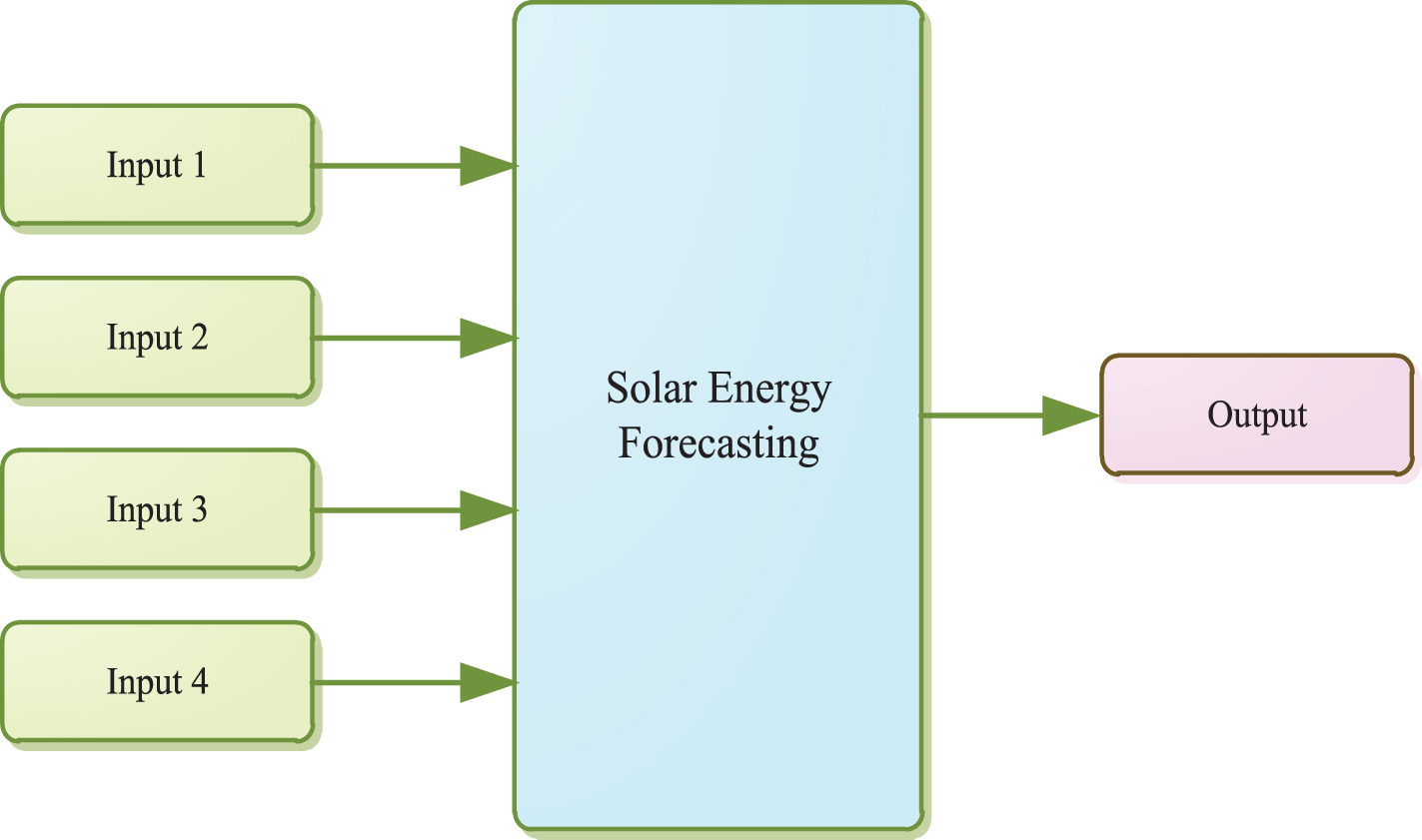
Fuzzy logic technique for solar energy forecasting.
ANN is defined as a large set of interconnected simple units which can operate in parallel to perform a common global task. These units will undergo a process is called learning process in which the network parameters are updated automatically in response to a possibly evolving input environment. Here, an ANN based model is developed for the solar energy forecasting at a given location using the high-quality ground measured data. To achieve this objective the weights are adjusted using network training so that the desired output may be obtained. This is the important step of ANN; in case the weights are not adjusted properly then the desired output will not be good. Once the output of network is calculated, then error is determined between the actual output and the desired output.
Thereafter the error is minimized by updating the weights. This step will be repeated till the error is minimized or become equal to zero. In the proposed research, architecture of ANN is consisting four inputs as input layer, one hidden layer and output layer as depicted in Fig. 6. The tan-sigmoid activation function is used in this work.

Proposed ANN architecture for solar energy forecasting.
In the previous sections, the modelling based on fuzzy and ANN were used for solar energy forecasting This section presents the hybrid intelligent model using the hourly solar irradiance data to forecast the solar energy at a particular location. This model is based on the principle of ANFIS architecture. An ANFIS involves hybrid learning rule for various applications including solar energy forecasting and optimization applications. The main advantages of using this approach is that the convergence rate is faster due to reduction of search space dimension for the back-propagation neural network method. This approach combines the ANN with fuzzy inference systems (FIS), which allows transformation of the system into if-then rules set, and the fuzzy inference system becomes a neural network structure with distributed connection strengths. An adaptive network is basically a network structure comprising nodes and directional links with overall input-output behavior defined with a set of modifiable parameters and makes use of hybrid learning algorithm for identifying parameters of the FIS.
It combines least-squares along with the back-propagation gradient descent method to train the parameters of the membership function. In the forward phase of the network algorithm, identification of the least squares estimates has been done by the consequent parameters. In the backward phase, the derivatives of the squared error propagate backwards from the output layer to the input layer wherein the premise parameters are updated by the gradient descent algorithm. ANFIS training uses algorithms for reducing the error. ANFIS is the fuzzy model which is placed in the framework of the adaptive system for model development and validation to facilitate training and testing. Further, the ANFIS model structure simulated in MATLAB with four input parameters as inputs solar energy as the output is shown in Fig. 7.

ANFIS model structure.
As discussed in Section 2, that there is a significant impact of global solar energy on the performance of solar power plants. Here, an intelligent approach based on fuzzy logic, ANN and ANFIS is utilized for the development of reliable and proficient forecast system. The high-quality measured data has been obtained and used as input parameter for different time horizons i.e. 15 minutes and one hour. In fuzzy model, various rules have been established for the development of the proposed model. The defuzzification process is carried out to get the results in the desired format. The performance of the developed model is assessed using ARE and MAPE. The results of the developed model for 15 minutes ahead and one hour ahead are provided in Figs. 8 and 9 respectively. As seen from Figs. 8 and 9 that the forecasted values are very close to the desired values, therefore it can be considered that the performance of the model is accurate with MAPE value of 1.05%. for 15 minutes ahead and 1.64%. for one hour ahead forecasting model. The maximum and minimum ARE value obtained from this model is found to be 12% and 0.03% respectively. The detailed results of fuzzy logic-based model for solar energy forecasting are provided in Table 1. The results of ANN model for one hour ahead are provided in Fig. 10. The input parameters of the proposed model are hourly irradiance level from 9:00 to 12:00 and output is solar energy at 13:00. The normalized data of solar irradiance level is used for training the network. Once the training of the network is satisfactory then testing of the model is performed. The obtained results of the proposed ANN model are presented in Table 1. The input parameters of the proposed model are hourly irradian 00. The normalized data of solar irradiance level is used for training the network.

Forecasted solar energy output in comparison with desired output for 15 minutes ahead using fuzzy logic.
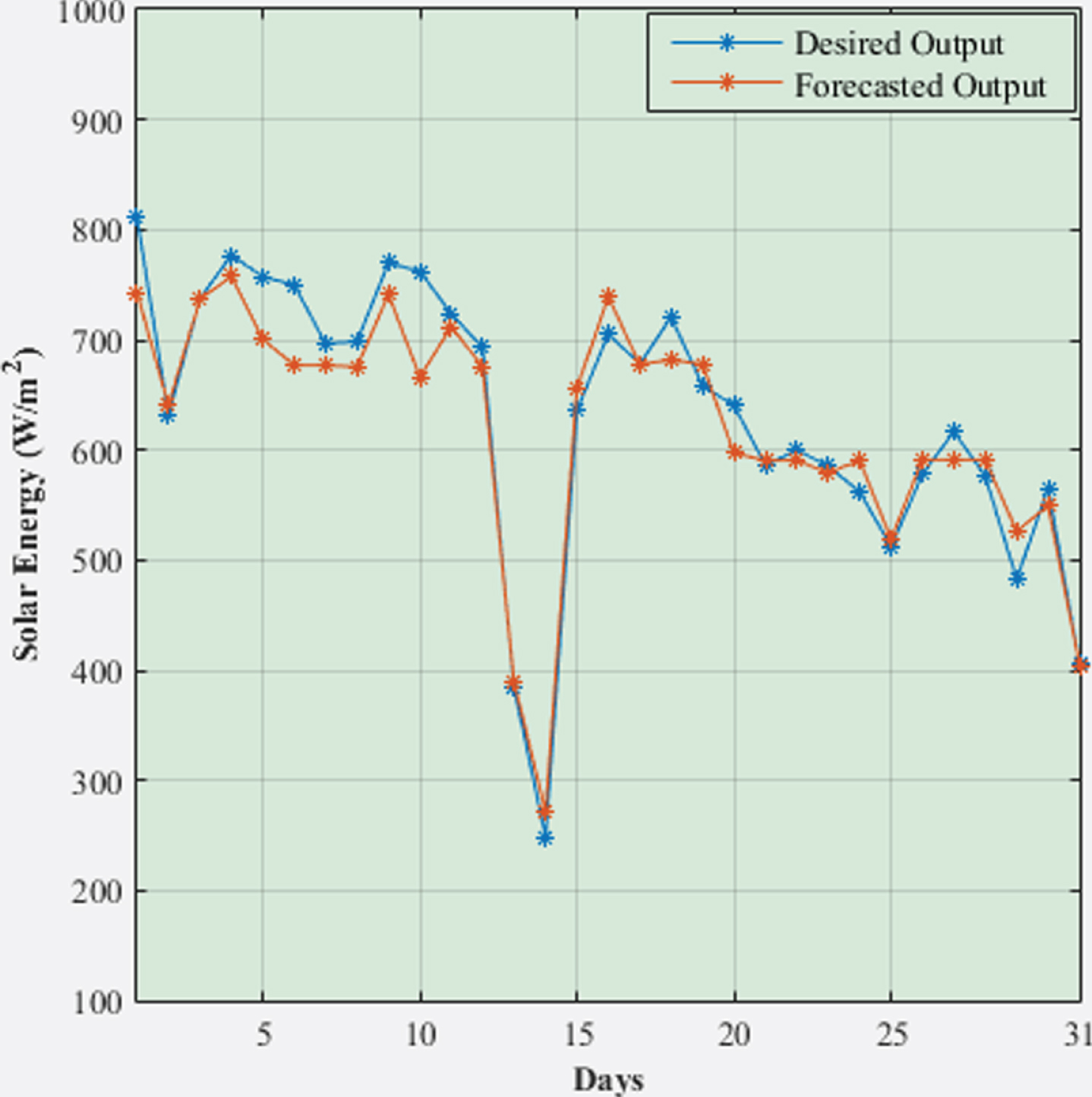
Forecasted solar energy output in comparison with desired output for one hour ahead using fuzzy logic.

Forecasted solar energy output in comparison with desired output for one hour ahead using ANN.
Percentage ARE in comparison with high quality ground measurements for one hour ahead very short-term solar energy forecasting
Once the training of the network is satisfactory then testing of the model is performed. The obtained results of the proposed ANN model are presented in Table 1. It is clearly seen from the Fig. 10 that the performance of the ANN model is found better as compared to the fuzzy logic with MAPE of 0.52% as compared to 1.64% in case of fuzzy logic approach. After, ANN, the results of ANFIS model for global solar energy forecasting are presented in Fig. 11. Using ANFIS model the MAPE is found to be 0.22% which is better than fuzzy logic and ANN.
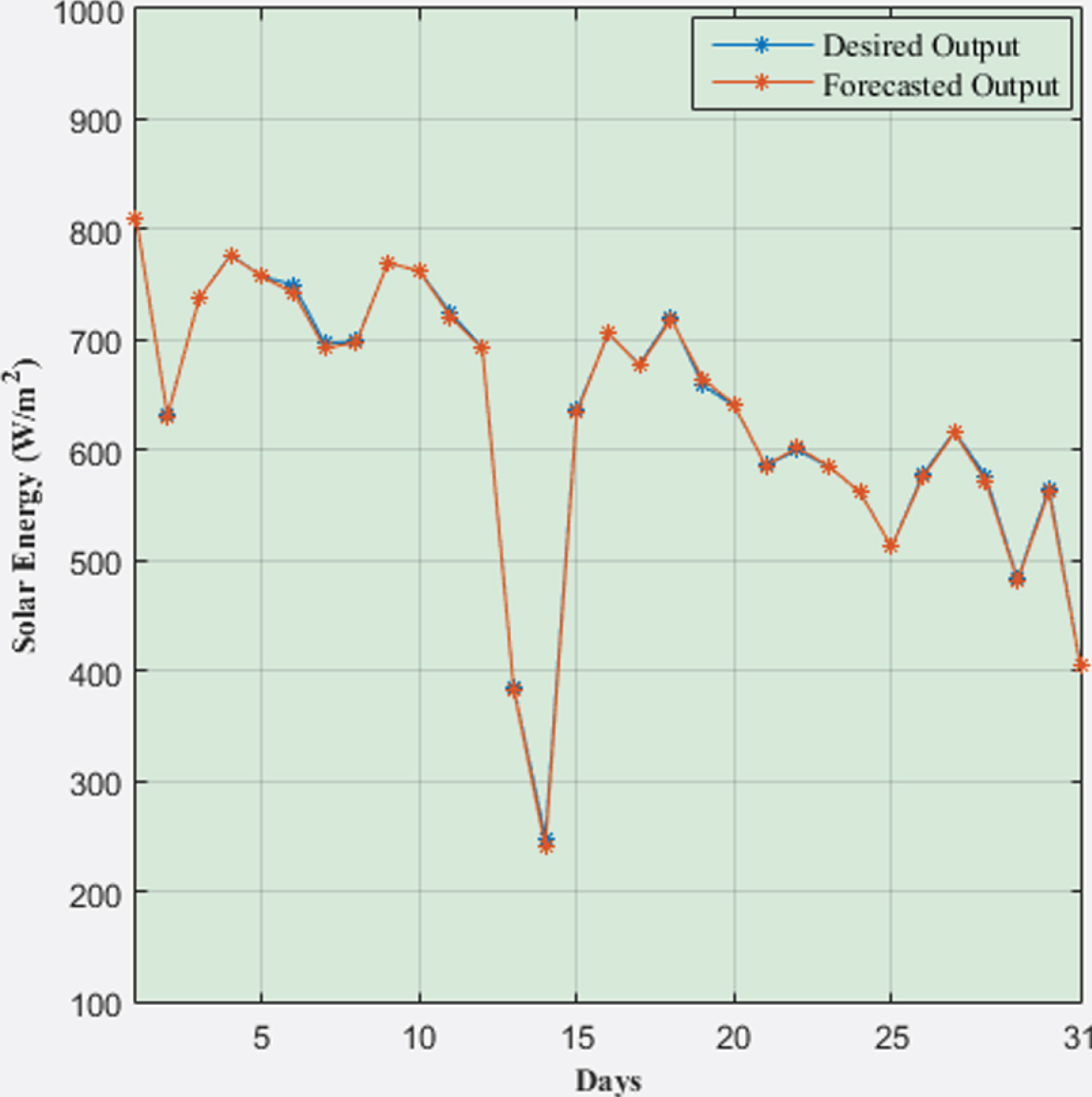
Forecasted solar energy output in comparison with the desired output for one hour ahead using ANFIS.
The availability of the solar power is not constant and highly influenced by meteorological parameters, thus solar energy forecasting is of utmost important in solar based power generating systems particularly solar PV based power generation. The high-quality ground measurements were done to evaluate the performance of the model.
After thorough analysis it is found that the performance of all the three models is found satisfactory for 15 minutes ahead and one hour ahead solar energy forecasting. The one hour ahead forecasted value of solar energy (W/m2) in comparison with the high-quality ground measurements for the month of October using fuzzy logic, ANN and ANFIS are presented in Table 1. Further, the detailed results for 15 minutes ahead solar energy forecasting are not provided in this paper because of space constraints. Finally, the assessment of fuzzy logic, ANN and ANFIS models for one hour ahead solar energy forecasting is presented in Fig. 12.

Comparative chart of forecasted solar energy with high quality ground measurements.
As seen from Fig. 12 that ANFIS has lower ARE and MAPE values for all forecast horizons. From this performance metric analysis, it can be considered that ANFIS can provide more reliable and proficient forecasting results. Moreover, it is observed that the capability of ANFIS model is more promising as compared to other AI models such as fuzzy logic and ANN models.
In this section AI based techniques have been utilized for very short-term solar energy forecasting. The solar energy forecasting could provide the meaningful guidance to the system operators, decision makers and electricity participants for proper planning and effective management. Moreover, the appropriate solar energy forecasting horizon can be chosen to ensure the performance of the specific application. By using the results obtained from the developed model, the energy management may be performed efficiently in the following manner. If the solar energy is forecasted 15 minutes or one hour ahead, then power output from solar plants can be estimated or forecasted by using the obtained results as input parameter. Accordingly, the utility may take an appropriate action for providing the reliable power supply and grid management. Once the power generated from the solar plant is known, the appropriate energy storage systems (ESS) may be selected and hence the deficit power may be drawn from ESS or the excess power, if any may be utilized in planned manner instead of using the dump loads. If the power generated from the PV plant is forecasted, the distribution company may participate in electricity market for bidding to sell the excess power and buy the power in case of deficit as per the requirements. Further, by knowing the power generation from solar PV system, the demand response algorithm may be implemented by sending the message or alarm to the customers to switch off the non-critical loads, in case of deficit power generated from the PV system. The proposed forecasting model may also provide a very short-term PV power forecasting like few seconds to minutes which could be used to determine the requirements of reactive power compensation from the PV inverter and active power curtailment threshold [33]. The proposed approach would be helpful to reduce the local overvoltage under the scenario of high penetration of solar PV in smart grid environment [33].
Conclusion
In this research, it is aimed to develop an effective model for short term solar energy forecasting. The high-quality ground measurements data is used to forecast the solar energy for the composite climatic condition such as New Delhi, India using different time horizons. The results for all the months of the year are obtained using different models. The performance of the model is evaluated based on ARE and MAPE. The ARE and MAPE values obtained from all the three forecast models are analyzed and it is found that the ANFIS based model has lower values in both the forecast horizons. Therefore, it can be considered that the ANFIS model is providing more satisfactory forecast results in different months of the year. Further studies may be conducted for other stations which are having the same weather conditions and different forecast horizon like one day ahead to validate the effectiveness of the proposed model. A future study by implementing the obtained results in smart grid energy management systems such as grid management, energy storage control, demand response concept, reactive power compensation, active power curtailments, and overvoltage/undervoltage issues in high penetration of solar plants in the distribution networks would be very interesting.
Footnotes
Acknowledgments
Researchers wish to express thanks to the administration of the College of Engineering for providing the opportunity and research facilities to perform this research. Moreover, the authors are also thankful to the Deanship of Scientific Research, Qassim University, Saudi Arabia for funding this publication.