



Abstract
Social networks have emerged as a fertile ground for the spread of rumors and misinformation in recent times. The increased rate of social networking owes to the popularity of social networks among the common people and user personality has been considered as a principal component in predicting individuals’ social media usage patterns. Several studies have been conducted to study the psychological factors influencing the social network usage of people but only a few works have explored the relationship between the user’s personality and their orientation to spread rumors. This research aims to investigate the effect of personality on rumor spread on social networks. In this work, we propose a psychologically-inspired fuzzy-based approach grounded on the Five-Factor Model of behavioral theory to analyze the behavior of people who are highly involved in rumor diffusion and categorize users into the susceptible and resistant group, based on their inclination towards rumor sharing. We conducted our experiments in almost 825 individuals who shared rumor tweets on Twitter related to five different events. Our study ratifies the truth that the personality traits of individuals play a significant role in rumor dissemination and the experimental results prove that users exhibiting a high degree of agreeableness trait are more engaged in rumor sharing activities and the users high in extraversion and openness trait restrain themselves from rumor propagation.
Introduction
Social computing has emerged as a new field of computing systems that enables faster communication and serves an important paradigm for modeling the social behavior of people through the use of software and technology. It facilitates people all over the world to interact and share information through various channels including emails, online chat rooms, blogs, forums, social networking sites, instant messaging, social bookmarking and so on [1]. Among the various social platforms, social networks have gained an indispensable role in our daily lives during recent years with the proliferation of smart devices. Social networks are open to everyone and any person owning a smartphone or having a minimal computer knowledge can create an account and post stories or share their views and opinions through their social networking space.
The most valuable potential of these networks is the rapid dissemination of information to a large community of people within a short period of time [2]. But, the lack of proper mechanisms to monitor the credibility of the contents posted or shared by the users in real-time paves way for the immense spread of rumors and fake news through social networks which is one of the serious issues faced by the online social network users [3]. Rumor propagation through social networks has become a critical issue that social network providers are trying to resolve as it can create severe impairments at individual, organizational, and societal levels [4]. There are no effective methods to assess the trustworthiness or check the authenticity of users in these networks which are being exploited by rumor mongers and they use this medium as a convenient channel for rumor propagation. In addition, the ease of access and the anonymity enjoyed by the social network users are also elemental reasons for the increased rate of rumor diffusion through social networks. Even though users enjoy anonymity in their social networking space, individual behavior could be easily predicted from the traces left behind by the users in connection with their social networking patterns. Several studies have been carried out to elicit the relationship between online behavior and the personality of people but only limited research has been done to study the behavior of people who orient to spread rumors. Different people respond in different ways to the news and rumors spreading through social networks. Some people easily believe all types of information flowing through these networks and share it with their neighbors whereas some other people do not share even a single piece of information without verifying it. Users who easily tend to believe and share rumors can be grouped into the susceptible group since they are more susceptible to be affected by rumors whereas the other group of people are much more reluctant to share gossip stories. Analyzing the responses of different people towards rumor stories helps us easily identify which users are more susceptible to share rumors since user behaviors contain hidden clues to recognize rumor mongers [5]. User behavior analysis is very much significant in rumor diffusion study since social network users are the prime contributors to the quick spread of rumors during any events. There is a difference in the behavioral traits exhibited by each individual, and studies have proven that the individual personality traits of a user can be analyzed from his or her social networking pattern. Social networks are the venues where users present themselves to other people and the information they display on their profiles, the opinions they share, the communities they interact with etc. are a clear reflection of their actual personalities. Several personality models and theories were put forward to study the individual differences in personality and these theories have been later on utilized by the researchers to prove the interdependence between users’ personality and their online behavior [6]. Similarly, the people who are continually involved in rumor sharing would be exhibiting certain behavioral peculiarities which could be assessed from their social network profiles. This research is an attempt to identify which all social networking characteristics are high, medium or low in different individuals involved in rumor sharing and thereby categorize users into the susceptible and resistant categories based on their personality traits associated with their social networking nature. Categorizing users based on their underlying personality features helps us identify which all users are more susceptible to be affected by rumor during a rumor spread. In this work, we are proposing a fuzzy-based approach to distinguish the behavioral traits that are dominant and submissive in individuals involved in high rumor sharing activities based on the Five-Factor Model which differentiates human personalities into a series of five-dimensional traits [7]. Ten basic features from the Twitter profiles of users are considered to analyze the online behavior of people. These ten factors are pivotal in determining the social networking behavior of users which in turn can be used as a measure to decide the personality traits that are more distinct in different rumor mongers. Later on, users can be classified into either susceptible or resistant categories based on these identified behavioral features. The major contributions of this research are highlighted here. To the best of our knowledge, this is the first major work to study the behavioral psychology of people who are highly involved in rumor propagation utilizing the concept of Fuzzy logic. The personality traits evident in rumor mongers are determined from their social networking pattern with the support of the Five-Factor Model of behavioral theory. Ten basic attributes obtained from the Twitter profiles of users are considered to analyze the social networking behavior of rumor mongers. The users are classified into susceptible and resistant group based on the personality traits identified from their social networking pattern. The proposed approach has been experimented in five real-world datasets compiled from five different rumor stories that circulated through social networks.
The remaining sections of the paper are structured as follows: Section 2 gives a general overview of some of the major works indicating the significance of personality assessment of individuals based on their online social networking behavior and the role of user behavior analysis in rumor propagation through social networks. Section 3 explains the background theory utilized in this research and Section 4 describes our proposed approach for user categorization in a rumor affected network based on the user personality assessed from their social networking nature. Section 5 provides a brief description of the datasets used for the study. Section 6 summarizes the key findings of our research and eventually, the paper concludes in Section 7.
Related works
Personality study in connection with the social network usage is imperative in determining the peculiar features hidden in users primarily involved in rumor diffusion. Earlier, several studies have been conducted to discover the association between individual’s personality and their online behavior and from the studies it is clear that an individual’s character can be analyzed from his/her social networking pattern. Some of the major works done in the area of personality assessment from the social networking behavior of people are discussed below. Studies correlating personality and Internet usage could be dated back to early 2000s [8–11] but one of the notable works citing the existence of a relationship between the personality of individual users and their social network usage was proposed by Ross et al. in 2009. In this work [12], they explored the influence of the Five-Factor Model of personality and competency factors in association with Facebook usage. The study was conducted on university students with the help of a Facebook application which was based on a Facebook usage questionnaire and the researchers were able to find only a partial link between the user behavior on Facebook and three traits of personality factors. They could not establish any remarkable connection with the rest of the two traits. Following the study conducted by Ross et al., Amichai-Hamburger and Vinitzky as part of their research [6] proved that there exists a strong correlation between the personalities of surfers and their conduct on Facebook. In addition to the self-report measure of the Five-Factor Model of personality collected from the participants, the user information uploaded on Facebook was also utilized for their research. The results of their study were supporting the hypotheses put forward by them and their study proved that personality is very much related to social network usage. The work [13] done by Wilson et al. attempted to predict the social network usage in young adults and their addictive tendencies towards social networks from their personality characteristics and self-esteem. Even though personality and self-esteem are important predictors of both social network usage and addictive tendencies; there are some more underlying factors including psychological aspects that account for the high usage and addictive tendencies in young adults which were not considered in their study. During 2011, the research [14] done by Golbeck et al. has shown that the Big Five personality traits in users’ behavior could be predicted from the public information they share on their Twitter profiles. In the same year, another study [15] carried out by Querica et al. also proved that there are similarities and differences in the personalities of different Twitter users including listeners, popular, highly-read and influential users, which could be inferred from their profile data. The work [16] presented by Bachrach et al. during 2012 showed the association of the personality traits with the patterns of social network usage but their approach suffered from certain limitations as their studies were conducted on a biased sample. Another research mentioned in [17] carried out during the same period by Sumner et al. explored the chances of predicting anti-social personality traits based on the Twitter usage. This was done by comparing the Dark Triad and Big Five personality traits of different Twitter users with their profile attributes and the use of language. The approach discussed in [18], incorporates text, image and meta-features of users obtained from Twitter and Instagram to infer user personality. The joint analysis of user activities from the two popular social networking sites led to a considerable decrease in the prediction errors for each personality trait.
In a recent work [19] proposed by Azucar et al., the Big 5 personality traits of users with different personality profiles could be deduced from the digital footprints obtained from social media. Even though their study had some limitations, the predictions could be effectively used for customizing online services to provide better user experience, improve recommender systems, and as a feasible screening and implementation tool for public health. In the same year, Carducci et al. proposed a supervised learning approach to extract the personality traits from the individual tweets of users but this method was solely based on the text messages posted by the user and they didn’t consider the influence of other social networking features for personality prediction [20]. From the previously mentioned works, it is obvious that the individual differences in personality could be clearly interpreted from one’s online behavior and social networking pattern. User behavior analysis is important in analyzing rumor propagation across social networks as user attributes, neighboring nodes and several other environmental factors play a crucial role in the quick spread of rumors. Several noteworthy works have been done to analyze the behavior of people who orient to spread rumors and a few of them are listed here. Huang and Su proposed an epidemic model in [21] to describe how a rumor spreads among the followers by considering the retweeting behavior and the browsing nature of users on microblogs. The work mentioned in [2] analyzed the role of different types of users who support rumors and enhance rumor diffusion. One of their striking findings was that highly reputable users such as news agencies endorse rumors and they even provide evidences in support of it. In [5], Liang et al. explored machine learning approaches for rumor identification based on user behavior. They collected features related to user behavior from microblog posts and they found that the behavior of rumor publishers vary from that of normal users which can be used to trace rumor mongers. Another work which analyzed the characteristics of users in rumor propagation was presented in [22] which addressed the user beliefs during a rumor spread and how different users react to rumor stories propagating through social networks.
A major work which examined the influence of personality, motivation and perceived characteristic of information in the misinformation sharing tendency of users on social media is discussed in [23]. Their study revealed the huge impact of individual personality traits and motivation in misinformation sharing and they concluded that users’ act of sharing played a key role in misinformation spread than the accuracy of the information being shared. Since their research mainly relied on a survey conducted on the university students, it had some limitations due to its self-reporting nature. The research carried out by Gumelar et al. in [24] explored the role of Big 5 personality traits in the engagement and spreading of fake news. The study focused on analyzing how users with different personality traits identify a fake news from a genuine one and how different users react to the fake news which help examine the spread of fake news. Their study proved that extraverted people showed a moderate effect on the engagement and propagation of fake news compared to other other personality traits.
In 2018, Li et al. proposed an Ising model combining the attributes of the individual’s self-identity, the interaction between users and the influence of social environment to study the decision-making behavior of people involved in rumor circulation. In this work [25], the self-identity characteristics of each individual were closely analyzed which can greatly affect the users’ decision-making process which slows down the rumor spreading process and thereby reduce the spreading scale of rumors in the network. In [26], Lai et al. examined the relationship between the Big Five personality traits and individual’s belief in false rumors that circulated in social media. They conducted a survey in China as part of their study and their findings show that people high in extraversion and neuroticism are more liable to believe false rumors. Moreover, users’ demographic features including gender and possession of less education were also factors related to rumor beliefs. A recent work [27] done by Mikhaeil and Mougy investigated the possible factors affecting a rumor spread and identified the type of personality traits that are more likely to involve in rumor propagation. Their study on Twitter users found that people with higher number of followers are considered as trustworthy users and they could influence the speed of rumor propagation. Their research supported the claim that personality traits affect the rate of spreading of rumor through social media platforms.
The literature clearly states that personality study is instrumental in determining users who are highly taking part in rumor sharing as rumor mongers would be displaying particular behavioral mannerisms. There are plenty of works utilizing user behavior analysis for studying rumor propagation in networks but to the best of our knowledge, a very few have investigated the influence of personality traits and individual character dissimilarities of users who are involved in rumor dissemination. Various network and user-specific features are generally considered in user behavior analysis but the interrelationship between personality traits of a user and social networking behavior is least explored in the context of rumor propagation. This line of research has greater significance in identifying users who are more interested or reluctant towards rumors and thereby classify users into susceptible and resistant groups.
Background theory
The five-factor model of behavioral theory
Personality study is imperative in the domain of psychological research. Various personality theories have been put forward by the researchers to pin down the different personality traits and behavioral peculiarities underlying in humans in a systematic manner. Research has proven that the personality traits inherent in a person are clear indicators of the different aspects of a person including personal life, academic success, health, career performance, social and political orientations and even one’s online behavior [19]. Even though there exist several personality models describing individual’s personalities, the Five-Factor Model or the Big 5 Model of behavioral theory has emanated as one of the most widely accepted and well- researched measures of personality structure in recent years [15]. The Five-Factor Model (FFM) divides the personality into a series of five-dimensional traits which are characterized by the following [28].
Proposed approach
Our proposed approach tries to analyze the behavior of divergent groups of people involved in rumor propagation based on the personality traits inherent in their character which could be assessed from their social networking nature. There are two major sections in our proposed approach. The first part is the behavioral study of users involved in rumor propagation based on the Five-Factor Model and second is the categorization of users into different compartments based on their personality inferred from their social networking pattern. The personality traits intrinsic in individuals studied on the basis of the Five-Factor Model can be related to a person’s social networking behavior and this concept is extended to discover whether any specific behavioral trait is high or low in people highly involved in rumor spread. This analysis can be later on utilized to categorize social network users into susceptible and resistant categories based upon the presence of the identified behavioral traits that are dominant or submissive in rumor mongers. In the proposed work, we are introducing a fuzzy-based approach to find out the personality traits that are strong and weak in rumor mongers by analyzing their previous social networking practices and classify them into two compartments as susceptible and resistant group based on their behavioral study conducted. Every social network user will be either in the susceptible or resistant category and this categorization can be done on the basis of how they respond to the news/stories/rumors appearing on their timeline. Some users have increased tendency to share most of the information they come across their social network pages whereas some other users are more reluctant in sharing the news. This information-sharing behavior in individuals is examined during the spread of rumor stories on the grounds of their behavioral characteristics. The behavioral attributes of a person get reflected in his/her social networking pattern and by closely examining one’s social networking nature we can analyze the personality traits that are prominent in a person. This concept is exploited in our current work to determine whether people highly involved in rumor sharing exhibit high traces of any specific behavioral trait which could be analyzed from their social networking pattern.
The overall design of our proposed approach is depicted in Figure 1. Initially, the personal details of the users involved in rumor propagation are gathered from their social network profiles. Ten basic attributes determined from the user profiles are considered for mapping the social networking behavior of users with the OCEAN Five-Factor model. In the previous works, the relationship between the personality traits and social network usage in users were determined through surveys where users’ personal details and their social networking usage pattern were collected directly from the users through questionnaires. But this methodology can produce a biased sample as there is a chance of false reporting by the users since people tend to submit more idealistic answers to project their ideal behavior as they already know that the data is collected for a research purpose. In order to avoid this, the personal details of rumor propagators are collected directly from their social network profiles which are later on used to determine their social networking behavior. The behavioral psychology of rumor mongers is studied using a fuzzy-based approach and fuzzy rules are formulated by correlating the social networking nature and personality traits inherent in people identified using the Five-Factor Model. Using the fuzzy rules we can estimate the behavioral characteristics that are dominant in rumor spreaders and later on classify users into two groups as susceptible and resistant based on the personality traits analyzed from their social networking nature. The social networking nature of users is determined from the three social networking features such as the account activity (T acc ), Twitter follower – following ratio (T ff ) and the disclosure of personal details in profile (T pd ) of which the account activity and T ff are calculated based on the feature mapping of rumor propagation with the forest-fire spread from our earlier work [30]. Each step in the proposed framework is detailed in the subsequent sections.

Overall design of the proposed work.
The first step in the proposed approach is the compilation of the personal details of users who are highly involved in rumor dissemination from their social network profiles. Our study is limited to the Twitter platform due to the unavailability of user data from other popular social networks. Therefore, the information of the users who are involved in the spread of five popular rumor stories circulated on Twitter during the past few years has been considered for our analysis. Ten attributes that can be collected directly from the Twitter profiles are used to calculate the three social networking features of users such as T acc , T ff and T pd . These three features could be later on mapped with the Five-Factor Model for the behavior analysis of rumor purveyors. The ten basic attributes obtained from the Twitter profiles of users which are used for calculating the social networking nature of individuals are shown in Table 1.
Social network attributes considered for evaluating social networking pattern of users
Social network attributes considered for evaluating social networking pattern of users
The account activity of a user (T acc ) can be used to envisage how much active a user is in his/ her social networking space which is an influencing component in personality prediction. The account activity of a user can be determined using Eq.(1) by taking the total count of the tweets posted by the user (A tc ) and the overall number of likes (A lk ) of the user from the time of his/her account registration (A age ).
A high number of tweets for a recently registered account denotes a user with high Twitter activity and the number of likes received for his/her tweets is an indication of the general acceptability of the user’s tweets among his/her followers. A span of values is given for various users based on their account activity [30].
The Twitter follower-following ratio is a determinant factor to measure the popularity of a person on Twitter or how much influence he/she has among other Twitter users. A follower is a person who follows a Twitter account and following indicates the number of people, a particular Twitter user is following. A negative value for T ff denotes that the user has lesser number of followers than the number of people he/she follows and vice versa. Twitter follower-following ratio calculation is done using Eq.(2) where A frc refers to the follower count of a user and A fic denotes the user’s following count.
The amount of personal details disclosed by a user on his/her social network profile is another determining factor in assessing the personality of the user. Certain users do not like to provide too much of their personal information via social networks whereas some other people do not hesitate to reveal their personal data publicly. In our present study, we are considering five attributes from the Twitter profile of a user to infer the personality traits apparent in that user. The attributes taken into consideration are profile name, profile picture, date-of-birth, location details of the user and presence of self-photos on the profile. For each user in our dataset, we check for these five conditions.
Whether the user has displayed his/her original name as the profile name, A
pn
?
Whether the user has displayed his/her original photo as the profile picture, A
pp
?
Has the user mentioned his date of birth on his/her account, A
dob
?
Has the user displayed his/her location details on his/her profile, A
lc
?
Does the user has the habit of uploading self-photos frequently on his/her profile, A
sp
?
The five factors considered for evaluating the personal details of the user are flagged either as 1 or 0 depending upon its presence or absence. If all of these five attributes are present on a user’s Twitter profile, then we can assume that the user is willing to publish his/her personal information with others and a span of values are assigned for various users depending on the amount of personal data they have unveiled on their profiles.
There are several other social networking factors that could be considered for the personality assessment of social network users but from the literature survey conducted, these three social networking features prove to be more judgmental in determining the behavioral traits of rumor mongers and categorize them accordingly.
Mapping of social network features with the OCEAN properties
The next step is the mapping of the identified social network features with the Big 5 personality model in order to determine the OCEAN properties that are more apparent for each social networking attribute. The mapping is purely done on the basis of psychological research conducted in this domain. There are several hypotheses put forward by the researchers in their studies connecting the social networking behaviors and personality traits of people in [6, 16] and a few are discussed here.
Openness and Neuroticism are positively connected to the account activity whereas these two traits are negatively related to the number of friends/followers of a user.
Conscientiousness is positively related to the number of friends/followers while it is negatively correlated with the account activity and posting of self-photos.
Extraversion is positively associated with the account activity of the users but it is negatively associated with the publishing of personal details and posting of self-pictures.
Agreeableness is positively connected with the account activity, number of friends and posting of photos but it is negatively connected with the usage of positive words in the tweets/posts.
After compiling the findings of various researchers in the field of behavioral study connecting one’s social networking behavior, we have made an analysis and the results of our research are summarized in Table 2.
User behavior and Twitter activity analysis
User behavior and Twitter activity analysis
This analysis is further utilized to formulate the fuzzy rules to identify the personality traits corresponding to the different combinations of Twitter features in each user in order to discover the behavioral traits that are strong and weak in rumor purveyors.
The mapping of social network features with the OCEAN properties is performed by applying fuzzy logic to understand the behavioral psychology of rumor spreaders. User behavior prediction usually exhibits an ambiguous nature and therefore, fuzzy logic is applied in this work as there is some uncertainty in the behavior prediction of individuals who are involved in rumor propagation. Here, we are applying the Mamdani fuzzy inference model [31] as there is fuzziness in the output behavior predicted from the three social networking features. The input membership functions are displayed in Figure 2. Here, the three social networking features: T acc , T ff and T pd are given as the input fuzzy values for determining the behavior trait prominent in each user.
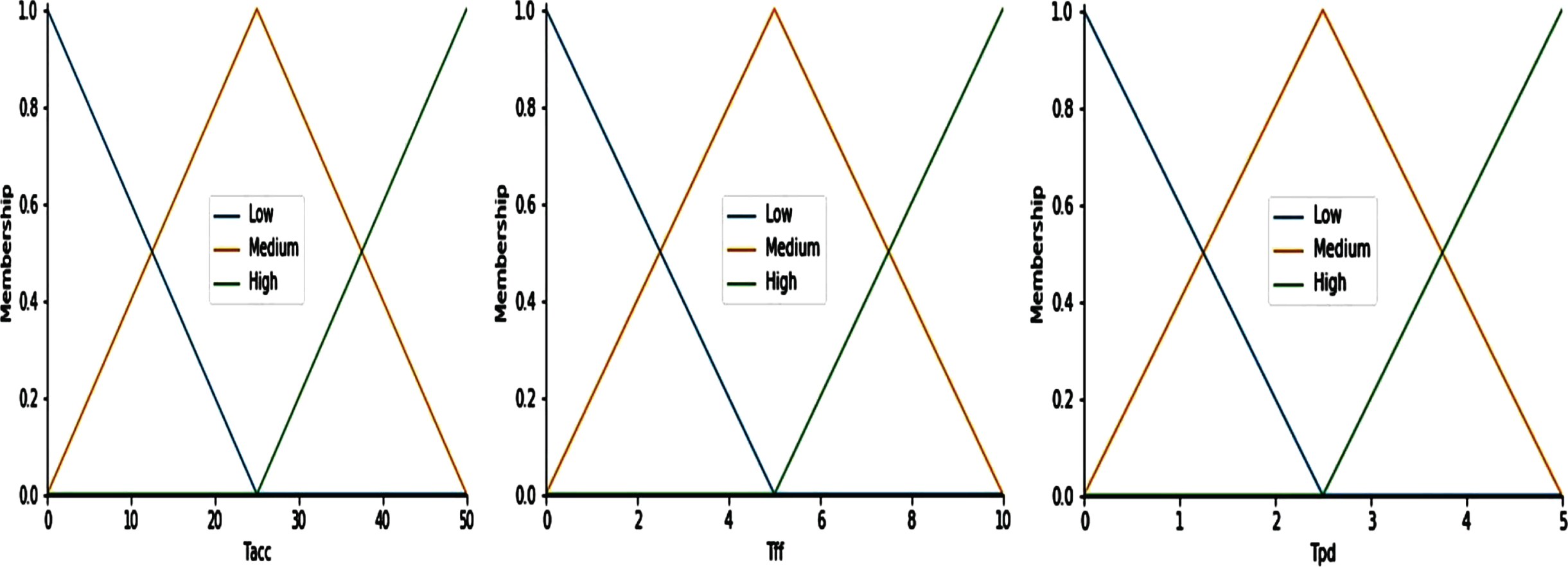
Input fuzzy membership values.
The input features are mapped to the corresponding OCEAN properties using three linguistic variables: “High”, “Medium” and “Low”. Since each combination of input social networking feature values to the fuzzy system lies within a specific range, we applied triangular membership function to define the fuzzy membership values. Since there are three linguistic variables, a total of 27 fuzzy rules have been formulated to determine the behaviors corresponding to all possible combinations of the three social networking features. Based on our analysis presented in Table 2, we have generated the fuzzy rules for calculating the OCEAN property correlated with each triad of input values. The fuzzy rules structured for the behavioral study of different rumor spreaders are listed below in Table 3. If all the three social networking features are having a "High" value, then the person is likely to be open in nature and conversely if all the input features are having a "Low" value, the the person will be more conscientiousness in nature. The rest of the behavioral traits are evaluated based on whether each social networking feature is “High”, “Medium” or “Low” for each user.
Fuzzy rules for mapping social network features to OCEAN behavior
The fuzzy rules are applied on the input membership values to determine the behavior based on the output membership function. The output membership values are distributed within a range of [-1, 1] as depicted in Figure 3.
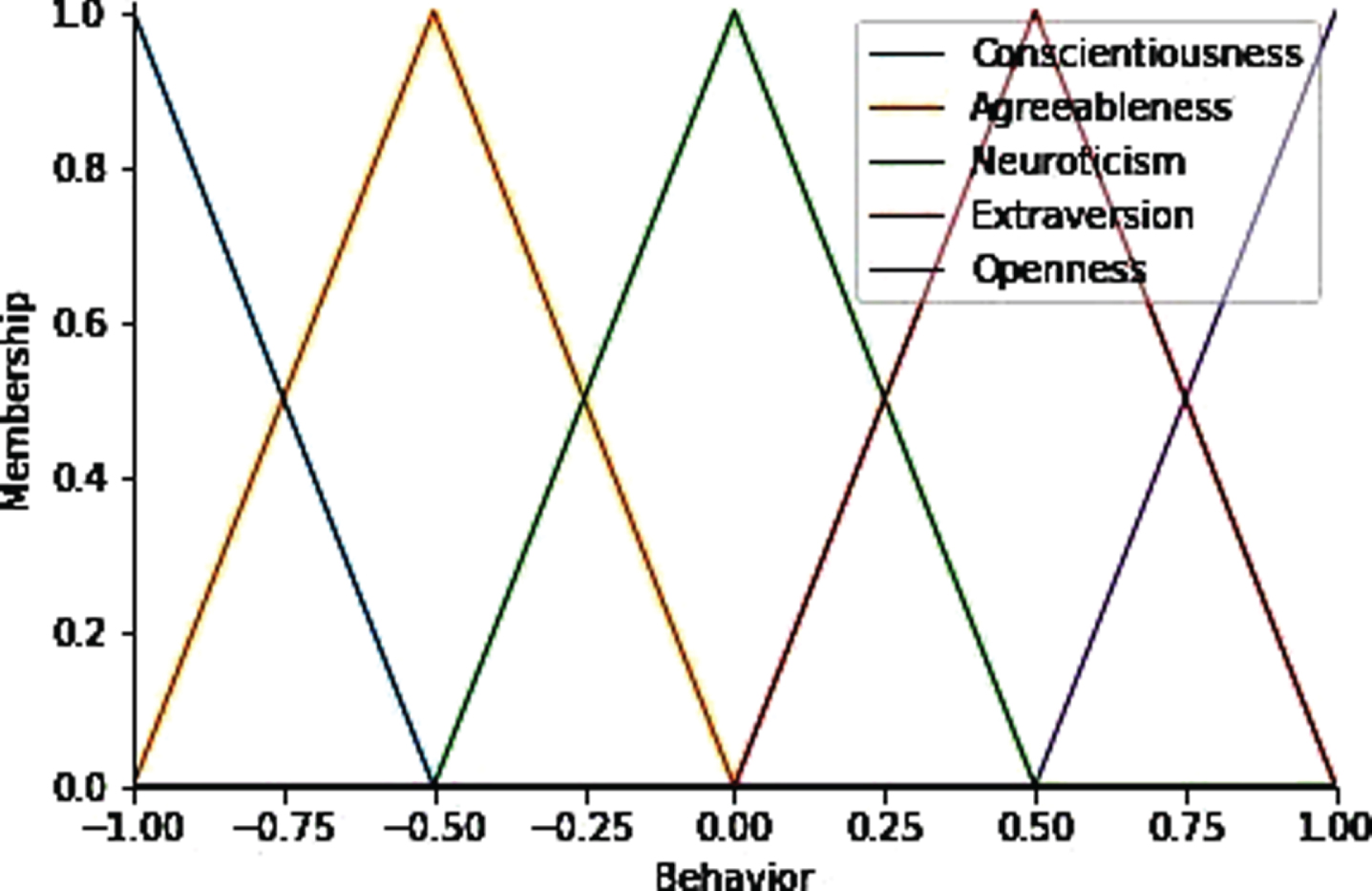
Output fuzzy membership values.
Eventually, defuzzification is performed by calculating the centroid of the output membership area to determine the OCEAN behavior corresponding to each user. The area of distribution of each behavioral trait in the output membership area mapped within the range of -1 to +1 can be calculated from Figure 3. Based on the range of the output membership value obtained after defuzzification, we determine which behavior is associated with each user. The overall steps in the proposed approach are explained in Algorithm 1.
1: Initialize Behavior, B ← {}, Tpd← 0
2:
3:
4: Compute T acc ← (A tc + A lk )/A age
5: Compute T ff ← A frc /A fic
6: Extract features, Λ ← {A pn , A pp , A dob , A lc , A sp }
7:
8: Evaluate T pd ← T pd + Λ i
9:
10:
11:
12: Extract values to N array ← N {T acc , T ff , T pd }
13:
14: Input β array ← Trimf (N array )
15: Define rules with Antecedent ←Inputβ array and Consequent ←B
16: Behavior, B ←FuzzyInference (Inputβ array , rules)
17:
The proposed approach has been experimented on five datasets related to five rumor stories circulated on Twitter. The first dataset was related to the rumors that spread regarding the release of the new 2000 rupee notes during the time of demonetization and the second was related to the misinformation on Indian National Anthem. The other three datasets were compiled from the rumor datasets published by Liu et al. in connection with their work entitled “Real-time Rumor Debunking on Twitter” during the year 2015 [32]. In that, Event 1 was related to the hoax spread on Twitter during 2014 with the hashtag #RIPHulkHogan regarding the death of the wrestler Hulk Hogan. Event 2 contained rumor tweets that circulated on Twitter with the hashtag #SeriouslyMcDonalds saying that McDonalds has introduced some racist policies and Event 3 was related to the false rumors spread claiming that a frustrated Chick-Fil-A manager posted a list of slang words which his employees were banned from using in his restaurant. The details of the datasets and the number of users considered for our study are displayed in Table 4. A total of 825 users on Twitter were analyzed which include 150 users who retweeted rumor tweets on each event and 75 users who initially tweeted the rumor tweets in these five events.
Details of the dataset
Details of the dataset
We considered rumor events that disseminated national and international wide and also from different areas of interest including political, entertainment, business, etc. so as to include users with varying interests. This was done to check whether the nature of events played a role in the rumor diffusion as there is a chance of some people getting more involved in rumor sharing based on their topic of interest. The chance of the same users getting repeated in different datasets has also been checked during the time of dataset compilation in order to avoid duplicate entries but we could not identify the presence of same users repeating in the above five datasets.
We have conducted our experiments in different users who have shared rumor tweets related to five rumor events as mentioned before. The results generated confirm that there exist some commonalities in the behavior of people who are highly involved in rumor sharing activities. Figure 4 to Figure 8 represent the analysis of the personalities of people who shared rumor tweets on five different events. The results from the five datasets indicate that individuals who scored high on agreeableness are highly involved in rumor sharing whereas users high in extraversion and openness are not much associated with misinformation sharing. The results obtained from our study are displayed below.
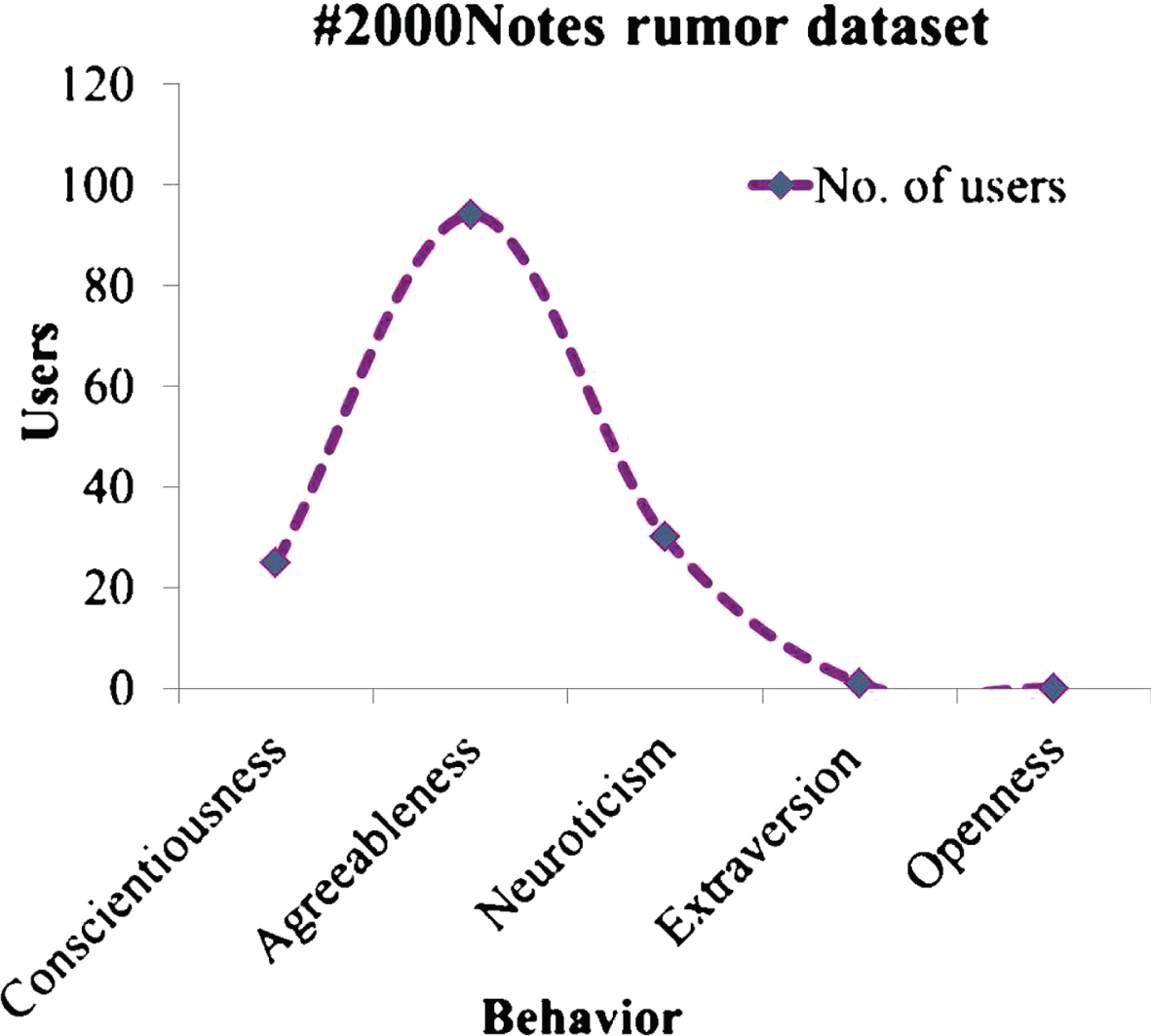
#2000notes.
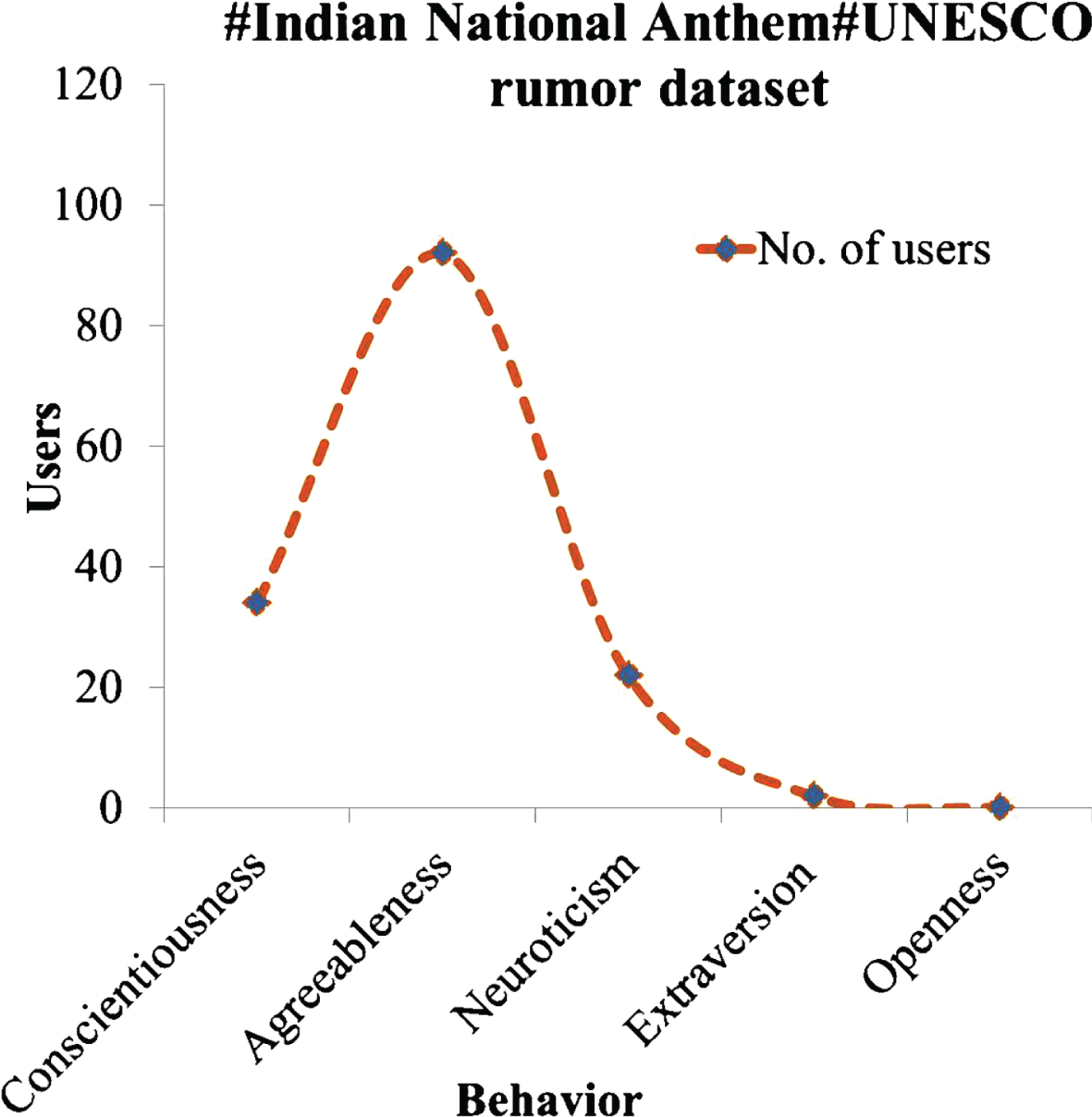
#IndianNationalAnthem#UNESCO.

Twitter 15 (Event 1).
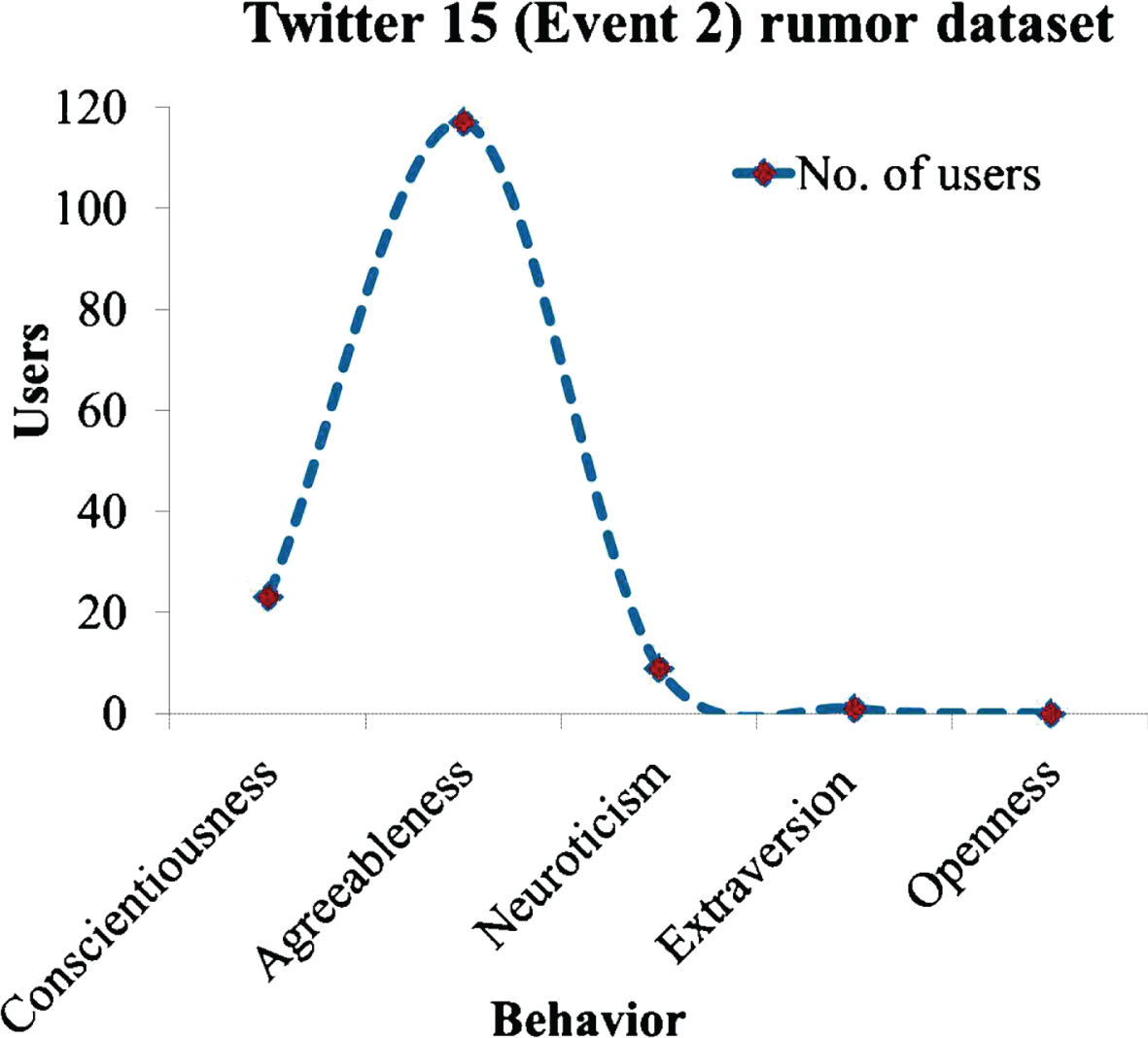
Twitter 15 (Event 2).

Twitter 15 (Event 3).
Our previous research on rumor propagation [30] has proved that during most of the rumor spread through social networks, a large percentage of rumors are propagated in the form of retweets rather than direct tweets posted by the user himself. The five datasets we considered for our analysis also contained users who retweeted rumor tweets from others. So, in order to check whether there is any difference between the behavior of people who initially tweeted the rumor tweet and the retweeted users, we conducted our experiment in one more dataset which contained the list of source nodes who originated the rumor tweets in these five rumor events. The behavior analysis of users who initially tweeted the rumor tweets in these five datasets is depicted in Figure 9. The results indicated in Figure 9 also confirms the fact that users high in agreeableness are more susceptible to post the rumors initially whereas extraverted people and individuals high in openness are reluctant to post rumor tweets.
The percentage of users exhibiting different personality traits who shared rumor tweets are listed in Tables 5 - 9. Table 10 indicates the percentage of users who originally tweeted the rumor tweets. Among the five rumor datasets and their source node analysis, users high in agreeableness show the highest percentage in rumor sharing.
#2000notes
#IndianNationalAnthem #UNESCO
Twitter 15 (Event 1)
Twitter 15 (Event 2)
Twitter 15 (Event 3)
Rumor source nodes
One of the striking findings inferred from the comprehensive assessment of the results generated is that, individuals scoring high in agreeableness have a greater tendency to post and share rumor stories. This supports the hypothesis put forward by Moore and McElroy in [33] that agreeable people being more sympathetic and co-operative were found to be greatly involved in posting self-generated content on social media and there was a positive correlation between agreeableness and regret. Their research proved that agreeable people conveyed greater levels of regret about the inappropriate content they had posted on their social network pages. Also, from the studies related to personality, it has been seen that agreeable personalities show more willingness to help others; even strangers. This tendency might also be a reason for their involvement in rumor sharing, thinking that the information they share might be useful to others.
Conscientious and neurotic people are also part of rumor sharing but their percentage is very low compared to agreeable people. The percentage of conscientious people in the rumor source node dataset is comparatively low when compared to its percentage in other datasets. As conscientious people are more goal-oriented and mindful of how their action and behavior affect others, they have a tendency to restrain themselves from creating new rumors. This can be the reason for their low percentage in source node dataset analysis of various rumors. Another conclusion we have arrived from our study is that, even though extraverted and open people spend more time on social networks, they are not interested in sharing or posting rumor tweets. Only a slight percentage of extraverted people are part of rumor creation but we couldn’t identify their significant presence in rumor sharing activities.
The personality assessment of different users from the five datasets and their source nodes are together represented in Figure 10. From the behavior analysis of rumor purveyors and initiators from all the datasets, we could arrive at the conclusion that agreeableness is the trait evident in majority of the rumor mongers whereas the presence of the traits extraversion and openness are negligible. Thus, the people high in agreeableness trait can be categorized under Susceptible category and the people high in extraversion and openness can be categorized under the Resistant group.

Source nodes of 5 datasets.

Personality assessment of rumor mongers and their sources from all the five datasets.
The users considered for our study belong to different nationalities and the events were also taken from different domains so as to incorporate maximum variety of users. Twitter users from almost 15 nationalities covering India, Pakistan, Malaysia, Nepal, Canada, USA, UK, Spain, Switzerland, Germany, Australia, Singapore, Oman, Kenya, and Ghana were included in our study. Also, 5 different rumor events were taken into consideration to avoid people having specific interest or who share news or opinions on a particular topic. Our analysis proved that the nationality and the nature of events do not play a major role in the rumor transmission process since the users from the five datasets exhibited almost similar behavioral characteristics. So from our analysis, we can conclude that agreeable people are more susceptible to share rumor tweets whereas extroverted and open people are more reluctant to share false information.
Even though social computing platforms serve as an effective medium for human interaction and user behavior analysis, the spread of false information plays a major role in shaping users’ opinions and affects the active participation of users in information dissemination as the spread of misinformation greatly affects the users’ decision-making process. There is a natural inclination in some users to readily believe the information posted or shared by other users and immediately pass it to their neighbors without verifying the authenticity of the message. i.e. Among several social network users, some have greater tendency to share the tweets or posts from other users whereas some others are less interested in this. This behavior in people is explored in this research to find out whether any particular personality trait stands out in those groups of social network users who have a greater orientation to believe and spread rumor stories.
This work attempted to understand the influence of personality in the sharing of misinformation and thereby categorize users into the susceptible and resistant group based on their behavioral characteristics. The behavioral psychology of people highly involved in rumor sharing is studied by analyzing their social networking pattern utilizing the Big 5 personality model with the aid of fuzzy logic. The attributes extracted from the social network profiles of users are used for studying the social networking pattern of different users which in turn can be used to elicit the personality traits hidden in rumor mongers. We have reached at the following conclusions from the study conducted on various users who shared rumor tweets on different events on Twitter. There exists a significant correlation between the individuals’ personality traits and their rumor sharing behavior on social networks. People high in agreeableness trait are more susceptible to be affected by rumor and people high in extraversion and openness are more resistant to misinformation sharing. The nature of events/rumor stories and the ethnicity of the users do not have any remarkable association with the rumor spreading nature of users.
In this study, we have mapped each individual’s behavior to the most dominant trait visible in individuals based on their social networking nature. We have considered the factors typically affecting the social media usage of users but this line of research can be extended by extracting features from the contents posted by the users. Moreover, we have limited our study to Twitter platform due to the unavailability of datasets, but personality prediction can be done more accurately by considering the same people using different social media platforms.
Footnotes
Acknowledgment
This research was funded by the fellowship released by the Kerala State Council for Science, Technology, and Environment [No.001/FSHP-MAIN/2014/KSCSTE]. The authors would also like to thank LBS Centre for Science and Technology for providing an opportunity for the accomplishment of the research and SocioViz for providing them with the dataset.