



Abstract
Rapid progress has been made in the intelligent technology of prefabricated buildings in recent years, and the related scheduling in many fields such as component production, workshop assembly, and road transportation is used for the optimization of resources. In this paper, the prefabricated building project is taken as the research objective to analyze the constraint conditions between prefabricated building projects in detail. It is proposed that the radial basis function (RBF) fuzzy logic neural network algorithm should be introduced into the optimization of building resource scheduling. Finally, the results of the experimental analysis suggest that the proposed method can effectively address the problem of resource scheduling in the prefabricated construction project, which can also provide a reference for the managers of prefabricated construction projects.
Keywords
Introduction
The other category is resource scheduling, that is, under the premise that the time limit for a project is known and has no impact on the related construction process, the optimal start time of each process is adjusted to schedule the consumption of resources [9, 13]. For the second case of resource scheduling, an in-depth study is carried out in this paper on the resource scheduling issue of the prefabricated project [3, 7]. At present, the studies on resource scheduling of construction projects mainly start with the specific features of the project to establish an effective target model [11, 13]. However, there are still relatively few studies on resource scheduling based on the features of prefabricated construction projects [10, 12]. Damci et al. selected examples of steel structure industrial building projects to establish 9 different resource optimization functions and analyze the effectiveness of resource scheduling under various goals [2, 6]. For the objective optimization function of the resource scheduling problem, the cost, quality, or multi-objective combination can also be taken as the optimization objective.
Resource cost accounts for a large proportion of the total cost of the project. Hence, the minimization of the cost of resource use is one of the crucial goals of project scheduling [5, 8]. More and more attention has been paid to the quality and safety of engineering construction, and the quality objective has also been studied as an objective function gradually. Icmeli-Tukel et al. [1, 4] used the estimated minimum rework time and the increased cost to evaluate the quality of a project [14, 15]. Due to the features of the complexity in a project, the combination of multiple objectives as the optimization object has become the focus of research.
In addition, effective solutions have remained to be a research hot spot in resource scheduling problems. Regarding the algorithms for solving the problems, resource scheduling issues can be divided into three categories as the following: precise algorithms, heuristic algorithms, and intelligent optimization algorithms. The precise algorithms are generally applicable for solving problems with simple projects and relatively few tasks. The commonly used methods include integer programming, dynamic programming, branch and bound, and so on. In the process of project resource scheduling, an initial schedule is often established in the heuristic algorithms. The start time of the process is adjusted sequentially according to specific priority rules (such as maximum free time difference, resource usage, process execution urgency) so that the result obtained after adjustment can be improved. In most cases, the quality of the solutions obtained based on the heuristic algorithms is not satisfactory. Hence, the intelligent optimization algorithm has been used as the main algorithm in the research on resource scheduling problems at present. Based on this method, a relatively satisfactory solution, or even the optimal solution can be obtained for large-scale problems within the expected time. The commonly used intelligent optimization algorithms include the RBF fuzzy logic neural network algorithm, the simulated annealing, the particle swarm algorithm, the neural network, the ant colony algorithm, and so on. In summary, the prefabricated construction projects are taken as the research background in this study, and the construction project resource scheduling is introduced from the perspective of the objective function and solution method of the research problem. The actual features of prefabricated construction projects are combined to establish an optimization model for resource scheduling problems to minimize resource variance. On this basis, an RBF fuzzy logic neural network algorithm is put forward to solve this model. The results thus obtained are used to address the resource scheduling issues of prefabricated construction projects effectively.
Problem description and model establishment
Problem description
In the intelligent construction resource scheduling problem of prefabricated buildings, resources can be divided into renewable resources and non-renewable ones. Renewable resources mean that the total volume is limited. However, when a certain task is completed, and the next task is required, the resources can be adjusted to the initial total volume, such as equipment and labor resources. As for non-renewable resources, the volume of resources will continue to decrease with the progress of the construction, such as the raw materials and funds used. In the intelligent construction resource scheduling problem of prefabricated buildings studied in this paper, only human resources are taken into consideration, denoted by R (ik, jk), which refers to the volume of human resources in the process (i, j) of the project k. At the same time, the following assumptions are put forward: (1) There are time constraints and project priorities between projects. It is necessary to focus on the operation period of the assembly space and limit the operation time of the production and transportation space. The operation period of the assembly space is the total time limit for the project; (2) The operation duration of each process remains the same, the relationship between immediately before and after the process remains unchanged, and the operation of a single process is continuous and uninterrupted; (3) The demand for resources in each process is determined before the commencement of the project construction, and the quantity remains unchanged during the execution process.
Based on the analysis assumptions described above, the resource variance is introduced as the goal in the evaluation of the resource scheduling configuration. Three separate projects are converted into a whole entity by adding auxiliary processes at the beginning and end of the project. Subsequently, the Critical Path Method (hereinafter referred to as CPM for short) is used to determine the key routes and critical processes of the project, and the non-critical processes are selected accordingly. The actual start time of the non-critical processes is taken as the decision variable. The resource usage over various time units is adjusted by changing the actual start time of the non-critical processes. The smaller the objective function variance value σ2 is, the more balanced the distribution of resource usage is. Hence, the idleness of resources or exceeding the given amount of resources can be avoided. The objective function for solving the intelligent construction resource scheduling problem of prefabricated buildings put forward in this paper is shown in Equation (1) as the following.
In the above equation: T stands for the total project duration; R (t) stands for the resource usage of all construction procedures at the time t;
In order to make it operable to solve the problem of the intelligent construction resource scheduling of prefabricated buildings, it is necessary to add an auxiliary process at the beginning and the end of the double-code network diagram in the three sub-projects, that is, the production, transportation, and assembly space, to convert multiple spatial operations into a single operation space. In this way, the multi-project resource scheduling problem of prefabricated construction engineering can be converted into a problem for the optimization of the single project resource scheduling. It should be noted that the auxiliary processes added are on the critical route and have a specific duration. However, there is no resource consumption. The start auxiliary process and the end auxiliary process share a node each.
For prefabricated construction projects, they can be divided into production operations, transportation operations, and assembly operations. Hence, there are 3 projects in total, A = {1, 2, 3} stands for the project set; the process set of the project is B ={ i1, i2, ⋯ , i
n
i
}. The start time of a single project is Si, the duration of a single project is Ti, and the auxiliary processes added at the beginning and the end are is and ie, respectively. Thus, the overall project start time S and total project duration T after combination transformation can be obtained as the following:
In order to accomplish the set goals and make the resources more properly scheduled, it is necessary to adjust the start time of some processes. Prior to the adjustment, it is required that the duration of the auxiliary process should be calculated to ensure that the start time and duration of the project will remain unchanged during the adjustment process. The duration d
i
s
and d
i
e
of the auxiliary processes is and ie of the project i can be obtained as the following:
The calculation for the duration of the auxiliary processes in the above equation has ensured that all auxiliary processes are vital processes and that the start time of the key processes will remain unchanged during the scheduling operation.
The free time difference refers to the difference between the earliest start time and the latest start time. Its value determines the range that the process can be changed in time, as shown below:
In the above equation: S (ik, jk) stands for the free time difference of the process (i, j) in the project k; TE (ik, jk) stands for the earliest start time of the process (i, j) in project k; TL (ik, jk) stands for the latest start time of the process (i, j) in the project k; and TS (ik, jk) stands for the actual start time of the process (i, j) in the project k.
In the network planning diagram, if there are immediate jobs (possibly one or more) in a certain process, then the start time of the process is the completion of all immediate jobs, and the constraint conditions thus generated can be obtained, as shown in Equation (8) as the following.
In the above equation: (vk, ik) stands for the set of procedures immediately before the procedure (i, j) in the project k; and T (vk, ik) stands for the duration of the procedure (v, i) in the project k.
In the process of resource allocation, the mean value
In the above equation: TK stands for the total construction period of the project K in the implementation phase; T stands for the construction period of the whole project; R (t) stands for the sum of the resource consumption of all sub projects on the day t; Rt (ik, jk) stands for the resource consumption of the process (i, j) in the project K at the time t.
In addition, it is required that the working time t of the process (i, j) should be between the actual start time and the actual completion time. If this constraint condition is met, the resource consumption can be expressed as R (ik, jk); otherwise, the resource consumption is 0, that is, the following can be obtained
In the above equation: R (ik, jk) stands for the resources consumed per unit time of the process (i, j) in the project K; and Tf (ik, jk) stands for the actual completion time of the process (i, j) in the project K.
The problem of resource scheduling has been proved to be an NP-hard problem. For this type of NP-hard problem, the RBF fuzzy logic neural network algorithm, as an efficient, intelligent optimization algorithm, can be used to address this type of optimization problem through selection, crossover, mutation, and other operations. There is no constraint in the RBF fuzzy logic neural network algorithm on the constraint space of the problem. Hence, a satisfactory solution can be obtained in a short time upon operation. In addition, it has expanded the scale of solving NP-hard problems to a certain extent. In view of the advantages of the RBF fuzzy logic neural network algorithm in solving resource scheduling problems with high speed and high efficiency, the RBF fuzzy logic neural network algorithm is used in this paper to solve the problem. Through the analysis of the features in the practical operation of the prefabricated building, an algorithm applicable for resource scheduling in such projects is designed. The specific process of the RBF fuzzy logic neural network algorithm is shown in Fig. 1 as the following.

Process flow of the RBF fuzzy logic neural network algorithm.
Due to the relatively large number of processes in prefabricated construction projects, both the free time difference and total time difference in the critical processes of the key routes in the dual-code network diagram are 0, that is, the start time and end time of the critical process remain unchanged. Only the actual start time Ts (ik, jk) of the non-critical process is selected in this paper as a variable to carry out the real number coding. It is assumed that there are λ non-critical processes, then the length of the code string is λ. Only the actual start time of the non-critical processes is coded, which ensures that processes on the critical routes will not be affected. In this way, the decision variables can be reduced, and the time for the optimization of the resource scheduling problem can be shortened.
Initialization of the Population
The initial population is generated. The actual start of the non-critical process is expressed as the following: TE (ik, jk)≤TS (ik, jk)≤TL (ik, jk), that is, it is randomly generated within the range of the earliest start time and the latest start time.
Fitness function
The fitness value is calculated. The goal of intelligent construction resource scheduling for prefabricated buildings is to reduce the variance of resource consumption to the minimum. Hence, given this optimization goal, the inverse of the optimization objective function is designed as a fitness function and expressed as the following:
In the above equation: F stands for the individual fitness value, which means that the smaller the variance corresponding to the resource consumption of an individual, the higher the fitness value of the individual, and the better the individual. The practical significance lies in that the more reasonable the construction schedule is, the more appropriately dispatched the resource allocation.
The selection operation is to select superior individuals from the current population at a certain probability, reestablish a new group, and then reproduce the next generation of individuals. The ratio of a superior individual selected is closely related to the fitness value. The greater the individual fitness value is, the greater the probability of the individual being selected is; otherwise, the smaller the probability of the individual being selected is. Based on the fitness value calculated according to Equation (13), roulette is used to select individuals from the group. The probability pi of selecting each individual in a group is proportional to the fitness value, as shown in the following.
In the above equation: Fi stands for the fitness value of individual i; and the number of individuals in the population is N.
In the crossover operation, two chromosomes are randomly selected from the population for mating and recombination. The superior genes of the parent chain are retained and passed to the child chain to form a new excellent chromosome. The chromosomes in this paper are real number codes, and the real single-point crossover method is used for the crossover operation. The crossover operation method for the kth chromosome ak and the lth chromosome al at the j position is shown as the following:
In the above equation: b stands for a random number in the interval [0, 1].
The mutation operation is triggered by accidental factors, and the probability of mutation is generally very small. The mutation operation randomly selects a chromosome from the population and chooses a point in the chromosome for the mutation to generate more superior individuals. The operation method of the
In the above equation: the upper bound of the gene aij is amax; the lower bound of the gene aij is amin; f (g)=r1 (1-g/Gmax)2, in which r1 stands for a random number, g stands for the current iteration number, and Gmax stands for the maximum number of evolutions; r stands for a random number on the interval [0, 1].
The assembly construction method is adopted for the construction of a residential area. In this paper, the standard floor construction process is selected as the research object to study the labor resources in the production scheduling process. The prefabricated construction project has three construction spaces as the following: on-site assembly, component production, and logistics transportation, that is, sub projects 1, 2, and 3, respectively. Among them, the on-site assembly space operation includes 15 processes such as component hoisting and node pouring. For the component production space, the standard floor construction involves the production of prefabricated components such as prefabricated exterior walls, prefabricated interior walls, laminated boards, stairs, and balconies, with a total of 12 processes. The transportation plan of the prefabricated components is arranged based on the on-site assembly construction schedule. The transportation of components mainly involves four tasks, that is, component loading, component transportation, component unloading, and return trip.
Figures 2∼4 show the double-code network diagrams of sub-projects 1, 2, and 3, and the names of each process, the consumption of labor resources, the processes, and the time limit of the project are shown in Table 1 as the following. This project has a total of 35 processes. After auxiliary processes are added, multiple projects are converted into single projects. Based on the data such as the processes and time limit of the project, as well as the consumption of labor resources given in Figs. 2 to 4 and Table 1, the CPM method is used to determine the key routes and critical processes. The earliest start time, the latest start time, and the free time difference in each process are calculated, and the non-critical processes are identified accordingly. In this case, a total of 12 processes are non-critical processes, which are B1, C1, D1, E1, E2, F2, G2, H2, I2, J2, K2, and L2, respectively. The non-critical processes are marked with * in Table 1 as follows. The total time limit for the prefabricated construction project in this case is 29 days.

Subproject 1.
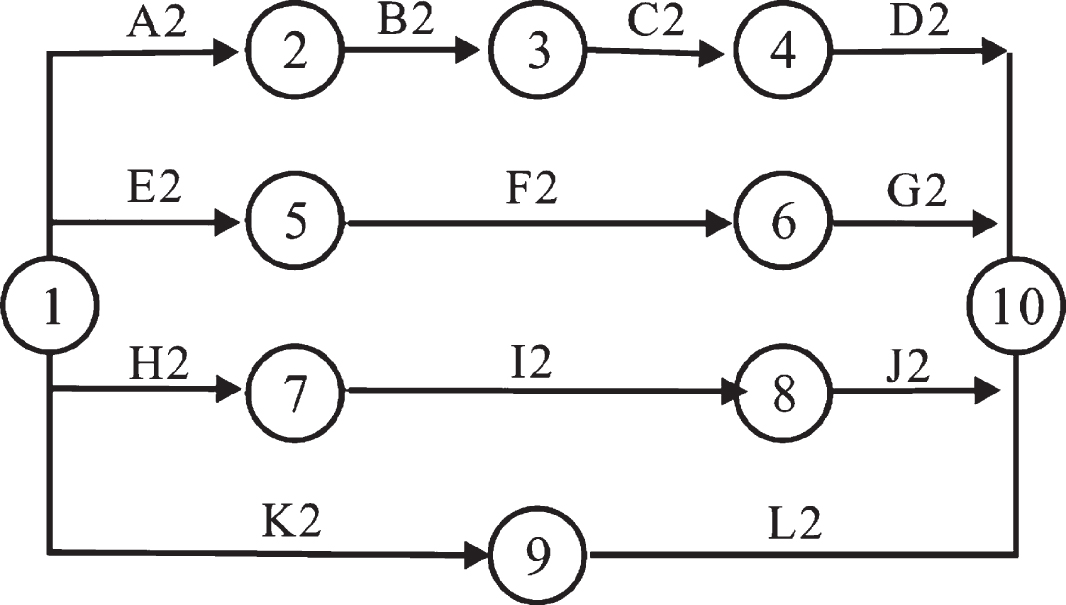
Subproject 2.
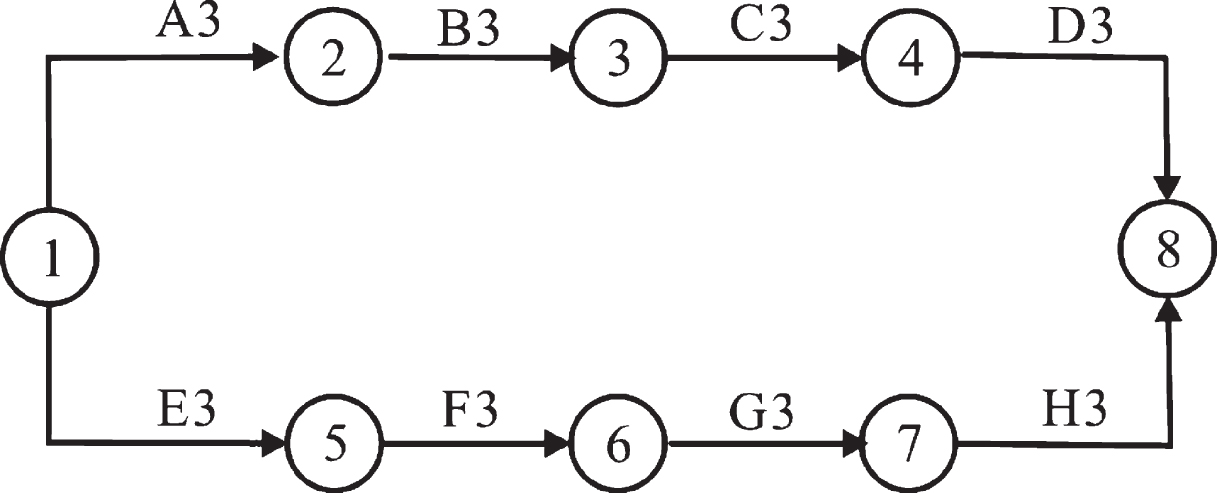
Subproject 3.
Project parameters
The above objective functions, constraint conditions, and project parameter information are combined to obtain the specific mathematical model of the project as the following:
Thus, the fitness function can be obtained as the following:
In the above equation: xi (i = 1, 2,..., 12) is an integer, xi≥0; and fit stands for the individual fitness value.
Before the optimization starts, firstly, it is necessary to set the RBF fuzzy logic neural network algorithm parameters as the following: the population size is 100, the number of evolution generations is 50, the crossover probability is 0.9, and mutation probability is 0.01. The MATLAB2016a is used to program the RBF fuzzy logic neural network algorithm. Through multiple iterations, the optimal start time of the non-critical process can be obtained as the following: T S (B1) =0; T S (C1) =4; T S (D1) =7; T S (E1) =9; T S (E2) =0; T S (F2) =14; T S (G2) =19; T S (H2) =0; T S (I2) =11; T S (J2) =17; T S (K2) =6; T S (L2) =16.
Table 2 is the comparison table that shows the results of resource scheduling, and Figs. 5 and 6 are resource distribution diagrams.
Comparison of the resource scheduling results

Initialization of the resource distribution.
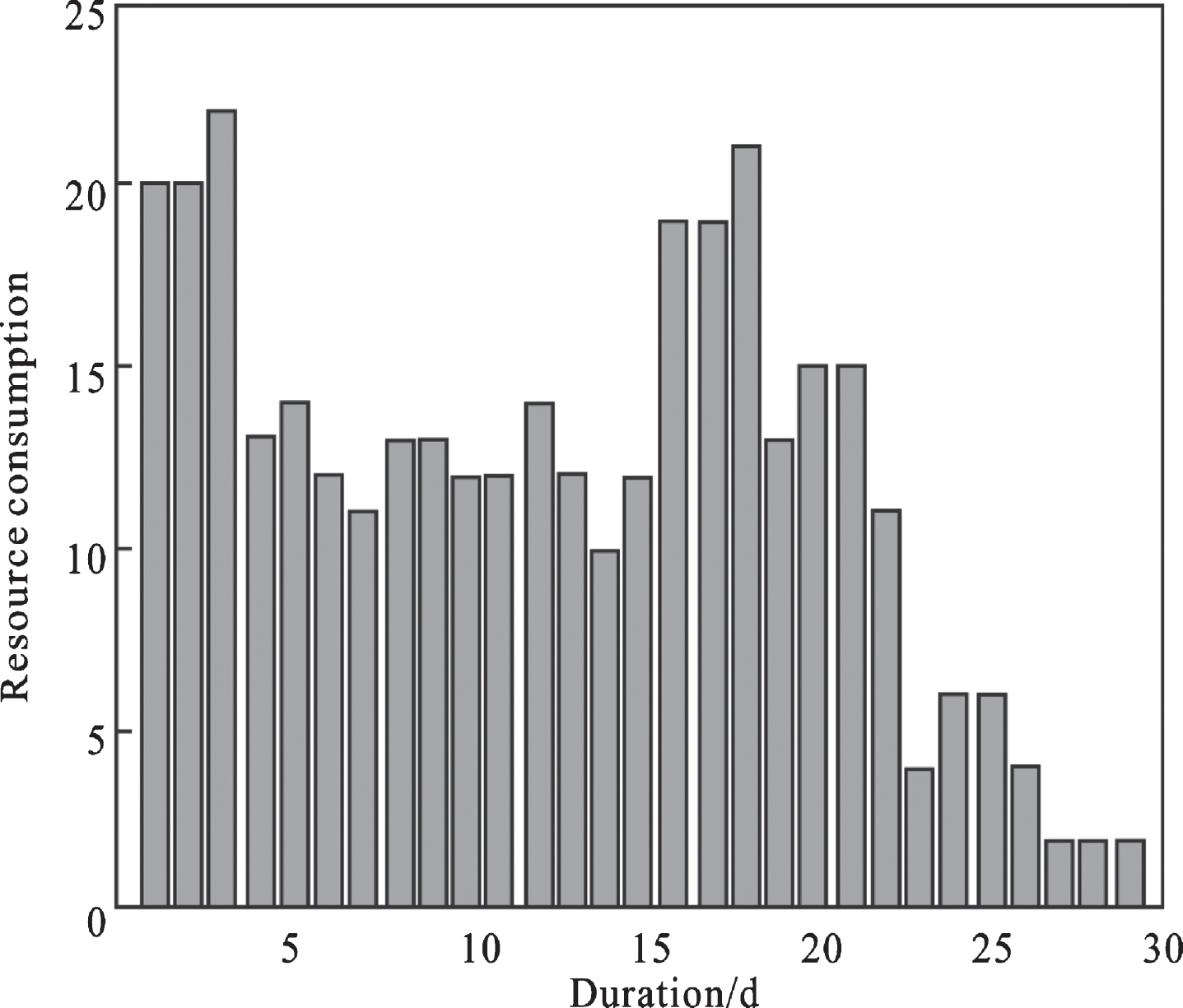
Resource distribution based on the RBF fuzzy logic neural network algorithm.
From Figs. 5 and 6, it can be observed the peak value of resources has decreased from 26 units per working day in the initial situation to 22 units as required, and the daily resource usage is more concentrated on the average usage of manual resources. From Table 2, it can be seen that the variance σ2 value after the optimization based on the RBF fuzzy logic neural network algorithm is reduced from 20.41 to 6.21, which is about 70% lower than the σ2 value based on the initial network plan. It suggests that the resource distribution is more properly scheduled and that the method proposed in this paper can address the application problems in the actual assembly construction engineering effectively.
The evolution process of the RBF fuzzy logic neural network algorithm is shown in Fig. 7 as the following. From the convergence process in Fig. 7, it can be seen that the fitness after optimization has been greatly improved, and convergence has been maintained to reach the optimal solution after about 30 generations.
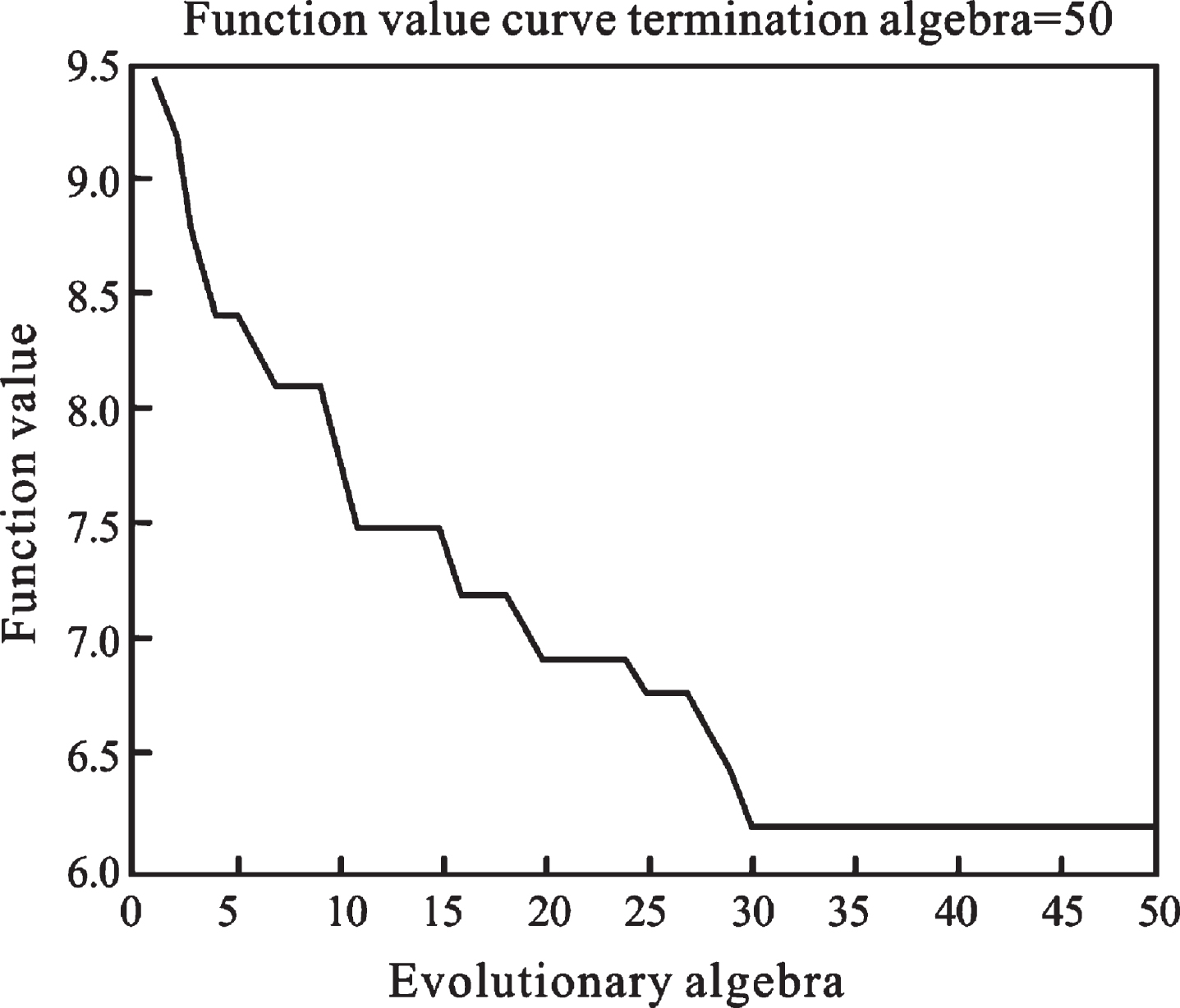
Evolution process of the RBF fuzzy logic neural network algorithm.
In this paper, the problem of resource scheduling in the intelligent construction of prefabricated buildings is studied to make the resource distribution more properly scheduled. In this way, the proportion of resource consumption in the cost of prefabricated building projects can be reduced effectively. Specifically, a resource scheduling model that meets the features of prefabricated construction projects is established by adding auxiliary jobs to connect multiple operation spaces with the minimization of the resource variance as the optimization target. The RBF fuzzy logic neural network algorithm is selected to carry out the algorithm design, and the optimal start time of each non-critical process is obtained accordingly. Through the analysis of actual cases, it is verified that the resource scheduling model established to address this problem is simple to operate and has some practical reference value for prefabricated construction engineering, which has enriched the related theory of the resource scheduling issue and broadened the application scope of resource scheduling. In future studies, the resource scheduling problem under complex conditions such as multiple resources and uncertainty in the construction process will be taken into further consideration.