




Abstract
As a new business model, crowdsourcing innovation is widely used for enterprises to complete innovation tasks by the external crowds. The enterprises, the external crowds, and the crowdsourcing platform make an alliance and co-create value to achieve the multi-win goal. Based on the operation process analysis of the third-party platform crowdsourcing innovation model, this paper proposes that the essence of crowdsourcing innovation is the value co-creation of multi-agent participation. Based on grounded theory, this paper constructs the theoretical model of the realization mechanism of multi-agent participation value co-creation in crowdsourcing innovation from the three parties’ perspective. This research finds that value co-creation factors include six factors: task attributes, incentive mechanisms, trust mechanisms, the platform supports, participation motivation, and diversities. The process of value co-creation includes resource integration and interaction. The results of value co-creation include three elements: innovation value, knowledge value, and relationship value.
Introduction
As a new type of innovation model, crowdsourcing innovation refers to a business model in which a company or organization transfers the employees’ innovation issues to the crowds of the external network [13]. Its essence is that the company acquires and integrates user knowledge of external networks to improve innovation performance through breaking organizational boundaries [25]. The practice has proven that crowdsourcing innovation is an effective model to obtain the network group’s wisdom to solve innovation problems. Since InnoCentive founded in 2001, it has gathered more than 360, 000 people from more than 200 countries/ regions and cracked more than 2000 Innovation problems; IdeaStorm—Dell’s crowdsourcing innovation community, has nearly 30, 000 ideas submitted and 550 ideas realized; zbj.com, a typical Chinese crowdsourcing platform, has nearly 19 million users, helped 6,157,952 employers to solve innovation problems. Crowdsourcing innovation is profoundly affecting the innovation model of enterprises, and more and more Chinese companies are developing their crowdsourcing innovation platforms, such as Haier, Midea, etc. These Chinese platforms have achieved remarkable results, but their application is still in the primary scope of information processing or simple crowdsourcing work. And mainstream enterprises have insufficient participation, which is in sharp contrast with other countries leading companies effort to build crowdsourcing innovation models. One of the main reasons is that Chinese companies lack a systematic understanding of the advanced concepts of crowdsourcing innovation models, lack confidence in their applications, and need theoretical guidance.
For this reason, many scholars carry out related issues such as the crowdsourcing innovation model and its performance improvement from different perspectives. In consideration of that, crowdsourcing has an open organizational form and voluntary participants. Some scholars carried out an empirical analysis on open source software, Wikipedia, and some crowdsourcing websites. Research indicates that external motivations (bonus remuneration, the benefit to career, sense of achievement, etc.) and intrinsic motivations (interests, hobbies, learning, etc.) are users key motivations for participating in crowdsourcing innovation [14, 17]. And there has a crowding-out effect between external motivations and intrinsic motivations. The incentive strategy based on the user’s diverse participation motivation has an important impact on improving the performance of crowdsourcing innovation, but the mechanism is still in a black box [16, 31]. Crowdsourcing contest, as the most direct mode of crowdsourcing innovation, is the main research object of crowdsourcing innovation, which related research is relatively rich. Current research mainly focuses on the setting of innovation tasks, design of crowdsourcing process, and reward mechanism. But in practice, the phenomenon of low user continuous participation and inefficient competition still hasn’t resolved. Some scholars hold a great lack of just considering the motivation of user participation and the crowdsourcing operation model to explore the improvement of crowdsourcing innovation performance. And it is necessary to analyze the impact of knowledge on the quality of crowdsourcing innovation from the perspective of knowledge sharing [17]. The above literature has great significance for interpreting crowdsourcing innovation and improving the innovation performance. However, crowdsourcing innovation operates in a free and open organizational model to accomplish hard tasks with participants uncertain, which have to carry out in-depth research on the mechanism of participant acquiring and applying knowledge to improve innovation performance from multiple perspectives.
To further clarify the nature of the crowdsourcing innovation, some scholars integrate value co-creation theory to conduct research: Kelleher et al. (2017) explore the value co-creation of online community-based idea contests (OCBICs) from three aspects (motivation, role, and behavior) by analyzing multiple cases [4]. Research indicates the participants mainly have internal and external motivations, and their role and behavior are adapted and coordinated according to the rules of the competition, the values and organizational model of the virtual community. Bloodgood (2013) and Kohler (2015) propose the value of contributors mainly included experience value and approbation value, both of them will be positively affected by perception control [10, 11]. Piyathasanan et al. (2018) consider the value of co-creation mainly included user value (social value and emotional value) and enterprise value (knowledge sharing and users’ loyalty), commitments in the innovation process will significantly positively affect user value and thus corporate value [3].
The existing literature mainly explored the value co-creation of crowdsourcing innovation from a unilateral perspective (enterprise value acquisition) [10, 11], without fully considering the characteristics of multi-agent participation in the crowdsourcing innovation model. Too much emphasis on methods of theoretical analysis, lack of empirical exploration combined with specific practices. This article analyzes the value co-creation issue under the crowdsourcing innovation model from the perspective of multi-agent participation. Based on the management practice of crowdsourcing innovation, using grounded theory, combined with typical Chinese crowdsourcing innovation platforms (zbj.com, Taskcn.com, epwk.com, and 680.com), carried out grounded theory approach on the realization mechanism of multi-agent participation in value co-creation under the crowdsourcing innovation model. The rest of this paper is organized as follows. In Section 2, this part introduces the related theories about crowdsourcing innovation and value co-creation and the similarities and differences between crowdsourcing innovation and value co-creation; Section 3 demonstrates the process and the result of grounded research; and the Section 4 is the findings of this research.
Basic theory and construct definition
Crowdsourcing innovation
Brabham (2008) considers crowdsourcing innovation as a problem-solving model that has both online and distributed features [7]. Jeppesen (2010) proposes that crowdsourcing innovation refers to a business model of enterprises transfer the innovation tasks originally completed by enterprises to non-specified external network groups through open tendering, and to select an optimal innovation proposal submitted by the public [20]. Afuah (2012) believes that crowdsourcing innovation is a new model for making full use of external resources of enterprises to solve problems of corporate innovation, attaching great importance to the orientation of enterprises to absorb the intellectual resources of external groups of the network [1]. Based on different research perspectives, Howe (2009) divides crowdsourcing into four categories (crowd creation, crowd vote, crowdfunding, and crowd wisdom) [12]. Panchal et al. (2011) propose crowdsourcing has two types of competition and cooperation according to the way of crowdsourcing [19]. In accordance with the build mode of the crowdsourcing platform, Frey et al. (2011) hold that there are two types of crowdsourcing innovation modes, one is based on enterprise self-built community and the other is based on third-party platforms [17]. Hao et al. (2014) divide the crowdsourcing model into the non-profit crowdsourcing innovation model and the for-profit crowdsourcing innovation model based on whether the crowdsourcing model had commercial characteristics [21].
This article focuses on the third-party platform-based crowdsourcing innovation model. The main participants of this model can be divided into the seeker, the solver, and the crowdsourcing platform. Generally, the seeker is a company with innovation needs. Due to constraints of resources or high R&D (research and development, R&D) costs, these companies choose the crowdsourcing model to obtain innovative solutions. The solver is generally a full-time/part-time team or individual with strong professional knowledge and skills, who want to meet their needs by solving innovative tasks. The crowdsourcing platform is the commercial e-commerce company to attract and acquire contractors and contractors as a basis for traffic, getting commissions by facilitating the completion of transactions between the outsourcer and the contractor. The general operation process of a crowdsourcing innovation project is shown in Fig. 1:(1) The seeker clarifies the innovation requirements, determines the reward, and submits the task; (2) The crowdsourcing platform reviews and releases the tasks, and collect commission in advance for safekeeping; (3) The solver selects appropriate innovative tasks, carries out work and completes the innovative tasks; (4) The solver submits the preliminary solvation and modify based on feedback; (5) The solver submits the final salvation. The seeker reviews the solvation whether meets the task requirements and lets the platform pay rewards to the solver.
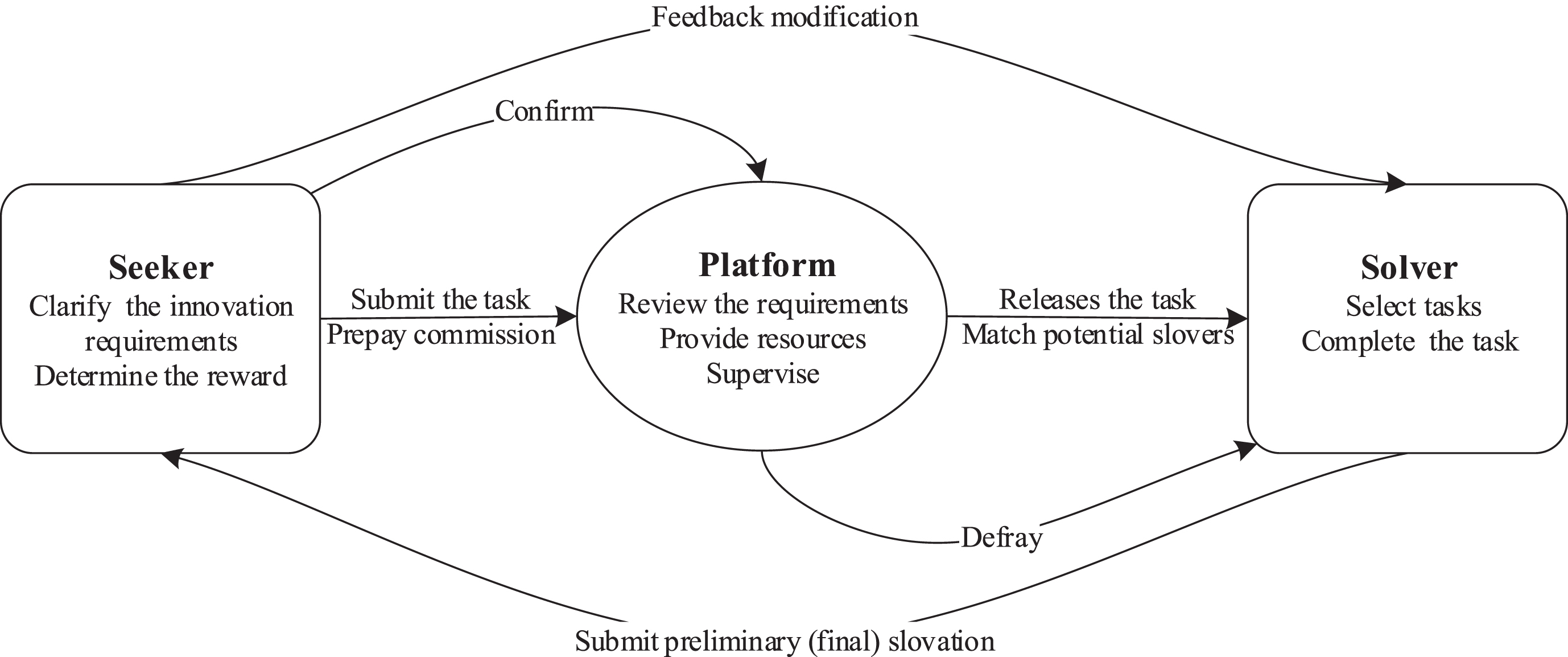
The general operation process of the crowdsourcing innovation model.
Value co-creation emphasizes value is created jointly by multiple stakeholders. Different scholars explore the connotation of value co-creation from multiple perspectives.
It mainly can be divided into two important branches. One is the value co-creation theory based on consumer experience proposed by Prahalad and Ramaswamy (2004) [6]. The other is based on service-led logic proposed by Vargo and Lusch (2004) [27]. The theory of value co-creation based on consumer experience holds that [6, 19]:(1) The core of value co-creation is how to create the best consumer experience. (2) The basic way of value co-creation is dialogue and interaction between enterprises and consumers. Value co-creation based on service-led logic holds that [24, 27]:(1) Service is the basis of economic exchanges, and value co-creation is based on service exchanges. (2) Consumers as operational resources (knowledge, skills, experience, etc.) are also the creator of value. The difference between the two concepts is mainly reflected in the analysis perspective and the connotation expression. The value co-creation theory based on consumer experience mainly starts from the micro perspective of business management and focuses on improving the value of customer experience by creating an interactive environment. The value co-creation based on service-led logic is based on a macro perspective, reflecting the structure of the relationship between producers and consumers in the process of value creation. In terms of connotation, the value co-creation theory based on consumer experience is centered on the experience value of consumers, attaching great importance to the co-creation of experience value during the entire life cycle of design, production, and service; the value co-creation theory based on service-led logic and focus on use-value, it attaches great importance to the integration of products and services to create a complete set of solutions that meet customers’ needs.
Comparison of crowdsourcing innovation and value co-creation
Crowdsourcing innovation is a business model in which the employer transferring traditional tasks accomplished by internal employees to external network users (the public) in a free and voluntary manner. From the connotation of crowdsourcing innovation and specific management practices, it can be seen that the essence of crowdsourcing innovation is the value co-creation of multi-agent participation, which can be understood from the following aspects:
(1) From the purpose of crowdsourcing innovation, no matter what kind of crowdsourcing innovative models a company adopts, the ultimate goal is to complete innovation tasks and solve innovation problems. The high-quality solution for innovative tasks requires the active participation and effective coordination of multiple agents. The seekers must set the task requirements and reward clearly; the solvers must actively participate in submitting high-quality innovation solutions; the crowdsourcing platform must provide guarantee reliably and environment support. The output of crowdsourcing innovation not only includes the generation of high-quality innovative solutions, but also encourages users to obtain rewards, identification, and self-improvement in the participation process. And the crowdsourcing platform can obtain benefits commissions, reputation enhancements, and online value appreciation. It can be seen that the initial intention of the enterprise to establish a crowdsourcing innovation model is in line with the concept of “collaborative value creation” pursued by value co-creation.
(2) Judging from the process of crowdsourcing innovation, the process of crowdsourcing innovation and the process of value co-creation are the same, as shown in Table 1. The realization process of value co-creation is generally divided into two stages of communication and interaction and resource integration [8]. First through the interaction between multiple participants to identify the needs of multiple parties; then through resource integration and matching, it generates more value than the original creation of a unilateral subject. In the process of crowdsourcing innovation, the crowdsourcing platform provides a free and open place for knowledge trading, and knowledge seekers release innovative tasks, reward programs, and knowledge requirements; the solvers use their diversified and specialized knowledge to complete innovative tasks and get deserved rewards [33]. High-quality innovative solutions require the three parties to integrate diverse knowledge from a wide range of sources and collide with the knowledge from the solvers to generate new knowledge. During this period, whether it is a clear statement of innovation requirements or the process of providing and evaluating solutions, it is necessary for the seekers, the solvers, and the platform to continuously interact and share the information continuously.
Comparison of core elements of crowdsourcing innovation and value co-creation
Comparison of core elements of crowdsourcing innovation and value co-creation
Research method
Grounded theory, as a qualitative research method, formats related theories through mining concepts and refining categories from the collection of empirical materials of related research objects [30]. The whole research process of the grounded theory presents a bottom-up inductive research idea, which is directly rooted in actual data. And summarize similar concepts into a category. Finally, the relationship between these categories is formed into a theoretical construction [5]. This method attaches great importance to building theoretical models based on factual data. It applies to areas where existing theoretical systems have difficulty explaining new practical phenomena or existing theories have certain flaws [32].
Research process
The main idea of the grounded theory is reflected in the progress of open coding, spindle coding, and selective coding, which mainly includes five major steps: problem definition, literature discussion, data collection, decoding, and theoretical construction, as shown in Fig. 2. After the initial theoretical model is constructed, it still needs to Test the saturation of the theoretical model. Use Nvivo11.0 to carry out grounded theory research following the processes of open coding, spindle coding, and selective coding.
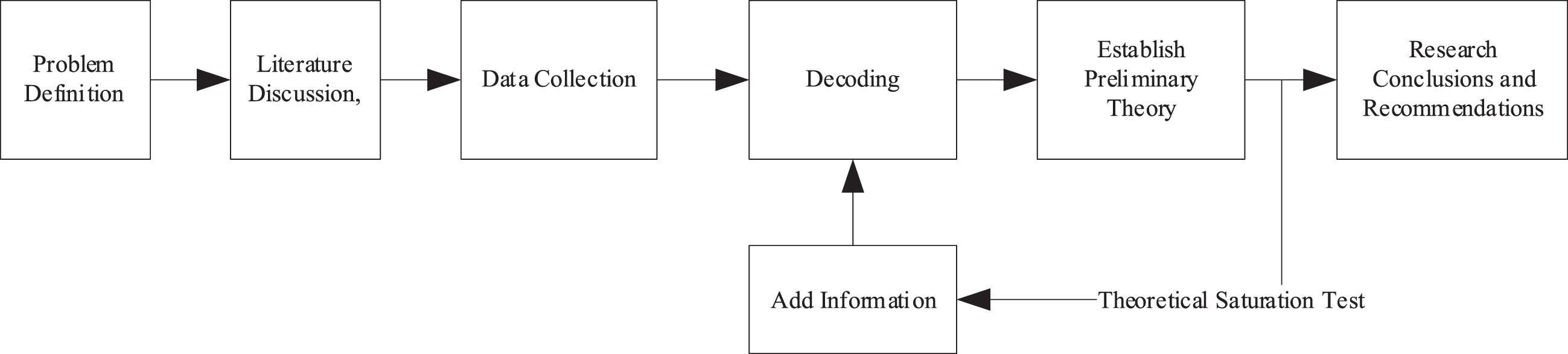
The main process of grounded theory.
Take into consideration that zbj.com, taskcn.com, epwk.com, and 680.com are the most famous comprehensive crowdsourcing platforms in China. Data includes the bid winning experience and related interview records shared by participants on the platform. The data sources are shown in Table 2.
Data sources
Data sources
In the process of collecting data, these principles are followed: (1)The participants are either freelancers with successful bidding experience, employers with experience in releasing tasks, or platform staff. (2)The types of innovation tasks involved are diversified to reduce the impact of type deviations. (3) The content of the data should be closely related to the winning experience, process experience, and gains. (4)The interview materials should be continuously supplemented and analyzed until the new concepts no longer appear in the process.
The time range is from January 2018 to December 2018. Interviews, reports, and articles about freelancer winning experience and participation experience of the employer were collected from four platforms. A total of 66 interview records was collected, covering the experience of the three parties (the seeker, the solvers, and the platform) of participating in crowdsourcing innovation.
Open coding is a preliminary analysis and the arrangement of the raw materials. The following procedure was followed: data collecting ⟶ labeling ⟶ conceptualization ⟶ categorization. When coding the 56th interview, it finds there is no new codes appearing. Then the coding of the materials will be stopped, and the remaining 10 materials are used for theoretical saturation test. Through open coding of the interview records, 36 initial concepts and 33 initial categories were obtained. The results are shown in Table 3.
Open coding
Open coding
The spindle coding is to discover and establish the links between the main categories. Through the exploration and analysis of the relationship between the categories, 6 main categories and 11 subcategories are formed, as shown in Table 4.
Spindle coding
Spindle coding
Selective coding is the refining and integration of the content of spindle coding. Through mining the “core category” from the main and subsidiary categories, and analyzing the connection between the core category and the main and subsidiary categories, this article develops a new substantive theoretical framework. The canonical relational structure of the main category obtained through selective coding is shown in Table 5; the theoretical model of the realization mechanism of multi-agent participation in value co-creation under the environment of crowdsourcing innovation is constructed, as shown in Fig. 3.
Relationship structure
Relationship structure

The model of realization mechanism of multi-agent participation in value co-creation under the crowdsourcing innovation.
To test the saturation of the theoretical model, the test was performed on the remaining 10 interviews. The result shows that there are no new concepts or categories that emerged during the coding of the remaining material. It can be considered that the model obtained is theoretically saturated by taking the grounded theory of the 66 data collected.
Result analysis
Based on the above analysis, the frequency of all codes in each conceptual category was statistically analyzed as shown in Table 6. It can be seen that extrinsic motivation, credit evaluation, motivation for growth, and customer loyalty are the four codes with a high reference frequency. By comprehensive comparison, among the factors of influencing value co-creation, the frequency of task attribute was the highest (9.04%); among the factors of the process of value co-creation, the mentions frequency of communication interaction (12.78%) is higher than the resource integration (10.92%); among the factors of the result of value co-creation the most frequently mentioned is relationship value (10.31%).
Statistical analysis of the codes
Statistical analysis of the codes
Based on the qualitative research results of the grounded theory, this paper analyzes the value co-creation realization mechanism of multi-agent participation in the crowdsourcing innovation model from two aspects: the key influencing factors of value co-creation and the influence mechanism of the value co-creation process.
The co-creation of value in crowdsourcing innovation activities is achieved by the three parties: the seeker, the solvers, and the crowdsourcing platform. Based on different motivations, participants invest different resources and have different behaviors, so their influencing factors of value co-creation are different.
From the perspective of the seeker, the factors that affect value co-creation mainly include the task attribute and the incentive mechanism. Task attributes are the characteristics of innovative tasks, including task difficulty, details of the task description, task novelty, etc. The purpose of the seekers’ participation in crowdsourcing is to solve innovation problems and complete innovation tasks. Zhang et al. (2016) found that task difficulty, task duration, task novelty, and other attributes have a significant impact on crowdsourcing the innovation performance [31]. The incentive mechanism focuses on the incentive methods adopted by the seekers to promote the realization of value co-creation, generally including internal incentives and external incentives. Frey et al. (2011) found that the incentive mechanism has a significant impact on the behavior of the solvers, which will increase the fairness perception of the solvers, and thus improve the participation of the solvers [17].
Factors affecting value co-creation from the perspective of crowdsourcing platforms include trust mechanisms and platform support. In the network environment, the symmetry and transparency of information between subjects are closely related to trust, which in turn directly affects the enthusiasm and investment of participants in value co-creation. Marian et al. (2015) pointed out that users’ participation in crowdsourcing and knowledge sharing is affected by users’ perception of trust and reliability [23]. Platform support includes the aesthetics and easy use of the crowdsourcing platform website pages, and assistance from the platform website customer service. The nice appearance and easy use of the platform’s website pages help to attract users and increase their willingness to continue participating; the platform’s good services can help participants to solve collaboration problems, strengthen the depth of participation of the seekers and the solvers, and promote value co-creation. Yang et al. (2018) believe that the support of the platform has a significant impact on the behavior of citizens participating in value co-creation [29].
The key influencing factors of value co-creation from the perspective of the solvers include participation motivation and diversity. Participation motivation determines the individual’s willingness to participate, which directly affects the individual’s participation behavior. The motivation of the solvers’ participation will affect their efforts and attention to the task, thus affecting the quantity and quality of the submitted task solutions [14]. Diversity due to the number and heterogeneity of the solvers, because the diversity of the solvers can ensure the breadth of innovation source, the multi-dimensionality of the knowledge source, and the diversity of professional skills. These are critical to the efficiency and effectiveness of complex innovation tasks. Reypens (2016) and Jiang (2016) also fully verified that the more participants in value co-creation, the more operable resources they have, and the more conducive to value co-creation implementation [5, 15].
Ranjan et al. (2016) proceeds from the service-led logic and believed that co-production should include two key processes: resource integration and communication interaction [18]. Resource integration is the sharing and integration behavior of the participants, while interaction is the reflection behavior of the participants to strengthen the quality of the relationship. In the crowdsourcing innovation environment, the three parties are all resource contributors to the value co-creation system and promote the co-creation of value through interaction and resource sharing. This is very consistent with the research of Tajvidi et al. (2017), which found that the higher the quality of interaction between the participants, the deeper the value co-creation will be [22]. Therefore, it can be considered that under the crowdsourcing innovation model, resource integration and interaction constitute the key process of value co-creation.
In the crowdsourcing innovation environment, only by integrating diverse skills and knowledge resources, the traditional knowledge base of the seeker can be optimized to form a high-quality innovative solution. The effective integration of resources requires the interaction of multiple participants. Through continuous interaction, they can improve their cognition and prompt knowledge innovation [2]. The process of value co-creation promotes the integration and transformation of resources such as knowledge and skills to form creative or innovative task solutions and generate innovative value; the acquisition and use of knowledge resources promote the diffusion, integration, and innovation of knowledge, thereby generating knowledge value; the relationship interaction in value co-creation deepens the emotional connection between each other and generates relationship value. Therefore, an effective value co-creation process can produce diversified outcomes (innovation value, knowledge value, and relationship value).
Discussions
This paper starts from the management practice of crowdsourcing innovation, combining the theory of crowdsourcing innovation and value co-creation, it is proposed that the essence of crowdsourcing innovation is the co-creation of value by the participation of multiple agents. Based on four typical Chinese crowdsourcing platforms (zbj.com, Taskcn.com, epwk.com, and 680.com), the grounded theory approach is used to research the value co-creation implementation mechanism of multi-agent participation under the crowdsourcing innovation model, and finds that task attribute, incentive mechanism, trust mechanism, platform support, motivation for participation and diversity of solvers are the key influencing factors of value co-creation; resource integration and communication interaction constitute the value co-creation process of crowdsourcing innovation; knowledge value, innovation value, and relationship value are the outcome of value co-creation. And this paper further analyzes the realization mechanism of multi-agent participation in value co-creation in crowdsourcing innovation.
This research has certain guiding value for understanding the operation mechanism of the crowdsourcing innovative business model, expanding the related theories of crowdsourcing, and leading the healthy development of crowdsourcing platforms. But there are still the following deficiencies: This research focuses on crowdsourcing innovation based on the third-party platform, does not fully consider the crowdsourcing innovation model based on self-built communities; this paper mainly uses the grounded theory to explore the value co-creation mechanism under the crowdsourcing innovation, lacking empirical research on the theoretical conceptual model constructed. The above two aspects can be future research directions.
Footnotes
Acknowledgments
The authors thank the editor and the referees for carefully reading the paper. This research was supported by the Social Science Fund of MOE under Grant 19YJA630055, Jiangsu Social Science Fund under Grant 18HQ003, 20GLB016, and Jiangsu University Philosophy and Social Science Research Fund under Grant 019SJA1908.