



Abstract
Rational and orderly passenger organization in subway station can improve travel efficiency and safety. How to improve the efficiency of security check, which has a significant impact on the passenger organization, to reduce passengers staying time in the terminal level has the potential to improve service satisfaction. The Weidong Station of Line 1 of Nanchang Metro was selected as the research object. Anylogic software was used to simulate the process of arrival, ticket purchase, security check, gate-crossing machine etc. The results indicate that the dynamic adjustment of security checkpoints and fast passage for passengers without luggage can improve the security efficiency and relieve the congestion in the station hall.
Introduction
With the development of society and economy, Subway has become a new mode of transportation in more and more cities. As an element of urban public transportation, the subway bears a large part of the passenger flow. The station which the passenger must pass through, undertakes passenger trip distribution function, and it is one of the steps for passengers to take subway. Therefore, the research aims to improve the efficiency of security check, which has impacts on the smooth degree of the station hall and the spending time that would affect the efficiency of passengers subway travel.
At present, the researches on security check is mainly in three aspects: subway, railway station and civil aviation. Li [11] revealed the inherent properties of MOHN assist in making beforehand strategies prior to metro accident and contributes to elevate system safety of metro operation. Yang and Zhu [12] suggested that the main reason for congestion at security checkpoints is that the number of equipment cannot meet the needs of large passenger flow, There is a streamline crossing between people at security checkpoints and those at ticket machine, which is likely to cause congestion. Zhang and Huang [7] showed that changing the layout of security machines can effectively alleviate the subway queues during rush hours. Li, Liu, Gu [3] based on hierarchy process, triangular fuzzy number was used to describe the evaluation value obtained by experts. Ma and Sha [1] pointed out that the security check area on the level of the station hall is crowded. There is an obvious interweaving conflict between the security check area and the passenger flow. Chen, Zhang, Hu, Ji [8] divided the security check time into the waiting time, the check time and the evacuation time, and pointed out that the carrying baggage, the passenger’s gender and the carrying baggage quantity are the main factors that affect the check time. Zhou [4] studied the passenger arrival regularity and time at the security check of the high-speed railway terminal. Ploch Jindčich and Žihla Zdeněk [9] showed the aim of this discussion is focusing on the choice of technology, suitable for the analysis of passengers' behaviour, and evaluating options for the detection of potential dangerous security risks. Laura A. McLay, Adrian J. Lee and Sheldon H. Jacobson [5] studied that the objective is to use the passengers’ perceived risk levels to determine the optimal policy for passenger screening assignments that maximize the expected total security, subject to capacity and assignment constraints. Wang [13] established a network flow structure to analyze the bottleneck of the security system. The above researchers found out the factors that affect the security check, defined the service time of security check. They are only optimized the number and layout of screening machines, ignoring the luggage is the key to determine whether or not they need screening. This paper is mainly from whether to carry luggage to optimize the efficiency of security checks.
Weidong station, one of the most popular stations of Nanchang Metro Line 1, is located below Wanda Plaza in Honggutan (shown in Fig. 1). Located in the ground floor, Weidong station is divided into two levels, the station hall level and the platform level. The station is surrounded by commercial streets, office buildings, schools and hospitals. The staffs of these places must use the station to commute, resulting in heavy morning and evening rush hour traffic and a crowded lobby level (shown in Fig. 2). Based on the study of the passenger arrival process in Weidong station during the evening rush hour, this paper analyzed that the security check is the most crowded part of the passenger arrival, and put forward the optimization measures. After the optimization, the number of queue in the security check section is greatly reduced, and the passengers could get into the platform level more quickly and comfortably. The measures could ensure the safety smooth flow of the station hall level, and reduce passengers’ time spent in the station hall level to greatly improve the efficiency of passengers entering the station.

Weidong station location.
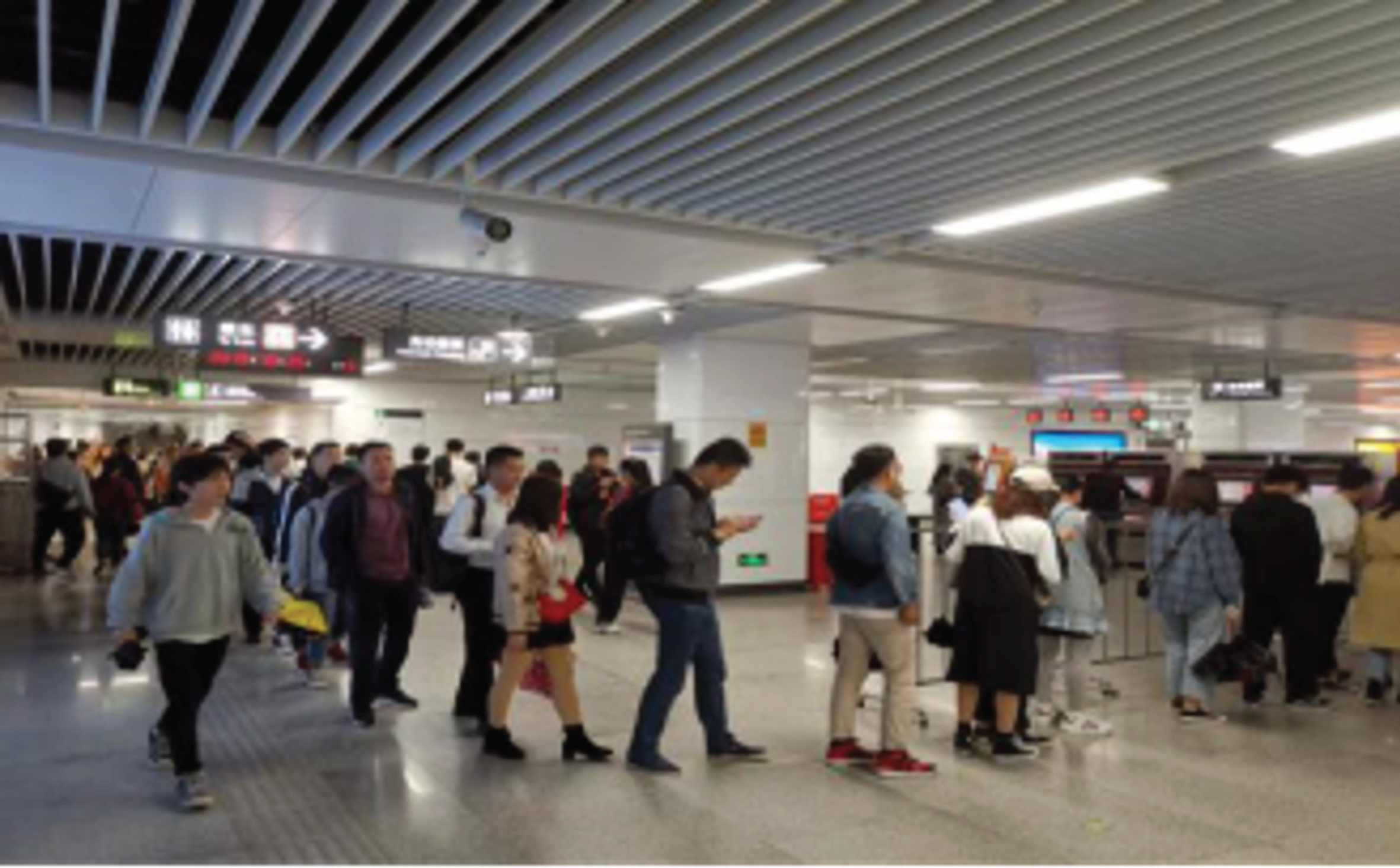
The evening peak of Weidong station.
Layout of facilities on station hall level of Weidong station
The Station Hall of Weidong station of Nanchang Metro Line 1 is almost rectangular in shape. The station hall level consists of a pay area and a non pay area with 10 ticket machine and 3 security check facilities. There are 18 entry and exit gates and 1 service center in the paid area. Among them, there are two security check machines near the entrance of No. 2(one of them only serves until 7 : 00pm), and there are barrier bars near the side wall of the entrance of No. 1 and No. 2(its function is to facilitate the passage of passengers at both ends). The facility layout is shown in Fig. 3 and the number of facilities is shown in Table 1.
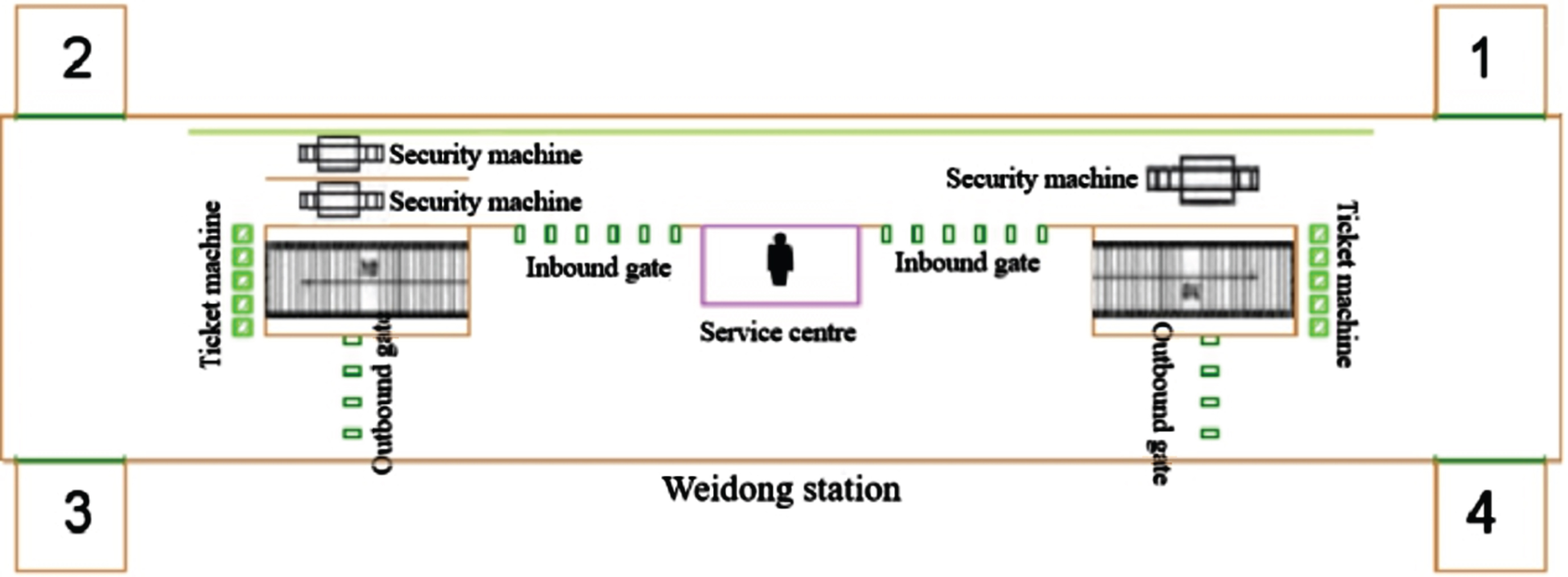
Layout of facilities on station hall level of Weidong station.
Number of service facilities in the station and hall level
This paper mainly analysis the layout of facilities from the time and space crowded degree to improve the security check efficiency of Weidong station hall floor. Therefore, the pedestrian density, the average queue length and the number of people served are proposed as evaluation indicators.
K means pedestrian density, refers to the average number of passengers per unit area per unit time. The larger the number, the more crowded and less comfortable the passengers are. The calculation is shown in formula (1).
n represents the total number of passengers passing through a certain area in a certain period of time. t means the set unit time. And s refers to the area demarcated in a certain area.
L, average number of queuing for security check, refers to the average of the total number of passenger queues at all security checkpoints at the same time. The larger the number, the less smooth the passenger flow is. At a certain point in time, the number of people in a queue at each checkpoint is compared to the number of checkpoints. The calculation is shown in formula (2).
l i represents the number of passengers queued i in group. m represents the number of security queues.
Y, number of persons served, refers to the number of passengers who have completed all services, that is, the number of passengers from the station hall level to the platform level. The larger the value, the more passengers enter the platform level and the higher the efficiency of the station hall level.
Establishment and experiment of simulation model
The building of Metro Station Hall level model is mainly based on Anylogic pedestrian library module. Anylogic is a software based on social force model (Hu, Fang, Deng [10]) to simulate pedestrian traffic behavior, which can simulate the process of passengers entering the subway station from the station hall level to the platform level (Zhou, Liu, Zhang, Feng, Zheng [2]). A survey of Weidong station’s weekday evening rush hour found that 80% of passengers swipe in (there is no need to go through the ticket machine process), the remaining 20% bought their tickets through the ticket machine (it takes 10 to 20 seconds longer to buy a ticket than to Swipe a card). 60% of the passengers brought their luggage with them (it takes 7 to 10 seconds to check in). However, 40% of the passengers still need to go through the security check process (5∼6 s) because of no bags. There is a large number of passengers entering the station during the evening rush hour, and the number of passengers leaving the station is much less and intermittent. According to the survey, the module parameters are demarcated as Table 2.
Module parameters
Module parameters
Passengers are connected through the station hall level process module as shown in Fig. 4. The current simulation effect is shown in Fig. 5.

Weidong station hall level status section module.

Current passenger density at station concourse level.
We could to observe the crowded situation of the area in the process of passengers entering the station in Fig. 5. In the Figure, the red represents the crowded, indicating that the sense of passengers comfort is low; the blue represents loose, and the sense of passengers comfort is high. And the darker the color, the more intense it is. When t = 5 min, the station hall level is relatively smooth. There was no crowded situation, and near the 1, 4 entry and exit of the security check machine queue number is also smaller. When t = 10 min, there was a crowded area in the station hall level. The security check machine line near the entrance 1 or 4 was too long, which led to the queue waiting for the exit to be crowded to the entrance 1 or exit. And security queues near entrances 2 and 3 are beginning to affect the arrival of passengers at them. When t = 30 min, it could be seen from Fig. 5c that the passenger flow at entrances 2 and 3 is not much different from that at entrances 1 and 4. Although the total passenger arrival rate at entrances 2 and 3 is nearly twice as high as that at entrances 1 and 4, there are two security check machines near the entrance and exit of No.2 and No.3, only one near the entrance and exit of No.1 and No.4. The number of security check machines greatly affects the security check rate of both sides. The long queues at both sides of the security line have resulted in heavy passenger traffic at entrances 1 and 2 and longer queues at ticket machine and 3. The long queue of passengers entering the station causes the passengers waiting for the security check to crowd around the entrance and exit. The security check becomes a bottleneck.
According to the simulation results and the existing problems, the optimization schemes were put forward. That was mainly aimed at the optimization of the installation of the security check facilities and the entry gate facilities (Fig. 6).
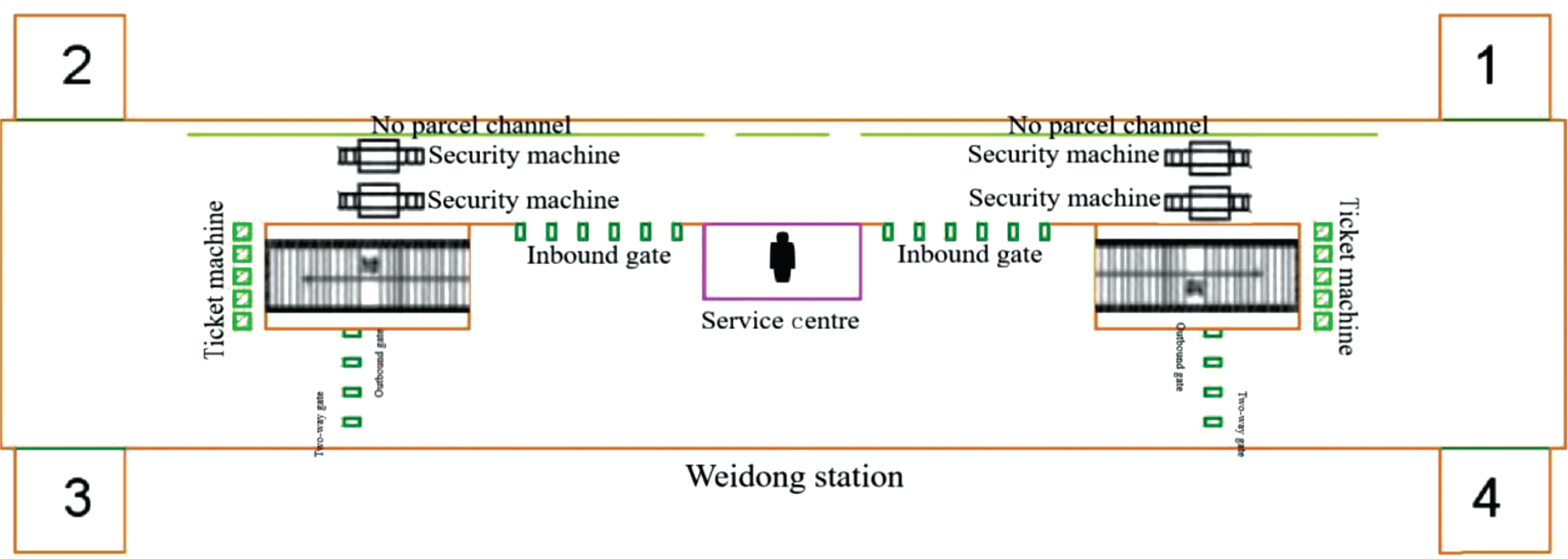
Optimization scheme of the station hall level at Weidong station.
Add a security check machine to the security check place near the entrance of No. 1, which is convenient for the security check of passengers at the entrance of No. 1 and No. 4.
Open two openings on the barrier near the wall of entrances 1 and 2 so that passengers without entrances at entrances 1 and 2 can skip the security check process and enter the station directly.
As there are fewer and intermittent outbound passengers during the evening rush hours, we have replaced four outbound wall gates near the side of entrances nos. 3 and 4 with two-way Gates to facilitate direct access by non-inclusive passengers at entrances nos. 3 and 4, speeding up the efficiency of non-package passengers.
The optimized section of the Weidong station concourse is shown in Fig. 7, and the simulation is shown in Fig. 8. The optimization is mainly to separate the passenger flow with and without bags into the station, so that passengers without bags can skip the security check process. The measures greatly reduces the time spent by non-package passengers entering the station, and avoids crowding between package and non-package passengers.

Weidong station hall level optimized after the part of the module.
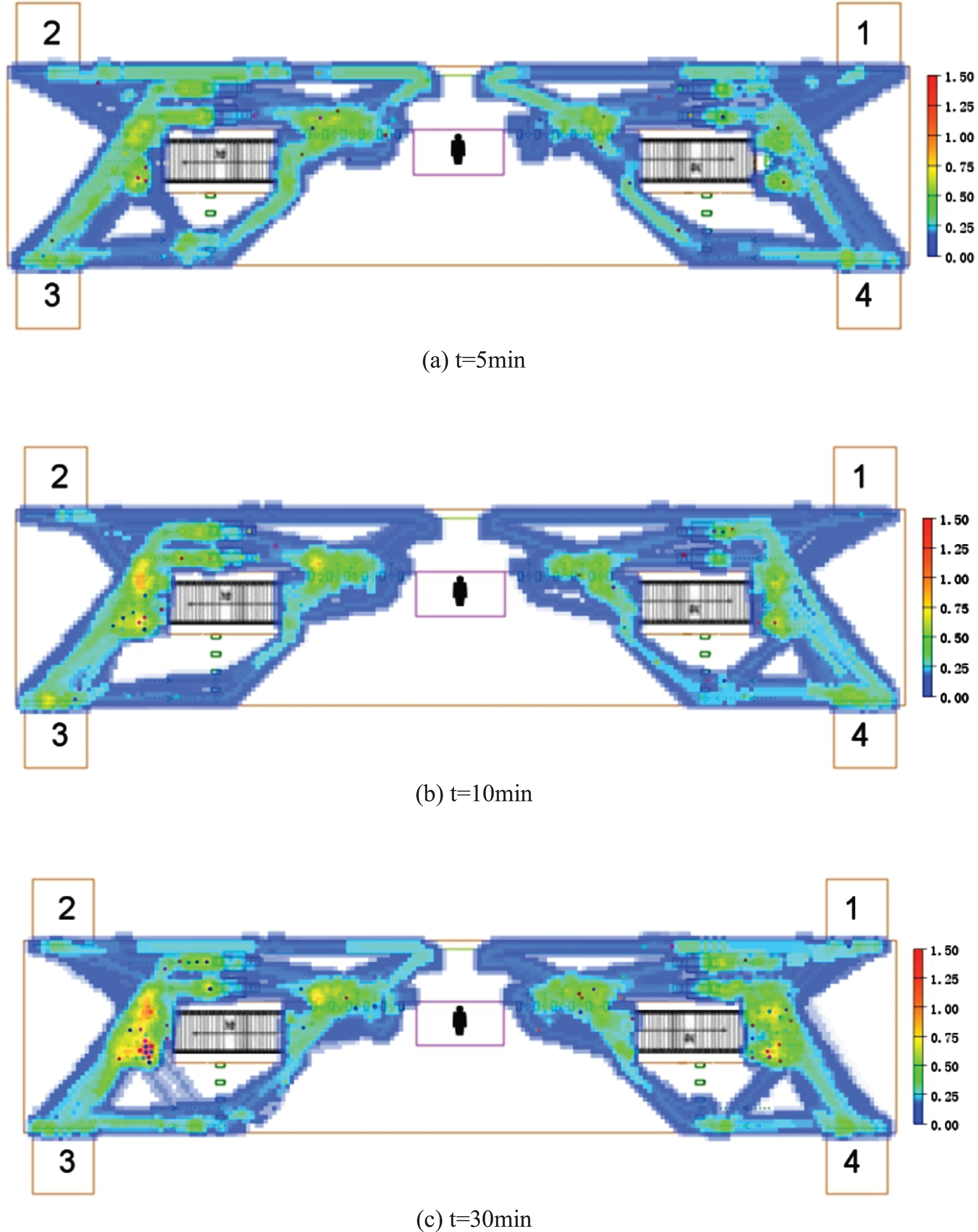
Optimized passenger density at terminal level.
Compared with Figs. 5a and 8a, the optimized level of the station and hall is unobstructed, the crowd density is small, and the number of the security check queue is small. Compared with Figs. 5b and 8b, the not optimized station hall level already has a congested area, but according to the post-optimized rendering, there is no red area, the station hall level is relatively smooth, and the queues before the security check machine and the ticket machine are relatively short. Compared with Figs. 5c and 8c, the number of passengers in the optimized front station hall level is large and the congested area is very large, which seriously affects the arrival and departure of passengers at entrances 1 and 2. The optimized crowd density is obviously reduced, the crowd is no longer crowded and blocking the entrances of No.1 and No.2, there are still a small number of passengers waiting for the security check machine near the entrance of No.2, while there are very few passengers waiting for the security check machine near the entrance of No.1, instead, there are more people waiting in line at the ticket machine. Generally speaking, the area of pedestrian density has been greatly reduced, which has eliminated the situation of most of the security line passengers blocking the entrance and exit, and passengers can safely, comfortably and quickly enter the platform to take the train (Li, Wang, Jia [6]).
By comparing the average number of queues before and after optimization, we found that the average number of queues increases with the change of time in 0-30 min before optimization. That is to say, the security line is getting longer and the station hall is getting more crowded. And after the optimization, we added a new security check machine. At the same time, we let all the non-bag passengers at the entrances and exits go through the security check process, causing non-bag passengers and passengers carrying bags to be shunted into the stations. As can be seen from Fig. 9, the average number of people queuing for security check after optimization has been greatly reduced to less than 20, which is quite different from 250 before optimization. The optimized security queue has been greatly reduced, allowing passengers to reduce the queuing time at the security check point, thus easing the congestion on the station hall level and reducing the service time of passengers on the station hall level.

Average number of queuing for security check before and after optimization.
By comparing the number of people served before and after optimization from Fig. 10, the number of people served during the 30 minutes before optimization increased with time. But the increase rate was small, cause the number of passengers arriving was much larger than the number of passengers leaving. The increasing number of people queuing at security check points and the increasing congestion at the level of stations and halls affect the normal arrival efficiency of passengers, resulting in a downward trend in the growth rate of the number of people served. When t = 5 min, the number of people served before optimization was 123, and the efficiency after optimization was increased by 56.9% to 193. When t = 30 min, the number of people served before optimization was 960, and the efficiency after optimization was increased by 87.5% to 1800. After the optimization, the waiting time of passengers at the security check-point is reduced, and no passengers or even no security check is needed. This makes the passengers entering the station Hall Level Balance With those entering the platform level. The arrival and departure of passengers tend to be stable, and the service efficiency of the station hall level is improved, increase in number of people served.
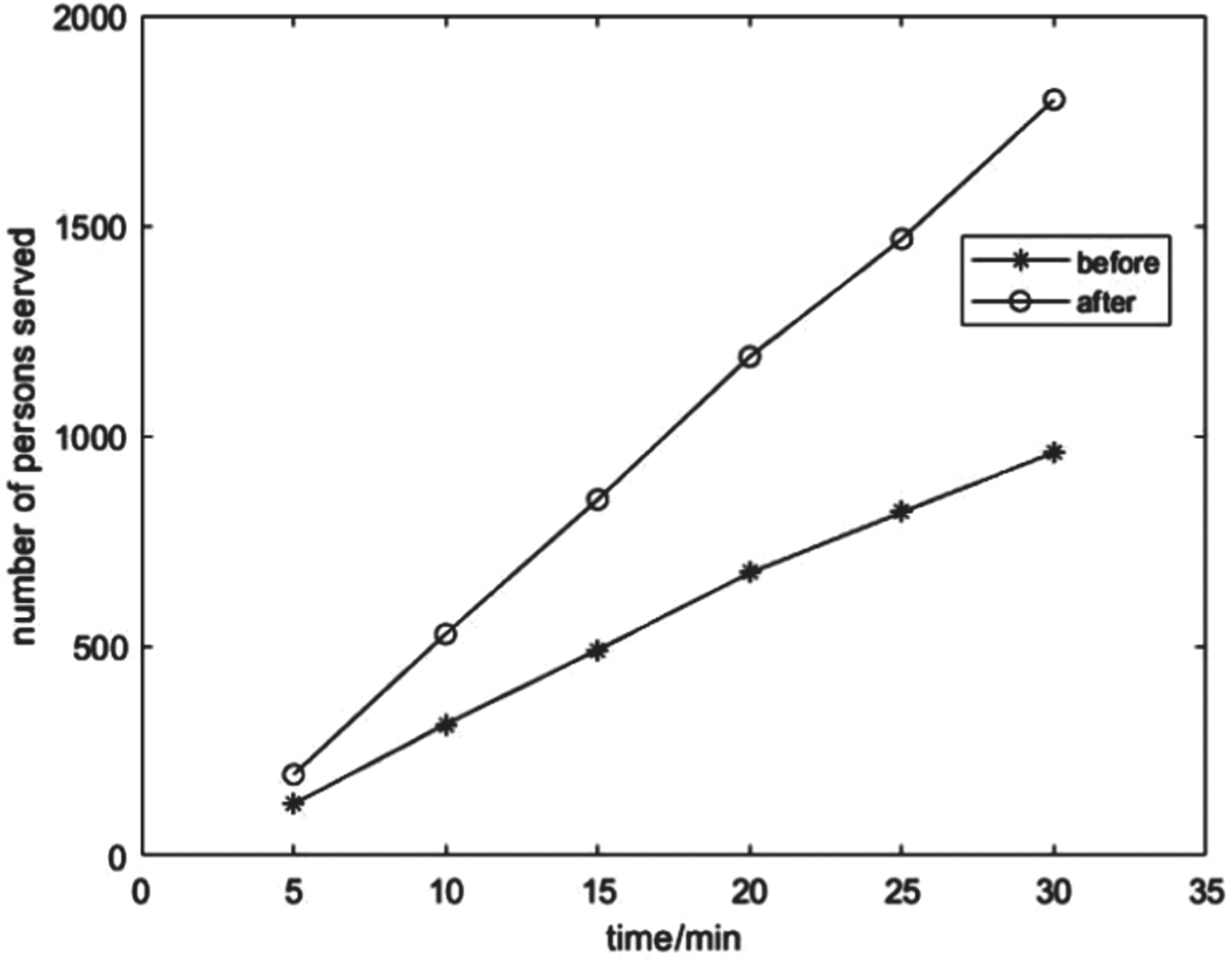
Number of persons served before and after optimization.
In this paper, the efficiency of security check in metro station hall is studied. The pedestrian density, the average number of queues and the number of people served are put forward as evaluation indexes. Anylogic software is used for simulation analysis. Through the simulation of Weidong station, such as passenger arrival, ticket purchase, security check and gate-crossing, we found the bottleneck stage of the process —— security check. After optimization, the security check efficiency is improved, the problem of passenger security check congestion is alleviated, and passengers can enter the platform level safely, comfortably and quickly.
Data availability
The data will be accessible upon request.
Conflicts of interest
The authors declare that they have no conflicts of interest.
Footnotes
Acknowledgments
The work was supported by the National Natural Science Foundation of China (51805169, 52062014). This study is also supported by Natural Science Foundation of Jiangxi Province under Grant 20202BABL212009.